Search results for The

Re-posted in honor of Grandparents’ Day.

My Christmas present to my mom one year was time off from childcare. For several days while I was back home, I took over all of her usual duties regarding her grandkids; as she tries to support two daughters who are divorced with kids and struggling to get by, taking care of grandkids had expanded to take up most of her non-working life. She was incredibly excited to have the free time to finally go to the dentist and do other basic errands for herself.

MetLife and Generations United just released the results of a study of grandparents’ contributions to the support and care of their grandkids. It illustrates how grandparents serve as a support system, providing both childcare and financial assistance.

The data come from a national sample of 1,008 grandparents over age 45. A caution: the survey was conducted online, though they say the sample was weighted to be representative of the full population, not just the online population.

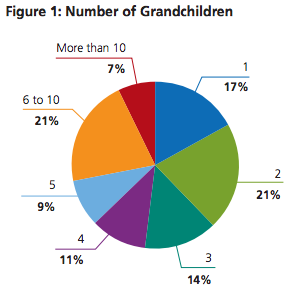
On average, grandparents have 4 grandkids:
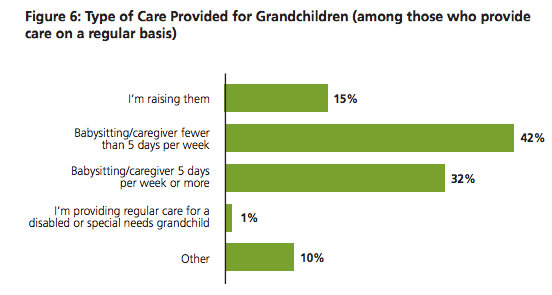
Thirteen percent of the sample reported caring for their grandchildren on a regular basis. Of those, a third watch the grandkids at least 5 days per week, while over 40% babysit less often, and 15% are raising their grandchildren:
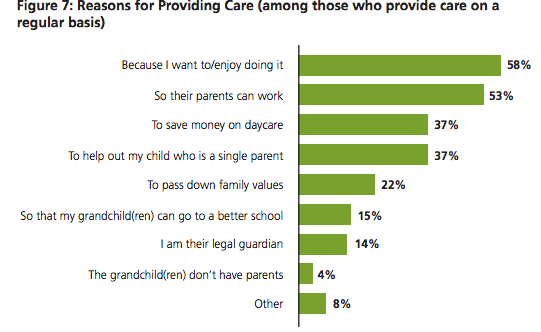
Most grandparents reported that one of the reasons they watch their grandchildren is because they enjoy it, but their answers also make clear that grandparents are playing a key role in filling the gap in care during periods when parents are at work but kids aren’t in school:
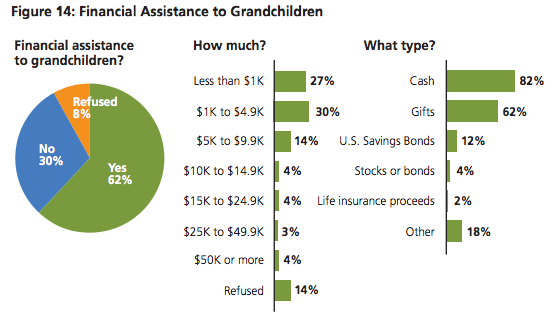
Grandparents also serve as a form of economic safety net. It’s not surprising that grandparents buy stuff for their grandkids; we often depict grandparents as spoiling their grandkids with lots of toys and luxuries. But grandparents also provide more direct support. Of this sample, 62% had provided financial assistance in the past 5 years, and of those, 43% said they are providing more help than they used to because of the economic crisis. These graphs show the amount and type over the past 5 years:
And the money isn’t just going for toys and fun stuff. Clothing, general financial help, and educational expenses are the most common types of assistance, though the biggest average levels of giving are for investments, followed by educational expenses and helping buy a home:
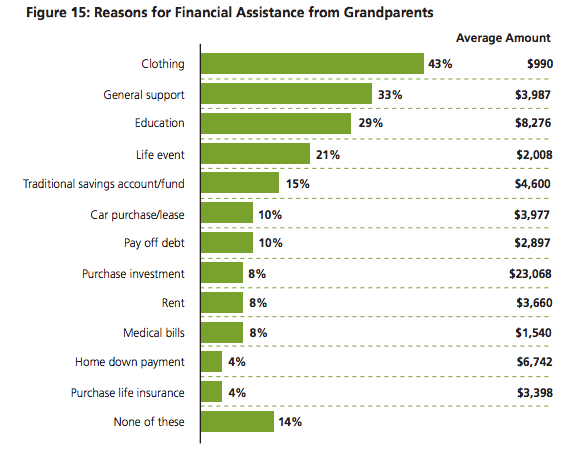
A third (34%) said they continue to provide financial assistance even though they think it’s going to cause problems for their own financial futures.

For another aspect of the essential support grandparents provide, check out Philip Cohen’s earlier post on poverty and the number of kids living with their grandparents.

Gwen Sharp is an associate professor of sociology at Nevada State College. You can follow her on Twitter at @gwensharpnv.

Screenshot_1This is the fourth post in a four part series.  Start at the beginning with: Whimsical Branding Obscures Apple’s Troubled Supply Chain.

Despite the recent scandals regarding Apple’s business practices, it has succeeded at cultivating a brand to which we feel positive emotional attachment. In three previous posts, I showed that the company accomplishes this with commercials that associate its products with playfulness, sentimentality, and cool youthfulness.  The most prominent theme, however, and I suspect the most powerful aspect of the company’s emotional branding strategy, is the hope it cultivates in each of us of who we could be by virtue of using the company’s products.

Taken together, the whole of Apple’s advertising campaigns suggest that, if we use their products, we will be our hippest, coolest, most creative, intelligent, adventurous, socially engaged, and admired selves. The idea of Apple users as standouts from the masses was introduced in the company’s first commercial that aired only once, during the 1984 Super Bowl broadcast:

In this commercial Apple attacks the “boring” IBM and its “mindless” users controlled by a televised ruler in an Orwellian dystopia.  It also suggests that there is something special about the company and its products that will allow it, with the help of its customers, to change the course of history. A commodification of the counter-cultural ethos of the 1960s and ‘70s, this theme was prominent in the first few years of the company’s advertising, but went dormant during Steve Jobs’ 12-year hiatus. It was resurrected in 1997 when Jobs returned to the helm of the company. The now iconic and much revered commercial titled “The Crazy Ones” launched the company’s slogan “Think Different” into our vocabulary, and helped reposition the company, then floundering, onto its path to meteoric financial growth:

With ads like these, Apple doesn’t suggest that one will become Mahatma Ghandi, Amelia Earhart, or Pablo Picasso per se, but that daring to be different (by purchasing an Apple product) opens up the possibility for one to do great things.

This trend continues today in commercials that appeal to our desire to be valued and admired as artistically creative, culturally relevant, and intellectually engaging. Apple’s commercial for the iPhone 4S and Siri, titled “Rock God”, aired in 2012 and exemplifies this trend.

Others, like the “iPad is Amazing” commercial that introduced the device in 2010, speak to how iPad users will be intellectually, culturally, and professionally engaged and valuable people for using the device:

Commercials like these emphasize that Apple products are tools for self-development. By providing the opportunity to learn, create, and share, Apple products facilitate the expression of one’s unique, individual, and socially valued identity. In today’s digitally mediated world where social networking is the norm, the promise of such narcissistic pursuits and outcomes is a key part of Apple’s brand strategy. “Be your best 21st century you!”, recent ads seem to shout.

In this sense, Apple products offer consumers the opportunity to increase their cultural capital. Social theorist Pierre Bourdieu defined cultural capital broadly as one’s accumulated knowledge and skills. Commercials like those above for the iPhone and iPad suggest that Apple helps its customers bolster their cultural capital and raise their social standing. In a time when we are all tasked with marketing and selling ourselves to make it in the world, commercials like these amount to a message about personal and financial success. This is a powerfully seductive promise.

Is it any wonder that news of worker abuse, poisoning, and workplace suicide fails to compromise the company’s financial standing? In fact, in the immediate aftermath of negative reports about its Chinese supply chain in early 2012, Apple went on to post record sales of iPhones and iPads. Most recently, a report by China Labor Watch that documents unlawful, unsafe, and abusive work conditions at Pegatron facilities throughout China has been popularly interpreted by the tech community and mainstream journalists as exciting news that a “cheap iPhone” is on its way. As I pointed out in my first post  in this series, Apple’s ability to obscure with its brand promise the environmental degredation and human rights abuses within its supply chain is commodity fetishism at both its best and its worst. Behind that beautiful fetish of aluminum and glass lies the reality of globalization.

Nicki Lisa Cole, Ph.D. is a lecturer in sociology at Pomona College. She studies the connections between consumer culture, labor, and environmental issues in global supply chains. You can follwer her at 21 Century Nomad, visit her website, and learn more about her research into Apple here.

Course Guide for
SOCIOLOGY OF WORK
(last updated 9/2014)

Developed by Lisa Wade
Occidental College

Disclaimer: I am not a sociologist of work.  If you are, I would love to see someone take a more expert crack at this.  Please feel free to volunteer!

The Social Construction of Work

Work in Popular Culture

Unemployment, Underemployment, and the “Class War”

Unions and Unionization

Economic Change, Globalization, and the Great Recession

Gender and Work

Work and Racial, Ethnic, and National Identity

The U.S. in International Perspective

Specific Occupations

Flight Attendants

Sex Workers

Academia

Just for Fun

As the Wall Street Journal reports:

Four years into the economic recovery, U.S. workers’ pay still isn’t even keeping up with inflation. The average hourly pay for a nongovernment, non-supervisory worker, adjusted for price increases, declined to $8.77 last month from $8.85 at the end of the recession in June 2009, Labor Department data show.

In other words, as the chart below illustrates, the great majority of workers are experiencing real wage declines over this expansion”

image

Growth also remains sluggish, increasing “at a seasonally adjusted annual pace of less than 2% for three straight quarters — below the pre-recession average of 3.5%.”  But by intensifying the pace of work and reducing the pay of their employees, corporations have been able to boost their profits despite the slow growth.

The following chart from an Economic Policy Institute study shows the continuing and growing disconnect between productivity and private sector worker compensation (which includes wages and benefits) using two different measures of compensation.

epi trends

As the Economic Policy Institute study explains, “there has been no sustained growth in average compensation since 2004. The stagnation began even earlier, in 2003, when considering wages alone. Since 2003, wages as measured by both the ECI and the ECEC (not shown) have not grown at all — a lost decade for wages.”

The point then is that we need a real jobs program, one that is designed to create new meaningful jobs and boost the well-being of those employed.  Government efforts to sustain the existing expansion have certainly been responsive to corporate interests.  It should now be obvious that such efforts offer workers very little.

Martin Hart-Landsberg is a professor of economics at Lewis and Clark College. You can follow him at Reports from the Economic Front.

Today is Labor Day in the U.S. Though many think of it mostly as a last long weekend for recreation and shopping before the symbolic end of summer, the federal holiday, officially established in 1894, celebrates the contributions of labor.

Here are some SocImages posts on a range of issues related to workers, from the history of the labor movement, to current workplace conditions, to the impacts of the changing economy on workers’ pay:

The Social Construction of Work

Work in Popular Culture

Unemployment, Underemployment, and the “Class War”

Unions and Unionization

Economic Change, Globalization, and the Great Recession

Gender and Work

The U.S. in International Perspective

Just for Fun

Bonus!

Gwen Sharp is an associate professor of sociology at Nevada State College. You can follow her on Twitter at @gwensharpnv.

Happy end of August!

SocImages News:

I had the opportunity to publish essays in Politico and Salon this month.  The first was a response to an accusation that progressives refuse to talk about race, genetics, and intelligence, so I did in “Yes, Let’s Talk about Race and IQ.”

The second sounds like it belongs better in Cosmopolitan, but I promise there’s good sociology in there: “5 Reasons Your ‘Sexual Peak’ Might be Fake.”

Backstage at SocImages, we put together a new Pinterest board aimed at collecting examples of women being presented as catty and jealous of one another (e.g., “Don’t hate me because I’m beautiful”).  We call it the Mean Girls Meme.  We’re excited to add additional examples!

Finally, Gwen and I offered some advice to new college students.

Top Posts:

Elsewhere on the Net:

This month SocImages or its authors were quoted in articles at:

Cross-Post Highlights…

Upcoming Lectures and Appearances:

My fall schedule is falling into place.  If any readers are in the Twin Cities or Salt Lake City, I’d love to schedule a meet up!

  • Citrus College (Sept. 10, 2013): “A Feminist Defense of Friendship”
  • Carleton College (Sept. 30, 2013): TBD
  • Macalester College (Oct. 2-3, 2013): TBD
  • Westminster College (Mar.  11, 2014): “‘The Night Overall Wasn’t Bad’: What College Students Really Think About Hooking Up”

Social Media ‘n’ Stuff:

Finally, this is your monthly reminder that SocImages is on TwitterFacebookGoogle+, and Pinterest.  Lisa is on Facebook and most of the team is on Twitter: @lisawade@gwensharpnv@familyunequal@carolineheldman, and @jaylivingston.

In Other News…

I enjoyed a drive to Key West thanks to my mom, Kay West.  It was pretty:

fl001_751

Lisa Wade, PhD is an Associate Professor at Tulane University. She is the author of American Hookup, a book about college sexual culture; a textbook about gender; and a forthcoming introductory text: Terrible Magnificent Sociology. You can follow her on Twitter and Instagram.

Screenshot_1This is the third post in a four part series.  Start at the beginning with: Whimsical Branding Obscures Apple’s Troubled Supply Chain.

I cannot watch this 2003 Apple iPod commercial without shaking my hips, even in the midst of delivering a lecture or conference presentation. In fact, I struggle deeply to refrain from jumping around in an ecstatic dance of joy.

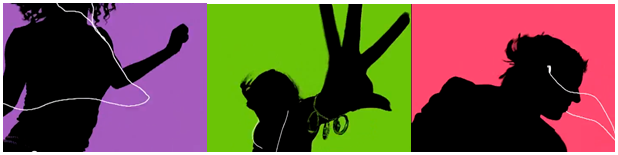
This commercial moves me. But, why? Yes, it has rocking music and popping colors. But, I suspect, more importantly, it has hip young things gyrating to the music, lost in the euphoria provided by an iPod and earbuds, with seemingly no cares in the world. For four years Apple aired a string of these, which became known as the “Silhouette” commercials, each featuring a different soundtrack and style of dance. In my previous posts, I’ve focused on two important elements of Apple’s brand promise: whimsicality and  sentimentality. In this post I spotlight another key finding from our research: the association of Apple products with coolness, hipness, youth, and a carefree attitude.

This trend was introduced into the brand by the iPod commercial above, and it continues to be an important part of Apple’s brand promise today. Similar qualities are present in this ad from early 2012, titled “Road Trip,” which showcases the utility of the voice-activated assistant, Siri, on the iPhone 4S:

And, early this summer, Apple released a commercial that emphasizes the musical enjoyment that an iPhone can provide. The ad, which seems a re-imagining of the “Silhouette” campaign, depicts these young, fit, and beautiful iPhone owners as indulgent in their passions, carefree, too cool to care about dancing in public, and thus hip, energetic, and fun to be around.

These ads and the many like them in Apple’s oeuvre suggest that the product makes users spontaneous, proud to embrace their unique individuality, and happy to “let their freak flag fly,” so to speak. In this case, the brand promises uninhibited enjoyment. With their bouncing, lithe bodies and shiny, happy faces, these Apple users are the epitome of cool in today’s American culture.

Like the promise of playfulness, and sentimental connection to others, this aspect of Apple’s brand promise acts as a powerful fetish, in the Marxist sense, that obscures the troubling labor conditions and environmental pollution in the company’s Chinese supply chain. Who has the presence of mind to think about global social, economic, and environmental problems when they are busy rocking out, road-tripping, and dancing in the shower?

Next: Apple’s Seductive Brand Promise of Cultural Capital & Social Mobility.

Nicki Lisa Cole, Ph.D. is a lecturer in sociology at Pomona College. She studies the connections between consumer culture, labor, and environmental issues in global supply chains. You can follwer her at 21 Century Nomad, visit her website, and learn more about her research into Apple here.

Screenshot_22Congratulations to everyone starting college this semester! College can be a bewildering new challenge, but a bit of advice can go a long way. Below are some of the secrets of college success from us: two sociologists — one from an open-access four-year school and one at a private liberal arts school — with over 15 years of college teaching combined.

Don’t put pressure on yourself to get straight As from the get-go.

College is a unique institution with its own rules and skills. You will not simply get an A because you are “smart.” Getting an A is a combination of effort, prior knowledge, and experience, so being smart at college means learning a specific skill set. If you are in your first year, you may find that you must work harder to get the same grade as a senior who has much more experience at excelling in college classrooms and, thus, knows better how to do it. Be patient with yourself. Acknowledge that there will be a learning curve and give yourself some time to climb it. In the meantime, look forward to when you will be the one who knows exactly what to do.

Sometimes studying hurts and that’s a good thing.

The mind is like a muscle: if you use it, it becomes stronger. You can improve your emotional intelligence, your reasoning skills, your mathematical ability, how quickly and effectively you absorb new information, and more. But it isn’t necessarily fun. Like working out your body, working out your mind can be uncomfortable, even painful. You’re not really challenging and improving your mind unless it hurts a little. So you may find that learning can sometimes feel kind of like suffering. This is normal. It doesn’t mean that you’re not smart, it means that you’re getting even smarter.

Memorize the phrase “pluralistic ignorance.”

Research shows that most college students misperceive their peers’ behaviors and attitudes. They think drug and alcohol use is higher than it is and that their peers are less concerned about it than they are. They also tend to think that everyone else might be having more fun and more sex. We suspect this is even worse now that everyone stalks each other on social networks. Keep in mind the possibility that studying a lot, having other responsibilities, and not partying all the time is normal. Because it is.

Collect as many mentors as you can.

Often new students will be assigned an advisor when they arrive on campus. That’s great. Definitely go talk to them. But don’t think that you only get to have one. Collect lots. Turn to older students, professors you like, counselors and coaches, and members of the staff or administration. Build a range of relationships with people who understand this college thing pretty well and lean on them all. You will be glad to have their advice and, later, they’ll all be lining up to write you letters of recommendation for jobs and graduate programs.

On tests, change your answers if you second-guess yourself.

Somewhere along the line, you’ve probably heard the standard advice for taking multiple-choice or true/false tests: stick with your first answer. Instructors often reinforce this adage before each exam, and students encounter it everywhere from SAT prep books to the study skills lecture in their Intro to College course. Just one problem: decades of research show it isn’t true. There’s overwhelming evidence that when students change their answers, they do better on the test. In one study of 1,561 students, 51% of the changes were from wrong answers to right ones; only 25% were from right to wrong ones (the others were from one wrong answer to another wrong one).

So why are we still so convinced we should stick with our first answer? Because we feel more regret when a bad outcome is due to an action we took than when it’s due to our inaction, and that regret makes us more likely to remember it. You shouldn’t change answers just for the sake of it, of course, but if you’re taking an exam and begin to doubt an answer, don’t be afraid to change it. You’ll be wrong sometimes, but mounds of data strongly suggest you’ll be right quite a bit more often—even though it might not feel that way.

Think hard about whether online classes are the best choice for you.

Online classes — and even entirely online degrees — are increasingly common at most campuses. They offer flexibility that can help you fit classes in around work, family life, or conflicting class schedules. But before you sign up, think honestly about your strengths and weaknesses. Ask yourself:

  • Can you keep yourself on schedule without in-person classes where instructors or other students might remind you of upcoming due dates?
  • Do you learn well independently?
  • Do you have reliable access to a decent computer and fast internet connection?
  • Do you struggle with the topic, making it likely that you might need at least some one-on-one help?

It’s not that face-to-face classes are always or inherently better than online courses. But the flexibility that online courses offer may make them particularly tempting, even when they’re unlikely to be your best choice for success. Online classes aren’t always the smartest way to go, even if they’re convenient.

When picking a major, get the facts.

Research shows that many students choose a major somewhat randomly.  In the process of fulfilling their required range of classes, they encounter a particularly inspiring or effective instructor in an intro-level course and the rest is history.

Inspiration can help narrow down your choices, but most students have to be at least a little bit practical, too. Here are some questions to ask:

  • Does the major have a rigid set of pre-reqs you have to take in order, and if so, when do you need to start taking them?  Are you “on track?”  If not, can you afford to stay in school longer to pursue a major you’re really passionate about?
  • Are lengthy unpaid internships usually required after graduation? If they are, can you or your parents afford to support you while you work for free to build up a resume?
  • Will you need to go to grad school to have many job options in the field and, if you will, are there good graduate programs in your area or will you need to move? Can you do so if needed?
  • What’s your starting salary likely to be, and if you’re taking out student loans, how much of your likely income would go to paying them each month?

Don’t get us wrong — being passionate about a topic or discovering you have a particular knack for a field should be important factors as you pick a major! But it’s a good idea to turn to older students, professors, and advisers with these questions so that you know what you’re getting into. Whatever you decide, you’ll likely be more satisfied long-term if you go into it with a clear understanding of the implications of your decision.

Finally, take the time to make true friends.

Not Facebook friends, but real, solid, good, we-can-count-on-each-other besties. We know, we know.  College is supposedly about freedom and parties and drinking and hooking up! There’s plenty of time for that. Also make friends a big priority. There’s a very strong correlation between happiness and being surrounded by friends you can really talk to. In fact, both psychological and physical well-being are more strongly related to friendship than they are to romance. So, hook up and form relationships if you want, but don’t prioritize sex and romance over friendship. The latter is equally important to a happy, fulfilling life.

Cross-posted at Pacific Standard.

Lisa Wade is a professor of sociology at Occidental College and the author of American Hookup: The New Culture of Sex on Campus. You can follow her on Twitter and Facebook.  Gwen Sharp is the Associate Dean of LAS at Nevada State College. You can follow her on Twitter.