Search results for The

It’s that time of year again!  We are about to embark on ten straight days of Sociological Halloween Images.  In the meantime, enjoy our collection of Halloween posts from years past or visit our Halloween-themed Pinterest page.

Just For Fun

Halloween, Politics, and Culture

Race and Ethnicity

Gender

Gender and Kids

The intersection of Race, Class, and Gender

And, for no conceivable reason…

Lisa Wade, PhD is an Associate Professor at Tulane University. She is the author of American Hookup, a book about college sexual culture; a textbook about gender; and a forthcoming introductory text: Terrible Magnificent Sociology. You can follow her on Twitter and Instagram.
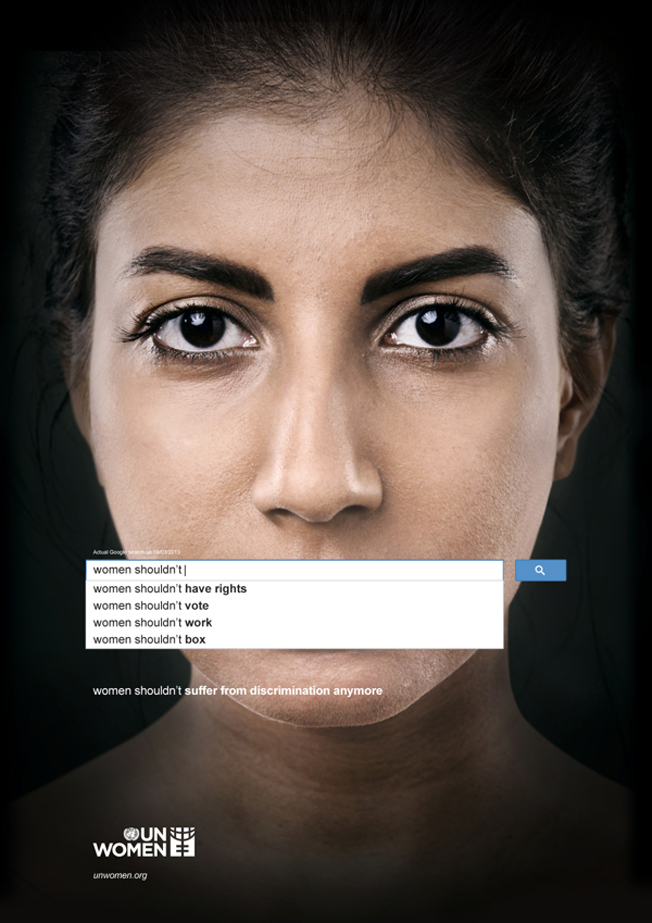
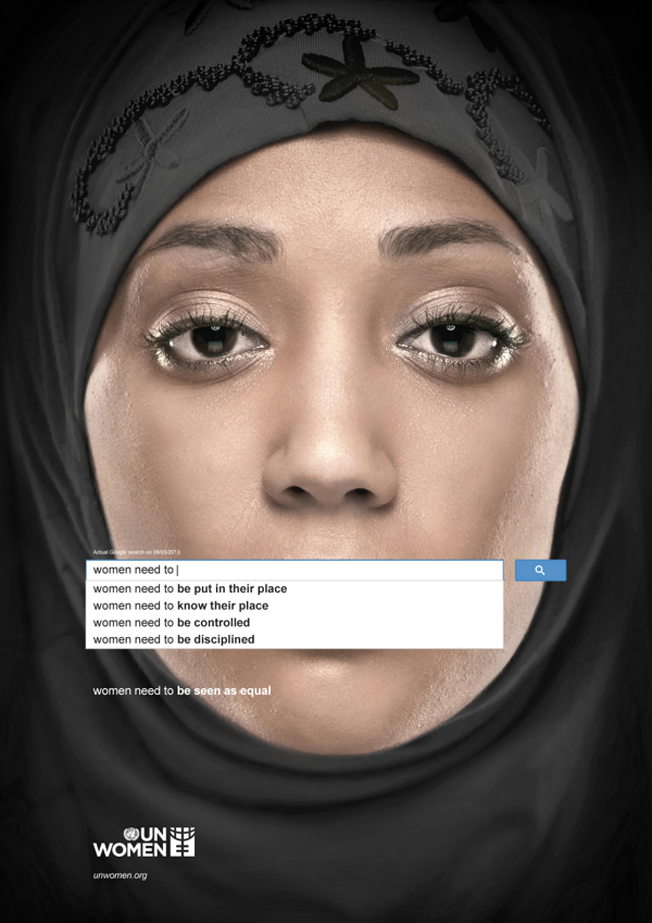
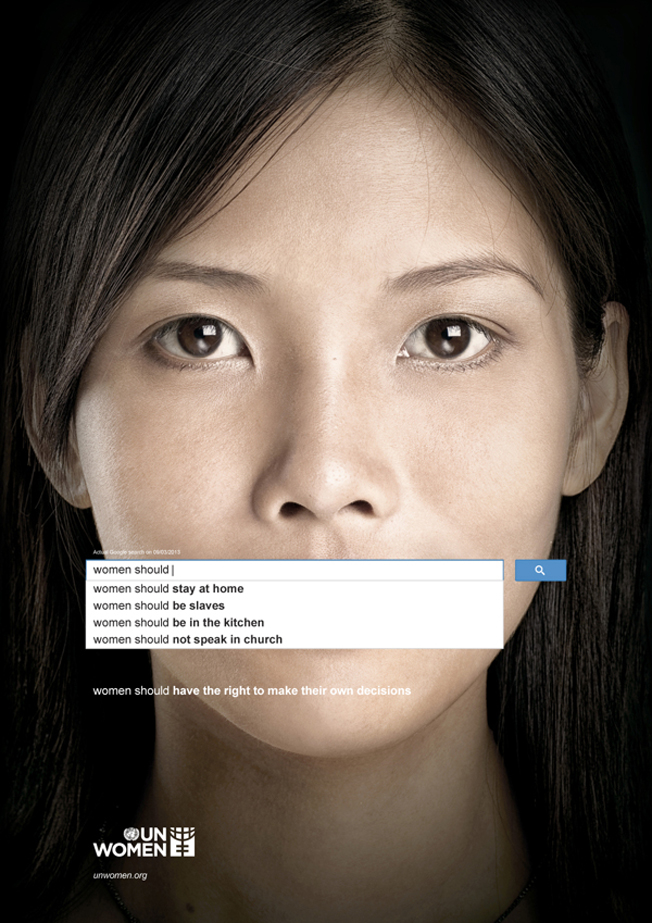
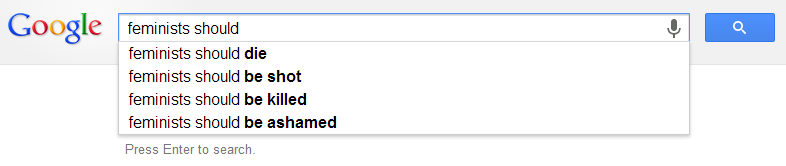
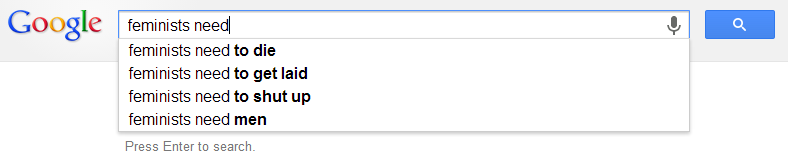
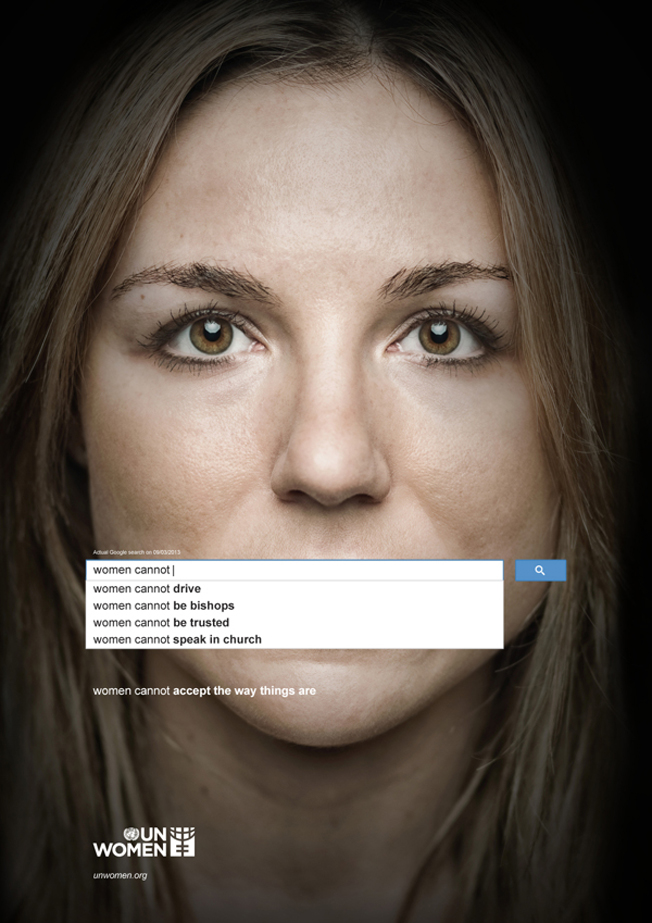
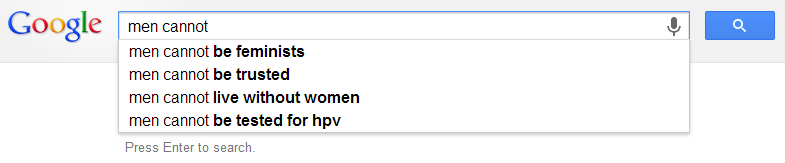
Thanks to a tweet from sociologist Sarah Sobieraj, we learned of a powerful campaign to raise awareness about gender inequality from the arm of the United Nations dedicated to empowering women.  The designers of the ads did Google searches, allowing the auto-complete to fill in word stems with the most commonly searched phrases.  The results are eyebrow-raising.

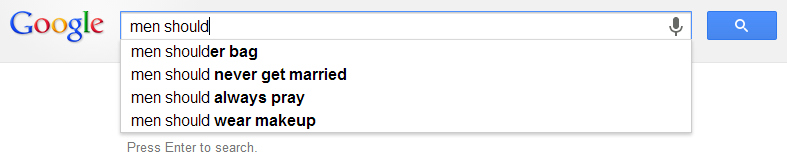
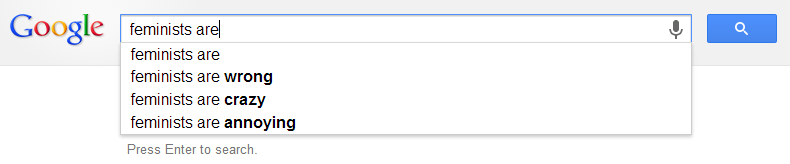
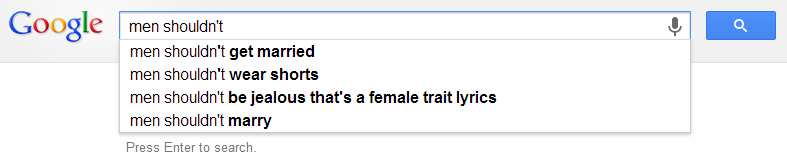
I was curious to find out what my personal Google machine would spit out and, also, what the equivalent searches for men would return.  Below, I reproduce the ads, followed by my own results.  Eyebrow-raising.  As a bonus, I did the searches for feminists.

autocomplete-sexism2

Screenshot_1

Screenshot_9 autocomplete-sexism1

Screenshot_4

Screenshot_10 autocomplete-sexism4

Screenshot_3

Screenshot_11 autocomplete-sexism3 Screenshot_12 Screenshot_8

I guess we still need feminism.  Unfortunately…

Screenshot_15 Screenshot_17 Screenshot_18 Screenshot_19Cross-posted at Talking Points Memo and Pacific Standard.

Lisa Wade, PhD is an Associate Professor at Tulane University. She is the author of American Hookup, a book about college sexual culture; a textbook about gender; and a forthcoming introductory text: Terrible Magnificent Sociology. You can follow her on Twitter and Instagram.

In 1990 I was still an American Culture major in college, but I was getting ready to jump ship for sociology. That’s when Madonna’s “Justify My Love” video was banned by MTV, which was a thing people used to use to watch videos. And network TV used to be a major source of exposure.

I was watching when Madonna went on Nightline for an interview.  The correspondent intoned:

…nudity, suggestions of bisexuality, sadomasochism, multiple partners. Finally, MTV decided Madonna has gone to far.

They showed the video, preceded by a dire parental warning (it was 11:30 p.m., and there was no way to watch it at any other time).  In the interview, Forrest Sawyer eventually realize he was being played:

Sawyer: This was a win-win for you. If they put the video on, you would get that kind of play. And if they didn’t you would still make some money. It was all, in a sense, a kind of publicity stunt. … But in the end you’re going to wind up making even more money than you would have.

Madonna: Yeah. So, lucky me.

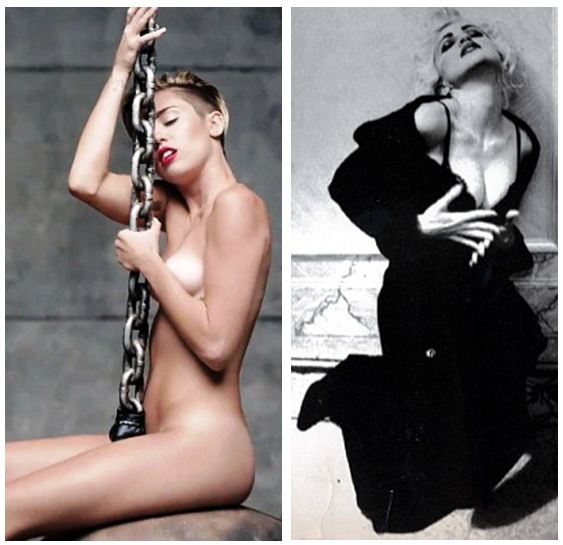
The flap over Miley Cyrus completely baffles me. This is a business model (as artistic as any other commercial product), and it hasn’t changed much, just skinnier, with more nudity and (even) less feminism. I don’t understand why this is any more or less controversial than any other woman dancing naked. Everyone does realize that there is literally an infinite amount of free hardcore porn available to every child in America, right? There is no “banning” a video. (Wrecking Ball is pushing 250 million views on YouTube.)
mileymadonna1
No one is censoring Miley Cyrus — is there some message I’m missing? When she talked to Matt Lauer he asked, “Are you surprised by the attention you’re getting right now?” And she said, “Not really. I mean, it’s kind of what I want.”

I think the conversation has slid backward. In Lisa Wade’s excellent comment, she draws on a 1988 article, “Bargaining With Patriarchy,” which concluded:

Women strategize within a set of concrete constraints, which I identify as patriarchal bargains. Different forms of patriarchy present women with distinct “rules of the game” and call for different strategies to maximize security and optimize life options with varying potential for active or passive resistance in the face of oppression.

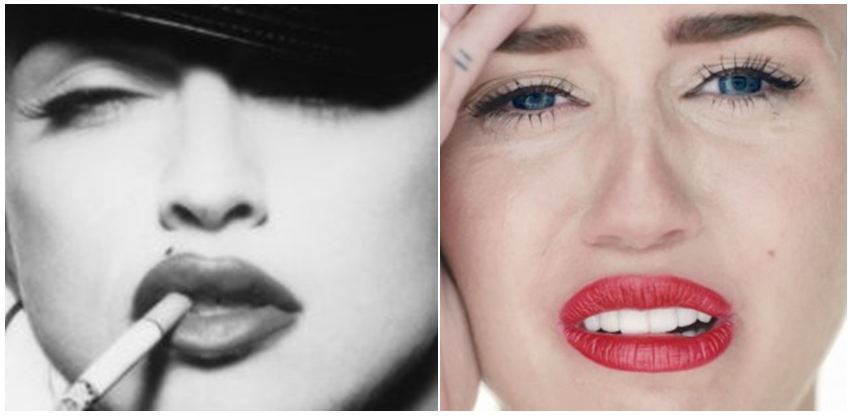
I think it applies perfectly to Miley Cyrus, if you replace “security” and “life options” with “celebrity” and “future island-buying potential.” Lisa is 1,000-times more plugged in to kids these days than I am, and the strategies-within-constraints model is well placed. But that article is from 1988, and it applies just as well to Madonna. So where’s the progress here?

mileymadonna2

Interviewed by Yahoo!, Gloria Steinem said, “I wish we didn’t have to be nude to be noticed … But given the game as it exists, women make decisions.” That is literally something she could have said in 1990.

The person people are arguing about has (so far) a lot less to say even than Madonna did. When Madonna was censored by MTV, Camile Paglia called her “the true feminist.”

She exposes the puritanism and suffocating ideology of American feminism, which is stuck in an adolescent whining mode. Madonna has taught young women to be fully female and sexual while still exercising total control over their lives. She shows girls how to be attractive, sensual, energetic, ambitious, aggressive and funny — all at the same time.

When Miley Cyrus caused a scandal on TV, Paglia could only muster, “the real scandal was how atrocious Cyrus’ performance was in artistic terms.”

Madonna was a bonafide challenge to feminists, for the reasons Paglia said, but also because of the religious subversiveness and homoerotic stuff. Madonna went on, staking her claim to the “choice” strand of feminism:

I may be dressing like the typical bimbo, whatever, but I’m in charge. You know. I’m in charge of my fantasies. I put myself in these situations with men, you know, and… people don’t think of me as a person who’s not in charge of my career or my life, okay. And isn’t that what feminism is all about, you know, equality for men and women? And aren’t I in charge of my life, doing the things I want to do? Making my own decisions?

And she embraced some other feminist themes. When Madonna was asked on Nightline, “Where do you draw the line?” she answered, “I draw the line with violence, and humiliation and degradation.”

I’m not saying there hasn’t been any progress since 1990. It’s more complicated than that. On matters of economic and politics gender has pretty well stalled. The porn industry has made a lot of progress. Reported rape has become less common, along with other forms of violence.

But — and please correct me if I’m wrong — I don’t see the progress in this conversation about whether it’s feminist or anti-feminist for a women to use sex or nudity to sell her pop music. As Lisa Wade says, “Because that’s what the system rewards. That’s not freedom, that’s a strategy.” So I would skip that debate and ask whether the multi-millionaire in question is adding anything critical to her product, or using her sex-plated platform for some good end.  Madonna might have. So far Miley Cyrus isn’t.

Cross-posted at Family Inequality and Pacific Standard.

Philip N. Cohen is a professor of sociology at the University of Maryland, College Park, and writes the blog Family Inequality. You can follow him on Twitter or Facebook.

It’s Love Your Body day!  Below is a Hall of Fame and a Hall of Shame.  The second set of posts reveal just what we’re up against, but the first set is a salve, a celebration of all of our beautifully diverse and interesting bodies.  You choose what will amp you up today,  but don’t miss this year’s SocImages Pick: Kara Kamos on the total irrelevance of beauty.

The Hall of Fame

Disability
Body Types
Gender
Race/Ethnicity/Color

The Hall of Shame

Body Types
Hair
Transsexuality
Heightism
Disability

Lisa Wade, PhD is an Associate Professor at Tulane University. She is the author of American Hookup, a book about college sexual culture; a textbook about gender; and a forthcoming introductory text: Terrible Magnificent Sociology. You can follow her on Twitter and Instagram.
October is Breast Cancer Awareness Month and the Boston Globe included a discussion of the pink ribbon campaign and cause-related marketing (products marketed with a promise of a donation to a social cause) more generally.  It, like books by sociologists — including Samantha King’s Pink Ribbon Inc. and Gayle Sulik’s Pink Ribbon Blues — paints a pretty depressing picture of cause-related marketing.

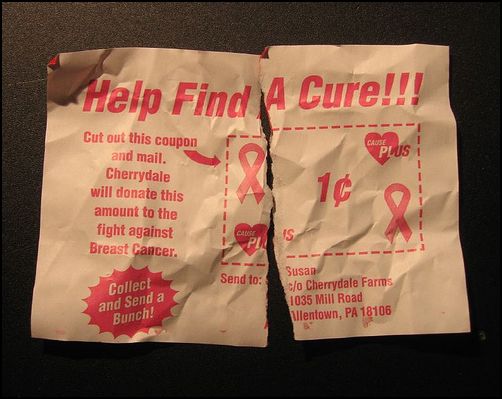
As the article discusses, this approach to raising money for a cause is suspect for a number of reasons.  In many instances, the percent of profit that goes to charity is very small.  For example, one woman bought a candy bar being sold door-to-door under the auspices of a breast cancer donation, only to discover that she was invited to spent .42 cents to mail in a coupon (story here).  The company would then donate one cent to breast cancer research!  (And the chocolate was bad, too.)

Capture

In other instances, companies have a cap on how much they’ll donate.  But consumers may or may not know that the cap is exceeded when they are in a position to buy the product.  This is the case with New Balance.

In addition, companies that participate in cause-based marketing may do so without thinking through and altering their own practices that may be contributing to rates of breast cancer.  Yoplait, for example, “pinked” their yogurt for breast cancer, even as it contained milk from cows given recombinant bovine growth hormone, a substance correlated with breast cancer rates.  After pressure from Breast Cancer Action, Yoplait changed its practices (Dannon followed).

This suggests that companies participating in cause-related marketing may not really be behind the cause, but may instead simply be interested in the profits.  However, cause-related marketing does give advocacy organizations a wedge.  If Yoplait hadn’t pinked its product, it’s unclear whether it would have felt compelled to change its ingredients.  In this sense, the hypocrisy was an opportunity.

The article also introduces Jeanne Sather, who blogs about “the most egregious, tasteless examples of pink-ribbon products.”  The winner of her most recent contest for the most tasteless product: Jingle Jugs, “plastic breasts mounted taxidermy-style on wood” that jiggle and bounce in response to music.  They are, as you might imagine, marketed largely to frat boys (and the like) and the breast cancer edition allowed fraternities to merge their philanthropic and misogynistic tendencies seamlessly:

customercreated

Jingle Jugs’ slogan: “Partnering with our nation’s youth to save our loved ones.”

header

Nice double entendre there.

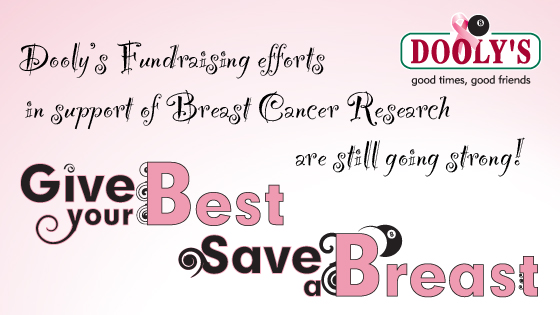
This type of objectification of women’s bodies in breast cancer awareness advertising is common.  Renée Y. sent in this advertisement for a breast cancer research fundraiser. Again, note that it says “Save a breast,” not “Save a woman’s life.”

Opponents of cause-based marketing argue that it is fraught with ethical problems and, at its worst, is deceiving and offensive.  While it does result in money for the cause, it may also reduce the amount of money people donate directly because they think that by buying the breast cancer cookies, cream cheese, combination locks, cat food, cookware, chewing gum, limo rides, and golf accessories, they’ve already done their part.

Originally posted in 2009; images found here, here, and here.

Lisa Wade, PhD is an Associate Professor at Tulane University. She is the author of American Hookup, a book about college sexual culture; a textbook about gender; and a forthcoming introductory text: Terrible Magnificent Sociology. You can follow her on Twitter and Instagram.
This week I had the pleasure of being a part of Take Part Live’s discussion of “pinktober.”  Here’s a really interesting piece of research that I didn’t get a chance to talk about, sent in by Lindsey B.

A paper in the Journal of Marketing Research suggesting that the current approach to raising awareness of breast cancer hurts more than helps.  You might have noticed, just maybe, I mean if you’ve been paying attention, that breast cancer awareness has become associated with the color pink.

Screenshot_1

Stefano Puntoni and his colleagues found that when women were exposed to gender cues, like the color pink, they were less likely than women who had not been primed with a gender cue to think that they might someday get breast cancer and to say that they’d be willing to donate to the cause.  Pink, in other words, decreased both their willingness to fund research and the seriousness with which women took the disease.

Puntoni explains this finding with a common psychological tendency. When people are faced with a personal threat, they tend to subconsciously go on the defensive.  In this case, when women are exposed to information about breast cancer at the same time that they are reminded that they, specifically, are vulnerable to it, they subconsciously try to push away the idea that they’re vulnerable and that breast cancer is something that they, or anyone, needs to worry about it.

Originally posted in 2010, with an extended version appearing at Ms.

Lisa Wade, PhD is an Associate Professor at Tulane University. She is the author of American Hookup, a book about college sexual culture; a textbook about gender; and a forthcoming introductory text: Terrible Magnificent Sociology. You can follow her on Twitter and Instagram.

The Sexual Politics of Meat is a scathing, powerful analysis of the relationship between the oppression of women and the farming of animals for food.  Written by Carol J. Adams and published in 1990, it inspired many a feminist to choose vegetarianism and made many more take pause.

In the six-and-a-half minute video below, she discusses the sexualization and feminization of chicken specifically.  She shows lots of examples of the ways in which chicken carcasses are objectified as women: put in high heels, bikinis, sexual positions, etc.  We feature many examples of this at our Pinterest board collecting gendered and sexualized food, some of which we’ve borrowed from Adams.

1

Adams then argues that this is a way to distract us from the fact that we are eating the flesh of an animal that has been killed for us. She writes:

By sexualizing animals, we trigger another thing, that uneasiness becomes sexual energy… and everybody knows what to do about sexual energy.  You can laugh at it, you can talk about it, it reduces whoever is presented to an object.  And so it makes it okay again.

So the sexualization of animals enters into and participates in the wider issue of “Why are we doing this to animals?”  Oh yeah, because it’s funny, because it’s fun, because we can have fun with it. And it takes the ethical out.

Moreover, presenting chicken as dressing up for the male gaze suggests that the animal wants to be consumed.  The animal appears to desire to inspire (culinary) lust and, accordingly, it’s okay if you eat her.  This works best alongside feminization, as it is women who are typically presented as objects of a lustful male gaze.

Screenshot_1

Bonus: Fifty Shades of Grey makes an appearance, and not incidentally.   In response to its popularity, a book was published called Fifty Shades of Chicken.  Here’s the book trailer:

Adams call Grey a “regressive book that implied that despite all the advances feminism has made, women really just wanted to be in bondage.”  In both books, she argues, we’re seeing the “packaging and sexualizing [of] dominance over another being.”

Hear it straight from Adams, via Uncooped:

Cross-posted at Pacific Standard.

Lisa Wade, PhD is an Associate Professor at Tulane University. She is the author of American Hookup, a book about college sexual culture; a textbook about gender; and a forthcoming introductory text: Terrible Magnificent Sociology. You can follow her on Twitter and Instagram.
In the U.S., we tend to organize politically according to identities.  For example, we have a Gay Liberation Movement, a Women’s Movement, and the Civil Rights Movement, to name three big ones.  All of these are personal characteristics made political.

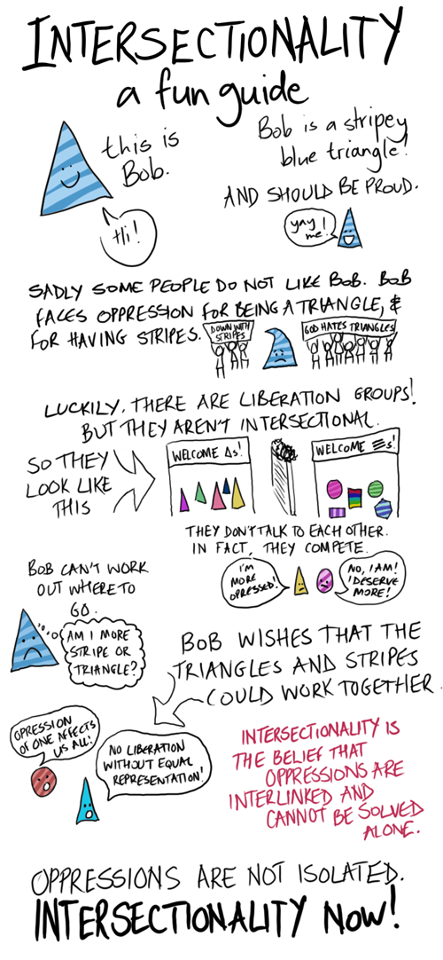
The cartoon below, by Miriam Dobson, does a great job of showing one of the downsides of fighting for progressive social change in this way.  For one, it can make people who carry multiple marginalized identities (for example, gay black men) feel unwelcome. And, two, it makes it seem like people without the identity can’t be part of the movement.

One solution is to think about oppressions in terms of intersectionality: we are all a mix of identities that resonate with each other in complicated ways.  This is a rich idea, but one lesson that it has taught us is that the strategy of divide-and-conquer has been an effective way to keep multiple groups marginalized.

Instead of emphasizing identities, we could identify issues. And if our issue is oppression, we can join-to-resist.  As the graphic explains: “oppression of one affects us all.”

1

Via Sociology SourceAnother Angry Woman, and The Sociological Imagination.

Lisa Wade, PhD is an Associate Professor at Tulane University. She is the author of American Hookup, a book about college sexual culture; a textbook about gender; and a forthcoming introductory text: Terrible Magnificent Sociology. You can follow her on Twitter and Instagram.