Search results for The

Migrant labor sustains U.S. agriculture. It is essential and constant. Yet the people who do the work remain hidden. That invisibility is not just social. It is spatial. Employers tuck housing behind groves, set it far off the road, or place it on private land behind locked gates. These sites are hard to reach. They are also hard to leave.

As a paralegal at my stepmother’s immigration law firm in Metro Detroit, I met with many migrant workers who described the places they were housed. They worked long days in fields or orchards, often six or seven days a week, and returned to dormitories built far from town. The stories stayed with me. They worked in extreme heat and came back to shared spaces without privacy, comfort, or dignity. Workers are placed in dorms with shared beds and tight quarters. Bathrooms are communal. Kitchens are often bare.

A bedroom for migrant farmworkers at the Nightingale facility in Rantoul, Ill., in July 2014.
Credit: Photo by Darrell Hoemann/Midwest Center for Investigative Reporting. Used with permission.

Images help tell this story. Photographs from North Carolina and California show identical cabins in rows. Inside are narrow beds, small windows, and not enough space to stretch. These photos are more than documentation. They are evidence. They show us what it looks like to build a system that erases the people who keep it running.
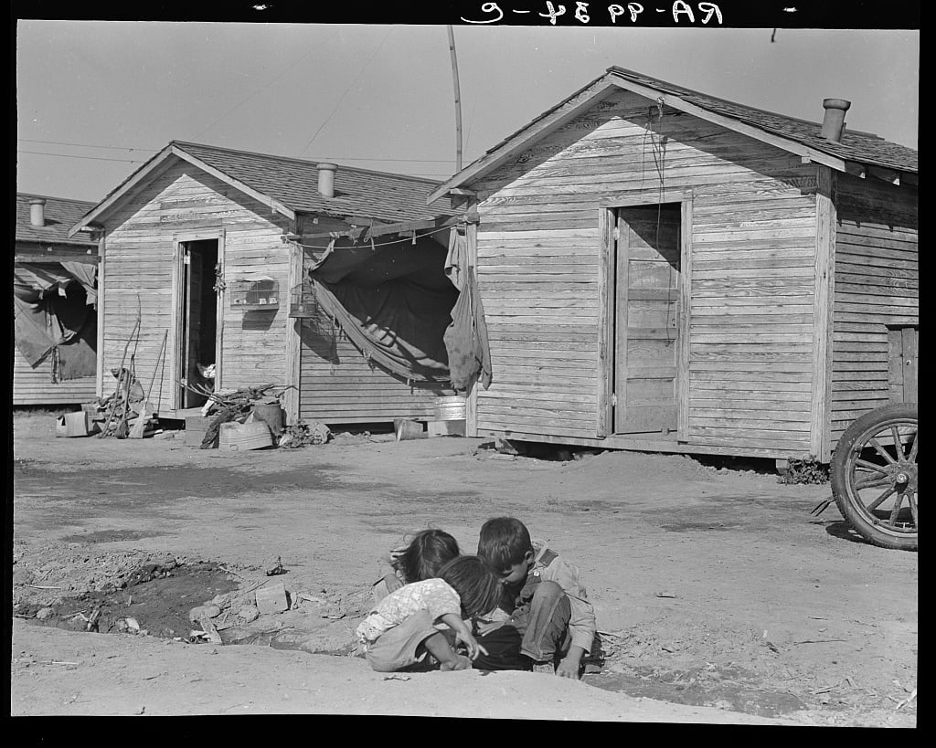
Migrant agricultural worker’s family in Nipomo, California, 1936. The mother, age 32, sits with three of her seven children outside a temporary shelter during the Great Depression.
Credit: Photo by Dorothea Lange. Farm Security Administration Collection, Library of Congress. Public domain.

Sociology gives us a framework to see that this is not just bad housing structure. It is a structural problem. When the employer controls housing, every complaint becomes a risk. Speaking up may not only cost your job, it also means losing your bed and risking forcible deportation. The design limits autonomy and keeps people quiet. The fewer choices a person has, the easier it is to control them.

In sociology, conflict theory starts with a simple idea: society develops and changes based on struggles over power and resources. In the case of migrant labor, that struggle is visible in the very organization of housing. Henri Lefebvre argued that space is socially produced. Social production means that space is shaped by those who have authority to determine how people live. This is not driven by comfort, fairness, or function. The arrangement and social production of space reflects the interests of those and control. The shape of a room, the distance between houses, and the layout of a building are not random. They reflect relationships.

Similarly, Michel Foucault shows how institutions use architecture to enforce discipline. In migrant housing, space signals control. These dorms do not need bars or guards. The buildings are made to meet the minimum legal standard for shelter. That standard is barely above what is allowed for a prison cell. The architecture dehumanizes, and in doing so, it controls.

I saw this firsthand. A worker told me his bunk was so close to the next that he could hear every breath of the man above him. His wife told me there were rules about visitors, meals, and noise. They could not live together, even though they were married. They felt monitored. They were afraid to speak. These homes were not theirs. The system made sure of that.

Sociology gives us the language to name what is happening. This is not a housing crisis. It is a labor strategy. These camps are not temporary accidents. They are long-term solutions to a problem no one wants to fix. As scholars and citizens, we should bring these designs to light. We cannot change what we do not see.

Joey Colby Bernert is a statistician and licensed clinical social worker based in Michigan. She is a graduate student in public health at Michigan State University and studies feminist theory, intersectionality, and the structural determinants of health.

In recent weeks, we’ve seen multiple examples of women on the political right straddling two kinds of womanhood: the girlboss and the tradwife. The visibility of these women exposes a hidden link between conservative womanhood and girlboss feminism that deserves our attention. 

Katie Britt broadcast her response to the State of the Union from her kitchen. Michelle Morrow, the conservative activist from North Carolina who has just been elected state Superintendent of Education in North Carolina, burnishes her credentials as a wife and mother above all else.

They aren’t the first to do this; #tradlife has been trending since at least 2019. Tradwife influencers perform a version of femininity that leans on a strong husband providing financial support so they can devote themselves to caring for children and the home. There is almost always an apron, a kitchen, and a perfectly coiffed, carefully made-up woman in a serene environment cooking from scratch recipes — a vibe that belies the real chaos of having young humans to care for in a home. 

We might assume that tradwives hearken back to an earlier “backward” mode of femininity and marriage. But this way of being in the world is unmistakably modern because it involves “choice” and entrepreneurship. It is not enough for a tradwife to simply focus on her husband and kids, she must be entrepreneurial about it. She must blog about it, vlog about it, become an influencer. This is where the “girlboss” mentality comes in.

Sheryl Sandberg’s 2013 book Lean In told women that if they would just ask for what they wanted in the workplace, like the men, they too would advance. But women continue to face barriers in corporate America and marginalization in labor markets. Despite this girlboss feminism has been incorporated into our culture across the political spectrum. US women widely believe structural problems are with women ourselves. With individual effort, good planning, the right domestic help, and a little luck and chutzpah, we can overcome societal inequalities. We rely on a myth of mutuality that belies the true gender division of labor in American families.

It turned out lean-in feminism was both colorblind and a sham. And the #tradwives know it – there are even Black tradwife influencers. They say proudly: we have decided it’s way too exhausting to run the family and corporate America at the same time. So we will focus on our family and “opt out” of the vulnerability and constant stress of the labor market, which values our labor less. And in doing so, we take a stand with men and shore up the dying ideology of the father as breadwinner. We choose this, and you too can see just how great this choice is on our successful TikTok channels. 

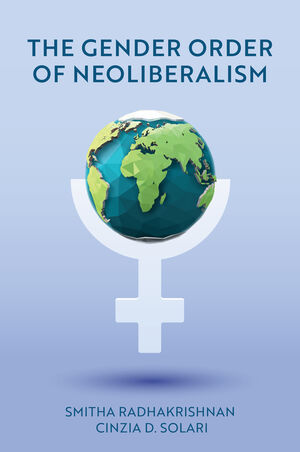
As we discuss in depth in our new book, The Gender Order of Neoliberalism, U.S. has long drawn soft power from the idea that its women are “empowered.” Not “backward,” like those oppressed women in the Middle East or India or Africa, who are poor and come from patriarchal cultures. Our women, we like to tell the world, make choices of their own, work outside the home in high-powered jobs, fly planes, and even save women in other parts of the world.

But focusing on the individual choices of women who must “do it all” was not always what “women’s empowerment” meant. We show in our book that women involved in transnational feminist organizing in the 1950s and 60s lobbied for reproductive justice, fair pay for fair work, universal childcare, universal healthcare, and fair trade between countries. Those visions of empowerment have all but disappeared from our collective political imaginations. What would a joyful life look like if there were community kitchen tables, childcare collectives, and widely available healthcare? Where are the inviting visuals for that kind of empowerment?

Our impoverished feminist imagination leaves us straddling the skinny divide between tradwives and girlbosses and reinforcing the notion that women should continue to be America’s social safety net.

Smitha Radhakrishnan is Marion Butler McLean Professor in the History of Ideas and Professor of Sociology at Wellesley College. She is author of Making Women Pay: Microfinance in Urban India.

Cinzia D. Solari is Associate Professor of Sociology at University of Massachusetts Boston. She is author of On the Shoulders of Grandmothers: Gender, Migration, and Post-Soviet Nation-Building.

How are borders made? State borders are the product of political conflict, nationalist discourse, unequal economic systems, and, as this essay shows, significant public financial investment. Public policy and political narratives naturalize state borders, often hiding how their origins are arbitrary and violent. State borders often mark space following war and conflict, but they also perform additional social functions like maintaining distinct political systems and differentiating between insiders and outsiders. Borders also construct economic difference by maintaining unequal trade relations, national currencies, and disparate value regimes across states and regional zones.

States create borders by dedicating public funds to construct and uphold them. In the post-9/11 United States, state officials juxtaposed the discourse of anti-terrorism with that of border regulation, contributing to the securitization of the US-Mexico border. President George W. Bush’s administration founded the Department of Homeland Security (DHS) through the Homeland Security Act of 2002. Customs and Border Protection (CBP) and Immigration and Customs Enforcement (ICE) are two key agencies under DHS, responsible for apprehending, detaining, and deporting immigrants. CBP touts itself as “one of the world’s largest law enforcement organizations” (CBP, 2020) and states that its primary mission is “to detect and prevent the illegal entry of individuals into the United States” and “maintain borders that work” (CBP, 2021). ICE states that its “mission is to protect America from the cross-border crime and illegal immigration that threaten national security and public safety” (ICE, 2022).

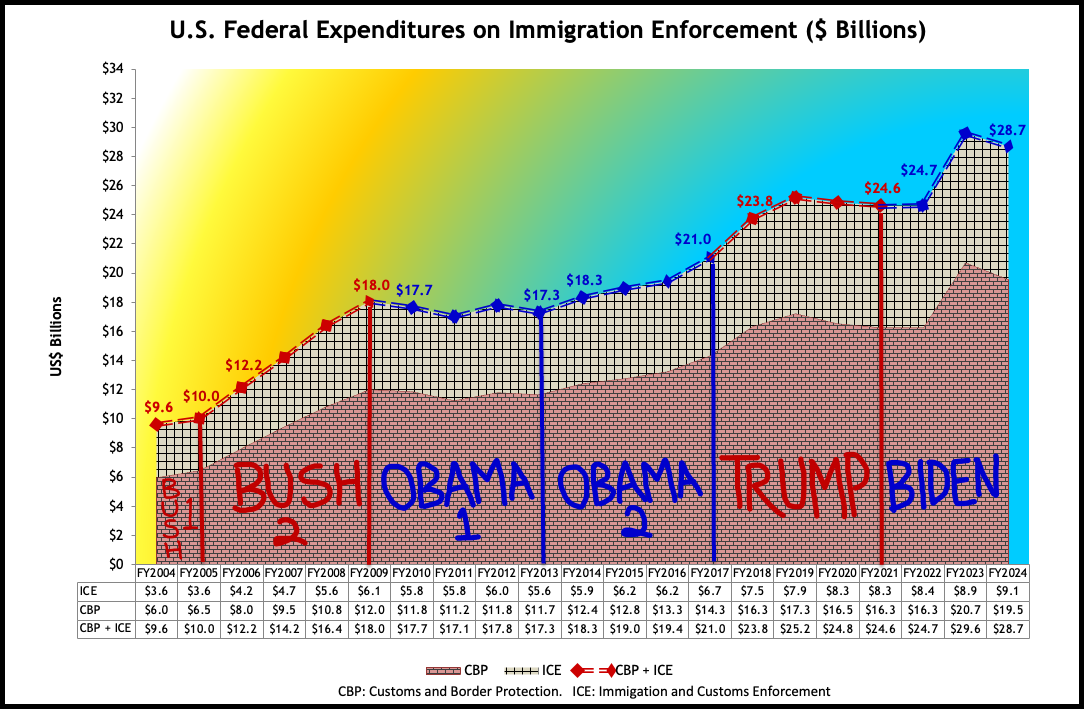
Data visualization by the Author. Source: U.S. Department of Homeland Security. Budget in Brief Reports, FY2006 to FY2024, inclusive (Reports not adjusted for inflation).

The chart above illustrates trends in federal spending on immigration enforcement and border security in the image of a fenced border wall (these figures are not adjusted for inflation). The brick wall represents the annual budget of CBP. The fence above the brick wall represents the annual budget of ICE. Graffitied sections of the wall represent the six presidential terms since 2002, namely, Bush 1, Bush 2, Obama 1, Obama 2, Trump, and Biden. The red and blue barbed wire represents the sum of annual budgets for CBP and ICE. Red sections of the barbed wire indicate budgets approved by Republican presidents, while blue sections indicate budgets approved by Democratic presidents. Numeric labels above the barbed wire represent the combined budget for CBP and ICE at the beginning and end of each presidential term.

Democratic and Republican presidents have expressed rhetorical differences in immigration policy, with Democrats articulating a more pro-immigrant stance compared to their Republican counterparts. The chart above gives the lie to the political performativity of partisan differences on immigration policy. In practice, Democratic presidents appear no less enthusiastic than their Republican counterparts in funding the border policing. In a period of 21 years, Democratic and Republican governments have spent a staggering total of $409.4 billion of public funds on immigration enforcement. $178.9 billion has been spent by Republican Presidents, averaging to $17.9 billion annually. $230.5 billion has been spent by Democratic Presidents, averaging to $21.0 billion annually. In total, $275 billion has been spent on CBP and $134.4 has been spent on ICE. Overall, federal expenditures on immigration enforcement have nearly tripled from $9.6 billion (FY2004) to $28.7 billion (FY2024) in unadjusted dollars. Adjusting for inflation to 2024 dollars still suggests an increase from about $17.5 billion to $28.7 billion.

When it comes to immigration, Republicans put their money where their mouth is, while Democrats do not. What explains this? The contrast between the partisan difference in immigration rhetoric and partisan consensus on immigration policy is rooted in the fundamental contradictions of bourgeois liberal democracy. While elected representatives are supposed to represent the will of the working people, in actuality they represent the interests of the ruling economic, political, and racial elite. Substantive progress towards de-carcerating the United States and de-securitizing the US-Mexico border might have been possible if progressives exercised greater power in Congress and if, in turn, Congress exercised greater power over the budget and immigration enforcement. In the current context, however, this is unlikely. In October 2023, President Joe Biden’s administration waived no fewer than 26 federal regulations to construct a border wall between the US and Mexico in Texas (Gonzalez, 2023), seemingly mimicking his Republican predecessor Donald Trump in advance of the 2024 presidential election. In the gaping void left by the abandonment of any commitment to a progressive ideological agenda in the Democratic Party, anti-immigrant violence fills the void.

Sources and Additional Reading

  • Ackleson, J. (2005). Constructing security on the US–Mexico border. Political Geography24(2), 165-184.
  • CBP 2020. Customs and Border Protection. 2020. “About CBP.” Washington, DC: Customs and Border Protection. Retrieved November 17, 2021 (https://www.cbp.gov/about)
  • CBP 2021. Customs and Border Protection. 2021. “Border Patrol Overview.” Washington, DC: Customs and Border Protection. Retrieved November 17, 2021. (https://www.cbp.gov/border-security/along-us-borders/overview)
  • Gonzalez, V. (2023, October 6). The Biden Administration says it is using executive power to allow border wall construction in Texas. AP News. https://apnews.com/article/border-wall-biden-immigration-texas-rio-grande-147d7ab497e6991e9ea929242f21ceb2 
  • ICE 2022. Immigration and Customs Enforcement. 2022. “Keeping America Safe.” Washington, DC: Immigration and Customs Enforcement. Retrieved November 17, 2021. (https://www.ice.gov/#)
  • Reinke de Buitrago, S. (2017). The meaning of borders for national identity and state authority. Border politics: defining spaces of governance and forms of transgressions, 143-158.
  • U.S. Department of Homeland Security. Budget in Brief Reports, FY2006 to FY2024, inclusive.

Dr. Ghazah Abbasi is a Postdoctoral Associate in Public Engagement at the Cornell Brooks School of Public Policy

Over the course of the past year, M&M’s have been plastered all over the news, social media, and even Super Bowl commercials. In January 2022, Mars Wrigley gave the brown M&M shorter heels and replaced the green M&M’s boots with sneakers in a push toward more inclusive marketing. 

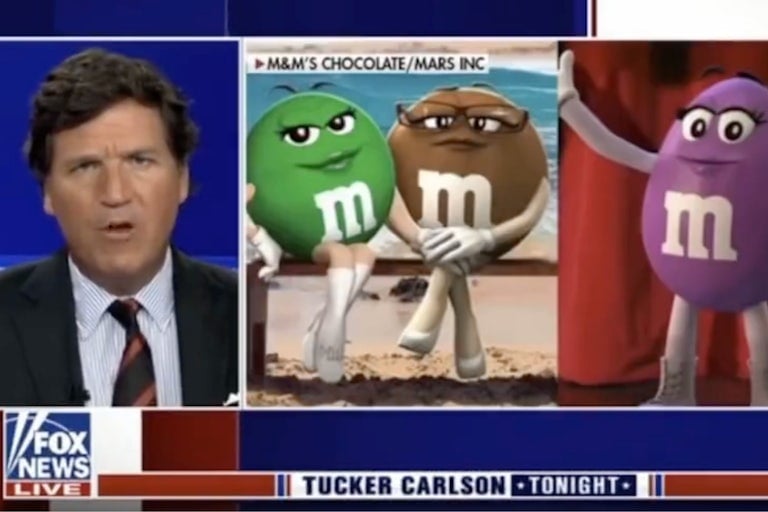
What resulted was outrage. Tucker Carlson became the face of the backlash, stating, “M&M’s will not be satisfied until every last cartoon character is deeply unappealing and totally androgynous.” Carlson was not the only one speaking out. In a Rolling Stone article titled, “Let the Green M&M Be a Nasty Little Slut,” senior writer EJ Dickson argues, “The green M&M has spent decades building her brand as a horny, sexy bitch, and for what? For her creators to give her Larry David footwear in the name of feminism?”

By September, the purple M&M had made her debut. Carlson soon reignited the war, leading to Mars’ temporary suspension of their spokescandies. On FOX News, he remarked, “The green M&M got her boots back, but apparently is now a lesbian maybe? And now there’s a plus-sized, obese purple M&M.” While all of these comments are nonsensical, they point to the pressure placed on women to conform to gender norms and accommodate men’s sexual desires.

Sexualization of Women in the Media

M&M’s were not the first nor the only gendered commercial food product. In the 1940s, the Chiquita Banana, the world’s first branded fruit, made her debut. The original Miss Chiquita Banana was racialized and sexualized in order to appeal to the American market. Her femininity, specifically, was oversexualized through her flirtatious winking and eye-rolling as well as her frilly dresses and lipstick. 

Smithsonian Magazine, Chiquita Banana’s Recipe Book, 1947
Photo courtesy of Christina Ceisel

M&M’s has long employed the same strategy by sexualizing their female spokescandies. Their hypersexualization not only appears in their dress, but the erotic nature of the commercials in which they have been featured. The green M&M has been pictured pole dancing, stripping, and fondling chocolate, among other overt sexual acts. What’s more, the male M&M’s can be seen ogling her in the background, reinforcing the pervasiveness of the male gaze, in which men actively view women as passive ‘objects’ of their sexual desires.

Emphasized Femininity

Emphasized femininity refers to a range of traditional feminine norms that encourage women to accommodate men’s sexual appetites and desire for control. It legitimizes the gender hierarchy and upholds various forms of oppression. 

As women step away from the “stereotypical cultural notions” of emphasized femininity, men must “negotiate the dilemma of incorporating women’s resistance into their masculine identity projects.” Therefore, when the female M&M’s became less conventionally attractive and “sexy,” those that subscribe to the ideals of hegemonic masculinity felt threatened. They became angry that their sexual desires were not being satisfied, even with regard to a candy mascot.

This outrage reveals that women face the prospect of being labeled “socially undesirable” when they possess masculine characteristics.

In Carlson’s words, “When you’re totally turned off, we’ve achieved equity.” In our patriarchal society, when a woman exhibits defiance or authority, men feel threatened unless they can stigmatize and feminize their behavior.

When this happens, a woman is no longer a “good girl,” but a “bitch,” “lesbian,” or “slut.” Evidently, for women to be valued by men, they need to be subservient to the male gaze.

Impact of Hypersexualization

The hypersexualization of women is incredibly harmful to young people. Adolescents’ exposure to a sexualized media environment leads them to recognize women as sex objects. When women and young girls constantly see their bodies objectified, they begin to internalize the idea that the most valuable thing about them is their body. They become acutely aware that they are seen as “sexual playthings waiting to please men’s sexual desires” and begin to feel unworthy if they do not meet society’s standards. It does not go unnoticed when children see that the very candy they eat is sexualized.

When people become outraged when a female M&M’s shoe is changed, what message does that send? Of course, a so-called “culture war” waged against M&M’s is ludicrous, but there is power behind words, and this controversy’s real-world implications must be addressed. The vicious cycle of sexualizing women, mascots or not, for profit must be brought to an end, and prominent figures need to realize that the oppression of others is not a punchline.

Jillian Nord is a sociology student at Hamilton College.

Picture this. Walking down 135th street in Harlem, you spot a park in the distance. As you walk closer, you hear a basketball bouncing and kids yelling. It’s a small, outdoor court, well-maintained with fresh paint and a sturdy chain-link fence surrounding it. The ball is constantly in motion, being passed, dribbled, and shot from all angles. As the game progresses, the excitement draws in more kids around the court. 

New York City is synonymous with basketball. From Harlem to Brooklyn, basketball has been a part of the city’s culture for decades. But why has basketball become such a staple of African American culture in cities? The answer is complex, but the roots of its popularity among minority groups stem from discriminatory practices like redlining and segregation.

A White Man’s Sport

Basketball was originally invented as a white man’s game

  – Micheal Novack, The Joy of Sports (1946)

Basketball was founded in 1891 by Dr. James Naismith, a Canadian physical education instructor seeking a way to keep his students active. By the early 1900s, it was being played in colleges and high schools across the nation. Colleges like Harvard, Yale, Cornell and Princeton began to play games against each other as early as 1901. The first professional basketball league, the National Basketball League (NBL), was founded in 1937. It was later merged with the Basketball Association of America (BAA) to form the National Basketball Association (NBA) in 1949. 

The 1950 Minneapolis Lakers basketball team, Wikimedia Commons

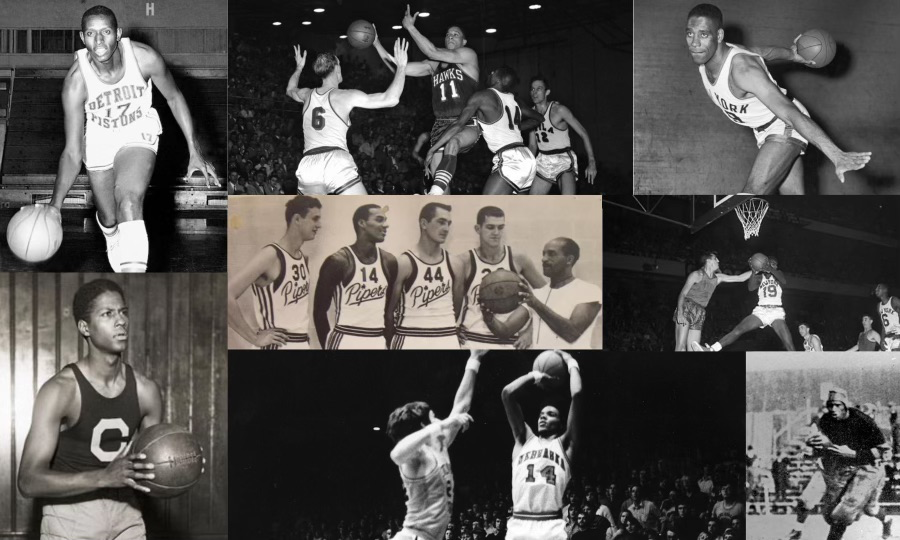
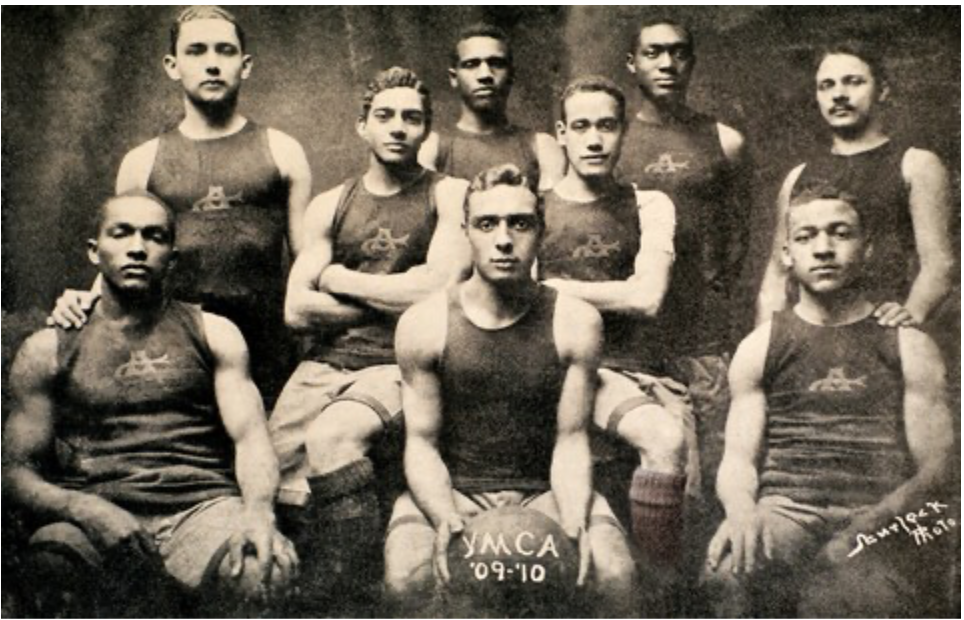
For the first 30 years, the majority of participants at the collegiate and professional level were white, as black participants were barred from playing. The first black collegiate player, George Gregory Jr, did not appear until 1928. In the 1949-1950 season Chuck Cooper, Nathaniel Clifton, and Earl Lloyd became the first black players to play professional basketball, breaking the color barrier. Basketball at this time was played mostly at community centers like YMCAs, where white owners refused membership to black people. If black people wanted to play basketball, they would need to build their own. 

NYC’s History Of Racial, Economic, and Athletic Segregation

Redlining and other forms of economic discrimination depressed resources in minority neighborhoods. Redlining is an exclusionary practice that began in 1934 with the implementation of the National Housing Act (NHA). The NHA created government programs such as the Federal Housing Association (FHA) and the HomeOwner Loan Corporation (HOLC) with the intent to improve the housing market. It intended to promote homeownership by providing mortgage insurance to lenders, which would make it easier for people to obtain loans to buy homes. While the FHA improved housing conditions for White people, this support largely excluded black people.

The HOLC wrote dozens of reports to banks which categorized areas with large populations of black residents as “risky” for investors, driving down their property values and scaring off many potential investors. The FHA then used these maps to guide its lending policies, which meant refusing federally insured housing loans for minorities. In addition to this, as more black people began moving to white neighborhoods in northern cities in efforts to escape Jim Crow segregation, white people began to create suburbs outside the city to escape the influx of black people. As more white homeowners fled to the suburbs, the remaining ones agreed to sell their homes at deeper discounts, fearful of falling prices. 

Economic inequality caused by redlining practices also created disparities in the types of sports played by the kids in poorer neighborhoods. Redlined neighborhoods have less green space and have smaller parks on average. According to an analysis by the Trust for Public Land, the average park size is 6.4 acres in poor neighborhoods, compared with 14 acres in wealthy neighborhoods in New York City. 

In addition to available parks, minority children gravitated toward basketball because of the cost of entry barriers that other sports carried. In order to play baseball at a high level, you need money to pay for equipment and travel teams. Basketball did not carry this prerequisite. David C Ogden, a professor at the University of Nebraska who studied race and sport dynamics, wrote that the most common reasons for the lack of racial diversity were the paucity of baseball facilities in Black neighborhoods, and the cost of playing select baseball. As a result:

“More than two-thirds of the 27 coaches said that African-American youth prefer to spend their time on the basketball court rather than on the diamond”

Ogden (2003)

Rise of Black YMCAs

Basketball’s popularity among minority communities flourished because of the development of black YMCA’s. The Smart Set Athletic Club of Brooklyn would be the first fully independent Black basketball team in America in 1907. As more and more YMCA’s appeared in major cities, basketball spread in similar fashion. 

In the last game of the season, the 12th Streeters beat the Smart Set in Brooklyn 20:17 in front of more than 2,000 spectators and in this way directly dethroned the reigning champion.” (Domke 2011)

Edwin Bancroft Henderson, an educator working in Washington D.C., introduced the game of basketball to the Black community. Henderson learned the game during summer sessions at Harvard University, and then introduced the game to young Black men in the Wash. D.C. area. Soon the game would be played across the east coast of the United States, mainly in New York, Philadelphia and Baltimore.  

Basketball also became a means for economic upward mobility. The Harlem Globetrotters formed in 1926 and became the most renowned basketball team for black basketball players. For black basketball players, the globetrotters provided the best and only way to make a living while playing basketball. 

Basketball Today

Now, basketball is an important part of NYC culture, regardless of race. Black participation in basketball has soared in the decades after segregation, and has especially soared in NYC. Every summer, minority communities gather for basketball tournaments held in NYC parks, some that even draw national attention. Nike sponsored “NY vs NY” and Slam magazine’s Summer Classic feature the top ranked high school players and have thousands of fans watching every summer. They both have been held in Dyckman park in Manhattan for the past 5 years.

 Significant changes have occurred  in professional demographics as well. In contrast to 1950, 75 % of the NBA is black, with a bunch of black athletes playing abroad in leagues all over the world. Segregation and redlining stifled black participation in basketball in its early history, but the economic conditions it fostered helped basketball become an enduring staple of the community for generations.

Sharif Nelson ‘26 is a student at Hamilton College studying economics. 

Additional Resources:

Aaronson, D., Faber, J., Hartley, D., Mazumder, B., & Sharkey, P. (2020). The Long-Run Effects of the 1930s HOLC “Redlining” Maps on Place-Based Measures of Economic Opportunity and Socioeconomic Success. The Effects of the 1930s HOLC “Redlining” Mapshttps://doi.org/10.21033/wp-2020-33 

Bowen, F. (2023, April 7). In its early years, NBA blocked black players. The Washington Post. Retrieved April 24, 2023, from https://www.washingtonpost.com/lifestyle/kidspost/in-nbas-early-years-black-players-werent-welcome/2017/02/15/664aa92e-f1fc-11e6-b9c9-e83fce42fb61_story.html

Centopani, P. (2020, February 24). The makings of basketball mecca: Why it will always be New York. FanSided. Retrieved May 1, 2023, from https://fansided.com/2020/02/24/makings-basketball-mecca-will-always-new-york/ 

Domke, M. (2011). Into the vertical: Basketball, urbanization, and African American … Into the Vertical: Basketball, Urbanization, and African American Culture in Early- Twentieth-Century America. Retrieved March 31, 2023, from http://www.aspeers.com/sites/default/files/pdf/domke.pdf

Gay, C. (2022, January 13). The black fives: A history of the era that led to the NBA’s racial integration. Sporting News Canada. Retrieved April 24, 2023, from https://www.sportingnews.com/ca/nba/news/the-black-fives-a-history-of-the-era-that-led-to-the-nbas-racial-integration/8fennuvt00hl1odmregcrbbtj 

Gorey, J. (2022, July 25). How “White flight” segregated American cities and Suburbs. Apartment Therapy. Retrieved April 30, 2023, from https://www.apartmenttherapy.com/white-flight-2-36805862 

Hunt, M. (2022, October 11). What is the National Housing Act? Bankrate. Retrieved April 25, 2023, from https://www.bankrate.com/real-estate/the-national-housing-act/#:~:text=What%20is%20the%20National%20Housing%20Act%20(NHA)%3F,Loan%20Insurance%20Corporation%20(FSLIC).

Hu, W., & Schweber, N. (2020, July 15). New York City has 2,300 parks. but poor neighborhoods lose out. The New York Times. Retrieved April 21, 2023, from https://www.nytimes.com/2020/07/15/nyregion/nyc-parks-access-governors-island.html

Ivy league regular season champions, by Year. Coaches Database. (2023, March 5). Retrieved April 24, 2023, from https://www.coachesdatabase.com/ivy-league-regular-season-champions/

McIntosh, K., Moss, E., Nunn, R., & Shambaugh, J. (2022, March 9). Examining the black-white wealth gap. Brookings. Retrieved April 25, 2023, from https://www.brookings.edu/blog/up-front/2020/02/27/examining-the-black-white-wealth-gap/

Ogden, D. C. ., & Hilt, M. L. . (2003). Collective Identity and Basketball: An Explanation for the Decreasing Number of African Americans on America’s Baseball Diamond. Retrieved March 31, 2023, from https://www.nrpa.org/globalassets/journals/jlr/2003/volume-35/jlr-volume-35-number-2-pp-213-227.pdf

Ortigas, R., Okorom-Achuonyne, B., & Jackson, S. (n.d.). What exactly is redlining? Inequality in NYC. Retrieved March 30, 2023, from https://rayortigas.github.io/cs171-inequality-in-nyc/

Pearson, S. (2022). Basketball origins, growth and history of the game. History of The Game Of Basketball Including The NBA and the NCAA. Retrieved April 24, 2023, from https://www.thepeoplehistory.com/basketballhistory.html 

Robertson, N. M. (1995). [Review of Light in the Darkness: African Americans and the YMCA, 1852-1946., by N. Mjagkij]. Contemporary Sociology24(2), 192–193. https://doi.org/10.2307/2076853

Townsley, J., Nowlin, M., & Andres, U. M. (2022, August 18). The lasting impacts of segregation and redlining. SAVI. Retrieved March 30, 2023, from https://www.savi.org/2021/06/24/lasting-impacts-of-segregation/

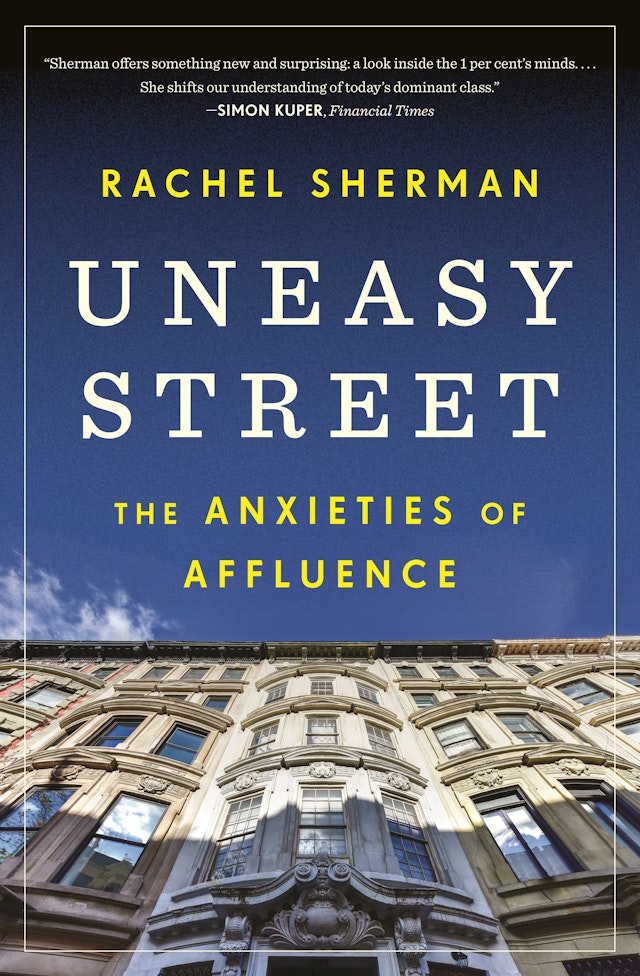
I love this podcast conversation with Rachel Sherman and Anne Helen Petersen about Sherman’s recent book, Uneasy Street: The Anxieties of Affluence. It is a great source for introduction to sociology courses looking to open up a conversation about differences in social class, especially because it draws attention to the fact that people do a lot of work to hide that social class position.

When we think about wealth, it is tempting to focus on flaunting riches through conspicuous consumption of flashy clothes, large homes, and other reality TV fodder. Sherman’s work makes an important point: phrases like “middle class” actually do a lot to hide our economic positions in society, and wealthy people often work to manage others’ perceptions of their wealth.

The podcast pairs well with a recent Twitter thread from John Holbein tracing research from around the world on how people’s perceptions of their economic position line up with their actual income and wealth. In case after case, many people report a social class that doesn’t line up with what they actually have.

This is a point I always try to make with my students: our social relationships are as much about the things we hide and avoid talking about as the things we openly share with each other. One of the most powerful points sociologists can make is to show these hidden patterns in the way we interact. The goal is not to call people out or to accuse them of lying, but rather to ask ourselves what it is about our economic lives that makes us want to work so hard to manage others’ perceptions in this way.

Evan Stewart is an assistant professor of sociology at University of Massachusetts Boston. You can follow his work at his website, or on BlueSky.

We seem to have been struggling with science for the past few…well…decades. The CDC just updated what we know about COVID-19 in the air, misinformation about trendy “wellness products” abounds, and then there’s the whole climate crisis.

This is an interesting pattern because many public science advocates put a lot of work into convincing us that knowing more science is the route to a more fulfilling life. Icons like Carl Sagan and Neil deGrasse Tyson, as well as modern secular movements, talk about the sense of profound wonder that comes along with learning about the world. Even GI Joe PSAs told us that knowing was half the battle.

The problem is that we can be too quick to think that knowing more will automatically make us better at addressing social problems. That claim is based on two assumptions: one, that learning things feels good and motivates us to action, and two, that knowing more about a topic makes people more likely to appreciate and respect that topic. Both can be true, but they are not always true.

The first is a little hasty. Sure, learning can feel good, but research on teaching and learning shows that it doesn’t always feel good, and I think we often risk losing students’ interest because they assume that if a topic is a struggle, they are not meant to be studying it.

The second is often wrong, because having more information does not always empower us to make better choices. Research shows us that knowing more about a topic can fuel all kinds of other biases, and partisan identification is increasingly linked with with attitudes toward science.

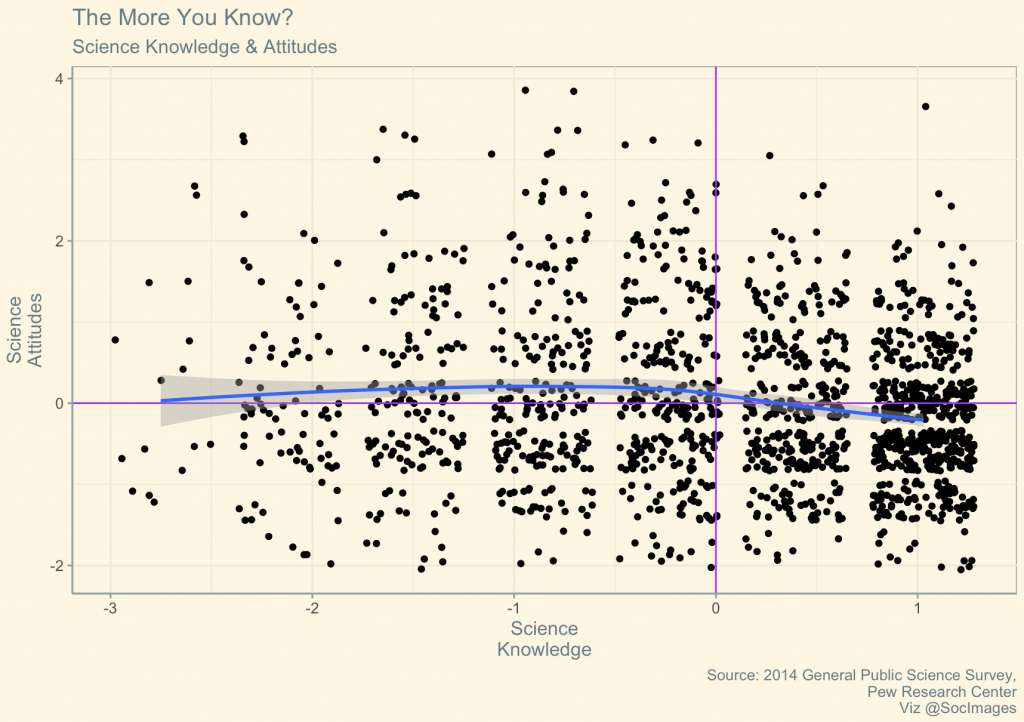
To see this in action, I took a look at some survey data collected by the Pew Research Center in 2014. The survey had seven questions checking attitudes about science – like whether people kept up with science or felt positively about it – and six questions checking basic knowledge about things like lasers and red blood cells. I totaled up these items into separate scales so that each person has a score for how much they knew and how positively or negatively they thought about science in general. These scales are standardized, so people with average scores are closer to zero. Plotting out these scores shows us a really interesting null finding documented by other research – there isn’t a strong relationship between knowing more and feeling better about science.

The purple lines mark average scores in each scale, and the relationship between science knowledge and science attitudes is fairly flat.

Here, both people who are a full standard deviation above the mean and multiple standard deviations below the mean on their knowledge score still hold pretty average attitudes about science. We might expect an upward sloping line, where more knowledge associates with more positive attitudes, but we don’t see that. Instead, attitudes about science, whether positive or negative, get more diffuse among people who get fewer answers correct. The higher the knowledge, the more tightly attitudes cluster around average.

This is an important point that bears repeating for people who want to change public policy or national debate on any science-based issue. It is helpful to inform people about these serious issues, but shifting their attitudes is not simply a matter of adding more information. To really change minds, we have to do the work to put that information into conversation with other meaning systems, emotions, and moral assumptions.

Evan Stewart is an assistant professor of sociology at University of Massachusetts Boston. You can follow his work at his website, or on BlueSky.

It is hard to keep up habits these days. As the academic year starts up with remote teaching, hybrid teaching, and rapidly-changing plans amid the pandemic, many of us are thinking about how to design new ways to connect now that our old habits are disrupted. How do you make a new routine or make up for old rituals lost? How do we make them stick and feel meaningful?

Social science shows us how these things take time, and in a world where we would all very much like a quick solution to our current social problems, it can be tough to sort out exactly what new rules and routines can do for us.

For example, The New York Times recently profiled “spiritual consultants” in the workplace – teams that are tasked with creating a more meaningful and communal experience on the job. This is part of a larger social trend of companies and other organizations implementing things like mindfulness practices and meditation because they…keep workers happy? Foster a sense of community? Maybe just keep the workers just a little more productive in unsettled times?

It is hard to talk about the motives behind these programs without getting cynical, but that snark points us to an important sociological point. Some of our most meaningful and important institutions emerge from social behavior, and it is easy to forget how hard it is to design them into place.

This example reminded me of the classic Social Construction of Reality by Berger and Luckmann, who argue that some of our strongest and most established assumptions come from habit over time. Repeated interactions become habits, habits become routines, and suddenly those routines take on a life of their own that becomes meaningful to the participants in a way that “just is.” Trust, authority, and collective solidarity fall into place when people lean on these established habits. In other words: on Wednesdays we wear pink.

The challenge with emergent social institutions is that they take time and repetition to form. You have to let them happen on their own, otherwise they don’t take on the same same sense of meaning. Designing a new ritual often invites cringe, because it skips over the part where people buy into it through their collective routines. This is the difference between saying “on Wednesdays we wear pink” and saying

“Hey team, we have a great idea that’s going to build office solidarity and really reinforce the family dynamic we’ve got going on. We’re implementing: Pink. Wednesdays.”

All of our usual routines are disrupted right now, inviting fear, sadness, anger, frustration, and disappointment. People are trying to persist with the rituals closest to them, sometimes to the extreme detriment of public health (see: weddings, rallies, and ugh). I think there’s some good sociological advice for moving through these challenges for ourselves and our communities: recognize those emotions, trust in the routines and habits that you can safely establish for yourself and others, and know that they will take a long time to feel really meaningful again, but that doesn’t mean they aren’t working for you. In other words, stop trying to make fetch happen.

Evan Stewart is an assistant professor of sociology at University of Massachusetts Boston. You can follow his work at his website, or on BlueSky.