Search results for The

Screenshot_3SocImages Meet Up in Minnesota!

Today I’m enjoying a visit to Carleton College and looking forward to spending the next two days at Macalester.  If you’re in the Twin Cities area, I’ll be at the W XYZ bar at the Aloft hotel in Minneapolis (900 Washington Ave S) on Thursday Oct. 3 at 8:30pm.  I would love to meet you and, more importantly, I would love to introduce you to each other!

Posts that Killed It:

We had an extraordinary month in September thanks to Sezin Koehler’s post on the lyrics of Robin Thicke’s “Blurred Lines.”  Many had called the song “rape-y” and the video misogynistic, but Koehler took it a step further, aligning the song’s lyrics with the words of actual rapists.  This struck a chord, making stark the discomfort many felt with the song.  The post has 163,000 “likes” and 1,600 comments and counting.  It was also cross-posted or discussed at Al Jazeera, Ms., Feministing, xoJane, Pacific Standard, and Jezebel.

We had some other super popular posts this month too!  Here are the highlights, starting with Koehler’s amazing work:

And y’all seemed to like our list of professors’ pet peeves too (5,000 likes)

New Course Guides:

You can see all of our course guides here.  We hope they’re useful!

Elsewhere on the Net:

This month I had the fun opportunity of writing two original essays for Salon and one for Alternet.

Social Media ‘n’ Stuff:

Finally, this is your monthly reminder that SocImages is on TwitterFacebookGoogle+, and Pinterest.  Lisa is on Facebook and most of the team is on Twitter: @lisawade@gwensharpnv@familyunequal@carolineheldman, and @jaylivingston.

In Other News…

Contributor Philip Cohen can cross another thing off his bucket list.  And the rest of us will live vicariously.  His pup was featured at the joy-spreading Cute Overload.  I’m so jealous!

Screenshot_1

Lisa Wade, PhD is an Associate Professor at Tulane University. She is the author of American Hookup, a book about college sexual culture; a textbook about gender; and a forthcoming introductory text: Terrible Magnificent Sociology. You can follow her on Twitter and Instagram.

Course Guide for
FAMILIES AND SOCIETY
(last updated 9/2013)

Developed by Marcie Hambrick, MSW
Georgia State University


Defining Contemporary Family

Partnering

Childless Families

Parenting

Socialization of Children

Extended Family

Gendered Roles

Work and Family

Race and Family

Social Class and Family

Family Violence

I recently across two examples of cross-species education.  Both illustrate that what we often consider instinctual must also often be learned, revealing that nature and nurture are not competitive forces, but deeply interconnected.  The first is adorable to the point of making me cry from laughter, the second is so sad I can hardly stand it.

Here’s the first.  A sheep tries to teach a young bull how to head butt.  Words don’t do justice to the care and patience shown by this teacher.

Perhaps the bull just isn’t ever going to understand, but the fact that the sheep seems to understand that the bull doesn’t understand, and then thinks of an idea of how to fix that, is amazing to me.  Presumably, he would take as much care with a young sheep who would be predispositioned for head-butting, but might still benefit from some instruction.

Here’s the second.  Remember the movie Free Willy, where the captive killer whale is freed by a little boy?  Well, in true Hollywood irony, the whale that played Willy, Keiko, wasn’t freed at the end of the movie, of course.

Screenshot_1

After the movie was released in 1993, however, people joined in a movement to free him.  After 22 years in captivity, humans — who count as animals in this story — spent a decade and 20 million dollars trying to rehabilitate him to the wild, attempting to teach him how to feed himself and bond with wild whales.  He continued to seek out humans, even after he was left to fend for himself, and died in 2003 from pneumonia.

There are lots of lessons to take from this story.  One is the importance of nurture in making us what nature intended us to be.  Keiko was a social individual who learned how to be a captive killer whale.  Given the opportunity, he never could be the wild killer whale he once had the potential to be.  Or, at least, we’ll never know if he could.

Whenever we talk about human biological imperatives, we should remember the patient sheep and the friendly killer whale.  We need each other to become human, and we can become human in many different ways, depending on what is demanded of us.  Nature never works alone. Without each other, we simply don’t become recognizably human at all — as one of the worst cases of child neglect taught us only too well — regardless of our biological potential.

Lisa Wade, PhD is an Associate Professor at Tulane University. She is the author of American Hookup, a book about college sexual culture; a textbook about gender; and a forthcoming introductory text: Terrible Magnificent Sociology. You can follow her on Twitter and Instagram.
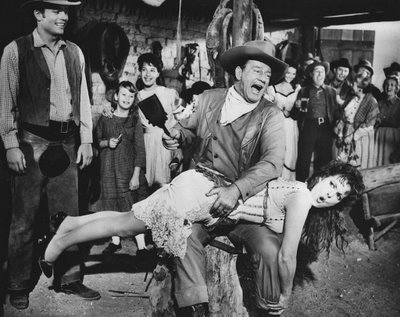
Lauren McGuire pointed us to a post by Gilligan at Retrospace inspired by a scene in the 1963 Western, McLintock!  The movie included a scene in which George McLintock, played by John Wayne, uses a shovel to spank his estranged wife, played by Maureen O’Hara.

The spanking scene apparent stuck quite the chord, as it was used repeatedly in the promotional materials.

Screenshot_1

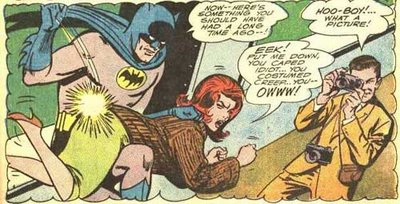
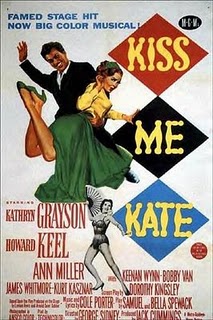
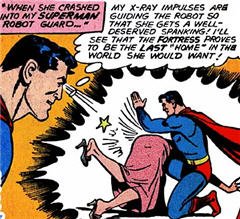
Gilligan suggests that the spanking of adult women by adult men was a midcentury theme, from Kiss me Kate to comic books:

Here’s an Q&A from the New York Daily Mirror, circa 1950s (thanks to @perstornes):

BSYdlNaIEAA7YJL

Lady spanking is a manifestation of the infantilization of women.  The idea that they are not men’s equals, but are expected to obey them as subordinates and can be punished when they do not behave.  Of course, materials riffing on the spanking adult women today (outside of porn and fetish communities) would probably inspire an outcry, but that leaves open the possibility that the gendered power asymmetry simply manifests in other ways.  Adult women are still infantilized (see posts here, here, and here) and dominance/submission is still sexualized in mainstream materials (consider our post asking what love is supposed to look like).

Originally posted in 2010; re-posted in response to a new example. Images borrowed from here, here, here, here, here.  H/t Retrospace.

Lisa Wade, PhD is an Associate Professor at Tulane University. She is the author of American Hookup, a book about college sexual culture; a textbook about gender; and a forthcoming introductory text: Terrible Magnificent Sociology. You can follow her on Twitter and Instagram.

Here is something quite simple, sent along by Judy B.  It’s a screenshot of Gimp, an open source image editing application.  An optional plug-in, created by a user, offers a series of filters for images, including ones that “beautify.”  One of the options is “skin whitening.”

1

This is one more reminder that we live in a racist society that conflates whiteness with beauty.  Remember, too, though, that someone — very possibly a set of people — had to make a conscious decision to include skin whitening as an option and position it as a sub-category of beautification.  Then they had to, literally, type the words into the program and make it so.

This shit doesn’t just happen.  It’s not random.  Racism isn’t just an ephemeral cultural thing.  It involves actual decisions made by real people who, if not motivated by racism, are complicit with it.

Cross-posted at Racialicious.

Lisa Wade, PhD is an Associate Professor at Tulane University. She is the author of American Hookup, a book about college sexual culture; a textbook about gender; and a forthcoming introductory text: Terrible Magnificent Sociology. You can follow her on Twitter and Instagram.
Excess under age-60 female mortality in less developed countries is estimated to add up to 3.9 million missing women worldwide (World Bank, 2011).  A large proportion of this is due to sex-selective abortion practices.  The practice occurs most commonly among poorer families in societies where boy children are given greater economic and social status than girl children. In such a context, the transition to smaller families can lead parents to choose boys over girls. Notably, female fetuses are most likely to be aborted when the first child born is a girl.

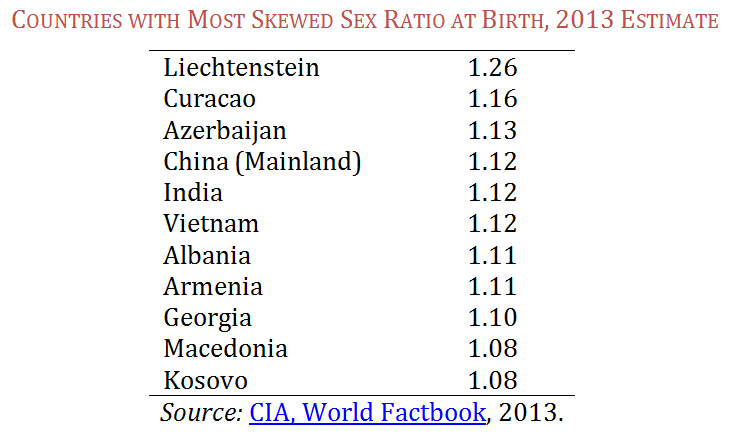
The table below shows the countries with the most skewed ratios at birth in the world. While there is naturally a slightly higher sex ratio of boys to girls — between 1.04-1.06 — ratios above that are considered to be altered by technology due to gender preferences for boy children.

Screenshot_1

The reason we find this newest 2013 data of particular interest is that, despite the popular Western focus on Asia, the practice occurs in more European countries. Perhaps most striking is the central European country that ranks at the top of the list—Liechtenstein. This strikes us as odd, given that Liechtenstein has never made this list in the past. Perhaps this is a data collection error (in very small populations, as also in Curacao, the results can be skewed). But we are surprised that no journalists have picked up on the fact that the worst offending son-preference country in the world is now, allegedly, a European country.  We contacted the CIA to ask them about this possible data anomaly but have not yet heard back.*

On the other hand, if the Liechtenstein data is accurate, this would be a very interesting story indeed, especially since Liechtenstein has the most restrictive laws against abortion in Europe.  A quick scan of gender equity policies in Liechtenstein shows that women there were not legalized to vote until 1984, indicating that it is not the most gender egalitarian of European countries.

In any case, whether Liechtenstein’s inclusion in this disreputable list is a data error or not, the other European countries on the list are legitimate.  They have been high for many years, and a recent report on Armenia, for example, documents longstanding norms in gender preference.  The disproportionate focus on birth sex ratios in China and India no doubt reflects their status as the #1 and #2 most populous countries, which means a much greater overall impact in sheer numbers.  Nevertheless, our point stands.  Why has the disproportionate inclusion of non-Asian countries on the above-list gone virtually unmentioned by journalists?

Do Developed Western Countries Prefer Boys?

Americans often think of parental sex preference as a thing of the past, or a problem in developing countries. After all, the U.S. sex ratio at birth falls in the normal range, at 1.05. This is in spite of the curious American cottage industry in sex-identification home use kits, such as the Intelligender, the GenderMaker and the Gender Mentor.

Screenshot_2

In surveys, American parents report an ideal of two children and equal preference for boys and girls. However, American gender preferences manifest themselves in more sneaky ways. A 2011 Gallup poll showed that, if they were only able to have one child, the highest preference was for a boy.  These results are little changed from the same Gallup question asked of Americans in 1941.

To return to a point made in an earlier post on skewed sex ratios, Americans may not be so different, after all, in their gender preferences from the countries in the above table.  The crucial difference, she noted, is that some Asian countries are more enabled to act on their boy preference than others. It appears we should now be including some European countries in that “enabled” group as well.

* Neither the United Nations, Population Reference Bureau, nor the World Bank have published 2013 statistics yet for comparison to the CIA data.

Jennifer Lundquist is an associate professor of sociology at the University of Massachusetts, Amherst who specializes in stratification and social demography.
Eiko Strader is a PhD student in sociology at the University of Massachusetts, Amherst who studies inequality in labor markets and the welfare state.

This seems like a good time to remind instructors that we have a series of image guides designed to make finding material for your classes as easy as possible.  These guides collect SocImages posts organized in a way that follows standard syllabi for frequently-taught sociology courses.

We’ve got the basics:

Major topics:

And sub-topics:

We hope they’re useful!

If you’d like to put an image guide together, we’re looking for sociology professors or graduate students to volunteer.  The task requires browsing our archives, pulling out the most compelling posts, and arranging them in ways other instructors would find familiar and convenient.  The Guides can cover entire courses, parts of courses, or be designed to help illustrate a well-known theory, article, or book.  We’re even happy to have duplicate Guides, since every instructor is different.

Happy teaching!

Lisa Wade, PhD is an Associate Professor at Tulane University. She is the author of American Hookup, a book about college sexual culture; a textbook about gender; and a forthcoming introductory text: Terrible Magnificent Sociology. You can follow her on Twitter and Instagram.
Screenshot_2If you haven’t watched Robin Thicke’s disaster of a music video for Blurred Lines, you absolutely must.  But first, feast your eyes on this quote by Virginia Woolf:

Women have served all these centuries as looking glasses… reflecting the figure of man at twice its natural size.

It’s women’s work to prop up male egos the idea of male superiority.  To me, that’s exactly what’s going on in this video.  It’s actually quite funny when you look at it that way; it makes the men look so desperate.

Anyhow, I’m glad smart, feminist, fearless women and men are fighting back:

An exercise in gender bending helps expose the ridiculousness as well. Why does it seem silly when men do it, but not when women do?  Because it’s women’s job to be fans of men.

Also, because I can’t help but add a little more snark, how does someone with ZERO charisma end up a pop star?  There’s got to be a story here about money and connections.

Thanks to Marie N., Bronwyn L., and Natalie S. for sending in the videos!

Lisa Wade, PhD is an Associate Professor at Tulane University. She is the author of American Hookup, a book about college sexual culture; a textbook about gender; and a forthcoming introductory text: Terrible Magnificent Sociology. You can follow her on Twitter and Instagram.