Search results for The

Today marks a celebration of the momentous 1963 march on Washington for Civil Rights.  We’ve linked to a few Civil Rights movement-related posts here and have embedded Martin Luther King’s famous “I Have a Dream” speech below.

Let us remember:

Sociology major, by the way.

Lisa Wade, PhD is an Associate Professor at Tulane University. She is the author of American Hookup, a book about college sexual culture; a textbook about gender; and a forthcoming introductory text: Terrible Magnificent Sociology. You can follow her on Twitter and Instagram.

Screenshot_1All In with Chris Hays does a great job mocking the “What’s wrong with Black culture?” question.  He and his “guest,” Gawker’s Cord Jefferson, straight-face skewer news programs that take every instance of African American law breaking as an opportunity to castigate the group writ large.  It’s great satire:

Via Todd Krohn at The Power Elite.

Lisa Wade, PhD is an Associate Professor at Tulane University. She is the author of American Hookup, a book about college sexual culture; a textbook about gender; and a forthcoming introductory text: Terrible Magnificent Sociology. You can follow her on Twitter and Instagram.

Screenshot_2The short answer? No.

Law professor Osagie K. Obasogie interviewed a series of people who had been blind since birth about their understanding of the concept of race.   Counter-intuitively, he found that race was as meaningful to them as it was to sighted people and that their descriptions and biases were largely in line with cultural norms.  The article includes really striking quotations from the interviewees and what Obasogie describes as an “empirical assessment of the metaphor of colorblindness.”  He’s also published a book based on the research: Blinded By Sight.

In this three minute interview, he explains some of his findings:

Lisa Wade, PhD is an Associate Professor at Tulane University. She is the author of American Hookup, a book about college sexual culture; a textbook about gender; and a forthcoming introductory text: Terrible Magnificent Sociology. You can follow her on Twitter and Instagram.

The Trouble with Apple

Suicide at Foxconn. Poisoned workers. Colluding to inflate the price of e-books. Tax evasion (albeit, legal). Shady suppliers who can’t toe the line of labor or environmental laws in China. Apple’s reputation has taken a hit in recent years. Or, so it seems it should have. But, despite the fact that news reports on the company’s behavior and supplier relationships have been more negative than positive since 2012, Apple’s revenue has continued to climb and break records.

In fact, while the press has illuminated terrible labor conditions in the supply chains for iPhones and iPads (with the most recent revelations coming via China Labor Watch’s report on Pegatron sites where the “cheap iPhone” is in the works), sales of these products in particular have soared, and now account for the majority of the company’s revenue. Apple has jockeyed with ExxonMobil for the world’s most valuable company over the last few years, and currently stands second to the oil giant with $413.9 billion. Remarkably, Apple amassed $156 billion in revenue in 2012 without being the industry leader in any of its product sectors (in terms of unit sales), due to the very high profit margins on iPhones and iPads.

Screenshot_1

How does Apple maintain this economic dominance in light of negative press that should be bad for its bottom line? How do we, the highly educated consumer base of the company, remain invested in Apple products when work conditions in China and the clever skirting of tax liability grate against our progressive sensibilities? As a sociologist who focuses on consumer culture, I suspect that it is Apple’s brand power that keeps us eating its fruit, and the company afloat. With its iconic logo, sleek aesthetic, and promise of creativity, excitement, and greatness embedded in its products and message, Apple successfully obscures its bad behavior with its powerful brand.

“Emotional Branding”

1

Marketing and branding experts describe a brand as a vision, a vocabulary, a story, and most importantly, a promise. A brand is infused throughout all facets of a corporation, its products, and services, and is the ethos upon which corporate culture, language, and communication are crafted. A brand connects the corporation to the outside world and the consumer, yet it’s intangible: it exists only in our minds, and results from experiences with ads and products.

To understand Apple’s brand and its significance in our contemporary world, I have embarked on a study of the company’s marketing campaigns. I started with a content analysis of television commercials, and with the help of Gabriela Hybel have analyzed over 200 unique television spots that have aired in the U.S. between 1984 and the present. One of the key findings to emerge is that Apple, and the ad firms it contracts with, are exceptionally talented at what the marketing industry calls emotional branding.

In his book named for this approach, Marc Gobé argues that understanding emotional needs and desires, particularly the desire for emotional fulfillment, is imperative for corporate success in today’s world. After studying Apple commercials, one thing that jumps out about them is their overwhelmingly positive nature. They inspire feelings of happiness and excitement with playful and whimsical depictions of products and their users. This trend can be traced to the early days of the iMac, as seen in this commercial from 1998.

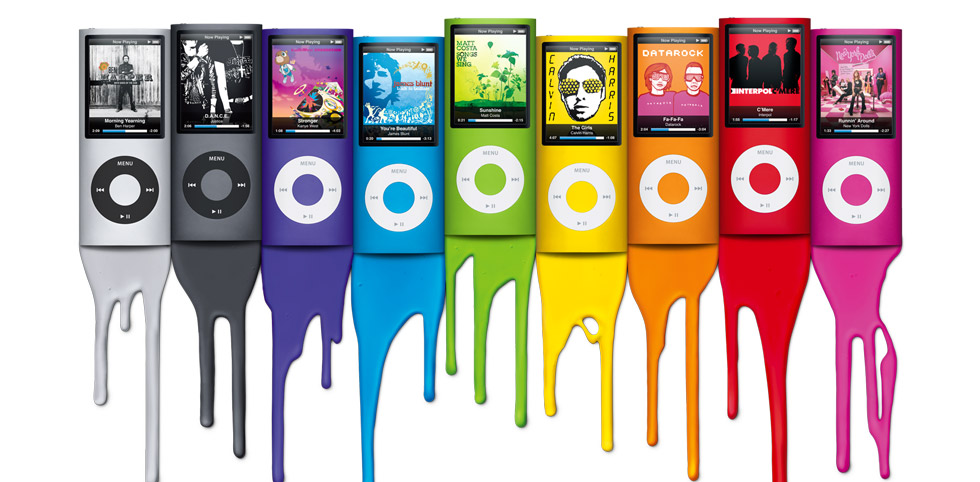
An iPod Nano commercial that aired in 2008 takes a similar approach to combining playful imagery and song:

In a more recent commercial, actor and singer Zooey Deschanel, known for her “quirky” demeanor, performs a playful spin on the utility of Siri, the voice activated assistant that was introduced with the iPhone 4S in 2011.

Commercials like these — playful, whimsical, and backed by upbeat music — associate these same feelings with Apple products. They suggest that Apple products are connected to happiness, enjoyment, and a carefree approach to life. To tip the sociological hat to George Ritzer, one could say that these commercials “enchant a disenchanted world.” While Ritzer coined this phrase to refer to sites of consumption like theme parks and shopping malls, I see a similar form of enchantment offered by these ads. They open up a happy, carefree, playful world for us, removed from the troubles of our lives and the implications of our consumer choices.

Importantly, for Apple, the enchanting nature of these ads and the brand image cultivated by them act as a Marxian fetish: they obscure the social and economic relations, and the conditions of production that bring consumer goods to us. Now more than ever, Apple depends on the strength of its brand power to eclipse the mistreatment and exploitation of workers in its supply chain, and the injustice it has done to the American public by skirting the majority of its corporate taxes.

Next: Sentimental Consumerism, the Apple Way.

Nicki Lisa Cole, Ph.D. is a lecturer in sociology at Pomona College. She studies the connections between consumer culture, labor, and environmental issues in global supply chains. You can follwer her at 21 Century Nomad, visit her website, and learn more about her research into Apple here.

This month I enjoyed a lovely week with my mother and step-father, during which we drove down to Key West, FL.  Flipping through the tourist book in the hotel, I was surprised to see this:

20130805_165653

I’ve been writing for Sociological Image for over six years now and, as a result, it takes a lot to shock me.  Well, you got me, Ripley’s!  I did not know that we were still marketing racial or ethnic others as “oddities.”  At least not this blatantly.

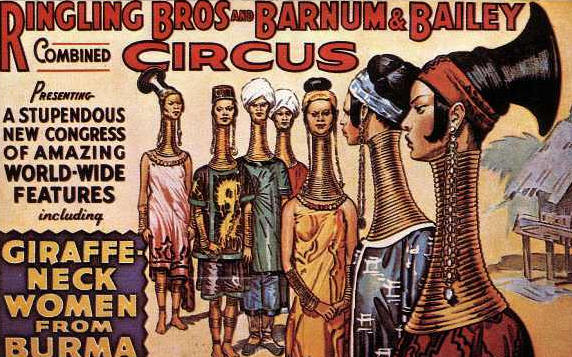
The women who have historically practiced this neck lengthening illusion (what you are seeing is a depressed collar bone, not a longer neck) are a Burmese ethnic minority called Kayan or Padaung.  As late as the early 1900s, Europeans and Americans were kidnapping “Giraffe-necked women” and forcing them to be exhibits in zoos and circuses.  Promotional materials from that era look similar. Here’s an example:

114

By the way, Kayan women weren’t the only humans kept in zoos.

I knew that Westerners still traveled to the communities where Kayan people live to see them “in their natural habitat” (sarcasm) and I’ve argued previously that this is a case of racial objectification.  I had no idea, however, that we still featured them as grotesque curiosities.  Ripley’s Believe It or Not!: “Proudly freaking out families for over 90 years.” Taking that tradition thing really seriously, I guess.

Lisa Wade, PhD is an Associate Professor at Tulane University. She is the author of American Hookup, a book about college sexual culture; a textbook about gender; and a forthcoming introductory text: Terrible Magnificent Sociology. You can follow her on Twitter and Instagram.
There’s a gem of an observation in Arlie Hochschild’s classic book, The Managed Heart.  She observes that, at the same time that airlines try to ensure that planes take off with every last seat occupied, advertising for air travel typically does not depict fully booked flights.  Frequent passengers covet the flight with an empty seat to their left or right, so marketers make sure that ads and commercials suggest that they might get lucky.

Here’s how American Airlines depicts the experience of flying (from a Google Image search of “cabin” on aa.com):

1 2 3 4

What a great example of not-quite-truth in advertising.

Lisa Wade, PhD is an Associate Professor at Tulane University. She is the author of American Hookup, a book about college sexual culture; a textbook about gender; and a forthcoming introductory text: Terrible Magnificent Sociology. You can follow her on Twitter and Instagram.

Any improvement in living and working conditions in the United States is going to require far more than tinkering at the margins.  The fact is that U.S. economic dynamics have undergone a major transformation.

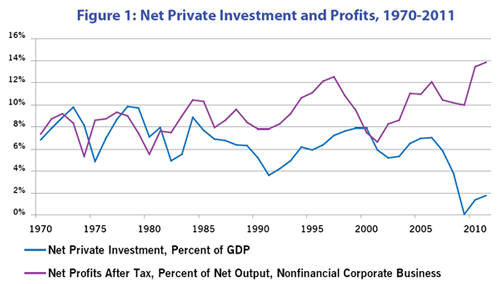
Figure 1, taken from an article by Gerald Friedman, shows that profits and investment are no longer positively related.  Since the early 2000s, profits have soared as a percent of GDP and net private investment has plummeted.  Even during the 1990s, when high-technology was celebrated as the engine of never-ending growth, net investment as a share of GDP remained below 1970s and 1980s highs.

Figure 1: Net Private Investment and Profits, 1970-2011

Our leading companies, the ones that shape government policy, are now able to make healthy profits without spending on plant and equipment much beyond replacement.  Their profits are now largely secured by globalizing manufacturing production, financialization, intensification of work, wage suppression, and government tax-breaks and subsidies.  Of course, that means that their quest for profits will continue to lead to policies likely to undermine progress in reversing negative trends in majority living and working conditions.

A case in point is their aggressive push, supported by the Obama administration, for new free trade agreements: the Trans-Pacific Partnership Free Trade Agreement and the Trans-Atlantic Free Trade Agreement. President Obama took the lead in securing passage of the Korea-U.S. Free Trade Agreement, arguing that it would improve our trade balance with Korea and by extension U.S. jobs.  Well, the returns are in, and in line with the record of past agreements, the outcome is the exact opposite.

The Eyes on Trade blog offers the following summary:

April [2013] was another record-breaking month for U.S. trade with Korea under the U.S.-Korea Free Trade Agreement (FTA).  The monthly U.S. trade deficit with Korea soared to its highest point in history, topping $2.5 billion for the month of April alone.

According to a ratio used by the Obama administration, the unprecedented deficit surge implies 13,500 U.S. jobs lost to trade with Korea in just thirty days.  April’s trade deficit with Korea was 30% higher than in April 2012 — the first full month of FTA implementation — and 90% higher than in April 2011, before the FTA took effect.

The deficit increase owes largely to a dramatic drop in U.S. exports to Korea since enactment of the FTA.  U.S. exports to Korea in April once again fell below the levels seen in any given month in the year before the FTA took effect.  The sorry track record defies the promise (FTA = more exports) that the Obama administration used to pass the FTA.  Undeterred by the facts, today the administration is using the same worn-out promise to sell the Trans-Pacific Partnership.

April 2013

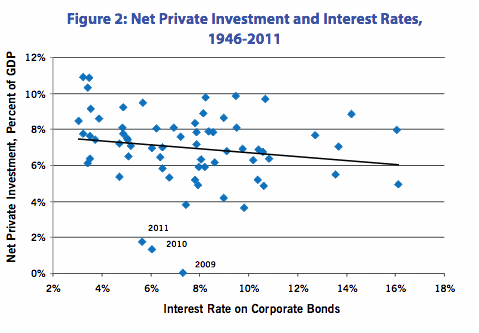
Unwilling to pursue policies that directly threaten corporate interests, the Obama administration has relied on monetary policy, or more specifically lower interest rates, to boost investment and employment.  As Figure 2 from Friedman’s article makes clear, while lower rates generally boost investment, data points for 2009, 2010, and 2011 strongly suggest that monetary policy has lost its effectiveness.

Figure 2: Net Private Investment and Interest Rates, 1946-2011

President Obama can talk all he wants about the need for more investment and better jobs, but unless he is pushed to pursue dramatically different policies, it is hard to see any real gains for working people over the next decades.

Martin Hart-Landsberg is a professor of economics at Lewis and Clark College. You can follow him at Reports from the Economic Front.

SocImages News:

We celebrated our 6th birthday this month.  As a present, we were gifted a launch page!

We’re super grateful to Jon Smadja for building it and enabling us to highlight all of the cool things going on at SocImages: not just new posts every day, but an active Twitter feed, a far-reaching Facebook page, and an interesting, funny, and sometimes disturbing Pinterest presence (yes, we’ve been flagged for inappropriateness).  Meanwhile, the slideshow helps us keep  some of our favorite older posts at the forefront of the site.  We love it!

For those of you who want to read the site the old way: just click on “blog” on the upper left under our logo.

Big Posts this Month:

We are eager to try and make public discourse more sociological, so we were really pleased when three of our posts this month made a significant impact:

Cross-post highlights…

Upcoming Visits:

20130719_182417

I just booked a four month sublet just outside the French Quarter (February through May).  So, all you New Orleanians out there, get ready to be my friend!  (Meanwhile, if anyone wants to sublet a place in Los Angeles…).  I’ll hopefully be travelling quite a lot this academic year for public speaking.  I’ll be at Westminster College in Salt Lake City and Macalester College in the Twin Cities. I would love to come to your school too!

Social Media ‘n’ Stuff:

Finally, this is your monthly reminder that we’re on the social medias!  I’m on Facebook and most of the team is on Twitter: @lisawade@gwensharpnv@familyunequal@carolineheldman, and @jaylivingston.

Lisa Wade, PhD is an Associate Professor at Tulane University. She is the author of American Hookup, a book about college sexual culture; a textbook about gender; and a forthcoming introductory text: Terrible Magnificent Sociology. You can follow her on Twitter and Instagram.