Search results for The

The reproductive health police are at it again, and this time they’ve got the gender and sexuality cops with them.  Despite the CDC reporting a decline in teen pregnancy across ethnic groups, public health and privately funded campaigns are popping up across the U.S. aimed at chastising, shaming, and blaming teenage mothers.

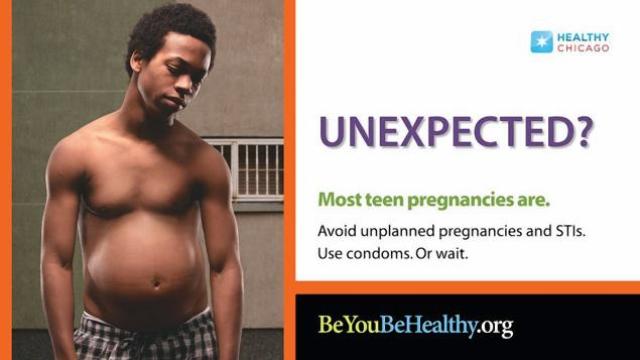
And now, the city of Chicago has gotten in on the act. Not satisfied with the traditional images of cheerleading teenage mothers with babies strapped to their chests, or wailing toddlers scolding their mothers for being too poor or too single, or even pop music icons who assure young women that motherhood ‘sucks’ even more than high school, the city of Chicago has decided to get creative. The Chicago Department of Public Health has created a series of posters featuring shirtless young men with apparently pregnant bellies – below the caption “Unexpected?”

 TPPI Bus King Sample2

Ok, I get it. The campaign was designed to communicate the fact that most teen pregnancies are, yes, unexpected, and that teen fathers should bear an equal responsibility for said pregnancies. But as someone working at the interstices of narrative, health, and social justice, I am less concerned with wondering if teen pregnancy is ‘bad’, or even if shame and/or shock are effective motivators for behavior change (which I would argue they are not, check out Brené Brown’s eloquent argument). What concerns me is what other work such images are doing. In other words, what additional cultural stories is this campaign telling, and are those narratives socially just or unjust?

As this fantastic take-off from the Media Literacy Project shows, the primary problem with the Chicago campaign is its deeply trans-phobic narrative:

In the frame of the advertisers, the pregnant bellies in the ads are solely female while the rest of the body is solely male. The contrast is supposed to cause discord in the viewer, yielding feelings that the image is “disturbing” or “unexpected,” as the ads say. However, sex and gender are much more complicated than the advertisers understand. Transgender boys and men can become pregnant. Calling their bodies disturbing perpetuates a culture of ignorance, prejudice, and violence against transgender people.

The truth is, bodies which do not look traditionally ‘female gendered’ can and do become pregnant (consider the much publicized story of Thomas Beattie, for instance, a transgender man who bore three children) while bodies which do look traditionally ‘female gendered’ sometimes can or do not.

Philosopher Judith Butler asserted that gender is nothing more than a series of repetitive performances; behaviors which, in cis-gendered (not transgendered) people, are often so subconscious as to feel ‘natural.’ But simply consider that the gender-coding of many such behaviors have changed over time. Hairstyles, clothing, and work-home-balance are all easy examples. Requiring at the very least a working uterus, pregnancy is one type of public ‘performance’ that still appears ‘naturally female.’ Therefore, ‘male pregnancy’ can be a subversive act, as with the work of cyber-artists Virgil Wong and Lee Mingwei, where, as feminist science scholar Donna Haraway would say, one ‘queers what counts as nature.’

But that’s not what is going on here. As with the broadly comic absurdness of male pregnancy in films like Arnold Schwarzenegger’s Junior, this anachronistic Chicago campaign actually reinforces a traditional gender binary while essentializing pregnancy as a function of only cis-gendered female bodies. In doing so, the campaign defeats its own stated purpose. By looking at these posters, cis-gendered boys won’t feel like pregnancy can happen to them. Rather, they will scoff, or laugh at the ‘absurdness’ of male pregnancy, reassured that their (utterly and fixedly ‘masculine’) bodies are ‘safe’ from such conditions. More devastatingly, the cis-gendered general public looking at these images will have their own prejudices and expectations about male pregnancy reinforced: as something ‘unexpected,’ shocking, and ‘unnatural.’

Additionally, like other individual-level ‘shaming and blaming’/’shocking’ campaigns, this Chicago anti-teen pregnancy series deflects attention from more systemic understandings and structural changes: from finding funding for affordable and accessible reproductive health care, to anti-poverty work, to programs which support LGBTQ youth. While they may satisfy the need for a ‘moral panic’ among us middle-aged people as we ‘clutch the pearls and think of the children,’ what such anti-teenage pregnancy campaigns don’t do is actually increase the well being of our young people – be they male or female, cis- or trans-gendered.

Cross-posted at Adios Barbie.

Sayantani DasGupta is a faculty member in Narrative Medicine at Columbia University. She is the editor of Stories of Illness and Healing: Women Write their Bodies,  co-authored The Demon Slayers and Other Stories: Bengali Folktales, and authored Her Own Medicine: A Woman’s Journey from Student to Doctor.

Earlier this year I wrote about how truly disturbing it is that so many of our insults have sexual connotations.  “Fuck you,” is a choice example, but I give lots more in the original post (read at your own risk).  I concluded:

…it’s interesting, right, to notice how often attempts to hurt other people come in the language of sexuality.  This reveals why sex can be scary, especially for women who are so often positioned as the one who “gets fucked”…  It’s also part of how we demean and marginalize gay and bisexual men.

This post came to mind when I saw this confession at PostSecret:

1

Let me put this in black and white: this person expressed “hate” by exposing another person to his penis.  So he considers his penis a thing that can defile.  This is the same penis that he puts (presumably) in his wife who he (presumably) doesn’t hate.  If I were his wife, I would wonder how exactly he decides when putting his penis in things is a loving thing to do and when it’s a way to harm or humiliate someone.

I don’t mean to pick on this individual.  The idea that it’s funny (“LOL”) to expose this woman to his genitalia without her consent is widespread.  This confession is just a manifestation of our cultural belief that men can hurt people with their penises.  And that it’s funny when they do.

Lisa Wade, PhD is an Associate Professor at Tulane University. She is the author of American Hookup, a book about college sexual culture; a textbook about gender; and a forthcoming introductory text: Terrible Magnificent Sociology. You can follow her on Twitter and Instagram.

A single event can take on great symbolic importance and change people’s perceptions of reality, especially when the media devote nearly constant attention to that event.  The big media story of the killing of Trayvon Martin and the trial of George Zimmerman probably does not change the objective economic, social, and political circumstances of Blacks and Whites in the U.S.  But it changed people’s perceptions of race relations.

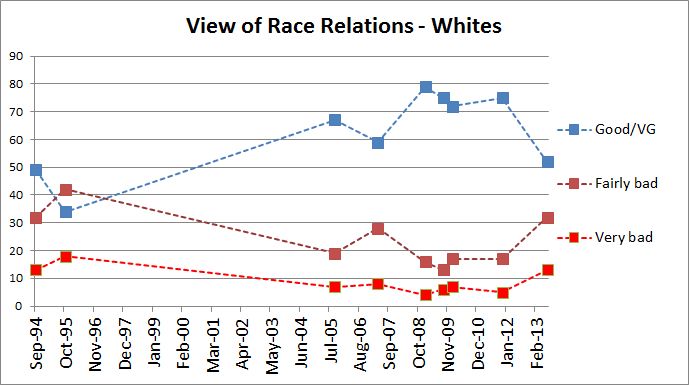
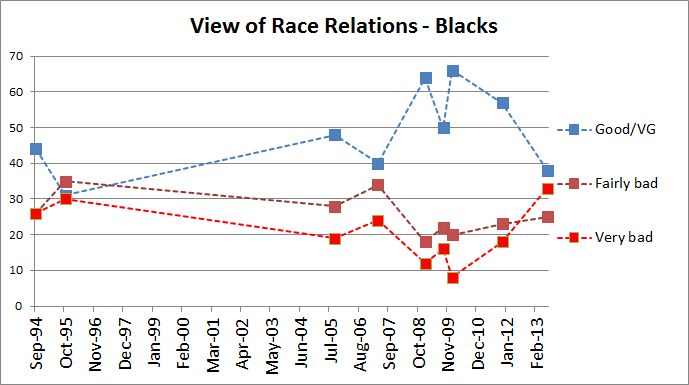
A recent NBC/WSJ poll shows that between November of 2011 and July 2013, both Whites and Blacks became more pessimistic about race relations.

1 2

Since 1994, Americans had become increasingly sanguine about race relations.  The Obama victory in 2008 gave an added boost to that trend.  In the month of Obama’s first inauguration, nearly two-thirds of Blacks and four-fifths of Whites saw race relations as Good or Very Good (here’s the original data). But now, at least for the moment, the percentages in the most recent poll are very close to what they were nearly 20 years ago.

The change was predictable, given the obsessive media coverage of the case and the dominant reactions to it.  On one side, the story was that White people were shooting innocent Black people and getting away with it.  The opposing story was that even harmless looking Blacks might unleash potentially fatal assaults on Whites who are merely trying to protect their communities.  In both versions, members of one race are out to kill members of the other — not a happy picture of relations between the races.

My guess is that Zimmerman/Martin effect will have a short life, perhaps more so for Whites than Blacks. In a few months, some will ascend from the depths of pessimism. Consider that after the verdict in Florida there were no major riots, no burning of neighborhoods to leave permanent scars — just rallies that were for the most part peaceful outcries of anger and anguish.  I also, however, doubt that we will see the optimism of 2009 for a long while, especially if the employment remains at its current dismal levels.

Cross-posted at Montclair SocioBlog.

Jay Livingston is the chair of the Sociology Department at Montclair State University. You can follow him at Montclair SocioBlog or on Twitter.

Trayvon Martin was a black teenage boy. He was walking home from the convenience store when he caught the attention and ire of George Zimmerman. Perceived as a “punk” and a threat, Martin was accosted by the older man, and a physical altercation ensued. Trayvon Martin died when he was shot through the heart at close range. Though Florida’s expansive “Stand Your Ground” laws were invoked in media conversations, that defense never even entered into the trial. Zimmerman was acquitted when a jury decided he’d killed Martin in self-defense. Zimmerman has since said Martin’s death was “God’s plan.”

Some Americans believe that race was not central to this killing or to the case that followed—they have believed it from February 2012 right up until today. But ask yourself: How many times you have been stopped and harassed because you looked threatening or suspicious wearing a hooded sweatshirt? For me, an Asian American female, that number is zero.

Yes, my gender alone distinguishes me from Trayvon Martin, but my partner Mike is a white male, and he, too, can only say “Zero.” We have never been stopped nor questioned, no matter how many times we’ve pulled on our hooded sweatshirts for warmth (and, in my case, to hide sea-tangled hair) after early morning surfing.

Stopping for breakfast or to run errands, Mike and I may not look polished in our hoodies, but we’ve also never had to worry that our appearance would cause suspicion. That’s privilege. It’s such a privilege, this presumed innocence of ours, that the morning after Zimmerman was acquitted, we went ignored even while acting suspiciously. Hoodies up, we casually stopped to look at a condo for rent in an affluent beach community in southern California. We knew from the online ad that the condo was vacant, so we parked outside, walked up the stairs to the unit, and peered into its windows. We sauntered around the grounds and walked into the unlocked community laundry room and garage. Several neighbors saw us, and they smiled.

I couldn’t help but think that the scenario would have been very different if Mike and I were black. Mike and I don’t have to wear our class in order to obviate being treated like threats or criminals; we can wear hoodies and board shorts without worrying that others will be suspicious, fearful, or make assumptions about our class status. Just being “not black” affords us this benefit of the doubt. It is a privilege because it is not something we have earned, but it is gifted to us every day regardless. I have always known about my privilege intellectually, but I felt it keenly last Saturday.

That some are afforded this privilege while others are systematically denied should make us all more empathetic. People perceive and experience the same event differently, depending on visible status markers such as race, gender, age, and class. Such status markers are more than just categories, they form a “system of social practices” that organize social relations. Status markers presume difference, and so people will react to and engage with Mike or with me differently than they would with someone like Trayvon Martin, even when we’re dressed the same.

We would like to believe that we don’t make assumptions based on race or gender, but evidence proves otherwise, as this social experiment of three individuals (a white male, a black male, and white female) trying to steal a bike clearly reveals:

As the sociologist Robert K. Merton insightfully observed nearly three-quarters of a century ago, “The very same behavior undergoes a complete change in evaluation in its transition from the in-group to the out-group.” As the video above indicates, the behavior of a black male (an out-group member) is regarded entirely differently than the same behavior of a white male and white female (in-group members).

The in-group/out-group divide goes further, with grave consequences in our criminal justice system. For example, Jennifer Eberhardt’s research has shown that race affects the severity of sentences that juvenile offenders receive, even for the same crime. Just the idea of a black juvenile offender leads people to imagine juveniles more like adults. Even liberal white Americans who claim low levels of prejudice project more blame onto black boys and sentence them more harshly. As Eberhardt has shown, “race has the power to dampen our desire to be merciful.”

I don’t have children, but if I did, I don’t know how I would explain Trayvon Martin’s death or the acquittal of his killer. But even just imagining being a parent to a black son makes me feel immense empathy for the parents of young black men. Can just that simple exercise make others more aware of race and class privilege, more aware of the power they have to recognize and even challenge that privilege and its consequences? As Henry David Thoreau asked, “Could a greater miracle take place than for us to look through each other’s eyes for an instant?”

References:

Jennifer Eberhardt and Aneeta Rattan, “The Race Factor,” New York Times, June 12, 2012.

Robert K. Merton. 1968 [1948]. “Self-fulfilling Prophecy,” in Robert K. Merton, Social Theory and Social Structure, 2nd edition. New York: Free Press.

Cecilia L. Ridgeway. 2011. Framed by Gender. New York: Oxford University Press.

Cross-posted at The Society Pages.

Jennifer Lee is a sociologist at the University of California, Irvine. Her book, The Diversity Paradox, examines patterns of intermarriage and multiracial identification among Asians, Latinos, and African Americans.

Six years ago today we posted our very first images: a re-touched magazine cover featuring Faith Hill and two almost identical Skyy Vodka ads that appeared in Maxim and Cosmo (hint: it’s in the nipples).

While people often congratulate Gwen and I for coming up with the idea for the blog, we never actually intended the public to read it.  We initially started the site as a place for the two of us to share images that we used in teaching.  The rest is history.

Screenshot_1

Thanks to everyone who has visited over the last six years!  Almost 5,000 posts later, you’ve changed our lives and careers in unexpected and delightful ways!

Here are some highlights from the year! All deserving exclamation points!

Here’s to you and here’s to another great year!

Lisa Wade, PhD is an Associate Professor at Tulane University. She is the author of American Hookup, a book about college sexual culture; a textbook about gender; and a forthcoming introductory text: Terrible Magnificent Sociology. You can follow her on Twitter and Instagram.

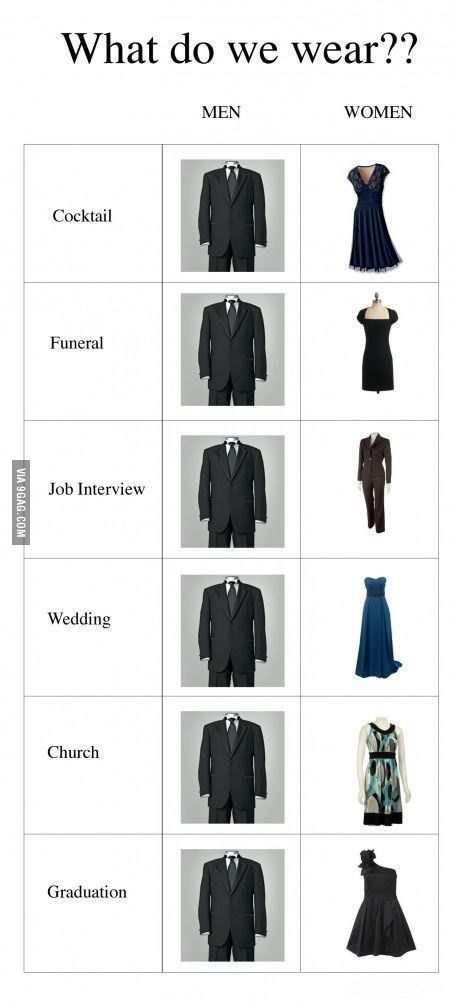
@hanhaiwen generously remembered the most popular SocImages post of all time when coming across this insightful observation at 9Gag.  Thanks Helga!
1

Lisa Wade, PhD is an Associate Professor at Tulane University. She is the author of American Hookup, a book about college sexual culture; a textbook about gender; and a forthcoming introductory text: Terrible Magnificent Sociology. You can follow her on Twitter and Instagram.

Dispatcher: Which entrance is that that he’s heading towards?

Zimmerman: The back entrance… fucking punks.

Dispatcher: Are you following him?

Zimmerman: Yeah.

Dispatcher: Okay, don’t do that.

Zimmerman: Okay.

If you followed the Zimmerman/Martin killing at all, you probably recognized that this is not what the dispatcher said.  The correct transcript is:

Dispatcher: Okay, we don’t need you to do that.

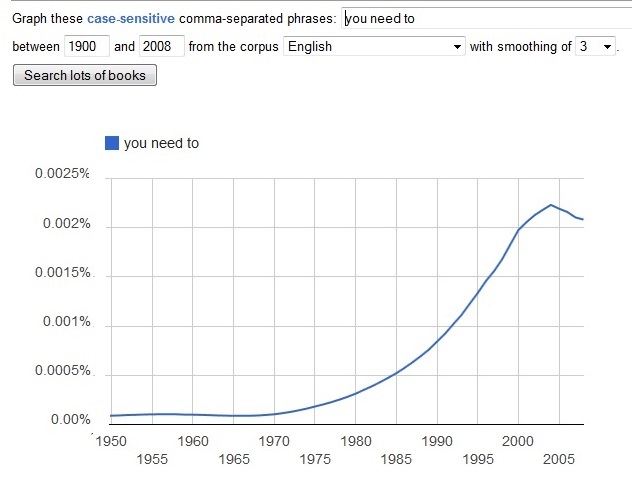
Nowadays, we don’t tell people what to do and what not to do. We don’t tell them what they should or should not do or what they ought or ought not to do.  Instead, we talk about needs – our needs and their needs.  “Clean up your room” has become “I need you to clean up your room.”

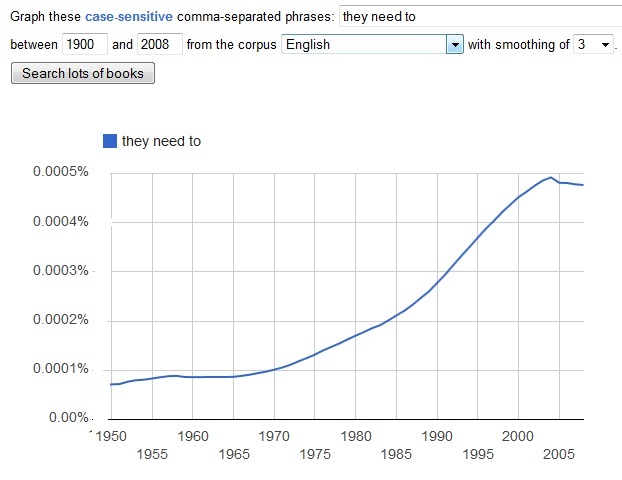
The age of “there are no shoulds,” the age of needs, began in the 1970s and accelerated until very recently.   Here are Google n-grams for “you need to” and “they need to.”

1 2

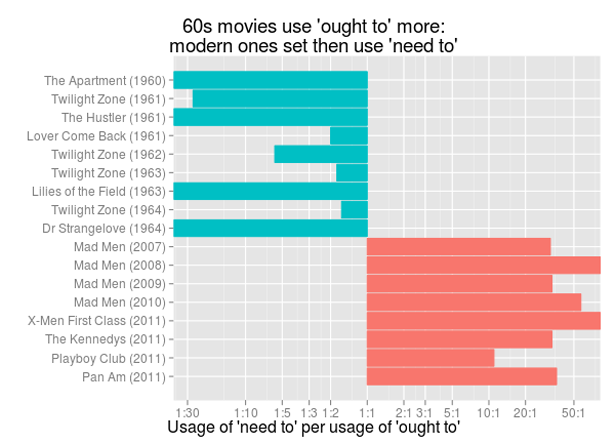
 We don’t say, “The writers on ‘Mad Men’ ought to watch out for anachronistic language.” We say that they “need to” watch out for it.  It was Benjamin Schmidt’s Atlantic post (here) about “Mad Men” that alerted me to this ought/need change.  Schmidt created a chart showing the relative use of “ought to” and “need to.”

3

All the films and TV shows in the chart are set in the 1960s.  But the scripts that were actually written in the 60s are more likely to use “ought”; the 60s scripts written in the 21st century use “need.”

Real imperatives (“Stop that right now”) claim moral authority. So do ought and should. But need is not about general principles of right and wrong.  In the language of need, the speaker claims no moral authority over the person being spoken to. It’s up to the listener to weigh his own needs against those of the speaker and then make his own decision.

No wonder Zimmerman felt free to ignore the implications of the dispatcher’s statement.  It was not a command (“Don’t do that”), it did not assert authority or the rightness of an action (“You should not do that”).  It did not even state what the police department needed or wanted.  It merely said that Zimmerman’s pursuit of Martin was not necessary.  Not wrong, not ill-advised, just unnecessary.

If the dispatcher had spoken in the language of the 1960s and told Zimmerman that he should not pursue Martin, would Trayvon Martin be alive?  We cannot possibly know. But it’s reasonable to think it would have increased that probability.

Philip Cohen, for what it’s worth, tells me that a TV commentator said that dispatchers have a protocol of not giving direct orders.  If such an instruction led to a bad outcome, the department might be held accountable.  So police departments’ efforts to avoid lawsuits may also have contributed to Martin’s death or, at least, the not-guilty verdict for Zimmerman.

Cross-posted at Montclair SocioBlog.

Jay Livingston is the chair of the Sociology Department at Montclair State University. You can follow him at Montclair SocioBlog or on Twitter.


Leontine G. sent in a troubling example of the framing of children’s deviance, and their own complicity in this framing. She included two links: one to a Today show story about a 7-year-old boy who took his family’s car on a joyride and got caught by police, and one to a CNN story about a 7-year-old boy who took his family’s car on a joyride and got caught by police.  Different 7-year-olds.  One white, one black.

The white boy, Preston, is interviewed with his family on the set of the Today show.  Knowing his kid is safe, his Dad describes the event as “funny” and tells the audience that if this could happen to a “cotton candy all-American kid like Preston,” then “it could happen to anybody.”

When the host, Meredith Vieira, asks Preston why hid from the police, he says, “cause I wanted to,” and she says, “I don’t blame you actually.”  With Preston not too forthcoming, his Mom steps in to say that he told her that “he just wanted to know what it felt like to drive a car.”  When Vieira asks him why he fled from the police, he replies with a shrug.  Vieira fills in the answer, “You wanted to get home?”

Vieira then comments on how they all then went to church.  The punishment?  Grounded for four days without TV or video games.  Vieira asks the child, “Do you think that’s fair?”  He says yes.  And she continues, “Do you now understand what you did?”  He nods and agrees.  “And that maybe it wasn’t the smartest thing?”  He nods and agrees.  “You gonna get behind the wheel of a car again?”  He says no.  Then she teases him about trying out model toy cars.

They conclude that this incident just goes to show that “Any little kid, you never know what can happen…” and closes “I’ll be seeing you at church buddy boy!”

The video:

All in all, exactly what you’d expect from the Today show: a heartwarming, human interest story with a happy ending. The child is framed as a fundamentally good kid who was curious and perhaps a bit impetuous. When he has no answers for Vieira’s questions, she slots in innocent ones.  And the mild punishment is seen as incidental to the more important idea that he learned something.

This story contrasts dramatically to the CNN story about Latarian Milton, a black 7-year-old who took his family’s car on a joy ride.  I’ll put the video first, but be forewarned, it’s disturbing not only because of the different frame placed on the boys actions, but because of the boy’s embracing of the spoiled identity (apology for the commercial):

With an absolutely polar introduction of “Not your typical 7-year-old,” this story is filmed on the street. Whereas the Today show screened the chase footage in real time, this one is sped up, making it seem even more extreme.

The interviewer, off-camera, asks Latarian why he took the car. He replied: “I wanted to do it ’cause it’s fun, it’s fun to do bad things.” The interviewer asks further, “Did you know that you could perhaps kill somebody?” And he replies: “Yes, but I wanted to do hoodrat stuff with my friends.”

The interviewer asks him what punishment he should receive and Latarian offers a punishment very similar to Preston’s: “Just a little bit… no video games for a whole weekend.” In a longer version of this news story, now taken down, the camera focuses on a reporter who explains that the police plan to go forward with charges of grand theft against him.  While he’s “too young to go into any type of juvenile facility,” he says, “police say they do want to get him into the system, so that they can get him some type of help.”

The implication here, of course, is that this child is not innocent or impetuous like Preston, he’s a pre-criminal who needs “some type of help.” The sooner they get Latarian into “the (prison?) system,” the better. No cotton candy kid this one.

Unfortunately, Latarian says all the right things to make the narrative fit. He says he likes to do “bad” things, calls himself a “hoodrat,” and seems unremorseful, even defiant, for at least part of the interview (he looks a bit sheepish in the end when he finds out his grandmother is going to have to pay for the damage he did to other cars).

One way to interpret this is to say that Latarian IS a pre-criminal. That he DOES need to get into the system because he’s clearly a bad kid.  Someone inclined to believe that black people were, in fact, more prone to criminal behavior could watch these two videos and feel confirmed in their view.

But there is good evidence that people, beginning as children, internalize the stereotypes that others have of them.  As Ann Ferguson shows in her book, Bad Boys: Public Schools in the Making of Black Masculinity, black children, especially boys, are stereotyped as pre-criminals; not adorably naughty, like white boys, but dangerously bad from the beginning.  And studies with children have shown that they often internalize this idea, as in the famous doll experiment in which both black and white children were more likely than not to identify the black doll as bad (see this similar demonstration of white preference on CNN and a discussion of the original doll experiment at ABC).  So I think this terribly sad story of Latarian is showing us how children learn to think of themselves as deviant and bad from the society around them.  Latarian, remember, is seven, just like Preston.  They’re both children, but they are being treated very differently, as these programs illustrate, and it is already starting to sink in.

Originally posted in 2010. Re-posted in solidarity with the African American community; regardless of the truth of the Martin/Zimmerman confrontation, it’s hard not to interpret the finding of not-guilty as anything but a continuance of the criminal justice system’s failure to ensure justice for young Black men. Crossposted at Racialicious, the Huffington Post, and Love Isn’t Enough.

Lisa Wade, PhD is an Associate Professor at Tulane University. She is the author of American Hookup, a book about college sexual culture; a textbook about gender; and a forthcoming introductory text: Terrible Magnificent Sociology. You can follow her on Twitter and Instagram.