Search results for The

Cross-posted in Portuguese at Conhecimento Prudente.

A lot of readers were taken with the new parody video, “Fotoshop by Adobé,” that has been making it’s way around the internet. Created by filmmaker Jesse Rosten, the video parodies beauty product commercials that play on and encourage insecurities while promising women magical transformations that will allow them to attain entirely unrealistic beauty standards overnight due to ground-breaking science-y sounding ingredients and processes (“pro-pixel intensifying fauxtanical hydro-jargon microbead extract”). Enjoy!

Thanks to Jessica B., Kate A., Rex S., Emma M.H., Jessica W., finefin, Bernardo, Robin D., Priyanka Mathew (who posts at Culture+Marketing+Politics), runbotrun, Dmitriy T.M., Lots of Models, Tom Megginson, and my colleague Pete La Chapelle for sending it in!


In my opinion, there is no way to administer a math test that will identify inborn ability. So people who think the greater presence of men in high-end math and science positions is a result of the distribution of inborn abilities generally rely on the observation of (a) big gender gaps, (b) long-standing gender gaps, or (c) widespread gender gaps, to make their case.

Big gaps (a) are only useful for creating a big impression. Long-standing gaps (b) are undermined by the scale of change in recent decades. And a new study does a very nice job weakening type-C support.

In “Debunking Myths about Gender and Mathematics Performance,” in the Notices of the American Mathematical Society, Jonathan Kane and Janet Mert study variation both between and within countries to test a variety of hypotheses about the sources male math advantage. They look at the distribution and variance in scores, the association with single-gender schooling, religious context and, most importantly, broader patterns of gender inequality. The main message I get is that gender ability in math differs so much across social contexts that any conclusion about “natural” ability is untenable. Also, gender equality is good.

Here’s my favorite figure from the paper, showing the distribution of eighth-grade scores for boys and girls in three countries:

In the Czech Republic there is no difference in either the means or the distributions for boys versus girls, and the average ability is high. Bahrain shows a much greater variance for boys versus girls — which is sometimes used to explain why to many top achievers are men — but women’s average is higher. Finally, in Tunisia the girls have a higher variance but a lower mean. Where’s the natural ability story?

An important consideration in all of these patterns is the role of selective dropouts. That is a potential problem with any school-based test, but also shows the problem with using any test of school-based knowledge to understand underlying “natural” ability (including SATs). Unless you can test populations with no schooling, or identical schooling experiences, you can’t resolve this.

In the meantime, the great social variability shows us that context matters, and since that’s something we can definitely address, there is no reason to get hung up on the biological stuff — at least as far as policy and practice are concerned.

Here’s a previous post from me on how teacher interactions affect gender patterns of learning, and another writeup on the new study from ScienceBlogs.

I’m very pleased to announce that Amanda Jungels, a graduate student in sociology at Georgia State University, has put together a new course guide!  Amanda collected and organized material relevant to classes on the sociology of sexuality.  This brings our list of materials guides up to four:

If you’re a graduate student or professor of sociology interested in writing a materials guide, we’d love to hear from you!

Cross-posted at Ms.

It’s time for a round-up of all the reader submissions illustrating the annoying habit of having products and products-for-women.  The phenomenon illustrates the way we continue to think of men as people and women as women, thereby centering men and men’s lives as “normal” and women’s as “special” (and not in a good way).

Anti-Monkey Butt Powder and Lady Anti-Monkey Butt Powder, sent in by Jennifer N.:

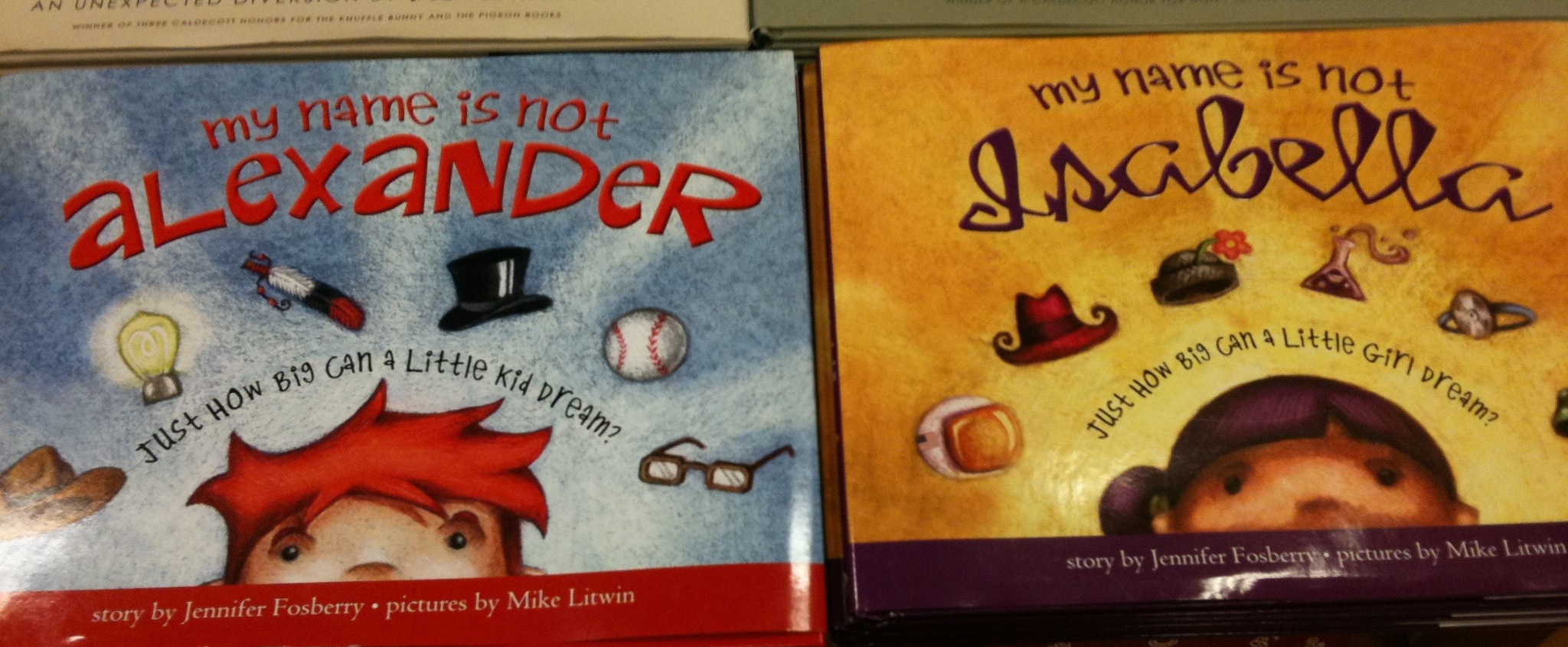
Alexander is a “little kid,” Isabella is a “little girl” (thanks Heather F.!):


Snippet from a consumer survey taken by Alison M.:

SMBC t-shirt order page, sent in by Mordy O.:

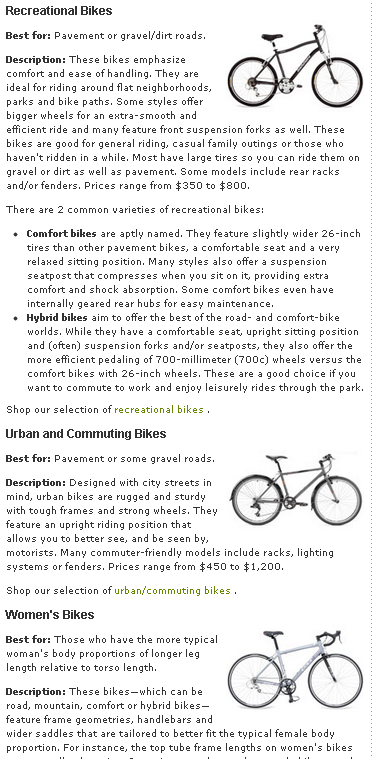
At REI, Jackie H. noticed, there are “road bikes,” “mountain bikes,” “recreational bikes,” “urban and commuting bikes,” and… “women’s bikes”:

And no men = people, women = women round-up would be complete without a sports website.  As Amy H. says:  “Basketball, Running, Soccer, Football, Baseball, Training, Women. Sigh.”

For more, see an earlier round up of the neutral male and our posts on the Body Worlds exhibit“regular” t-shirts and women’s t-shirts, scientists and female scientists, Best Buy assumes customers are malestick figures are stick figures who parent, default avatars.

Lisa Wade, PhD is an Associate Professor at Tulane University. She is the author of American Hookup, a book about college sexual culture; a textbook about gender; and a forthcoming introductory text: Terrible Magnificent Sociology. You can follow her on Twitter and Instagram.

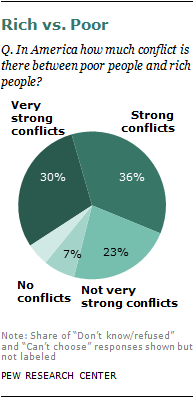
Recently the Pew Research Center released the results of a survey of 2,048 individuals about their perceptions of class conflict in the U.S., which are quite interesting in light of the Occupy Wall Street protests and the current attacks on Mitt Romney’s work with Bain Capital, which wouldn’t be that surprising except that they’re coming from other GOP presidential hopefuls (including Rick Perry referring to “vulture capitalism”). In the Pew survey, 2/3 of participants reported that there are “strong” or “very strong” conflicts between the rich and poor, with only 7% saying there are no conflicts:

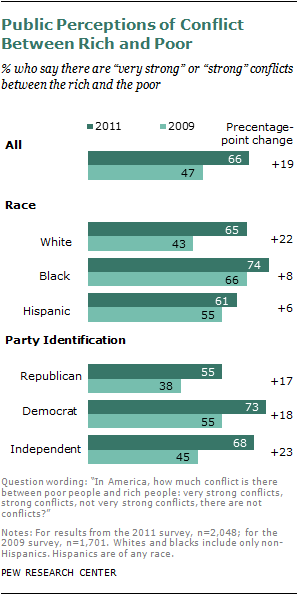
This indicates an increase in perceived class conflict since 2009, where under half said there were “strong” or “very strong” conflicts between rich and poor. We also some difference by race, with African Americans perceiving more conflict than Whites or Hispanics, and Democrats and Independents seeing more than Republicans:

While I think these findings are interesting, I’m also struck by the language. Since Americans tend to define themselves as middle class, regardless of income, the wording here (“rich” vs. “poor”) would seem to ask Americans about their perceptions of conflict between groups that they likely do not identify with personally (though many may interpret “rich vs. poor” as shorthand for general economic inequality, of course). I just wonder what the results would be if we had a survey that asked about conflicts between the rich and the middle class, or “the rich and people like you” (and the same questions about the poor).

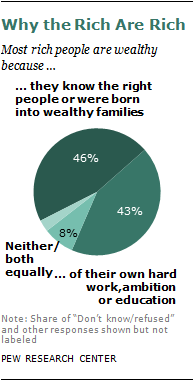
Regardless, increasing perceptions of class-based conflict doesn’t mean respondents necessarily think the wealthy are unfairly well-off. They were almost evenly split on whether the rich got their wealthy because of connections (family or otherwise) or because of their own hard work and effort:

The NYT has an article about the survey as well, with additional graphics. Thanks to Shamus Khan for the tip!

Course Guide for
SEXUALITY AND SOCIETY
(last updated 01/2012)


Developed by Amanda M. Jungels
Georgia State University


Integrating/Interrogating Biological and Social Views of Sexuality

Challenging Evolutionary Perspectives on Sex/Sexuality

Social Construction of (Biological) Sex


Social Construction: Changing Views on Sexuality


Sexuality and Social Categories

Social Construction of Gender

Transgender/Third Gender/Gender Queer

Social Construction of Sexual Orientation


Learning about Sex/Sex Education           

Sex Education

Abstinence vs. Comprehensive Sex Ed

Sexual Practices


The Sexual Body

The Female Body

Menstruation


Presenting the Female Body as Unclean: Removing Body Hair


Presenting the Female Body as Unclean: Douching

Bodily Modification and Female Genital Cutting


Social Construction of the Male Body/Male Sexuality

Presenting the Penis as a Dangerous Weapon


Representing Sex

Sexualization of Children’s Products

Sex in the Media

Ejaculation and Phallic Imagery

Sex and Violence

Objectification

Infantilization of Women

Forced/Coerced Sex

Sexual Script

Rape Culture

Use of Alcohol as a Tool for Coercive Sex

Sexual Assault Prevention Campaigns


Commercial Sex

Pornography

Contemporary Views on Prostitution

Historical Perspectives on Prostitution

Sex Trafficking

Other Forms of Sex Work

Social Control of Sex Work


Reproduction/Abortion

Reproduction

Abortion


Sterilization


Contemporary GLBT Issues

Gay Rights Movement

GLBT Parenting

Same-Sex Marriage

GLBT-Related Legislation

I don’t know if “subliminal” is a real thing or just a layperson idea, but when I talk about media in Introduction to Sociology I show some images to show just how carefully advertisers are steeping their material in raw sex. I start with the image below.

I ask: Notice anything interesting about this image? Even in very large classes it usually takes a long time for anyone to see…

…that the shadow of the liquor bottle is pointing directly between her nearly bare breasts.

Here are some more:

This is a picture of an ad at the Burbank airport.  Notice the profoundly phallic shape of the foaming surf that happens to be pointing directly at the woman’s crotch.  The foam mimicks the crown printed at the top of the Budweiser bottle (in the upper left hand of the image in red).

And where is the rocket going?

This ejaculating bottle is in an ad for clothing in a magazine aimed at gay men:

What image accompanies the word “come”?

That’s Salma Hayak and Campari… or should I say Salma Hayak’s boobs and an ejaculation fantasy.

I love this one. Just underneath the banner you see two nuts, a thick pour and, let’s face it, a chocolate vaginal opening.

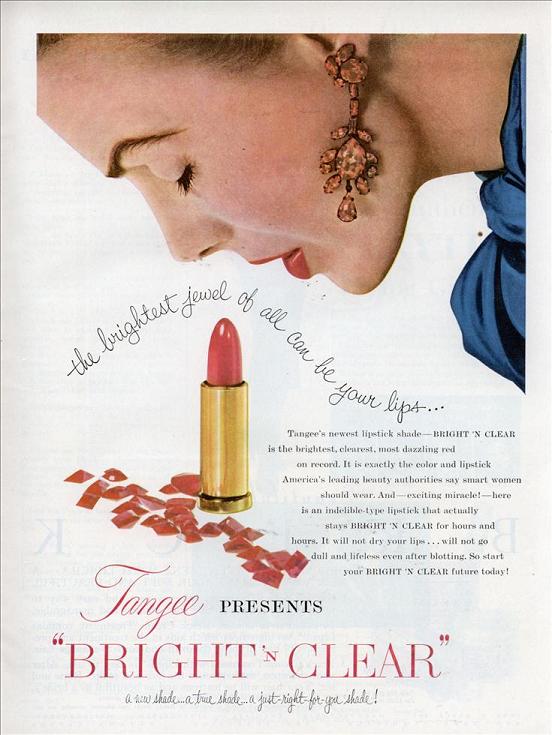
A vintage ad for Bright and Clear lipstick (found here):

2qmd6iu

Finally, Chappell E. sent in this Brookstone cover featuring a woman an an, errrr… automatic wine bottle opener:

See also our posts on ejaculation imagery, booby products, “boobs” in ads, other subtle and not-so-subtle sexual imagery used in advertising, and using sex to sell the most unlikely things.

Lisa Wade, PhD is an Associate Professor at Tulane University. She is the author of American Hookup, a book about college sexual culture; a textbook about gender; and a forthcoming introductory text: Terrible Magnificent Sociology. You can follow her on Twitter and Instagram.

A new study shows that owners of run-down apartment buildings are selling them to each other  “in a criminal conspiracy to avoid having to do the legally required maintenance necessary to keeping their buildings habitable and safe” (BoingBoing).

A tenant advocate was working with the city to document unsafe living conditions in apartments — things like leaking sewage and lead levels that were causing mental retardation — and get the owners of the buildings to make repairs  “But every time documented problems were delivered to the current LLC [Limited Liability Company] owners by city officials,” the report says, “nothing would happen.”

When the city’s deadline approached to fix the violations, the old LLC owner would explain that the property had changed hands and they were no longer involved. The buildings continued to deteriorate as owner after owner avoided addressing the violations.

In fact, the buildings were shifting hands within an extended family.  Confirming the connections between the various landlords proved that “…properties exchanged hands not as independent and valid real estate investments but as a conspiracy to avoid fixing the building violations.”

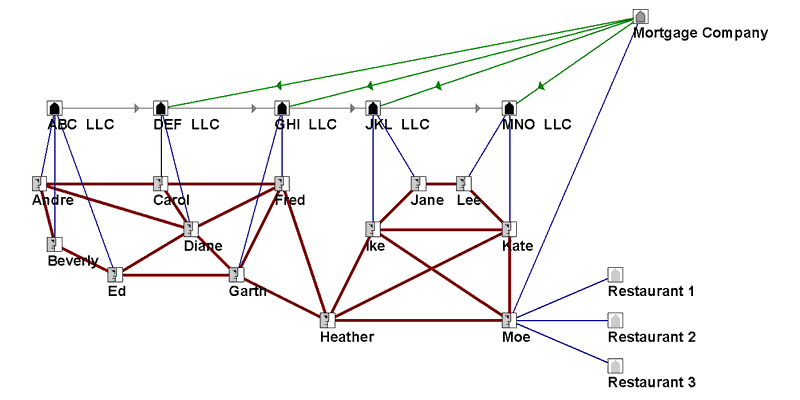
So, it went something like this. The building was passing from one LLC to another:

But all the LLCs were controlled by people connected to one other:

So the family had found a way around the law, “allowing the owners to ‘strip mine’ the equity from the buildings,” while leaving tenants in dangerous conditions.

The authors of the report call this a “common slumlord modus operandi.”  You should read the whole thing; it’s pretty stunning.

Lisa Wade, PhD is an Associate Professor at Tulane University. She is the author of American Hookup, a book about college sexual culture; a textbook about gender; and a forthcoming introductory text: Terrible Magnificent Sociology. You can follow her on Twitter and Instagram.