Search results for The

Cross-posted at Citings and Sightings.

In an interview discussing whether teen sleepovers can actually prevent teen pregnancy, CNN’s Ali Velshi says flatly, “This is a little bit counter-intuitive.” But as his interviewee, UMass sociologist Amy Schalet (who wrote on this subject in Contexts in “Sex, Love, and Autonomy in the Teenage Sleepover” in the Summer of 2010), explains:

Let me clarify: it’s not a situation where everything goes… It’s definitely older teenage couples who have established relationships and whose parents have talked about contraception.

Which is to say, as Velshi puts it, sex and sex education in countries like the Netherlands, in which parents are more permissive—or as Schalet says, “parents are more connected with their kids”—about allowing boyfriends and girlfriends to sleep over, take “a holistic approach.”

Schalet’s research, explored more deeply in her new University of Chicago book Not Under My Roof, takes a look at American parenting practices surrounding teen sex and the practices of parents in other countries. Using in-depth interviews with parents and teens and a host of other data, she finds:

The takeaway for American parents… isn’t necessarily “You must permit sleepovers.” Many parents are going to say, “Not under my roof!” That’s why it’s the title of my book. The takeaway is that you can have more open conversations—you should probably have more open conversations—about what’s a good relationship, sex and contraception should go together, what does it mean to be “ready,” how to get rid of some of these damaging stereotypes (gender stereotypes). Those are all things that are going to help promote teenage health and better relationships between parents and kids.

Schalet is clear that parental approaches are nowhere near the only factor in the stark differences in teen pregnancy rates between the U.S. and the Netherlands, but says they are, in fact, particularly important. “Kids are having sex, clearly,” Velshi says. And that’s precisely the point, no matter whether parents believe their kids should be able to have sex in their own homes, Schalet believes: “I think what you emphasize is that, above all, the conversation is important, and the conversation itself does not make kids have sex.” Ideally, she points out, that conversation will take place at home with parents, but a holistic talk about sexuality, relationships, and health can also take place in schools, with clergy, and in many other locations.

Dr. Schalet on CNN (we apologize for the commercial):

Amy Schalet’s new book is Not Under My Roof: Parents, Teens, and the Culture of Sex.

—————————

Letta Page is the Associate Editor and Producer of The Society Pages. She has a decade of experience in academic editing across a range of disciplines, including two years as the managing editor of Contexts. Page holds degrees in history and classical studies from Boston University and an art degree from the University of Minnesota.

If you would like to write a post for Sociological Images, please see our Guidelines for Guest Bloggers.
Since its release in November, Get Up!’s commercial supporting gay marriage in Australia has garnered substantial social media interest (over four million views on Youtube). The U.S. LGBT news magazine The Advocate called it “possibly the most beautiful ad for marriage equality we’ve seen” (source). Take a look:

From a sociological point of view, what is interesting about this ad is how it avoids the powerful, but charged language of equality and rights. Supporters of same-sex marriage typically frame their cause in terms of non-discrimination (“all people are equal”), non-interference or privacy (“how is my gay marriage affecting yours?”) or in terms of freedom of speech (“I should marry who I want”). See images of posters using this frame here and here.

Rights language such as this, however, comes with the potential of conflicts and trade-offs. Accordingly, opponents of same-sex marriage have often capitalized on this in their responses. This poster, for instance, expresses a fear or mockery of assertive, unbridled individualism. Posters with this frame here.

 This “Yes to Proposition 8” video is another good example. In it one woman claims that, if gay marriage is legal, her religious identity will be subject to discrimination and her freedom to speech will be contested.

The language used by the marriage equality movement, then, enables its opponents to re-frame their responses in the same type of language.

This is why the Get Up! commercial is a game changer. Instead of using “rights talk,” it keeps both words and slogans to a minimum. It uses visuals to embed the couple in a network of family and friends.  At the end, for example, the camera steps back to show not just the couple but a wider network of people who happily witness a marriage proposal. This approach implicates the happiness of not just two individuals, but a community.  The message is that gay marriage is not just about individual rights, but about collective celebration and social recognition.

—————————

Ridhi Kashyap is a researcher in the Migration Group at the Institute for Empirical and Applied Sociology in Bremen, Germany. She studied interdisciplinary social sciences at Harvard University, and was a human rights fellow there after graduating in 2010. She is actively interested in human rights, particularly as they implicate issues of gender, migration, and development.

If you would like to write a post for Sociological Images, please see our Guidelines for Guest Bloggers.


Lisa Wade, PhD is an Associate Professor at Tulane University. She is the author of American Hookup, a book about college sexual culture; a textbook about gender; and a forthcoming introductory text: Terrible Magnificent Sociology. You can follow her on Twitter and Instagram.

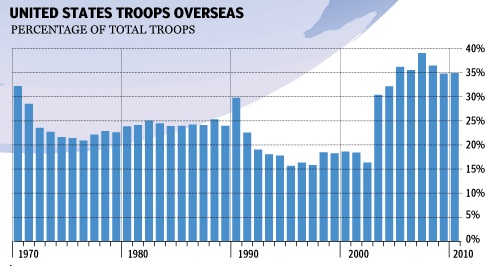
Shamus Khan brought my attention to an interesting image posted at La Course vers la Maison-Blanche, a French-language blog about U.S. politics. The image (in English) shows where U.S. troops are stationed around the world, at bases that vary widely in size and permanence.

Not surprisingly, with the U.S. engaged in two wars (until the official announced end of U.S. involvement in Iraq at the end of 2011), during the 2000s the percent of all U.S. troops stationed in other countries has been at its highest levels since the end of the Vietnam War (though we also see an uptick in 1990, corresponding with the Gulf War against Iraq, and then a significant reduction during the ’90s):

Total number of troops stationed in other countries:

So where are these troops? Scattered on every continent except Antarctica, with concentrations in Europe, South Korea and Japan, and the Middle East,though the map in Iraq would presumably look different now):

Enlargeable image available here, with detailed descriptions of the U.S. military presence in various countries.

Twenty-three of you (a record I think) have sent in this clip of a little girl in a toy store critiquing the way the store is divided into pink princesses for girls and superheros for boys.  It’s heartwarming and inspiring to see a child offer a critical analysis of the world she lives in, something that most commentators have observed.

What I, and some of you, noticed was that her own analysis and that of the adult taking the video (presumably her Dad) differ.  And, believe it or not, her analysis is more correct than his.

Rightfully identifying what sociologists call “androcentrism,” she notes that girls like both girl and boy toys, but boys only like boy toys.  She says:

…because girls want superheros and the boys want superheros and the girls want pink stuff and the girls… and the boys want… and the boys don’t want pink stuff… (gently shaking her head back and forth)

Her Dad corrects her, saying “Boys, well, boys want both…”

But her Dad is wrong.  Boys in the U.S. are taught from a very early age to avoid everything associated with girls.  Being called a “girl” is, in itself, an insult to boys.  And the slurs “sissy” and “fag” are reserved for men who act feminine.  So, no, boys (who have learned the rules of how to be a boy) generally reject anything girly.  (Indeed, this was one of the themes of Jimmy Kimmel “bad present” prank played by parents on their kids.)

The girl’s Dad, however, articulates a symmetrical analysis. The idea is that there are gender stereotypes — ones that apply to boys and ones that apply to girls — and that both are inaccurate, unfair, and constraining.  His mistake is in missing the asymmetrical value placed on masculinity and femininity.  Boys and girls are simply not positioned equally in relationship to stereotypes of femininity and masculinity.

I have to admit, it’s pretty neat that she has picked up on this nuance so early. I wish most adults had her insight… and her passion:

Thanks to James, Julie G., Carly M., Brooklin N., BogganStoryTeller, Denise, Allie H., Yvonne R., Mark L., Karim S., Ann K., Lenny M., Isabeau P.-S., Daniel K., Marsha, Jay L., Shayna A.-S., Josh W., Kimberly L., Melissa, Colleen W., Simon G., and Brad for sending in the link!

Lisa Wade, PhD is an Associate Professor at Tulane University. She is the author of American Hookup, a book about college sexual culture; a textbook about gender; and a forthcoming introductory text: Terrible Magnificent Sociology. You can follow her on Twitter and Instagram.

Appearances and Publications:

After I posted about the Jimmy Kimmel prank in which he encouraged parents to film their kids getting “bad” presents, I had the opportunity to inform a New York Times article about the subject.  I discussed the social rules of the Christmas gift-giving (and the importance of teaching kids how to be the butt of a joke).  My first time in the NYT. w00t!

Also, I’m proud to report that a paper I co-wrote with Caroline Heldman has been published in a new book titled Sex For Life: From Virginity to Viagra, How Sexuality Changes Throughout Our Lives (edited by Laura Carpenter and John DeLamater, and published by NYU Press).  Our chapter is about first-year college students experiences with hook up culture.  You can get a sneak peak here.

Pinterest!

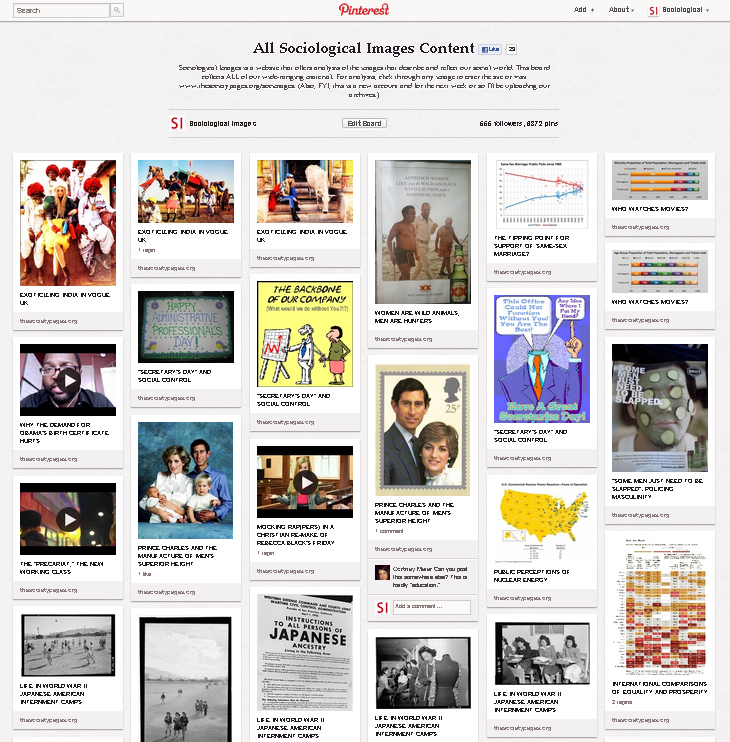
Over the holiday I went sort of bonkers and decided to start up a Pinterest site for SocImages.  Pinterest is a virtual “pin board” where people can collect images from around the web.  I uploaded our entire archive to the site: 4,002 posts and 8,040 images.  It will let you peruse our images much more quickly. If anything inspires, you can click through to the blog to read the analysis.  These are the “boards” we have so far:

They look like this (then you scroll down):

 Best of December:


Meanwhile, our fabulous intern, Norma Morella, collected the stuff ya’ll liked best from this month.  Here’s what she found:

Best of 2011:

Gwen and I ran our favorite posts from 2011 over the last five days.  Just in case you missed them, here’s a list:

Over at his blog, Family Inequality, SocImages Contributor Philip Cohen made a list of his best liked posts from 2011 too.  Check them out here.

Social Media ‘n’ Stuff:

Finally, this is your monthly reminder that SocImages is on TwitterFacebook and, now, Pinterest.  Gwen and I and most of the team are also on twitter:

For the last week of December, we’re re-posting some of our favorite posts from 2011.

————————

Enjoying a show last year at The Magic Castle, I was struck by the magician/assistant distinction.  The magician would make a dove disappear, and his assistant would suddenly reveal it in her possession.  “Who was doing magic,” I wondered? It looked like a team effort to me.

I was reminded of this distinction while watching an NPR short on artist Liu Bolin.  Bolin, we are told, “has a habit of painting himself” so as to disappear into his surroundings.  The idea is to illustrate the way in which humans are increasingly “merged” with their environment.

So how does he do it?  Well, it turns out that he doesn’t.  Instead, “assistants” spend hours painting him.  And someone else photographs him.  He just stands there.  Watch how the process is described in this one minute clip:

So what makes an artist?

One might argue that it was Bolin who had the idea to illustrate the contemporary human condition in this way. That the “art” in this work is really in his inspiration, while the “work” in this art is what is being done by the assistants. Yet clearly there is “art” in their work, too, given that they are to be credited for creating the eerie illusions with paint. Yet it is Bolin who is named as the artist; his assistants aren’t named at all.  What is it about the art world — or our world more generally — that makes this asymmetrical attribution go unnoticed so much of the time?

See also Hennessey Youngman on “How to make An Art.”

Lisa Wade, PhD is an Associate Professor at Tulane University. She is the author of American Hookup, a book about college sexual culture; a textbook about gender; and a forthcoming introductory text: Terrible Magnificent Sociology. You can follow her on Twitter and Instagram.

For the last week of December, we’re re-posting some of our favorite posts from 2011.

————————

You often hear that everything is sexualized nowadays, and not just women but men too. In the September 2011 issue of Sexuality & Culture, we examine this idea in an analysis of Rolling Stone magazine covers.  Specifically, we wanted to know if men and women are equally sexualized, and if they have become either more frequently or more intensely sexualized over time.  To do this, we analyzed every cover from the first issue of Rolling Stone in November 1967 through 2009, minus a few (such as those that featured cartoons rather than people, etc.). You can read more about our methods in the article here.

In order to analyze these 1000+ images of men and women, we developed a “scale of sexualization.”   This scale was composed of 11 different variables to measure different aspects of sexualization.  For instance, a cover model was given “points” for being sexualized if their lips were parted, if they were scantily clad (more points if they were naked), if the text describing them used explicitly sexual language, or if they were lying down on a bed or otherwise posed in a sexually suggestive way.  Images could score anywhere from 0 points (and 176 did) to 23 points (though 20 was our highest score).

Once all of the images on all 43 years of Rolling Stone were scored, we divided the images into three groups:  those images that were generally not sexualized, those images that were sexualized, and those images that were so sexualized that we dubbed them “hypersexualized.”

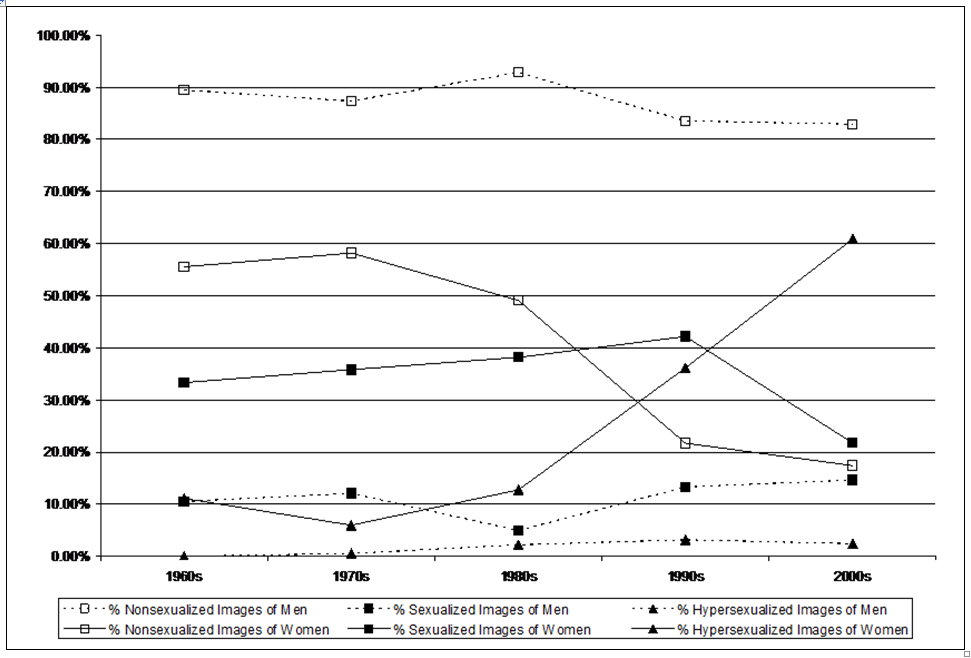
The graph below shows our findings:

Looking first at images of men (represented by dotted lines), we see that the majority of them– from 89% in the 1960s to 83% in the 2000s — were nonsexualized.  Men are sometimes shown in a sexualized manner (about 15% in the 2000s), but they are rarely hypersexualized (just 2% in the 2000s). In fact, only 2% of the images of men across the entire dataset — all 43 years — are hypersexualized.

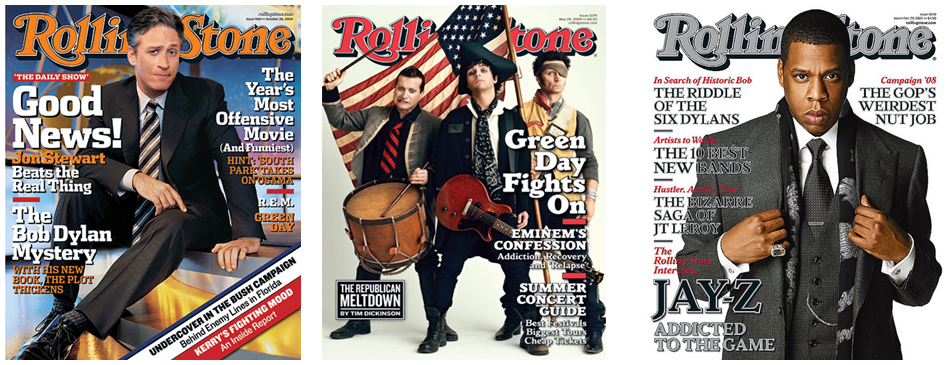
But, again, the vast majority of men — some 83% in recent years — were not sexualized at all.  So, if you were to pick up a copy of Rolling Stone in the 2000s, you would most likely see men portrayed in a non-sexualized manner, such as in these images:

In contrast, women, especially recently, are almost always sexualized to some degree.  In fact, by the 2000s, 61% of women were hypersexualized, and another 22% were sexualized.  This means that, in the 2000s, women were 3 1/2 times more likely to be hypersexualized than nonsexualized, and nearly five times more likely to be sexualized to any degree (sexualized or hypersexualized) than nonsexualized.

So, in the last decade, if you were to pick up a copy of Rolling Stone that featured a woman on its cover, you would most likely see her portrayed in a sexualized manner, since fully 83% of women were either sexualized or hypersexualized in the 2000s. Here are a few examples of hypersexualized images:

In our article, we argue that the dramatic increase in hypersexualized images of women — along with the corresponding decline in nonsexualized images of them — indicates a decisive narrowing or homogenization of media representations of women.  In Female Chauvinist Pigs: Women and the Rise of Raunch Culture, journalist Ariel Levy (2005:5) describes this trend in this way:  “A tawdry, tarty, cartoonlike version of female sexuality has become so ubiquitous, it no longer seems particular.  What we once regarded as a kind of sexual expression,” Levy writes, “we now view as sexuality” (emphases in original).  In this article, we offer empirical evidence for this claim.

So what explains this trend towards women’s hypersexualization?  We don’t think it’s just the idea that “sex sells.” If that were true, we’d see many more images of women on Rolling Stone’s covers (only 30% of covers feature images of women) and we’d also see more sexualized and hypersexualized images of men.  We’d love to hear your thoughts in the comments.

Mary Nell Trautner and Erin Hatton are Assistant Professors of Sociology at SUNY Buffalo. Trautner is the author of many articles on the relationship between law, culture, organizational practices, and social inequality (and has written a fantastic Soc Images Course Guide for Sociology of Gender courses).  Hatton, a sociologist of work, is the author of The Temp Economy: From Kelly Girls to Permatemps in Postwar America.

For the last week of December, we’re re-posting some of our favorite posts from 2011.

————————

A good mockery can go a long way towards exposing cultural trends.  And this faux “Trailer for Every Oscar-Winning Movie Ever,” sent along by Ben N., does a fabulous job of revealing just how damn formulaic American movies can be.  It’s a treat:

See also: mocking tampon commercials.

Lisa Wade, PhD is an Associate Professor at Tulane University. She is the author of American Hookup, a book about college sexual culture; a textbook about gender; and a forthcoming introductory text: Terrible Magnificent Sociology. You can follow her on Twitter and Instagram.