Search results for The

In a previous post, Lisa referred to Peggy McIntosh’s famous essay on White Privilege: Unpacking the Invisible Knapsack. One of the many privileges that McIntosh identifies is that, as she writes, “I can turn on the television or open to the front page of the paper and see people of my race widely represented.”

This statement resounded when I saw the images below from a 2011 Scottish Woolovers catalogue. Further, I was reminded that it’s not only a matter of whether we see people of our race widely represented, but also of how the media makes these portrayals.

The white woman in this ad is modelling a cardigan sweater. Meanwhile, the woman of colour in the photo is…well, that’s an interesting question. Nothing that she is wearing is for sale; she’s just there, wearing clothing that has no relevance to the advertisement.
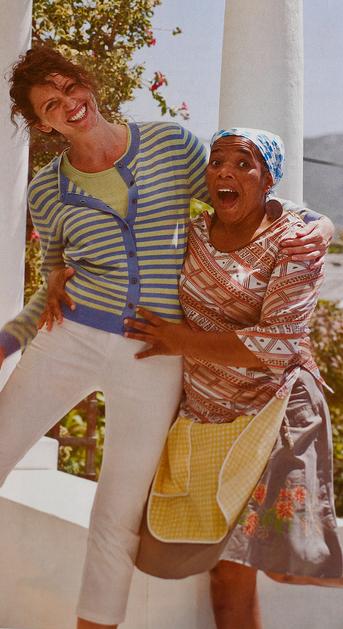
Normally, you’d expect that a woman in a fashion catalogue would be there to model clothing, but in this case, the woman of colour doesn’t have such a role. She is a prop for the white model, there to frolic and help illustrate the benevolent and fun-loving nature of the fashionable white model, clad in an apron that marks her as potentially a servant of some kind. She’s not there to directly market clothes to a white target market.

SocImages has addressed other examples of privileged representations of white women in catalogues; a discussion of a Punjammies catalogue highlighted the exclusive reliance on white women as models, while portraying women of colour as labourers and beneficiaries of the good will of the white, female target market. In a similar vein, we also had a post illustrating a comparable trend in the representation (and lack thereof) of people of colour in films. It is a function of our unearned privilege that, when those of us in a privileged position come across racialized images and representations like these, it is all too easy to miss or ignore their problematic nature.

Thanks to Flickr user Wishiwerebaking for sending us these images.

—————

Hayley Price has a background in sociology, international development studies, and education. She recently completed her Masters degree in Sociology and Equity Studies in Education at the University of Toronto.

If you would like to write a post for Sociological Images, please see our Guidelines for Guest Bloggers.
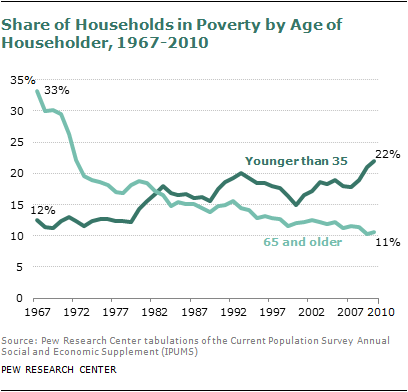
Amy H. sent in a link to a Pew Research  Center report on age and economic well-being in the U.S. The results indicate that over time, the economic situation has generally improved for older individuals in the U.S. Those over age 65 are much less likely to be poor today than they were a few decades ago, for instance:

Why the dramatic reduction beginning in the late 1960s? One important factor is the role of public policy. In 1965, the U.S. passed legislation establishing Medicare, which greatly increased access to medical care for the elderly regardless of income. Medical costs had previously been a major drain on savings; a significant illness could quickly eliminate a lifetime’s savings. Medicare reduced the risk posed by medical expenses and the percent of income spent on health care among the elderly.

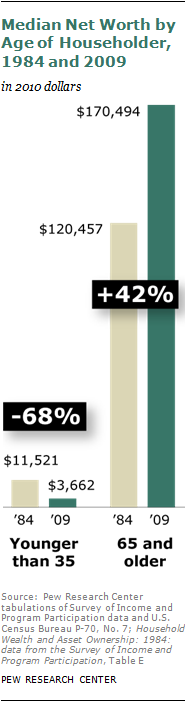
Today, retirement-age Americans have significantly higher net worth than those under age 35, and the gap has widened since the 1980s. The younger age group actually lost ground, with a lower median net worth in 2009 than in 1984:

Of course, we expect individuals to become better off economically over time as they settle into jobs, save for retirement, perhaps pay off a home so that housing expenses go down. But the improving economic well-being of older Americans isn’t just a natural outcome of the lifecourse; it reflects changing public policies that have over time increasingly allowed the elderly to access medical care and other services without impoverishing themselves in the process.

Los Angeles Meet Up:

Plan ahead! We’ve scheduled a SocImages Meet Up for March.  Please join us The Escondite (downtown L.A.) on Sunday, March 4th.  All ages.  Food and drink.  Great company guaranteed.

(P.S.: If you’re in Boston, I’ll be visiting Harvard and Boston University at the end of March. Will try to schedule a meet up then as well.)

SocImages News:

Amanda Jungels has put together a fantastic SocImages Course Guide for Sexuality and Society.  Check out all of our Course Guides here.

We’re having great fun with our Pinterest account; our collection of sexy toy makeovers showed up as a slideshow at the Huffington Post.  We’ve also added two new boards:

A super big “thank you” to Ron Anderson!  Dr. Anderson notified us that he nominated us for the ASA Section on Communication and Information Technologies Public Sociology Award.

We’re in Portuguese!  Thanks to Dr. Claudio Cordovil, some of our posts are appearing at the University of Brazil’s Conhecimento Prudente.

I think this is our first appearance as a source on Wikipedia… on the page about the online game, Evony… of all things.

Are you on Google Plus? So are we!

Authors and Contributors in the News:

Contributor Philip Cohen was discussed in an NPR story about using Google searches as data.

I was quoted in an NPR story about photographer Shelby Lee Adams’ portrayal of Appalachia and I enjoyed a few fun minutes on air with CKNW’s Bill Good talking about the recent trend of sexualizing toys for young girls.

Best of January

Our hard-working intern, Norma Morella, collected the stuff ya’ll liked best from this month.  Here’s what she found:

Social Media ‘n’ Stuff:

Finally, this is your monthly reminder that SocImages is on TwitterFacebook, Google+, and Pinterest.  Gwen and I and most of the team are also on twitter:

Cross-posted in Portuguese at Conhecimento Prudente.

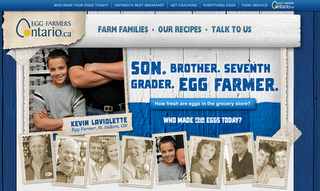
Philippa brought our attention to a recent ad campaign by the Egg Farmers of Ontario, an organization that promotes Ontario’s egg industry. The campaign, titled Who Made Your Eggs Today?, draws the consumer’s attention to the families engaged in producing Canada’s eggs. The images and videos focus on an idealized image of family farms, emphasizing tradition, family togetherness, and a connection to the land:


But as Philippa pointed out, there’s something noticeably absent here: the chickens themselves. There’s quite a bit of talk about chickens — how much the farmers enjoy working with them, how amazing it is that they produce an egg nearly every day, what they eat, and so on — but I didn’t see a single chicken in any of the videos listed on the Farm Families page. (Though videos on later years include brief shots of chickens.)

This ad campaign seems to provide transparency into how food is produced; we get to see into the lives of actual egg producers in Ontario, and hear them speak about their lives and the process that brings eggs to the consumer. And for those of us concerned about how the conditions under which our food is produced, this is an important step, as most consumers have little or no direct experience with farming or the lives of people who raise food. The appeal of farmers’ markets , community-based agriculture, and other alternative food distribution outlets is not just the idea of getting environmentally sustainable produce, but also making a connection to a specific producer, and often a desire to support small-scale family farmers.

But the insight into the egg supply chain offered here is selective.  What is carefully avoided in the videos is any discussion of how the hens are treated. We never quite see into the barns to see how the chickens are housed; we don’t hear whether artificial lighting and other techniques are used to boost egg production in ways that cause physical stress to the hens; we don’t know anything at all, in fact, about the chickens.

We enter the story when the eggs have been separated from layers’ housing; we see clean, pretty eggs moving along on mechanized belts or being carefully placed into cartons by hand; our attention as consumers is directed to the people running the farms and away from discussions of the animals or larger concerns about sustainability. As Philippa says, “in giving the egg farmers a public face, the campaign is actually distancing the public from the product they are promoting.”

Also check out our post about Nathan Meltz’s artwork highlighting modern food production, including his Chicken Coup video.

Gwen Sharp is an associate professor of sociology at Nevada State College. You can follow her on Twitter at @gwensharpnv.

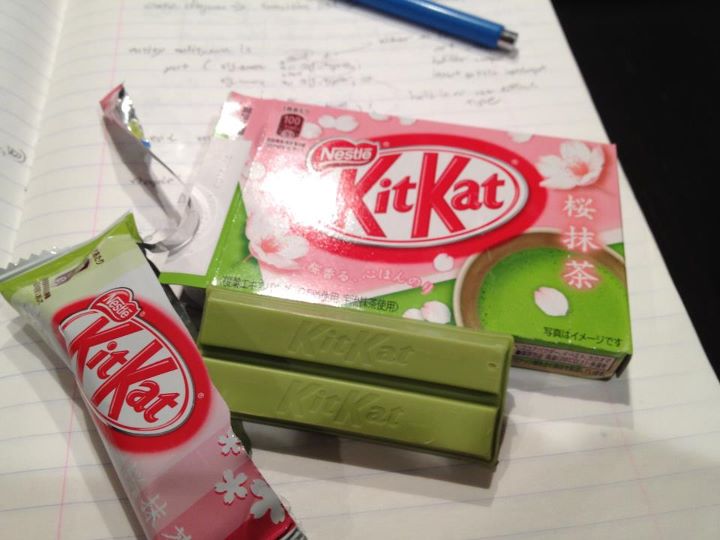
Here’s a fun one for our series on the social construction of flavor!

See also:

And the list wouldn’t be complete without our Jell-O posts:

Lisa Wade, PhD is an Associate Professor at Tulane University. She is the author of American Hookup, a book about college sexual culture; a textbook about gender; and a forthcoming introductory text: Terrible Magnificent Sociology. You can follow her on Twitter and Instagram.

In this 8 1/2 minute talk, sent in by Dmitriy T.M., AJ Jacobs recounts his efforts to perfectly follow every single piece of health advice he encountered.

Lisa Wade, PhD is an Associate Professor at Tulane University. She is the author of American Hookup, a book about college sexual culture; a textbook about gender; and a forthcoming introductory text: Terrible Magnificent Sociology. You can follow her on Twitter and Instagram.

In “Portraying Tiger Woods: Characterizations of a ‘Black’ Athlete in a ‘White’ Sport,” Andrew Billings discusses how race plays a role in sports commentators’ evaluations of golfers, and particularly in how they describe and comment upon Tiger Woods. A content analysis of 37.5 hours of coverage of golf tournaments between April and August of 2001 by CBS, NBC, and ABC, during which 2,989 evaluative comments occurred, revealed patterns in how sportscasters described Tiger Woods compared to other golfers. When he was losing, Woods was more likely than other golfers in the same position to be described as lacking composure or concentration, of “self-destructing,” and of lacking control over his emotions. Overall, Billings found that the types of language other students have found to be applied to Black athletes were applied to Woods only when he was losing. When he was doing well, commentators did not significantly stereotype Woods.

The study is interesting in light of a video sent in by Jason Eastman. This Wall Street Journal segment discusses the results of a study that investigated how media depictions of college quarterbacks’ performances. A recent study published in the Academic of Management Journal found that media coverage rarely gave African American quarterbacks credit for leadership. When their teams do well, it is because of their natural athletic talent; when they do poorly, it is lack of leadership — blame not equally placed on White quarterbacks when their teams do poorly. So Blacks are blamed more for losses but get less credit for successes — an outcome of stereotyping that has disturbing implications for hiring and promotion in the workplace (sorry for the ad):

Full cites:

Andrew Billings. 2003. “Portraying Tiger Woods: Characterizations of a ‘Black’ Athlete in a ‘White’ Sport.” The Howard Journal of Communications 14: 29-37.

Andrew Carton and Ashleigh Shelby Rosette. 2011. “Explaining Bias against Black Leaders: Integrating Theory on Information Processing and Goal-Based Stereotyping.” Academy of Management Journal 54: 1141-1158.

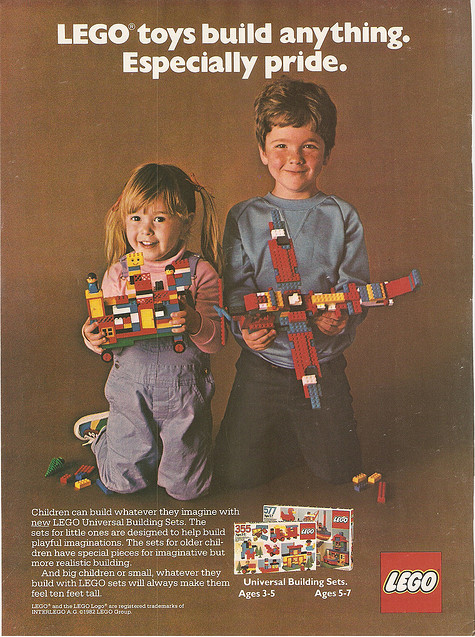
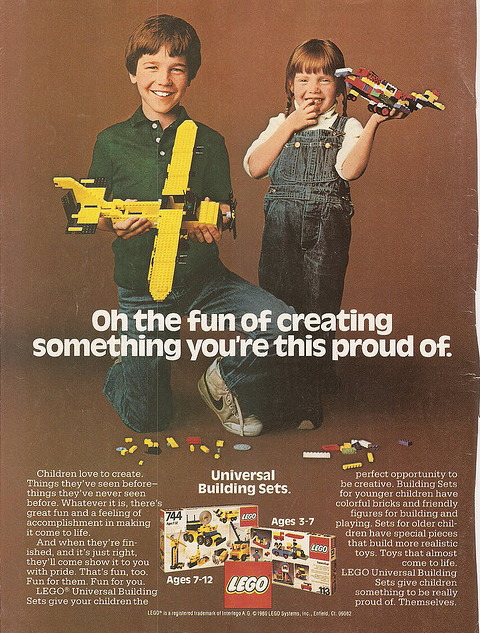
After the recent scandal over LEGO Friends, I am excited to report that I am in the process of working with a LEGO “fanatic,” David Pickett, on a series of posts about gender and the history of LEGO.  In the meantime, as a teaser, I wanted to offer you two LEGO ads that were from the same campaign as the one making its semi-viral way around the internet (1980-1982).  As with the original, these are evidence that advertising doesn’t have to reproduce the idea of “opposite sexes”:

Thanks to Moose Greebles and his Photostream.

Lisa Wade, PhD is an Associate Professor at Tulane University. She is the author of American Hookup, a book about college sexual culture; a textbook about gender; and a forthcoming introductory text: Terrible Magnificent Sociology. You can follow her on Twitter and Instagram.