Search results for The

In this 15min TED talk, the eminent masculinities scholar Michael Kimmel argues that feminism is in everyone’s best interest. After discussing the robust research on the benefits of gender equality, he concludes:

Gender equality is in the interest of countries, of companies, and of men, and their children and their partners… [It is] is not a zero sum game, it’s not a win-lose, it is a win-win for everyone.

Watch!
From an angry tweet to an actual change.

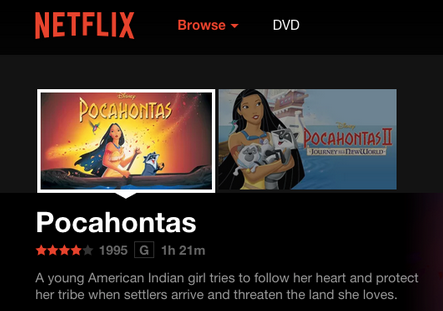
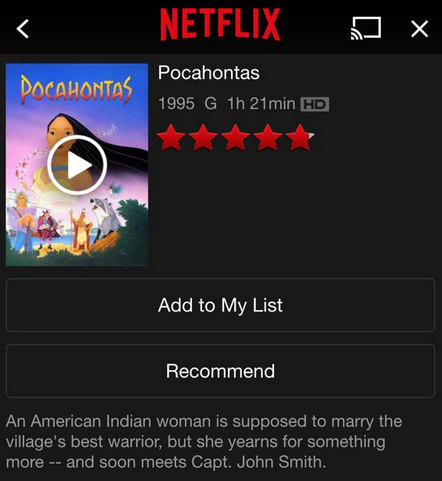
On September 1st I objected to the description of the Disney movie Pocahontas at Netflix. It read:

An American Indian woman is supposed to marry the village’s best warrior, but she years for something more — and soon meets Capt. John Smith.

8

I argued that, among other very serious problems with the film itself, this description reads like a porn flick or a bad romance novel. It overly sexualizes the film, and only positions Pocahontas in relation to her romantic options, not as a human being, you know, doing things.

Other Disney lead characters are not at all described this way. Compare the Pocahontas description to the ones for a few other Disney films on Netflix:

The Hunchback of Notre Dame. “Inspired by Victor Hugo’s novel, this Disney film follows a gentle, crippled bell ringer as he faces prejudice and tries to save the city he loves.”

The Emperor’s New Groove. “In this animated Disney adventure, a South American emperor experiences a reversal of fortune when his power-hungry adviser turns him into a llama.”

Tarzan. After being shipwrecked off the African coast, a lone child grows up in the wild and is destined to become lord of the jungle.”

Hercules. “The heavenly Hercules is stripped of his immortality and raised on earth instead of Olympus, where he’s forced to take on Hades and assorted monsters.”

I picked these four because they have male protagonists and, with the exception of Emperor’s New Groove which has a “South American” lead, the rest are white males. I have problems with the “gentle, crippled” descriptor but, the point is, these movies all have well developed romance plot lines, but their (white, male) protagonists get to save things, fight people, have adventures, and be “lord of the jungle” – they are not defined by their romantic relationships in the film.

We cannot divorce the description of Pocahontas from it’s context. We live in a society that sexualizes Native women: it paints us as sexually available, free for the taking, and conquerable – an extension of the lands that we occupy. The statistics for violence against Native women are staggeringly high, and this is all connected.

NPR Codeswitch recently posted a piece about how watching positive representations of “others” (LGBT, POC) on TV leads to more positive associations with the group overall, and can reduce prejudice and racism. This is awesome, but what if the only representations are not positive? In the case of Native peoples, the reverse is true – seeing stereotypical imagery, or in the case of Native women, overly sexualized imagery, contributes to the racism and sexual violence we experience. The research shows that these seemingly benign, “funny” shows on TV deeply effect real life outcomes, so I think we can safely say that a Disney movie (and its description) matters.

So, my point was not to criticize the film, which I can save for another time, but to draw attention to the importance of the words we use, and the ways that insidious stereotypes and harmful representations sneak in to our everyday lives.

In any case, I expressed my objection to the description on Twitter and was joined by hundreds of people. And… one week later, I received an email from Netflix:

Dear Dr. Keene,

Thanks for bringing attention to this synopsis. We do our best to accurately portray the plot and tone of the content we’re presenting, and in this case you were right to point out that we could do better. The synopsis has been updated to better reflect Pocahontas’ active role and to remove the suggestion that John Smith was her ultimate goal.

Appreciatively,

<netflix employee>

9

Text:

A young American Indian girl tries to follow her heart and protect her tribe when settlers arrive and threaten the land she loves.

Sometimes I’m still amazed by the power of the internet.

Adrienne Keene, EdD is a graduate of the Harvard Graduate School of Education and is now a postdoctoral fellow in Native American studies at Brown University. She blogs at Native Appropriations, where this post originally appeared. You can follow her on Twitter.

Cross-posted at Pacific Standard.

1 (2)

Today is Labor Day in the U.S. Though many think of it mostly as a last long weekend for recreation and shopping before the symbolic end of summer, the federal holiday, officially established in 1894, celebrates the contributions of labor.
Here are some SocImages posts on a range of issues related to workers, from the history of the labor movement, to current workplace conditions, to the impacts of the changing economy on workers’ pay:

The Social Construction of Work

Work in Popular Culture

Unemployment, Underemployment, and the “Class War”

Unions and Unionization

Economic Change, Globalization, and the Great Recession

Work and race, ethnicity, religion, and immigration

Gender and Work

The U.S. in International Perspective

Academia

Just for Fun

Bonus!

Lisa Wade, PhD is an Associate Professor at Tulane University. She is the author of American Hookup, a book about college sexual culture; a textbook about gender; and a forthcoming introductory text: Terrible Magnificent Sociology. You can follow her on Twitter and Instagram.

Flashback Friday.

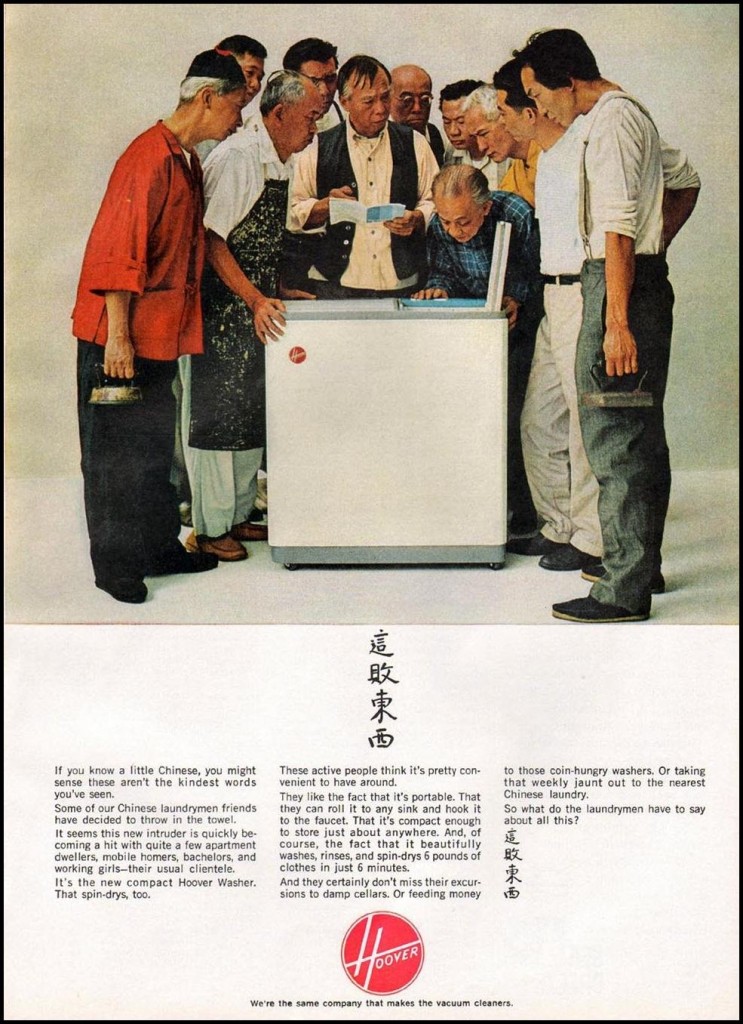
Vintage Ads put up this advertisement in which a collection of “Chinese” bemoan the invention of the compact washer/dryer (text below):

Selected text:

If you know a little Chinese, you might sense these aren’t the kindest words you’ve seen.

Some of our Chinese laundrymen friends have decided to throw in the towel.

It seems this new intruder is quickly becoming a hit with quite a few apartment dwellers, mobile homers, bacherlors, and working girls–their usual clientele.

It’s the new compact Hoover Washer. That spin-drys too.

This stereotype–that Chinese men were professional launderers–is still around today (e.g., the U-Washee laundromat and the shoe company and restuarant called “Chinese Laundry”), but it may be unfamiliar to some.

Many Chinese men ran laundry businesses between the late 19th century and the end of World War II.  They turned to laundry because they were shut out of other types of work (such as mining, fishing, farming, and manufacturing) and didn’t have the English skills or capital to make other choices.  Washing and ironing was considered women’s work, so it was low status and also posed no threat to white, male workers.

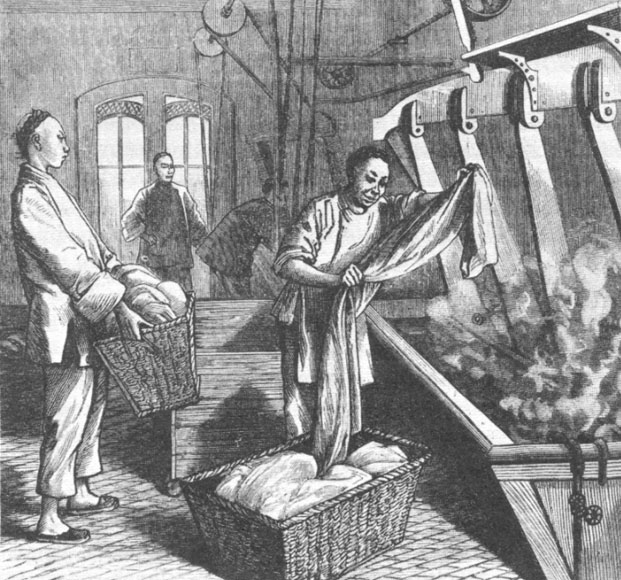
Drawing of an 1881 Chinese laundry in San Francisco (source):

According to sources cited in Wikipedia, “Around 1900, one in four ethnic Chinese men in the U.S. worked in a laundry, typically working 10 to 16 hours a day.”  John Jung, who grew up behind a Chinese laundry and wrote a book about the business, explains that “New York City [alone] had an estimated 3,550 Chinese laundries at the beginning of the Great Depression of the 1930s.”

As the vintage ad suggests, the Chinese laundry disappeared into history not because discrimination disappeared, but because of technological innovation.

Originally posted in 2010.

Lisa Wade, PhD is an Associate Professor at Tulane University. She is the author of American Hookup, a book about college sexual culture; a textbook about gender; and a forthcoming introductory text: Terrible Magnificent Sociology. You can follow her on Twitter and Instagram.

In a new blog post, Brad Wilcox and Nicholas Wolfinger ask, “are red or blue spouses happier?” Their answer — suspense — red.

Using the 2010-2014 General Social Survey, they start with this descriptive figure:

marital-quality-fig-1

Then they do adjustments, and show how their statistical controls explain the “Republican advantage in marital satisfaction.” And get this:

marital-quality-fig3

So, with all those controls, the “Republican advantage” remains.

That was enough for the sadly credulous David Leonhardt, editor of the New York Times Upshot site, to conclude:

Liberal attitudes toward gender equality, sexual orientation and education all seem to foster stronger, more stable family lives. But Mr. Wilcox’s recent writings strike me as significant because they’re a reminder that conservatism also has values and cultural attitudes — about the importance of marriage and family life — that seem to improve the environment in which children grow up.

Quite a conclusion to draw from a 3% net difference in a question on marital happiness — not exactly the best measure of “the environment in which children grow up.” But more importantly, I think it’s empirically wrong anyway.

Wilcox and Wolfinger left out all the details of their analysis, but it was easy to replicate it pretty closely. As a left-versus-right story it just doesn’t hold up. The GSS allows people to specify eight party identifications (including “other party”), not just three (Democrat, Republican, Independent). Wilcox and Wolfinger code those as “Independent, near Democrat/Republican” as identifying with the parties, but they don’t show the whole pattern:

marital-happiness-partyid.xlsx

The upward slope toward “strong Democrats” undermines the left-right story. Still, the figure skews right. When I apply the statistical controls, however, the differences are muted:

marital-happiness-partyid.xlsx

Now the “strong Democrats” appear happier than all but the “strong Republicans.” And not even the “strong Republicans” are significantly more likely to say they’re “very happy” in marriage than the “strong Democrats.” Here’s the relevant part of the table:

marital-happiness-partyid-coefs

Lots of ways you could interpret this. But I’m pretty sure the Wilcox and Wolfinger conclusion is not supported: “married Republicans are more likely than married Democrats to say they are in very happy marriages.” And the Leonhardt conclusion is just ridiculous (insofar as it’s based on these data).

Note: I did this really quickly. If I made a mistake, feel free to correct me. But I’m still calling this a “research brief” and a “report.”  More methodological details here.

Philip N. Cohen is a professor of sociology at the University of Maryland, College Park. He writes the blog Family Inequality, where this post originally appeared, and is the author of The Family: Diversity, Inequality, and Social Change. You can follow him on Twitter or Facebook.

SocImages News:

It was an incredible honor this month to attend the American Sociological Association meetings and accept the Distinguished Contributions to Teaching Award on behalf of myself and Gwen Sharp and our work on this site. We are so thrilled to know that instructors find the site useful and invigorating and, as I said at the ceremony, if what we do is make instructors’ lives a little less hectic and their time in the classroom a little more productive and fun, then we’re just ecstatic about taking the award home.

We couldn’t do it without the incredible support of Chris Uggen and Doug Hartmann, the visionaries behind The Society Pages; Jon Smadja, whose skills are the invisible forces behind a seamless website; our regular contributors — Jay Livingston, Philip Cohen, and Martin Hart-Landsberg — and all of the guest bloggers who donate their time and brilliant ideas; my institution, Occidental College, which has always been warmly appreciative of the site and its role in making sociology public; and, of course, the readers who make all this worthwhile.

To all of you and to public sociology and a more informed world for everyone!

Back to work!

Here are our most appreciated posts this month:

Thanks everybody!

Top funny:

Social Media Milestones:

Our Pinterest page reached 15,000 followers this month! If you haven’t visited, it’s a fun ride and great for planning classes. We have 30 boards, ranging from central sociological concepts to creative collections. You have to sign up to browse them, but it’s worth it!

And, amazingly, our Facebook page reached 75,000 followers. At Facebook we post all our material plus other sociologically interesting stuff from around the web. I’ve recently started tagging posts with hashtags, so hopefully it’ll become increasingly easy to collate exactly the material you’re looking for.

You can follow us on Twitter and Tumblr, too! And I miiiiiiight be experimenting with Instagram, but it’s still a secret.

Finally…

After a busy and exciting ASA, it was nice to be home, even if Oliver doesn’t care that I’m a sociologist.

??????????????

Lisa Wade, PhD is an Associate Professor at Tulane University. She is the author of American Hookup, a book about college sexual culture; a textbook about gender; and a forthcoming introductory text: Terrible Magnificent Sociology. You can follow her on Twitter and Instagram.

Riffing on neologisms like mandles (candles for men), guyliner (mascara for men), and bronuts (donuts for men), comic Zach Weiner explores a dystopian future in which men masculinize their language beyond all recognition. It’s great. See the whole thing here!

Lisa Wade, PhD is an Associate Professor at Tulane University. She is the author of American Hookup, a book about college sexual culture; a textbook about gender; and a forthcoming introductory text: Terrible Magnificent Sociology. You can follow her on Twitter and Instagram.

1 (3)

Today marks ten years to the day that Hurricane Katrina flooded the city of New Orleans and devastated the Gulf Coast.   These posts are from our archives:

Was Hurricane Katrina a “Natural” Disaster?

Racism and Neglect

Disaster and Discourse

Devastation and Rebuilding

10 Years Later and Beyond

Lisa Wade, PhD is an Associate Professor at Tulane University. She is the author of American Hookup, a book about college sexual culture; a textbook about gender; and a forthcoming introductory text: Terrible Magnificent Sociology. You can follow her on Twitter and Instagram.