
Search results for The

Is there really a clean-cut difference between work and sex work? Is sex work really or always sexual? Are all the other jobs asexual? Where do we draw the line? Can we draw a line? Should we?

These were some of the questions that we discussed in my power and sexuality class this past semester and, like magic, an article appeared asking whether “bikini-clad baristas” at sexy-themed coffee shops are sex workers. Well, are they?

These coffee shops require women to wear bikinis or lingerie. At The Atlantic, Leah Sottile writes that “bikini” is an overstatement. On that day, a Wednesday, the employee slinging coffee wears lacy underwear. It’s their slow day, she explains, because on Tuesdays and Thursdays she wears only a thong and pasties.

“It’s like a really friendly drive-through peep show,” writes Sottile.

School administrators have re-routed buses.

—————

There are some interesting players in this debate, people who sociologists would call stakeholders.

Mike Fagan is one. He’s a politician and some would say that he’s responsible for making sure that city rules match the values of his constituents. He’s pro-regulation, explaining:

In my mind we’re talking adult entertainment. We don’t want to shut down the stands. We want to say, “Look, you either put the bikinis back on, or you move your business to an appropriately zoned area.”

Business owners — at least the ones that own sexy coffee shops — are generally anti-regulation. They’re not interested in relocating their businesses to an “appropriately zoned area,” the sad, skeezy corners of the city where we find strip clubs. One explains that she’s “just selling coffee” and if her girls want to wear a bikini when they do, who’s to say they shouldn’t?

Sex worker advocates are also involved. Savannah Sly, a representative of the Seattle Sex Workers Outreach Project, argues that bikini baristas are sex workers:

…because their work involves using sexual appeal… Because they may be stigmatized or their place of employment scrutinized due to the erotic nature of the work, I deem it worthy of the label of sex work.

Right or wrong, this is a convenient conclusion for Sly. If more workers are classified as sex workers, than sex workers become more powerful as a group, enabling them to better advocate for better working conditions, more protection, and rights.

The bikini baristas themselves surely have a variety of opinions. The one interviewed by Sottile points out that models often wear as little or less clothing, but no one’s debating whether they’re sex workers.

It’s a fair point. And it gets back to our question — and the question for the cities of Spokane, WAClovis, CAForest Grove, OR; Aurora, CO and more — where do you draw the line between sex work and not sex work?

Honestly, I don’t think it’s possible.

Sex is a part of lots of jobs. It’s not a binary, it’s a spectrum. Sex is a part of modeling, dancing, and acting. The bartender, the waitress, and the hostess all sometimes deploy their sex appeal. How much does sex play into how lawyers are viewed in courtrooms or personal trainers are evaluated? Is sex a part of pro sports? The therapist’s relationship with their client? Selling pharmaceuticals to physicians? Heck, even college professors are evaluated with chili peppers.

Maybe the difference is the contact or the penetration? But there are other jobs that centrally involve bodies and some involve kinds of penetration. What about the dentist climbing in your mouth? The phlebotomist drawing your blood? The surgeon opening up your chest? All these things are invasive and risky, but we manage them.

If not the penetration, maybe it’s the stigma? But there are other jobs that are stigmatized, too: undertakers, sewage plant employees, slaughterhouse workers, abortion providers, politicians (only sort of kidding), and many more.

The truth is that the things involved with sex work — emotional vulnerability, intimacy, emotional manipulation, physical contact, health risks, and moral opprobrium — all characterize at least some other jobs, too. So, the only thing that separates work from sex work is sex.

And, this might sound weird but, I don’t really think that sex is a thing that lines can be drawn around.

Is penile-vaginal intercourse sex? Is oral sex? Is manual stimulation of the genitals? Is making out? Is kissing? Is thinking about kissing? Would you offer different answers if I asked if those things were sexual? Would you answer differently if the question wasn’t about what counted as sex, but what counted as abstinence?

Is the penis a sexual body part? The clitoris? The anus? Breasts? The inner thigh? The back of one’s knee? The back of one’s neck? How do you decide? Who gets to?

So when is work sex work? I can’t conceive of an answer that would satisfy me.

So, what should be done about bikini baristas? A strong minimum wage. Unions. Protection from harassment. Sick days. A nice vacation. Penalties for wage theft. Predictable schedules. A nice benefits package. I want all those things for bikini baristas. I want them for all the other “sex workers,” too. I want those things for all workers because the important word in the phrase “sex work” isn’t sex, it’s work.

Cross-posted at Pacific Standard.

Lisa Wade, PhD is an Associate Professor at Tulane University. She is the author of American Hookup, a book about college sexual culture; a textbook about gender; and a forthcoming introductory text: Terrible Magnificent Sociology. You can follow her on Twitter and Instagram.
Medical professionals often have the final say in deciding what counts as a “defect.” Often, their decisions exceed the bounds of medicine, addressing bodies that may deviate from “normal” or “average,” but do not actually cause medical problems.

An alternative might be to allow the patient to decide if his or her body is acceptable, but in doing so they risk allowing people’s deeply subjective and often dysmorphic perceptions of their own bodies determine whether they undergo a risky procedure.

Is there another way?

Pediatric surgeon Norma Ruppen-Greeff and hers colleagues thought so. Pediatric physicians often correct hypospadias: a condition in which the meatus, or opening of the urethra, doesn’t quite make it to the top of the penis during fetal development, such that the urethra exits the penis somewhere along the shaft. This is generally corrected surgically, but physicians found that some men returned to them as adults with concerns that their penis still appeared abnormal.

Instead of dismissing men’s concerns or jumping with a knife, they decided to ask women if they noticed. They had 105 women fill out a questionnaire and rate which aspects of penile appearance were important to them. And, lo and behold, the shape and placement of the meatus was the least important. No need for surgery, plus they can reassure the guys that they’re okay. (Someone should follow up and ask gay and bisexual men; anyone for an awesome senior thesis?)

This is a great way to measure the sociocultural value of a surgery. Whereas we’re used to thinking about surgical issues as psychological (someone wants it) or medical (someone needs it), these physicians asked a distinctly sociological question. They measured how penises are widely perceived and which parts are socially constructed as important. That’s a pretty neat way to incorporate sociological realities into surgical practice.

Cross-posted at Pacific Standard.

Lisa Wade, PhD is an Associate Professor at Tulane University. She is the author of American Hookup, a book about college sexual culture; a textbook about gender; and a forthcoming introductory text: Terrible Magnificent Sociology. You can follow her on Twitter and Instagram.

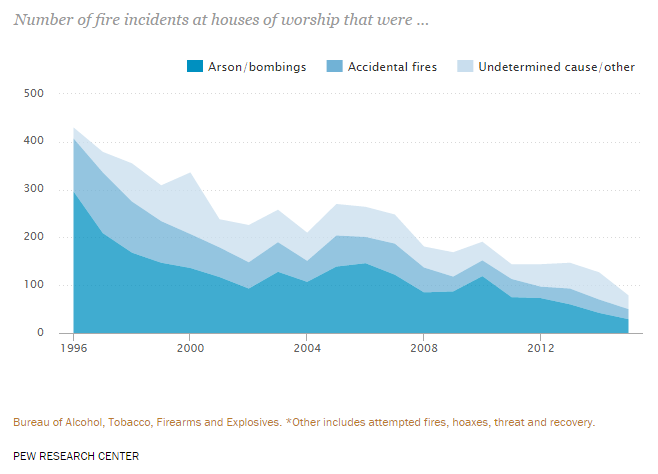
According to data presented by Pew Research Center, 51% of the last 20 years of fires at houses of worship were ruled “intentional.” In contrast, 10% of non-residential fires and 5% of residential fires are believed to be arson.

Overall, all types of fire incidents at churches and other houses of worship have been declining, but the proportion that are ruled intentional has been stable. In 1996, a House Judiciary Committee report found that arson attacks disproportionately targeted black churches in the South.

This is your image of the week:5

Play with the interactive data here.

Lisa Wade, PhD is an Associate Professor at Tulane University. She is the author of American Hookup, a book about college sexual culture; a textbook about gender; and a forthcoming introductory text: Terrible Magnificent Sociology. You can follow her on Twitter and Instagram.

Social science bloggers have been buzzin’ over whether drag performance is offensive and to whom. I have been researching and doing drag through a queer feminist anthropology lens for two years. I’ve taken an autoethnographic approach in an attempt to fill the scholarly gap where a male-bodied researcher, specifically a queer one, has lacked the enthusiasm to habitually perform as a drag queen. The motivations for this post easily align with my research as I hope to further develop the trending conversations of drag and its meanings.

Is drag offensive? It’s necessary to specify that this conversation is primarily about drag queening men. This is what most people would think of in terms of “drag queen,” a cisman who dresses as a woman on a stage, which I argue is a limiting definition. Five or ten years ago I would not have to specify “drag queening men,” but today there are genderqueer performers, ciswomen, transwomen – all bodies participate in drag as an expression, and not necessarily while cross dressing. Drag queens embody a range of femininities and masculinities (and sometimes species).

So, are drag queening men offensive? I keep in mind the ultimate queer mantra – both/and.

Looking to literature, this is an argument worked out back in the high Butler days. Esther Newton started this dialogue in the ‘70s and it was clearly closed out by Rupp and Taylor (and Shapiro) in the last decade. There are plenty of lit reviews to read on this [tired] subject.

Drag queening implies an individual who performs and embodies femininities for some kind of audience. Historically, and today, the majority of queens are male bodied. Some may continue this femininity off the stage, others do not. Their identities are assumed to be cis men, but this is incredibly complicated by the fluidity of drag bodies and the politics of the “transgender” category.

Regardless, you have male bodies who are distinctly breaking heteronormative ideas of identity and performance. Drag queening is a subversive outlet for male bodies to participate in gender play, oftentimes exploring femininity within themselves that they have been socialized to fear. Doing drag successfully is “working it” — you don’t give a shit about the patriarchy, your parent’s disappointment, getting fired from your job, or who will think you are date-able. It’s breaking out of boxes. Drag is a display of who you are (or just a part of yourself) and telling everyone to deal with it. If you like what you see, feel free to tip a dollar.

Drag claims the labels “offensive” and “radical” because its goal is to disrupt and show the audience that some identities, especially gender, are more fluid and performed than we think. Drag pokes holes into rigid ideas of gender and sexuality that most choose to ignore. Drag queening men are defiant, messy cyborgs, performing fluid and simultaneous contradictions of femininities and masculinities through their bodies. And of course, there is an entire history of drag acting as an important mode of protest, resistance, and survival for the queer community.

At the same time, drag queens are people who live in the same society that we all do. Drag is an institution that still exists — and always will — within the larger social structures. So, drag queens can be racist, transphobic, homophobic, and even more problematic. The best example for this is the drag queening man who takes her microphone privileges too far, such as a joke about a trans audience member’s genitals.

Drag queening men will often claim immunity under the trans umbrella or argue for the sanctity of comedy, but the reality is that drag queening men do have an underlying rhetoric of transphobia. The reminders that they return to presenting as men after the performance (“This is just a job, I don’t want to be a woman!”) are an unneeded distance created by drag queening men who are afraid and feel an attack against their masculinity. The heteropatriarchy suggests that male bodies who express femininity should fit into a more complicit, fictionally ideal “transsexual woman” category where all parts match behaviors. Some drag queening men respond to this pressure with transphobic masculinity, disastrously reinstating the binary they work to dismantle. It’s also in part to the idea that hegemonic forces continually pressure marginalized groups to create an Other, even if they are part of the same “community.”

Similarly, drag queening men still participate in hegemonic masculinity, and so they may make misogynistic jokes or may think domestic abuse makeup is some kind of “high fashion” (which is the WORST). Drag pageantry can be racially segregated and transwomen can be discouraged through the exclusionary bans of hormones and surgeries. Drag queening men can be soaked in privilege — using the T-slur, blackface, or feeling authority over female-bodied audience members. Most drag queening men have the ability to take off their wigs and makeup to “pass” outside queer spaces.

This in no means is an apology toward these actions, but I feel a stress needed to be made that the tradition of drag queening, a male body performing femininities, is not offensive. It stands as a transgressive act of male bodies deviating from and deconstructing the binary of gender. When drag queening men remind an audience they have a penis, it explodes the heteropatriarchy and dislocates gender from the body. For my own purposes in research and performance, drag is a safe place to explore forbidden femininities, freely navigate bodily inscription, and embrace corporeal versatility.

The tradition of drag queening is not an offensive act, but drag performers may abuse privilege and create problematic messages regardless of their intent. The problems of drag as an institution are the pre-existing racist heteropatriarchal structures that impede upon it. These difficulties with drag are the same hegemonic forces which delve deep into our film, art, video games and universities.

In closing, it is impossible to ignore the reality that groups of people think drag is offensive and no feelings should be ignored. I have no answer as to how this claim of offense can be processed besides our scholarly discussions, but I do hope that drag performers take care to be consciously aware of their privileges and prejudices, remembering their duties as queens who take down the heteropatriarchy one lip sync at a time.

Ray Siebenkittel is a student in the anthropology MA program at Louisiana State University in Baton Rouge. They take a feminist anthropologist approach to studying drag performance. You can follow their blog, where this post originally appeared, or meet them on twitter.

I saw “Trainwreck” last night. The 7:00 p.m. showing at the 68th Street AMC was full. Maybe people had come just to get out of the apartment and yet avoid the beastly heat, but they enjoyed the movie.  Sometimes the laughter lasted long enough to cover up the next joke.

The “Trainwreck” story is standard rom-com: Amy Schumer plays a young woman who rejects the idea of commitment and love. Circumstances put her together with a man she seems to have nothing in common with. You can guess the rest.

But this is Amy Schumer’s movie, so there’s an important twist – the conventional sex roles are reversed. It’s the man who is sweet and naive and who wants a real relationship; the woman has a lot of sex with a lot of different guys, drinks a lot, smokes weed, and resists love until at the end, she decides to become the woman he wants her to be.

Here is the R-rated version of the trailer:

What interested me was not the movie itself, but the reaction in some conservative quarters. For Armond White at the National Review, the movie triggered something like what Jonathan Haidt calls “disgust” – a reaction to the violation of strong taboos that surround things like food, sex, blood and other bodily matters, and death. These taboos are often arbitrary, not rational. Pork is an “abomination,” for example, because… well, because it is, and because pigs are “unclean.”

“Trainwreck” has no pork, but it does have what some find unclean.

Schumer’s tampon jokes and gay jokes, female versions of locker-room humor, literally drag pop culture to the toilet. A girl-talk scene set in adjoining restroom stalls — one revealing dropped panties, the other panty-less (obviously Amy) — is just Apatow using women to show off his indecency.

As a comedian and now as a filmmaker, Schumer talks about women-things: body functions and body parts. These jokes seem to elicit two different kinds of laughter. Back when researchers studying small group interaction were trying to code and categorize behavior, laughter posed a problem (see this earlier post). It could be coded as “Shows Tension,” but it might also be “Shows Tension Release.”

With Amy Schumer jokes, the male laughter is mostly a nervous, full of tension about a taboo subject. But the female laughter seems much less inhibited – tension release, maybe even a relief, as if to say, “Someone is finally talking publicly and frankly about things we could only whisper about,” since most of the time they have had to pretend to share the male taboo.

Indecency indeed. But something is indecent only to members of groups that deem it indecent. Some groups are not at all disgusted by pork.  And for some audiences, tampon jokes and toilet-stall conversations about Johnny Depp movies are not indecent; they’re just funny. What audiences might those be? Women.

Take the tampon joke that the National Reviewer finds indecent. It would seem obvious that used tampons look different depending on where you are in your period – less bloody on the final day, more so a few days earlier. But at the mere mention of this fact in “Trainwreck,” hilarity ensues, especially among women in the audience.

The thing about taboos – ideas about what is indecent or disgusting – is that entire social structures get built around them. To violate the taboo is to threaten the entire edifice. Powerful taboos on women-things often go with male domination. So for the National Review, the “Trainwreck”reversal of rom-com gender roles makes the movie dangerous and subversive.

Here are some excerpts from the review just to give the flavor of this Purity-and-Danger-like conflating of taboo, female sexuality, and social/political threat to the established order (emphasis mine):

Schumer turns female sexual prerogative into shamelessness

the degradation of sex — and women

uses sex to promote feminist permissiveness.

She enjoys a sexual license

Amy brazenly practices the same sexual habits as men

Lacking
. . . old-fashioned sense of shame,

It’s merely brazen, like Lena Dunham’s HBO series, Girls (also about a promiscuous female writer

Schumer’s film can be seen to distort human relations into smut.

This is not just disrespectful, it confirms Schumer’s project of cultural takeover,

she aims to acquire cultural power

Schumer disguises a noxious cultural agenda as personal fiat. She’s a comedy demagogue who okays modern misbehavior yet blatantly revels in PC notions about feminism, abortion, and other hot-button topics

Wow.

I should add that not all conservative publications felt so threatened. Joe Morganstern at the Wall Street Journal gave the movie a warm review. Breitbart saw the movie’s essential conservatism (“The anti-slut message is a healthy one”) and praised Schumer as a comic actor.  Still, the National Review piece seems emblematic of something broader in the cultural conservative camp: a taboo-like reaction to female sexuality.

Originally posted at Montclair SocioBlog.

Jay Livingston is the chair of the Sociology Department at Montclair State University. You can follow him at Montclair SocioBlog or on Twitter.

SocImages News:

  • A huge thanks to Jon Smadja for freshening up the site and made it mobile friendly!

You like!  Here are our most appreciated posts this month:

Thanks everybody!

Editor’s pick:

Top comic:

Top post on Tumblr this month:

Social Media ‘n’ Stuff:

This is your monthly reminder that SocImages is on TwitterFacebookTumblr, and Pinterest.  I’m on Facebook and most of the team is on Twitter: @lisawade@gwensharpnv@familyunequal, and @jaylivingston.

Finally…

It’s been a hard summer so far, but let’s not let July 2015 go without one more time reveling in the joy of discovery:

2

Lisa Wade, PhD is an Associate Professor at Tulane University. She is the author of American Hookup, a book about college sexual culture; a textbook about gender; and a forthcoming introductory text: Terrible Magnificent Sociology. You can follow her on Twitter and Instagram.

2Killing at the hands of an illegal alien spurs furious debate about closing borders and deporting the undocumented. It is the year before a presidential election and candidates denounce undocumented immigrants as the conveyors of Mexican violence into our country.

When Robert J. Sampson, Harvard sociologist and criminologist, wrote about this news, he was not writing about the death of young Kate Steinle in San Francisco in 2015, but about murders in New Jersey in 2007. And he wrote to say that his research and that of others showed that immigrants are less likely than the native-born to commit murder and “that immigration — even if illegal — is associated with lower crime rates….” He had previously made similar claims in The New York Times and had gotten vituperation in response.

Popular skepticism toward Sampson might be expected given the media coverage of sensational crimes like the one on Pier 14 and of Mexico’s drug wars. But behind the headlines, the daily reality on the streets of the U.S. seems to be that immigrants bring less crime. Indeed, scholars like Sampson have suggested that the surge of Latino immigration, documented and not, may partly explain the great drop in violent crime in American cities since the 1980s.

Now, two presidential cycles since the Sampson article, we have new studies and more technically sophisticated ones on the topic. What do they say about the effects of immigration on crime and violence?

Immigration does not increase crime

The research I reviewed – several recent articles (see bibliography here) – is pretty consistent: Immigrants and concentrations of immigrants are associated with lower rates of crime and homicide. To be more cautious: at minimum, there is no connection between immigration and higher rates of crime.

Studies of individuals show that, as two experts summarize, “immigrants are less, not more, crime prone than their native-born counterparts.” Second- and third-generation immigrants start to look more like many-generation Americans in criminality (much as they do in other ways, such as diet and health behaviors). One study suggests that for adolescents the “protective” effect against criminality of being an immigrant may wear off after four years. But newcomers are notably less likely to commit crime than otherwise similar American-born youth.

Neighborhoods with many immigrants are not higher in crime

Many new studies compare neighborhoods, cities, or counties to assess the relationship between local concentrations of immigrants (or of Latinos) and rates of crime or violence. The general conclusion is that the higher these concentrations in a community, the lower the rates. A couple of studies find that the connection depends on the local context. In more impoverished neighborhoods or in cities with historically larger numbers of immigrants or with immigrant political power, additional immigration seems to push crime down yet more.

Complex statistical work suggests that this correlation reflects a causal connection: more immigrants arrive and violent crime fades. Why would that be so?

Sampson and others suggest that Latino immigrants have stronger families and community institutions, such as churches, than do the native-born. These provide more social control over youth. Researchers also propose that immigration has helped economically revitalize many U.S. cities and driven down crime that way, too.

Whatever the explanation, the general pattern is the reverse of the heated rhetoric: Overall, immigration goes with less criminal violence.

Claude Fischer is a sociologist at UC Berkeley and is the author of Made in America: A Social History of American Culture and Character. This post originally appeared at his blog, Made in America, and was re-posted on the Berkeley Blog.

Hoooo-ray! This (newly described by science) spider has 8 legs and it’s doing cartwheels to celebrate SocImages’ 8th birthday!

1

This is our 5,530th post and still going strong. Thanks to all of you who discovered SocImages this year and those of you who’ve been hanging on since the beginning!

Here are some highlights from the last year. Quite a trip down memory lane!

  • Sociological Images was awarded this year’s American Sociological Association’s Distinguished Contributions to Teaching Award. We would love to think that the blog eases class prep a little and helps people get the best out of their students. If that’s what this award means, we’re over the moon.
  • I was honored to be invited to talk about SocImages in a plenary speech at the Midwest Sociological Society. Of course, there were lots of pictures. You’re welcome to view the slideshow here.
  • Rush Limbaugh covered a post about the relationship between studying economics and being antisocial and it sheds a scary light into the inner workings of his mind. (And I got called a “professorette” so… like I said, all high kicks all the time.)
  • We got tumbld by Wil Wheaton!
  • Two new Pinterest pages: pinkwashing and sexy what!?, a collection of totally random stuff being advertised as weirdly and unnecessarily sexual.
  • Our social media accounts continue to grow like weeds: thanks to the 74,000 of you on facebook,  23,000 on tumblr, 22,000 on twitter, and 14,000 on pinterest.  We do have fun and learn stuff, too!

Here’s to another year! (Sorry about the spider.)

Lisa Wade, PhD is an Associate Professor at Tulane University. She is the author of American Hookup, a book about college sexual culture; a textbook about gender; and a forthcoming introductory text: Terrible Magnificent Sociology. You can follow her on Twitter and Instagram.