Search results for The

Flashback Friday.

Labiaplasty, a plastic surgery in which the labia is reshaped, is on the rise in many Western countries. Usually this means trimming the labia so that it is less “obtrusive” and social pressure, especially from increased exposure to pornography, is blamed for the rise. For reference, see our post on the natural range of labia shapes and sizes (nsfw).

The report below is about the rise of labiaplasty in Australia. It offers some fascinating insight into why it is that porn stars have such “tidy” labia. It turns out that the aesthetic has nothing to do with the preferences of men, women, or porn producers. Instead, pornography features vulvas reduced to a simple “slit” because rating boards require that soft-core porn show “only discreet genital detail.”

Brad Boxall, Former Editor of Picture Magazine, explains:

The only acceptable vagina [sic: vulva] as far as the Classification Board is concerned is one that is ‘neat and tidy’ in their eyes. They basically consider the labia minora “too offensive” for soft core porn.

Accordingly, porn stars themselves sometimes have surgery and/or their vulvas are re-touched to make their labia minora disappear. This practice may have far-reaching consequences if non-porn stars all over the Western world are suddenly feeling like they have freakishly large labia… all because the ratings board has decided that the true range of bodies is unacceptably crass.

In the video you will see actual footage of labiaplasty and genital re-touching, so it’s not safe for work or the squeamish.

Originally posted in 2010.

Lisa Wade, PhD is an Associate Professor at Tulane University. She is the author of American Hookup, a book about college sexual culture; a textbook about gender; and a forthcoming introductory text: Terrible Magnificent Sociology. You can follow her on Twitter and Instagram.

When it comes to rule-breakers and rule enforcers, which side you are on seems to depend on the rule-breaker and the rule. National Review had a predictable response to the video of a school officer throwing a seated girl to the floor. Watch with caution; disturbing imagery:

[youtube]https://www.youtube.com/watch?v=JAD15m6wqJI[/youtube]

Most of the response when the video went viral was revulsion. But not at National Review. David French said it clearly:

I keep coming to the same conclusion: This is what happens when a person resists a lawful order from a police officer to move.

The arrested student at Spring Valley High School should have left her seat when her teacher demanded that she leave. She should have left when the administrator made the same demand. She should have left when Fields made his first, polite requests. She had no right to stay. She had no right to end classroom instruction with her defiance. Fields was right to move her, and he did so without hurting her. The fact that the incident didn’t look good on camera doesn’t make his actions wrong.

This has been the general response on the right to nearly all the recently publicized incidents of the police use of force. If law enforcement tells you to do something, and then you don’t do it, it’s OK for the officer to use force, and if you get hurt or killed, it’s your fault for not complying, even if you haven’t committed an offense.

That’s the general response. There are exceptions, notably Cliven Bundy. In case you’d forgotten, Bundy is the Nevada cattle rancher who was basically stealing – using federal lands for grazing his cattle and refusing to pay the fees.  He’d been stiffing the United States this way for many years. When the Federales finally arrested him and rounded up his cattle, a group of his well armed supporters challenged the feds. Rather than do what law enforcers in other publicized accounts do when challenged by someone with a gun – shoot to kill –  the Federal rangers negotiated.

Bundy was clearly breaking the law. Legally, as even his supporters acknowledged, he didn’t have a leg to stand on. So the view from the right must have been that he should do what law enforcement said. But no.

Here is National Review’s Kevin Williamson:

This is best understood not as a legal proceeding but as an act of civil disobedience… As a legal question Mr. Bundy is legless. But that is largely beside the point.

What happened to “This is what happens when a person resists a lawful order”? The law is now “beside the point.” To Williamson, Bundy is a “dissident,” one in the tradition of Ghandi, Thoreau, and fugitive slaves.

Not all dissidents are content to submit to what we, in the Age of Obama, still insist on quaintly calling “the rule of law.”

Every fugitive slave, and every one of the sainted men and women who harbored and enabled them, was a law-breaker, and who can blame them if none was content to submit to what passed for justice among the slavers?

(The equation with fugitive slaves became something of an embarrassment later when Bundy opined that those slaves were better off as slaves than are Black people today who get government subsidies. Needless to say, Bundy did not notice that the very thing he was demanding was a government handout – free grazing on government lands.)

The high school girl refused the teacher’s request that she give up her cell phone and then defied an order from the teacher and an administrator to leave the classroom.  Cliven Bundy’s supporters “threatened government employees and officials, pointed firearms at law enforcement officers, harassed the press, called in bomb scares to local businesses, set up roadblocks on public roads, and formed lists (complete with photos and home addresses) of their perceived enemies” (Forbes).

A Black schoolgirl thrown to the floor by a weightlifting cop twice her size — cop right, rule-breaker wrong. A rural White man with White male supporters threatening Federal law enforcers — cops wrong, rule-breakers right.

Originally posted at Montclair SocioBlog.

Jay Livingston is the chair of the Sociology Department at Montclair State University. You can follow him at Montclair SocioBlog or on Twitter.

Barbie has never exactly been a feminist icon, but last week Mattel was celebrated for a new advertising campaign that some say empowers young girls. In the “Imagine the Possibilities” commercial, the viewer sees young girls in professional settings — a science museum, a veterinary office, a soccer field — where they lead adults as if they are the ones in charge. At the end of the ad, the scene shifts to a girl acting out her role as a college professor with Barbie dolls in her bedroom. Across the screen flashes, “When a girl plays with Barbie, she imagines everything she can become.”

But does the Barbie commercial really send an affirmative message about women in male-dominated occupations? And how does it stack up against actual Barbie products?

To answer the first question, I invite you to watch the commercial with a special focus on how the adult observers treat the young girls who are acting out their career fantasies. From the very first scene, everyone the girls encounter has the same reaction: laughter. The idea that these girls can fill the roles they’re imagining strikes the adults as so silly that the only complete sentence any of the adults says to these girls is, “You’re kidding.”

The girls are cute or funny, but never a force to be taken seriously. While the storyline may seem to encourage women’s participation in the labor force, the laughter throughout the commercial suggests that the girls’ aspirations are seen as adorable or silly.

Is it just because they’re kids? I don’t think so. Compare the Barbie ad to toy commercials that target boys. The clearest example I found was the commercial for the i-Que Robot. Like in the Barbie commercial, children take the central speaking roles as adults react to them. Unlike the Barbie commercial, these adults appear captivated and impressed by the boys’ pitches about their toy. By the end of the commercial, it’s easy to imagine these boys as successful salesmen or engineers, everyone has already treated them as such.

Does Barbie back up their message, though, with actual opportunities for play? My quick search on Amazon for the phrase “Barbie office” was pretty disappointing. The commercial, in other words, is disingenuous; it’s out of line with the actual Barbie products available for purchase. After limiting the results to only those produced by Mattel or Barbie, the only office settings I found were a pediatrician’s office and a bright pink veterinary office — which are both associated with stereotypically feminine careers — and a post office that was discontinued in 1995.

There was also a computer and desk intended to be placed in a home setting. From my search for “Barbie office,” I more commonly found  career sets for Ken than viable work-oriented play sets for Barbie. Given the options, I find it hard to image how Mattel sees girls playing with Barbie the way the newest ad suggests they might.

As it turns out, Barbie’s new advertising campaign is just the latest in a long string of commercials that try to go viral by appealing to feminist audiences. I would be more impressed if the ad made girls aspiring to male-dominated occupations seem like forces to be reckoned with or, at least, made products that reflected their appropriation of feminist ideals.

Cross-posted at Pacific Standard.

Nicole Bedera is a PhD student in sociology at the University of Maryland, College Park. She is currently studying college sexual assault and construction of young men’s sexualities.

SocImages News:

I’m so happy to announce a new partnership with Mental Floss! They will be featuring select posts from SocImages and bringing the sociological imagination to an even wider audience! Fabulous! Our first post is here.

Talks!

I’m excited to have been invited to speak about Sociological Images and public sociology in the upcoming months. I’ll be at the University of Nebraska, Omaha on November 13 and Witchita State University on March 4. (And thanks to Marshall University and Shawnee State for having me this month!) If anyone is in Omaha, Witchita, or Syracuse, let’s get in touch! More details here.

You like!  Here are our most appreciated posts this month:

Thanks everybody!

Editor’s pick:

Top post on Tumblr this month:

Social Media ‘n’ Stuff:

Your monthly reminder that SocImages is on TwitterFacebookTumblrGoogle+, and Pinterest.  I’m on Facebook and Instagram and most of the team is on Twitter: @lisawade@gwensharpnv@familyunequal, and @jaylivingston.

Finally…

Happy Halloween everyone! Here’s some scary characters riding the goblin float in the Krewe of Boo Halloween parade in New Orleans this year. Watch out or your might get some beads!

3

Lisa Wade, PhD is an Associate Professor at Tulane University. She is the author of American Hookup, a book about college sexual culture; a textbook about gender; and a forthcoming introductory text: Terrible Magnificent Sociology. You can follow her on Twitter and Instagram.
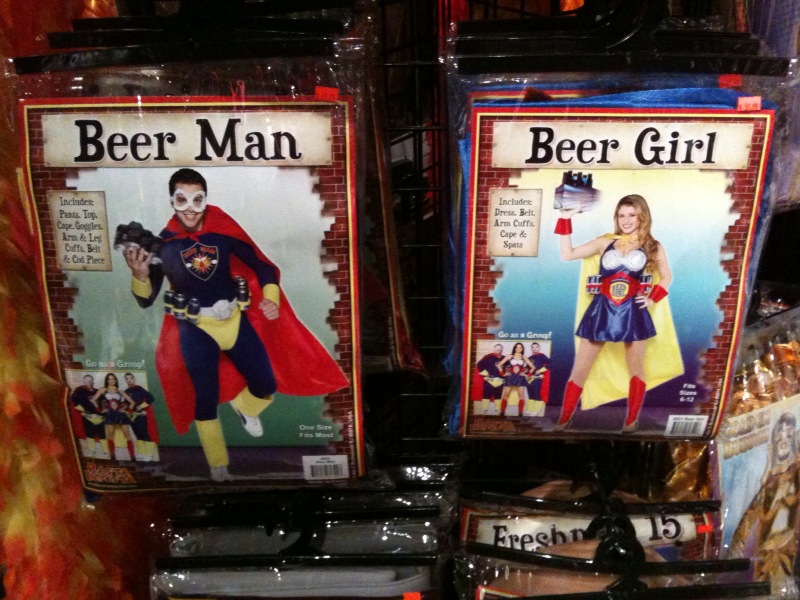
The practice of pairing the word “men” (which refers to adults) with “girls” (which does not) reinforces a gender hierarchy by mapping it onto age.  Jason S. discovered an example of this tendency at Halloween Adventure (East Village, NYC) and snapped a picture to send in:

photo

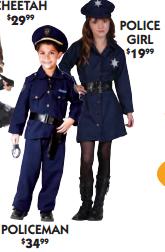
Sara P. found another example, this time from iparty.  The flyer puts a girl and a boy side-by-side in police officer costumes.  The boy’s is labeled “policeman” and the girl’s is labeled “police girl.”

11

This type of language often goes unnoticed, but it sends a ubiquitous gender message about how seriously we should take men and women.

Lisa Wade, PhD is an Associate Professor at Tulane University. She is the author of American Hookup, a book about college sexual culture; a textbook about gender; and a forthcoming introductory text: Terrible Magnificent Sociology. You can follow her on Twitter and Instagram.
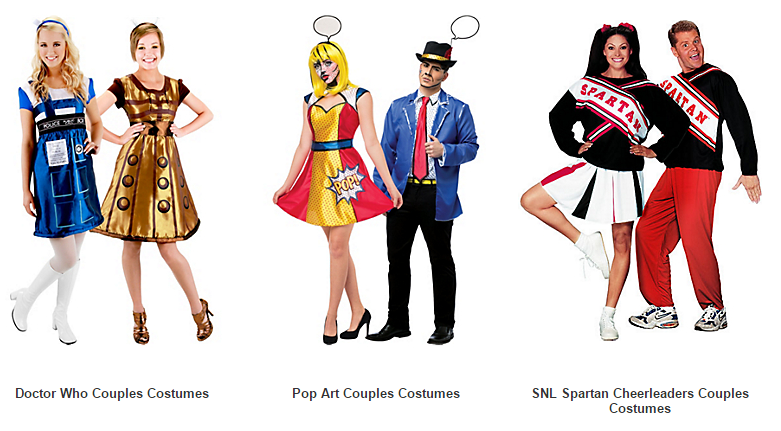
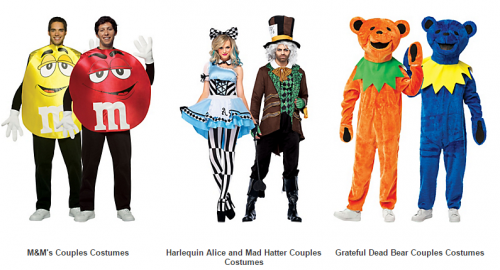
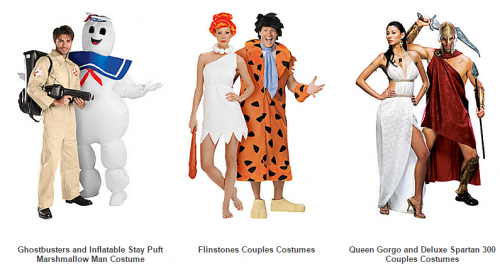
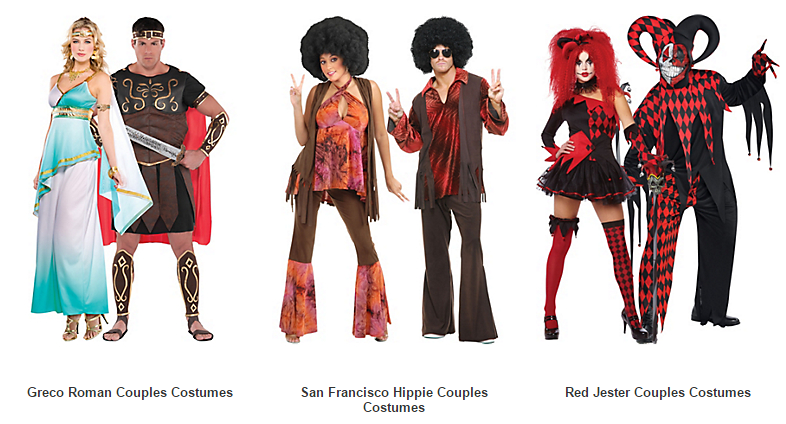
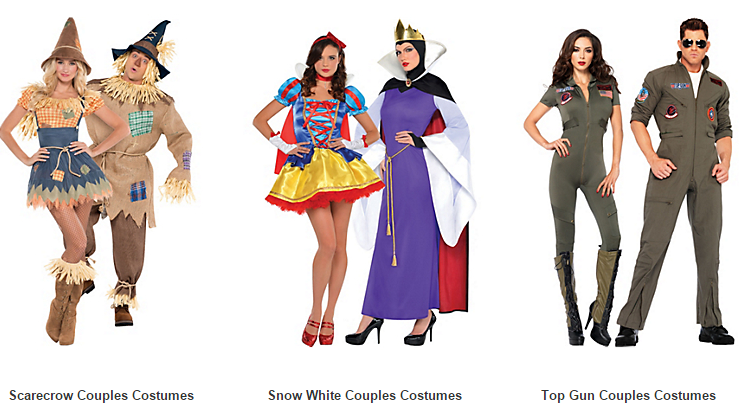
In 2012, I wrote about the heteronormativity in the couples Halloween costume category at Party City. Now, it’s 2015 and Party City has changed.

I counted all 103 costume sets, dividing them into whether they featured a heterosexual couple, a man-man couple, a woman-woman couple, or were ambiguous. Among them, 74 were aimed at heterosexuals, 12 were for men with men, and 3 were for women with women.

3 5
8

It might be too strong to say that the heteronormativity is gone. There are still more man-woman couples represented than man-man or woman-woman couples, but they’re very centrally there.

This makes people in similar-sex couples more visible. It also has the interesting effect of making some costumes not-so-obviously heterosexual anymore, like the bears or the Ghostbuster costumes. I counted 14 that were at least a little ambiguous as to whether they were intended for a similar-sex or other-sex couple.

6

9

Party City is not doing anything overly clever. Clearly they’re just looking for costumes they already have and putting them in combinations that might sell. And they could do a better job about thinking up woman-woman sets. But, there they are. And that’s a real change.

Lisa Wade, PhD is an Associate Professor at Tulane University. She is the author of American Hookup, a book about college sexual culture; a textbook about gender; and a forthcoming introductory text: Terrible Magnificent Sociology. You can follow her on Twitter and Instagram.
Research on college student alcohol consumption shows that they drink significantly more when they link their drinking to a reason to celebrate. Halloween is one of the many “alcoholidays” that occur throughout the school year.

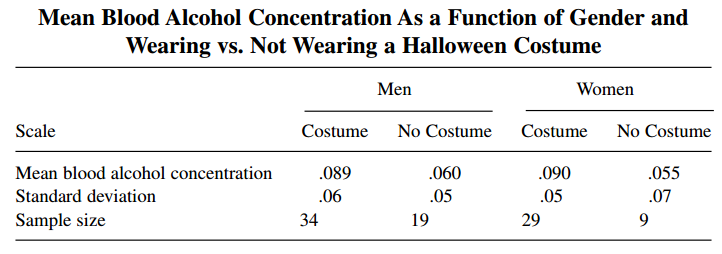
Psychologist Kent Glindemann and colleagues took measures of the blood alcohol concentration of college students on Halloween and a comparative non-holiday. As a measure of their investment in the celebration, the researchers also indicated whether the student was in costume on Halloween and asked the subject how much time and effort they spent putting it together.

They found that students on Halloween were significantly more intoxicated than they were on the non-holiday, significantly more intoxicated if they were in costume, and significantly more intoxicated if they had invested more versus less time in their appearance.

4

Glindemann and his colleagues theorize that the Halloween costume mediates the intent to celebrate, but costumes may also have an independent effect. Social work professor John D. Clapp and his colleagues studied non-holiday-related college parties. Such parties often have themes that encourage students to dress up. In theory, the themes apply to all students but in practice women dress up far more often than men.

Clapp and his colleagues found that women tested at themed parties had higher rates of intoxication than women at non-theme parties. Women may be de-inhibited by the costumes themselves or the costumes may make the party feel more like an alcoholiday.

Happy Halloween everybody! Celebrate safely!

Lisa Wade, PhD is an Associate Professor at Tulane University. She is the author of American Hookup, a book about college sexual culture; a textbook about gender; and a forthcoming introductory text: Terrible Magnificent Sociology. You can follow her on Twitter and Instagram.
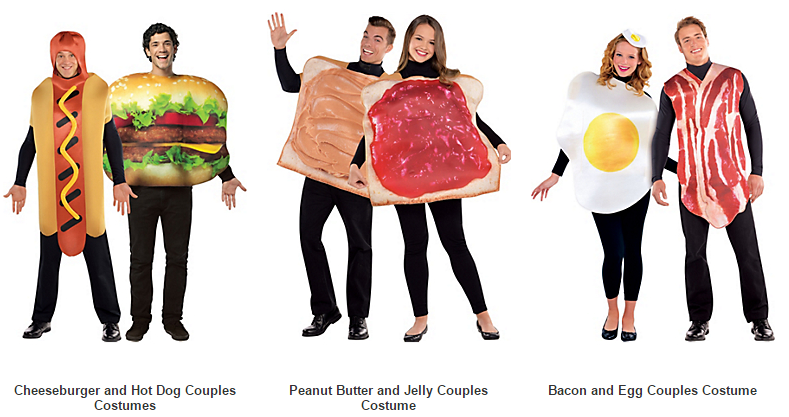
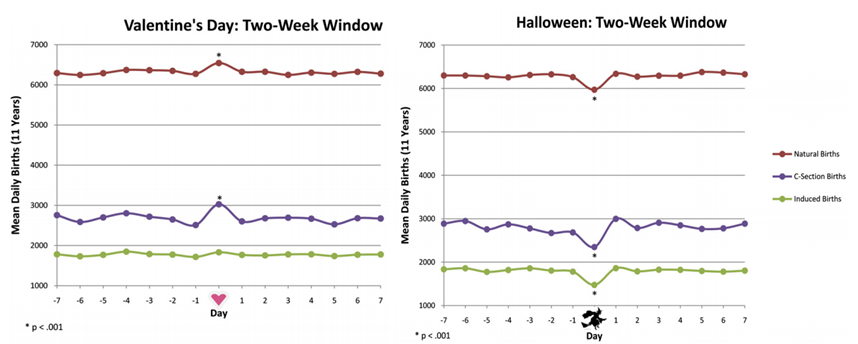
“Future research is needed to identify the process,” write the authors, but it appears that pregnant women have some control over when they give birth. A study of birth incidence on Halloween and Valentine’s Day, by public health scholar Becca Levy and colleagues, showed that spontaneous births dipped on the former and rose on the latter.

2

The authors suggest that this contributes to growing evidence that culture influences birth timing. Women’s bodies resist giving birth on a day associated with fright and death, but give into birth on a day associated with love. The authors recommend extra staffing on obstetric wards on Valentine’s Day and sending a few more doctors and nurses into the streets on Halloween.

Lisa Wade, PhD is an Associate Professor at Tulane University. She is the author of American Hookup, a book about college sexual culture; a textbook about gender; and a forthcoming introductory text: Terrible Magnificent Sociology. You can follow her on Twitter and Instagram.