Search results for The

Flashback Friday.

The AP has an interesting website about wildfires from 2002 to 2006. Each year, most wildfires occurred west of the Continental Divide. Many of these areas are forested. Others are desert or shortgrass prairie.

There are a lot of reasons for wildfires–climate and ecology, periodic droughts, humans. The U.S. Fish and Wildlife Service reports that in the Havasu National Wildlife Refuge, the “vast majority” of wildfires are due to human activity. Many scientists expect climate change to increase wildfires.

Many wildfires affect land managed by the Bureau of Land Management. For most of the 1900s, the BLM had a policy of total fire suppression to protect valuable timber and private property.

Occasional burns were part of forest ecology. Fires came through, burning forest litter relatively quickly, then moving on or dying out. Healthy taller trees were generally unaffected; their branches were often out of the reach of flames and bark provided protection. Usually the fire moved on before trees had ignited. And some types of seeds required exposure to a fire to sprout.

Complete fire suppression allowed leaves, pine needles, brush, fallen branches, etc., to build up. Wildfires then became more intense and destructive: they were hotter, flames reached higher, and thicker layers of forest litter meant the fire lingered longer.

As a result, an uncontrolled wildfire was often more destructive. Trees were more likely to burn or to smolder and reignite a fire several days later. Hotter fires with higher flames are more dangerous to fight, and can also more easily jump naturally-occurring or artificial firebreaks. They may burn a larger area than they would otherwise, and thus do more of the damage that total fire suppression policies were supposed to prevent.

In the last few decades the BLM has recognized the importance of occasional fires in forest ecology. Fires are no longer seen as inherently bad. In some areas “controlled burns” are set to burn up some of the dry underbrush and mimic the effects of naturally-occurring fires.

But it’s not easy to undo decades of fire suppression. A controlled burn sometimes turns out to be hard to control, especially with such a buildup of forest litter. Property owners often oppose controlled burns because they fear the possibility of one getting out of hand. So the policy of fire suppression has in many ways backed forest managers into a corner: it led to changes in forests that make it difficult to change course now, even though doing so might reduce the destructive effects of wildfires when they do occur.

Given this, I’m always interested when wildfires are described as “natural disasters.” What makes something a natural disaster? The term implies a destructive situation that is not human-caused but rather emerges from “the environment.” As the case of wildfires shows, the situation is often more complex than this, because what appear to be “natural” processes are often affected by humans… and because we are, of course, part of the environment, despite the tendency to think of human societies and “nature” as separate entities.

Originally posted in 2010.

Gwen Sharp is an associate professor of sociology at Nevada State College. You can follow her on Twitter at @gwensharpnv.
A new tumblr titled Every Word Spoken posted a quote from George Gerbner that goes like this:

Representation in the fictional world signifies social existence; absence means symbolic annihilation.

It’s the rallying cry for writer and performer Dylan Marron, who runs the tumblr. It’s exactly what it sounds like: a movie cut down to feature just the lines spoken by non-white people. He’s just getting started, but it looked to me like so far the longest clip is less than 1 minute long, most are around 30 seconds and this includes a few seconds at the beginning of each where they show the title.

In addition to showing us that people of color with speaking roles are almost non-existent — symbolically annihilated — the roles they play tell disturbing stories. Overwhelmingly, in the videos he’s picked so far, they are in service occupations (500 Days of Summer); literally maids (Enough Said); or with stereotypical accents (Wedding Crashers). And, oh hey movie people, making the only person of color with lines a doctor (The Fault in Our Stars; Black Swan) gets you no bonus points in my book. Nice try.

But THESE. These were the best ones…

Noah:

Into the Woods:

This project is calling out the movie industry in a simple, powerful way. Just the facts, ma’am. Time for change.

Lisa Wade, PhD is an Associate Professor at Tulane University. She is the author of American Hookup, a book about college sexual culture; a textbook about gender; and a forthcoming introductory text: Terrible Magnificent Sociology. You can follow her on Twitter and Instagram.

Flashback Friday.

The common sense assumption about success in sport often involves the belief that success is a result of innate talent and intensive practice. The more of both you have, the better you are. However, who is good at a particular sport is also the result of how that sport is organized. Sports have rules and those rules are made by the people who have the power to enforce their own ideas about what the rules should be over and against less powerful people with other ideas.

Long distance ski jumpers benefit from maximizing their surface area while simultaneously decreasing their weight. The less they weigh and the more drag they can produce, the farther they go. Their bodies are the primary source of weight and, as a result, there is incredible pressure for competing ski jumpers to be as thin as possible.

After criticism that the sport was creating an incentive for disordered eating, the International Ski Federation began penalizing jumpers who had a body mass index below 20. These skiers were required to jump with shorter skis, the primary source of drag. The hope was that the shorter skis would balance out the incentive for thinness, allowing jumpers to be competitive without starving themselves.

So, who wins isn’t only related to talent and practice. It is also a consequence of rules that no longer make the ability to train while starving oneself an advantage. This is a great example of the way that we write rules that shape the context for success in a sport.

—————————————

In light of this, it’s really interesting to consider the fact that ski jumping was the last Olympic event that excluded women. Women were given their first ski jumping event in 2014, though they still have one and the men have three.

The International Olympics Committee and the International Ski Federation listed a myriad of reasons for this, ranging from claims that the sport is not yet developed enough, to the idea that adding women would crowd an already overwhelmed Olympic schedule, to the assertion that the sport is not “…appropriate for ladies from a medical point of view.”

The rationales seem transparently thin, leading to the suggestion that the real reason that women weren’t allowed to compete — and still aren’t on parity with men — is because they might kick ass. If being lighter is an advantage, then women might beat men at the sport. In fact, during the time women’s future in Olympic ski jumping was being debated, the world record holder on the ski jump track at that year’s Olympics was held by a woman: Lindsey Van.

Sociologists recognize sport as a terrain on which social claims about gender are demonstrated. Not letting women play is one way that the mythology of men’s physical dominance has been maintained. Football is an excellent example. Women aren’t allowed to play football, it is asserted, because they are not big enough and would get hurt. Of course, rules that make size so critical to success in football also exclude the majority of men (who aren’t big enough to play either). If we organized football by weight classes, instead of gender, women could play football, and so could all of the men who are excluded as well. But, if we organized football by weight classes, we couldn’t claim that women were too small, weak, and fragile to play it.

It will be interesting to see how the future of women’s ski jumping plays out.

Originally posted in 2010.

Lisa Wade, PhD is an Associate Professor at Tulane University. She is the author of American Hookup, a book about college sexual culture; a textbook about gender; and a forthcoming introductory text: Terrible Magnificent Sociology. You can follow her on Twitter and Instagram.

I usually try to avoid posting videos that are more than five minutes long, but this commentary about trans rights from John Oliver was too great to pass up. He does a wonderful job of introducing what it means to be transgender, as well as discussing:

  • media coverage,
  • the terrible statistics on discrimination and anti-trans violence,
  • the gender binary in institutions and institutional inertia,
  • and the ridiculousness of “bathroom bills.”

Mostly, he just does a great job of talking about how easy it really is to just get over it and treat people like people.

Lisa Wade, PhD is an Associate Professor at Tulane University. She is the author of American Hookup, a book about college sexual culture; a textbook about gender; and a forthcoming introductory text: Terrible Magnificent Sociology. You can follow her on Twitter and Instagram.

Flashback Friday.

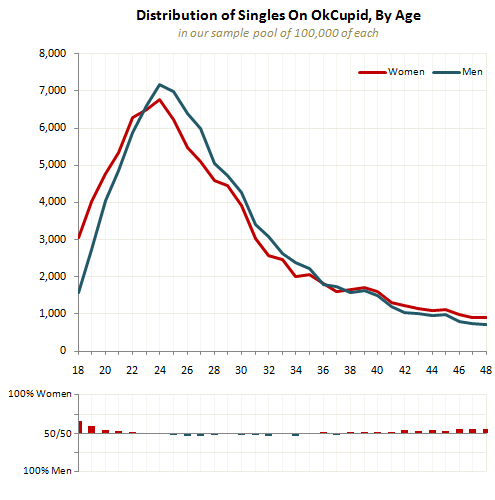
The number crunchers at OK Cupid recently looked at how age preferences disadvantage older women on the site.  First, the post’s author, Christian Rudder, points out, the distribution of singles is pretty matched by sex at most ages:

But that doesn’t necessarily mean that women and men of the same age are reaching out to one another.

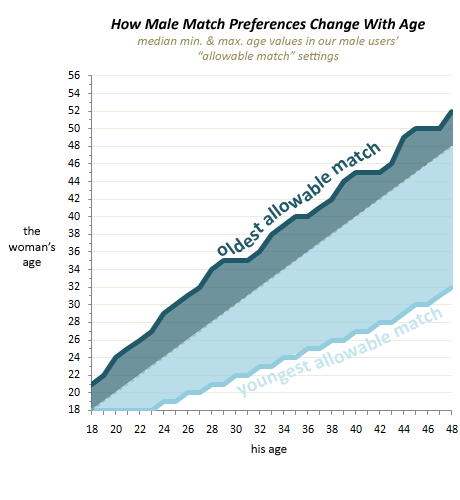
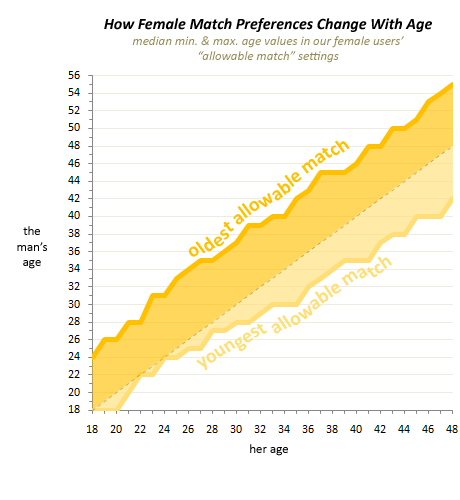
Women at most ages state a preference to date men who are up to eight years older or eight years younger:

But men show a decided preference for younger women, especially as the men get older:And, Rudder notes, men target their messages to women even younger than their stated preference.  In this figure, the greenest areas represent where men are sending more messages and the red areas are where they are sending less:

So, even though men and women are more-or-less proportionately represented on the site, men’s decided preference for younger women makes for many fewer potential dates for older women.

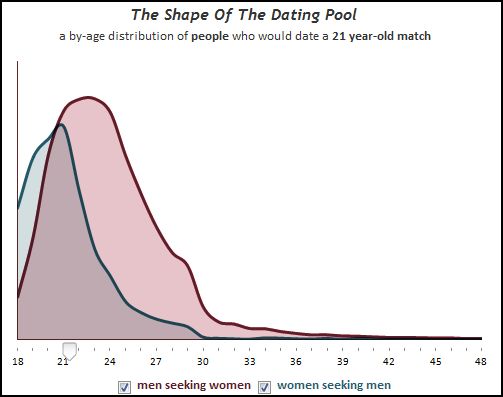
Here’s what the dating pool looks like for 21-year-olds (the blue = men seeking women who are 21; the pink = women seeking men who are 21):

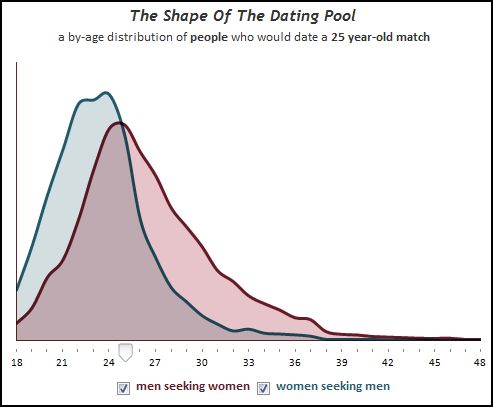
For 25 year olds:

For 30 year olds:

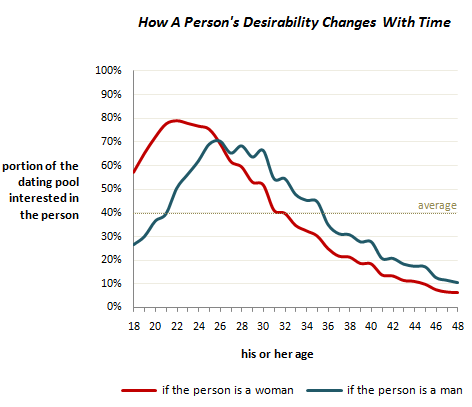
Rudder offers this summary measuring how a person’s desirability changes over time:

He writes:

…we can see that women have more pursuers than men until age 26, but thereafter a man can expect many more potential dates than a woman of the same age. At the graph’s outer edge, at age 48, men are nearly twice as sought-after as women.

Thus opportunities for dating are shaped by the intersection of gender and age to the detriment of women over 26 and men under 26.

Originally posted in 2010.

Lisa Wade, PhD is an Associate Professor at Tulane University. She is the author of American Hookup, a book about college sexual culture; a textbook about gender; and a forthcoming introductory text: Terrible Magnificent Sociology. You can follow her on Twitter and Instagram.

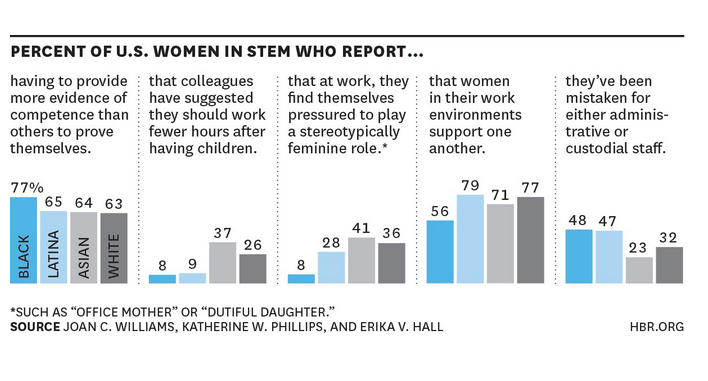
A new survey of 557 female scientists found widespread experiences of discrimination and alienation in the workforce that varied in interesting ways by race.7

While all types of women reported experiencing these forms of discrimination in large numbers — and 100% of a sub-sample of 60 interviewed for the study reported at least one — the race differences are interesting:

  • Black women were especially likely to need to prove and re-prove competence.
  • Asian and white women, especially, received pressure to withdraw from the workplace after having children.
  • Asian women were most likely to be pushed to perform a stereotypically feminine role in the office, followed by white and then Latina women. Black women rarely reported this.
  • Latina and white women were most likely to feel supported by other women in the workforce; Black women the least.
  • And almost half of Black and Latina women had been mistaken for janitors or administrative assistants, compared to a third of white women and a quarter of Asian women.

The study, by law professor Joan Williams and two colleagues, can be found here.

Lisa Wade, PhD is an Associate Professor at Tulane University. She is the author of American Hookup, a book about college sexual culture; a textbook about gender; and a forthcoming introductory text: Terrible Magnificent Sociology. You can follow her on Twitter and Instagram.

SocImages News:

Phew. What a month.

You like!  Here are our most appreciated posts this month:

Thanks everybody!

Editor’s pick:

Top post on Tumblr this month:

With over 15,000 likes and shares, I’m so happy to be helping bring awareness to this issue. At Tumblr, this month’s top post: Defensive architecture aimed at the homeless as a deliberate, considered kind of cruelty.

Social Media ‘n’ Stuff:

Finally, this is your monthly reminder that SocImages is on TwitterFacebookTumblrGoogle+, and Pinterest.  I’m on Facebook and most of the team is on Twitter: @lisawade@gwensharpnv@familyunequal, and @jaylivingston.

Finally…

Bye-bye June 2015; we’ll remember you forever.

12

Lisa Wade, PhD is an Associate Professor at Tulane University. She is the author of American Hookup, a book about college sexual culture; a textbook about gender; and a forthcoming introductory text: Terrible Magnificent Sociology. You can follow her on Twitter and Instagram.

I was on jury duty this week, and the greatest challenge for me was the “David Brooks temptation” to use the experience to expound on the differences in generations and the great changes in culture and character that technology and history have brought.

I did my first tour of duty in the 1970s. Back then you were called for two weeks. Even if you served on a jury, after that trial ended, you went back to the main jury room. If you were lucky, you might be released after a week and a half. Now it’s two days.

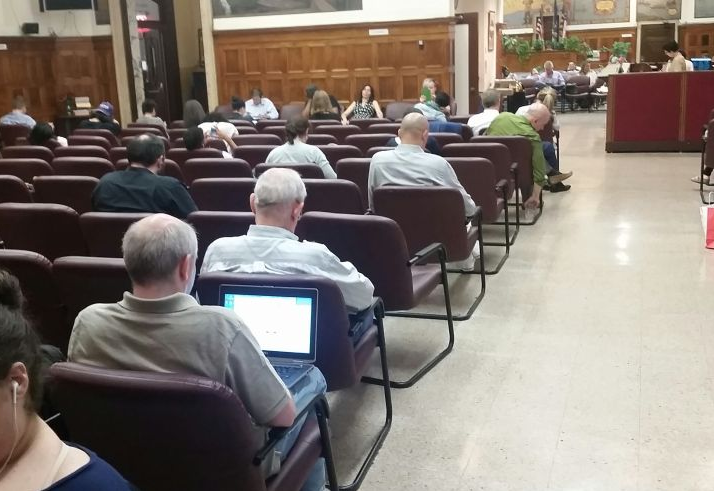
What most struck me most this time was the atmosphere in the main room. Now, nobody talks. You’re in a large room with maybe two hundred people, and it’s quieter than a library. Some are reading newspapers or books, but most are on their latops, tablets, and phones. In the 1970s, it wasn’t just that there was no wi-fi, there was no air conditioning. Remember “12 Angry Men”? We’re in the same building. Then, you tried to find others to talk to. Now you try to find a seat near an electric outlet to connect your charger.

2 (1)

I started to feel nostalgic for the old system. People nowadays – all in their own narrow, solipsistic worlds, nearly incapable of ordinary face-to-face sociability. And so on.

But the explanation was much simpler. It was the two-day hitch. In the old system, social ties didn’t grow from strangers seeking out others in the main jury room. It happened when you went to a courtroom for voir dire. You were called down in groups of forty. The judge sketched out the case, and the lawyers interviewed the prospective jurors. From their questions, you learned more about the case, and you learned about your fellow jurors – neighborhood, occupation, family, education, hobbies. You heard what crimes they’d been a victim of.  When judge called a break for bathroom or lunch or some legal matter, you could find the people you had something in common with. And you could talk with anyone about the case, trying to guess what the trial would bring. If you weren’t selected for the jury, you went back to the main jury room, and you continued the conversations there. You formed a social circle that others could join.

This time, on my first day, there were only two calls for voir dire, the clerk as bingo-master spinning the drum with the name cards and calling out the names one by one. My second day, there were no calls. And that was it. I went home having had no conversations at all with any of my fellow jurors. (A woman seated behind me did say, “Can you watch my laptop for a second?” when she went to the bathroom, but I don’t count that as a conversation.)

I would love to have written 800 words here on how New York character had changed since the 1970s.  No more schmoozing. Instead we have iPads and iPhones and MacBooks destroying New York jury room culture – Apple taking over the Apple. People unable or afraid to talk to one another because of some subtle shift in our morals and manners. Maybe I’d even go for the full Brooks and add a few paragraphs telling you what’s really important in life.

But it was really a change in the structure. New York expanded the jury pool by eliminating most exemptions. Doctors, lawyers, politicians, judges – they all have to show up. As a result, jury service is two days instead of two weeks, and if you actually are called to a trial, once you are rejected for the jury or after the trial is over, you go home.

The old system was sort of like the pre-all-volunteer army. You get called up, and you’re thrown together with many kinds of people you’d never otherwise meet. It takes a chunk of time out of your life, but you wind up with some good stories to tell. Maybe we’ve lost something. But if we have lost valuable experiences, it’s because of a change in the rules, in the structure of how the institution is run, not a because of a change in our culture and character.

Cross-posted  at Montclair Socioblog.

Jay Livingston is the chair of the Sociology Department at Montclair State University. You can follow him at Montclair SocioBlog or on Twitter.