Search results for The

As the 2016 presidential campaign enters the final stretch, Donald Trump has doubled down on his hard-line stance on immigration. In his August 31st immigration policy speech, Trump proposed implementing extreme vetting and employing a deportation force, and opposed amnesty for more than 11 million undocumented immigrants already in the U.S. Polling by Latino Decisions, a leader in Latino political opinion research, indicates Trump’s current poll numbers among Latinos have slipped to 19%. However, given Trump’s proposed policies and charged rhetoric against Latinos, it might seem perplexing that even that many Latinos still support Trump.

Recently on MSNBC’s All in With Chris Hayes, Joy Reid asked Latinos for Trump co-founder Marco Gutierrez whether Trump’s immigration policies would fundamentally drive Latinos away from the Republican party. Gutierrez replied that Trump’s message was “tough” but necessary; asked to clarify, he responded with the comment that immediately spawned a new internet meme:

My [Mexican] culture is a very dominant culture. And it’s imposing. And it’s causing problems. If you don’t do something about it, you’re gonna have taco trucks every corner.

Gutierrez defended his assessment, saying “you guys defend a Mexico that doesn’t exist anymore. There is a new Mexico that’s rising with crime and we need to stop that. And that stops right here [in America].”

His comments illustrate important concepts related to the psychology of ethnic identity. First, people differ in how strongly they affiliate with their Mexican or Latino identity; some feel more strongly identified and others less so. Second, Latinos in the U.S. navigate two cultural identities: their ethnic identity and their American identity. And these identity differences are linked to political ideology.

My co-authors and I asked 323 U.S.-born Mexican Americans about their political ideology and socioeconomic status, the strength of their identification with Mexican and American cultures, and their attitudes toward acculturating to American culture. Those who strongly identified with Mexican culture were more likely to support the integration of both their Mexican and American identities into one unified identity, such as maintaining their own cultural traditions while also adapting to Anglo-American customs. These leaned more liberal. In contrast, those who held weak Mexican identification were more likely to support full assimilation to American culture. These were more moderate or conservative in their ideologies.

Their socioeconomic status also influenced their political ideology. Those with higher socioeconomic status were significantly less liberal, but this was most true for those participants who both belonged to higher social classes and had the weakest identification with Mexican culture.

This may explain why some Latinos aren’t put off by Trump’s anti-immigrant rhetoric. Latinos who support Trump may feel less strongly identified with their ethnic culture and have a stronger desire to identify with American culture. They probably also believe that other Latinos should assimilate fully into American culture and minimize ties or connections to their heritage culture. These beliefs comport with Trump’s message that immigrants need to “successfully assimilate” in order to join our country.

Given that Mexican Americans with a strong ethnic identification were more likely to be liberal and support biculturalism over assimilation attitudes, it’s quite unlikely that Trump will be successful in winning over many Latino constituents who don’t already support him. In fact, being photographed eating taco salad and exclaiming “I love Hispanics!” could backfire with  conservative Latinos who do support him because that type of appeal makes salient a cultural identity that is unimportant to them, or worse, lumps them into a cultural group they have actively sought to minimize.

Laura P. Naumann, PhD is a personality psychologist who teaches in the Department of Social Sciences at Nevada State College. Her research interests include the expression and perception of personality as well as individual differences in racial/ethnic identity development. You can learn more about her here.

How are media sources from opposing sides of the political spectrum covering the election? Most of us have no idea. We live in a media “bubble,” one in which we usually only consume “friendly” material: news and opinion from outlets and commentators who share our lean.

At Facebook, employees followed a sample of 10.1 million users who publicly identified their political leanings. They then looked at the forces that created the bubble: (1) “ideological homophily,” the degree to which friends shared the same leanings; (2) Facebook’s algorithm, feeding you things it thinks you want to see; (3) and click-through behavior, which links were ignored and which attracted interaction.

They concluded that “individuals’ choices played a stronger role in limiting exposure” to politically diverse content than did their algorithm. (You can get the data yourself here.)

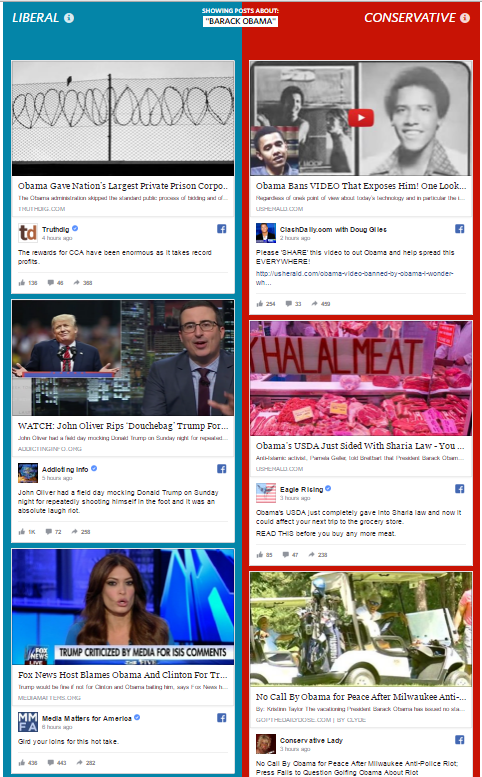
At the Wall Street Journal, you can take a look at these different media bubbles side-by-side. They frame the data as what you might see in your Facebook feed if most of your friends identify as “very liberal” or “very conservative.” More broadly, what the data represents is the use of Facebook data as an insight into the bigger media bubbles we all live in both on- and off-line.

Here’s the first four results for posts about “Barack Obama”:

1

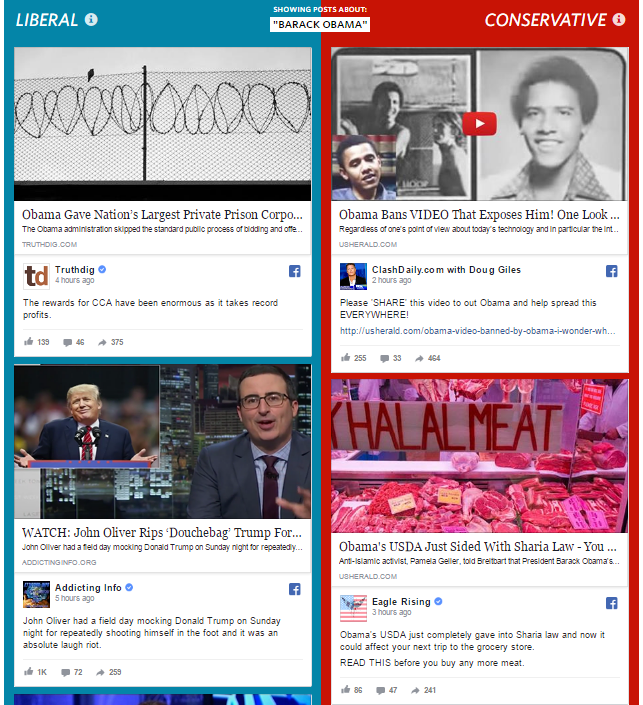
On the left you have a critical article about Obama’s light treatment of private prison corporations, but also a headline calling Donald Trump a “douchebag.” On the right you have a link to a video “banned by Obama himself” which purports to out him as an Islamist and a communist and a headline that says that Obama “gave into Sharia law.”

Liberal-leaning and conservative-leaning headlines and updates related to Donald Trump and Hillary Clinton read like this:

Liberal: “Clinton surges past 270 electoral votes…”

Conservative: “After Leading by 18 Points — Hillary’s Lead Over Trump Shrinks to Margin-of-Error”

Liberal: “Reagan’s Son Says His Dad Would be ‘Humiliated’ by Trump”

Conservative: “FBI Caves: Will Hand Over Notes from Clinton Interview”

Liberal: “Fox News is the Origin Story of Trump’s Bigotry”

Conservative:”Hillary Mobilizes Illegal Army”

Liberal: “Brian Stelter Blasts Sean Hannity for Spreading Conspiracy Theories Regarding Clinton’s Health”

Conservative: “Trump Releases Bombshell Report Linking Obama and Hillary to Rise of ISIS”

You get the picture.

It’s interesting that the narrative of America being a united country is so widely promulgated by both liberal and conservative sides alike. If the politicians really want us to come together (and I doubt they do), the media isn’t helping. Granted, these are the extremes, but the sources on the side I oppose look like delusional conspiracy hubs to me, whereas I recognize many of the outlets on the side to which I lean. To me, those are “good” news sources, ones I count on. Presumably someone on the other side would feel the same about theirs and be equally horrified about mine.

The stories these different sources tell are not compatible. The “very liberal” and “very conservative” side are two wholly different worlds. It’s no wonder each side has such a difficult time understanding the other. I fear what it means about the future of our democracy.

Lisa Wade, PhD is an Associate Professor at Tulane University. She is the author of American Hookup, a book about college sexual culture; a textbook about gender; and a forthcoming introductory text: Terrible Magnificent Sociology. You can follow her on Twitter and Instagram.

Today is Labor Day in the U.S. Though many think of it mostly as a last long weekend for recreation and shopping before the symbolic end of summer, the federal holiday, officially established in 1894, celebrates the contributions of labor.

Here are some SocImages posts on a range of issues related to workers, from the history of the labor movement, to current workplace conditions, to the impacts of the changing economy on workers’ pay:

The Social Construction of Work

Work in Popular Culture

Unemployment, Underemployment, and the “Class War”

Unions and Unionization

Economic Change, Globalization, and the Great Recession

Work and race, ethnicity, religion, and immigration

Gender and Work

The U.S. in International Perspective

Academia

Just for Fun

Bonus!

Lisa Wade, PhD is an Associate Professor at Tulane University. She is the author of American Hookup, a book about college sexual culture; a textbook about gender; and a forthcoming introductory text: Terrible Magnificent Sociology. You can follow her on Twitter and Instagram.

On this anniversary of Hurricane Katrina, all of Louisiana is reeling from this month’s floods. A third of the state has been declared a disaster area. Here in New Orleans we were spared, but we are opening our hearts, pocketbooks, and homes to our neighbors. It is in this time of crisis that we remember the day that Katrina devastated the Gulf Coast and side-swiped New Orleans, breaching and breaking the levees.

Was Hurricane Katrina a “Natural” Disaster?

Racism and Neglect

Disaster and Discourse

Devastation and Rebuilding

Cultural appropriation generally refers to the adoption of traditional practices, objects, or images by a person or group that is not part of the originating culture. Cultural appropriation can become problematic when it is done without permission, serves to benefit the dominant group, and erases or further marginalizes the oppressed group. In this way, cultural appropriation can recreate larger structures of inequality.

On a recent stroll through a duty-free shop, I was introduced to one of these problematic examples in the form of a new Canadian product named “Totem Vodka,” packaged in a bottle resembling a totem pole. Totem Vodka is not a product of Indigenous entrepreneurship. Instead it is a form of problematic cultural appropriation. Here’s why:

First Nations Erasure

Totem poles are important symbolic creations of some First Nations families in Canada’s Pacific Northwest. They are symbols of family lineage that serve to document stories or histories of people, communities or clans. The Totem Vodka bottle and marketing images erases these families, while appropriating their symbols.


The bottle stopper is shaped like a Thunderbird, a supernatural bird who causes thunder and lightning according to First Nations mythology. The Thunderbird crest is traditionally carved on the totem poles of people from the Thunderbird clan of the Kwakwaka’wakw nations (on Vancouver Island). The origin of the Thunderbird (and totem poles) within Pacific Northwest First Nations communities is absent from the company’s description of the bottle’s design and construction. Instead, the bottle is superficially connected to a wide-array of global references; the bottle was “designed on the West Coast of Canada, moulded by French glassmakers and topped with an Italian-made custom stopper.”

Significantly, the individuals featured in pictures on the company’s Twitter account include few or no indigenous people.

First Nations Exploitation

The owner of Totem Distilleries is a wealthy white entrepreneur and proceeds from the vodka help support a wildlife rescue association without any First Nations connection.

Settler societies have, paradoxically, both outlawed the sacred work of totem pole carving by indigenous peoples and exploited it for their own profit. In this case, the totem pole is used as an aesthetic tool to distinguish the vodka as authentically “Canadian,” while reproducing an abstracted, exotified, and ultimately false vision of indigeneity. First Nations people in Canada have rarely been either credited or compensated for the use of their cultural symbol.

The example of Totem vodka fits within a larger pattern of racism and colonial exploitation of indigenous people. We can look to the historical effects of colonization in Canada to see how attempts to erase Indigenous culture, while simultaneously exploiting it for the benefit of colonizers, has led to systemic discrimination, exclusionary policies and neglect that continue into the present day. Using a totem pole as a vodka bottle symbolizes this larger, patterned systems of inequality.

Alexandra Rodney is a PhD candidate in the Department of Sociology at the University of Toronto. She teaches Cultural Sociology and researches in the areas of food, gender and health. You can read more of Alexandra’s work on her website or follow her on Twitter

A special thank-you to Josée Johnston and Samantha Maskwa for their feedback on this post. Samantha is of Cree, Ojibway and Celtic ancestry. Her family is from the Rice Lake area and the southern part of Turtle Island and she is Bear clan. In addition to her midwifery degree, she is also completing a minor in Sociology and an Aboriginal Knowledges and Experiences certificate at Ryerson University in Toronto.

Flashback Friday.

I heard stories this week about dung beetles and cuttlefish.  Both made me think about the typical stories we hear in the media about evolved human mating strategies.  First, the stories:

—————————-

Story #1 :The Dung Beetle

Photo from flickr by Camilo Hdo.
Photo by Camilo Hdo, retrieved from flickr.

A story on Quirks and Quarks discussed the mating strategies of the dung beetle.  The picture above is of a male beetle; only the males have those giant horns.  He uses it to defend the entrance to a tiny burrow in which he keeps a female.  He’ll violently fight off other dung beetles who try to get access to the burrow.

So far this sounds like the typical story of competitive mating that we hear all the time about all kinds of animals, right?

There’s a twist: while only male dung beetles have horns, not all males have horns.  Some are completely hornless.  But if horns help you win the fight, how is hornlessness being passed down genetically?

Well, it turns out that when a big ol’ horned male is fighting with some other big ol’ horned male, little hornless males sneak into burrows and mate with the females.  They get discovered and booted out, of course, and the horned male will re-mate with the female with the hopes of displacing his sperm.

But.

Those little hornless males have giant testicles, way gianter than the horned males.  While the horned males are putting all of their energy into growing horns, the hornless males are making sperm.  So, even though they have limited access to females, they get as much mileage out of their access as they can.

The result: two distinct types of male dung beetles with two distinct mating strategies.

———————————

Story #2: The Giant Australian Cuttlefish

846693304_2d180b3fff_z
Photo by Paul Oughton, retrieved from Flickr.

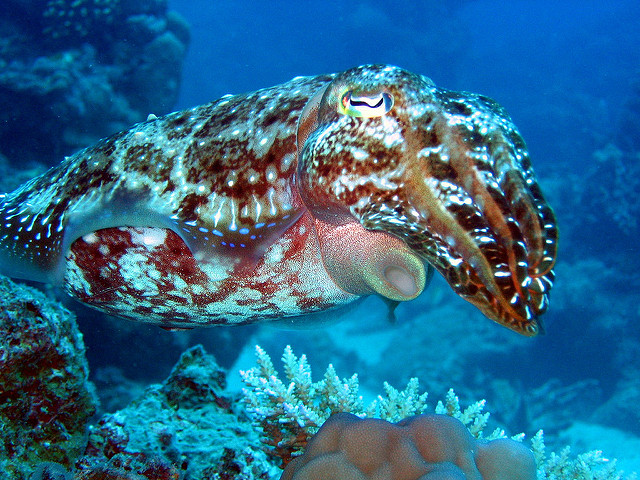
The Naked Scientists podcast featured a story about Giant Australian Cuttlefish.  During mating season the male cuttlefish, much larger than the females, collect “harems” and spend their time mating and defending access.  Other males try to “muscle in,” but the bigger cuttlefish “throws his weight around” to scare him off. The biggest cuttlefish wins.

So far this sounds like the typical story of competitive mating that we hear all the time about all kinds of animals, right?

Well, according The Naked Scientists story, researchers have discovered an alternative mating strategy.  Small males, who are far too small to compete with large males, will pretend to be female, sneak into the defended territory, mate, and leave.

How do they do this?  They change their color pattern and rearrange their tentacles in a more typical female arrangement (they didn’t specify what this was) and, well, pass.  The large male thinks he’s another female. In the video below, the cuttlefish uses his ability to change the pattern on his body. He simultaneously displays a male pattern to the female and a female pattern to the large male on the other side.

———————————

So, can the crossdressing cuttlefish and dodge-y dung beetle tell us anything about evolved human mating strategies?

Probably not.

But I do think it tells us something about how we should think about evolution and the reproduction of genes. If you listen to the media cover evolutionary psychological explanations of human mating, you only hear one story about the strategies that males use to try to get sex. That story sounds a lot like the one told about the horned beetle and the large male cuttlefish.

But these species have demonstrated that there need not be only one mating strategy. In these cases, there are at least two. So, why in Darwin’s name would we assume that human beings, in all of their beautiful and incredible complexity, would only have one? Perhaps we see a diversity in types of human males (different body shapes and sizes, different intellectual gifts, etc) because there are many different ways to attract females. Maybe females see something valuable in many different kinds of males! Maybe not all females are the same!

Let’s set aside the stereotypes about men and women that media reporting on evolutionary psychology tends to reproduce and, instead, consider the possibility that human mating is at least as complex as that of dung beetles and cuttlefish.

Originally posted in 2010.

Lisa Wade, PhD is an Associate Professor at Tulane University. She is the author of American Hookup, a book about college sexual culture; a textbook about gender; and a forthcoming introductory text: Terrible Magnificent Sociology. You can follow her on Twitter and Instagram.

Signaling white supremacy.

On the heels of the Republican national convention, the notorious KKK leader David Duke announced his campaign for the Louisiana Senate. On his social media pages, he released a campaign poster featuring a young white woman with blonde hair and blue eyes wearing a gray tank top decorated with American flag imagery. She is beautiful and young, exuding innocence. Atop the image the text reads “fight for Western civilization” and included David Duke’s website and logo. It does not appear that she consented to being on the poster.

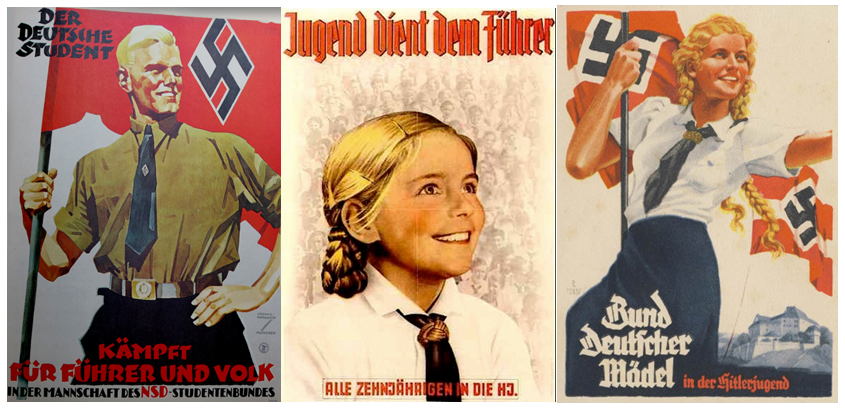
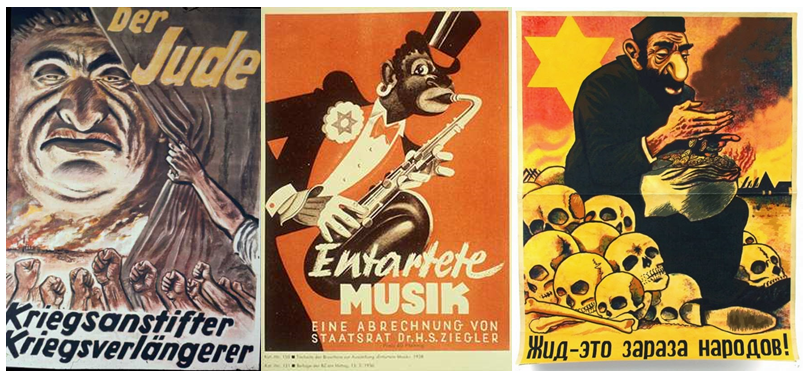
When I came upon the image, I was immediately reminded of pro-Nazi propaganda that I had seen in a museum in Germany, especially those depicting “Hitler youth.” Many of those posters featured fresh white faces, looking healthy and clean, in stark contrast to the distorted, darkened, bloated, and snarling faces of the targets of the Nazi regime.

7

8

It’s different era, but the implied message of Duke’s poster is the same — the nationalist message alongside the idealized figure — so it wasn’t difficult to find a Nazi propaganda poster that drew the comparison. I tweeted it out like this:

Given that David Duke is an avowed racist running on a platform to save “Western” civilization, it didn’t seem like that much of a stretch.

Provoking racist backlash.

I hashtagged it with #davidduke and #americafirst, so I can’t say I didn’t invite it, but the backlash was greater than any I have ever received. The day after the tweet, I easily got one tweet per minute, on average.

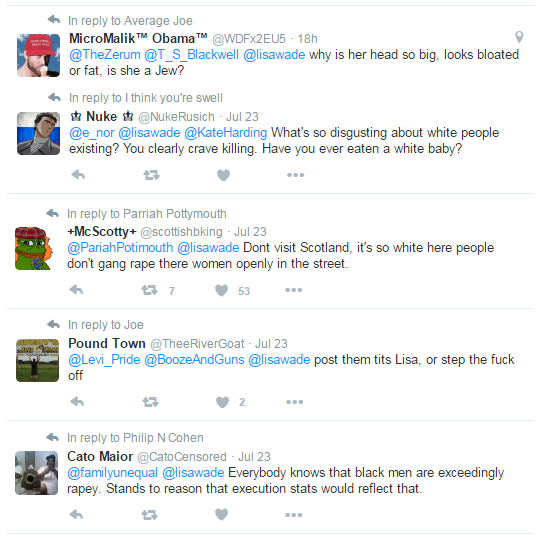
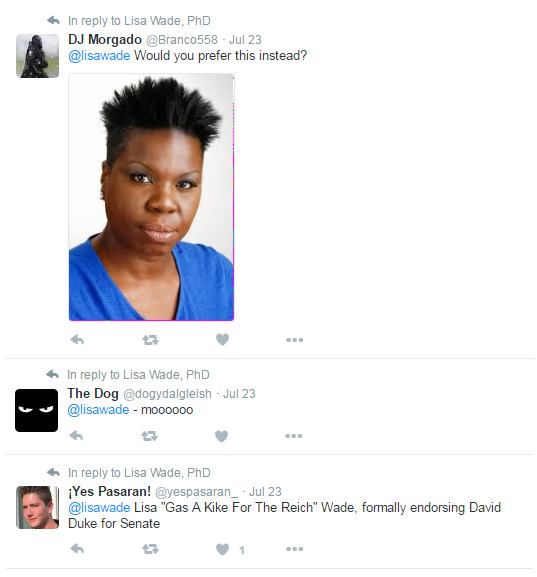
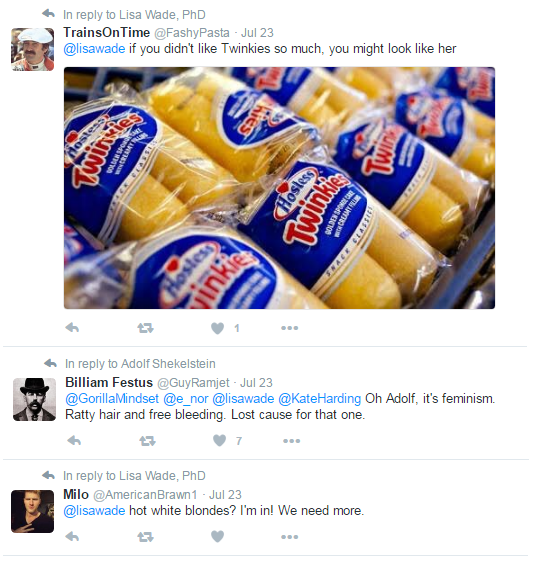
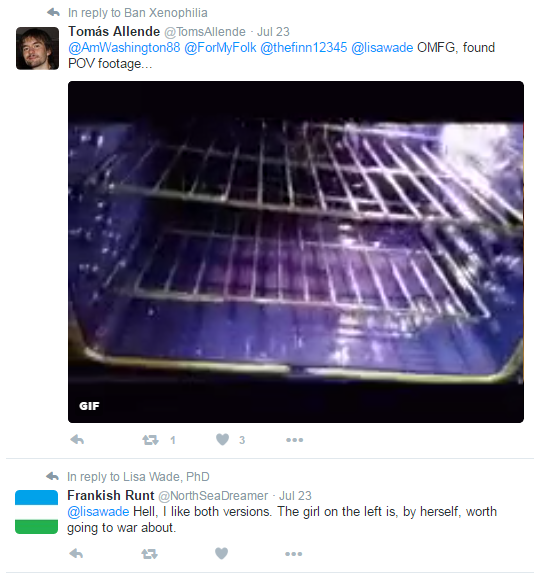
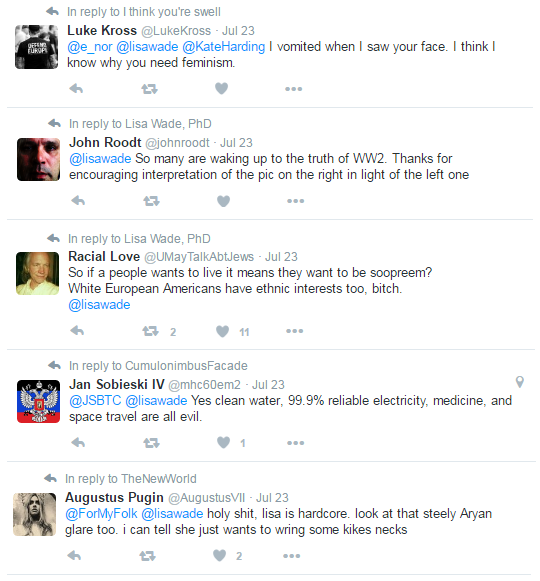
What I found fascinating was the range of responses. I was told I looked just like her — beautiful, blue-eyed, and white — was asked if I hated myself, accused of being a race traitor, and invited to join the movement against “white genocide.” I was also told that I was just jealous: comparatively hideous thanks to my age and weight. Trolls took shots at sociology, intellectuals, and my own intelligence. I was asked if I was Jewish, accused of being so, and told to put my head in an oven. I was sent false statistics about black crime. I was also, oddly, accused of being a Nazi myself. Others, like Kate Harding, Philip Cohen, and even Leslie Jones, were roped in.

Here is a sampling (super trigger warning for all kinds of hatefulness):

1011 12 13 14

It’s not news that twitter is full of trolls. It’s not news that there are proud white supremacists and neo-nazis in America. It’s not news that women online get told they’re ugly or fat on the reg. It’s not news that I’m a (proud) cat lady either, for what it’s worth. But I think transparency is our best bet to get people to acknowledge the ongoing racism, antisemitism, sexism, and anti-intellectualism in our society. So, there you have it.

Lisa Wade, PhD is an Associate Professor at Tulane University. She is the author of American Hookup, a book about college sexual culture; a textbook about gender; and a forthcoming introductory text: Terrible Magnificent Sociology. You can follow her on Twitter and Instagram.

Flashback Friday. 

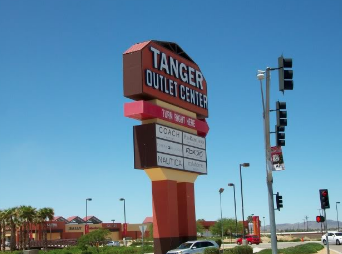
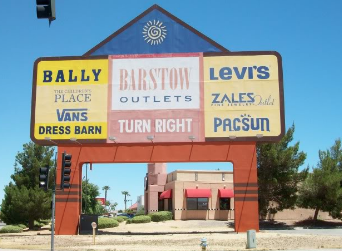
Outlet malls are often in the middle of nowhere, in places that are hard to get to, or in places that you wouldn’t think of as retail magnets. For instance, you’ve got the outlet mall in Barstow, California:

Barstow is roughly mid-way between L.A. and Las Vegas, so locating it there might be a smart move to try to get some of the weekend traffic between the two cities. And there are some logical reasons you might want to locate outlets in places like Barstow: by putting them in outlying cities, you make sure they don’t overlap too much with the customer base for the main stores, potentially stealing customers who would otherwise pay full-price for new products rather than going to the outlet. You want the outlet to be complement the regular store, not compete with it.

And aside from that, surely real estate is cheaper in Barstow than in either L.A. or Las Vegas, which would keep costs down for building or renting retail space.

That’s part of the story. But there’s some interesting psychology going on, too, as Ellen Ruppel Shell explains in Cheap: The High Cost of Discount Culture. It turns out that being difficult to get to is, in fact, part of the appeal of outlet malls. The fact that they often require a drive of an hour or more signals to consumers that they must have really good deals. That’s the payoff for inconvenience — it’s harder and more time-consuming than going to your local mall, but in return you’re getting a great bargain. Right?

Well… not really. I remember driving two hours once to go to this outlet mall I had heard so much about — friends would go and come back with bags full of clothes, telling me about all the money they’d saved. I got there and was shocked by the prices; they didn’t strike me as particularly cheap at all. I ended up going home without buying anything, trying to figure out how I had missed the great sales racks.

According to Shell, though, that’s pretty typical of outlet malls: they often don’t really provide great bargains. Instead, they provide the illusion of bargains, and a motivation for thinking you’re finding them.

It turns out that the more trouble people go through to get to an outlet, the more they overestimate the amount of savings compared to prices at regular stores. The very fact that it was hard to get to convinces people that it must provide something fantastic; if you aren’t saving a lot of money by going there, why on earth would it be so far out of the way? And the more remote it is, the cheaper the products must be!

Our efforts to understand the placement of outlet malls actually leads us to think we’re getting better deals than we are, because we must be. Otherwise it doesn’t make sense for them to be where they are. And so the location of outlet malls becomes proof that they’re cheap. Why else would they be there?

We have another powerful motivation to believe this. If you’ve driven an hour or more one-way to get great deals at the outlet mall, you are primed to believe you’re getting bargains because otherwise you just wasted a lot of time, effort, and gas for nothing. Once you get there, you’re psychologically motivated to believe your effort was worth it, and you do that by buying stuff and thinking the price is a steal.

As a result of these two factors, research shows that people perceive merchandise found at out-of-the-way outlet malls as being more of a bargain than they do if they see similarly-priced items closer to home. We overestimate what the original value of the item must have been and focus on the difference between that hypothetical price and the outlet price, rather than on the objective price itself. And consumers tend to discount the cost of getting to the outlet, not including the cost of gas and their time into the price of the items they buy.

So the placement of outlet malls isn’t just a simple reaction to real estate prices or an effort to not compete with the regular-priced store. The placement itself is an important element of marketing, signaling to consumers that wonderful bargains await those who are willing to accept a little inconvenience. When you combine this with the meaningless discount, you have a powerful marketing tool, a way to convince consumers they are saving more money, or getting higher-quality products, than they actually are.

Originally posted in 2010.

Gwen Sharp is an associate professor of sociology at Nevada State College. You can follow her on Twitter at @gwensharpnv.