Search results for The

1America woke up this weekend to the news of the Orlando massacre, the deadliest civilian mass shooting in the nation’s history. The senseless tragedy will undoubtedly evoke anger, sadness and helplessness.

In the meantime, many will forget to think and talk about Stanford swimmer Brock Turner’s crime and his “summer vacation” jail sentence: three months for the vile sexual assault of an unconscious woman.

As a sociologist, I was struck not by the abrupt shift to a new moral crisis, but by the continuity. Sociologists look for the bigger picture, and in my mind, Mateen’s crime didn’t displace Turner’s. Yet the media simply replaced one outrage with another, moving our attention away from Stanford and toward Orlando, as if these two crimes were unrelated. They’re not.

Status, masculinity and sexual assault

Brock Turner was an all-American boy: a white, Division I swimmer at one of the nation’s top universities. What he did to his victim was arguably all-American, too, confirmed by decades of research tying rape to a sense of male superiority and entitlement.

I study sex on campus, where sexual violence is perpetrated disproportionately by “high-status” men – fraternity men and certain male athletes in particular. These men are more likely than other men to endorse the sexual double standard, believing that they are justified in praising sexually active men, while condemning and even abusing women who are less sexually active.

They are also more likely to promote homophobia, hypermasculinity and male dominance; tolerate violent and sexist jokes; endorse misogynistic attitudes and behaviors; and endorse false beliefs about rape. Accordingly, athletes are responsible for an outsized number of sexual assaults on campus, and women who attend fraternity parties are significantly more likely to be assaulted than those who attend other parties with alcohol and those who don’t go to parties at all.

Status, masculinity and violent homophobia

Omar Mateen’s crime is related to this strand of masculinity. Mateen’s father told the media that his son had previously been angered by the sight of two men kissing, and reports claim that he was a “regular” at the Pulse nightclub and was known to use a gay hookup app.

Anti-gay hate crimes, like violence against women (Mateen also reportedly beat his ex-wife), are tied closely to rigid and hierarchical ideas about masculinity that depend on differentiating “real” men from women as well as gay and bisexual men. Men who experience homoerotic feelings themselves sometimes erupt into especially aggressive homophobia.

As the sociologist Michael Kimmel has argued, while we talk ad infinitum about guns, mental illness and, in this case, Islamic identity, we miss the strongest unifying factor: these mass murderers are men, almost to the last one. In his book Guyland,” Kimmel argues that as many boys grow into men, “they learn that they are entitled to feel like a real man, and that they have the right to annihilate anyone who challenges that sense of entitlement.”

He means “annihilate” literally.

We now know that many boys who descend on their schools with guns are motivated by fears that they are perceived as homosexual and that attacking suspected or known homosexuals is a way for boys to demonstrate heterosexuality to their peers.

It makes sense to me, as a woman, that men would fear gay men because such men threaten to put other men under the same sexually objectifying, predatory, always potentially threatening gaze that most women learn to live with as a matter of course. Being looked at by a gay man threatens to turn any man into a figurative woman: subordinate, weak, penetrable. That can be threatening enough to a man invested in masculinity, but discovering that he enjoys being the object of other men’s desires – being put in the position of a woman – could stoke both internalized and externalized homophobia even further.

Meanwhile, gay men, by their very existence, challenge male dominance by undermining the link between maleness and the sexual domination of women. It’s possible that Mateen, enraged by his inability to stop men from kissing in public and struggling with self-hatred, took it upon himself to annihilate the people who dared pierce the illusion that manhood and the righteous sexual domination of women naturally go hand-in-hand.

The common denominator

Mass shootings, frighteningly, appear to have become a part of our American cultural vernacular, a shared way for certain men to protest threats to their entitlement and defend the hierarchy their identities depend on. As the sociologists Tristan Bridges and Tara Leigh Tober wrote last year for the website Feminist Reflections:

This type of rampage violence happens more in the United States of America than anywhere else… Gun control is a significant part of the problem. But, gun control is only a partial explanation for mass shootings in the United States. Mass shootings are also almost universally committed by men. So, this is not just an American problem; it’s a problem related to American masculinity and to the ways American men use guns.

Some members of the media and candidates for higher office will focus exclusively on Mateen’s Afghan parents. But he – just like Brock Turner – was born, raised and made a man right here in America. While it appears that he had (possibly aspirational) links to ISIS, it in no way undermines his American-ness. This was terrorism, yes, but it was domestic terrorism: of, by and aimed at Americans.

I don’t want to force us all to keep Turner in the news (though I imagine that he and his father are breathing a perverse sigh of relief right now). I want to remind us to keep the generalities in mind even as we mourn the particulars.

Sociologists are pattern seekers. This problem is bigger than Brock Turner and Omar Mateen. It’s Kevin James Loibl, who sought out and killed the singer Christina Grimmie the night before the massacre at Pulse. It’s James Wesley Howell, who was caught with explosives on his way to the Los Angeles Pride Parade later that morning. It’s the grotesque list of men who used guns to defend their sense of superiority that I collected and documented last summer.

The problem is men’s investment in masculinity itself. It offers rewards only because at least some people agree that it makes a person better than someone else. That sense of superiority is, arguably, why men like Turner feel entitled to violating an unconscious woman’s body and why ones like Mateen will defend it with murderous rampages, even if it means destroying themselves in the process. And unless something changes, there will be another sickening crisis to turn to, and another sinking sense of familiarity.

Cross-posted at The Conversation, New Republic, Special Broadcasting Company (SBS)United Press InternationalNewsweek Japan (in Japanese), and Femidea (in Korean).

Lisa Wade, PhD is an Associate Professor at Tulane University. She is the author of American Hookup, a book about college sexual culture; a textbook about gender; and a forthcoming introductory text: Terrible Magnificent Sociology. You can follow her on Twitter and Instagram.
1In his speech accepting the Republican nomination for President, Donald Trump said (my emphasis):

…our plan will put America First. Americanism, not globalism, will be our credo. As long as we are led by politicians who will not put America First, then we can be assured that other nations will not treat America with respect.

Donald Trump’s insistence that we put “America First” hardly sounds harmful or irrational on its face. To be proud and protective of one’s country sounds like something good, even inevitable.  Americans are, after all, Americans. Who else would we put first?

But nationalism — a passionate investment in one’s country over and above others — is neither good nor neutral. Here are some reasons why it’s dangerous:

  • Nationalism is a form of in-group/out-group thinking. It encourages the kind of “us” vs. “them” attitude that drives sports fandom, making people irrationally committed to one team. When the team wins, they feel victorious (even though they just watched), and they feel pleasure in others’ defeat. As George Orwell put it:

A nationalist is one who thinks solely, or mainly, in terms of competitive prestige… his thoughts always turn on victories, defeats, triumphs and humiliations.

  • Committed to winning at all costs, with power-seeking and superiority as the only real goal, nationalists feel justified in hurting the people of other countries. Selfishness and a will to power — instead of morality, mutual benefit, or long-term stability — becomes the driving force of foreign policy. Broken agreements, violence, indifference to suffering, and other harms to countries and their peoples destabilize global politics. As the Washington Post said yesterday in its unprecedented editorial board opinion on Donald Trump, “The consequences to global security could be disastrous.”
  • Nationalism also contributes to internal fragmentation and instability. It requires that we decide who is and isn’t truly part of the nation, encouraging exclusionary, prejudiced attitudes and policies towards anyone within our borders who is identified as part of “them.” Trump has been clearly marking the boundaries of the real America for his entire campaign, excluding Mexican Americans, Muslims, African Americans, immigrants, and possibly even women. As MSNBC’s Chris Hayes tweeted on the night of Trump’s acceptance speech:

  • A nationalist leader will have to lie and distort history in order to maintain the illusion of superiority. A nationalist regime requires a post-truth politics, one that makes facts irrelevant in favor of emotional appeals. As Dr. Ali Mohammed Naqvi explained:

To glorify itself, nationalism generally resorts to suppositions, exaggerations, fallacious reasonings, scorn and inadmissible self-praise, and worst of all, it engages in the distortion of history, model-making and fable-writing. Historical facts are twisted to imaginary myths as it fears historical and social realism.

  • Thoughtful and responsive governance interferes with self-glorification, so all internal reflection and external criticism must be squashed. Nationalist leaders attack and disempower anyone who questions the nationalist program and aim to destroy social movements. After Trump’s acceptance speech, Black Lives Matter co-founder Patrisse Cullers responded: “He… threaten[ed] the vast majority of this country with imprisonment, deportation and a culture of abject fear.” Anyone who isn’t on board, especially if they are designated as a “them,” must be silenced.

When Americans say “America is the greatest country on earth,” that’s nationalism. When other countries are framed as competitors instead of allies and potential allies, that’s nationalism. When people say “America first,” expressing a willfulness to cause pain and suffering to citizens of other countries if it is good for America, that’s nationalism. And that’s dangerous. It’s committing to one’s country’s preeminence and doing whatever it takes, however immoral, unlawful, or destructive, to further that goal.

.

Lisa Wade, PhD is an Associate Professor at Tulane University. She is the author of American Hookup, a book about college sexual culture; a textbook about gender; and a forthcoming introductory text: Terrible Magnificent Sociology. You can follow her on Twitter and Instagram.
Movie Reviews

The History of Christmas

Christmas and Consumption

Christmas Across Cultures

The Economics of Christmas

Racializing Christmas

Christmas and Gender

Gift Guides and the Social Construction of Gender

Sexifiying Christmas

Christmas Marketing

Just for Fun

Lisa Wade, PhD is an Associate Professor at Tulane University. She is the author of American Hookup, a book about college sexual culture; a textbook about gender; and a forthcoming introductory text: Terrible Magnificent Sociology. You can follow her on Twitter and Instagram.
Are some Trump supporters’ political views motivated by race?

One way to find out is to see whether the typical Trump supporter is less likely to support policies when they are subtly influenced to think that they are helping black versus white people. This was the root of a study by political scientists Christopher Federico, Matthew Luttig, and Howard Lavine.

Prior to the election, they asked 746 white respondents to complete an internet survey. Each person was randomly assigned to see one of two pictures at the beginning of the survey: a white man standing next to a foreclosure sign or the exact same photograph featuring a black man. Respondents were also asked whether they supported Trump. (Non-white people were left out of the analysis because there were too few Trump supporters among them to run meaningful comparative statistics.)

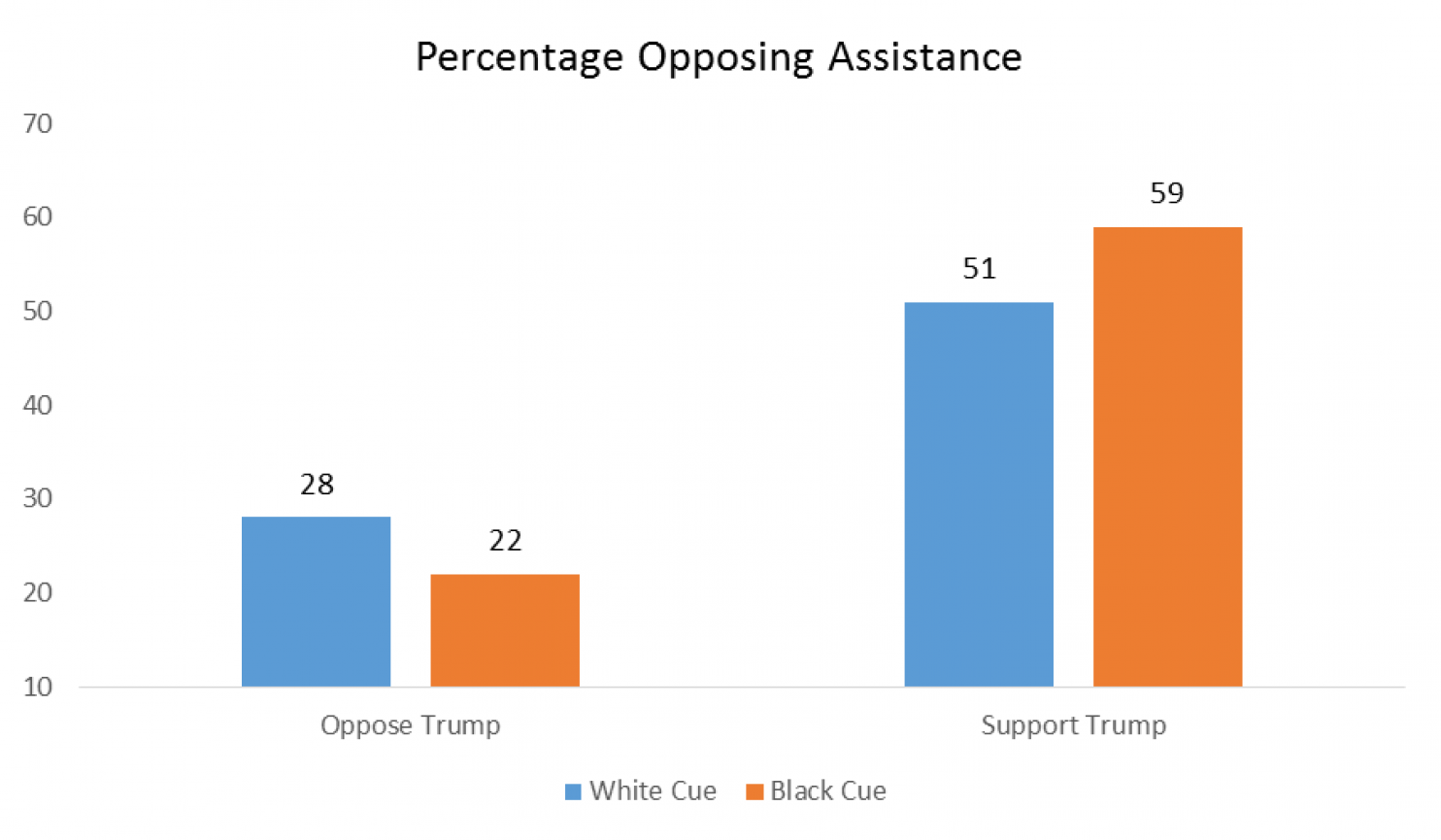
The first graph shows that white Trump supporters were eight percentage points more likely to oppose mortgage relief if they had seen a “black cue” (the picture featuring a black man) than a “white cue.” The opposite was true for white Trump opponents.

3

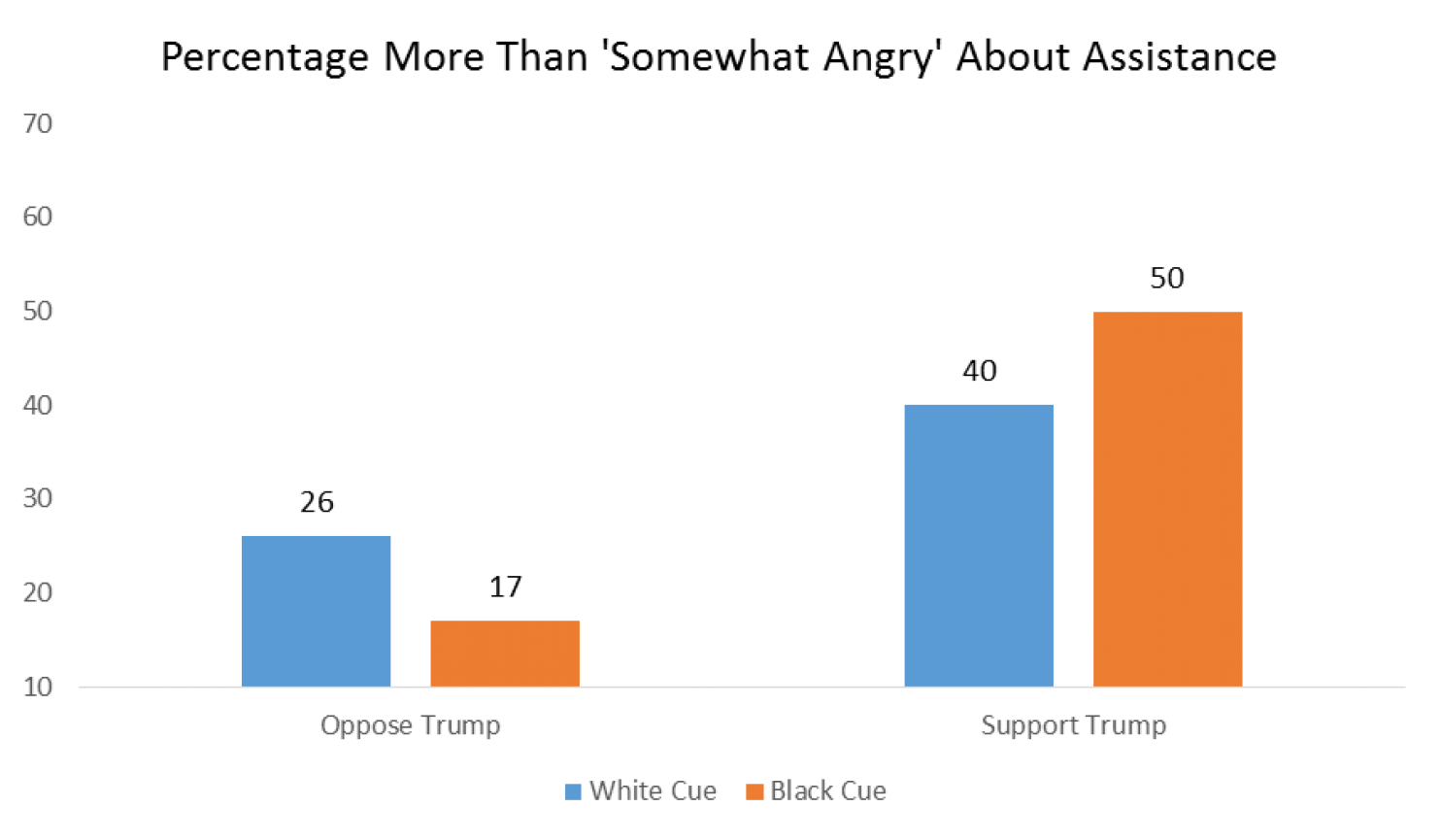
When asked if they were “somewhat angry” about the assistance, the same pattern held:

4

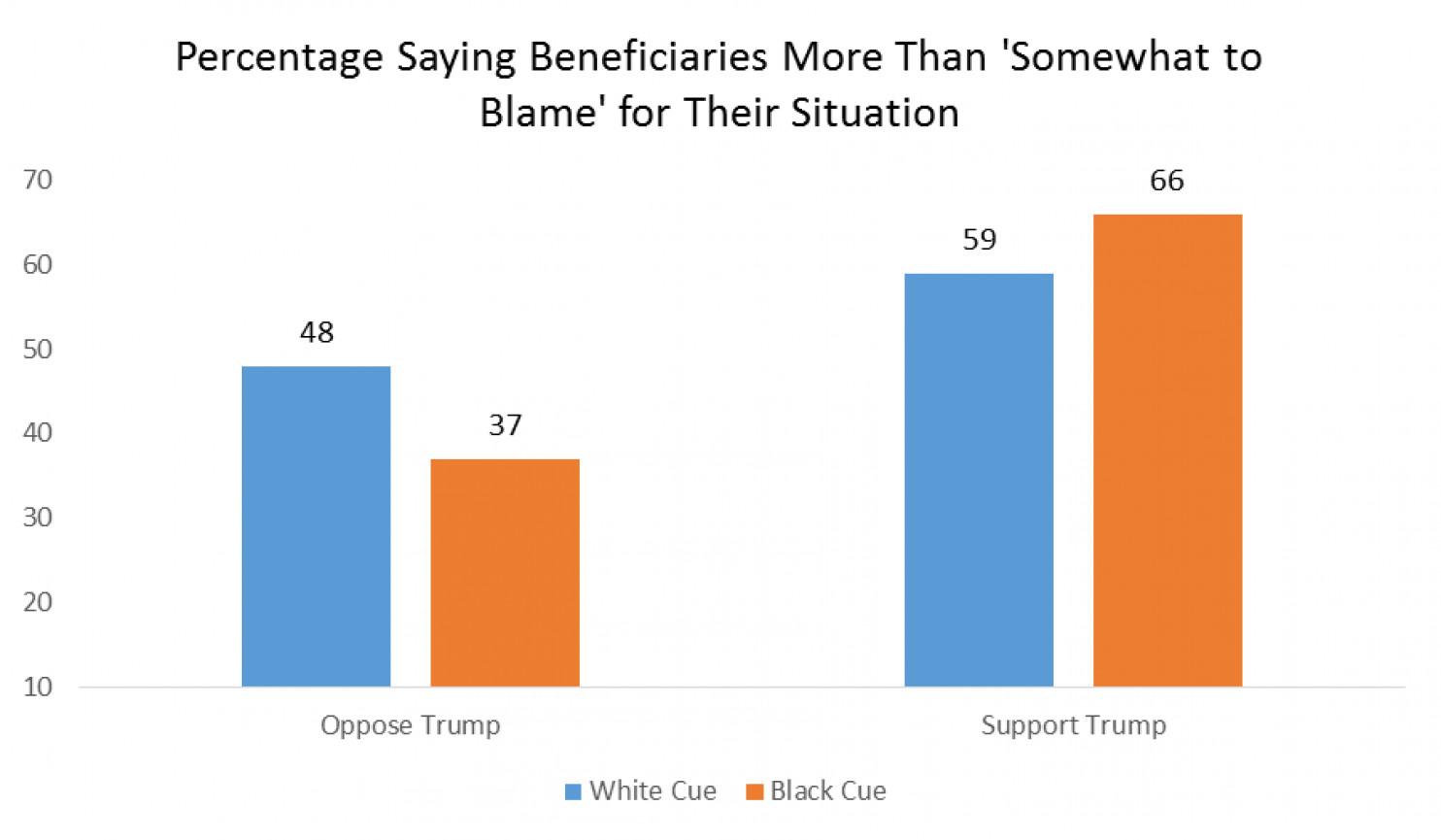
And likewise when asked if the beneficiaries of mortgage assistance were at least “somewhat to blame” for their situation:

5

Findings held when the researchers controlled for possible confounding variables.

These findings aren’t particularly surprising. Others have also found that priming respondents to think of black people tends to make them tougher on crime and advocate for less generous social programs, like in this study on attitudes toward CA’s three-strikes law. What’s new here is the difference between Trump supporters and opponents. For opponents of Trump, priming made them more sympathetic toward mortgage holders; for supporters, priming made them less. This speaks to a real divide among Americans. Some of us feel real hostility toward African Americans. Others definitely do not.

Lisa Wade, PhD is an Associate Professor at Tulane University. She is the author of American Hookup, a book about college sexual culture; a textbook about gender; and a forthcoming introductory text: Terrible Magnificent Sociology. You can follow her on Twitter and Instagram.

Last month my neighbor and I mustered our emotional strength, gathered up our neighborhood cat, and drove to the SPCA to help her leave this earth in peace. He had named her Minou — French for kitty, a common term of endearment for cats in Cajun country — though I’m sure she’d had many names, which is why I’m posting about her here.

Minou is one of the tens of thousands of animals that were victims of Hurricane Katrina. An estimated 15,500 were rescued, many more died, and some, like Minou, started a new life all on their own. Another of my neighbors, one who rode out the storm, remembers Minou showing up after the waters receded. The cat — tame, spayed, and quite clearly someone’s pet before Katrina — made my and my neighbors’ yards her home, supporting herself for 11 years on lizards and rainwater and the kindness of strangers.

When I showed up two years ago, she was the first to welcome me. I woke up one morning to find her snuggled up in bed. She had found one of the holes in my dilapidated house and climbed in. She left me dead things. She made me feel at home.

She was our little Minou. One of my neighbors fed her. We all gave her pets and treats. When she got sick, I was the one who could afford to take her to the vet, so I did. I bought her the medicine; a neighbor administered it.

She had always been a tough little survivor but, in the end, it was her time. She died in the arms of people she loved, who loved her.

As we drove to the SPCA to say goodbye, I was struck by how much she had done for us. She had brought us together by giving us a common friend and responsibility. She was the node in our network, more so even than our proximity. Often, she was why we talked to each other. Or we talked to each other over her. When one of us paused to give her some attention, it kept us outside long enough to run into each other. And since everyone stopped to give her a pet, we’d all be there together.

I knew, too, that the two of us who rode in that car together — we who had made and then carried out that impossible decision — would never be able to call each other strangers. Even in her last minutes, Minou forged a bond.

Sociologists are interested in community: the difference between those neighborhoods in which people feel a sense of togetherness and those in which they do not. I don’t know much about that literature, nor much about social networks, but I do know that, with noted exceptions, pets are on the fringe of sociological analysis. It’s an interesting oversight given that more than half of American households include at least one pet. And that’s not counting the strays.

But I do know that Minou is part of why my neighbors and I are a community and her final gift to us was to cement that bond. And when I memorialized her passing on social media, many people commiserated with similar stories of “neighborhood cats.” I bet there are stray cats all over America, bringing people together. I’m so grateful that she did that for us.

2

Lisa Wade, PhD is an Associate Professor at Tulane University. She is the author of American Hookup, a book about college sexual culture; a textbook about gender; and a forthcoming introductory text: Terrible Magnificent Sociology. You can follow her on Twitter and Instagram.
Cross-posted at Cyborgology.

Fake news among the alt-right has been central in post-election public discourse, like with Donald Trump’s dubiously sourced tweet about the “millions of illegal voters” supposedly driving Clinton’s substantial lead in the popular vote. Less attention, however, has been paid to the way “real” news is, to use the sociologist Nathan Jurgenson’s term, based in “factiness,” described as “the feel and aesthetic of ‘facts,’ often at the expense of missing the truth.”  Mainstream news gets cast as objective in part because journalists, stack of papers and obligatory pen studiously in hand, point to statistics that back up their reports. Such reliance on “data” can mask the way that humans are involved in turning things into numbers and numbers into stories. So here I present a cautionary tale.

It is a common truism that white male voters without college degrees disproportionately supported Trump in the 2016 election. Indeed, the notion that men with high school as their highest level of education were more likely to vote for Trump is an empirically supported fact. This data point spread widely throughout the campaign season, and bore out in the post-election analyses. But also in the post-election analyses — over which researchers poured in response to the statistically surprising result — another data point emerged that could have, but didn’t, change the narrative around this demographic voting bloc.

The data point that emerged was that white American men without college degrees have remained economically depressed since the 2008 recession and subsequent recovery. Although the U.S. economy has been steadily improving, the economic reality for this particular segment of the population has not. This is what Michael Moore talked about experientially (but not statistically), claiming that he knows the people who live in the rust belt, and they are struggling. He was right, the data show that they are struggling. Highlighting the economic reality for people without college degrees in the U.S. tells a very different story than highlighting the fact that they don’t have college degrees. The former renders an image of a voting contingent who, in the face of personal economic hardship that contrasts with national economic gain, are frustrated and eager to try something — anything — new. The latter renders an image of ignorance.

Data about education levels of voters is transformed by its coupling with economic trajectories. What’s been strange, is that although this coupling was discovered, it never really penetrated the larger “what happened” narrative. This is particularly strange given the meticulous and sometimes frantic search for explanation and the media’s public introspective quests to understand how so many got it all so wrong.

The transformative effect of the economic data point and its failure to effectively transform the story underlines two related things: data are not self-evident and narrative currents are hard to change.

The data weren’t wrong — people without college degrees were more likely to vote for Trump — but they were incomplete and in their partialness, quite misleading. That’s not a data problem, it’s a people problem. Data are not silent, but they are inarticulate. Data make noise, but people have to weave that noise into a story. The weaving process begins with survey construction, and culminates in analyses and reports. Far from an objective process, turning data into narrative entails nuanced decisions about the relevance of, and relationship between, quantifiable items captured through human-created measures. The data story is thus always value-laden and teeming with explicit and implicit assumptions.

Framing a contingent of Trump supporters through the exclusive metric of education without examining the interaction, mediating, and moderating effects of economic gains, was an intellectual decision bore out through statistical analyses. That is, pollsters, strategists, and commentators treated “lack of education” as the variable with key explanatory power. Other characteristics or experiences of those with low levels of education could/should/would be irrelevant.

Such dismissal created a major problem with regard to Democratic strategy. To situate a voting bloc as “uneducated” is to dismiss that voting bloc. How does one campaign to those voting in ignorance? In contrast, to situate a voting bloc as connected through an economic plight not only validates their position, but also gives a clear policy platform on which to speak.

But okay, after the election, analysts briefly shed light on the way that economics and education operated together to predict candidate preference. Why has this gotten so little attention? Why is education — rather than economics or the economic-education combination — still the predominant story?

The predominance of education remains because narrative currents are strong. Even when tied to newly emergent data, established stories are resistant to change. Narratives are embedded with social frameworks, and changing the story entails changing the view of reality. A key tenet of sociology is that people tend towards stability. Once they understand and engage the world in a particular way, they do social and psychological gymnastics to continue understanding and engaging the world in that way. To reframe (some) Trump voters as part of an economic interest group that has been recently underserved, is an upheaval of previous logics. Moreover, disrupting existing logics in this way forces those who practice those logics to, perhaps, reframe themselves, and do so in a way that is not entirely flattering or identity affirming. To switch from a frame of ignorance to a frame of economics is to acknowledge not only that the first frame was distorted, but also, to acknowledge that getting it wrong necessarily entailed ignoring the economic inequality that progressives take pride in caring so much about. Switching from ignorance to economics entails both a change in logic and also, a threat to sense of self.

Data are rich material from which stories are formed, and they are not objective. Tracing data is a process of deconstructing the stories that make up our truths — how those stories take shape, evolve, and solidify into fact. The “truth” about Trump voters is of course complex and highly variable. The perpetually missed nuances tell as much of a story as those on which predominant narratives hang.

Jenny L. Davis, PhD, is in the department of sociology at James Madison University. She studies social psychology, experimental research methods, and new and social media. She is also a contributing author and editor at Cyborgology.  You can follow her at @Jenny_L_Davis.

Originally posted at Orgtheory.

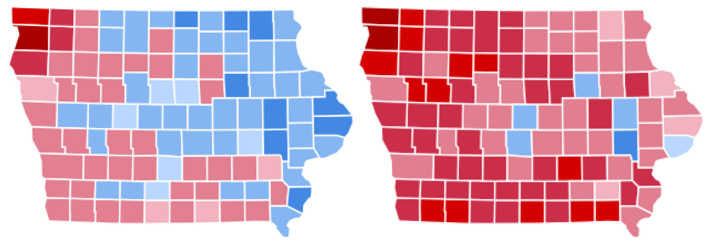
6Iowa in 2008, Iowa in 2016

So there are a thousand reasons Trump won the election, right? There’s race, there’s class, there’s gender. There’s Clinton as a candidate, and Trump as a candidate, the changing media environment, the changing economic environment, and the nature of the primary fields. It’s not either-or, it’s all of the above.

But Josh Pacewicz’s new book, Partisans and Partners: The Politics of the Post-Keynesian Society, implies a really interesting explanation for the swing voters in the Rust Belt—the folks who went Obama in 2008, and maybe 2012, but Trump in 2016. These voters may make up a relatively small fraction of the total, but they were key to this election.

Pacewicz’s book, which just came out this month, doesn’t mention Trump, and presumably went to press long before Trump was even the presumptive Republican nominee. And the dynamics Pacewicz identifies didn’t predict a specific outcome. (In fact, Josh guest-blogged at orgtheory in August, but focused on explaining party polarization, and did not venture to predict a winner.)

But Partisans and Partners nevertheless does a really good job of explaining what just happened. Its argument is complex, and doesn’t imply a lot of obvious leverage points for decreasing political polarization or the desire for “disruptive” candidates. But I think it’s an important explanation nonetheless.

The book is based on ethnographic and interview data collected over a period of several years in two Rust-Belt Iowa cities of similar size, one traditionally Republican, and the other traditionally Democratic. Both of these cities saw a transformation in their politics in the 1980s. Until the 1970s, urban politics were organized around a partisan divide closely associated with local business elites, on the Republican side, and union leaders, on the Democratic side. Politics was highly oppositional, and the party that won local elections got to distribute a lot of spoils. But it was not polarized in the sense it is today—while there were fundamental differences between the parties, particularly on economic issues, positions on social issues were less rigidly defined.

During the 1980s, something changed. Pacewicz calls that something “neoliberal reforms”; I might argue that those are just one piece of a bigger economic transformation that was happening. But either way, the political environment shifted. Regulatory changes encouraged corporate mergers and buyouts. This put control of local industry in distant cities and hollowed out both business elites and union power. The federal government shifted from simply handing cities pots of money that the party in power could control, to requiring cities to compete for funds, putting together applications that would compete with those of other cities. This environmental change facilitated the decline of the old “partisans”—the business and labor elites—and the rise of a new group of local power brokers—the “partners”.

The partners were more technocratic and pragmatic. They did not have strong party allegiances, nor did they see politics as being fundamentally about competition between the incompatible interests of business and labor. Instead, they focused on building temporary alliances among diverse groups with often-conflicting interests. Think business-labor roundtables, public-private partnerships, and the like. This is what was needed to attract industry from other places (look how smooth our labor relations are!) and to compete for federal grants and incentives (cities with obviously oppositional politics tended to lose out). The end of politics. Sounds great, right?

The problem was that these dynamics also hollowed out local parties. The old partisans had lost power. Partners didn’t want to be active in party politics. This left parties to activists, who over time came to represent increasingly extreme positions—a new wave of partisans.

What did this mean for the average voter? Pacewicz shows how older voters still conceptualized the two parties as fundamentally reflecting a business/labor divide. But most younger voters came to understand politics as representing a divide between partners—people working together, setting aside differences, for the benefit of the community—and partisans—people representing the interests of particular groups.

Partners didn’t like politics. They didn’t really think it should exist. They disliked political polarization, thought that people were pretty similar underneath their surface differences, and that conflict was generally avoidable. They distrusted politics, their party affiliation tended to be provisional, and they often responded only to negative ads around hot-button issues.

The new partisans, on the other hand, were alienated from contemporary life. They thought things were going to hell in a handbasket. They were looking for change, and saw outsider candidates as appealing—candidates who promised to shake up the system. Many had a strong preference for Democrats or Republicans. But while for traditional voters party affiliation was rooted in a sense of positive commitment, for the new partisans, it was based on disaffection with the alternative. And a key group of “partisans” was politically uncommitted (a contradiction in terms?)—disaffected and angry and wanting politics to solve their problems, but not aligned with a party.

The 2008 election illustrates how these types respond to candidates. In the primaries, partners liked Obama, responding well to his post-partisan image. He was less favored by Democrats and traditional voters and partisans. By fall, though, traditional (Democratic) voters and (Democratic) partisans tended to get on board, while partners waffled as Obama came to seem more partisan.

The most erratic group was the uncommitted partisans. These people wanted somebody—anybody—to shake things up, to change the system. And they wanted somebody to represent them—the outsider. They tended to lean toward GOP candidates (one illustrative voter was a big Palin fan), but many also simply remained disaffected and stayed home.

This is the group, it seems to me, that is key to understanding the 2016 election. Democrats gonna Democrat, and Republicans gonna Republican. In the end, most people really aren’t swing voters. But the unaffiliated partisans are the type of voters who would have found some appeal in both Bernie and Trump: someone claiming to represent the everyman, and someone willing to shake up the status quo.

In the end, these folks are unlikely to be motivated to vote for a Clinton or a Romney. It’s just more of the same. But they can be energized by populism, and by the outsider. These are the people who will vote for Trump just as a big old middle finger to the system. Partisans and Partners isn’t specifically trying to explain Trump’s win, in Iowa or anywhere else. But it does as good a job as anything I’ve read at pointing in the direction we should be looking.

Elizabeth Popp Berman, PhD is an associate professor of sociology at the University at Albany, SUNY, and the author of the award-winning book Creating the Market University: How Academic Science Became an Economic Engine. 

Originally posted at the Huffington Post.

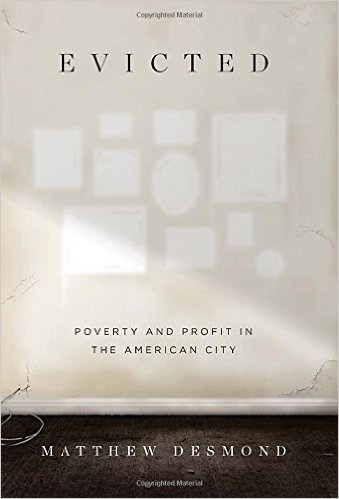
In the 21st century, it is perhaps time to rethink the American Dream of owning a house. The feasibility of this dream was in the back of my mind the entire time I read Matthew Desmond’s Evicted, the highly praised ethnography of landlords and renters in Milwaukee. Dr. Desmond flips the relationship between poverty and housing instability on its head: eviction is a cause, not a symptom, of poverty.

2 To make a long, well-put, and worth-reading argument short: eviction isn’t rare as many policymakers and sociologists might assume; it is actually a horrifyingly common phenomenon. Urban sociologists have missed the magnitude of the eviction phenomenon because they have traditionally used neighborhoods as the unit of analysis, studying issues such as segregation and gentrification. Because eviction is rarely studied, we don’t have good data on eviction. Establishing a dataset of eviction is not a simple data collecting task, given that there are many forms of informal eviction. The consequences of eviction are devastating and have a profound, negative, and life-long impact on subsequent trajectories: worse housing, more eviction, and homelessness, all disproportionately affecting women of color with children (“a female equivalent of mass incarceration,” Desmond argued at a talk at the University of Pennsylvania last week).

The solution is a universal housing voucher program that is funded using money that currently goes to the mortgage interest tax deduction, a $170 billion program for homeowners that benefits mostly the upper-middle class.

Let’s set the economics of a universal voucher program aside — Desmond and many economists on both sides of the political spectrum (including Harvard economist Edward Glaeser) have already addressed the effects on the market, the argument that such a program will be a disincentive to work, and the fear of the lag time that a program will create in the housing market increasing search times. At the heart of public policy are norms and values, and the existence of the mortgage interest tax deduction — the largest housing assistance program in the country — is not a reflection of an inherent American preference for the rich over the poor. Rather, it is a reflection of an inherent American preference for the homeowner over the renter.

To implement the universal voucher program that Desmond argues for, we need to rethink the way we conceive of homeownership in American culture. As I read Evicted, the work of Robert K. Merton came to mind. In 1938, Merton, one of the contenders for the title “founder of modern sociology,” published a paper titled “Social Structure and Anomie.” In the paper, Merton argues that every society has cultural goals, “a frame of aspirational references,” and institutionalized means, “permissible and required procedures for attaining these ends.”

In American society, the institutionalized means are study hard/work hard (and maybe go to church every so often), and the cultural goals are accumulate wealth and own a house. Obviously, the vast majority of Americans don’t achieve these goals and it is extremely hard to argue that the institutionalized means will actually lead them there. But that’s okay; it just makes for a nation of ritualists. Ritualism is devotion to the means without achieving the goals. These ritualists are everywhere in American society, or at least in the way we perceive our society. We romanticize a fictional poor person that takes pride that s/he never took welfare, for example, no matter how tough times were. Welfare is not one of the institutionalized means, and the ritualist prefers to stay farther away from the goal than to cross the line to non-institutionalized means.

According to City Lab, 41% of all US households are residing in a rental unit. Are these households inhabited by ritualists, trying to achieve the goal but without the means? Maybe, but Merton offers another option – they could be rebels. The rebel may or may not conform to the cultural goals and may or may not use the means. The condition for rebellion, according to Merton, is that “emancipation from the reigning standards, due to frustration or to marginalist perspectives, leads to the attempt to introduce ‘a new social order.’”

If one of the American cultural goals is homeownership, the mortgage interest tax deduction is a tool to maintain this social order. The goal’s support structure recognizes in a sense that, with only the purist version of the institutionalized means (hard work with no government assistance), the goal is out of reach. If that support system is taken away, if we shift funding from the mortgage interest tax credit to a universal housing voucher program, we must recognize that we are supporting a cultural rebellion.

It is time to call for a change in the norms and values that are at the heart of our public policy. That is not a simple task. When I think of the “American,” I think about Ron Swanson from the TV show Parks and Recreation. In one of the show’s episodes, Swanson explains America to a little girl, “Let’s get started. Life, liberty, and property. That’s John Locke. This is your lunch.” Matthew Desmond, by calling for a universal voucher program, challenges this status quo and attempts to put habitability, stability, and opportunity at the heart of our value system and not as byproducts of homeownership and hard work. He also challenges the institutionalized means by calling for an increase in the number of people achieving this new goal — a stable home — specifically through quality rental housing, with government assistance, rather than through hard work alone.

The United States is nation of renters that views itself as a nation of homeowners. The millions of rental households deserve to be a part of the group that achieves the American cultural goal. They deserve government support, they deserve stability, and they don’t deserve to have to break away from the American institutionalized means. We must not shy away from the size of this task. The country might not be ready to think of itself as the nation of renters that it is. The United States is undergoing a housing and eviction crisis, and as Matthew Desmond said in his talk at Penn this week, “This is not us, there is nothing American about this.” It is time for a new social order, for the rise of the renter class as more than ritualists and rebels.

Originally from Tel Aviv, Abraham Gutman is currently at the Center for Public Health Law Research at Temple University. He is an aspiring sociologist working on econometrics, race, policing, and housing. He blogs at the Huffington Post and you can follow him on Twitter.