Search results for The

Flashback Friday.

In August of 2010, NPR reported on a scale developed by a forensic psychologist, Michael Stone, on which murderers could be placed according to how evil they are (from slightly evil to really, really really evil).  To illustrate the scale, NPR developed this graphic:
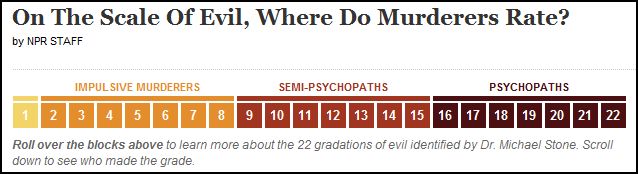
Let’s say, for the sake of argument, that the artists designing this graphic did not purposefully associate darker skin-like colors with more evil and lighter skin-like colors with less evil.  I think this is a fair assumption, though I don’t know for sure that this is true.  But let’s give them the benefit of the doubt.

If they didn’t do this on purpose, then race never consciously entered their minds.  Once you notice that the colors are skin-like colors, and if you are a member of a society that discriminates against darker-skinned people, you immediately see that this graphic reproduces those stereotypes… AND YOU CHANGE THE COLORS.   Any color, going from light to dark, will illustrate intensity.  How about red?  In Western societies, red is associated with anger.   If you insist on using black because black signifies evil in our culture, how about using a true black (that is very rarely if ever seen on people) and a gray scale?  How about any color other than brown?

I think this is likely a case in which the producers of the image did not think.  And not thinking is one of the most insidious ways that racism and other bigotries get reproduced.  People who don’t think about race are the most likely to endorse racial stereotypes.  When people who think about race are distracted — with another task, or loud music, or some other intervening stimulus — they are more likely to think stereotypically than when they are not distracted.  We can’t be colorblind.  Our unconscious is steeped in racial meanings.  Consciously fighting those associations is the only way to be less racist.

Not thinking about race is a cousin to thinking racist thoughts.  Only thinking hard about race helps alleviate racism.  And this graphic is an excellent example of why.

Originally posted in 2010.

Lisa Wade, PhD is an Associate Professor at Tulane University. She is the author of American Hookup, a book about college sexual culture; a textbook about gender; and a forthcoming introductory text: Terrible Magnificent Sociology. You can follow her on Twitter and Instagram.

Originally posted at Made in America.

Explaining how such an unfit candidate and such a bizarre candidacy succeeded has become a critical concern for journalists and scholars. Through sites like Monkey Cage, Vox, and 538, as well as academic papers, we can watch political scientists in real time try to answer the question, “What the Hell Happened?” (There are already at least two catalogs of answers, here and here, and a couple of college-level Trump syllabi.) Although a substantial answer will not emerge for years, this post is my own morning-after answer to the “WTHH?” question.

I make three arguments: First, Trump’s electoral college victory was a fluke, a small accident with vast implications, but from a social science perspective not very interesting. Second, the deeper task is to understand who were the distinctive supporters for Trump, in particular to sort out whether their support was rooted mostly in economic or in cultural grievances; the evidence suggests cultural. Third, party polarization converted Trump’s small and unusual personal base of support into 46 percent of the popular vote.

Explaining November 8, 2016

Why did Donald Trump, an historically flawed candidate even to many of those who voted for him, win? With a small margin in three states (about 100,000 votes strategically located), many explanations are all true:

* Statistical fluke: Trump won 2.1 percentage points less of the popular vote than did Clinton, easily the largest negative margin of an incoming president in 140 years. (Bush was only 0.5 points behind Gore in 2000.) Given those numbers, Trump’s electoral college win was like getting two or three snake-eye dice rolls in a row. Similarly, political scientists’ structural models–which assume “generic” Democratic and Republican candidates and predict outcomes based on party incumbency and economic indicators–forecast a close Republican victory. “In 2012, the ‘fundamentals’ predicted a close election and the Democrats won narrowly,” wrote Larry Bartels. “In 2016, the ‘fundamentals’ predicted a close election and the Republicans won narrowly. That’s how coin tosses go.” But, of course, Donald Trump is far from a generic Republican. That’s what energizes the search for a special explanation.

* FBI Director Comey’s email announcement in the closing days of the election appeared to sway the undecided enough to easily make the 100,000 vote difference.

* Russian hacks plus Wikileaks.

* The Clinton campaign. Had she visited the Rust Belt more, embraced Black Lives Matter less (or more), or used a slogan that pointed to economics instead of diversity… who knows? Pundits have been mud-wrestling over whether her campaign was too much about identity politics or whether all politics is identity politics. Anyway, surely some tweak here would have made a difference.

* Facebook and Fakenews.

* The weather. It was seasonably mild with only light rain in the upper Midwest on November 8. Storms or snow would probably have depressed rural turnout enough to make Clinton president.

* The Founding Fathers. They meant the electoral college to quiet vox populi (and so it worked in John Q. Adams’s minus 10 point defeat of Andrew Jackson in 1824).

* Add almost anything you can imagine that could have moved less than one percent of the PA/MI/WI votes or of the national vote.

* Oh, and could Bernie would have won? Nah, no way, no how. [1]

Small causes can have enormous consequences: the precise flight of a bullet on November 22, 1963; missed intelligence notes about the suspicious student pilots before the 9/11 attacks; and so on. Donald Trump’s victory could become extremely consequential, second only to Lincoln’s in 1860, argues journalist James Fallows, [2] but the margin that created the victory was very small, effectively an accident. From an historical and social science point of view, there is nothing much interesting in Trump’s electoral college margin.

Trump’s Legions

More interesting is Trump’s energizing and mobilizing so many previously passive voters, notably during the primaries. What was that about?

One popular answer is that Trump’s base is composed of people, particularly members of the white working class (WWC), who are suffering economic dislocation. Because their suffering has not been addressed, they rallied to a jobs champion.

Another answer is that Trump’s core is composed of people, largely but not only WWC, with strong cultural resentments. While often suffering economically and voicing economic complaints, they are mainly distinguished by holding a connected set of racial, gender, anti-immigrant, and class resentments–resentments against those who presumably undermined America’s past “greatness,” resentments which tend to go together with tendencies toward authoritarianism (see this earlier post).

The empirical evidence so far best supports the second account. Indicators of cultural resentment better account for Trump support than do indicators of economic hardship or economic anxiety. [3]

In-depth, in-person reports have appeared that flesh out these resentments in ways that survey questions only roughly capture. They describe feelings of being pushed out of the way by those who are undeserving, by those who are not really Americans; feelings of being neglected and condescended to by over-educated coastal elites; feelings of seeing the America they nostalgically remember falling away. [4]

trump-supportersDefenders of the economic explanation would point to the economic strains and grievances of the WWC. Those difficulties and complaints are true–but they are not new. Less-educated workers have been left behind for decades now; the flat-lining of their incomes started in the 1970s, with a bit of a break in the late 1990s. Moreover, the economy has been in an upswing in the last few years; the unemployment rate was about 8 percent when Obama was re-elected in 2012, but about half of that when Trump was elected. Economic conditions do not explain 2016.

Nor are complaints about economic insecurity new. For example, the percentage of WWC respondents to the General Social Survey who said that they were dissatisfied with their financial situations has varied around 25 percent (+/- 5 points) over the last 30 years. The percentage dissatisfied did hit a high in the early years of the Great Recession (34 percent in 2010), but it dropped afterwards (to 31% in 2012 when Obama was re-elected and 29% in 2014). Economic discontent has been trending down, not up. [5] That only one-fifth of Trump voters supported raising the minimum wage to $15 further undercuts the primacy of economic motives.

To be sure, journalists can find and record the angry voices of economic distress; they do so virtually every election year. (Remember the painful stories about the foreclosure crisis and about lay-offs during the Great Recession?). There was little distinctive about either the economic distress or the economic anxiety of 2016 to explain Trump.

Some have noted, however, what appear to be a significant number of voters who supported Obama in 2008 or in 2012 and seemed to have switched to Trump in 2016 (e.g., here). Do these data not undermine a cultural, specifically a racial, explanation for Trump? No. In 2008, Obama received an unusual number of WWC votes because of the financial collapse, the Iraq fiasco, and Bush’s consequent unpopularity. These immediate factors overrode race for many in the WWC. But WWC votes for Obama dropped in 2012 despite his being the incumbent. Then, last November, the WWC vote for a Democratic candidate reverted back to its pre-Great Recession levels. [6] Put another way, Clinton’s support from the WWC was not especially low, Obama’s was unusually high for temporary reasons.

What was special about 2016 was the candidate: Donald Trump explicitly and loudly voiced the cultural resentments and authoritarian impulses of many in the WWC (and some in the middle class, too) that had been there for years but had had no full-throated champion–not Romney, not McCain, not the Bushes, probably not even Reagan–since perhaps Richard Nixon. What changed was not the terrain for a politics of resentment but the arrival of an unusual tiller of that soil, someone who brought out just enough of these voters to win his party’s nomination and to boost turnout in particular places for the general election. As one analyst wrote, “Trump repeatedly went where prior Republican presidential candidates were unwilling to go: making explicit appeals to racial resentment, religious intolerance, and white identity.”

But this is still less than half the story.

Party Polarization

To really how understand how Trump could get 46 percent of the vote, it takes more than identifying the distinctive sorts of people whom Trump attracted, because they are not that numerous. Trump won only a minority of the primary votes and faced intense opposition within his party. In the end, however, almost all Republicans came home to him–even evangelicals, to whose moral standards Trump is a living insult. The polarization of American politics in recent years was critical. Party ended up mattering more to college-educated, women, and suburban Republicans than whatever distaste they had for Trump the man.

Consider how historically new this development is. In 1964, the Republican nominee, Barry Goldwater, was considered to be at the far right end of the political spectrum. About 20 to 25% of Republicans crossed over and voted for Democrat Lyndon Johnson. (This crossover was mirrored by Democrats in the 1972 election. [7]) In 2016, by contrast, fewer than 10% of Republicans abandoned Trump–a far more problematic candidate than Goldwater–so much has America become polarized by party in the last couple of decades. [8]

Conclusions

Readings of the 2016 election as the product of a profound shift in American society or politics are overblown. In particular, notions that the WWC’s fortunes or views shifted so substantially in recent years as to account for Trump seem wrong.

What about the argument that the Trump phenomenon is part of a general rise across the western world of xenophobia? I don’t see much evidence outside of the Trump case itself for that in the United States. Long-term data suggest a decline–too slowly, for sure–rather than an increase in such attitudes.[9] And let’s not forget: Hillary Clinton won the popular vote.

The best explanation of why Trump got 46% of the ballots: Advantages for the out party in a third-term election + Trump’s unusual cultural appeal to a minority but still notable number of Americans + historically high party polarization. That Trump actually won the electoral college as well is pretty much an accident, albeit a hugely consequential one.


NOTES____________________

[1] Basically no one, including Trump, said anything bad about Bernie Sanders from the moment it became clear that Sanders would lose the primaries to Clinton. Had he been nominated, that silence would have ended fast and furiously. Moreover as the always astute Kevin Drum pointed out, Sanders is much too far to left to get elected, even way to the left of George McGovern, who got creamed in 1972. Finally, the “Bernie Brothers” who avoided Clinton would have been more than outnumbered by Hillary’s pissed-off sisters if she had been once again displaced by a man.

[2] On the other hand, economist-blogger Tyler Cowen is skeptical: If the doomsayers are right, why aren’t investors dumping equities, shorting the market, or fleeing to safer commodities?

[3] See these sources: 1, 2, 3, 4, 5, 6.

[4] For examples: 1, 2, 34.

[5] My analysis of the GSS through 2014. White working class is defined as whites who have not graduated college.

[6] Again, I used the GSS. In 2000 and 2004, the Democratic candidates, Gore and Kerry, got about 35 percent of the WWC vote, about what Bill Clinton got in his first run in 1992. Obama got substantially more, 48%, in 2008, then somewhat less, 42%, in 2012. Hillary Clinton got, according to a very different sort of survey, the exit polls, 29% of the WWC, but it is hard to compare the two methods. Note that the GSS reports of who people voted for in the previous election tend to skew toward the winners, but the point still stands that Obama’s jump in support from the WWC, especially in 2008, was quite unusual, not Hillary Clinton’s apparent slump in support.

[7] According to Gallup’s last poll before the 1964 election, 20% of Republicans were going to vote for Johnson. According to my analysis of the American National Election Survey, which is retrospective, 26% actually did. In 1972, the Democrats nominated the most left-leaning candidate of postwar era. According to Gallup data, 33% of Democrats crossed over to vote for Nixon. ANES data suggest that about 40 percent did. Whatever the specifics, there was much more cross-over voting 40 to 50 years ago, even under milder provocation.

[8] On the decline of ticket-splitting, see here.

[9] For example, one of the longest-running items in the GSS is the question, “I’d like you to tell me whether you think we’re spending too much money … too little money, or about the right amount … improving the conditions of Blacks.” In the 1970s, 28% of whites said too much; in the 2000s, 19% did. Another question was asked only through 2002: “Do you agree or disagree… (Negroes/blacks/African-Americans) shouldn’t push themselves where they’re not wanted?” In the 1970s, 74% of whites agreed; from 1990 to 2002, 15% did. More striking, in the 1970s, 11% of whites “strongly disagreed”; from 1990 to 2002, 32% did. On immigrants: David Weakliem has graphed responses to a recurrent Gallup Poll question, “Should immigration be kept at its present level, increased or decreased?”. From 1965 to the mid-1990s, the trend was strongly toward “decreased,” but since then the trend has strongly been toward “increased” (although that’s still a minority view).

Claude S. Fischer, PhD is a sociologist at UC Berkeley and is the author of Made in America: A Social History of American Culture and Character. This post originally appeared at his blog, Made in America.

The 2020 Summer Olympics will be held in Japan.  And when the prime minister of Japan, Shinzo Abe, made this public at the 2016 Olympics in Rio de Janeiro, Brazil, he did so in an interesting way.   He was standing atop a giant “warp pipe” dressed as Super Mario.  I’m trying to imagine the U.S. equivalent.  Can you imagine the president of the United States standing atop the golden arches, dressed as Ronald McDonald, telling the world that we’d be hosting some international event?

Prime minister Abe was able to do this because Mario is a cultural icon recognized around the world.  That Italian-American plumber from Brooklyn created in Japan is truly a global citizen. The Economist recently published an essay on how Mario became known around the world.

Mario is a great example of a process sociologists call cultural globalization.  This is a more general social process whereby ideas, meanings, and values are shared on a global level in a way that intensifies social relations.  And Japan’s prime minister knew this.  Shinzo Abe didn’t dress as Mario to simply sell more Nintendo games.  I’m sure it didn’t hurt sales.  In fact, in the past decade alone, Super Mario may account for up to one third of the software sales by Nintendo.  More than 500 million copies of games in which Mario is featured circulate worldwide.  But, Japan selected Mario because he’s an illustration of technological and artistic innovations for which the Japanese economy is internationally known.  And beyond this, Mario is also an identity known around the world because of his simple association with the same human sentiment—joy.  He intensifies our connections to one another.  You can imagine people at the ceremony in Rio de Janeiro laughing along with audience members from different countries who might not speak the same language, but were able to point, smile, and share a moment together during the prime minister’s performance.  A short, pudgy, mustached, working-class, Italian-American character is a small representation of that shared sentiment and pursuit.  This intensification of human connection, however, comes at a cost.

We may be more connected through Mario, but that connection takes place within a global capitalist economy.  In fact, Wisecrack produced a great short animation using Mario to explain Marxism and the inequalities Marx saw as inherent within capitalist economies.  Cultural globalization has more sinister sides as well, as it also has to do with global cultural hegemony.  Local culture is increasingly swallowed up.  We may very well be more internationally connected.  But the objects and ideas that get disseminated are not disseminated on an equal playing field.  And while the smiles we all share when we connect with Mario and his antics are similar, the political and economic benefits associated with those shared smirks are not equally distributed around the world.  Indeed, the character of Mario is partially so well-known because he happened to be created in a nation with a dominant capitalist economy.  Add to that that the character himself hails from another globally dominant nation–the U.S.  The culture in which he emerged made his a story we’d all be much more likely to hear.

Tristan Bridges, PhD is a professor at the University of California, Santa Barbara. He is the co-editor of Exploring Masculinities: Identity, Inequality, Inequality, and Change with C.J. Pascoe and studies gender and sexual identity and inequality. You can follow him on Twitter here. Tristan also blogs regularly at Inequality by (Interior) Design.

Originally posted at Reports from the Economic Front.

Defenders of capitalism in the United States often choose not to use that term when naming our system, preferring instead the phrase “market system.”  Market system sounds so much better, evoking notions of fair and mutually beneficial trades, equality, and so on.  The use of that term draws attention away from the actual workings of our system.

In brief, capitalism is a system structured by the private ownership of productive assets and driven by the actions of those who seek to maximize the private profits of the owners.  Such an understanding immediately raises questions about how some people and not others come to own productive wealth and the broader social consequences of their pursuit of profit.

Those are important questions because it is increasingly apparent that while capitalism continues to produce substantial benefits for the largest asset owners, those benefits have increasingly been secured through the promotion of policies – globalization, financialization, privatization of state services, tax cuts, attacks on social programs and unions – that have both lowered overall growth and left large numbers of people barely holding the line, if not actually worse off.

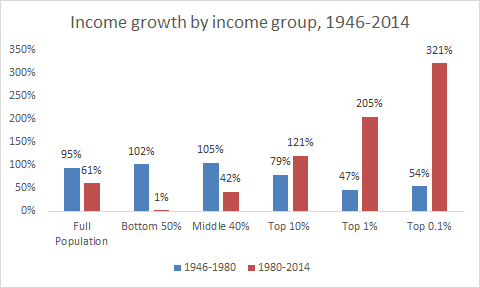
The following two figures come from a Washington Post article by Jared Bernstein in which he summarizes the work of Thomas Piketty, Emmanuel Saez and Gabriel Zucman. The first set of bars shows the significant decline in US pre-tax income growth.  In the first period (1946-1980), pre-tax income grew by 95 percent.  In the second (1980-2014), it grew by only 61 percent.

income-trends

This figure also shows that this slower pre-tax income growth has not been a problem for those at the top of the income distribution.  Those at the top more than compensated for the decline by capturing a far greater share of income growth than in the past.  In fact, those in the bottom 50 percent of the population gained almost nothing over the period 1980 to 2014.

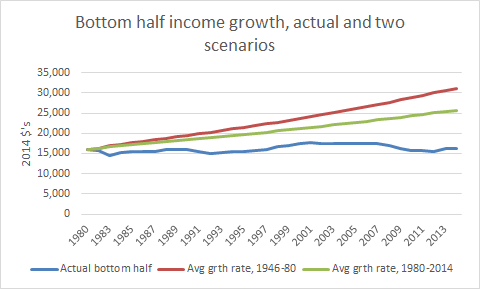
The next figure helps us see that the growth in inequality has been far more damaging to the well-being of the bottom half than the slowdown in overall income growth.  As Bernstein explains:

The bottom [blue] line in the next figure shows actual pretax income for adults in the bottom half of the income scale. The top [red] line asks how these folks would have done if their income had grown at the average rate from the earlier, faster-growth period. The middle [green] line asks how they would have done if they experienced the slower, average growth of the post-1980 period.

The difference between the top two lines is the price these bottom-half adults paid because of slower growth. The larger gap between the middle and bottom line shows the price they paid from doing much worse than average, i.e., inequality… That explains about two-thirds of the difference in endpoints. Slower growth hurt these families’ income gains, but inequality hurt them more.

inequality-versus-growth

A New York Times analysis of pre-tax income distribution over the period 1974 to 2014 reinforces this conclusion about the importance of inequality.  As we can see in the figure below, the top 1 percent and bottom 50 percent have basically changed places in terms of their relative shares of national income.

changing-places

The steady ratcheting down in majority well-being is perhaps best captured by studies designed to estimate the probability of children making more money than their parents, an outcome that was the expectation for many decades and that underpinned the notion of “the American dream.”

Such research is quite challenging, as David Leonhardt explains in a New York Times article, “because it requires tracking individual families over time rather than (as most economic statistics do) taking one-time snapshots of the country.”  However, thanks to newly accessible tax records that go back decades, economists have been able to estimate this probability and how it has changed over time.

Leonhardt summarizes the work of one of the most important recent studies, that done by economists associated with the Equality of Opportunity Project. In summary terms, those economists found that a child born into the average American household in 1940 had a 92 percent chance of making more than their parents.  This falls to 79 percent for a child born in 1950, 62 percent for a child born in 1960, 61 percent for a child born in 1970, and only 50 percent for a child born in 1980.

The figure below provides a more detailed look at the declining fortunes of most Americans.   The horizontal access shows the income percentile a child is born into and the vertical access shows the probability of that child earning more than their parents.   The drop-off for children born in 1960 and 1970 compared to the earlier decade is significant and is likely the result of the beginning effects of the changes in capitalist economic dynamics that started gathering force in the late 1970s, for example globalization, privatization, tax cuts, union busting, etc.  The further drop-off for children born in 1980 speaks to the strengthening and consolidation of those dynamics.

american-dream

The income trends highlighted in the figures above are clear and significant, and they point to the conclusion that unless we radically transform our capitalist system, which will require building a movement capable of challenging and overcoming the power of those who own and direct our economic processes, working people in the United States face the likelihood of an ever-worsening future.

Martin Hart-Landsberg, PhD is a professor emeritus of economics at Lewis and Clark College. You can follow him at Reports from the Economic Front.

Originally posted at Work in Progress.

Why do people sometimes resist remediation of pollution in their own backyards? Conventional academic wisdom suggests that it is because they are afraid of losing their jobs, but my recent research in La Oroya, Peru, questions this dominant framework.

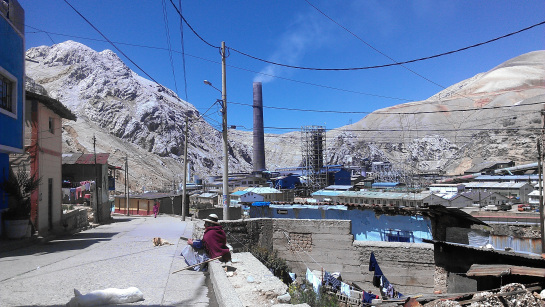
Photo by Pamela Neumann.

Since 1922, La Oroya has been home to three refineries for processing lead, copper, and zinc, and a lead smelter owned until recently by a company called Doe Run Peru. In the late ’90s, several scientific studies demonstrated dangerously high lead levels among the town’s children.

The findings drew extensive attention from the media, but not the kind that some residents appreciated. Tania, a local schoolteacher told me, “In the media there are these ideas that we are nothing but a bunch of slow, sick, contaminated people, but they don’t pay any attention to how some students are very high performing.” Elena, a 45-year old shop owner, agreed, saying: “Of course there are sick children everywhere, slow children, just like in your country [referring to the United States]. But we have children who are doing well, we have professionals, professors.”

School teachers and principals took pride in the achievements of their students, which they felt were ignored in the rush to paint La Oroya as nothing more than a town full of “mongolicos” (a local term for people who have Down’s syndrome or are disabled). In seeking to defend their town’s identity against a barrage of negative media coverage, some residents denied that the contamination was a problem at all. “Look at all the awards we’ve won,” one principal told me, pointing to a row of trophies on the wall. “We couldn’t have done this if the contamination was really a problem.”

In response to the media portrayals, many residents became reluctant to protest against the pervasive lead contamination because doing so affirmed negative stories about their town’s identity. Residents weren’t protective of their jobs, they were protective of their town and of their own reputation as “normal” and “good,” not a place full of “mongolicos.”

These findings suggest that heavy-handed exposes of polluted cities and towns might do harm as well as good. Environmental activists might be better served to find a balance between condemning pollution and uplifting the places and people who are its victims.

Pamela Neumann, PhD is a Post-Doctoral Fellow at the Stone Center for Latin American Studies at Tulane University. A longer version of this post can be found at Work in Progress.

Late last year Covergirl announced a new spokesmodel, a 17-year-old named James Charles. Their Instagram announcement currently boasts over 53,000 likes, though the comments on the post were decidedly mixed. They ranged from “I will never buy another (coverGIRL) because of this” to  “love love love” and “the world is coming to equality and acceptingness.”

In my circles, the overwhelming response was enthusiasm. Charles’ ascendance to Covergirl status was evidence that gender flexibility was going mainstream. And, I suppose it is.

I am always suspicious, though, of corporate motives. Covergirl’s decision to feature Charles does serve to break down the gender binary, but it does other things, too. Most notably, if makeup companies could convince boys and men that their product is as essential for them as it is for girls and women, it would literally double the size of their market.

That this hasn’t happened yet, in fact, is evidence of the triumph of gender ideology over capitalism. Either companies have decided that there’s (almost) no market in men or men have resisted what marketing has been applied. It’s an impressive resistance to what seems like an obvious expansion. There’s just no money in men thinking their faces look just fine as they are; the fact that we’ve allowed them to do so thus far is actually pretty surprising when you think about it.

If Covergirl had its way, though, I have no doubt that it would make every 17-year-old boy in America into a James Charles. Such a change would contribute to breaking down the gender binary, at least as we know it (though no doubt there are more and less feminist ways of doing this). Of course, if it was advantageous to do so, Covergirl would claim that it had something to do with feminism. But, I wouldn’t buy it.

Lisa Wade, PhD is an Associate Professor at Tulane University. She is the author of American Hookup, a book about college sexual culture; a textbook about gender; and a forthcoming introductory text: Terrible Magnificent Sociology. You can follow her on Twitter and Instagram.
1Recently Nadya Tolokonnikova was interviewed by NPR about Pussy Riot’s latest video. In it, Tolokonnikova explores themes of racism, xenophobia, and misogyny and its influence on governance through a graphic and violent imagined America under a Trump presidency. Trigger warning for… most things:

Tolokonnikova is making a statement about American politics, but she is clearly informed by Putin’s performance of masculinity and how that has translated into policy measures and electoral success. When he took office in early 2000, Putin needed to legitimize his power and counteract the global impression of Russian weakness after the collapse of the Soviet Union.

The projection of masculinity was a PR strategy: fishing and riding a horse shirtless, shooting a Siberian tiger, and emerging from the Black Sea in full scuba gear. These actions combined with bellicose foreign policy initiatives to portray Putin as assertive and unrelenting.

In the book, Sex, Politics, & Putin, Valerie Sperling makes a case that his strategy was successful. She investigates the political culture under Putin and argues there is popular support for Putin’s version of masculinity and its implications for femininity, even among young women. As a consequence, the gender and sexual politics of Russia have deviated from those of wider Europe, as indicated by the rise of the Russian slur “gayropa.”

The machismo and misogyny embodied by Putin have also translated into policy: the “gay propaganda” law, for example, and the ban on international adoption to gay couples. In his 2013 address to the Federal Assembly, Putin framed these policies as necessary to combat the “destruction of traditional values.”

While there is no systematic research on the role of masculinity in Trump’s rise to the national political stage in the US just yet, and while the nature of the link between Putin and Trump remains unclear (if one truly even exists), we should consider Putin’s Russia a cautionary tale. His performances of masculinity – his so-called “locker room talk,” discussion of genitalia size, and conduct towards pageant contestants — could go from publicity stunt to public support to actual policy measures. His bombastic language about defeating ISIS and the need for more American “strength” at home and abroad, for example, could easily translate into foreign policy.

Coverage of Trump during this election cycle is credited for hundreds of millions in profits for news agencies and Trump himself has enjoyed an unprecedented level of coverage. While Trump has benefited from far more airtime than Putin did in 2000, he has not been able to find the same level of popular support. At least not yet. When Putin rose to status as a national figure in Russia his approval rating was approximately 60%, and it grew from there to levels most American politicians only dream of. If Trump is willing and able to adopt other components of Putin’s leadership style, there is precedent for the possibility that his presidency could truly turn American back.

Alisha Kirchoff is a sociology PhD student at Indiana University-Bloomington. She has previously lived and worked in Russia and is currently working on research in political sociology, law and society, organizations, and gender. Her latest project is on fertility intentions and family policies in Putin’s Russia. You can follow her on twitter.

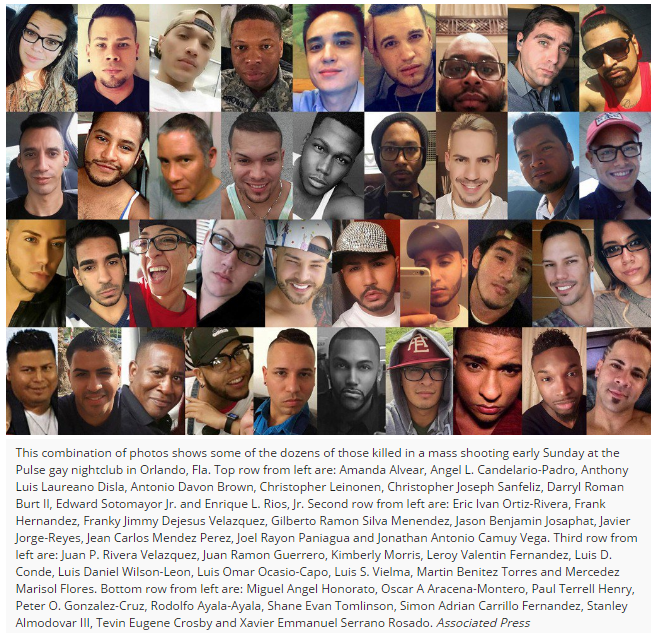
1It was “Latino night” at a gay club. When the story finally broke, that’s all I heard. Orlando’s tragedy at the Pulse puts Latina/o, Latin American, Afro-Latinos, and Puerto Ricans and other Caribbean LGBT people front and center. Otherness mounts Otherness, even in the Whitewashing of the ethno-racial background of those killed by the media, and the seemingly compassionate expressions of love by religious folk. The excess of difference—to be Black or Brown (or to be both) and to be gay, lesbian, bisexual, or transgender (or queer, as some of us see ourselves) serves to shock, through difference, how news are reported. Difference – the very basis of feminist and ethnic politics in the 20th century – has been co-opted and ignored, sanitized even, to attempt to reach a level of a so-called “humanity” that is not accomplishable. We know this, but we don’t talk about it.

4

.

Don’t get me wrong: empathy is essential for most social codes of order to functionally sustain any given society. To pay one’s respects for others’ losses, however, does not mean that we think of those lost as equals. Liberal people demanding that sexuality be less important in the news (and thus removed from the coverage) is an inherent violence toward those who partied together because there was real love among them, in that club, for who they were – and are. Religious righters may spread hate while trying to give the illusion of compassion, but they do so in a clear hierarchical, paternalistic way – that is hypocrisy, and we must call it out every chance we get. But this goes beyond liberal notions and conservative hypocrisy – even while Anderson Cooper wept when reading the list of those killed, he knows the distance between himself and many of those at the club is enough to build a classed, raced, and social wall between them. Clearly, empathy is not enough.

To be Latina/o in the US – increasingly another Latin American country, again – is to breathe in hate, to face retaliation, to be questioned at every turn about our allegiances, tested on our sense of citizenship, pushed in our capacity to love the nation and thus hate “like the rest” (a testament to the masculinity of the nation). At a minimum, to be Latina/o guarantees one to be looked at oddly, as if one was out of place, misplaced, inappropriately placed. Simply by being, Latinas/os rupture the logics of normalcy in USAmerica. To be Latina/o and LGBT is to disrupt the logics of racial formation, of racial purity, of the Black and White binary still ruling this country – all while de-gendering and performing an excess (of not only gender, but sexuality) that overflows and overwhelms “America.” In being Latino and queer, some of us aim to be misfits that disrupt a normalcy of regulatory ways of being.

A break between queer and América erupted this past weekend – in Orlando, a city filled with many Latin Americans; a city that, like many others, depends on the backs of Brown folk to get the work done. Put another way, Orlando’s tragedy created a bridge between different countries and newer readings of queerness – Orlando as in an extension of Latin América here. Queer-Orlando-América is an extension of so many Latin American cities as sites of contention, where to be LGBT is both celebrated and chastised – no more, or less, than homophobia in the US.

Enough has been said about how the Pulse is a place where people of color who desired others like themselves, or are trans, go to dance their fears away, and dream on hope for a better day. Too little has been said about the structural conditions faced by these Puerto Ricans, these immigrants, these mixed raced queer folks – some of whom were vacationing, many of whom lived in Florida. Many were struggling for a better (financial, social, political – all of the above) life. Assumptions have also been made about their good fortune as well. Do not assume that they left their countries seeking freedom – for many who might have experienced homophobia back home, still do here; though they have added racism to their everyday lived experience. Of course, there are contradictions on that side of queer-Orlando-América, too; yet same sex marriage was achieved in half a dozen countries before the US granted it a year ago. This is the world upside down, you say, since these advances – this progress – should have happened in the US first.Wake up. América is in you and you are no longer “America” but América.

You see, this is how we become queer-Orlando-América: we make it a verb, an action. It emerges where the tongues twist, where code switching (in Spanish/English/Spanglish) is like a saché-ing on the dance floor, where gender and race are blurry and yet so clear, where Whiteness isn’t front and center – in fact it becomes awkward in this sea of racial, gendered, and sexual differences. This queer-Orlando-América (a place neither “here,” nor “there,” where belonging is something you carry with you, in you, and may activate on some dance floor given the right people, even strangers, and real love – especially from strangers) was triggered – was released – by violence. But not a new violence, certainly not a Muslim-led violence. Violence accumulated over violence – historically, ethnically, specific to transgender people, to Brown people, to effeminate male-bodied people, to the power of femininity in male and female bodies, to immigrants, to the colonized who speak up, to the Spanglish that ruptures “appropriateness,” to the language of the border. And in spite of this, queer-Orlando-América has erupted. It is not going down to the bottom of the earth. You see us. It was, after all, “Latino night” at a gay club. You can no longer ignore us.

As the week advanced, and fathers’ day passed us by, I have already noticed the reordering of the news, a staged dismissal so common in media outlets. Those queer and Brown must continue to raise this as an issue, to not let the comfort of your organized, White hetero-lives go back to normal. You never left that comfort, you just thought about “those” killed.  But it was “Latino night” at a gay club. I do not have that luxury. I carry its weight with me. Now the lives of those who are queer and Latina/o have changed – fueled with surveillance and concerns, never taking a temporary safe space for granted. Queer-Orlando-América is thus a “here and now” that has changed the contours of what “queer” and “America” were and are. Queer has now become less White – in your imaginary (we were always here). América now has an accent (it always had it – you just failed to notice).  Violence in Orlando did this. It broke your understanding of a norm and showed you there is much more than the straight and narrow, or the Black and White “America” that is segmented into neatly organized compartments. In that, Orlando queers much more than those LGBT Latinas/os at the club. Orlando is the rupture that bridges a queer Brown United States with a Latin America that was always already “inside” the US – one that never left, one which was invaded and conquered. Think Aztlán. Think Borinquen. Think The Mission in San Francisco. Or Jackson Heights, in NYC. Or the DC metro area’s Latino neighborhoods. That is not going away. It is multiplying.

I may be a queer Latino man at home, at the University, at the store, and at the club. That does not mean that the layered account of my life gets acknowledged (nor celebrated) in many of those sites – in fact, it gets fractured in the service of others’ understandings of difference (be it “diversity,” “multiculturalism” or “inclusion”). But it sure comes together on the dance floor at a club with a boom-boom that caters to every fiber of my being. It is encompassing. It covers us. It is relational. It moves us – together. So, even if I only go out once a year, I refuse to be afraid to go out and celebrate life. Too many before me have danced and danced and danced (including those who danced to the afterlife because of AIDS, hatred, and homophobia), and I will celebrate them dancing – one night at a time.

We are not going away – in fact, a type of queer-Orlando-América is coming near you, if it hasn’t arrived already, if it wasn’t there already—before you claimed that space. No words of empathy will be enough to negotiate your hypocrisy, to whitewash our heritage, or make me, and us, go away. If anything, this sort of tragedy ignites community, it forces us to have conversations long overdue, it serves as a mirror showing how little we really have in common with each other in “America” – and the only way to make that OK is to be OK with the discomfort difference makes you experience, instead of erasing it.

We must never forget that it was “Latino night” at a gay club. That is how I will remember it.

Salvador Vidal-Ortiz, PhD, is associate professor of sociology at American University; he also teaches for their Women’s, Gender, and Sexuality Studies program. He coedited The Sexuality of Migration: Border Crossings and Mexican Immigrant Men and Queer Brown Voices: Personal Narratives of Latina/o LGBT Activism. He wrote this post, originally, for Feminist Reflections.