Search results for The

It’s all harmless political shenanigans until a racist mob murders Vincent Chin.

It’s amazing how the new figureheads of both major parties are now pretending to oppose globalization, outsourcing, and the corporate “free trade” agenda that they both have spent their professional lives furthering. It wasn’t long ago that I taught in my stratification class that this agenda was the one thing we could be sure both parties and the big money behind them wouldn’t give up. Never say never, but I’m still pretty sure that’s still true.

There are humans that are hurt by this agenda, but most of them aren’t Americans. If politicians want to talk about slave labor, exploitation, and environmental degradation in the new manufacturing centers of the world, then I would be happy to listen to them talk about the harmful effects of those practices “here at home” too. But if they just want to bash China, then that’s racist, and no thank you.

Case in point, Pennsylvania Senator Bob Casey at the Democratic National Convention the other day. Here’s his speech, followed by some of the text and my comments:

Casey quoted his father, the former governor:

The sweat and blood of working men and women who built Pennsylvania forged the industrial revolution in our country, and outproduced the world.

How touching, attributing the industrial revolution the efforts of the working class and not the capitalists. It reminds me of when another Pennsylvania governor, Democrat Robert Pattison, reached across the aisle, helping out Republican industrialists by lending them the National Guard to attack striking steelworkers.

I assume today’s Democratic politician will now go on to recognize the working class of today’s manufacturing centers, who, through their sweat and blood, are outproducing the world and building the middle class in their countries. Oh right, Senator Casey is an American.

What about Donald Trump? Donald trump says he stands for workers, and that he’ll put American first, but that’s not how he’s conducted himself in business. Where are his, quote, tremendous products made? Dress shirts: Bangladesh. Furniture: Turkey. Picture frames: India. Wine glasses: Slovenia. Neckties: China. China! Why would Donald Trump make products in every corner of the world, but not in Altoona, Erie, or here in Philadelphia? Well, this is what he said, quote, outsourcing is not always a terrible thing. Wages in America quote, are too high. And then he complained about companies moving jobs overseas because, quote, we don’t make things anymore. Really? … [examples of stuff made in America]. Donald Trump hasn’t made a thing in his life, except a buck on the backs of working people. If he is a champion of working people, I’m the starting center for the 76ers! The man who wants to make America great, doesn’t make anything in America! If you believe that outsourcing has been good for working people, and has raised incomes for the middle class, then you should vote for Donald Trump. … We need to making good paying jobs for everyone here at home, so that everyone who works hard can get ahead and stay there.

The great conflict of our time is between “China” and “working people”? Maybe we should all link arms and together put down striking Chinese workers to keep the price down on our iPhones and Wal-Mart junk.

The Democratic National Convention was very on-message. In Hillary Clinton’s acceptance speech the next day, she said:

If you believe that we should say “no” to unfair trade deals, that we should stand up to China, that we should support our steelworkers and autoworkers and homegrown manufacturers — join us.

She gave no definition of what it means to “Stand up to China,” though her website says she will insist on trade deals that raise wages and create good-paying jobs (presumably in the US). That’s not important — the important thing communicated to her audience is she’s against China and for American workers. Then she went through the same list of Trump production locations that Casey did, before concluding, “Donald Trump says he wants to make America great again – well, he could start by actually making things in America again.” The current U.S. trade deficit in goods (as opposed to services) is about $62 billion — per month. Virtually all Americans are dependent on imported goods (including, apparently, Clinton, whose Nina McLemore suits are made from European and Asian fabrics). No major politician is seriously against this. Trump hiring U.S. workers to make his ties would make about as much difference as Clinton buying clothes with U.S. fabrics, which is basically none. It’s just symbolism, and the symbolism here is “China is bad.” Unless you join this kind of talk with explicit concern for the suffering and exploitation of Chinese workers, this just feeds American racism.

Decades later, Vincent Chin’s murder still resonates with me. There is debate about whether racism was the real motivation behind his murder, and it wasn’t as simple as a random lynch mob. Despite the legend, it is not the case that the auto workers just killed him because they falsely believed he was Japanese. But a witness at the bar said they blamed him for them being out of work before they fought. She said:

I turned around and I heard Mr. Ebens say something about the “little motherfuckers.” And Vincent said, “I’m not a little motherfucker,” and he said, “Well, I don’t know if you’re a big one or a little one.” Then he said something about, “Well, because of y’all motherfuckers we’re out of work.”

After losing the first round, Ronald Ebins and his stepson, Michael Nitz, hunted Chin down and killed him with a baseball bat, a crime for which they ultimately served no jail time.

My 8-year-old Chinese immigrant daughter, who learns all about how racism and bullying are bad and MLK is great in her neoliberal public American elementary school, is routinely offended and hurt by the China-bashing she hears from Democrats as well as Trump (she supported Bernie but is willing to back Hillary to stop Trump).

Hillary says we should protect our children from having to listen to Trump’s nastiness — she even has ad on that, which I’ve personally witness liberals tearing up over:

So, what about the people making speeches at the Democratic convention, spitting out the word China! like it’s a disease? “What example will we set for them?”

If the new normal of politics is both parties bashing foreigners  while they pretend to oppose globalization — and then pursuing the same policies anyway (which, face it, you know they will), then what have we gained? It seems to me there is a small chance Clinton will negotiate better trade deals to the benefit of workers (U.S. or Chinese), alongside a much greater chance that her rhetoric will stoke nativism and racism. Trump’s megaphone may have drawn the White supremacists out from under their rocks, but the new anti-TPP Hillary is bellowing the same obnoxious chauvinism.

Philip N. Cohen is a professor of sociology at the University of Maryland, College Park, and writes the blog Family Inequality, where this post originally appeared. He is the author of The Family: Diversity, Inequality, and Social Change. You can follow him on Twitter or Facebook.

It’s been a difficult summer and I’ve done my best to try to ensure that SocImages is contributing to the many important conversations we’ve had. I’m grateful for the many guest bloggers who have helped. I’ll summarize the relevant posts here, throwing in June as well since I missed that month’s update.

Sociological perspectives on this summer’s current events:

Brexit

The Republican race

The Democratic race

Gun control

The Orlando massacre

Black Lives Matter

Brock Turner’s sentence for sexual assault

P.S.

Sociological Images turned 9-years old!

Social Media ‘n’ Stuff:

Find SocImages on twitterfacebooktumblr, and pinterest.

Or join me on facebook, twitter, and instagram.

Lisa Wade, PhD is an Associate Professor at Tulane University. She is the author of American Hookup, a book about college sexual culture; a textbook about gender; and a forthcoming introductory text: Terrible Magnificent Sociology. You can follow her on Twitter and Instagram.

Woo hoo! SocImages is nine!

Photo by zeitzeph on Flickr.

Thanks to all of you who discovered SocImages this year and to those of you who’ve been hanging on!

It was my bumpiest year yet with a three month hiatus to finish American Hookup. There are also changes afoot. After nine years, it makes sense to shake things up a bit. I’m hoping to step back into more of an editor role, helping established scholars bring attention to their research, giving newer scholars a platform, and helping other sociology bloggers reach a wider audience. So, to all the sociologists out there, look out for more requests to re-print, please don’t hesitate to pitch me ideas, and feel free to send me things to share!

Here’s to the wide, varied, and important sociological blog-o-sphere that has erupted in the past nine years. I’m impressed with how far we’ve come and am eager to see how far we can go. To sociology!

Lisa Wade, PhD is an Associate Professor at Tulane University. She is the author of American Hookup, a book about college sexual culture; a textbook about gender; and a forthcoming introductory text: Terrible Magnificent Sociology. You can follow her on Twitter and Instagram.

Why are relations between black America and the police so fraught? I hope that this collection of 50 posts on this topic and the experience of being black in this country will help grow understanding. See, also, the Ferguson syllabus put together by Sociologists for Justice, the Baltimore syllabus, and this summary of the facts by Nicki Lisa Cole.

Race and policing:

Perceptions of black men and boys as inherently criminal:

Proof that Americans have less empathy for black people:

Evidence of the consistent maltreatment, misrepresentation, and oppression of black people in every part of American society:

On violent resistance:

The situation now:

W.E.B. DuBois (1934):

The colored people of America are coming to face the fact quite calmly that most white Americans do not like them, and are planning neither for their survival, nor for their definite future if it involves free, self-assertive modern manhood. This does not mean all Americans. A saving few are worried about the Negro problem; a still larger group are not ill-disposed, but they fear prevailing public opinion. The great mass of Americans are, however, merely representatives of average humanity. They muddle along with their own affairs and scarcely can be expected to take seriously the affairs of strangers or people whom they partly fear and partly despise.

For many years it was the theory of most Negro leaders that this attitude was the insensibility of ignorance and inexperience, that white America did not know of or realize the continuing plight of the Negro.  Accordingly, for the last two decades, we have striven by book and periodical, by speech and appeal, by various dramatic methods of agitation, to put the essential facts before the American people.  Today there can be no doubt that Americans know the facts; and yet they remain for the most part indifferent and unmoved.

– From A Negro Nation Within a Nation

A Pew study found that 63% of white and 20% of black people think that Michael Brown’s death at the hands of Darren Wilson was not about race. This week many people will probably say the same about two more black men killed by police, Philando Castile and Alton Sterling.

Those people are wrong.

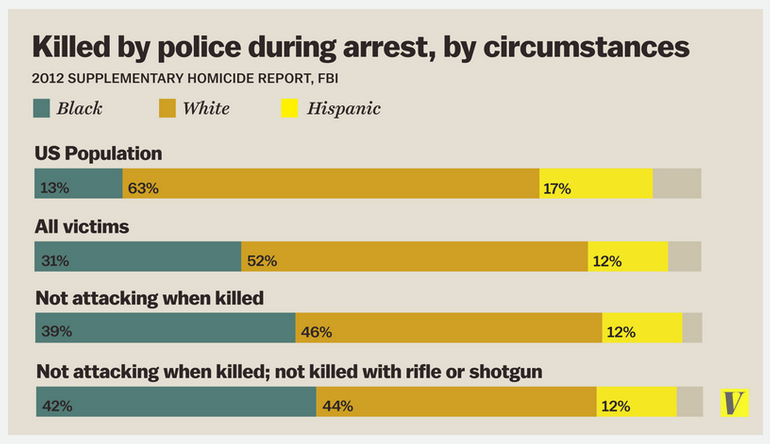
African Americans are, in fact, far more likely to be killed by police. Among young men, blacks are 21 times more likely to die at the hands of police than their white counterparts.

But, are they more likely to precipitate police violence?  No. The opposite is true. Police are more likely to kill black people regardless of what they are doing. In fact, “the less clear it is that force was necessary, the more likely the victim is to be black.”

1 (4)

That’s data from the FBI.

This question was also studied by sociologist Lance Hannon. With an analysis of over 950 non-justifiable homicides from police files, he tested whether black people were more likely to take actions that triggered their own murder. The answer was no. He found no evidence that blacks were more likely than whites to engage in verbal or physical antecedents that explained their death.

There is lots, lots more evidence if one bothers to go looking for it.

Castile and Sterling, unlike Brown, were carrying weapons. People will try to use that fact to justify the police officer’s fatal aggression. But it doesn’t matter. Black men and women are killed disproportionately whether they are carrying weapons or not, whether carrying weapons is legal or not. Carrying weapons is, in fact, legal in both Minnesota and Louisiana, the states of this week’s killings. What they were carrying is no more illegal than Trayvon’s pack of Skittles. Black people can’t carry guns safely; it doesn’t matter whether they are legal. Heck, they can’t carry Skittles safely. Because laws that allow open and concealed carry don’t apply the same way to them as they do white people. No laws apply the same way to them. The laws might be race neutral; America is not.

Revised from 2014.

Lisa Wade, PhD is an Associate Professor at Tulane University. She is the author of American Hookup, a book about college sexual culture; a textbook about gender; and a forthcoming introductory text: Terrible Magnificent Sociology. You can follow her on Twitter and Instagram.

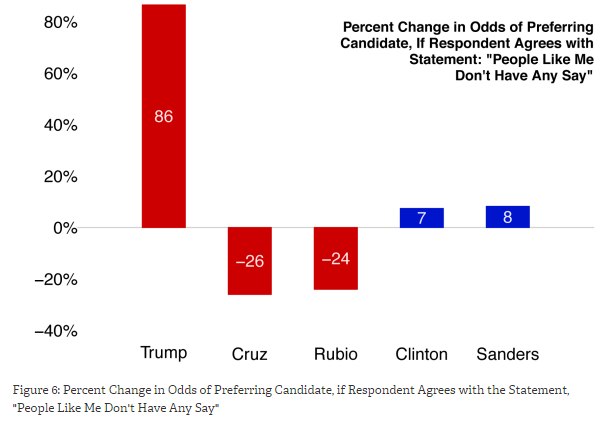
One explanation for Trump’s popularity on the political right is that supporters are attracted to him because they feel invisible to “establishment” candidates and Trump, as an “outsider” is going to “shake things up.” A survey of 3,037 Americans completed by RAND, weighted to match the US (citizen) population, suggests that there is something to this.

About six months ago, RAND asked respondents if they agreed with the statement “people like me don’t have any say about what the government does.” Responses among likely Democratic voters didn’t significantly correlate with support for either Sanders or Clinton and those among likely Republican voters didn’t significantly correlate with support for Rubio or Cruz, but responses did correlate dramatically with a preference for Trump. All other things being equal, people who “somewhat” or “strongly” agreed with the statement were 86% more likely to prefer Trump over other candidates.

7

“This increased preference for Trump,” RAND explains, “is over and beyond any preferences based on respondent gender, age, race/ethnicity, employment status, educational attainment, household income, attitudes towards Muslims, attitudes towards illegal immigrants, or attitudes towards Hispanics.”

Whatever else is driving Trump voters, a sense of disenfranchisement appears to be a powerful motivator.

Lisa Wade, PhD is an Associate Professor at Tulane University. She is the author of American Hookup, a book about college sexual culture; a textbook about gender; and a forthcoming introductory text: Terrible Magnificent Sociology. You can follow her on Twitter and Instagram.

Racial segregation in housing is a persistent and pernicious problem in American life. If neighborhoods are filled predominantly by one race or another, that group of people can be advantaged or disadvantaged by virtue of where they live. Decisions about where to put parks, garbage dumps, toxic facilities, airports, and highways, for example, can affect some groups more than others. Some neighborhoods might not have good jobs or public transportation, or sufficient numbers of grocery stores, nursing homes, or recreation facilities, but be filled with check cashing businesses, liquor stores, and cigarette advertising. The quality of schools, water systems, levee systems, and even the air itself varies by neighborhood. And a large and robust literature in sociology shows that good things tend to cluster in whiter neighborhoods and bad things in neighborhoods that are predominantly African American or Latino.

But why are neighborhoods racially segregated? And why do they resist integration?

One possibility is that white people simply prefer to live among others of the same race. What comes to mind perhaps is a white family that sells their house the second a black family moves in next door, but a model developed by economist Thomas Schelling shows that even a surprisingly weak preference will produce systemic segregation.

What if, for example, there are two types of people and each are happy in a diverse neighborhood, but they become uncomfortable when fewer than 1/3rd of their neighbors are like them? If you randomly move the uncomfortable households around until everyone’s happy, segregation is mathematically guaranteed. Here is a simulation, at the Parable of the Polygons (h/t orgtheory), of how segregation results from a preference that 1/3rd or more of one’s neighbors are the same race:

Obviously, the more of a preference, the more extreme the segregation, but the lesson is that racially diverse neighborhoods are undermined not only by a strong of living alongside other races, but also a slight preference for being among at least some people of the same race.

Schelling also notes that if we start with already segregated neighborhoods and we reduce bias, nothing changes at all. Most people who are surrounded by people like themselves won’t move just because they wouldn’t object to being around people who are different than them.

Instead, to substantially reduce residential segregation, people will not only have to accept diversity, they will have to actively reject segregation. And, again, even a weak preference for diversity will do it. In fact, Schelling’s model shows that if people are comfortable living in neighborhoods in which 90% of their neighbors are the same race, but reject 100% segregated ones, the result is integration. Here’s what it would look like if people moved out of neighborhoods in which 90% of their neighbors were the same race and into more integrated neighborhoods:

4

The take home message is that, to end residential racial segregation, we don’t need to reduce bias, we need to increase desire. We need people to actively seek the diversity they want.

Lisa Wade, PhD is an Associate Professor at Tulane University. She is the author of American Hookup, a book about college sexual culture; a textbook about gender; and a forthcoming introductory text: Terrible Magnificent Sociology. You can follow her on Twitter and Instagram.

Rose Eveleth’s piece for Fusion on gender and bodyhacking was something I didn’t know I needed in my life until it was there. You know how you’ve always known something or felt something, but it isn’t until someone else articulates it for you that you truly understand it, can explain it to yourself, think you might be able to explain it to others – or, even better, shove the articulation at them and be all THAT RIGHT THERE, THAT’S WHAT I’M TALKING ABOUT. You know that kind of thing?

Yeah, that.

Eveleth’s overall thesis is that “bodyhacking” isn’t new at all, that it’s been around forever in how women – to get oversimplified and gender-essentialist in a way I try to avoid, so caveat there – alter and control and manage their bodies (not always to positive or uncoercive ends), but that it’s not recognized as such because we still gender the concept of “technology” as profoundly masculine:

Men invent Soylent, and it’s considered technology. Women have been drinking SlimFast and Ensure for decades but it was just considered a weight loss aid. Quantified self is an exciting technology sector that led tech giants such as Apple to make health tracking a part of the iPhone. But though women have been keeping records of their menstrual cycles for thousands of years, Apple belatedly added period tracking to its Health Kit. Women have been dieting for centuries, but when men do it and call it “intermittent fasting,” it gets news coverage as a tech trend. Men alter their bodies with implants and it’s considered extreme bodyhacking, and cutting edge technology. Women bound their feet for thousands of years, wore corsets that altered their rib cages, got breast implants, and that was all considered shallow narcissism.

As a central personal example, Eveleth uses her IUD, and this is what especially resonated with me, because I also have one. I’ve had one for about seven years. I love it. And getting it was moderately life-changing, not just because of its practical benefits but because it altered how I think about me.

The insertion process was not comfortable (not to scare off anyone thinking of getting one, TRUST ME IT IS GREAT TO HAVE) and more than a little anxiety-inducing ahead of time, but I walked out of the doctor’s office feeling kind of cool. I had an implant. I had a piece of technology in my uterus, that was enabling me to control my reproductive process. I don’t want children – at least not right now – and my reproductive organs have never been significantly important to me as far as my gender identity goes (probably not least because I don’t identify as a woman), but managing my bits and what they do and how they do it has naturally been a part of my life since I became sexually active.

And what matters for this conversation is that the constant task of managing them isn’t something I chose. Trying to find a method that worked best for me and (mildly) stressing about how well it was working was a part of my identity inasmuch as it took up space in my brain, and I wasn’t thrilled about that. I didn’t want it to be part of my identity – though I didn’t want to go as far as permanently foreclosing on the possibility of pregnancy – and it irked me that it had to be.

Then it didn’t have to be anymore.

And it wasn’t just about a little copper implant being cool on a pure nerd level. I felt cool because the power dynamic between my self and my body had changed. My relationship between me and this set of organs had become voluntary in a way entirely new to me.

I feel like I might not be explaining this very well.

Here: Over thirty years ago, Donna Haraway presented an image of a new form of self and its creation – not creation, in fact, but construction. Something pieced together with intentionality, the result of choices – something “encoded.” She offered a criticism of the woman-as-Earth-Mother vision that then-contemporary feminists were making use of, and pointed the way forward toward something far stranger and more wonderfully monstrous.

The power of an enmeshing between the organic and the technological lies not only in what it allows one to do but in what it allows one to be – and often there’s no real distinction to be made between the two. We can talk about identity in terms of smartphones, but when we come to things like technologies of reproductive control, I think the conversation often slips into the purely utilitarian – if these things are recognized as technologies at all.

Eveleth notes that “technology is a thing men do,” and I think the dismissal of female bodyhacking goes beyond dismissal of the utilitarian aspects of these technologies. It’s also the dismissal of many of the things that make it possible to construct a cyborg self, to weave a powerful connection to the body that’s about the emotional and psychological just as much as the physical.

I walked out of that doctor’s office with my little copper implant, and the fact that I no longer had to angst about accidental pregnancy was in many respects a minor component of what I was feeling. I was a little less of a goddess, and a little more of a cyborg.

Sunny Moraine is a doctoral candidate in sociology at the University of Maryland and a fiction author whose work has appeared in Clarkesworld, Lightspeed, Shimmer, Nightmare, and Strange Horizons, as well as multiple Year’s Best anthologies; they are also responsible for both the Root Code and Casting the Bones novel trilogies. Their current dissertation work concerns narrative, temporality, and genocidal violence. They blog at Cyborgology, where this post originally appeared, and can be followed on Twitter at @dynamicsymmetry.