Search results for The

TSP_Assigned_pbk_978-0-393-28445-4Assigned: Life with Gender is a new anthology featuring blog posts by a wide range of sociologists writing at The Society Pages and elsewhere. To celebrate, we’re re-posting four of the essays as this month’s “flashback Fridays.” Enjoy! And to learn more about this anthology, a companion to Wade and Ferree’s Gender: Ideas, Interactions, Institutions, please click here.

.

“Tits,” by Matt Cornell

Of the many nicknames I’ve acquired over the years, there’s one I’m reminded of today. The name was given to me by a bully shortly after I entered the sixth grade. I had been a fat kid since elementary school, but as puberty began to kick in, parts of me started growing differently than expected. The doctors said I had gynecomastia. “Man boobs,” or “moobs” in the jeering parlance of our popular culture.

But my bully simply called them “tits.” And so this also became my name in the school hallways.

I was Tits.

He would pass me in the hall and catcall “Hey Tits!” and his buddies would laugh. Sometimes, if he was feeling extra bold, he might actually grab one of my breasts, and squeeze it in front of the other kids. Not everyone laughed. But many did.

As direct as this bullying was, growing up with gynecomastia was characterized by smaller insults. Most kids would just ask “Why don’t you wear a bra?” Even adults could be cruel. “Are you a boy or a girl?” I was often asked.

When wearing shirts, it was crucial that they be loose fitting. If a T-shirt had shrunk in the dryer, I would spend hours and days stretching it out, so that it didn’t cling to my body. You can see fat boys do this every day. Pulling at their shirts to hide the shape of their bodies, but particularly their breasts.

As a fat kid, and one who hated competition, I learned to loathe sports, and especially, physical education. The one form of exercise which I enjoyed from childhood was swimming. Unfortunately, as my breasts grew, so did my shame about removing my shirt. At summer camp, I never set foot in the swimming pool. I knew that taking off my shirt would bring ridicule, and that leaving it on while swimming would show that I felt ashamed of my body. So, I pretended that I was above swimming — that I was too cool for the pool.

By high school, I had developed remarkable powers of verbal self defense. I absorbed cruelty and learned how to mete it back out in sharp doses. There’s no doubt that this shaped the person I became, for better and for worse. In high school, I managed to carve out a social niche for myself. The bullying stopped. But the shirts stayed loose-fitting. I rarely went swimming.

The doctors thought that perhaps I suffered from low testosterone. I found this funny, since my sex drive had been in high gear since the time I was a sophomore. I assured them that this was not the case. Finally, the doctors said that my excess breast tissue was probably just a result of being fat. Lose the weight and the breasts will go away.

So I lost weight. I don’t remember how much. But by senior year, I was slender. Girls were starting to talk to me. I was more confident. And I still had breasts. After graduation, the doctors congratulated me on my thin body. Now it was time to get rid of my breasts.

In the first surgery, I was placed under general anesthesia. The doctor made a half moon incision under each nipple and cut out the excess breast tissue, finishing the job with some liposuction. Unfortunately the surgery wasn’t a complete success. My breasts were smaller, but lumpy, and my nipples were puckered. It took a second surgery to make everything look “normal.”

I was nineteen. On New Year’s Eve, I went to a party and got drunk for the first time in my life. There, I met a girl who took my virginity. She was too drunk to insist on taking my shirt off. This was a relief, because under my shirt was a sports bra, and under that layers of gauze. My chest was still healing from the second surgery. In many senses of the word, I was still becoming a man.

I’m reminded of this recently, oddly enough, after reading one of those “humorous” snarky news stories that pop up in the right column of The Huffington Post. Perhaps you’ve seen the photo making the rounds. It’s of Barney Frank’s “moobs.” The photo inspired similar stories at gay culture site Queerty, Gawker and Slate, which used the incident as the pretense for a scientific column.
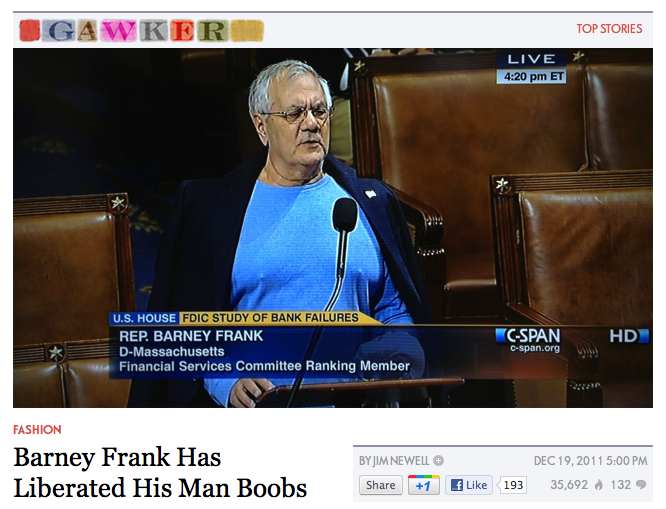
While all of these nominally liberal sites pay lip service to the dignity of gay and transgender people, they miss one thing that is very clear to me. Aside from the obvious fat shaming in these stories, the fixation on “man boobs” reveals our culture’s obsession with binary gender. As I noted on The Huffington Post’s comment thread, before a moderator whisked my comment away, “the only breasts The Huffington Post approves of are those of thin, white female celebrities.”

Here’s one of the many comments Huffpo didn’t delete:

It’s culturally ubiquitous. PETA, for example, is a habitual offender:
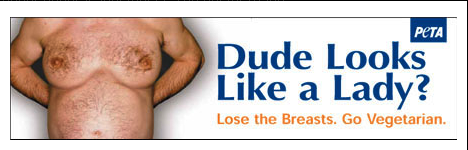
Men are supposed to have flat chests, hairy bodies and big penises. Women are supposed to have large breasts, thin hairless bodies and tidy labias. (If a woman’s labia are too big, it just might remind us that, with a little testosterone, the same tissue would make a penis.)

We have all the evidence we need that biological sex and gender are not as rigid or fixed as we imagine. There are intersexed people. There are transgender people and genderqueer people. There are millions of men and boys like me, who also have large breasts, or gynecomastia, a medically harmless (though socially lethal) condition that your insurance just might pay to correct. The prevalence of gynecomastia in adolescent boys is estimated to be as low as 4% and as high as 69% . As one article notes: “These differences probably result from variations in what is perceived to be normal.” You think?

We’re so entrenched in that snips ‘n snails bullshit, that we can’t accept bodies which don’t fall on either extreme of the gender continuum. Transgender men and women encounter these attitudes in direct, and sometimes life-threatening ways. And, given the misogyny that pervades our society, these pressures are even harder for women and girls, whether they’re cisgender or transgender. Their bodies are hated and desired in equal measure. When my bully grabbed my breasts and called me “Tits,” he was taking what he wanted. He was also reminding me that I was no better than a girl. I was beneath him.

With the explosion of social media and the surveillance society, body policing has gotten much more intense. We live in an age of crowdsourced bullying. I cannot imagine what it would be like to grow up as a boy with breasts in 2011. I suppose I’d spend hours in Photoshop digitally sculpting my body, to remove fat from my face, belly and chest before uploading my profile photos. If I were a fat girl, I might become very skilled at using light and angles to disguise my less than ideal body, to avoid being dubbed a “SIF” or “secret internet fatty,” by my tech-savvy peers. I would probably become vigilant about removing tags from unflattering photos and obsess over remarks people made about me on comment threads.

Twenty years have gone by, and I miss my breasts. As a chubby adult male, I still have a small set of breasts, but not the ones I was born with. The two surgeries also deprived my nipples of their sensitivity.

I’ve often joked that if I knew I was going to become a performance artist, I would have kept my breasts. The breasts I have now are smaller, but still capable of stoking the body police. I once scandalized a fancy pool party in Las Vegas simply by taking off my shirt. I realize that, as a man, it is my privilege to do so. In most parts of our society, it is either illegal or strongly frowned upon for a woman to go topless. (Female breasts are either for maternity or for male sexual pleasure, not for baring at polite parties.) Perhaps my breasts, which remind people of this prohibition, invite a similar kind of censure.

I’ve performed naked enough in my adult life to know that the body police can always find a new area to target. I was recently stunned to hear porn actress Dana DeArmond describe me during a podcast interview as a “fat lady” while her host Joe Rogan openly theorized that my small penis was somehow connected to my feminism. Rogan’s view of gender is so restrictive that he can only conceive of male feminism if it is in a feminized body. (This is probably also why men who support feminism are often dubbed “manginas” by misogynists.)

There might actually be tens of thousands of words devoted to describing my fat body and small penis on the internet. It’s almost a point of pride. Now, I don’t just use my sharp tongue for self defense. I also use my body itself, as an argument, and as a provocation.

I am Tits. Got a problem with that?

Originally posted at My Own Private Guantanamo. Posted at Sociological Images in 2012. Cross-posted at Adios Barbie and Jezebel

 Matt Cornell is an artist, performer and film programmer who lives and works in Los Angeles. You can follow him on twitter at @mattcornell.
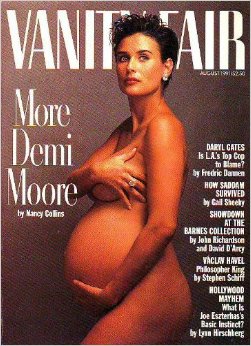
Pregnancy wasn’t always something women did in public. In her new book, Pregnant with the Stars, Renée Ann Cramer puts public pregnancies under the sociological microscope, but she notes that it is only recently that being publicly pregnant became socially acceptable. Even as recently as the 1950s, pregnancy was supposed to be a private matter, hidden behind closed doors. That big round belly was, she argues, “an indicator that sex had taken place, [which] was simply considered too risqué for polite company.”

Lucille Ball was the first person on television to acknowledge a pregnancy, real or fictional. It was 1952, but it was considered lewd to actually say the word “pregnant,” so the episode used euphemisms like “blessed event” or simply referred to having a baby or becoming a father.

Almost 20 years later, in 1970, a junior high school teacher was forced out of the classroom in her third trimester on the argument that her visible pregnancy would, as Cramer puts it, “alternately disgust, concern, fascinate, and embarrass her students.” So, when Demi Moore posed naked and pregnant on the cover of Vanity Fair just 21 years after that, it was a truly groundbreaking thing to do.

2

Today being pregnant is public is unremarkable. Visibly pregnant women are free to run errands, go to restaurants, attend events, even dress up their “baby bump” to try to (make it) look cute. All of this is part of the entrance of women into the public sphere more generally and the pressing of men to accept female bodies in those spaces. The next frontier may be breast feeding, an activity related to female-embodied parenting that many still want to relegate to behind closed doors. We may look back in 20 years and be as surprised by intolerance of breastfeeding as we are today over the idea that pregnant women weren’t supposed to leave the house. Time will tell.

Lisa Wade, PhD is an Associate Professor at Tulane University. She is the author of American Hookup, a book about college sexual culture; a textbook about gender; and a forthcoming introductory text: Terrible Magnificent Sociology. You can follow her on Twitter and Instagram.

Wealth inequality in the U.S. is extreme, but global wealth inequality, illustrates a video by The Rules, is even more stunning. Some facts:

  • The top 20% control 80% of the world’s wealth.
  • The richest 2% control more wealth than the bottom half of the world’s population.
  • The richest 300 people on earth have more wealth than the poorest 3,000,000,000.
  • 200 years ago, rich countries were three times as rich as poor countries. Today, they are eighty times richer.
  • Rich countries give $130 billion dollars worth of aid to poor countries every year, but they extract $2 trillion each year thanks to global economic rules.

Here are their sources; or watch the four minute video:

The Rules wants to reveal and challenge the laws that govern our global economy. It is a distinctly sociological project, looking at how factors outside of individuals — or, in this case, countries — shape lives. Shaped strongly by the richest countries in their own best interest, rules governing the trading of goods and money are determining the economic solvency and future of countries.

When those rules are invisible, it can seem like struggling countries are just poorly managed or culturally problematic when, in fact, the rules ensure that the deck is stacked against them.

Hat tip to Martin Hart-Landsberg.

Lisa Wade, PhD is an Associate Professor at Tulane University. She is the author of American Hookup, a book about college sexual culture; a textbook about gender; and a forthcoming introductory text: Terrible Magnificent Sociology. You can follow her on Twitter and Instagram.

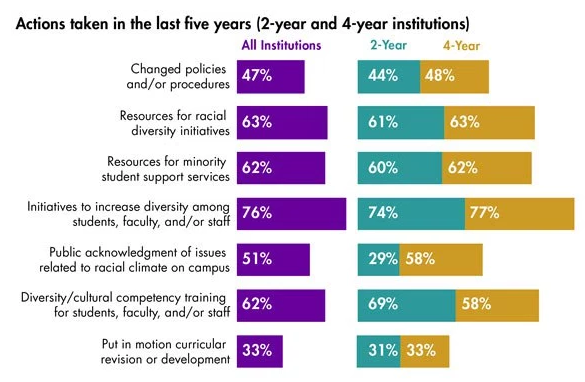
A survey of college and university presidents conducted earlier this year suggests that campus activists are making a difference. The American Council on Education asked 567 presidents about their experience with and response to activists on campus organized around racial diversity and justice.

Almost half (47%) of presidents at 4-year institutions said that such activism was occurring on their campuses and that the dialogue about such matters had increased (41%). The majority (86%) had met with student organizers more than once and more than half (55%) said that the “racial climate” on campus was more of a priority  than it had been just a few years ago. The trends for 2-year institutions were weaker, but in the same direction.

When asked what concrete steps they had taken to improve the racial climate, presidents reported a range of strategies:

5

As with all activism, progress requires vigilance, so it will be interesting to see how many of these efforts translate into real changes in climate. New policies and procedures can be toothless or even harmful, resources can be mis-spent and trainings can be terrible, public acknowledgement can be nothing but lip service, and curricular revision can die in committee. Still, these data point to the potential for activism to make a difference and are encouraging for those of us who care about this issue.

Cross-posted at Pacific Standard.

Lisa Wade, PhD is an Associate Professor at Tulane University. She is the author of American Hookup, a book about college sexual culture; a textbook about gender; and a forthcoming introductory text: Terrible Magnificent Sociology. You can follow her on Twitter and Instagram.

5The Numbers

Some History

The Winners and the Losers

Tax Cultures

Lisa Wade, PhD is an Associate Professor at Tulane University. She is the author of American Hookup, a book about college sexual culture; a textbook about gender; and a forthcoming introductory text: Terrible Magnificent Sociology. You can follow her on Twitter and Instagram.

Despite the maxim about familiarity breeding contempt, we usually like what’s familiar.  With music for example, familiarity breeds hits in the short run and nostalgia in the long run. The trouble is that it’s tempting to attribute our liking to the inherent quality of the thing rather than its familiarity.  With movies, film buffs may make this same conflation between what they like and what they easily recognize.

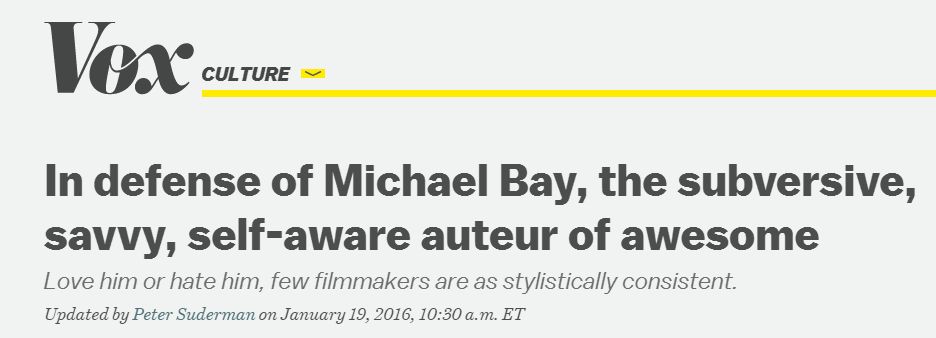
That’s one of the points of Scott Lemieux’s takedown of Peter Suderman’s Vox article about Michael Bay.

Suderman hails Bay as “an auteur — the author of a film — whose movies reflect a distinctive, personal sensibility. Few filmmakers are as stylistically consistent as Bay, who recycles many of the same shots, editing patterns, and color schemes in nearly all of his films.”

But what’s so great about being an auteur with a recognizable style? For Lemieux, Michael Bay is a hack. His movies aren’t good, they’re just familiar. Bay’s supporters like them because of that familiarity but then attribute their liking to some imagined cinematic quality of the films.

My students, I discovered last week,  harbor no such delusions about themselves and the songs they like. As a prologue to my summary of the Salganik-Watts MusicLab studies, I asked them to discuss what it is about a song that makes it a hit. “Think about hit songs you like and about hit songs that make you wonder, ‘How did that song get to be #1?’” The most frequent answers were all about familiarity and social influence. “You hear the song a lot, and everyone you know likes it, and you sort of just go along, and then you like it too.” I had to probe in order to come up with anything about the songs themselves – the beat, the rhymes, even the performer.

Lemieux cites Pauline Kael’s famous essay “Circles and Squares” (1963), a response to auteur-loving critics like Andrew Sarris. She makes the same point – that these critics conflate quality with familiarity, or as she terms it “distinguishability.”

That the distinguishability of personality should in itself be a criterion of value completely confuses normal judgment. The smell of a skunk is more distinguishable than the perfume of a rose; does that make it better?

Often the works in which we are most aware of the personality of the director are his worst films – when he falls back on the devices he has already done to death. When a famous director makes a good movie, we look at the movie, we don’t think about the director’s personality; when he makes a stinker we notice his familiar touches because there’s not much else to watch.

Assessing quality in art is difficult if not impossible. Maybe it’s a hopeless task, one that my students, in their wisdom, refused to be drawn into. They said nothing about why one song was better than another. They readily acknowledged that they liked songs because they were familiar and popular, criteria that producers, promoters, and payola-people have long been well aware of.

“In the summer of 1957,” an older friend once told me, “My family was on vacation at Lake Erie. There was this recreation hall – a big open room where teenagers hung out. You could get ice cream and snacks, and there was music, and some of the kids danced. One afternoon, they played the same song – ‘Honeycomb’ by Jimmie Rodgers – about twenty times in a row, maybe more. They just kept playing that song over and over again. Maybe it was the only song they played the whole afternoon.”

It wasn’t just that one rec hall. The people at Roulette Records must have been doing similar promotions all around the country and doing whatever they had to do to get air play for the record. By the end of September, “Honeycomb” was at the top of the Billboard charts. Was it a great song? Assessment of quality was irrelevant, or it was limited to the stereotypical critique offered by the kids on American Bandstand: “It’s got a good beat. You can dance to it.” Of course, this was before the 1960s and the rise of the auteur, a.k.a. the singer-songwriter.

Hollywood uses the same principle when it churns out sequels and prequels – Rocky, Saw, Batman. They call it a “franchise,” acknowledging the films had the similarity of Burger Kings. The audience fills the theaters not because the movie is good but because it’s Star Wars. Kael and the other anti-auteurists argue that auteur exponents are no different in their admiration for all Hitchcock. Or Michael Bay. It’s just that their cinema sophistication allows them to fool themselves.

Originally posted at Montclair SocioblogBig hat tip to Mark at West Coast Stat Views.

Jay Livingston is the chair of the Sociology Department at Montclair State University. You can follow him at Montclair SocioBlog or on Twitter.

Almost all of the representations of breasts we encounter in the mass media are filtered through the hypothetical heterosexual male gaze. Breasts are objects, things that people desire. Women’s personal, subjective experiences of having breasts is almost never discussed in pop culture. I mean, yes, occasionally two female characters might talk about their breasts, but usually in reference to whether and how they do or fail to attract male attention (e.g., “Is this too much cleavage?” and “I wish I had more cleavage!”). What it feels like to have breasts outside of the context of being a sex object isn’t talked about. There’s a void, a black hole of experience.

The only other common discourse about breasts that comes to mind centers around breastfeeding. In that discourse, the idea that breasts are for men is challenged, but only in favor of the idea that breasts are for babies. In neither discursive context does anyone make the case that breasts are primarily for the people who have them. That the pleasure (and pain) and comfort (and discomfort) that comes with breasts belongs — first and foremost — to female-bodied people.

Last week, I saw something different. Crazy Ex-Girlfriend is an odd little TV show with a couple musical numbers in each episode and one of the numbers last week was called “Heavy Boobs.” It’s safe for work but… maybe not safe for work.

Rachel Bloom‘s song names and describes one subjective experience of breasts. Breasts are “heavy boobs,” she sings, just “sacks of yellow fat” that can weigh on women. In the song, the breast-haver’s experience is centered to the exclusion of what men or babies might want or think or experience. I can’t ever remember seeing that on TV before.

And that’s plenty, but what she and her fellow dancers do with their bodies is even more extraordinary. They defy the rules of sexiness. Their movements are about embodying heavy boobs and that’s it. It’s as if they don’t care one iota about whether a hypothetical heterosexual male will see them. The dance is unapologetically unsexy. No, it’s more than unsexy; it’s asexy. It’s danced neither to repulse or attract men; instead, it’s danced as if sexiness is entirely and completely irrelevant. There’s no male gaze because, in that two minutes, there’s not a man in sight.

Lisa Wade, PhD is an Associate Professor at Tulane University. She is the author of American Hookup, a book about college sexual culture; a textbook about gender; and a forthcoming introductory text: Terrible Magnificent Sociology. You can follow her on Twitter and Instagram.

Over at Montclair Socioblog, Jay Livingston discusses a recent study showing that some Americans don’t think that their votes make any difference in how they’re governed. Those of us who care about politics often respond to this kind of pessimism with the old adage that every vote counts, but are they wrong?

Livingston suggests that they’re not.

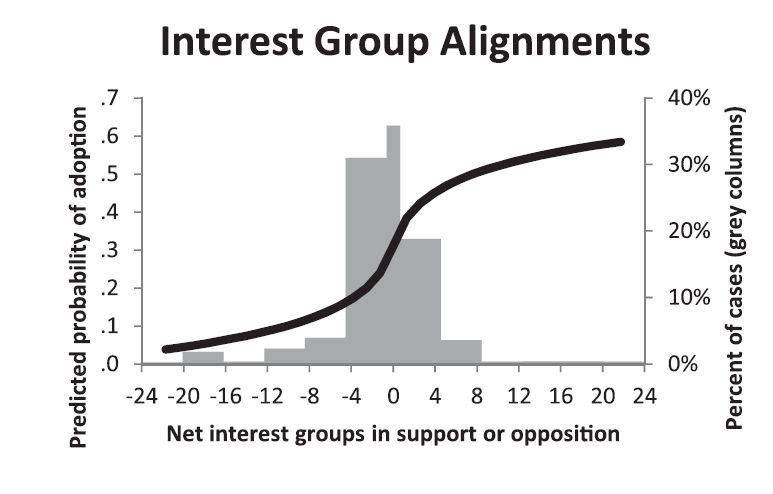
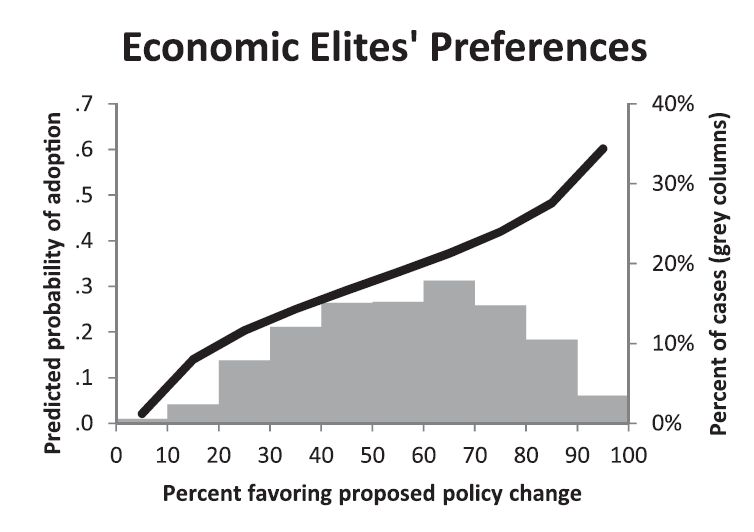
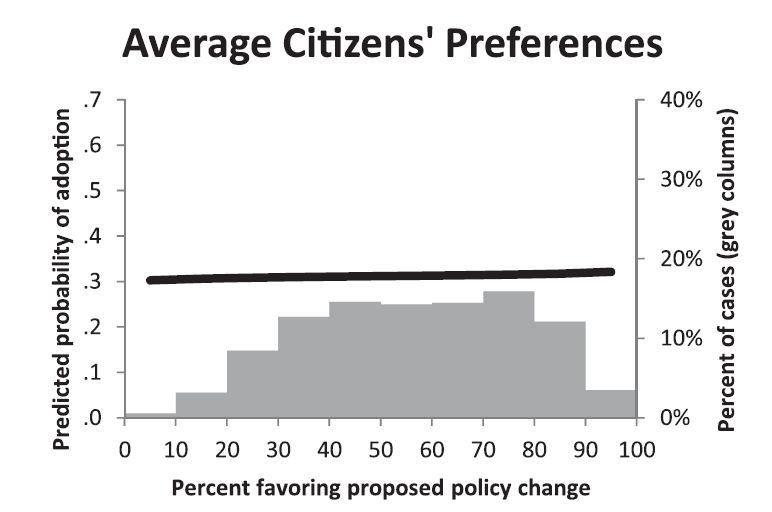
He cites political science research that compared 1,779 policy outcomes with the preferences of ordinary voters, economic elites, and interest groups. Here’s the data; note that if the black line is going up to the right, that means that the policy outcomes and preferences align.

2 3 4

The slope on the relationship between “average citizens'” preferences and policy is, Livingston writes, “close to zero.” The disaffected, in other words, might be onto something.

What about those of us who care about policy? It seems to me the take away message from this research isn’t not to vote, but to get involved in changing the outsized role money has in politics. If we really want to make the country a better place, voting isn’t enough.

Lisa Wade, PhD is an Associate Professor at Tulane University. She is the author of American Hookup, a book about college sexual culture; a textbook about gender; and a forthcoming introductory text: Terrible Magnificent Sociology. You can follow her on Twitter and Instagram.