Search results for The

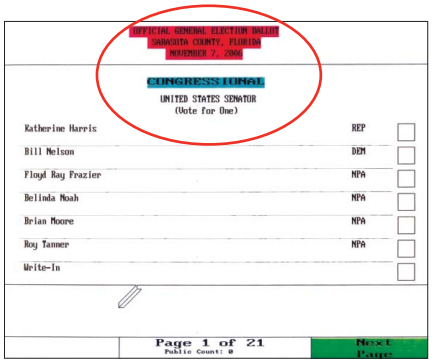
According to a report from the Brennan Center for Justice, tens and sometimes hundreds of thousands of votes are rejected or miscast because of known bad ballot designs. Intuitive design is especially important because approximately 50 million people each year encounter a ballot design for the first time, either because they’ve moved, are new to voting, or because the ballot has been revised. People who are most vulnerable to ballot design disenfranchisement are people living in poverty, older voters, and new voters.

Some problems with ballot designs:

  • Including all instructions at the beginning of the ballot instead of alongside each task.
  • Passive voice; negatives.
  • Small or unreadable fonts, like this:

6

  • Unnecessarily complex language.
  • Listing candidates for a single office on multiple pages.
  • Including more than one contest per page.
  • Centered, all-caps, and dense text, like this:

3

  • Inconsistent use of font or failure to differentiate different kinds of information with shading or font.
  • Confusing indications as to how to indicate the voter’s choice.
  • Publicizing sample ballots that don’t match actual ballots.

There are many examples of good and bad ballots at the Brennan Center’s report, Better Ballots.

The Brennan Center asserts that these problems are easily identified. Unfortunately, many jurisdictions aren’t paying attention: very few pre-test their ballot designs to discover problems and few examine results of election to discover which counties’ elections are most undermined by lost and miscast votes. Some jurisdictions, moreover, are operating under laws that require the use of ballot designs that we know are bad and many are using voting machines that are not flexible enough to accommodate good design.

Good ballot design, the report emphasizes, is non-partisan, well understood, inexpensive, and simple to implement. It may not be the most scandalous way to lose hundreds of thousands of votes, but it’s a real and substantial problem, and one that can be easily fixed.

Lisa Wade, PhD is an Associate Professor at Tulane University. She is the author of American Hookup, a book about college sexual culture; a textbook about gender; and a forthcoming introductory text: Terrible Magnificent Sociology. You can follow her on Twitter and Instagram.
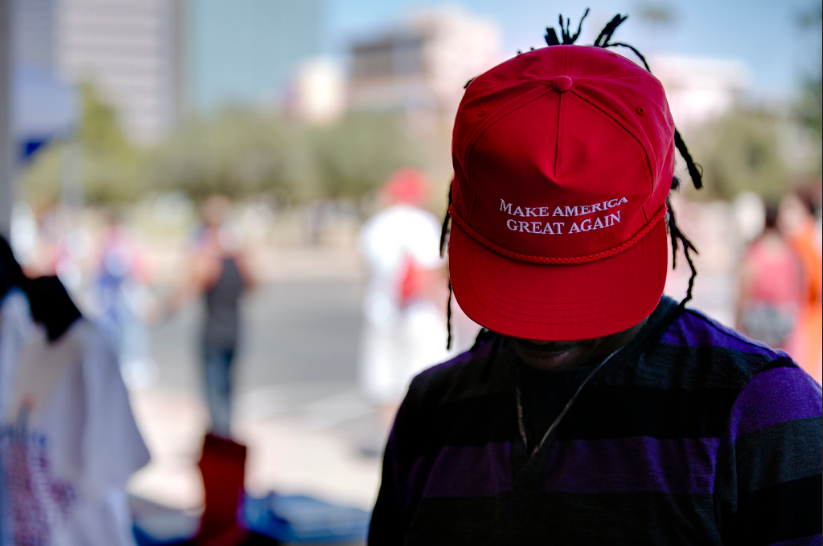
In a recent poll of registered voters by Pew Research Center, 30% of women, 26% of people of Hispanic descent, and 2% of black people say they’re planning to vote for Donald Trump. In fact, polls consistently find that women and racial minorities favor Hillary Clinton. So, what do we make of the statistics-defying members of those groups who support Trump?

Flickr photo by Johnny Silvercloud; creative commons license.

For many, this fact is source of cognitive dissonance, that uncomfortable feeling of knowingly holding irreconcilable beliefs. How could women, racial minorities, and especially minorities who are women, support a man who so persistently insults and attacks them? The discomfort of dissonance has led some to look for answers, with a few coming to the conclusion that supporting Trump is equivalent to betrayal — an identity-voiding decision (“You’re not true Mexican“) — and that women and racial minorities who support Trump are “hypocritical” and “ought to be ashamed.”

This sense of cognitive dissonance though, the idea that it’s “strange” for women or racial minorities to support Trump, is based on identity politics. Such politics has its strengths, but it also risks reducing complex social beings into one-dimensional labels, with the assumption that the label is the most important thing about them.  In this case, critics of women and racial minorities for Trump find their support of him to be more incomprehensible than that of others, based on identity alone. Thus, the individual blurs into a monolithic group, where each person is expected to be politically identical to the whole, thereby setting up the case for Trump support to be framed as a betrayal.

In fact, people are complex. They carry many intersecting identities at once, sometimes ones with conflicting politics attached, as well as a suite of other personal characteristics and structural situations. People make political choices that seem to contradict some of their identities not because they’re hypocrites, but because most people are themselves a whole host of contradictions. Reality is never so clear cut and finite as a singular label, nor are humans so easily generalized.

Given these realities, the poll numbers with which I began this post makes some sense. Trump has insulted and degraded women and minorities, and he has made policy promises that threaten them, too. Based on these facts, it should be no surprise that he is losing large swaths of those groups to Clinton. But given the complexity of identity, it should also be no surprise that he isn’t losing all of them. People are complicated, and politics is as well.

Paige Miller is a graduate student at the University of New Orleans working on her MA in Sociology. Her research interests include social psychology, new media, gender, and inequalities. You can find her on Twitter and Instagram.

Originally posted at Montclair SocioBlog.

Is Donald Trump undermining the legitimacy of the office of the presidency? He has been at it a while. His “birther” campaign – begun in 2008 and still alive – was aimed specifically at the legitimacy of the Obama presidency. Most recently, he has been questioning the legitimacy of the upcoming presidential election and by implications all presidential elections.

If he is successful, if the US will soon face a crisis of legitimacy, that’s a serious problem. Legitimacy requires the consent of the governed. We agree that the government has the right to levy taxes, punish criminals, enforce contracts, regulate all sorts of activities…  The list is potentially endless.

Legitimacy is to the government what authority is to the police officer – the agreement of those being policed that the officer has the right to enforce the law. So when the cop says, “Move to the other side of the street,” we move. Without that agreement, without the authority of the badge, the cop has only the power of the gun. Similarly, a government that does not have legitimacy must rule by sheer power. Such governments, even if they are democratically elected, use the power of the state to lock up their political opponents, to harass or imprison journalists, and generally to ensure the compliance.

Trump is obviously not alone in his views about legitimacy.  When I see the posters and websites claiming that Obama is a “tyrant” – one who rules by power rather than by legitimate authority; when I see the Trump supporters chanting “Lock Her Up,” I wonder whether it’s all just good political fun and hyperbole or whether the legitimacy of the US government is really at risk.

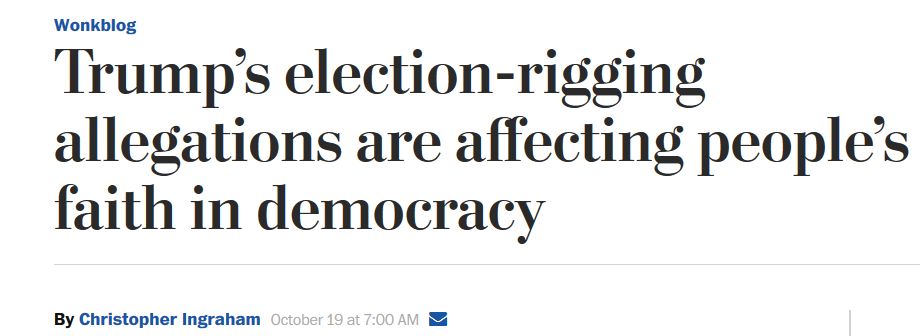
This morning, I saw this headline at the Washington Post:

1

Scary. But the content of the story tells a story that is completely the opposite. The first sentence of the story quotes the Post’s own editorial, which says that Trump, with his claims of rigged elections, “poses an unprecedented threat to the peaceful transition of power.” The second sentence evaluates this threat.

Trump’s October antics may be unprecedented, but his wild allegations about the integrity of the elections might not be having much effect on voter attitudes.

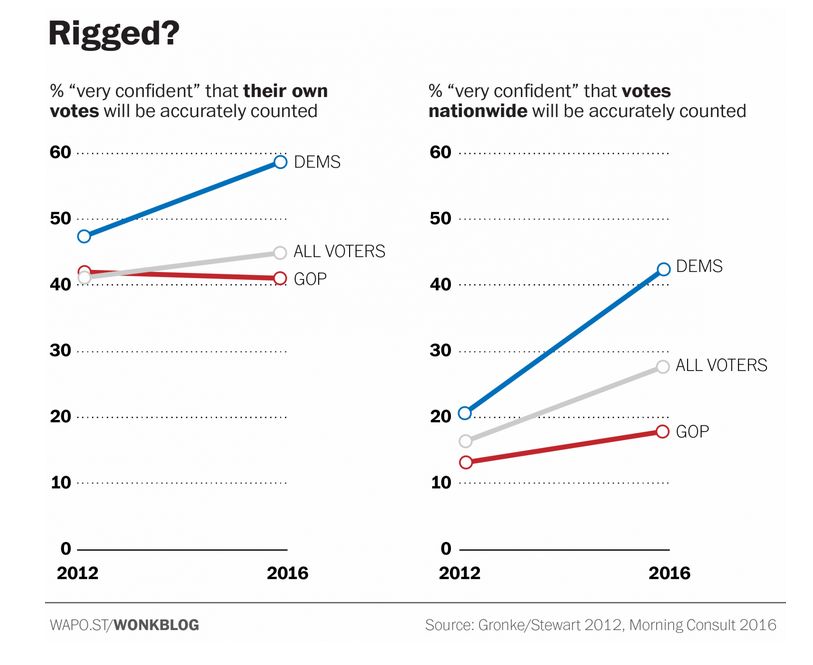
Here’s the key evidence. Surveys of voters in 2012 and 2016 show no increase in fears of a rigged election. In fact, on the whole people in 2016 were more confident that their vote would be fairly counted.

2

The graph on the left shows that even among Republicans, the percent who were “very confident” that their vote would be counted was about the same in 2016 as in 2012. (Technically, one point lower, a difference well within the margin of error.)

However, two findings from the research suggest a qualification to the idea that legitimacy has not been threatened. First, only 45% of the voters are “very confident” that their votes will be counted. That’s less than half. The Post does not say what percent were “somewhat confident” (or whatever the other choices were), and surely these would have pushed the confident tally well above 50%.

Second, fears about rigged elections conform to the “elsewhere effect” – the perception that things may be OK where I am, but in the nation at large, things are bad and getting worse. Perceptions of Congressional representatives, race relations, and marriage follow this pattern (see this post). The graph on the left shows that 45% were very confident that their own vote would be counted. In the graph on the right, only 28% were very confident that votes nationwide would get a similarly fair treatment.

These numbers do not seem like a strong vote of confidence (or a strong confidence in voting). Perhaps the best we can say is that if there is any change in the last four years, it is in the direction of legitimacy.

Jay Livingston is the chair of the Sociology Department at Montclair State University. You can follow him at Montclair SocioBlog or on Twitter.

Who among us this election — except perhaps that elusive undecided voter — has not turned to a politically aligned friend and said, from their heart of hearts, “I just can’t understand how anyone could vote for Clinton/Trump”? The sheer mindbogglingness of it, the utter failure of so many Americans to even begin to fathom voting for the other candidate, is one of the most disturbing features of this election. We all seem to be asking: What could the other side be thinking!?

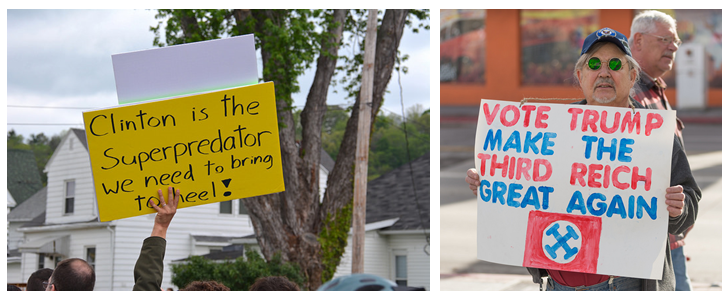
left: flickr photo by Sarah Hina; right: flickr photo by Darron Bergenheier.
left: flickr photo by Sarah Hina; right: flickr photo by Darron Bergenheier

Perhaps what we need is a “sociology of thinking.” And we’ve got one; it’s called cognitive sociology.

One of the foundational texts in the subfield is called Social Mindscapes. In it, the sociologist Eviatar Zerubavel argues that we think as individuals (we are all alone in our brains) and we think as human beings (with the cognitive processes that humans have inherited from evolution), but we also think as members of social groups. Our thinking, then, is not only idiosyncratic (i.e., “individual”), nor universal (i.e., “human”) — though it is both those things — it’s also social. Our thinking is influenced by the groups to which we belong, what Zerubavel called “thought communities.” These are the people with whom we enjoy a meeting of the minds.

By this, Zerubavel doesn’t simply mean that our social groups shape what information we get and what arguments resonate, though that’s true. He and other cognitive sociologists argue that our thought communities shape cognition itself, that the brains of people in strongly divergent thought communities literally work differently. To Zerubavel, the idea that many Democrats can’t begin to understand Republican thinking — and vice versa — isn’t a surprise, it’s a hypothesis.

Research on sensory perception is fun evidence for their claims. Researchers have shown, for example, that our language categories influence not just how we describe the world we see, but how we see it. The Himba in Namibia, for example — who have one word for blue and some greens and another word for other greens, reds, and browns — are better than English speakers at differentiating one shade of green from another, but worse at differentiating green and blue from each other. Likewise, Russian speakers are better than English speakers at differentiating shades of blue because they have more than one word for the color and English speakers, in turn, are better than Japanese speakers at recognizing the gradations between blue and green, because the Japanese have traditionally used only one word to describe them both.

If our membership in thought communities is powerful enough to shift our very perception of color, then it must be able to influence our thinking in many other ways, too. In Social Mindscapes, Zerubavel shows that what we pay attention to, the categories we use, what we remember, and even our perception of time are all shaped by our thought communities.

Accordingly, cognitive sociology would predict that the rising polarization in politics and the fragmentation of media will make it harder and harder to understand each other, not because we don’t agree on the facts or because we have different political interests, but because our brains are actually working in divergent ways. That is, what we’re experiencing with this election is not just political disagreement, it’s a total breakdown in functional communication, which sounds about right.

Lisa Wade, PhD is an Associate Professor at Tulane University. She is the author of American Hookup, a book about college sexual culture; a textbook about gender; and a forthcoming introductory text: Terrible Magnificent Sociology. You can follow her on Twitter and Instagram.
In 1985, Zeneca Pharmaceuticals (now AstraZeneca) declared October “National Breast Cancer Awareness Month.” Their original campaign promoted mammography screenings and self-breast exams, as well as aided fundraising efforts for breast cancer related research.  The month continues with the same goals, and is still supported by AstraZeneca, in addition to many other organizations, most notably the American Cancer Society.

The now ubiquitous pink ribbons were pinned onto the cause, when the Susan G. Komen Breast Cancer Foundation distributed them at a New York City fundraising event in 1991. The following year, 1.5 million Estée Lauder  cosmetic customers received the promotional reminder, along with an informational card about breast self-exams. Although now a well-known symbol, the ribbons elide a less well-known history of Breast Cancer Awareness co-opting grassroots’ organizing and activism targeting women’s health and breast cancer prevention.

The “awareness” campaign also opened the floodgates for other companies to capitalize on the disease. For example, Avon, New Balance, and Yoplait have sold jewelry, athletic shoes, and yogurt, respectively, using the pink ribbon as a logo, while KitchenAid still markets a product line called “Cook for the Cure” that includes pink stand mixers, food processors, and cooking accessories, items which the company first started selling in 2001.  Not to be left out, Smith and Wesson, Taurus, Federal, and Bersa, among other companies, have sold firearms with pink grips and/or finishing, pink gun-cases, and even pink ammo with the pink ribbon symbol emblazoned on the packaging. Because breast cancer can be promoted in corporate-friendly ways and lacks the stigma associated with other diseases, like HIV/AIDS, these companies and others, have been willing to endorse Breast Cancer Awareness Month and, in some cases, donate proceeds from their merchandise to support research affiliated with the disease.

2 (1)

Yet companies’ willingness to profit from the cause has also served to commodify breast cancer, and to support what sociologist Gayle Sulik calls “pink ribbon culture.” As Sulik notes, marking breast cancer with the color pink not only feminizes the disease, but also reinforces gendered expectations about how women are “supposed” to react to and cope with the illness, claims also corroborated by my own research on breast cancer support groups.

Based on participant observation of four support groups and in-depth interviews with participants, I have documented how breast cancer patients are expected to present a feminine self, and to also be positive and upbeat, despite the pain and suffering they endure as a result of being ill. The women in the study, for example, spent considerable time and attention on their physical appearance, working to present a traditionally feminine self, even while recovering from surgical procedures and debilitating therapies, such as chemotherapy and radiation. Similarly, members of the groups frequently joked about their bodies, especially in sexualized ways, making light of the physical disfigurement resulting from their disease. Like the compensatory femininity in which they engaged, laughing about their plight seemed to assuage some of the emotional pain that they experienced.  However, the coping strategies reinforced traditional standards of beauty and also prevented members of the groups from expressing anger or bitterness, feelings that would have been justifiable, but seen as (largely) culturally inappropriate because they were women.

Even when they recovered physically from the disease, the women were not immune to the effects of the “pink ribbon culture,” as other work from the study demonstrates. Many group participants, for instance, reported that friends and family were often less than sympathetic when they expressed uncertainty about the future and/or discontent about what they had been through.  As “survivors,” they were expected to be strong, positive, and upbeat, not fearful or anxious, or too willing to complain about the aftermath of their disease. The women thus learned to cover their uncomfortable emotions with a veneer of strength and courage. This too helps to illustrate how the “pink ribbon culture,” which celebrates survivors and survivorhood, limits the range of emotions that women who have had breast cancer are able to express. It also demonstrates how the myopic focus on survivors detracts attention from the over 40,000 women who die from breast cancer each year in the United States, as well as from the environmental causes of the disease.

Such findings should give pause. If October is truly a time to bring awareness to breast cancer and the women affected by it, we need to acknowledge the pain and suffering associated with the disease and resist the “pink ribbon culture” that contributes to it.

Jacqueline Clark, PhD is an Associate Professor of Sociology and Chair of the Sociology and Anthropology Department at Ripon College. Her research focuses on inequalities, the sociology of health and illness, and the sociology of jobs, work, and organizations.

Controversy erupted in 2014 when video of National Football League (NFL) player Ray Rice violently punched his fiancé (now wife) and dragged her unconscious body from an elevator. Most recently, Deadspin released graphic images of the injuries NFL player Greg Hardy inflicted on his ex-girlfriend. In both instances, NFL officials insisted that if they had seen the visual evidence of the crime, they would have implemented harsher consequences from the onset.

Why are violent images so much more compelling than other evidence of men’s violence against women? A partial answer is found by looking at whose story is privileged and whose is discounted. The power of celebrity and masculinity reinforces a collective desire to disbelieve the very real violence women experience at the hands of men. Thirteen Black women collectively shared their story of being raped and sexually assaulted by a White police officer, Daniel Holtzclaw, in Oklahoma. Without the combined bravery of the victims, it is unlikely any one woman would have been able to get justice. A similar unfolding happened with Bill Cosby. The first victims to speak out against Cosby were dismissed and treated with suspicion. The same biases that interfere with effectively responding to rape and sexual assault hold true for domestic violence interventions.

Another part of the puzzle language. Anti-sexist male activist Jackson Katz points out that labeling alleged victims “accusers” shifts public support to alleged perpetrators. The media’s common use of a passive voice when reporting on domestic violence (e.g., “violence against women”) inaccurately emphasizes a shared responsibility of the perpetrator and victim for the abuser’s violence and generally leaves readers with an inaccurate perception that domestic violence isn’t a gendered social problem. Visual evidence of women’s injuries at the hands of men is a powerful antidote to this misrepresentation.

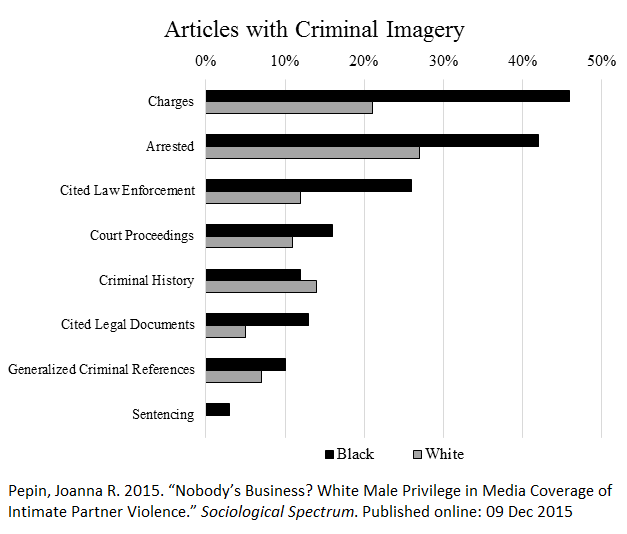
In my own research, published in Sociological Spectrum, I found that the race of perpetrators also matters to who is seen as accountable for their violence. I analyzed 330 news articles about 66 male celebrities in the headlines for committing domestic violence. Articles about Black celebrities included criminal imagery – mentioning the perpetrator was arrested, listing the charges, citing law enforcement and so on – 3 times more often than articles about White celebrities. White celebrities’ violence was excused and justified 2½ times more often than Black celebrities’, and more often described as mutual escalation or explained away due to mitigating circumstances, such as inebriation.

Data from an analysis of 330 articles about 66 Black and White celebrities who made headlines for perpetrating domestic violence (2009-2012):

Caption: Data from an analysis of 330 articles about 66 Black and White celebrities who made headlines for perpetrating domestic violence (2009 – 2012).

Accordingly, visual imagery of Ray and Hardy’s violence upholds common stereotypes of Black men as violent criminals. Similarly, White celebrity abusers, such as Charlie Sheen, remain unmarked as a source of a social problem. It’s telling that the public outcry to take domestic violence seriously has been centered around the NFL, a sport in which two-thirds of the players are African American. The spotlight on Black male professional athletes’ violence against women draws on racist imagery of Black men as criminals. Notably, although domestic violence arrests account for nearly half of NFL players’ arrests for violent crimes, players have lower arrest rates for domestic violence compared to national averages for men in a similar age range.

If the NFL is going to take meaningful action to reducing men’s violence against women, not just protect its own image, the league will have to do more than take action only in instances in which visual evidence of a crime is available. Moreover, race can’t be separated from gender in their efforts.

Joanna R. Pepin a PhD candidate in the Department of Sociology at the University of Maryland. Her work explores the relationship between historical change in families and the gender revolution.

Flashback Friday.

Sociologists distinguish between the terms norm, normal, and normative.

  • The norm refers to what is common or frequent.  For example, celebrating Christmas is the norm in America.
  • Normal is opposed to abnormal.  Even though celebrating Christmas is the norm, it is not abnormal to celebrate Hanukkah.  To celebrate Hanukkah is perfectly normal.
  • In contrast to both of these, normative refers to a morally-endorsed ideal. Some Americans make a normative argument that Americans should celebrate Christmas because they believe (wrongly) that this is a Christian country.

A thing can be the norm but not be normative. For example, a nuclear family with a married man and woman and their biological children is normative in the U.S., but it is certainly not the norm. Likewise, something can be normal but not the norm. It’s perfectly normal, for example, to date people of the same sex (so say the scientists of our day), but it’s not the norm. And something can be both normal and the norm, but not be normative, like Americans’ low rates of physical activity.

These three terms do not always work in sync, which is why they’re interesting.

I thought of these distinctions when I looked at a submission by Andrew, who blogs at Ethnographer. Bike lanes in Philadelphia used to be designated with this figure:

Today, however, they’re designated by this one:

Do you see the difference? The new figures are wearing bike helmets. The addition is normative. It suggests that bikers should be wearing bike helmets. It may or may not be the norm, and it certainly isn’t normal or abnormal either way, but the city of Philadelphia is certainly attempting to make helmets normative.

Originally posted in 2010.

Lisa Wade, PhD is an Associate Professor at Tulane University. She is the author of American Hookup, a book about college sexual culture; a textbook about gender; and a forthcoming introductory text: Terrible Magnificent Sociology. You can follow her on Twitter and Instagram.
Originally posted at Racism Review.

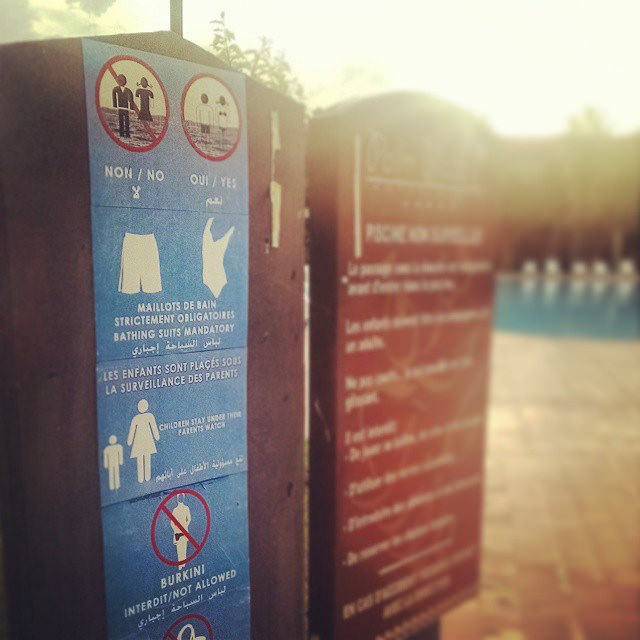
The photos capture a woman lying serenely on a pebble beach. She is unaware of the four men as they approach. They wear guns and bulletproof vests, and demand the woman remove her shirt. They watch as she complies. This scene was reported in recent weeks by news outlets across the globe. More than twenty coastal towns and cities in France imposed bans on the burkini, the full body swimsuit favored by religious Muslim women.

Flickr photo by Bruno Sanchez-Andrade Nuño

French politicians have falsely linked the burkini with religious fundamentalism. They have employed both blatant and subtly racist language to express indignation at the sight of a non-white, non-Western female body in a public space designated as “white.” Like many, I have been transfixed by the images of brazen discrimination and shaming. Although the woman in the photographs, identified only as Siam, was not wearing a burkini, her body was targeted by a racist institution, the State.

Olivier Majewicz, the Socialist mayor of Oye-Plage, a town on the northern coast of France, described a Muslim woman on the beach as appearing “a bit wild, close to nature.” Her attire, he said, was not “what one normally expects from a beachgoer… we are in a small town and the beach is a small, family friendly place.” France’s Socialist Prime Minister, Manuel Valls, utilized more direct language, stating that the burkini enslaved women and that the “nation must defend itself.” Similarly blunt, Thierry Migoule, an official with the municipal services in Cannes, said the burkini “conveys an allegiance to the terrorist movements that are waging war against us.”

These quotes reflect the pernicious limitations of the white gaze. When I look at the photos of Siam, I see a woman, a mother, being forced to undress before a crowd of strangers. I can hear her children, terrified, crying nearby. Siam’s encounter was a scene of trauma, and as Henri Rossi, the vice president of the League of Human Rights in Cannes, said “this trauma has not been cured; the convalescence has not yet begun.”

Some sixty years ago, Frantz Fanon in Black Skin, White Masks, explored the relationships between the white gaze and the black body, specifically in France and its colonies. In the age of the burkini ban, Fanon’s observations ring poignant and true. He writes: “…we were given the occasion to confront the white gaze. An unusual weight descended on us. The real world robbed us of our share. In the white world, the man of color encounters difficulties in elaborating his body schema. The image of one’s body is solely negating. It’s an image in the third person. All around the body reigns an atmosphere of certain uncertainty.” Fanon’s words could serve as the soundtrack to Siam’s encounter with the police. She was robbed of her share, her body negated and deemed a public threat by the white gaze.

In the wake of recent terrorist attacks in France, politicians have capitalized on the politics of fear in order to renegotiate the boundaries of institutional racism as expressed in the public sphere. In Living with Racism, Joe Feagin and Melvin Sikes quote Arthur Brittan and Mary Maynard (Sexism, Racism and Oppression) about the ever-changing “terms of oppression.” Brittan and Maynard write:

the terms of oppression are not only dictated by history, culture, and the sexual and social division of labor. They are also profoundly shaped at the site of the oppression, and by the way in which oppressors and oppressed continuously have to renegotiate, reconstruct, and re-establish their relative positions in respect to benefits and power.

As the burkini affords Muslim women the benefit to participate in different arenas of public space, the state recalibrates its boundaries to create new or revive previous sites of oppression. In the case of the burkini, the sites of oppression are both public beaches and women’s bodies – common sites of attempted domination, not only in France, but also the US.

Fanon, Feagin and Sikes all point to institutional racism as an engine that fuels white supremacy and its policies of discrimination. As Feagin and Sikes observe, these:

recurring encounters with white racism can be viewed as a series of “life crises,” often similar to other serious life crises, such as the death of a loved one, that disturb an individual’s life trajectory.

The photos of Siam capture the unfolding of life crisis and illustrate the power of institutional racism to inflict both individual and collective traumas.

Julia Lipkins is an archivist and MA candidate in American Studies at The Graduate Center, CUNY.