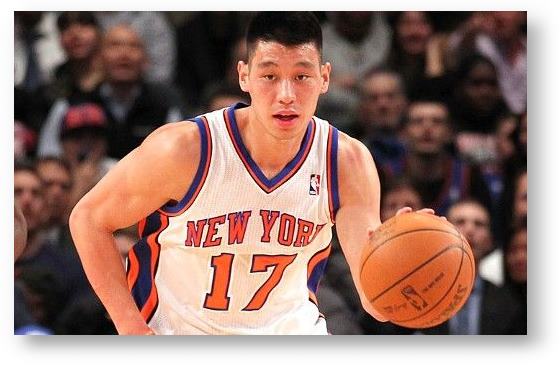
In my recent post titled, “Jeremy Lin Mania and How it Relates to Colorblindness,” among other things, I noted that Jeremy’s emergence as a media sensation and explosion onto the center stage of mainstream U.S. popular culture does represent a small step toward the eventual ideal of colorblindness. At the same time, I also argued that the reality is that unfortunately, we are still a long way from being a truly colorblind society.
This past week, several public incidents have solidified the sad fact that many Americans still think that we are already in a colorblind society and as such, they can basically say anything they want about Jeremy, including offensive references to him as a Chinese American. Unfortunately there have been several examples of racial insensitivity in the past couple of weeks, but in this post I will focus on two in particular.
First, after the Knicks defeated the Los Angeles Lakers in which Jeremy scored 38 points, FoxSports.com columnist Jason Whitlock tweeted “Some lucky lady in NYC is gonna feel a couple inches of pain tonight.” Whitlock later apologized for the remark, but you can’t unring that bell — clearly he thought it was perfectly acceptable to invoke the emasculating racial stereotype about Asian men having small penises.
But wait, there’s more.
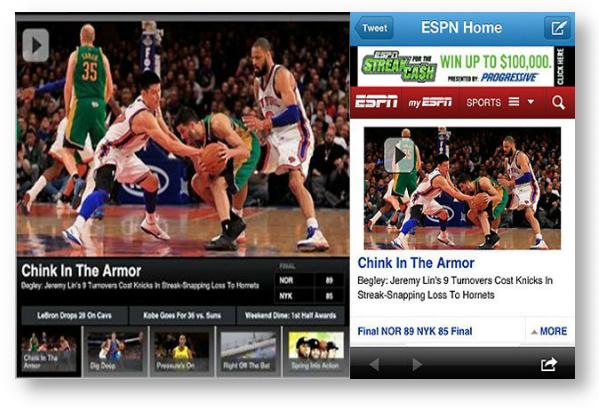
A few days later, after Jeremy committed nine turnovers in a game that the Knicks eventually lost, thereby snapping their 7-game winning streak, the following headline made it onto ESPN’s mobile website (screenshot below): “Chinks in the Armor: Jeremy Lin’s 9 Turnovers Cost Knicks in Streak-Snapping Loss to Hornets.”
The headline was apparently taken down after being public for 35 minutes but again, the damage was done — the editors at ESPN apparently had no idea or did not care that the term “chink” is a blatantly racist term against all Asian Americans but particularly and deeply offensive to Chinese Americans. I might expect people outside the U.S., such as Spain’s national basketball team, not to know that the term “chink” is racist, but it is very disappointing to learn that many Americans still think it’s perfectly fine to use in reference to a Chinese American.
Disappointing, but unfortunately not really surprising.
That is because many Americans already believe, consciously or unconsciously, that we are already a colorblind society. As such, they have been taught, socialized, and desensitized to naively think that all racial groups are equal now, that no racial discrimination ever takes place nowadays, and therefore, it’s fine to casually use terms such as “chink” in everyday conversation.
These particular incidents may not be as blatantly offensive as the racial taunts Jeremy encountered back when he played for Harvard, but they nonetheless illustrate a woeful level of ignorance and lack of sensitivity about Asian Americans, our history, and our community.
Imagine what the public’s reaction would have been if Jason Whitlock was referring to a Black player and his remark invoked the racial stereotype about Black men having large penises. What would the public’s reaction had been if ESPN went public with some headline that referred to a Black player using the ‘N’ word? I think it would be safe to say that the American public would be shocked, outraged, and furious if these hypothetical examples occurred in reference to a Black player.
To Whitlock’s and ESPN’s credit, they both apologized and in ESPN’s case, fired the person responsible for the website headline and suspended one of their sportscasters, Max Bretos, who repeated the “chink in the armor” phrase on air. To be honest, I was pleasantly surprised at how quickly and decisively ESPN acted in regard to these incidents. In the past, more than likely, ESPN would have taken days to issue a half-hearted apology and probably would not have disciplined any of their staff involved. I suppose ESPN’s actions in this matter do represent an encouraging sign of progress.
Fortunately, there are others in the mainstream media who “get it” — those who understand the contradiction and inequality that exist when such racial/ethnic stereotypes are in reference to, say Blacks, versus when they reference Asian Americans. Specifically, leave it the crew at Saturday Night Live to use comedy and satire to deftly illustrate this contradiction:
So I suppose that it does represent progress that when these types of racially ignorant incidents happen, the mainstream media nowadays does recognize it and take disciplinary action (or use satire to point out the absurdity of such ignorance) more quickly than in the past. Now if we can just get to the point where such incidents don’t happen in the first place.
Back in 2010, I wrote about Jeremy Lin, who was leading Harvard University to a league title, a birth in the NCAA postseason tournament, and was poised to become one of the first Asian American players in the National Basketball Association (NBA). Back then, I pointed out how he represents an example of Asian Americans balancing both model minority expectations with an extracurricular passion, and in doing so, is expanding the definition of success for Asian Americans.
Since then, Jeremy went undrafted in the NBA after graduation but has now landed with the New York Knicks and is now exploding onto the basketball scene, as this New York Times article describes:
On Saturday night [Feb. 4, 2012], Lin came off the bench and powered the Knicks to a 99-92 victory over the Nets at Madison Square Garden, scoring a career-best 25 points with 7 assists. Two nights later, he made his first N.B.A. start and produced 28 points and 8 assists in a 99-88 win over the Utah Jazz.
Knicks fans now serenade Lin with chants of “Je-re-my!” and “M.V.P.!” while the franchise uses his likeness to sell tickets and teammates and coaches gush with praise. . . . Lin is raising expectations, altering the Knicks’ fate and redefining the word “unlikely.” On Twitter, fans and basketball pundits are using another term to describe the phenomenon: “Linsanity.”
[H]e became the first player in more than 30 years to record at least 28 points and 8 assists in his first N.B.A. start. . . . When the Knicks claimed Lin off waivers Dec. 27, he was fourth on the depth chart at point guard. Now he is No. 1, continuing a long pattern of low expectations and surprising results.
As another example of the accelerating Jeremy Lin bandwagon, ABC News just named Jeremy its “Person of the Week” and profiled him in the following news segment video:
Needless to say, Jeremy’s explosion into the U.S. cultural mainstream has inspired many Americans, and particularly Asian Americans. Beyond the mainstream media’s ever-increasing proclamations of him as “Linsanity,” “Lincredible,” “Going All Lin,” “Lin Your Face,” or “May the Best Man Lin,” Jeremy has also been described as Asian Americans’ version of Tim Tebow, both for embracing his Christian faith and for the media sensation and “Linspiration” that he has become for so many Asian Americans. For the record, Jeremy is the first monoracial (that is, both his parents are Asian) Asian American (either born or raised in the U.S.) to play in the NBA, and one of the few monoracial Asian Americans to play professional team sports in the U.S. at all.
In so many ways, Jeremy represents a big step forward for Asian Americans and U.S. society in general in terms of racial inclusion and being considered part of mainstream U.S. culture. Jeremy’s success actually follows a similar breakthrough moment for Asian Americans last year, as the hip-hop group Far East Movement became the first all-Asian American musical group to hit number one on the music charts with their single “Like a G6.” As another example of the “mainstreaming” of Asian Americans, the creators of MTV’s “Jersey Shore” are apparently in the process of creating a version that features an all-Asian American cast, to be called “K-Town.”
From a sociological point of view, the cultural emergence of Jeremy Lin, Far East Movement, and K-Town demonstrate that Asian Americans are indeed increasingly part of the U.S. mainstream. Up to this point, because of the relative scarcity of Asian Americans in the mainstream media and popular culture, it was usually a shock when we did see an Asian American on TV, in the movies, or on the music charts.
But as Asian Americans becoming increasingly common in these areas of U.S. popular culture, are we headed for a day when it is no longer a “big deal” when we see Asian American faces in the media, just like it’s taken for granted when we see White faces or Black faces? Ultimately, yes, that is the goal — for us as a society to no longer consider it “strange” or “unusual” to see Asian Americans in the media or in other prominent positions in U.S. social institutions.
If this idea sounds familiar, you might know it by its more common name — colorblindness.
In other words, part of being colorblind is what I just described — an ideal situation in which everyone in U.S. society is considered equal and when social, political, and economic distinctions based on race or ethnicity are no longer important or carry any sort of advantage or disadvantage. So in many respects, Jeremy Lin’s success gives us hope that, as a society, we are moving a little closer to the ideals of colorblindness.
Having said that, as I have written repeatedly in this blog, in order to eventually attain this ideal of true colorblindness, we first have to recognize that despite the progress that our nation has made in eradicating racism, the practical reality is that inequalities based on race and ethnicity unfortunately still exist and that groups such as Asian Americans still experience much ignorance, intolerance, and outright discrimination because of their identity and position as a racial minority group.
Therefore, much like the idea of Asian Americans as the “model minority,” I think we should definitely embrace and celebrate the emergence of Jeremy Lin, Far East Movement, and other examples in which Asian Americans are recognized for their success. Their accomplishments reflect how it is not a contradiction to recognize both their racial/ethnic uniqueness and their position as an integral part of mainstream society.
At the same time, we should also keep in mind that while we are getting closer to the ultimate ideal of colorblindness, there is still a lot of work to be done. Along with that, in order to keep working toward a time when true equality exists across all racial/ethnic groups, we need to understand that racial/ethnic distinctions still exist and still matter, and that the success of one person or a few people within that racial/ethnic minority group does not yet mean that members of that group no longer experience any injustice or discrimination.
In the meantime, despite my roots as a Los Angeles Lakers fan, I will definitely be rooting for Jeremy to keep lighting up the scoreboard and the “Lin-magination” of all Americans and beyond.
As regular readers to this blog know already (and as I write in the top section of every Asian-Nation post I write), I feel very strongly “public sociology” — to make sociological theory, research, and data as accessible to as wide of an audience as possible, and as applicable to real-world issues and situations as possible. I recently received an email that gave me just that opportunity.
Specifically, one reader wrote to me:
I am a full time elementary school teacher and I will have a new student in a few days from China. He and his family do not speak English–they are opening a restaurant in our small community. In our community, he will be the only Asian child. What can I do to help him not feel so alone and alienated? I know language will be a problem, but what could I as his teacher do to help? I was scanning the internet trying to find resources and found your site. Thank you for your time.
I replied back:
I commend you on trying to find ways to make this new student feel welcomed. Although my expertise is not in education, these are some suggestions that come to mind:
(1) Some time ago, there was a commercial (I forgot what the actual product or service was), but it showed a young Chinese boy about to enter a predominantly White school for his first day. Before entering, he was speaking in Chinese with his mom outside and told her, “My English is not good. What if the other students hate me?” His mother calmly replied, “You’ll be fine.” As he entered his classroom escorted by the principal, the teacher introduced the new student to the class. Then the entire class welcomed him by saying in unison, “Ni hao [student's name]” — translated, it means “Hello [student's name].” It was very sweet and it would be great if your class would do the same.
(2) You may already have plans to do so already, but I’ve heard from many educators that it helps new students if one or two other students are assigned to be their “guide” or someone who will spend time him the new student, show him around the school, eat lunch with him, introduce him to other students, and basically act like an ambassador for him to make him feel more comfortable.
(3) You may know Google Translate already , but if not, it’s a great tool to assist in translating between different languages. In the meantime, you’ll probably be surprised how quickly the student will learn English. Just stay patient and positive while he does.
(4) Perhaps some time in the future, your class can make a field trip to his parent’s restaurant to learn about Chinese food, running a small business, etc. This would be a great way to welcome the family to the community and to show the other students that he is welcomed in their class.
(5) Finally and perhaps most importantly, I hope you and the rest of the teachers and administrators can do whatever possible to stay on top of any incidents of racial teasing. Nothing will alienate the new student more than if other students start making fun of him because he’s Chinese — because he’s different than everybody else around him. With that in mind, it is absolutely critical to let the other students (in your class and elsewhere) that it is not acceptable to make fun of him because he’s Chinese and that any such incidents will be punished. This how we start to break the cycle of racial prejudice — one student at a time.
The teacher wrote me back and thanked me for the ideas and seemed very excited about them.
This question of how a school, administrators, teachers, and students can best welcome new student who is both an immigrant and a racial minority to their class got me thinking that, rather then just giving her my ideas, I should “crowdsource” this question and ask all of you for your suggestions on how to best welcome this new student.
If you have been in this situation, either as the new student, one of the existing students, or the educator, what were some ways to make this new student feel welcomed and comfortable? Or even if you were never in this situation, what are some strategies to try? If you are a researcher who is familiar with this issue, what are some “best practices” that have been shown to be effective? I would love to hear from others with your ideas and suggestions.
As globalization and demographic changes keep taking place and as U.S. society and more communities around the country like this become more diverse and multicultural, this kind of situation is likely to become more common. In other words, this is sociology taking place in the real world.
Last week, the U.S. commemorated the 70th anniversary of the attack on Pearl Harbor by the Japanese military that led to the U.S.’s entry into World War II. Of course, the attack was a watershed moment in U.S. history — Japan’s unjustified and heinous act led to the deaths of 3,000 human beings, united the U.S. like never before, and in the end, was the start of Japan’s downfall as a imperial military power.
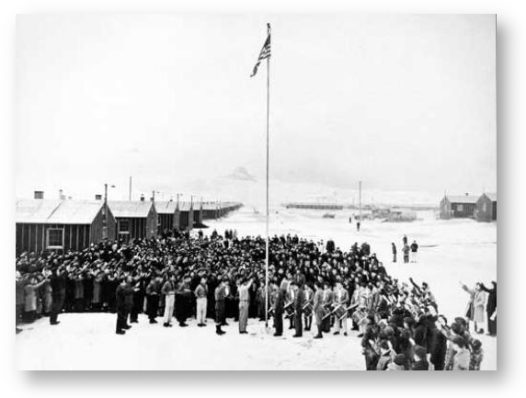
Unfortunately, the Pearl Harbor attacks also prompted the U.S. government to strip 120,000 Japanese Americans of their legal rights and imprison them without any due process, based largely on the “fear” that Japanese Americans would be loyal to Japan and engage in espionage or treason against their adopted U.S. homeland.
This entire “internment” episode has been recounted and analyzed over the years, most notably by the bipartisan Congressional “Commission on Wartime Relocation and Internment of Civilians,” which ultimately conducted a thorough investigation and in their final report titled “Personal Justice Denied: Report of the Commission on Wartime Relocation and Internment of Civilians,” finally concluded that the imprisonment of Japanese Americans during World War II was a “grave injustice” and resulted from “race prejudice, war hysteria, and a failure of political leadership.” Congress then approved and distributed a reparation payment of $20,000 to all surviving Japanese Americans who were imprisoned. To my knowledge, this is the only instance in which the U.S. government has officially apologized and provided monetary reparations to any of the injustices that they’ve committed in its history.
As it turns out, this week’s anniversary commemoration unfortunately prompted some to once again bring up the old argument that there was a logical rationale to the U.S.’s imprisonment of Japanese Americans, or that it was even completely justified. For example, in a museum review of Heart Mountain Interpretive Center (in Wyoming, site of one of the prison camps) in the Dec. 9, 2011 edition of the New York Times, ‘art critic’ Edward Rothstein engages in such musings.
Specifically, Rothstein uses a few historical examples of misdeeds by Japanese and Japanese Americans to argue that “the threat was palpable” and that therefore, there was a “rationale” for the U.S.’s subsequent imprisonment of 120,000 Japanese Americans. While Rothstein does state, “I am not suggesting that such factors justified the relocations,” the tone of his piece displays an ignorant accounting of the entire collection of historical facts surrounding how isolated incidents of Japanese and Japanese Americans misdeeds were exaggerated and generalized to an entire population, how many allegations of espionage and sabotage by Japanese Americans were never substantiated and even completely fabricated, and how similar and even more pernicious acts by Germans and German Americans were largely ignored.
Unfortunately, Rothstein’s piece is a sad example of selective memory, if not outright revisionist history. The examples he cited as providing “rationale” for the mass imprisonment are of dubious historical accuracy and value and even if valid, only reinforce and perpetuate the tired notion that the acts of a few can be taken out of context and generalized to an entire population. In response to Rothstein, I would like to share the responses of some of my colleagues who provide a more clear and comprehensive picture of the supposed “palpable” threat of Japanese Americans after the Pearl Harbor attacks:
In his attempt to understand the wartime removal of Japanese Americans, Edward Rothstein (“the How of Internment, but not all the Whys”, NYT, December 9) repeats a set of falsehoods and distortions about its causes. He insists that because Japan engaged in widespread espionage, and decoded Japanese messages (in reality a mere handful) spoke of contacts, surely Japanese Americans were implicated in espionage. In fact, Tokyo’s spymasters shied away from using Americans of Japanese ancestry, whose loyalty to Japan they rightly suspected, and made use of non-Japanese. Col. Kenneth Ringle, the prewar agent of the Office of Naval Information who broke the most important Japanese spy ring in Los Angeles and was in a position to know the facts, was an outspoken defender of the loyalty of Japanese Americans.
Similarly, Rothstein declares that the Japanese “threat was palpable” since a Japanese submarine had sunk American shops and shelled a California oil field. In fact, only a single American ship was sunk, compared to the hundreds sunk by German submarines off the East Coast, and the single shelling incident took place after the order to remove Japanese Americans had already been issued. Worse, Rothstein argues that the “treasonous” conduct of a Nisei couple in Hawaii validated the fears of government authorities about West Coast Japanese Americans. The absurdity of this statement is easily demonstrated by the fact that there was no mass roundup of the large Japanese community in Hawaii itself.
Although he insists that he is not justifying removal, cultural critic Rothstein sadly displays not only a carelessness toward history, but reveals how much the baseless ideas about “Japanese” disloyalty that led to mass removal still remain in the culture.
Greg Robinson
Associate Professor of History
Université du Québec a Montréal
I write this disappointed letter in response to Edward Rothstein’s December 9, 2011 piece, “The How of an Internment, but Not All the Whys.” Notwithstanding the express reason for this piece (as a review), I was particularly struck by Mr. Rothstein’s incomplete and incendiary reading of not only U.S. history but Japanese American history. Dismissing the “now standard” evaluation of the internment as the “result of wartime hysteria and racism,” Mr. Rothstein offers an allegedly “clearer understanding of the prewar Japanese-American population” rooted in familiar characterizations of yellow peril takeovers, perpetual foreign frames, and traitorous subjects. What is especially remarkable and distressing is that Mr. Rothstein manages – quite irresponsibly — to take NYT readers “back in time” to aforementioned “wartime hysteria and racism.”
Cathy J. Schlund-Vials
Assistant Professor, English and Asian American Studies
University of Connecticut
I teach Asian American Studies to graduates of this city’s k-12 system, and I am continuously disheartened by the many young people who have never heard of Japanese American internment, or, if they have, possess no meaningful understanding of the nature of the event. With that lack of information in mind, I was appalled to see your paper repeat long since discredited misinformation in apparent disregard for rigorous scholarly work, and the trauma inflicted upon thousands upon thousands of individuals and families who did nothing but look like “the enemy.” Despite his assurance to the contrary, Edward Rothstein’s review of the Heart Mountain Interpretive Center implies that we should explore long since debunked (dare I say “fringe”) theories that justify the racial stereotype of Japanese Americans as inherently treasonous, and thereby make excuses for what scholars agree is a racially motivated and shameful event in U.S. civil rights history.
Jennifer Hayashida
Director, Asian American Studies Program
Hunter College, City University of New York
In Edward Rothstein’s review of the Heart Mountain Interpretive Center (“the How of Internment, but not all the Whys”, NYT, December 9) he declares that the unconstitutional incarceration of over 110,000 people of Japanese ancestry was “a geographic rationale, not simply a racial one.” Yet Mr. Rothstein fails to account for the fact that mass removal and incarceration of Japanese Americans did not occur at the site that propelled the U.S. into WWII—Hawaii. Indeed, all reputable scholars of the Japanese American Internment note that it was war time xenophobia and racism that spurred Executive Order 9066—an order that never specified ethnic ancestry and that effectively nullified the constitutional rights of every person living on the West Coast during WWII. FDR ordered the military to target Japanese Americans using EO9066. If that’s not a racial rationale, I’m not sure what is.
Jennifer Ho
Associate Professor
University of North Carolina, Chapel Hill
Unfortunately, as a country, we are now poised to repeat the same mistake that was committed 70 years against Japanese Americans. Specifically, Congress is currently debating the National Defense Authorization Act for fiscal year 2013. One of the proposed provisions is to give U.S. government authorities the ability to arrest and indefinitely detain anybody who they deem to be a threat to national security — including U.S. citizens — without charging them with a crime or giving them a trial. In other words, it would basically legalize what happened to Japanese Americans after the Pearl Harbor attacks.
Fortunately, there is opposition to these provisions from both sides of the political spectrum. If you also oppose these provisions, I urge you to contact your Representative and Senator and tell them to vote against these provisions. As George Santayana’s quote goes, “Those who cannot learn from history are doomed to repeat it.”
One of the most popular and controversial articles on my Asian-Nation.org site is the one on Interracial Dating and Marriage. This is a topic that has provoked much discussion and debate among Asian Americans through the years and continues to do so today. Within the larger range of opinions on interracial dating and marriage, many Asian Americans and non-Asians alike consider dating and marrying someone outside of your racial/ethnic group as a natural progression of Asian Americans becoming more integrated into the mainstream, while others see it as renouncing one’s Asian identity.
As the saying goes, you are entitled to your opinion, but not your facts. In that context, as a sociologist, I try to make an empirically-sound and objective contribution to this debate by presenting updated data and statistics from the 2010 U.S. Census American Community Survey (ACS) on the racial/ethnic marriage patterns of Asian Americans for both men and women and the six largest Asian ethnic groups. The full tables are presented in my Interracial Dating and Marriage page, but below is a summary of recent trends and changes from 2006, the last time I updated these statistics:
Consistently, rates of marriages involving Asian Americans and Whites have declined. Specifically, among those marriages in which both spouses are U.S.-raised (either born in the U.S. or immigrated before age 13, and thereby socialized within the U.S. racial/ethnic landscape), for five of the six Asian American ethnic groups, the rates of having a White spouse for both men and women declined from 2006 to 2010. Among men/husbands, the largest decline involved Asian Indians and Koreans. For women/wives, the largest decline was for Filipinos and Koreans.
The only exceptions to this trend of declining rates of White-Asian marriages were for Asian Indian women/wives (whose rate slightly increased from 2006 to 2010) and for both Vietnamese men/husbands and women/wives. For Vietnamese men, their rates of having a White wife increased from 15.0% to 21.9% while for Vietnamese women, their rate for having a White husband jumped from 28.3% to 41.3%.
Strangely, the population sizes for U.S.-raised married Vietnamese American men and women declined from 2006 to 2010. For example, in 2006, there were about 40,500 and 45,200 U.S.-raised Vietnamese men and women respectively who were married. In 2010, those numbers declined to 26,795 and 34,998. Some possible explanations are that many who were married in 2006 got divorced, U.S.-raised Vietnamese men and women are delaying getting married, and/or many U.S.-raised Vietnamese have changed their ethnic identity to some other ethnic group, such as Chinese or Hmong.
In contrast to the declining rates of Asian-White marriages, the rates for Pan-Asian/Other Asian marriages have increased notably from 2006 to 2010 (having a spouse of a different Asian ethnicity). This increase was almost universal across all the six ethnic groups and for both genders (the only exception was for Filipino women). Among U.S.-raised men/husbands, Vietnamese Americans experienced the biggest increases in having a pan-Asian spouse — from 5.8% in 2006 to 13.7% in 2010 for men and from 7.8% to 12.2% for women/wives.
It’s Halloween time again. Around this time every year, many people — particularly high school and college students — think it’s “all in good fun” to dress up as a member of some racial, ethnic, religious, or cultural minority group as a “costume” for Halloween. As some examples, they might dress up as a geisha, or a Muslim terrorist, or a Mexican border-crosser, or in blackface as a rap star. Unfortunately, in virtually all cases, these kinds of “costumes” end up reinforcing and perpetuating offensive imagery and racist stereotypes against such minority groups.
Inevitably, when members of that minority group protest and criticize them, the costume-wearers reply that it’s just a joke, that they don’t mean to offend people, or even that the costumes are meant to “celebrate” that particular personality or culture that they’re portraying. The problem of course, is that it may just be a joke to them, but to the minority group being portrayed in such a stereotypical manner, it is deeply offensive and does nothing more than promote the naive and misguided idea of colorblindness — that since we now have an African American president, that we’re all equal now and as such, it’s perfectly fine to make fun of minorities and not suffer any consequences from it.
Fortunately, many young Americans around the country are fighting back. Specifically, a student group at Ohio University named Students Teaching About Racism in Society has put together an awesome campaign to encourage everyone to think twice about Halloween costumes (thanks to AngryAsianMan for first mentioning it). Some of their posters are below.
Please help to circulate their message as widely as possible.
In recent years, it has become more common to see Asian American actors in mainstream U.S. advertisements and commercials. This trend is notable for a two reasons. First, it represents a significant change from decades past, in which Asian American faces were almost completely absent from such advertising campaigns. Alternatively, when they were included, more often than not, Asian Americans were depicted in racially offensive and stereotypical caricatures, many of which were based on Orientalist perceptions of Asians and Asian Americans as exotic, mysterious, dangerous, inferior, and/or hypersexual.
Second, this increased visibility of Asian Americans in mainstream advertising seems to reflect the growing political, economic, and cultural influence of Asian countries and of Asian Americans within the U.S. Within the current climate of increased globalization, economic instability, and demographic changes, Asian Americans, other racial/ethnic minorities, and immigrants are in a unique position to leverage their individual and community resources to make important contributions to help move the U.S. forward into the 21st century.
With this in mind, and with the recognition that the Asian American population has an estimated $452 billion in purchasing power, advertisers and their corporate clients are increasingly including Asian American actors in their ads and commercials. As summarized on Asian American-focused sites like 8Asians.com, recent examples of television commercials that feature Asian Americans include eSurance, Target, Verizon, Staples, Hewlett Packard, Subaru, and McDonalds, to name just a few.
However, even though the level of blatant Orientalist stereotypes has declined, there are still numerous examples in which perceptions of Asian culture and Asian Americans as exotic, mysterious, and slightly dangerous are used in the advertising industry. For example, to the right is a relatively recent advertisement for the Motorola Razr cellphone that appeared in mainstream U.S. magazines such as Newsweek. Unfortunately, its Orientalist depictions are clear, particularly as applied to Asian women in clearly sexualized terms.
Specifically, the ad uses a woman of Asian descent dressed in an outfit that suggests a ninja-like image and striking a subtly menacing pose in which, rather than a sword, she wields a “Sharper Than Ever” Razr cellphone in her right hand, implying that the user of it can become a dangerous weapon in the figurative sense. Further, the woman’s curvaceous figure, Cleopatra-like eye makeup, skin-tight outfit, and long flowing hair again builds on the Orientalist image of Asian woman as seductive and sexually alluring. The result of these historical and ongoing Orientalist images of Asian Americans is that they are seen only within a narrowly-confined box of popular images and racially-tinged caricatures, rather than as normal citizens or even as Americans.
Opportunities and Dangers Ahead
In more recent years, portrayals of Asian Americans in mainstream ads and commercials has generally been less prone to such Orientalist images. Nonetheless, even as more advertisers incorporate more Asian Americans into their marketing campaigns, there is still the danger of promoting stereotypes, as the above-discussed Motorola Razr advertisement exemplifies. Further, a recent article by journalist Paul Farhi in the Washington Post describes a recent television commercial in which a White customer learns about a few multipurpose cellphone from an Asian American Staples sales clerk:
When Asian Americans appear in advertising, they typically are presented as the technological experts — knowledgeable, savvy, perhaps mathematically adept or intellectually gifted. They’re most often shown in ads for business-oriented or technical products — smartphones, computers, pharmaceuticals, electronic gear of all kinds.
The stereotypical portrayal reinforces a marketing concept known as the “match up” theory, which states that consumers respond more favorably to products advertised by an actor or spokesperson who “fits” the product. Just as consumers expect cosmetics to be sold by a supermodel or athletic equipment by a professional athlete, in the minds of the U.S. public, Asian Americans are strongly associated with technical know-how. . . . Variations on the theme have appeared in numerous TV commercials in recent months:
Staples advertises its computer-repair service with images of laptops flying like gulls into one of its stores. When one of the laptops crash-lands, the fix-it technician who comes to its “rescue” is an Asian American.
CVS’s TV ads feature a lab-coated pharmacist of Asian descent dispensing advice about medication to a baffled Caucasian lady.
A mother and her teenage son shopping at Best Buy learn that the store offers “Geek Squad” techies, who are packaged and displayed like life-size action figures on the store’s shelves. One of the tech guys is an Asian American.
IBM’s commercials feature brainy IT consultants, including a young Asian American woman who talks up the company’s efforts to create “a smarter planet.”
The article goes on to note that recent advertisements (such as this one from Staples) that feature Asian American actors can be a double-edged sword. That is, on the one hand, it is encouraging to see more Asian American faces in the mainstream media and in positions of authority or knowledge, rather than in the kind of blatantly demeaning and offensive roles that Asian American are used to seeing about themselves. On the other hand, the predominance of such roles that cast Asian Americans as tech experts has the danger of creating another narrowly-defined, one-dimensional stereotype – of Asian Americans as technically proficient, but nothing more.
In other words, to market to Asian Americans, advertisers and their corporate clients should remember that the history, culture, and socioeconomic characteristics of the Asian American population is complex, three-dimensional, and intricate. Like all other racial, ethnic, cultural, or religious groups, the Asian American experience cannot be reduced into a limited set of media and popular culture images, no matter how seemingly “positive” such portrayals may appear to be. Similar to model minority perceptions of Asian Americans, we need to both recognize the successes as well as the ongoing challenges and multiple levels of diversity within the Asian American community.
Indeed, when it comes to this trend of incorporating more Asian Americans into mainstream ads and commercials, there needs to be a diversity and wide range of images and marketing approaches that highlight both the unique characteristics and contributions that are specific to the Asian American population but that no not rely on Orientalist stereotypes, in addition to “race-neutral” ones that illustrate that Asian Americans are just regular, normal citizens and reflect their identity and position in society – just another part of the American mainstream.
Toward this goal, Asian Americans can have also a direct impact in facilitating positive change. Some time ago, I had with a student in which she mentioned that, as an advertising major, she also has a strong commitment to use her experiences and training to work toward greater racial equality and justice for Asian Americans and people of color. But she also expressed reservations about entering the advertising industry with its history of portraying people of color in very narrow and even stereotypical ways.
One of the things that I told her was that if students like her self-select out of these kinds of industries, everything will just be perpetual status quo and no positive change would ever occur. Instead, I encouraged her to bring her determination toward activism and passion for social change with her into the advertising industry, build a critical mass with others who share similar goals, and to fight for the change that she wants to see happen.
Many of you have probably seen The Hangover Part 2, the sequel to the surprise hit of 2009. I recently watched the first Hangover film and mostly enjoyed it, although it was not quite as uproariously hilarious as many of my friends hyped it up to be. I have yet to see Hangover 2 and now my motivation has declined even further, after reading my friend Jeff Yang’s recent article about it in his column for the San Francisco Chronicle. Some excerpts:
“H2″ made an absurd $103 million over the three-day weekend — an all-time record for a live-action comedy, despite near-universal excoriation by critics, who called it “uninspired and unoriginal,” “unclean and mostly unfunny,” and “rancid and predictable.” What few pointed out was that, in seeking to top the already over-the-top comic sensibilities of the original, the filmmakers chose the sleaziest, easiest possible solution, unleashing a relentless bastinado of abuse at the expense of Asians, a group that they presumably felt could be targeted with minimal concern about potential backlash.
If you’re an Asian who swallowed hard upon hearing that the sequel would be set in Bangkok, you’ll need to swallow harder just to keep down your gorge at what they’ve produced. The film’s depiction of Thailand transforms the “Land of Smiles” into a bizarro realm of brute violence, grim depravity and unfettered libido, populated entirely by broad racial stereotypes: Thuggish gangsters. Wizened monks. Lascivious ladyboys. Not to mention whiz-kid pre-meds, infinitely forgiving lotus-blossom brides and the Father of All Tiger Dads. . . .
As an Asian American who enjoyed the first film, I found the sequel bluntly and inexplicably offensive — with the fact that the movie opened in the waning days of May [Asian Pacific American Heritage Month] being soy sauce in the wound.
Jeff Yang could have ranted on about the various ways in which he found Hangover 2 offensive but most of his article actually focuses on what Asian Americans can actually do about this ongoing problem of Asians and Asian Americans consistently being portrayed using racist stereotypes in mainstream Hollywood films. Specifically, he offers some thoughts about the possibility of not only creating an alternative set of filmmakers who would portray Asian Americans more accurately, but also creating an alternative audience that would be able to sustain such independent efforts. But along the way, Jeff raises some important challenges that still need to be addressed:
For an indie filmmaker, you simply can’t make money with theatrical distribution. But if you’re talking a target not of theatrical distribution but direct-to-DVD, a film with a guerrilla $250,000 budget can make back its costs and return a healthy profit if it sells 20,000 units at $20 a pop. . . .
Now, there are currently more than a million Asian Americans enrolled in college — two-thirds of whom are concentrated in eight states. It would only take two percent of them collectively purchasing a book or DVD or CD to make it solidly profitable — supporting the work of a creative artist, and enabling that creator to continue doing what he or she does, with full freedom to make art that’s appealing and authentic and true to an Asian American experience.
This is the gist of something that, in our conversations, cultural critic and academic Oliver Wang has dubbed The Two Percent Project. Here’s how it might work: Get together a group of smart, influential tastemakers — journalists, critics, student leaders, bloggers. Have them select five indie Asian American creators — writers, filmmakers, musicians — from an open call that includes anyone with a brand-new, brashly different and commercially viable product.
Send these creators on a collective national barnstorming tour of the college campuses with the biggest Asian American student representation — reading, performing, speaking, and showing their work and their potential. The costs of the tour would be covered by student organization funds and corporate sponsors.
Here’s the kicker: Although attendance at these events would be free, every attendee would have to purchase one of the five products these artists are promoting on the spot, while enrolling in an online community that gives the artists long-term engagement with their consumers. The goal? Constructing an independent audience. Reinventing the Asian American brand. And creating recorded proof that Asian American artists are marketable and that a market exists to sustain them.
Jeff’s idea sounds plausible to me, especially if Asian Americans, young and old, keep railing against movies rife with racial stereotypes like Hangover 2. Jeff’s idea doesn’t even take into consideration the growing numbers of Asian American professionals who are making good money and actually have the financial means to support such independent efforts even more than college students. If there is a plan that can incorporate them into this movement, it would certainly produce positive results.
Either way, I applaud Jeff Yang, Oliver Wang, and others who are doing more than just complaining about injustices against Asian Americans — they’re proposing potential plans of action and solutions to the problem. Their specific ideas may or may not bear fruit immediately but at the least, they get the conversation started, get ideas rolling, and will hopefully lead to some innovative thinking and action to get something done.
Even if it’s a small step, at least it’s a step in the right direction.
I’m sure you have all heard by now that last week, after dealing with increased media publicity about questions regarding his U.S. citizenship, President Obama felt compelled to petition the state of Hawai’i to publicly release his long form Certificate of Live Birth that verifies that he was in fact born in the U.S. and is therefore eligible to be President. Below is a news clip of the story from NBC News:
As many observers point out, this release of the long form Certificate of Live Birth should appease many Americans who may have had a slight doubt about President Obama’s birthplace. However, it is not likely to convince “hardcore” birthers who will undoubtedly continue to question Obama’s status as an American, no matter what the evidence.
So let’s just cut to the chase: this “birther” movement is not really about Obama’s eligibility to be President. Rather, it just another example of the White Backlash that I have been describing for a while now and illustrates the resistance and difficulty that a number of White Americans still have about having a person of color as President and the larger context of demographic and cultural changes taking place in U.S. society. To summarize some of my earlier posts, several institutional trends are fundamentally changing U.S. society:
The changing demographics of the U.S. in which non-Whites increasingly make up a larger proportion of the population and the projection that in about 35 years, Whites will no longer be a majority in the U.S.
The political emergence of non-Whites, best represented by the election of President Obama, and also illustrated by the growing Latino population.
The continuing evolution and consequences of globalization, the growing interconnections between the economies of the U.S. with other countries, and the economic rise of China and India.
The “normalization” of economic instability and how, even after this current recession ends, Americans will likely still be vulnerable to economic fluctuations that affect the housing market, stock market, and overall unemployment.
The unease about the U.S.’s eroding influence and military vitality around the world.
In basic terms, these institutional trends have led many (as always, meaning a large number but not all) White Americans to feel destabilized as their implicit and taken-for-granted position at the top of the U.S. racial hierarchy is increasingly being threatened — politically, economically, and socially. They are also afraid that, as the U.S. is starting to lose its position of being the dominant political, economic, and military superpower in the world, their standard of living — and hence, their identity — are being threatened in the process.
As social scientists document, whenever anybody or any group feels threatened, they tend to get defensive, reactive, and attempt to cling on to their privileges as much as possible. One mechanism by which they do so is to assert a more rigid cultural boundary between them and “others” — insiders vs. outsiders, us vs. them. In the case of the birther movement, this attempt revolves around differentiating between “real” Americans (in the traditional image of U.S. society — White, middle class, and Protestant) and those perceived as “fake” Americans — immigrants, people of color, and specifically, President Obama.
The birthers usually counter with accusations that critics like me are just “playing the race card” and that their questions about Obama’s status as an American have nothing to do with his race. Unfortunately the evidence is not in their favor. As observers and critics like Tim Wise have argued elsewhere, the racial overtones of the birther movement and the larger White backlash movement are overwhelming.
At this point, it is almost exasperating to list and recount every single example of the racist aspects of the birther and White backlash movement. So for now, perhaps the best way to illustrate this further is to use humor and satire. For that, I will turn to Stephen Colbert and his recent observations about this issue below — make sure you view the video through to the end — punchline is well worth it:
I presume that by now, you have heard about the furor surrounding UCLA student Alexandra Wallace and her ill-advised video that she posted to YouTube in which she “complains” about Asian Americans talking in the library by mocking them with such offensive phrases such as “Ohhhhhhhhhh ching chong ling long ting tong ohhhhhhhhhh” and makes light of the natural disasters and human suffering in Japan (the video in its entirety is below).
For various reasons, there quickly followed a big backlash and firestorm against her — UCLA’s Chancellor, Dean G. Block, issued a statement condemning the video (but later and separately adding that she would not be expelled because she did not commit a violation of the school’s code of ethnics):
I am appalled by the thoughtless and hurtful comments of a UCLA student posted on YouTube. Like many of you, I recoil when someone invokes the right of free expression to demean other individuals or groups. . . . I believe that speech that expresses intolerance toward any group of people on the basis of race or gender, or sexual, religious or cultural identity is indefensible and has no place at UCLA.
UCLA’s well-respected Asian American Studies Center summed up the sentiments of many in the academic community very well:
[T]his rant — beyond the action of an individual — is clear evidence that we still have much work to do before we can claim to live in a “post-racial” society. . . . “Asians in the Library” is a travesty on many levels, representing an attack on Asian and Asian American students and their families and undermining UCLA as a global university with deep ties to communities and institutions in Asia and other parts of the world.
It entails a “new racism” by foregrounding students who speak Asian languages and have different family traditions, as it insidiously groups and attacks UCLA’s American-born as well as our international students of Asian ancestry. As the only University of California campus without a diversity requirement, UCLA surely needs to implement a diversity requirement that will expose every student to the task of living civilly with people of different origins, backgrounds, orientations, and beliefs, whether they are born here or come from abroad.
I would like to highlight and expand on some of the points raised in UCLA’s Asian American Studies Center statement. Specifically, I see this video rant as another unfortunate and dangerous example of what happens (and is likely to continue happening) when institutional factors intersect with each other, as they are doing right now: White privilege, colorblindness, Asian Americans seen as the quiet ‘model minority,’ and ‘yellow peril’ fears of the rise of Asian countries.
Lesson 1: White Privilege
Let’s start with White privilege. However difficult it is for many White Americans to hear, examples like this video clearly show that many (as in a large number, but certainly not all) Whites implicitly think there’s nothing wrong with invoking cultural stereotypes to portray an entire group of color. I have written about this dynamic many times before, but needless to say, this is certainly not the first time that Whites have tried to “make fun” of Asian Americans or other groups of color on college campuses and elsewhere in society.
In her video, Alexandra Wallace unconsciously invokes White privilege by assuming that she can say whatever she wants about Asian Americans. For the sake of argument, I might accept that she is not aware that such phrases as “Ohhhhhhhhhh ching chong ling long ting tong ohhhhhhhhhh” and calling them “hordes” are deeply offensive and conjure up historical examples of Asians as faceless, sub-human invaders and villains.
But unfortunately, this “lack of awareness” is at the heart of the problem and in fact, forms the basis for much of the racism that Asians and Asian Americans encounter on an everyday basis. In other words, most non-Asians (most of whom are admittedly White) don’t purposely intend to be racist when make jokes or casual comments about Asians.
But when they do so, based on their ignorance of Asians and Asian Americans, they only reinforce and perpetuate their racial privileges as Whites. That privilege also gives them the ability to not have to worry about saying or doing offensive things about other racial groups.
That is, their racial privilege gives them a larger “comfort zone” to say and do things that they think are funny or harmless but ultimately, minorities find very offensive. Even if most Whites don’t have this consciously or even unconsciously in their minds when it comes to Asians, this climate of racial ignorance is a reality and functions to “protect” and “insulate” Whites — whether or not they’re even aware of it — at the expense of people of color.
Of course, many Whites will respond by basically saying that it was just a joke, Asians should just shrug it off, that it was harmless and that we Asians should just lighten up and not take things so seriously. The problem with that argument is that it ignores the larger historical and cultural context and that there are fundamental institutional power differences inherent in situations in which Whites denigrate minorities.
Each time an incident like that happens, it reinforces the notion of White supremacy — that Whites can say and do whatever they want toward anybody at any time without facing any negative repercussions. Ultimately, suggesting to us that we should just “get over it” only serves as another clear illustration of White privilege — of those with in an institutionally superior position telling those below them what to do and what they should think.
Lesson 2: Colorblindness
A contributing factor that functions to reinforce and perpetuate White privilege is the ideology of colorblindness. Again, I have written about the fallacies and failures of trying to be colorblind in U.S. society many times.
In this case, the institutional backdrop to Alexandra Wallace’s rant is the misguided belief that we now live in a colorblind society in which everyone and every racial group is now politically, economically, and socially equal, and that racial/ethnic discrimination, inequality, and racism no longer exist. Further, being colorblind also means that it’s impolite to discuss race or the U.S.’s history of racial oppression and domination — let’s just forget about them since they’re not important anymore, right?
Suffice it to say, and as this video shows, race and racial differences are clearly still very important today. They are still relevant because inequalities still exist and discrimination still takes place, and because colorblindness still provides a crucial foundation upon which White privilege can exist. In other words, if everybody is the same and on an equal playing field, it’s perfectly fine to joke about them however we want, right?
Lesson 3: The Model Minority Image
Another factor that comes into play is the image of Asian Americans as the model minority: smart and high achieving, but also quiet, passive, and obedient. While it is true that on the aggregate level, Asian Americans as a collective group outperform Whites on many measures of socioeconomic achievement, when we look beneath the surface, we see that there are notable differences between ethnic groups (some Asian immigrant groups are more self-selective in terms of their human capital while others are more likely to be involuntary refugees). Further, generalizing the seemingly positive belief that Asian Americans are successful puts extraordinary pressure on all Asian Americans to live up to those standards.
In this particular case, I will hypothesize that Alexandra Wallace (and many others like her) presume that almost all Asian Americans are smart ans successful but also passive and therefore, won’t care if she complains and mocks them. Also, I cannot rule out some degree of resentment about the success of Asian Americans as well, particularly at a university where 40% of the student population is Asian American.
This resentment leads me to my final lesson . . .
Lesson 4: Yellow Peril and Fears About Rising Asia
At the risk of being redundant, again I have already highlighted numerous examples in which U.S. society and U.S. citizens are increasingly feeling destabilized by demographic changes in the U.S. population, the negative effects of globalization, and increased competition with the rising economies of Asian countries such as China and India.
The latter is often referred to as the new “yellow peril” image of Asians “invading” the U.S. and taking over or destroying its institutions and society. It is an image that frequently gets conjured up in times of economic recession and especially when Americans perceive others to be benefiting and prospering at their expense. With the economic and political emergence of Asian countries such as Japan, China, and India in recent decades and the concurrent decline of U.S. superiority, this yellow peril image has gained new life and indeed, seems to be a growing fear, consciously and unconsciously, for many Americans these days.
When people feel that their standard of living or “way of life” is being threatened, they are likely to get defensive, consciously and unconsciously. In that situation, one way to react is to draw a more rigid cultural boundary between “us” and “them.” In this case, Alexandra Wallace invoked this nativist sentiment clearly when she said, “In America, we don’t talk in the library.” Inside Higher Education has a very well-written analysis of this entire episode and journalist Allie Grasgreen quotes Professor Joe Feagin, former President of the American Sociological Association and well-respect expert on White privilege research, on this emerging distinction between “insiders” and “outsiders”:
For Joe R. Feagin, a sociology professor at Texas A&M University and co-author of The Myth of the Model Minority: Asian Americans Facing Racism, Wallace made a blatant statement that Asian students are separate from — and less important than — white students. “A key part of the stereotyping of Asians and Asian Americans is their foreignness,” Feagin said. “She makes the point that not only are Asians and Asian-Americans stereotyped and evaluated from the old, white vs. others — you know, racial framing — but they also face this dimension of not being American. That is, foreign vs. American.”
Taken together, all of these factors form the sociological context within which Alexandra Wallace publicly expressed her anti-Asian sentiments. The sad part of this episode is that she is certainly not the first person to engage in racism against Asian Americans and alas, she will not be the last.
Applying sociological concepts, trends, and data to more fully understand the real-world issues related to race, ethnicity, and immigration in 21st century American society. Read more...