Search results for The

Law professor and critical race scholar Kimberlé Crenshaw developed the term” intersectionality” to draw attention to the way that all of our socially salient identities work together to shape the stereotypes that apply to us. The experience of being black, for example, is shaped by gender, just as the experience of being a man is shaped by race.

Once a person has internalized an intersectional lens, the old model — epitomized by the famous phrase “all the women are white, all the blacks are men” — can be jarring. It has a way of making certain kinds of people and their experience invisible. In the above case, women of color.

At this weekend’s debate, Bernie Sanders made exactly one of these jarring statements in response to an inquiry about “racial blind spots.”

When you’re white, you don’t know what it’s like to be living in a ghetto. You don’t know what it’s like to be poor. You don’t know what it’s like to be hassled when you walk down the street or you get dragged out of a car.

I imagine poor white people, middle class blacks, and women everywhere sat up and were like “What!?”

Author Joy Ann Reid noted on twitter that Sanders was conflating race and class, making poor white and middle and upper class black people invisible. Most African Americans are not poor and most poor people are white. She noted, as well, that white immigrants have lived in what we call the “ghetto” for much of American history.

I’ll add that one doesn’t need to be black to get hassled when walking down the street, as most women of all races can attest. Or, for that matter, how about being a feminine-presenting or gender queer man? And being dragged out of a car is something that happens to black people who are being accosted by the police, but also those who are being victimized by violent boyfriends or husbands.

Ironically, Sanders was saying that his racial blind spot was not being able to fully understand the black experience, but he revealed a different blind spot: intersectionality.

The comment starts at about a minute, twenty seconds:

Lisa Wade, PhD is an Associate Professor at Tulane University. She is the author of American Hookup, a book about college sexual culture; a textbook about gender; and a forthcoming introductory text: Terrible Magnificent Sociology. You can follow her on Twitter and Instagram.
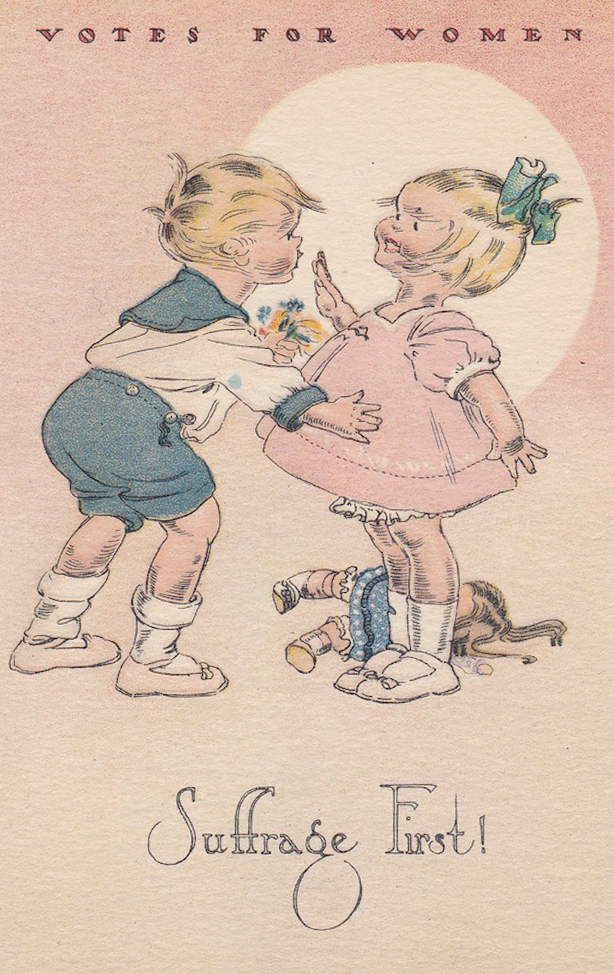
On February 14th, 1920, suffragist Carrie Chapman Catt founded the League of Women Voters. The League would go forward where the suffrage movement left off, thanks to the passage of the 19th amendment granting the right to vote to women.

Before that day, suffragists had used Valentine’s Day as an opportunity to spread their message. This 1915 valentine suggests that there will be no love on Valentine’s Day until women get the right to vote:

1c

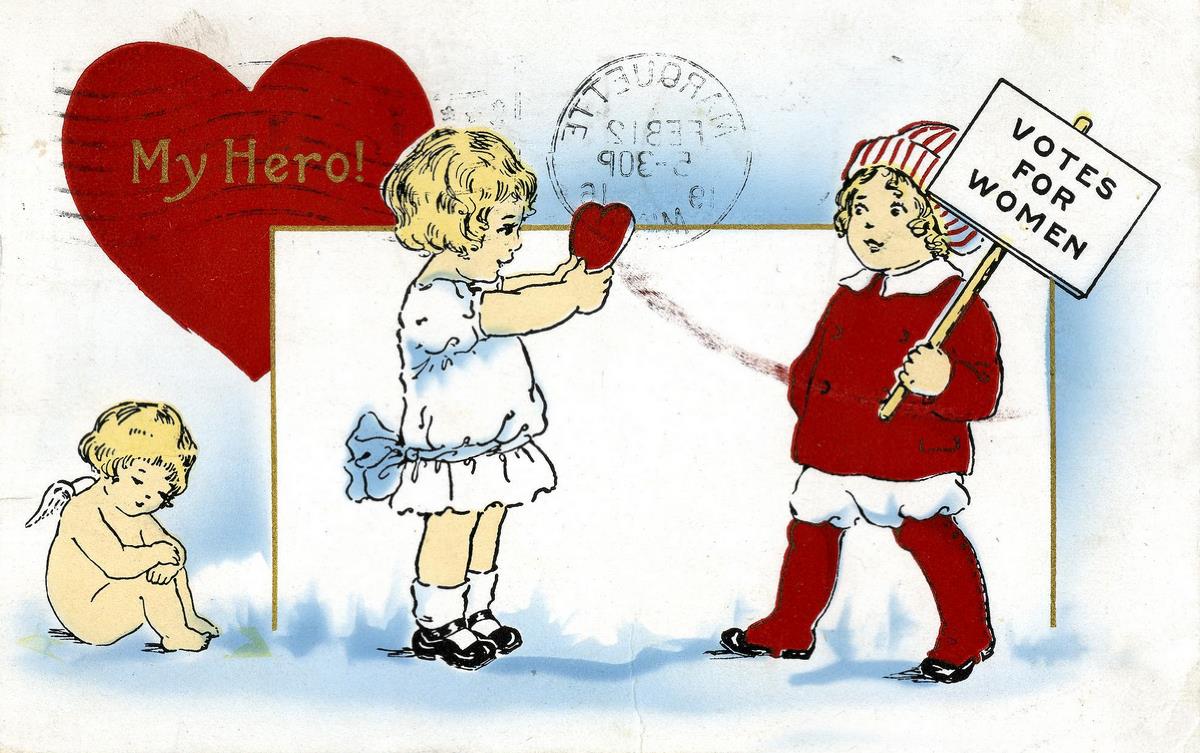
This 1916 valentine suggests that women love men who stand up for their right to vote:

2

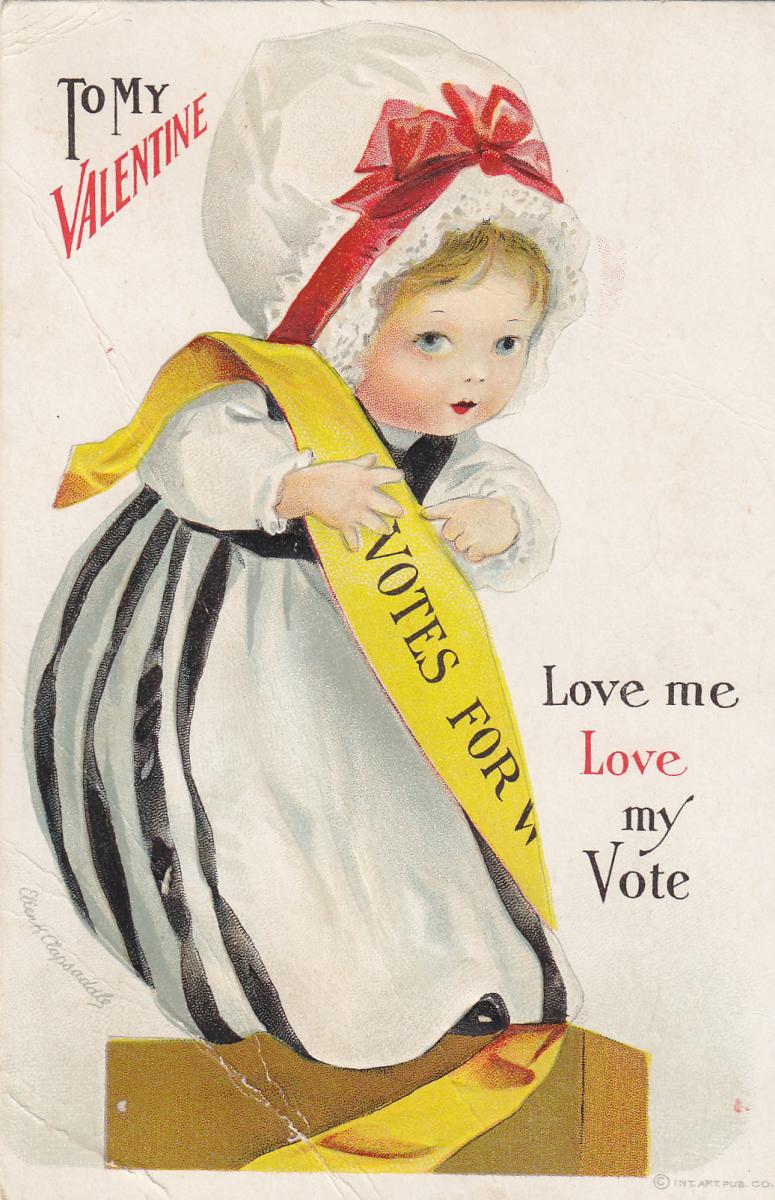
And this one from 1918 suggests that if men really loved women, they’d give them suffrage.

1b

Happy early Valentine’s/League of Women Voters’ Day!

Via Ms. Magazine; images borrowed from the League of Women Voters.

Lisa Wade, PhD is an Associate Professor at Tulane University. She is the author of American Hookup, a book about college sexual culture; a textbook about gender; and a forthcoming introductory text: Terrible Magnificent Sociology. You can follow her on Twitter and Instagram.
3Cultural and Historical Variation

Race/Ethnicity

Heteronormativity

Compulsory Coupling:

Gender

Marketing:

Consumption:

Lisa Wade, PhD is an Associate Professor at Tulane University. She is the author of American Hookup, a book about college sexual culture; a textbook about gender; and a forthcoming introductory text: Terrible Magnificent Sociology. You can follow her on Twitter and Instagram.
In New Orleans, it’s Mardi Gras! Everywhere else, it’s Tuesday.

If you’re not in the middle of the revelry, enjoy these Mardi Gras posts from previous years:

Lisa Wade, PhD is an Associate Professor at Tulane University. She is the author of American Hookup, a book about college sexual culture; a textbook about gender; and a forthcoming introductory text: Terrible Magnificent Sociology. You can follow her on Twitter and Instagram.

A New Vision and a Hiatus:

Sociological Images turned 8 this year. It’s been a long, busy, and exciting journey and my own writing has been front-and-center for much of that time. Moving forward, my hope is to step back into more of an editor role, helping established scholars bring attention to their research, giving newer scholars a platform, and helping other sociology bloggers reach a wider audience. Essentially, I would like to use this site as an amplifier, broadcasting as many sociologists as I can as widely as possible by either cross-posting or using the SocImages social media reach. So, to all the sociologists out there, look out for more requests to re-print, please don’t hesitate to pitch me ideas, and feel free to send me things to share!

But… not yet. SocImages is taking its first hiatus. My book deadline is March 1st, so I’m taking two months off to polish the draft. See you all in 30 days!

Visits:

We rounded out the year with over 2,900,000 visits and nearly 4,000,000 page views.  We are proud and honored to enjoy almost 80,000 Facebook friends, over 23,000 Twitter followers, plus nearly 15,000 on Pinterest and over 24,000 on Tumblr.  A huge thank you to everyone for your enthusiasm and support!

Highlights:

Best of 2015!

2 (1)

Over the last week we’ve featured my favorite and your most loved posts from 2015.  Here’s the list in case you missed it:

Reader’s Choice

Editor’s Picks

Happy New Year everyone!  Here’s to wonderful things in 2016!

Lisa Wade, PhD is an Associate Professor at Tulane University. She is the author of American Hookup, a book about college sexual culture; a textbook about gender; and a forthcoming introductory text: Terrible Magnificent Sociology. You can follow her on Twitter and Instagram.

2 (1)“It is fair to say,” writes historian Heather Williams about the Antebellum period in America, “that most white people had been so acculturated to view black people as different from them that they… barely noticed the pain that they experienced.”

She describes, for example, a white woman who, while wrenching enslaved people from their families to found a distant plantation, describes them as “cheerful,” in “high spirits,” and “play[ful] like children.” It simply never occurred to her or many other white people that black people had the same emotions they did, as the reigning belief among whites was that they were incapable of any complex or deep feeling at all.

It must have created such cognitive dissonance, then — such confusion on the part of the white population — when after the end of slavery, black people tried desperately to reunite with their parents, cousins, aunties and uncles, nieces and nephews, spouses, lovers, children, and friends.

And try they did. For decades newly freed black people sought out their loved ones. One strategy was to put ads in the paper. The “Lost Friends” column was one such resource. It ran in the Southwestern Christian Advocate from 1879 until the early 1900s and a collection of those ads — more than 330 from just one year — has been released by the Historic New Orleans Collection. Here is an example:

4

The ads would have been a serious investment. They cost 50 cents which, at the time, would have been more than a day’s income for most recently freed people.

Williams reports that reunions were rare. She excerpted this success story from the Southwestern in her book, Help Me To Find My People, about enslaved families torn asunder, their desperate search for one another, and the rare stories of reunification.

A FAMILY RE-UNITED

In the SOUTHWESTERN of March 1st, we published in this column a letter from Charity Thompson, of Hawkins, Texas, making inquiry about her family. She last heard of them in Alabama years ago. The letter, as printed in the paper was read in the First church Houston, and as the reading proceeded a well-known member of the church — Mrs. Dibble — burst into tears and cried out “That is my sister and I have not seen her for thirty three years.” The mother is still living and in a few days the happy family will once more re-united.

I worry that white America still does not see black people as their emotional equals. Psychologists continue to document what is now called a racial empathy gap, both blacks and whites show lesser empathy when they see darker-skinned people experiencing physical or emotional pain. When white people are reminded that black people are disproportionately imprisoned, for example, it increases their support for tougher policing and harsher sentencing. Black prisoners receive presidential pardons at much lower rates than whites. And we think that black people have a higher physical pain threshold than whites.

How many of us tolerate the systematic deprivation and oppression of black people in America today — a people whose families are being torn asunder by death and imprisonment — by simply failing to notice the depths of their pain?

Lisa Wade, PhD is an Associate Professor at Tulane University. She is the author of American Hookup, a book about college sexual culture; a textbook about gender; and a forthcoming introductory text: Terrible Magnificent Sociology. You can follow her on Twitter and Instagram.

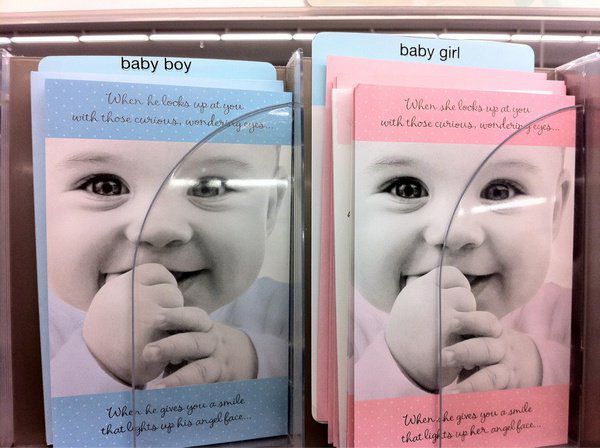
2 (1)Our Pointlessly Gendered Products Pinterest board is funny, no doubt. When people make male and female versions of things like eggs, dog shampoo, and pickles, you can’t help but laugh. But, of course, not it’s not just funny. Here are five reasons why.

1. Pointlessly gendered products affirm the gender binary.

Generally speaking, men and women today live extraordinarily similar lives. We grow up together, go to the same schools, and have the same jobs. Outside of dating — for some of us — and making babies, gender really isn’t that important in our real, actual, daily lives.

These products are a backlash against this idea, reminding us constantly that gender is important, that it really, really matters if you’re male and female when, in fact, that’s rarely the case.

2

But if there were no gender difference, there couldn’t be gender inequality; one group can’t be widely believed to be superior to the other unless there’s an Other. Hence, #1 is important for #3.

Affirming the gender binary also makes everyone who doesn’t fit into it invisible or problematic. This is, essentially, all of us. Obviously it’s a big problem for people who don’t identify as male or female or for those whose bodies don’t conform to their identity, but it’s a problem for the rest of us, too. Almost every single one of us takes significant steps every day to try to fit into this binary: what we eat, whether and how we exercise, what we wear, what we put on our faces, how we move and talk. All these things are gendered and when we do them in gendered ways we are forcing ourselves to conform to the binary.

2. Pointlessly gendered products reinforce stereotypes.

Pointlessly gendering products isn’t just about splitting us into two groups, it’s also about telling us what it means to be in one of those boxes. Each of these products is an opportunity to remind us.

3

3. Pointlessly gendered products tell us explicitly that women should be subordinate to or dependent on men.

All too often, gender stereotypes are not just about difference, they’re about inequality. The products below don’t just affirm a gender binary and fill it with nonsense, they tell us in no uncertain terms that women and men are expected to play unequal roles in our society.

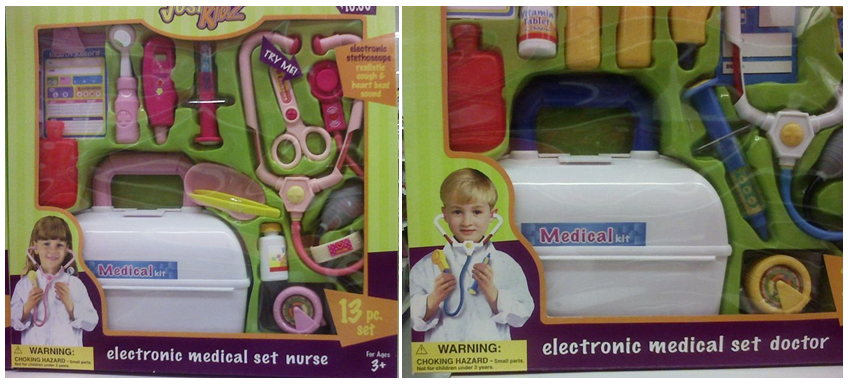
Girls are nurses, men are doctors:

4

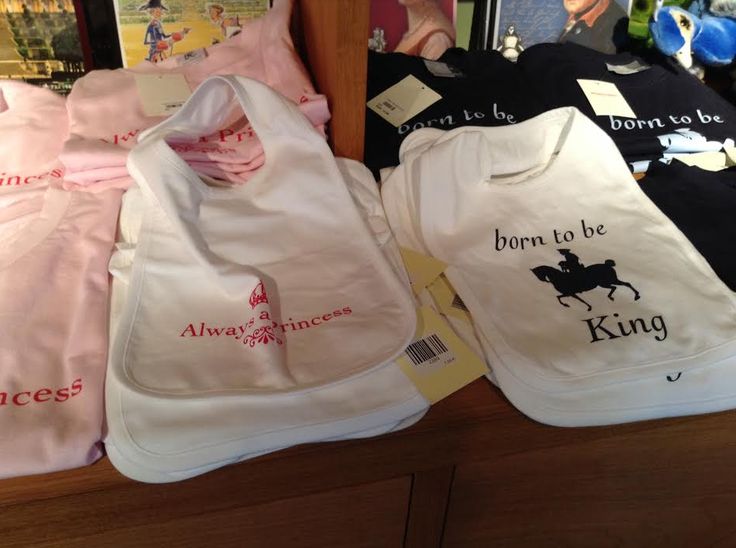
Girls are princesses, men are kings:

12

4. Pointlessly gendered products cost women money.

Sometimes the masculine and feminine version of a product are not priced the same. When that happens, the one for women is usually the more expensive one. If women aren’t paying attention — or if it matters to them to have the “right” product — they end up shelling out more money.  Studies by the state of California, the University of Central Florida, and Consumer Reports all find that women pay more. In California, women spent the equivalent of $2,044 more a year (the study was done in 1996, so I used an inflation calculator).

This isn’t just something to get mad about. This is real money. It’s feeding your kids, tuition at a community college, or a really nice vacation. When women are charged more it harms our ability to support ourselves or lowers our quality of life.

5. Pointlessly gendered products are stupid. There are better ways to deliver what people really need.

One of the most common excuses for such products is that men and women are different, but most of the time they’re using gender as a measure of some other variable. In practice, it would be smarter and more efficient to just use the variable itself.

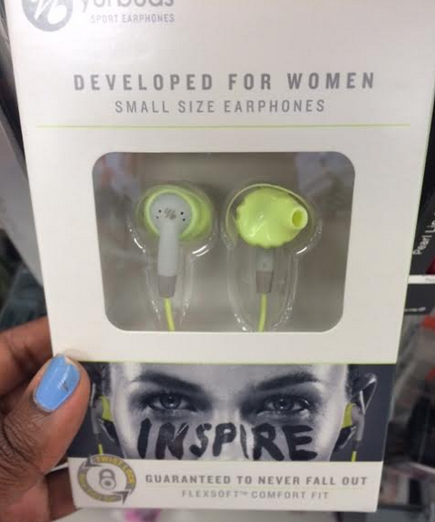
For example, many pointlessly gendered products advertise that the one for women is smaller and, thus, a better fit for women. The packaging on these ear buds, sent in by LaRonda M., makes this argument.

2

Maybe some women would appreciate smaller earbuds, but it would still be much more straightforward to make ear buds in different sizes and let the user decide which one they wanted to use.

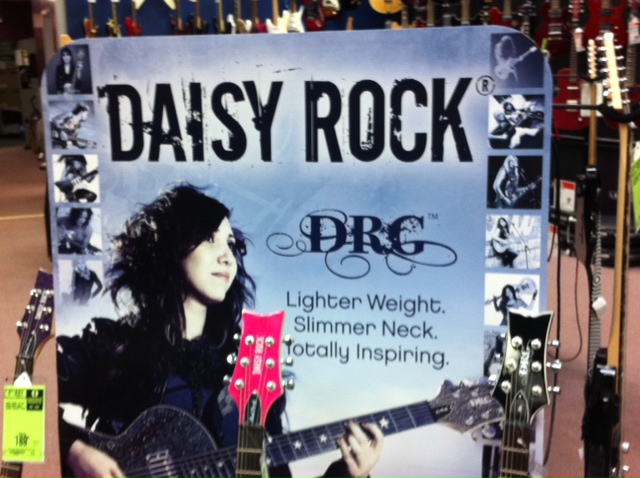
Products like these make smaller men and larger women invisible. They also potentially make them feel bad or constrain their choices. When the imperative for women is to be small and dainty, how do women who don’t use smaller earbuds feel?  Or, maybe the small guy who wants to learn how to play guitar never will because men’s guitars don’t fit him and he won’t be caught dead playing this:

1b

In sum, pointlessly gendered products aren’t just a gag. They’re a ubiquitous and aggressive ideological force, shaping how we think, what we do, and how much money we have. Let’s keep laughing, but let’s not forget that it’s serious business, too.

Lisa Wade, PhD is an Associate Professor at Tulane University. She is the author of American Hookup, a book about college sexual culture; a textbook about gender; and a forthcoming introductory text: Terrible Magnificent Sociology. You can follow her on Twitter and Instagram.
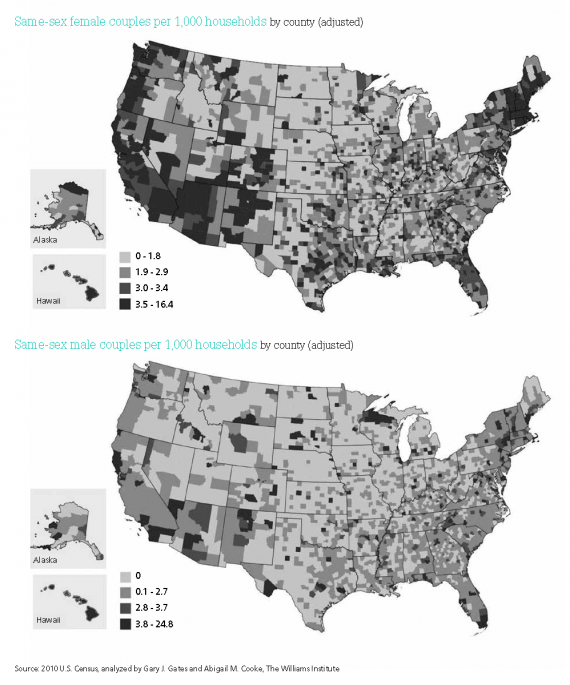
2 (1)February’s edition of Contexts had a fascinating article by Amin Ghaziani titled Lesbian Geographies. Most of us are familiar with the idea of a “gayborhood,” a neighborhood enclave that attracts gay men. It turns out that lesbians have enclaves, too, but they’re not always the same ones.

Here’s the frequency of same-sex female couples (top) and same-sex male couples (bottom) in U.S. counties. Census data tracks same-sex couples but not individuals, so the conclusions here are based on couples.

7

What are the differences between where same-sex female and same-sex male couples live?

First, Same-sex female couples are more likely than their male counterparts to live in rural areas. Ghaziani thinks that “cultural cues regarding masculinity and femininity play a part.” As one interviewee told sociologist Emily Kazyak:

If you’re a flaming gay queen, they’re like, “Oh, you’re a freak, I’m scared of you.” But if you’re a really butch woman and you’re working at a factory, I think [living in the midwest is] a little easier.

If being “butch” is normative for people living in rural environments, lesbians who perform masculinity might fit in better than gay men who don’t.

Second, non-heterosexual women are about three times as likely as non-heterosexual men to be raising a child under 18. Whatever a person’s sexual orientation, parents are more likely to be looking for good schools, safe neighborhoods, and non-postage stamp-sized apartments.

Finally, there’s evidence that gay men price lesbians out. Gay men are notorious for gentrifying neighborhoods, but data shows that lesbians usually get there first. When non-heterosexual men arrive, they accelerate the gentrification, often making it less possible for non-heterosexual women to afford to stay. Thanks to the gender pay gap, times two, women living with women don’t generally make as much money as men living with men.

Or, they might leave because they don’t want to be around so many men. Ghaziani writes:

Gay men are still men, after all, and they are not exempt from the sexism that saturates our society. In reflecting on her experiences in the gay village of Manchester, England, one lesbian described gay men as “quite intimidating. They’re not very welcoming towards women.”

Cross-posted at Pacific Standard.

Lisa Wade, PhD is an Associate Professor at Tulane University. She is the author of American Hookup, a book about college sexual culture; a textbook about gender; and a forthcoming introductory text: Terrible Magnificent Sociology. You can follow her on Twitter and Instagram.