Search results for The

Re-posted to add to the discussion about sexual assault in the aftermath of the Steubenville rape trial, the Senate hearing on rape and harassment in the military, and the controversy at Occidental College.

Toban B. sent us two pairs of photographs showing feminist activism and backlash (images found here) at the University of Western Ontario.  These posters, and their defacement, nicely demonstrate how resistance to oppression is met with counter-resistance.  Until inequality is challenged, things often seem to be just fine; when groups stand up and demand equality, we suddenly see how fiercely people will defend their privilege.

Images after the jump (includes language about sexual violence):

more...

Re-posted to add to the discussion about sexual assault in the aftermath of the Steubenville rape trial, the Senate hearing on rape and harassment in the military, and the controversy at Occidental College.
1The other day I came upon a post by Margaret Lyons at Vulture pointing out the frequent use of rape jokes in sitcoms this season. A number of sitcoms, especially Two Broke Girls, Whitney, and Work It included scenes where rape served as a punchline. Lyons explains what particularly bothers her about this is that references to rape are being used simply as a “shorthand for outrageousness,” a way to cue the audience that they’re watching a show that is bold and daring, that will say anything!

The post includes a video of clips of a lot of these rape-joke scenes from this season, showing how frequently and casually they’re included. Clearly, these could be particularly upsetting for some readers:

I’ve been thinking about posting the video for a couple of days, but then Jeremiah J. sent in a link to a post that captures what I find problematic about how rape is used in TV and movies so much better than I ever could. Film critic and screenwriter Drew McWeeny posted a lengthy article at HitFix about reaching the breaking point in his ability to watch gratuitous rape scenes in movies. McWeeny explains,

It seems to me that somewhere along the way, it was decided that the easiest way to make an audience uncomfortable was to have someone rape a character onscreen.  I must see 30 films a year where somebody needs to have “something bad” happen, and the go-to impulse in almost every case is rape. It is guaranteed to cause a visceral reaction, even when the scenes are badly staged and lazy, which most of them are.

…the point has been more than made on film that rape is a terrible thing, and at this point, if you’re not contributing some new idea to the conversation, then you are literally just using it as a button, something you push to get a response, and that unnerves me.

I think McWeeny’s points are relevant to a discussion of sitcoms’ use of rape jokes as well, because in both cases rape is often being used as a “button,” a lazy, predictable way to get a reaction from an audience and mark the show or movie as one that’s audacious and pushes boundaries. You really must read McWeeny’s full original post, as he eloquently explains why this matters.

Gwen Sharp is an associate professor of sociology at Nevada State College. You can follow her on Twitter at @gwensharpnv.

Re-posted to add to the discussion about sexual assault in the aftermath of the Steubenville rape trial, the Senate hearing on rape and harassment in the military, and the controversy at Occidental College.

This screenshot of the front page of The Sun is an excellent example of the eroticization of violence against women and our insistent denial of it:

capture1

The article is a condemnation of a video game in which the goal is to rape a mother and her two daughters (and force them to have abortions if they get pregnant).   They call the game “sick” and “shocking,” but also include a huge picture of the virtual rape victim sexily stripping down to her underwear.  Twisty, at I Blame the Patriarchy, observes that “…in terms of screen real estate, titillating images take up more space on the Sun’s web page than actual copy…”

Notice, also, the “related story” about a girl murdered who had reported rape threats and then, to the right of that, a dating advertisement featuring a couple of girls making bedroom eyes at the viewer.

This is what rape culture looks like: a story about a video game that encourages players to rape and otherwise torture women and girls, alongside titillating images from that very game; a story about a “girl” who had actually been murdered, alongside a photo of her looking invitingly into the camera; and a dating website.  With this material like this, we learn that sex, violence, and women aren’t separate concepts.  Instead of learning to think about sex, violence, and women, we learn to think about, and fantasize about, sexviolencewomen.

Lisa Wade, PhD is an Associate Professor at Tulane University. She is the author of American Hookup, a book about college sexual culture; a textbook about gender; and a forthcoming introductory text: Terrible Magnificent Sociology. You can follow her on Twitter and Instagram.

Re-posted to add to the discussion about sexual assault in the aftermath of the Steubenville rape trial, the Senate hearing on rape and harassment in the military, and the controversy at Occidental College.

Women’s vulnerability to men’s violence and harassment is a common topic of public service announcements (PSAs) in industrialized countries.  More often than not, however, awareness campaigns are aimed at women and tell them how to avoid victimization.  We’ve posted already, for example, on campaigns telling girls and women that they are responsible for stopping internet predators, preventing sexual harassment, and instigating domestic violence.

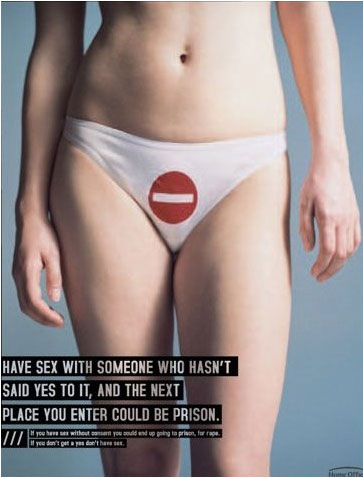
Critics argue that stopping predation, harassment, and violence by men requires telling men not to do those things and telling women to restrict their activities to avoid men who might victimize them is only doubly oppressive.  So, when Jeff H. sent in a nice example of a U.K. anti-rape ad targeting men, we thought it was worthy of a post (and see this anti-domestic violence ad for another example).

In a less complimentary mood, Copyranter noted that the poster was hanging in bathrooms and published in men’s magazines and wondered if anti-rape messages should really be communicated with a women’s nearly-naked navel, crotch, and thighs.

Lisa Wade, PhD is an Associate Professor at Tulane University. She is the author of American Hookup, a book about college sexual culture; a textbook about gender; and a forthcoming introductory text: Terrible Magnificent Sociology. You can follow her on Twitter and Instagram.

Re-posted to add to the discussion about sexual assault in the aftermath of the Steubenville rape trial, the Senate hearing on rape and harassment in the military, and the controversy at Occidental College. Cross-posted in Portuguese at Conhecimento Prudente.

Rape reporting, prosecution, and conviction rates across the country are appallingly low, but it’s easier to get away with sexual assault in some places compared to others.  Pennsylvania is one of those places. In Pennsylvania, expert testimony isn’t allowed in the courtroom.  Instead, jurors frequently rely on abundant, harmful rape myths.

We shouldn’t be that surprised, then, that earlier this week the Pennsylvania Liquor Control Board (PLCB) aired an ad plainly promoting the idea that women are to blame for being raped.

The ad shows a young woman sprawled on what appears to be a bathroom floor, underwear down at her ankles, with the caption, “She didn’t want to do it, but she couldn’t say no.”  The victim blaming here couldn’t be any clearer, right down to the illogical language suggesting that the victim both had agency (she is to blame) and lacked agency (because she couldn’t say “no”).

Crafted by the Neiman Group, this ad was part of a larger $600,00 campaign — two years in the making — to raise awareness of the ill effects of drinking.  Several different themes were proposed, but this was the “winner.”  Another ad in the same campaign holds a rape victim’s friend responsible for her rape.

The PLCB pulled the ad campaign in response to hundreds of messages from concerned citizens, some of whom claimed they were traumatized by the image/message.  However, a statement from the PLCB shows that those in charge still don’t comprehend the problem:

“We feel very strong, and still do, that when we entered the initial discussion about doing a campaign like this it was important to bring the most difficult conversations about over-consumption of alcohol to the forefront and all of the dangers associated with it—date rape being one of these things.”

The PLCB is right that alcohol and “date” rape (a term that trivializes rape) go hand in hand, but not because women are responsible for the criminal actions of the approximate 6% of men who perpetrate this crime.  Instead, perpetrators exploit cultural narratives — like the idea that intoxication = miscommunication and that “date rape” isn’t “real” rape — to repeatedly commit this crime.  In a recent study of college students, 4% of men were found to be serial rapists; they committed an average of 5.8 rapes each.

In short, sexual assault is committed by (often serial) perpetrators.  Yet ad campaigns like this will continue to ensure that sexual assault will continue to be the only crime in which society treats the victim like a perpetrator.

Caroline Heldman is a professor of politics at Occidental College. You can follow her at her blog and on Twitter and Facebook.

Course Guide for
HISTORY OF WOMEN
(last updated 03/2013)

Developed by Lisa Wade, PhD
Occidental College


Sports:

Health:

Fashion and Norms of Attractiveness:

Work:

Education:

Marriage and Motherhood:

Suffrage:

Marketing:

Children and Toys:

War and Military:

Activism:

Color, Sound,and Language:

Just for Fun:

Originally posted in 2009. Re-posted in honor of Women’s History Month.

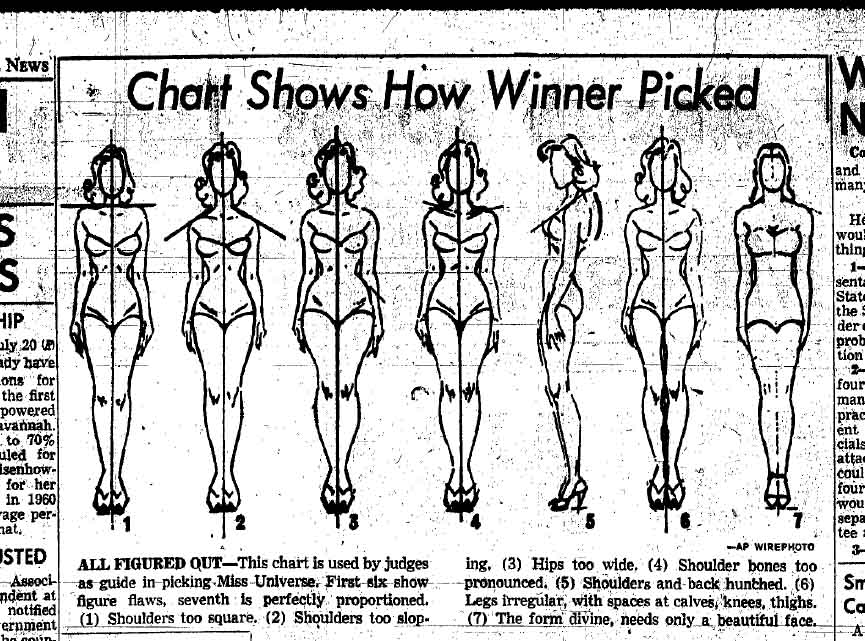
Larry Harnisch, of the Los Angeles Times blog The Daily Mirror, sent in this image, published in The Mirror in 1959, that illustrated how women’s bodies were judged in the Miss Universe contest:

-1

Text:

ALL FIGURED OUT–This chart is used by judges as [a] guide in picking Miss Universe. First six show figure flaws, seventh is perfectly proportioned. (1) Shoulders too square. (2) Shoulders too sloping. (3) Hips too wide. (4) Shoulder bones too pronounced. (5) Shoulders and back hunched. (6) Legs irregular, with spaces at calves, knees, thighs. (7) The form divine, needs only a beautiful face.

(I had no idea that I have irregular legs until I saw figure 6. My self esteem is taking quite the hit. I can’t tell if there’s anything wrong with my shoulders, though–I’ll have to ask someone else for an opinion.)

Two points:

First, some people like to suggest that men are programmed by evolution to find a particular body shape attractive.  Clearly, if judging women’s bodies requires this much instruction, either (1) nature has left us incompetent or (2) cultural norms defining beauty overwhelm any biological predisposition to be attracted to specific body types.

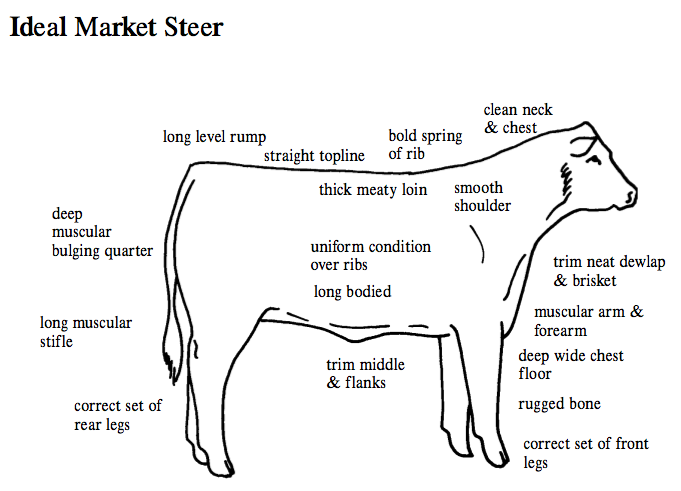
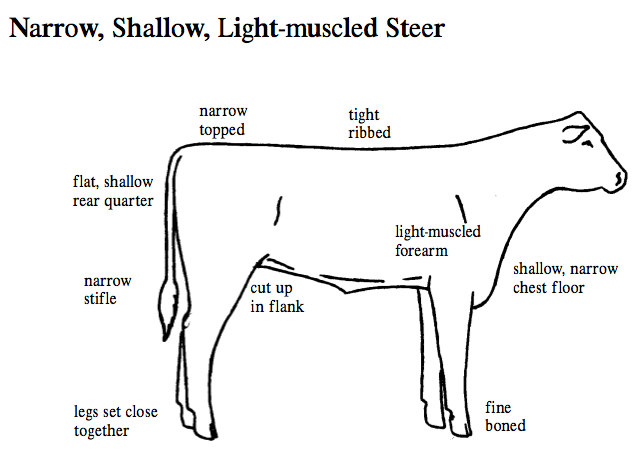
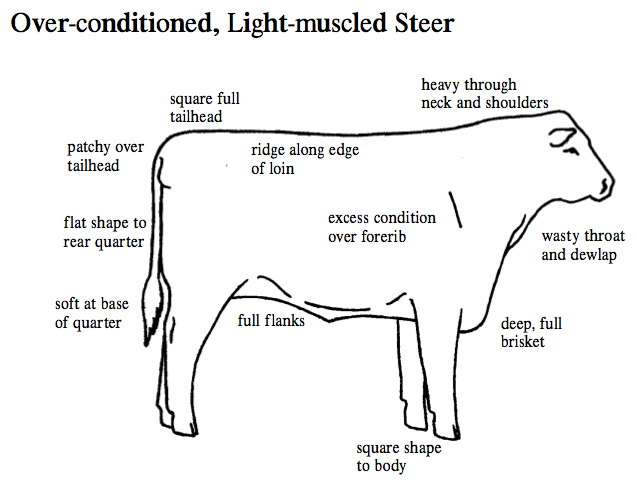
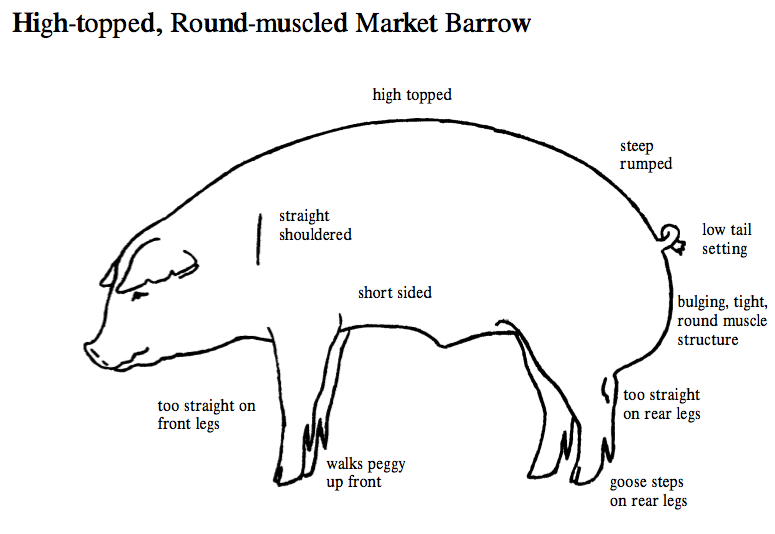
Second, the chart reveals the level of scrutiny women faced in 1959 (and I’d argue it’s not so different today).   It made me think of my years in 4-H. I was a farm kid and I showed steers for several years and also took part in livestock and meat judging competitions. I was good at it, just so you know. Anyway, what the beauty pageant image brought to mind was the handouts we’d look at to learn how to judge livestock. Here are some examples, from Kansas State University’s 4-H judging guide (pdf here):

Picture 1

Picture 2

Picture 3

This poor pig has a low-set tail–how dreadful:

Picture 4

It’s almost as if, like superior livestock, beautiful women are a desired cultural product in which we should all invest and be invested. You might compare these to some of the images in our post about sexualizing food that come from Carol Adams’s website.

Gwen Sharp is an associate professor of sociology at Nevada State College. You can follow her on Twitter at @gwensharpnv.

Chilling video taken at a high school party in Steubenville, Ohio in which attendees laugh and joke about an unconscious 16-year-old allegedly raped and sodomized by members of the football team, propelled the case into the national spotlight earlier this winter.

The deeply disturbing video focuses on Steubenville High School alum Michael Nodianos as he holds court with a grim comedy show, cracking up to quips such as, “They raped her quicker than Mike Tyson!” and “They raped her more than the Duke lacrosse team!” Those with the stomach to endure the entire 12-minute video hear the victim repeatedly referred to as “dead,” offering ugly details including, “They peed on her! That’s how you know she’s dead because someone pissed on her.” The death motif is so amusing to those involved that it leads to a litany of references to her being “deader than” everyone from Caylee Anthony to Trayvon Martin.

Trigger warning:

The video combined with other digital remains of the attack mined from Twitter and Instagram stirred public outrage at the accused perpetrators, at the bystanders who failed to intervene, and at adults — coaches, police, prosecutor, and parents — perceived as having been complicit in covering up the assault, preferring to sweep the violence under the rug to protect the football team and the young men on it. Protests sprouted around the courthouse and are expected to resume on Wednesday as the trial begins.

This video and other digital souvenirs of violence, such as the photos taken and circulated of Savannah Deitrich while she was sexually assaulted, may or may not have significant legal consequences. Yet their cultural legacy — the opportunity they have to undermine our most resilient rape myths — has the potential to be even weightier.

Read the rest of this article at WBUR’s Cognoscenti.