Search results for The

Last week many media outlets were busy celebrating the Dow Jones record high, suggesting that it was indicative of the United States’ recovery from the greatest economic downturn since The Great Depression.  The graph below comes from a New York Times story with the headline “As Fears Recede, Dow Industrial Hits a Milestone.”

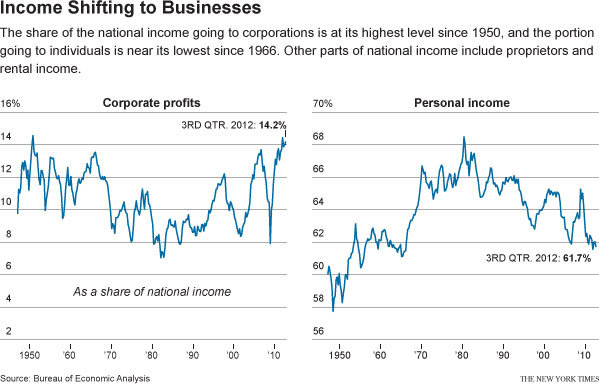
However, another story buried in the Business section of the New York Times, titled “Recovery in U.S. Is Lifting Profits, but Not Adding Jobs,” contains a graph illustrating how the supposed economic recovery is bitter-sweet at best:
2

The second graph uses data from the Bureau of Economic Analysis to highlight the fact that corporate profits and stock prices are at record highs, but the share of profits workers have taken home has steadily dropped since the early 1980s.  Some of the steepest declines have come during the last few years, or during the supposed “recovery.”

These two graphs illustrate that while ”The Market” is probably considered the go-to indicator of economic well-being, stock indexes are not always indicative of the economic reality experienced by non-investors.  If businesses and corporations were increasing their stock value by investing to expand productivity, thereby creating good-paying jobs and opportunities for workers, rising markets would be a sign good of economic times for all.  But this data suggests that is not what is happening; instead, as the twin charts show, rising corporate profits are at least partly the result of wage suppression.

Jason Eastman is an Assistant Professor of Sociology at Coastal Carolina University who researches how culture and identity influence social inequalities.

In case you’ve ever wondered, “Is there anything we won’t pointlessly gender?”, Katrin sent in evidence that there really, really isn’t:

bibles

Via Marginal Christianity.

Gwen Sharp is an associate professor of sociology at Nevada State College. You can follow her on Twitter at @gwensharpnv.

Cross-posted at Racialicious.

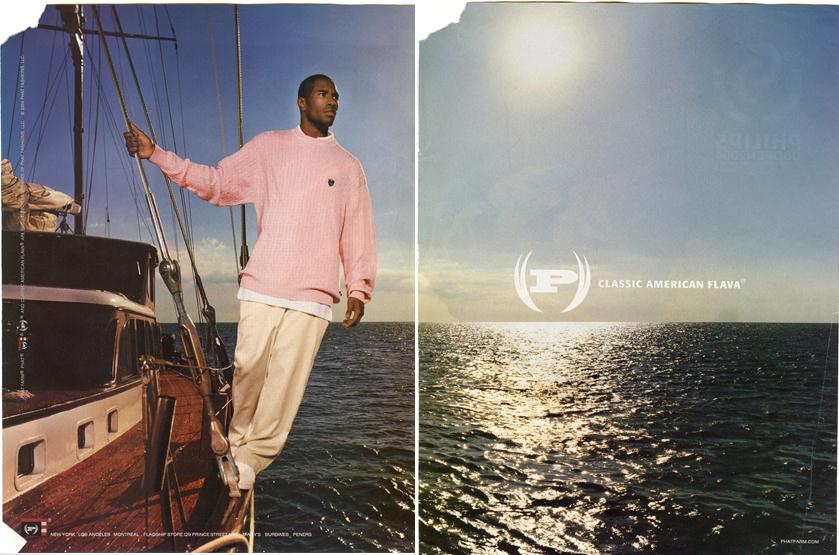
I featured the two-page ad below in one of the first posts I ever wrote for SocImages (it was October of 2007 and we’d written less than 100 posts; today we’re approaching 5,000, but I digress…).  It’s still one of my very favorite images.

I use it in Sociology 101 when I argue that race, class, and gender are, among other things, performances. Activities, items, and behaviors carry class, race, and gender meanings. In order to tell stories about ourselves, we strategically combine these things with the meanings we carry on our bodies (a gendered shape, skin color and hair texture etc., and signs of economic wealth or deprivation).

The ad for PhatFarm deftly balances Blackness (the body), upper-class Whiteness (the sailboat), and femininity (the pink sweater).  In strategically using culturally-resonant signifiers, he challenges popular representations of the Black body.

1

This happens in real life too.  Journalist Brent Staples powerfully discusses how he adds a signifier of upper-class Whiteness to his large Black body in order to avoid the discomfort of frightening people on the streets of New York.

…I employ what has proved to be an excellent tension-reducing measure: I whistle melodies from Beethoven and Vivaldi and the more popular classical composers. Even steely New Yorkers hunching toward nighttime destinations seem to relax and occasionally they even join in the tune. Virtually everybody seems to sense that a mugger wouldn’t be warbling bright, sunny selections from Vivaldi’s Four Seasons.

“It is my equivalent to the cowbell that hikers wear when they know they are in bear country,” Staples adds, referring to the fact that being perceived as dangerous can itself be dangerous, as we know from the example of Trayvon Martin and Rodrigo Diaz, who was shot in the head in January when he accidentally pulled into the wrong driveway thinking it belonged to a friend.

Thinking of class, race, and gender as performances gives us credit for being agents.  We don’t have control over what the signifiers are, nor how people read our bodies, but we can actively try to manage those meanings.  Of course, some people have to do more “damage control” than others.

Lisa Wade, PhD is an Associate Professor at Tulane University. She is the author of American Hookup, a book about college sexual culture; a textbook about gender; and a forthcoming introductory text: Terrible Magnificent Sociology. You can follow her on Twitter and Instagram.

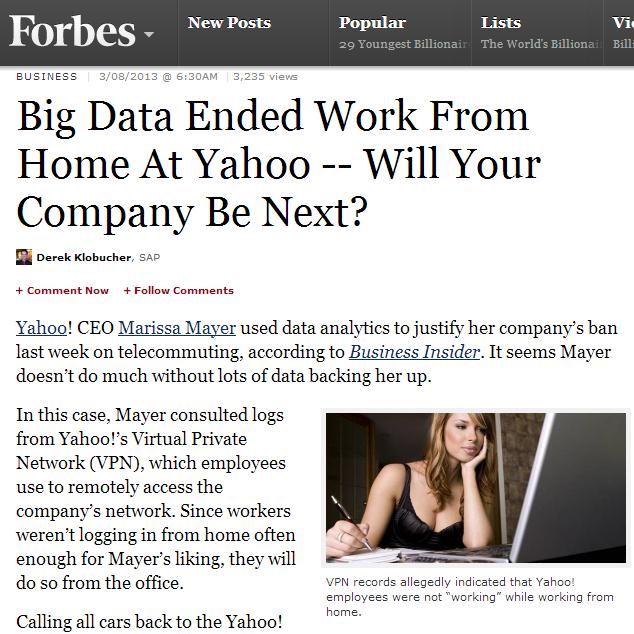
Todd Schoepflin, @CreateSociology, thought we should remark on the photo Forbes used to illustrate their story on Yahoo’s new no-work-from-home policy.  What do you think?  Totally realistic right?

1

Also, that hand is photoshop disaster worthy.

Lisa Wade, PhD is an Associate Professor at Tulane University. She is the author of American Hookup, a book about college sexual culture; a textbook about gender; and a forthcoming introductory text: Terrible Magnificent Sociology. You can follow her on Twitter and Instagram.

policymic

All posts at PolicyMic.

2013

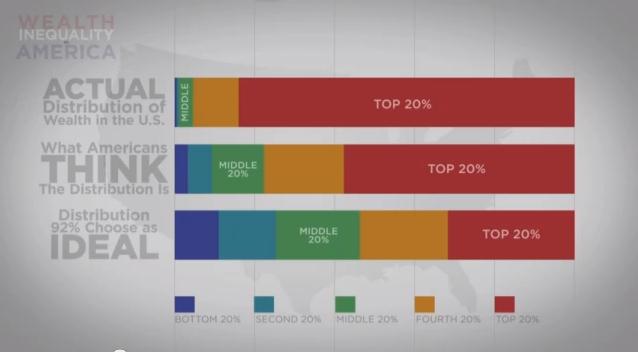
Emma K. submitted a sobering illustration of wealth inequality in the U.S.  It compares American ideal distributions of wealth, with what they think it is and what it really is. Suffice to say, Americans wish for more equal distributions, but the reality far outpaces their worst nightmare.

Here’s a snapshot:

1

A worthwhile 6 minutes:

Lisa Wade, PhD is an Associate Professor at Tulane University. She is the author of American Hookup, a book about college sexual culture; a textbook about gender; and a forthcoming introductory text: Terrible Magnificent Sociology. You can follow her on Twitter and Instagram.

My best friend’s car has four cup holders in the front seat. FOUR. I would ask what a person does with four cup holders, except I’m too busy feeling jealous.  I drive with a measly two.

Cup holders, or what the US News and World Report quaintly called “crannies for drinking cups” as late as 1989, weren’t considered an automotive necessity until the ’50s.  That was when, reports Bon Appetit, “drive-ins and drive-thru windows became mainstays of American eating.”  Before then, people were expected to stop for food and drink and then be sated.  Can you imagine?

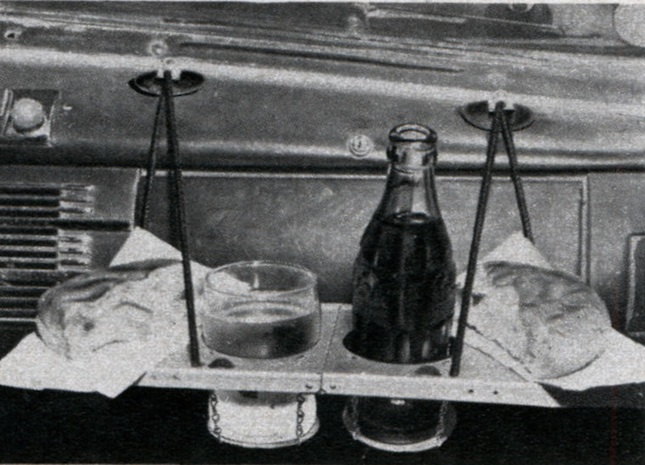
It took a long time, though, for the automobile industry to figure out exactly how to deliver us our cup holders.  First there was a “snack tray for car,” as pictured in a 1950 newspaper ad:

1

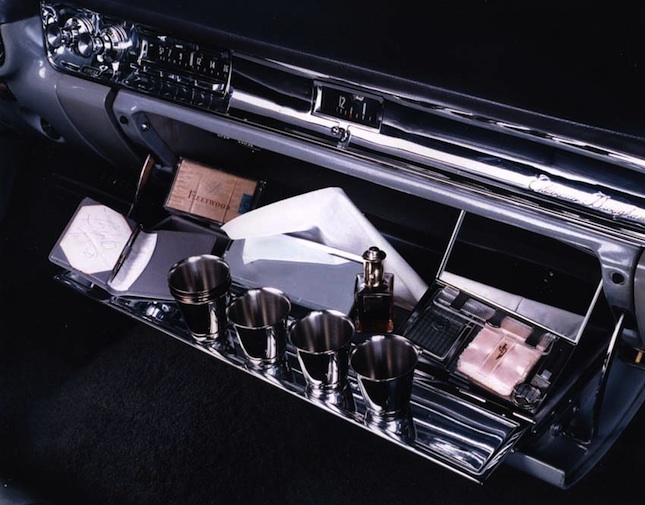
Companies also sold between the seat inserts that held cups and Cadillac sold a limousine with magnetic cup holders:

gmhistory cadillachistory eldoradoev

The cup holder as we know it today came to us in 1983 alongside another innovation: the mini van.  The first cup holders “sunk into the plastic of the dashboard” were installed in the Dodge Caravan and Plymouth Voyager.  It would be a decade, though, before cup holders came standard in essentially every car.

Lisa Wade, PhD is an Associate Professor at Tulane University. She is the author of American Hookup, a book about college sexual culture; a textbook about gender; and a forthcoming introductory text: Terrible Magnificent Sociology. You can follow her on Twitter and Instagram.

Cross-posted at Ms., The Huffington Post, and BlogHer.

Earlier this year a coalition of students and faculty at my institution, Occidental College, convinced the administration to make several changes to its sexual assault policy.  One of these changes involved the addition of reports of sexual assault to our OxyAlert system.  This meant that any time there was a report of a sexual assault, the college community would receive an email saying so, just as we now get alerts of all other crimes that are reported to have occurred in the vicinity.  The administration agreed to do this.

Last week the students learned of a report of a sexual assault second-hand (from the media), simultaneously discovering that the administration had declined to send out an OxyAlert in response.  Considering this a betrayal of their agreement, the students organized a marchpetition, and tumblr.

In response, the president of Occidental College, Jonathan Veitch, wrote a letter to the campus community. In it, he confirms what the students of Occidental fear: he is inclined to disbelieve students that report sexual assault.  He writes that OxyAlerts in cases of reports of sexual assault are not “possible or desirable” because:

In the first few hours, days or even weeks, it is not always clear what has happened in incidents like these. Investigators need time to sort through conflicting accounts in order to provide a clear narrative of what took place.

By suggesting that “incidents like these” need vetting, Veitch is reproducing a bias against sexual assault victims that feminists have been trying to eradicate for decades.  He is saying that sexual assault reports must be “sort[ed] through,” but reports of all other crimes can be taken at face value.  In other words, there is nothing wrong with the OxyAlert system per se, he just doesn’t think that women who report sexual assaults should necessarily have access to it.  This is unacceptable.

In fact, all crimes can be falsely reported and there is no evidence that reports of sexual assaults are more likely to be false than other reports of other crimes.  The sparse research is inconclusive: some find that sexual crimes are more often reported falsely, some find less.  So Veitch is on shaky ground suggesting that the college has a right to treat reports of sexual assault as hypothetical.  Moreover, the OxyAlert system is not judge and jury.  In all cases — whether it informs the community about a mugging, a stolen car, or a sexual assault — it simply states that there has been a report.

While I will admit that sexual assault is often complicated, this is a very black-and-white issue.  Sexual assault is a crime, Occidental has a system for alerting people to reports of crime, when a person reports the crime of sexual assault, that report should be included in this system.  To do otherwise is to allow college policy to be driven by the belief that women are uniquely untrustworthy and prone to malicious lies.  That is bias against women, plain and simple.

Lisa Wade, PhD is an Associate Professor at Tulane University. She is the author of American Hookup, a book about college sexual culture; a textbook about gender; and a forthcoming introductory text: Terrible Magnificent Sociology. You can follow her on Twitter and Instagram.