Search results for The

A new report by the ACLU reveals that “debtors’ prisons” in Ohio.  The phrase refers to the practice of imprisoning someone for the failure to pay fines.  This practice is in violation of the U.S. Constitution. Still, people who can’t afford to pay fines issued in response to traffic violations or misdemeanors are being routinely imprisoned in at least 7 out of 11 counties studied.
1

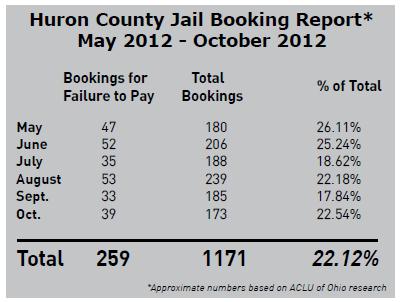
Among the worst offenders is Huron County.  An investigation found that as many as 22% of the bookings in Huron were for failure to pay a fine, usually coded as “contempt.”  Typically this resulted in a 10 day incarceration.  The state would then charge them fees related to being jailed, making it even more unlikely that a person would be able to pay.

The ACLU profiles several individuals.  One is a young man named John with a girlfriend and a nine-month-old daughter.  He was busted for disorderly conduct and underage consumption of alcohol, plus a few other related charges, and fined $1,300.  He agreed to a monthly payment plan to pay off the fines, but wasn’t able to make the payment every month.  Norwalk County, in response, put him in jail for 10 days.

He came out of jail owing more and the cycle continued.  At the time of the interview, John had been incarcerated for a total of 41 days and had incurred an extra $1,599.10 in fees related to his incarceration.  He had paid off $525 of the original $1,300, but owed an additional $2,374.

The ACLU points out that this is obviously an impossible cycle.  A person who is struggling financially may lose their job if they are incarcerated for ten days, especially if it happens more than once.  Meanwhile, loading on additional fines virtually ensures that they won’t be able to pay.  Moreover, however, they point out that it’s not good for Ohio.  The costs debtors incur don’t pay for their incarceration, so the state loses money each time they do this.  The net loss for the state in John’s case, for example, was $3,853.

Lisa Wade, PhD is an Associate Professor at Tulane University. She is the author of American Hookup, a book about college sexual culture; a textbook about gender; and a forthcoming introductory text: Terrible Magnificent Sociology. You can follow her on Twitter and Instagram.
Cross-posted at BlogHer and The Huffington Post.

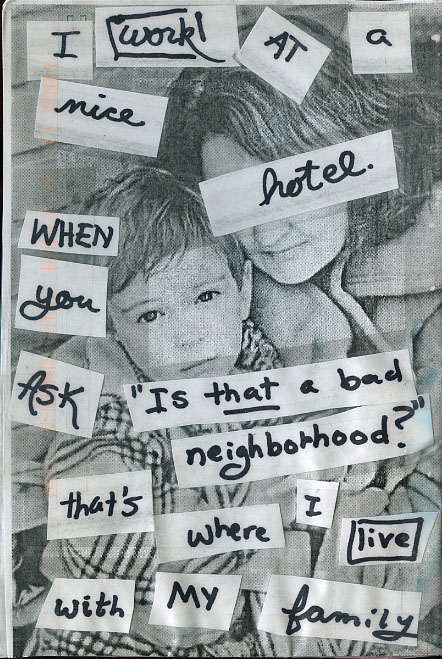
This PostSecret confession breaks my heart:

1

Most hospitality workers — especially those at high end hotels — routinely interact with people with significantly more economic resources than they.  This is an interesting point of contact analyzed exquisitely by Rachel Sherman in her book, Class Acts: Service and Inequality in Luxury Hotels (review here).

Sherman observes that workers and guests often minimized the class differences between them, even as enacting relationships strongly structured by their relative privilege.  Instead of obsessing about the wealth and privilege of the guests or ranting about the injustice of class inequality, though, they “normalized” it such that it was mostly invisible:

Unequal entitlements and responsibilities were not obscured, because they were perfectly obvious and well-known to interactive workers. Nor were they explicitly legitimated, since workers rarely talked about them as such. Rather, they simply became a feature of the everyday landscape of the hotel. Conflicts over unequal entitlement were couched in individual rather than collective terms and in the language of complaint rather than critique (p. 17).

Interestingly, this confession bucks the trend, which makes me wonder: if normalizing becomes habitual, what upsets it?  What knocks class consciousness back into full view?  In this case, it might have been the personal nature of the question.  When the guest expresses worry about the safety of the worker’s own neighborhood, questioning whether “someone like her” should go “somewhere like that,” perhaps it is to direct of a contrast to ignore.

Also inspired by Class Acts, see Employee “Empowerment” and Corporate Culture.

Lisa Wade, PhD is an Associate Professor at Tulane University. She is the author of American Hookup, a book about college sexual culture; a textbook about gender; and a forthcoming introductory text: Terrible Magnificent Sociology. You can follow her on Twitter and Instagram.
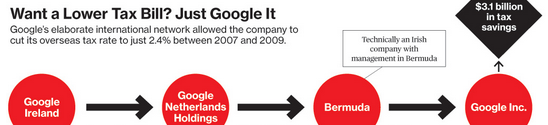
The Numbers

Some History

The Winners and the Losers

Tax Cultures

Lisa Wade, PhD is an Associate Professor at Tulane University. She is the author of American Hookup, a book about college sexual culture; a textbook about gender; and a forthcoming introductory text: Terrible Magnificent Sociology. You can follow her on Twitter and Instagram.
Course Guide for
ASIAN AMERICANS AND PACIFIC ISLANDERS
(last updated 04/2013)


Developed by Calvin N. Ho
University of California, Los Angeles


Social Construction of Race and Ethnicity

Doing race and ethnicity

Racial mixing and multiraciality

Colonialism, Neocolonialism, and Exotification

Geopolitics

Racism, Discrimination, and Stereotypes

Gender and Sexuality

Statistics on Asian Americans and Pacific Islanders

Geography of Asian Americans and Pacific Islanders

Labor Market Segmentation and Socioeconomic Mobility

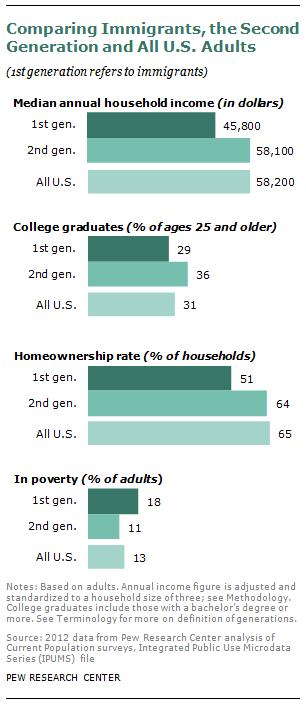
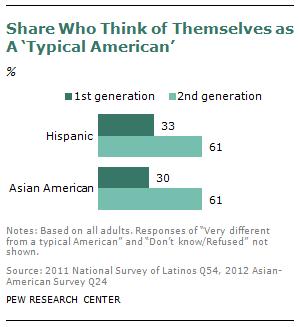
Data presented by Pew Social Trends suggests that immigrants are strongly assimilated by the second generation.  While first-generation immigrants (the children of migrants) often do worse on measures of economic security, second-generation immigrants (their grandchildren) are essentially indistinguishable from the general population.  They’re also more likely to identify as a “typical American.”

1 2

These data should calm the fears of people who think that high fertility rates among immigrants will harm the country by creating a “dependent” underclass or a dangerous population of non-patriots.

Lisa Wade, PhD is an Associate Professor at Tulane University. She is the author of American Hookup, a book about college sexual culture; a textbook about gender; and a forthcoming introductory text: Terrible Magnificent Sociology. You can follow her on Twitter and Instagram.
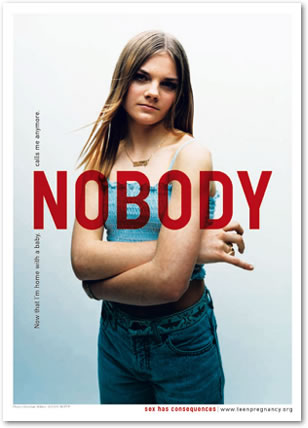
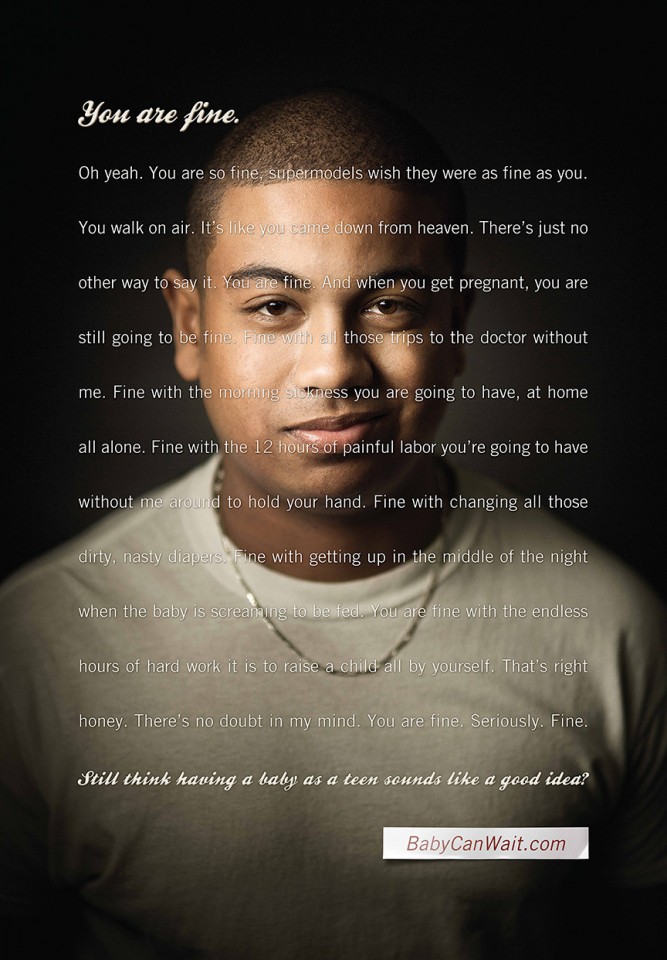
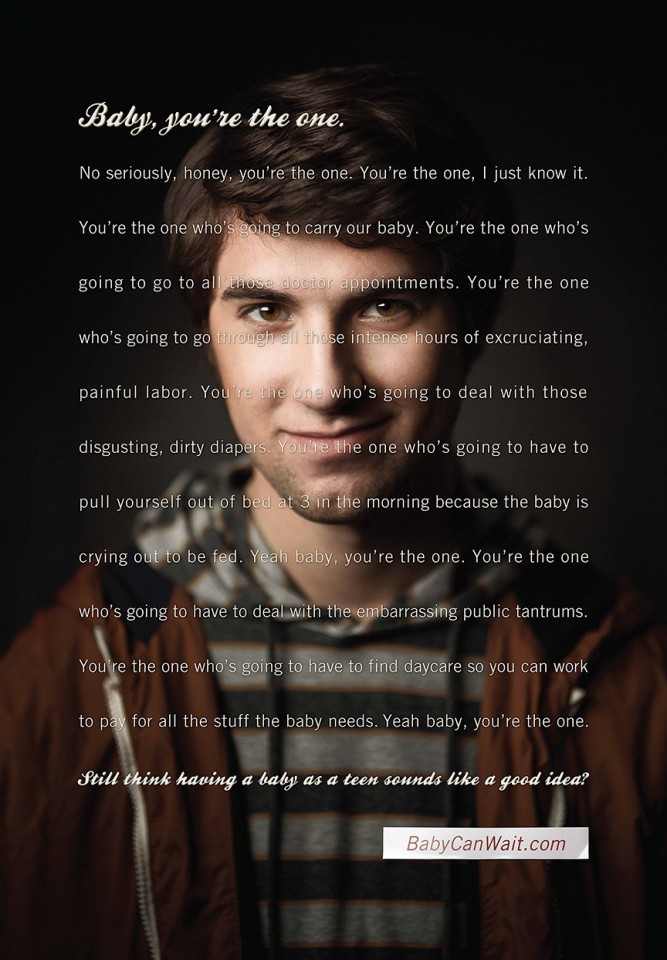
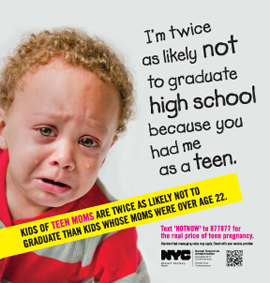
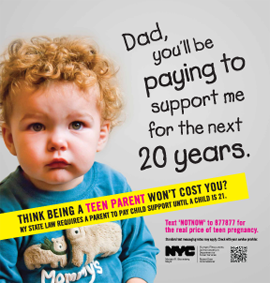
I first posted these posters on SocImages in 2008. They are designed to scare teenagers into taking precautions against pregnancy by demonizing teenagers who get (someone) pregnant. The way in which teens are portrayed in these images — labeled cheap, dirty, rejects, pricks, and nobodys — suggests that the organization, the National Campaign to Prevent Teen Pregnancy, doesn’t care about teenagers, only in controlling their behavior.

This is the sentence that runs along the left vertical with the word “reject” extracted in bold: “I had sex so my boyfriend wouldn’t REJECT me. Now, I have a baby. And no boyfriends.”

“Now that I’m home with a baby, NOBODY calls me anymore.”

“All it took was one PRICK to get my girlfriend pregnant. At least that’s what her friends say.”

“Condoms are CHEAP. If we’d used one, I wouldn’t have to tell my parents I’m pregnant.”

“I want to be out with my friends. Instead, I’m changing DIRTY diapers at home.”

In response to ads like these, sociologist Gretchen Sisson has started a tumblr of examples of anti-teen pregnancy PSAs that use fear, shame, and threats as motivators, sent to me by @annajobin.  Here’s the one I found most stunning; I think it goes something like don’t-drink-and-party-or-you’ll-get-raped-and-pregnant-and-your-life-will-be-horrible-and-oh-your-child-will-become-a-rapist-too:

Here are a set of ads that try to convince women not have (unprotected) sex with their male peers by suggesting that the men showing interest in them are bad guys who will inevitably abandon them:

1 2 3And here are a set that use simple threats to get across their message:

1 2 3About her tumblr, Sisson writes:

Public service announcements that claim to be about “preventing teen pregnancy” are more frequently about shaming and stigmatizing young parents. This is not a way to encourage young people to take control of their reproductive lives, and it’s certainly not a way to support young families.

Nor is it a way to support teenagers who are negotiating complicated interpersonal terrain and making difficult decisions.  These ads are about getting teenagers to do what we want, not helping them figure out what’s best for them.  They caricature the actual lives of teenagers and make early parenthood into a comical boogeyman.  Moreover, they send a clear message to the teenagers that do get pregnant: “you’re a slut/idiot and your life is over.”  This is not good for young parents and it sets them up to fail.

Lisa Wade, PhD is an Associate Professor at Tulane University. She is the author of American Hookup, a book about college sexual culture; a textbook about gender; and a forthcoming introductory text: Terrible Magnificent Sociology. You can follow her on Twitter and Instagram.

Screen Shot 2013-04-10 at 10.55.52 PM

Back in 2010 we featured a post about a segment from the “What Would You Do?” series from abc News that illustrated the way that race plays a role in who is labeled as deviant and who is given the benefit of the doubt.

The producers had teens vandalize a car in public to see what onlookers would do. To see if race played a role, they tried it with a group of White boys and then with a group of African American boys. Only one 911 call was made on the White boys, but 10 calls were made on the African American teens. Moreover, while the White teens were vandalizing the car, 911 received a call to report the African American boys simply for being asleep in a car, which the caller took as a possible sign they were planning to engage in criminal activity.

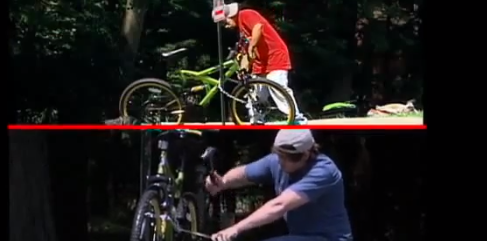
We see this same pattern in another “What Would You Do?” segment. This time, a young White man and a young African American man try to remove a lock from a bike as the cameras capture the reactions of onlookers.

The onlooker interviewed toward the end says race played no role in his reaction. But the extremely different reactions to the two teens indicate differences in who is perceived as likely to be engaged in criminal activity, and whose criminal activity we may think deserves being reported to the police, rather than given a disapproving tsk-tsk as we walk on by.

Gwen Sharp is an associate professor of sociology at Nevada State College. You can follow her on Twitter at @gwensharpnv.

UBC Sociology student Pat Louie tweeted us a touching set of photographs by artist Gabriele Galimberti.  Each image is a child with his or her favorite toys. They are in Malawi, Italy, Ukraine, Thailand, Zanzibar, Albania, Botswana, and elsewhere and the diversity is stunning.

The photographs reveal a universality — pride in favorite toys and the love of play — but, writes Ben Machell at Galimberti’s website, “how they play can reveal a lot.”  The children’s life experiences influenced their imaginative play:

…the girl from an affluent Mumbai family loves Monopoly, because she likes the idea of building houses and hotels, while the boy from rural Mexico loves trucks, because he sees them rumbling through his village to the nearby sugar plantation every day.

Galimberti, interviewed by Machell, also observed class differences in entitlement to ownership:

The richest children were more possessive. At the beginning, they wouldn’t want me to touch their toys, and I would need more time before they would let me play with them. In poor countries, it was much easier. Even if they only had two or three toys, they didn’t really care. In Africa, the kids would mostly play with their friends outside.

These photographs are reminiscent of another wonderful photography project featuring kids and their toys.  JeonMee Yoon photographed boys with all their blue stuff and girls with all their pink stuff.  The results are striking.  Likewise, there’s a wonderful set of photographs by James Mollison, counterposing portraits with children’s sleeping arrangements across cultures.  These are all wonderful projects that powerfully illustrate global and class difference and inequality.

Lisa Wade, PhD is an Associate Professor at Tulane University. She is the author of American Hookup, a book about college sexual culture; a textbook about gender; and a forthcoming introductory text: Terrible Magnificent Sociology. You can follow her on Twitter and Instagram.