Search results for The

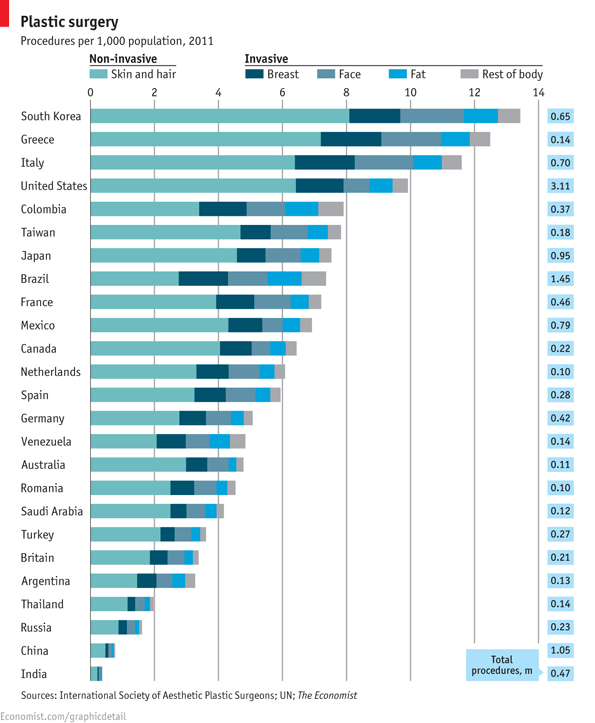
The  International Society of Aesthetic Plastic Surgeons has released new data on the incidence of invasive and non-invasive cosmetic procedures.  The U.S. leads in sheer numbers of procedures but, accounting for population, we fall into 4th place.  South Korea leads for the number of procedures per person, followed by Greece and Italy.
1

By far the most common kinds of surgical cosmetic procedures are lipoplasty and breast augmentation.  Along with fat, breasts seem to be a particular concern: breast lifts and breast reductions for both men and women are also in the top ten.  Abdominoplasty, nose jobs, eyelid surgeries, and facelifts are as well.

2

The incidence of these surgeries is strongly related to everything from the gender binary to global power dynamics.  In 2008 we reported that male breast reductions were the most common cosmetic surgery for 13-19 year olds (boys and girls combined). You would be shocked at what counts as excess breast tissue and how little the before and after photos look.  Boys and men getting breast reductions, alongside women getting augmentations, is obviously about our desire for men and women to be different, not naturally-occurring difference.  See The Story of My Man-Boobs for more.

Likewise, we’ve posted about surgeries that create an epithelial fold, a fold of skin in the eyelid more common in people with White than Asian ethnic backgrounds.  This surgery is a trend among Asians and Asian-Americans, as colonization has left us with an association between Whiteness, attractiveness, and power.

The Economist summarizes some other trends:

Breast augmentation, the second biggest surgical procedure, is most commonly performed in America and Brazil. Buttock implants are also a Brazilian specialty, as is vaginal rejuvenation. Asia is keen on nose jobs: China, Japan and South Korea are among the top five nations for rhinoplasty.

More on where and how many procedures are being performed, but nothing on why, at the ISAPS report.

Image at The Economist; via Global Sociology.

Lisa Wade, PhD is an Associate Professor at Tulane University. She is the author of American Hookup, a book about college sexual culture; a textbook about gender; and a forthcoming introductory text: Terrible Magnificent Sociology. You can follow her on Twitter and Instagram.

Screenshot_5One of the few genuinely large observed differences between men and women involves throwing ability.  Men, on average, are much stronger throwers than women.  Hence the phrase “throws like a girl.”

That we observe a difference, however, tells us nothing about where that difference comes from.  Figuring that out is much more difficult than simply measuring difference and sameness.  We know that the difference emerges at puberty, suggesting that sheer size might have something to do with it.  But the fact that boys and men, on average, get much more practice throwing than women might also play a role.  How to test this?

Well, here’s one way: compare men and women throwing with their non-dominant hand.  Muscle memory doesn’t transfer from one side of the body to the other.  Accordingly, since most people have a lot of practice throwing only with one hand, comparing the throws of men and women using their non-dominant hand might tell us something interesting.

I don’t know that that study has been done, but an enterprising videographer has captured video of a set of men throwing with the “wrong” hand. What I like most about the video is the men’s facial expressions.  You can see them laughing at themselves, suddenly reduced to a beginner thrower.  Though we still don’t know how much of it is biological and how much social — though, this is the wrong question anyway — it reveals that, no matter what the answer, men’s throwing ability is strongly related to practice:

A big thanks to Reynaldo C. for sending in the video!

Cross-posted at BlogHer.

Lisa Wade, PhD is an Associate Professor at Tulane University. She is the author of American Hookup, a book about college sexual culture; a textbook about gender; and a forthcoming introductory text: Terrible Magnificent Sociology. You can follow her on Twitter and Instagram.

Readers have submitted some great examples of gendered items in the last few months, so I’ve collected just a few here. This includes “the first gender-based wholefood,” certainly a milestone worth commemorating, so let’s get to it!

An anonymous reader pointed out that Barnes & Noble has book collections for boys and girls:

1

Screen Shot 2013-02-16 at 7.18.31 AM

The summaries of the books reinforce ideas about gender and especially the association of boys with action and girls with relationships. The description of the boys’ collection mentions “excitement” and “tales of action, adventure, and exploration”:

Screen Shot 2013-02-16 at 7.19.14 AM

The girls’ collection, on the other hand, includes “heartwarming tales” that teach us that “friendship is the most priceless and enduring gift of all”:

Screen Shot 2013-02-16 at 7.21.32 AM

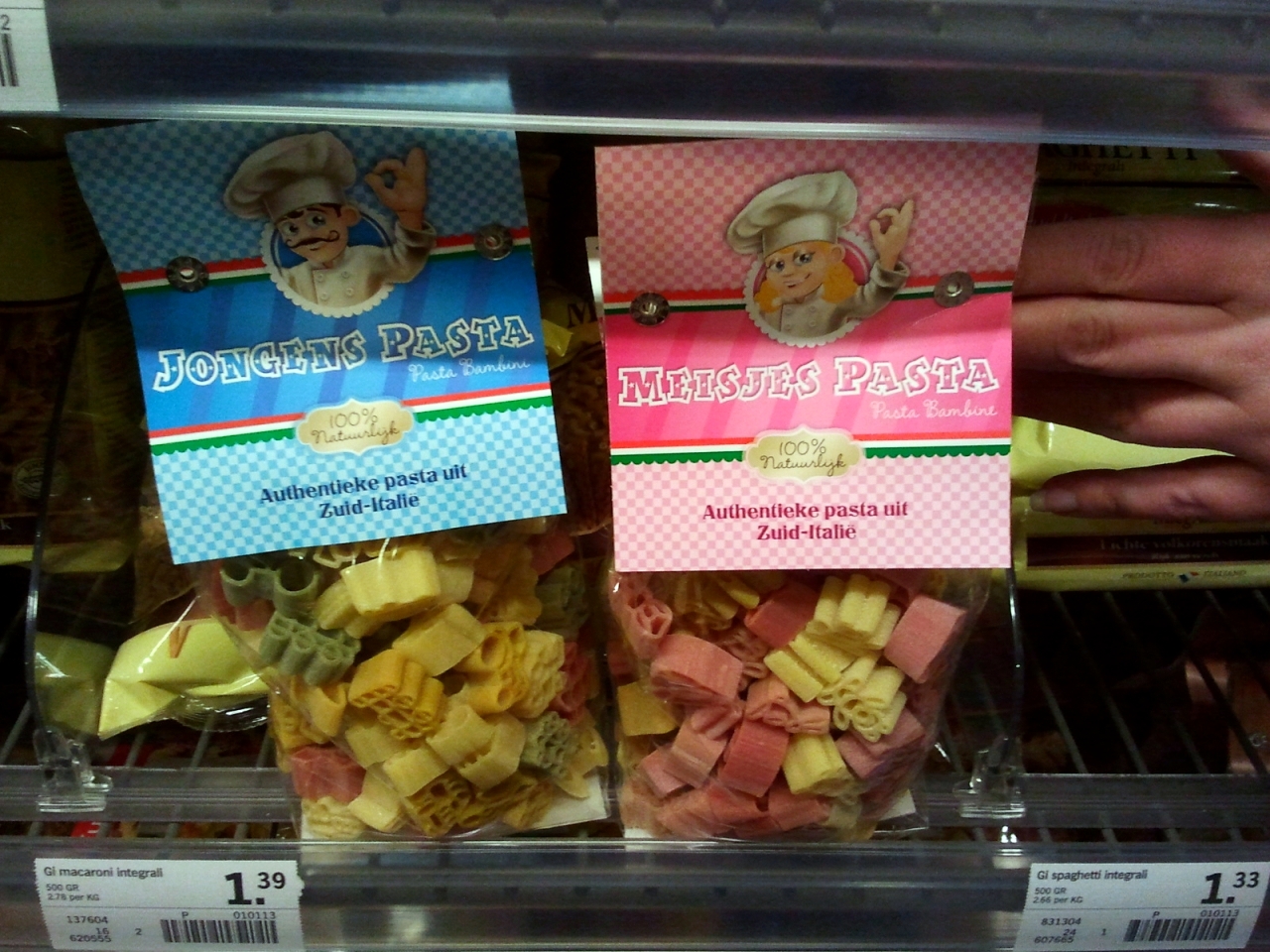
Nora Goerne sent in girls’ and boys’ pasta she saw in Dutch supermarket Albert Heijn:

20130202185512150

And Emily discovered you can get gender-specific yogurt for kids:

yoghurts

Nick O. noticed these bottle-opener rings, one of which is marketed to women by putting it on a pink background with the word “woman” on it but otherwise seemed the same to Nick:

Screen Shot 2013-02-16 at 7.26.35 AM

Carrie J. sent in this ad for gendered kids computers from 1999:

Screen Shot 2013-02-16 at 7.32.43 AM

Shara found boys’ and girls’ cake sprinkles in New Zealand:

Screen Shot 2013-02-16 at 7.35.06 AM

Screen Shot 2013-02-16 at 7.35.18 AM

CBH was looking for birthday supplies on the Party City website and noticed that according to the decorations, by their first birthday girls are already “angels” and boys are “rebels”:

Screen Shot 2012-10-12 at 9.51.55 PM

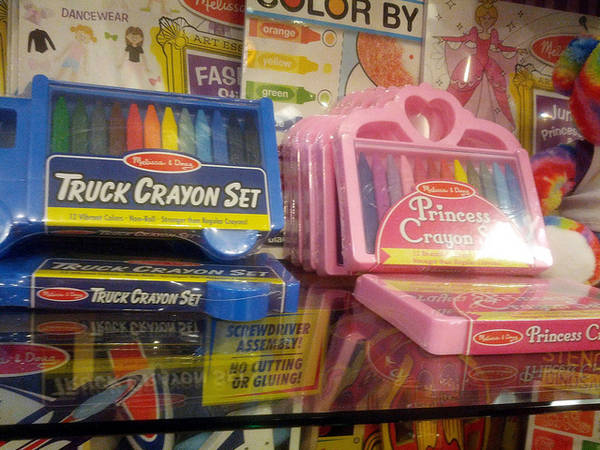
Helen S. sent us this image posted at Boing Boing of crayon sets that are implicitly gendered through the use of the colors and terms (especially “princess”) that have become codes for boys and girls:

7961433594_f2f52a0aa6_z

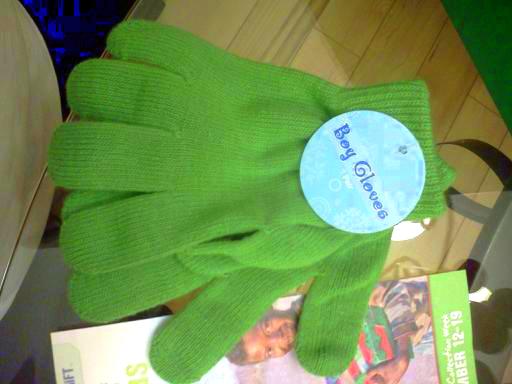
Green gloves are apparently for boys now (thanks, Michelle):

gloves

And finally, as promised: You will be relieved to know that “the first gender-based wholefood” is here, and not a moment too soon. According to the website for Sexcereal — no, stop laughing, this is serious — the female version supports “hormonal balance” while the male version has ingredients that “support testosterone and then some,” which actually makes me afraid this product might cause ‘roid rage if eaten too often:

image

Their website (sent in by Vanessa K.) is an absolute delight, and provides many a hearty laugh. It’s just too bad Sexcereal is only available in Canada. All of us non-Canadians are stuck eating our stupid unisex cereals, leaving our hormones unbalanced and our testosterone feeling sadly unsupported, and then some.

Gwen Sharp is an associate professor of sociology at Nevada State College. You can follow her on Twitter at @gwensharpnv.

Cross-posted at Policy Mic and The Huffington Post.

The gap between the household wealth of Black and White families is massive.  Today the median wealth held by White households is 20 times that of Black households.  There are lots of reasons for this difference and a new study offers great data on one of them: the need to assist poor relatives.

Kevin Hartnett, at Braniac, writes:

Middle-income blacks are more than twice as likely as middle-income whites to have a poor sibling and more than four times as likely to have parents below the poverty line. And because of these relationships, they’re called upon more often to provide financial assistance.

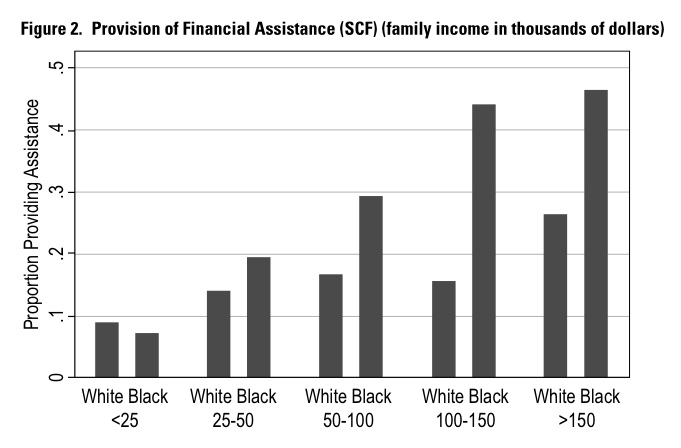
Sociology graduate student Rourke O’Brien used data on spending and other financial patterns among Americans to test whether this is a significant source of the wealth gap (link).  He found that, at all but the most low income level, Black households are more likely than White households to give money to struggling relatives.  And the wealthier the Black household, the more likely they were to help others.

The graph below illustrates this.  The vertical axis represents the proportion of households offering assistance and the horizontal axis represents increasing income levels (in thousands of dollars).

blackwhitewealth

The lesson is simple, but all too often unnoticed.  Due to hundreds of years of enslavement and discrimination, African Americans are more likely to be poor than Whites. If you grow up poor then most of the people in your family are poor.  Accordingly, even if you “make it out” and arrive in the middle class (income-wise), you will likely be less financially secure than a person that earns the same income but came from a middle class family.  That person can put all of their extra money towards buying a home (and earning equity), retirement, additional degrees, starting a business, and sending their kids to college.

But the poor person who earns a middle-class income might use a significant portion of their income keeping their parents’ heat on, helping their little brother go to college, or buying back-to-school clothes for their nieces and nephews.  This makes it much harder for poor and working class people who become middle class to stay that way.  And the cycle continues.

Via Citings and Sightings.

Lisa Wade, PhD is an Associate Professor at Tulane University. She is the author of American Hookup, a book about college sexual culture; a textbook about gender; and a forthcoming introductory text: Terrible Magnificent Sociology. You can follow her on Twitter and Instagram.

Cross-posted at Montclair SocioBlog.

You’re not going to persuade a conservative by appealing to liberal moral principles.  Tell a Tea Party type that industrial waste harms the environment and should be regulated, you won’t get very far.  But if you appeal to conservative moral principles, the story goes, you might have more luck.

I’ve been skeptical about Jonathan Haidt’s conservative moral principles — group loyalty, purity, and authority — mostly because they are used to justify practices I find wrong or immoral.  Things like anti-gay legislation, torture, assassination, terrorism, etc.

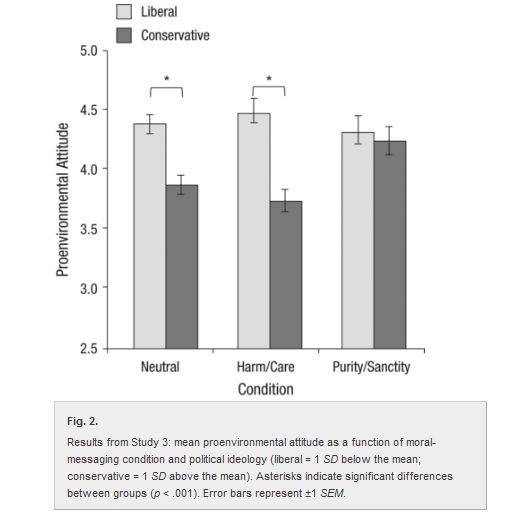
But a recent experimental study by UC Berkeley’s Robb Willer shows that the right kind of persuasion can make conservatives a bit more leftist on the environment.  In his study, participants read a pro-environmental message that was based either on “Harm/Care” (liberal logic) or on “Purity/Sanctity”(conservative logic) along with photos that matched the appeal.

  • Harm/Care: A destroyed forest of tree stumps, a barren coral reef, and cracked land suffering from drought.
  • Purity/Sanctity: A cloud of pollution looming over a city, a person drinking contaminated water, and a forest covered in garbage.

1

There was also a Neutral condition: “an apolitical message on the history of neckties.” (Willer has a fine sense of humor.)

Participants were then asked questions to determine their support for pro-environmental legislation.

2

For people who identified themselves as liberal, the type of material they saw — Harm, Purity, or Necktie — made no difference in their environmental position.  Conservatives, as expected, were generally cooler to environmental legislation, but only in the Neutral and Harm conditions.  Once they were shown the Purity materials, conservatives were as pro-environment as the liberals.

Other aspects of the conservative mind-set seem to go along with this emphasis on purity:  simplicity rather than complexity and a lower tolerance of ambiguity.  It’s a view that sees the need for clearly marked and rigidly enforced boundaries — the boundaries of the nation, the boundaries of the individual, the boundaries of cognitive categories.

Ultimately, the findings suggest that common ground between liberals and conservatives may not be as impossible to find as it may seem.

Jay Livingston is the chair of the Sociology Department at Montclair State University. You can follow him at Montclair SocioBlog or on Twitter.

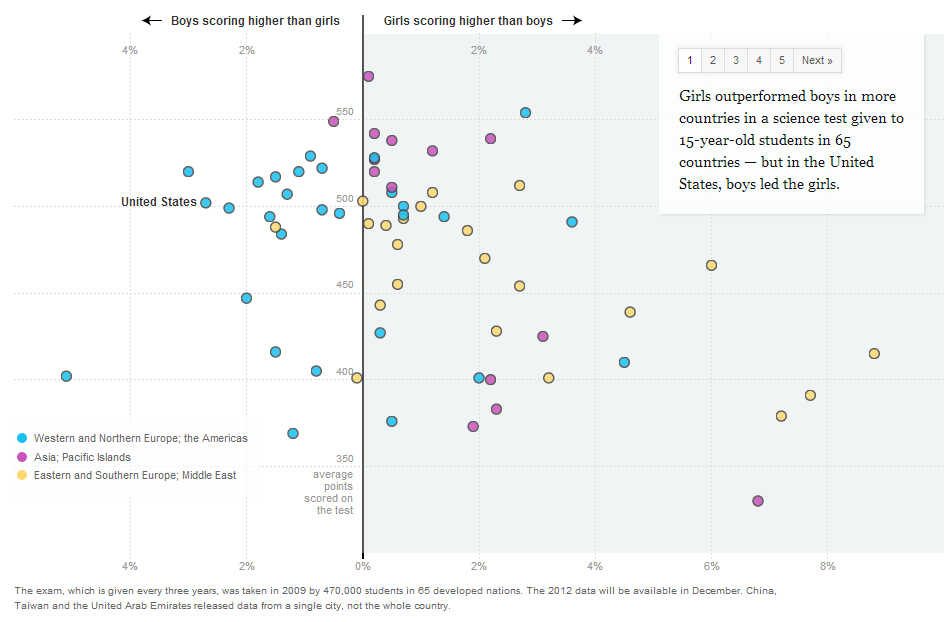
In 2009, 470,000 15-year-olds in 65 developed nations took a science test.  Boys in the U.S. outperformed girls by 14 points: 509 to 495.  How does the U.S. compare to other countries?

The figure below — from the New York Times — features Western and Northern Europe and the Americas (in turquoise), Asia and the Pacific Islands (in pink), and the Middle East and Eastern and Southern Europe (in yellow).  The line down the middle separates societies in which boys scored higher than girls (left) and vice versa (right).

Notice that the countries in which boys outscore girls are overwhelmingly Western and Northern Europe and the Americas.

This data tells a similar story to the data on gender and math aptitude.  Boys used to outperform girls in math in the U.S., but no longer.  And if you look transnationally, cultural variation swamps gender differences.  Analyses have shown that boys outperforming girls in math is strongly correlated with the degree of inequality in any given society.

One lesson to take is this: any given society is just one data point and can’t be counted on to tell the whole story.

Via The Global Sociology Blog.

Lisa Wade, PhD is an Associate Professor at Tulane University. She is the author of American Hookup, a book about college sexual culture; a textbook about gender; and a forthcoming introductory text: Terrible Magnificent Sociology. You can follow her on Twitter and Instagram.

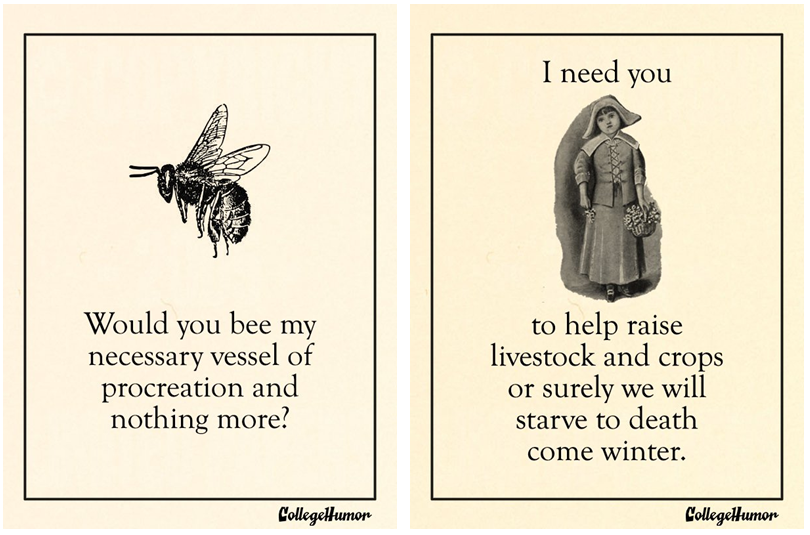
CollegeHumor posted a set of fake Puritan-themed Valentine’s Day cards.  They’re a humorous way of reminding us that our intensive focus on romantic love as a driving force for sex and marriage is, in fact, quite new.

1

When the Puritans landed on the rocky east coast of America in the 1600s, they brought with them the belief that sex should be restricted to intercourse in marriage, hence the sentiment on the left. All non-marital and non-reproductive sexual activities were forbidden, including pre- and extra-marital sex, homosexual sex, masturbation, and oral or anal sex (even if married).   Violations of the rules were punished by fines, whipping, public shaming (yes, with “scarlet letters”), ostracism, or even death.

Alongside religion, there were practical reasons why the Puritans were so darn puritanical.  Colonizing the U.S. was a dangerous job; lots of people were dying from exposure, starvation, illness, and war.  Babies replenished the labor supply, motivating the Puritans to channel the sex drive towards the one sexual activity that made babies: intercourse. Accordingly, having intercourse with your spouse wasn’t only allowed, it was essential; women could divorce men who had proven impotent.  

The Puritans also married primarily to form practical partnerships for bearing children and mutual survival, hence the sentiment in the card on the right.

The idea that love should be the basis for marriage didn’t take hold until the Victorian era, when industrialization was changing the value of children.  Useful on the farm, children were suddenly became a burden in expensive and overcrowded lodgings.  This gave couples a new reason to limit the number of children they had and, because industrial production had made condoms increasingly cheap and effective, they could.  Marital fertility rates dropped precipitously between 1800 and 1900: from 6+ children/woman to 3 1/2 in the U.S., England, and Wales.

In this context, a Puritan sexual ethic that restricted sex to efforts to make babies just didn’t make sense. People needed a new logic to guide sexual activity: the answer was love. Over the course of the 1800s, Victorians slowly abandoned the Puritan idea that sex was only for reproduction, embracing instead the now familiar idea that sex could be an expression of love and a source of pleasure, an idea that still resonates strongly today.

That’s at least part of the story anyway.

Sources:

Bremer, Francis J., and Tom Webster.  2006. Puritans and Puritanism in Europe and America: A Comprehensive Encyclopedia. SantaBarbara: ABC-CLIO, Inc.

D’Emilio, John & Estelle Freedman. 1997. Intimate Matters: A History of Sexuality in America. Chicago: University of Chicago Press.

Freedman, Estelle. 1982. Sexuality in Nineteenth Century America: Behavior, Ideology, and Politics. Reviews in American History 10, 4: 196-215.

Lisa Wade, PhD is an Associate Professor at Tulane University. She is the author of American Hookup, a book about college sexual culture; a textbook about gender; and a forthcoming introductory text: Terrible Magnificent Sociology. You can follow her on Twitter and Instagram.

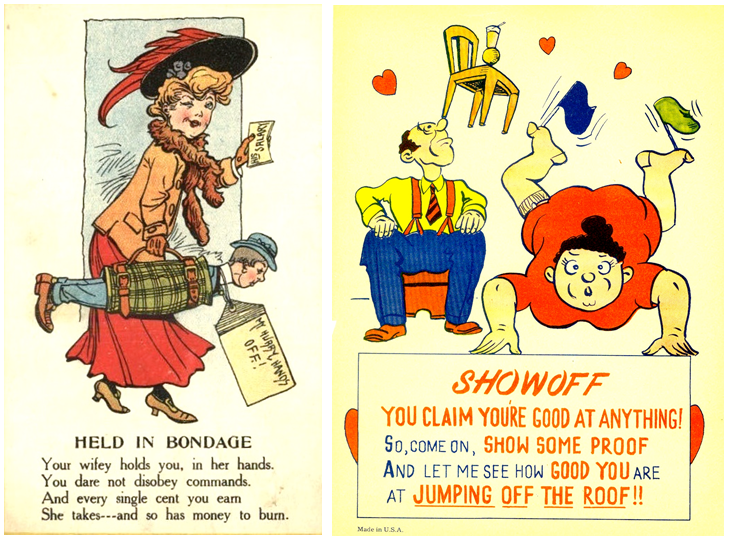
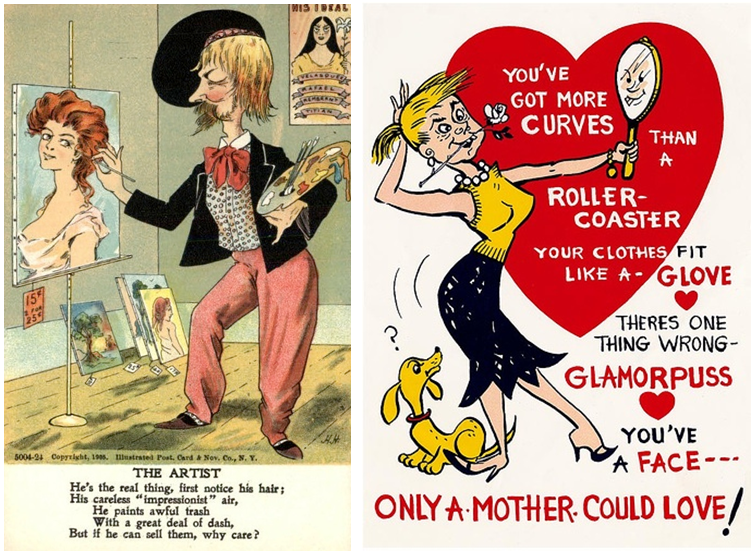
For 100 years Valentine’s Day was not only associated with sweet sentiments, but was an occasion to send a cruel and biting message to someone you didn’t like.  These cards — called “vinegar valentines” — were popular from 1840 to 1940 in both America and the U.K.

1Annebella Pollen, an art and design historian who talks about the valentine’s at Collector’s Weekly, explains that there was a valentine for many types of people and occasions:

 You could send them to your neighbors, friends, or enemies. You could send them to your schoolteacher, your boss, or people whose advances you wanted to dismiss. You could send them to people you thought were too ugly or fat, who drank too much, or people acting above their station. There was a card for pretty much every social ailment.

23

Pollen insists that people did send them to one another, albeit anonymously, and they were not meant to be jokes. Instead, they were meant to say: “Your behavior is unacceptable.”  For much of the 1800s there was no such thing as a pre-paid stamp, so the person who got the mail paid for it, so often they were forced to buy their own insults, a twist of the knife from the sender.

4

Many, many more vinegar valentine’s at Collector’s Weekly, where I also stole this great title.  Via BoingBoing.

Lisa Wade, PhD is an Associate Professor at Tulane University. She is the author of American Hookup, a book about college sexual culture; a textbook about gender; and a forthcoming introductory text: Terrible Magnificent Sociology. You can follow her on Twitter and Instagram.