
For the last week of December, we’re re-posting some of our favorite posts from 2012. Cross-posted at Jezebel, the Huffington Post, and Pacific Standard.
You might be surprised to learn that at its inception in the mid-1800s cheerleading was an all-male sport. Characterized by gymnastics, stunts, and crowd leadership, cheerleading was considered equivalent in prestige to an American flagship of masculinity, football. As the editors of Nation saw it in 1911:
…the reputation of having been a valiant “cheer-leader” is one of the most valuable things a boy can take away from college. As a title to promotion in professional or public life, it ranks hardly second to that of having been a quarterback.*
Indeed, cheerleading helped launch the political careers of three U.S. Presidents. Dwight D. Eisenhower, Franklin Roosevelt, and Ronald Reagan were cheerleaders. Actor Jimmy Stewart was head cheerleader at Princeton. Republican leader Tom DeLay was a noted cheerleader at the University of Mississippi.
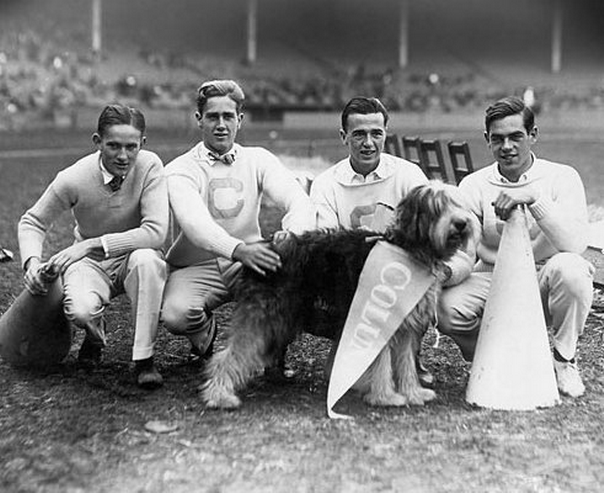
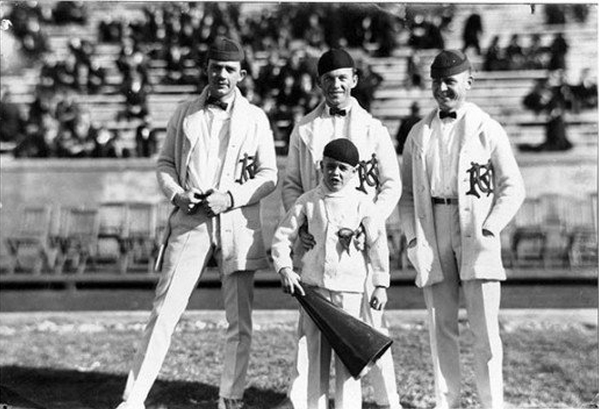
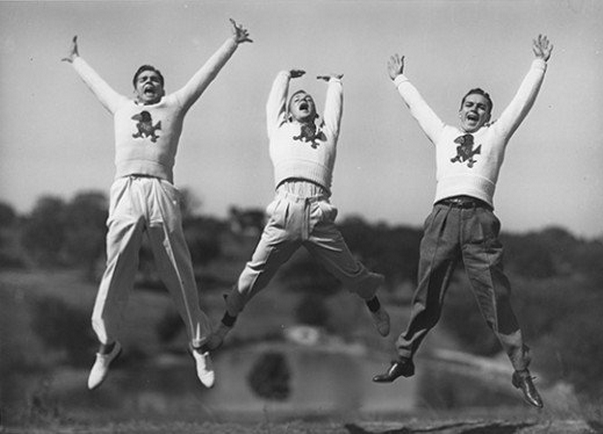
Women were mostly excluded from cheerleading until the 1930s. An early opportunity to join squads appeared when large numbers of men were deployed to fight World War I, leaving open spots that women were happy to fill.
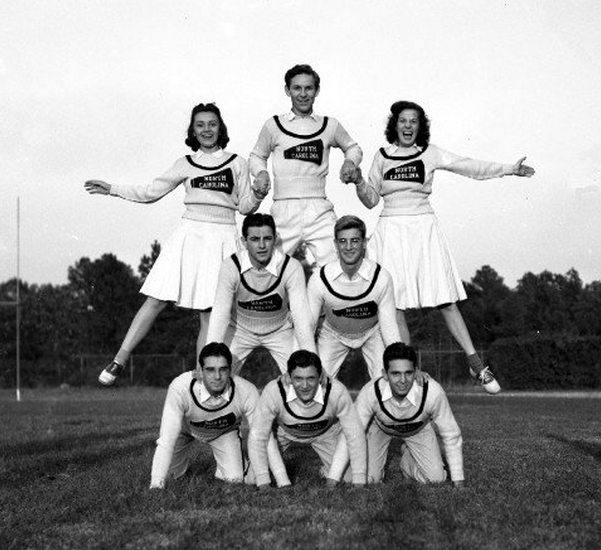
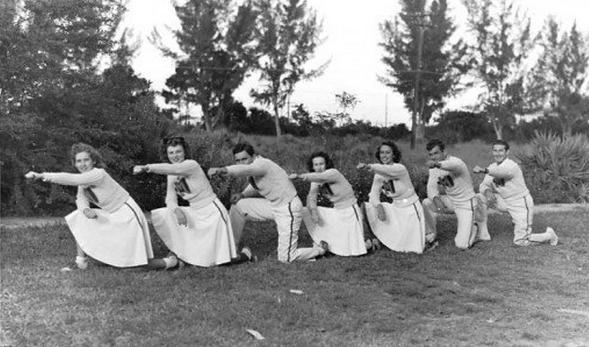
When the men returned from war there was an effort to push women back out of cheerleading (some schools even banned female cheerleaders). The battle over whether women should be cheerleaders would go on for several decades. Argued one opponent in 1938:
[Women cheerleaders] frequently became too masculine for their own good… we find the development of loud, raucous voices… and the consequent development of slang and profanity by their necessary association with [male] squad members…**
Cheerleading was too masculine for women! Ultimately the effort to preserve cheer as an man-only activity was unsuccessful. With a second mass deployment of men during World War II, women cheerleaders were here to stay.
The presence of women changed how people thought about cheering. Because women were stereotyped as cute instead of “valiant,” the reputation of cheerleaders changed. Instead of a pursuit that “ranks hardly second” to quarterbacking, cheerleading’s association with women led to its trivialization. By the 1950s, the ideal cheerleader was no longer a strong athlete with leadership skills, it was someone with “manners, cheerfulness, and good disposition.” In response, boys pretty much bowed out of cheerleading altogether. By the 1960s, men and megaphones had been mostly replaced by perky co-eds and pom-poms:
Cheerleading in the sixties consisted of cutesy chants, big smiles and revealing uniforms. There were no gymnastic tumbling runs. No complicated stunting. Never any injuries. About the most athletic thing sixties cheerleaders did was a cartwheel followed by the splits.***
Cheerleading was transformed.

Of course, it’s not this way anymore. Cultural changes in gender norms continued to affect cheerleading. Now cheerleaders, still mostly women, pride themselves in being both athletic and spirited, a blending of masculine and feminine traits that is now considered ideal for women.
See also race and the changing shape of cheerleading and the amazing disappearing cheerleading outfit.
Citations after the jump:
* Adams, Natalie & Pamela Bettis. 2003. Commanding the Room in Short Skirts: Cheering as the Embodiment of Ideal Girlhood. Gender and Society 17, 1: 73-91.
** Davis, Laurel. 1994. A Postmodern Paradox? Cheerleaders at Women’s Sporting Events. In Women, Sport, and Culture, edited by Susan Birrell and Cheryl Cole. Human Kinetics.
*** McElroy, James. 1999. We’ve Got Spirit: The Life and Times of America’s Greatest Cheerleading Team. New York: Simon & Schuster.
Photos borrowed from How to be a Retronaut.
Comments 75
Missa Ndrea — March 19, 2012
This reminds of the post about women boxers. As soon as women get involved in any sport, all of a sudden (or perhaps gradually) school officials decides the activity needs to sell woman-as-sex in order to appeal to men.
Imagine what would happen if the audience was all lesbians. It wouldn't even occur to anybody to do that.
Elena — March 19, 2012
In Japan, cheerleading squads are still quite manly, too. There's a hilarious game for the Nintendo DS called Osu! Tatakae! Ouendan in which you tap to the rhythm of the music to direct your cheerleading squad to, eh, cheer people up when they need determination. Like this.
Zaewen — March 19, 2012
At Texas A&M University, the male cheerleader tradition is going on quite strong. Except they're called Yell Leaders and it's become a very masculine tradition, to the point of completely excluding femininity. Part of the tradition is that cheerleading groups shouldn't be or aren't allowed on campus, as well as the belief that women shouldn't be Yell Leaders (the Yell Leaders are an elected position, and the popular vote almost never goes for women or non-white men).
A very strong undercurrent of the Yell Leader tradition is that Yell Leaders are better than cheerleaders because they don't dance around in skimpy outfits waving pompoms and doing silly little cheers. In essence, they are more masculine, which is always better than the femininity of cheerleading.
Samgarrison22222 — March 20, 2012
Actually four former US presidents got their start cheerleading.. George W. Bush wielded the megaphone as head cheerleader at Phillips Academy.
Jmpwawoo — March 20, 2012
Trent Lott, the former Republican Senate leader, not Tom Delay, was a Rebel Yeller. And GW Bush '43 was a Yale cheerleader. Throw in Rick Perry at Texas A&M and in aggregate, they do not add luster to the avocation. Currently, cheer leading is a hyper demanding athletic enterprise. There are certain odd entry's that are realized from college cheerleading such as the University of Kentucy pipeline to high end medical sales as an example.
Leblue — March 21, 2012
Well, in Japan, cheerleading is still seen as a very masculine thing, with the commanding presence and leadership skills it requires to keep a crowd enthusiastic. However, Japanese cheerleading doesn't require gymnastic, just sort of a masculine charisma. Of course they know of the "western" cheerleader, but it's seen as two very different types of activities.
Doug H — March 22, 2012
love this post, lisa. a fascinating little case study with uses and applications not only for gender studies but also for sport scholarship, research on body culture, and theories of social change. also, on a much different note, reminded me of a editor's column chris and I wrote in Contexts about being cheerleaders for social science. have to admit, i don't remember and don't think we discussed, the gendered angles of all that.
John Hensley — December 28, 2012
As a male I'm very upset about this appropriation of my distinctive identity[/mensrights]
BIGBOY — April 10, 2013
yehaw
Kyle — July 31, 2013
Thinking it was a good idea to make saying your breasts is lovely a "crime"? What do we call dumb,conceited,spiteful,irreverent women like you? Give me a B, give me an r, give me an a, give me an i, give me an n, give me a w, give me an a, give me an s, give me an h, give me an e, give me a d, give me an f, give me an o, give me another o, give me an l, give me an s, what does that spell? Brainwashed fools. Thats what you are, the foemeanists are and all of of you are going to be punished for judging and incriminating innocent men over trivial compliments. Harlotry is not a profession,calling,etc. and its not the oldest either, hunting and gathering is alot older as is blacksmithing should be called the oldest profession instead because its an actual occupation.
Gear Cheer — August 28, 2013
Well of course cheerleading was once an all male sport, everything was.
Marilynric — January 23, 2019
I am glad that I found this site!
John Smith — September 11, 2024
Wow, it give me new information about cheerleader