Search results for The

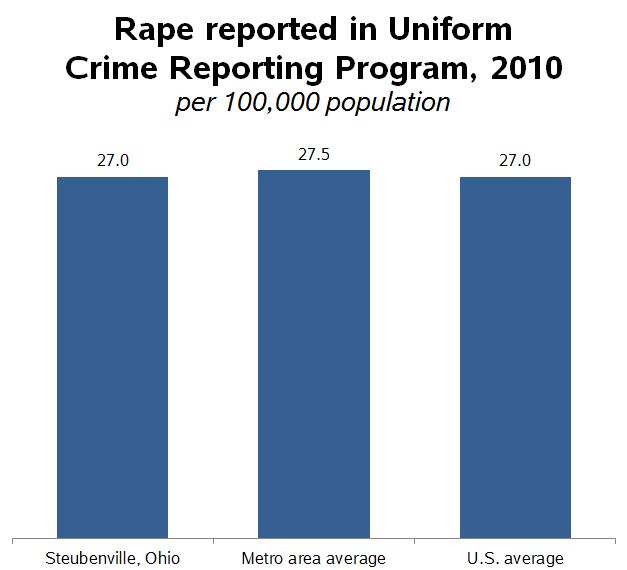
Philip Cohen, at Family Unequal, used FBI crime reports to put together this telling graph:
1

We need to remember that Steubenville is us and we are Steubenville.

Lisa Wade, PhD is an Associate Professor at Tulane University. She is the author of American Hookup, a book about college sexual culture; a textbook about gender; and a forthcoming introductory text: Terrible Magnificent Sociology. You can follow her on Twitter and Instagram.
When I approached my undergraduate mentors about graduate school in 1996, they warned me that many people who earn PhDs never get jobs in academia.  This is sometimes deliberate, as their are jobs outside of academia for some degree-holders to get, but it’s also sometimes a grave disappointment.  My mentors emphasized the extent of the risk (and frankly scared me quite a lot), but how bad was it?  And is it worse today?

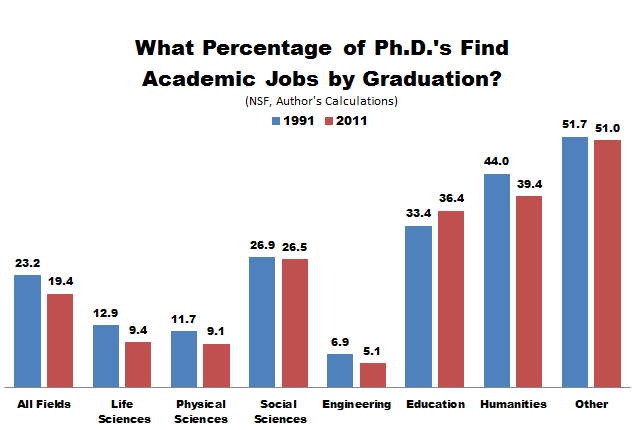
The Atlantic‘s Jordan Weissmann put together the data.  The leftmost bars on his figure show that, on average, under a quarter of PhDs landed a full-time job at a college or university in 1991.  That number had dropped to less than 20% by 2011.  The numbers, however, vary significantly by field:

1

See here for more details.

The looming question, of course, is what percentage of PhDs want a full-time academic job, something that certainly varies by field.  In other words, there aren’t a boatload of bitter engineers bad-mouthing the academy while slinging lattes at Starbucks.  Here’s a hint at an answer: A study published in 1999 found that 53% of all new PhDs said they wanted to become professors.  Ten years later, just over half were tenured (54%) and a handful more were tenure-track (7%); a third weren’t in academia at all.

On the one hand, I think these numbers are really depressing. Five to ten years is a long time to train for a career only to discover that, for whatever reason, you won’t be employed in the area of your expertise.  But I have two “on the other hands.”

On one other hand, I wonder how these numbers compare to other occupations?  We accept that certain occupations are highly competitive and include a lot of dumb luck and failure.  Modeling and acting are obvious examples, there are certainly others.  I know someone who’s spent their lifetime trying to become an astronaut.  Where does academia fall in the spectrum of risky job endeavors?

On a second other hand, I’d love to see some research on what happens to academics — especially in the humanities and social sciences — when they don’t get a job in academia or are denied tenure after getting there.  Within academia, this is often framed as THE END OF YOUR LIFE.  But maybe it’s often okay or pretty good.  Honestly, I don’t know.

Interesting and useful data, to be sure, but far from the whole story.

Lisa Wade, PhD is an Associate Professor at Tulane University. She is the author of American Hookup, a book about college sexual culture; a textbook about gender; and a forthcoming introductory text: Terrible Magnificent Sociology. You can follow her on Twitter and Instagram.
Cross-posted at Montclair SocioBlog.

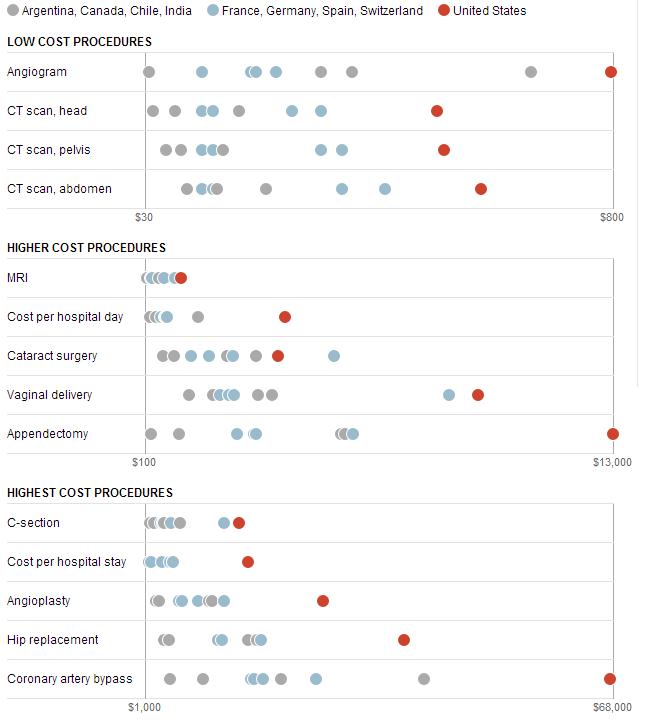
The Washington Post has provided some data on medical costs across a selection of countries (Argentina, Canada, Chile, and India in grey; France, Germany, Switzerland, and Spain in blue; and the U.S. in red). The data reveal that American health care is very expensive compared to other countries.

1

No wonder the US spends twice as much as France on health care.  In 2009, the U.S. average was $8000 per person; in France, $4000.  (Canada came in at $4800).  Why do we spend so much?  Ezra Klein quotes the title of a 2003 paper by four health-care economists:  “it’s the prices, stupid.”

And why are US prices higher?  Prices in the other OECD countries are lower partly because of what U.S. conservatives would call socialism – the active participation of the government.  In the U.K. and Canada, the government sets prices.  In other countries, the government uses its Wal-Mart-like power as a huge buyer to negotiate lower prices from providers.  (If it’s a good thing for Wal-Mart to bring lower prices for people who need to buy clothes, why is it a bad thing for the government to bring lower prices to people who need to buy, say, an appendectomy? I could never figure that out.)

There may also be cultural differences between the U.S. and other wealthy countries, differences about whether greed, for lack of a better word, is good.  How much greed is good, and in what realms is it good?  Klein quotes a man who served in the Thatcher government:

Health is a business in the United States in quite a different way than it is elsewhere.  It’s very much something people make money out of. There isn’t too much embarrassment about that compared to Europe and elsewhere.

So we Americans roll along, paying several times what others pay for medical procedures, doctor visits, and drugs.

Jay Livingston is the chair of the Sociology Department at Montclair State University. You can follow him at Montclair SocioBlog or on Twitter.

In this short video, Mitchell Moffit and Gregory Brown of AsapSCIENCE discuss the neurological processes behind porn addiction. High levels of porn consumption, they argue, can create a feedback loop that molds sexual desires and behaviors.

Looking at porn, then, doesn’t just reflect a person’s existing desires and preferences; it’s a mechanism for creating new ones or channeling them in particular directions. This is the problem critics such as Cindy Gallop see with the narrow, unrealistic (and often violently misogynistic) set of messages about sexuality that porn offers us.

Gwen Sharp is an associate professor of sociology at Nevada State College. You can follow her on Twitter at @gwensharpnv.

The representation of sexuality and safer sex in public health campaigns is fascinating given our simultaneous cultural obsession with yet pathologization of sexual behavior.  Safer sex campaigns and materials not only seek to increase prevention behaviors but also produce a range of social meanings surrounding gender, bodies, and desire.  Most are produced by organizations that fall well within the mainstream; others are not.  This post is about one of the latter (warning: sexual explicitness).

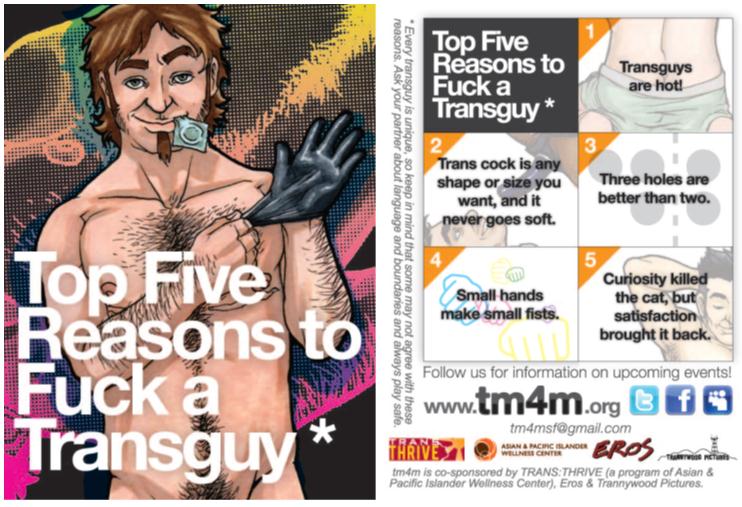
The following resource, titled “Top 5 Reasons to Fuck a Transguy” was produced and distributed by a collaborative project of the San Francisco-based Asian and Pacific Islander Wellness Center.  tm4m is a group for transgender men whose goal is to “provide information, education and support to transmen who have sex with men (both other transguys and cisguys).”

1

This material is interesting for two main reasons.  First, it combines traditional health education with an erotic, sex-positive context that is missing from most public health campaigns.  For the most part, public health approaches to HIV prevention and sexual health promotion utilize a “sex-negative” approach to sexual behavior; in other words, sex is represented as potentially dangerous or problematic and focus narrowly focused on its negative aspects, such as disease transmission.  Even more progressive “comprehensive” approaches to sexual health education (that is, approaches that do not focus solely on abstinence) tend to center on the potentially dangerous outcomes of sex and how to prevent them while ignoring the pleasurable and fun aspects of sexuality.

In contrast, “5 Reasons to Fuck a Transguy” depicts a naked transman with safer sex barriers (condom and a glove) and uses explicit language (“fuck” instead of “sex” and “cock” instead of “penis”) and imagery.  For example, in reason #2 we see two people about to engage in strap-on play and in #5 we see a guy that appears to be receiving oral sex or relaxing in a state of post-sex ecstasy.  This sort of language and imagery is absent from the vast majority of sexual health promotion materials aimed at a wide variety of populations.  Thus, in “5 Reasons to Fuck a Transguy,” safer sex is not presented as distinct and separate from sexual pleasure.

Second, the material uses an embodied approach to highlight differences between trans and cisgender men while at the same time eroticizing that difference.  Starting with reason #1 (“trans guys are hot”) we are invited to see the transmale body as the object of desire.  Reasons #2, #3, and #4 call attention to the physical differences between cisgender and transgender male bodies and eroticizes the latter by emphasizing interchangeable cock sizes, more holes to penetrate, and smaller hands for fisting (or using the whole hand for penetration).  Finally, reason #5 alludes to a fetishization of transmen: the transgender body incites curiosity that will ultimately pay off in enhanced pleasure.

Not everyone agrees this is good.  Some posts on Tumblr challenged the idea that transgender men are a sort of erotic “other” or that they will necessarily consent to the activities depicted in the pamphlet:

You better not assume I’m comfortable using the one that “other” guys don’t have and you better not assume that being a guy means I’d be up for being fucked in the ass, either. Go fuck yourself and make your own goddamn third hole.

The “your dick can be any size you want!” argument is like telling a female-identified survivor of breast cancer who’s had a mastectomy “your tits can be any size you want!”

Just because I don’t have my own natural cock doesn’t make me this insane sex toy thing that’s such an anomaly and such a fetish object and so very very strange and different.

So, despite the disclaimer that “every transguy is unique,” some viewers saw the material’s approach as a problemtic eroticization of their bodies and gender.

In sum, “5 Reasons to Fuck a Transguy” moves beyond typical sexual health promotion approaches to include desire and pleasure, but doesn’t avoid the problem of sending its own cultural messages about gender, bodies, and desire, ones that may be problematic from an entirely different point of view.

Christie Barcelos is a doctoral candidate in Public Health/Community Health Education at the University of Massachusetts Amherst.

A couple of weeks ago I had a fever and sore throat that left me with laryngitis.  I lost my voice completely for two days and spent three additional days making no sounds at all in order to get it back.  In the meantime, I learned just a tiny bit about how people respond to the deaf.

Disclaimer: I’m sure that deaf people handle these situations with much more grace than I.  And I’m not claiming in the slightest that I know what it’s like to be deaf.  But other people thought I was deaf, and that’s where things got interesting.  (If I make any insensitive steps, please let me know.)

When I would approach someone and either hand them a note or point to my throat and shake my head, I would get a range of responses.

  • First, humorously, many people would go correspondingly mute.  I would write a note and their lips would squeeze tightly together, almost like they were trying to forcibly hold back sound.  They would assume that I couldn’t hear and I guess it didn’t occur to them that I could read lips. So I would write “Giant diet coke, please” and they would clam up and get me the soda, but then they wouldn’t say “Here you go” or “Have a nice day” or any of the other niceties that pepper daily life.
  • Second, I was shocked to discover that people would, in no uncertain terms, express pity.  They would say “Oh I’m so sorry for you!” or “That’s so sad!”  Deaf people are not necessarily sad about not being able to hear and many are deeply proud of their unique culture.  But many hearing people pity the deaf and apparently they are not afraid to say so to your face!
  • Finally, I encountered the classic reaction where people would just say what they wanted to say to me, but louder and with extra enunciation.  As if that would work if I were deaf!  I think, too, that in some of these cases they assumed I was mentally challenged.

In all, I was surprised to discover just how uncomfortable people were with the supposedly deaf me.  They were truly unprepared for interacting with a person who they thought couldn’t hear.  In their lack of preparedness and experience, they made all kinds of mis-steps.

These experiences inspired me to look up some humor and I found a comic called That Deaf Guy, written by Matt and Kay Daigle.  Matt is deaf and Kay is a sign language interpreter who can hear.  They have a little boy. Matt and Kay’s comic is a nice window onto life as/with a deaf person and it was interesting for me to get a peek into what some deaf people might experience sometimes.

Hat tip to my friend Robb, whose therapeutic silence and similar observations preceded mine.

Lisa Wade, PhD is an Associate Professor at Tulane University. She is the author of American Hookup, a book about college sexual culture; a textbook about gender; and a forthcoming introductory text: Terrible Magnificent Sociology. You can follow her on Twitter and Instagram.
Cross-posted at Montclair SocioBlog.

In the third stall at a women’s room at the University of Western Ontario, someone had written, “What was the worst day of your life?”

A few responses were humorous, but most were serious.

  • Every day, struggling with an eating disorder.
  • The day I found out my father was an alcoholic.
  • The day I was raped.

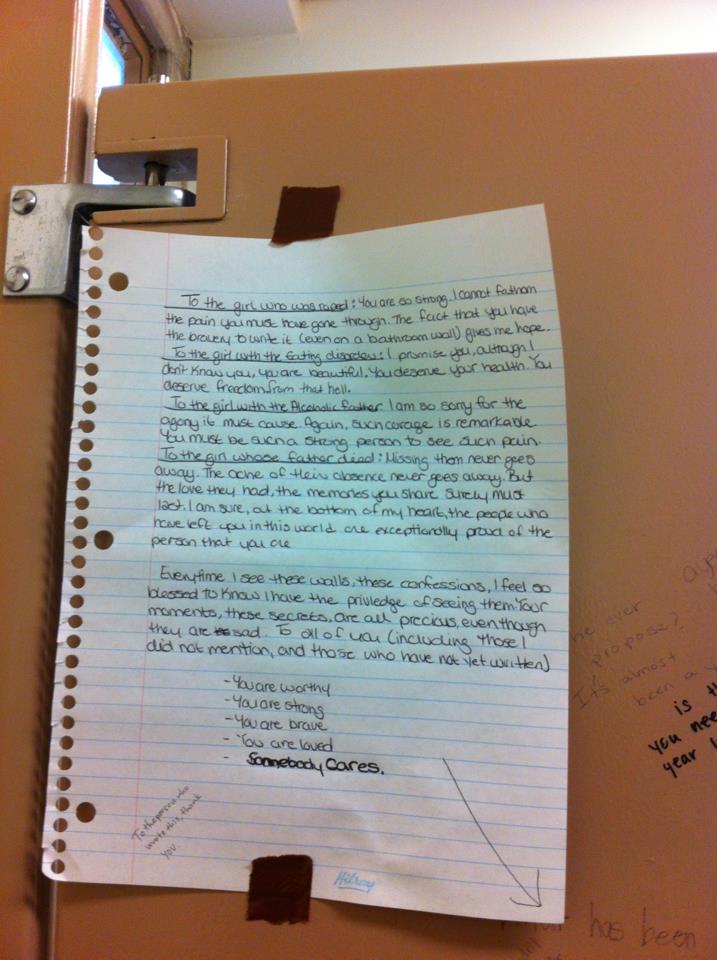
One student who saw these took a piece of notebook paper, wrote a sympathetic response to each, and taped it on the wall of the stall (transcript follows):

1

Transcript (borrowed from The Huffington Post):

To the girl who was raped: You are so strong. I cannot fathom the pain you must have gone through. The fact that you have the bravery to write it (even on a bathroom wall) gives me hope.

To the girl with eating disorders: I promise you, although I don’t know you, you are beautiful, you deserve your health. You deserve freedom from that hell.

To the girl with the alcoholic father: I am so sorry for the agony it must cause. Again, such courage is remarkable you must be such a strong person to see such pain.

To the girl whose father died: Missing them never goes away. The ache of their absence never goes away. But the love they had, the memories you share surely must last. I am sure, out of the bottom of my heart, the people who have left you in this world are exceptionally proud of the person you are.

Everytime(sic) I see these walls, these confessions, I feel so blessed to know I have the priviledge(sic) of seeing them. Your moments, these secrets, are all precious even though they are sad. To all of you (including those I did not mention, and those who have not yet written)

-You are worthy.
-You are strong.
-You are brave.
-You are loved.
-Somebody cares.

It  went viral.  Reddit picked it up, and the story has been in Canadian newspapers.  But this example is not so unusual.  A study of bathroom graffiti at a New Zealand university (unfortunately behind a paywall) found similar themes:

…inscriptions in the women’s toilets were talking about love and romance, soliciting personal advice on health issues and relationships, and discussing what exact act constitutes rape. Women also tried to placate more heated discussions (e.g., “Stop this. There is no reason to say these things. Why so much in-fighting?”).

The men wrote about politics and money (especially taxes and tuition).  Men also posted insults that were far more numerous and aggressive than those in the women’s room.  Only the men wrote racist graffiti.

Drier’s note, then, is a nice example of a documented trend: anonymous women being nice to each other in their bathrooms.

Jay Livingston is the chair of the Sociology Department at Montclair State University. You can follow him at Montclair SocioBlog or on Twitter.

Re-posted to add to the discussion about sexual assault in the aftermath of the Steubenville rape trial, the Senate hearing on rape and harassment in the military, and the controversy at Occidental College.

1On the heels of our recent post about an anti-rape ad that did the unusual — target men and tell then not to rape — comes this Scottish ad, sent along by Sociologist Michael Kimmel, that does a fantastic job of mocking the idea that some women are “asking for it”:

Lisa Wade, PhD is an Associate Professor at Tulane University. She is the author of American Hookup, a book about college sexual culture; a textbook about gender; and a forthcoming introductory text: Terrible Magnificent Sociology. You can follow her on Twitter and Instagram.