Search results for The

Cross-posted at The Ethical Adman.

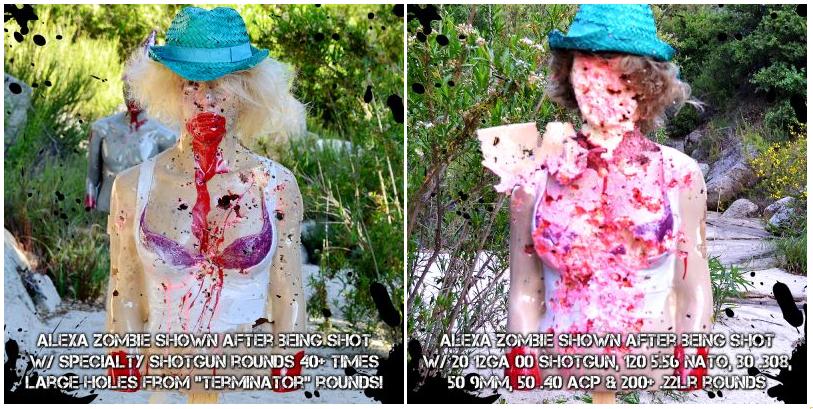
So it turns out there’s this company that makes “zombie” targets for gun enthusiasts. They have clown zombies, nazi zombies, “terrorist” zombies, dog zombies and even a green zombie named “Rocky” that has Barack Obama’s ears.

And one woman.

1

Here’s their explanation:

The Zombie virus does not discriminate and neither does Zombie Industries.  We take preparation for the Zombie Apocalypse seriously, which is why we strive to have all groups of undead monsters represented in our product selection.  In addition to the Ex Girlfriend Zombie, we currently sell 15 male zombies, 5 animal zombies & 2 aliens… to discriminate against Women by not having them represented in our product selection would be just plain sexist.

Each of the zombie targets has a story.  Here is the story of “The Ex”:

Be warned, hell hath no fury like a woman scorned but a man scorned is nothing to mess with! A young gent from Louisiana, we’ll call him André to protect his identity, was deeply committed to his one true love and her to him, or so he thought. While partying with her friends during one particular Mardi Gras, she took several suitors over the course of the festivities. André felt something odd indeed, so he paid a visit to his great aunt, Marie, who helped him see the truth. With a few eggs, candles lit and kiss upon his forehead, her voodoo curse was set in motion. Late each night while lying in bed, a smile would appear across his face, for a slight breeze would travel through a cracked window bringing with it, a faint whiff of decay and a unnatural cry of regret.

That’s right. In this narrative, a man kills a woman for cheating on him, and has her turned into a zombie. Which you, bro, are now invited to blow to bits.
2

Despite the game-like zombie theme, it is notable that the single human female representation has been created specifically as a target of violent male anger towards a woman’s ownership of her own sexuality.  And “The Ex” is portrayed in a highly sexual way, with what seems to be a bare lower torso and busting out chest.

Policymic writes, “Every day, at least three women are killed by an intimate partner in the US alone.  Let’s make sure those numbers go down, not up. Let’s make sure companies like Zombies Industries know that we’re not buying it.”

Some people, however, are buying it. And this is what’s most troubling.

From the product reviews:

This Zombie Bitch is awesome, reminds me of a girl I knew in High School, My LMT LM308MWS should put a stop to the undead bring them on !!! Later Party till you drop Corvette forever !!!!!

And:

I love that this target looks like Britney Spears and it bleeds when I shot it.

And from YouTube:1

Tom Megginson is a Creative Director at Acart Communications, a Canadian Social Issues Marketing agency. He is a specialist in social marketing, cause marketing, and corporate social responsibility. You can follow Tom at workthatmatters.blogspot.com.
Cross-posted at Pacific Standard.Screen Shot 2013-05-07 at 7.33.46 PM

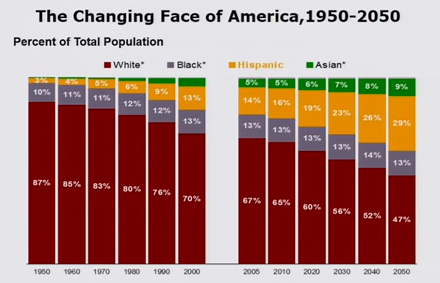
In this 20-minute video, the Pew Research Center’s Paul Taylor discusses trends in the racial/ethnic breakdown of the U.S. population over the last century. Taylor discusses a number of related issues, including the income and wealth gap, perceptions about interracial relations, and the electoral implications of the demographic changes. For instance, while Ronald Reagan once said Hispanics are “Republicans who don’t know it yet,” there’s no evidence that they’re any closer to realizing it. As Hispanics and Asians make up an increasing proportion of the voting population, old electoral strategies based on winning most of the White vote are no longer sufficient to win a national election.

I’d skip the introductory remarks and start just after the 2-minute mark.

Gwen Sharp is an associate professor of sociology at Nevada State College. You can follow her on Twitter at @gwensharpnv.

1I was so honored to be invited to give the AKD Induction Ceremony Address for the University of Akron this year.  It was an opportunity to give a speech about something in which I deeply believe: the awesomeness of sociology.  So, here it is!

My 13 minute ode to the discipline, featuring (an attempt at) self-deprecating sociology humor and a few personal confessions regarding my own rough start with sociology:

Lisa Wade, PhD is an Associate Professor at Tulane University. She is the author of American Hookup, a book about college sexual culture; a textbook about gender; and a forthcoming introductory text: Terrible Magnificent Sociology. You can follow her on Twitter and Instagram.

Cross-posted at BlogHer, VitaminW, and The Huffington Post.

At about 1:00 Monday, a quorum of the Occidental Faculty overwhelmingly voted No Confidence in the campus attorney, Carl Botterud, and the Dean of Students, Barbara Avery. I was among the faculty in attendance.

The votes are in response to a belief that these high-level Occidental employees have mishandled sexual assault education, reporting, and adjudication in ways that have harmed individual students and campus culture.

While the motions are symbolic, such measures are quite rare. It is a very powerful statement coming from a faculty united in defense of survivors of sexual assault and their allies. We now wait to see how the College President, Jonathan Veitch, moves forward. The two are currently still active employees at Occidental (that is, not on administrative leave) and Avery continues to chaperone students through the reporting and adjudication process. We are told there is or will be an internal investigation into their conduct.

The vote of no confidence comes on the heels of two federal complaints filed by a coalition of students and faculty and a set of lawsuits filed by Gloria Allred. It is the next step in our personal fight for a better campus, but part of a nationwide movement involving dozens of campuses across the country.

Lisa Wade, PhD is an Associate Professor at Tulane University. She is the author of American Hookup, a book about college sexual culture; a textbook about gender; and a forthcoming introductory text: Terrible Magnificent Sociology. You can follow her on Twitter and Instagram.

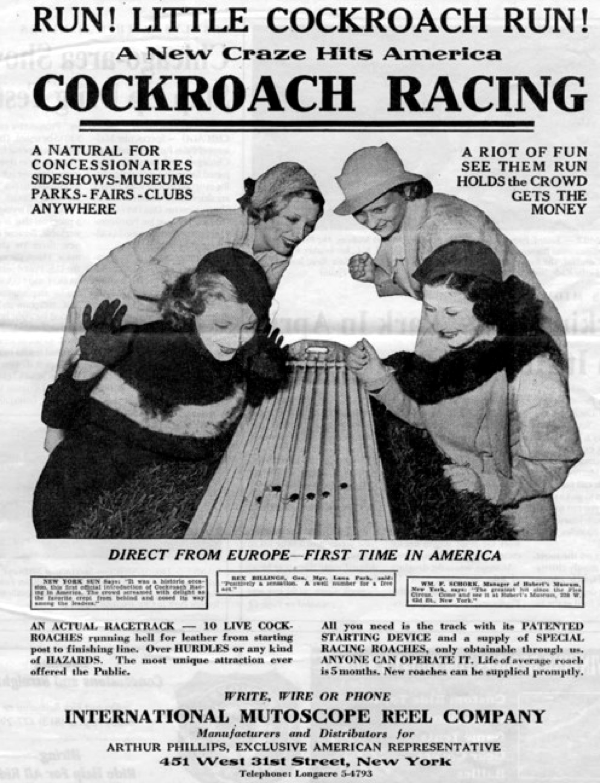
This vintage ad for a cockroach racing game is a great reminder that what seems normal isn’t necessarily natural or inevitable.  Most Americans today would grimace at the idea of playing with cockroaches, as the insect is held up as an icon of filth and disease.  But sometime in the ’40s, someone at the International Mutoscope Reel Company thought this was a good idea!  Or, then again, maybe times haven’t changed so much; the company went bankrupt in 1949.

1From Weird Universe.

Lisa Wade, PhD is an Associate Professor at Tulane University. She is the author of American Hookup, a book about college sexual culture; a textbook about gender; and a forthcoming introductory text: Terrible Magnificent Sociology. You can follow her on Twitter and Instagram.

Scholars suggest that studying abroad in a previously-colonized country may increase people’s cultural sensitivity and awareness of global inequality.  I investigated this hypothesis by interviewing college students: one group had studied abroad for a semester or more, the other had only traveled out of the country for vacation.

I asked both groups to view and analyze fashion photography that contrasted models with more humble images of residents of less developed countries.  I hoped people would point to how, by contrasting glamorous, thin, conventionally-attractive White models with “average” people from less-privileged countries served to heighten the high status of the West and their representatives.  I saw this as a form of Western “slumming”: a practice of spending time in places or with people who are “below” you, out of curiosity or for fun or personal development.

My findings revealed that study abroad students think they’re more culturally competent but, in fact, they were no more likely than people who had never studied abroad to express concern about the exploitation of previously colonized people in ads like these.

The majority of students from both groups – those who’d studied abroad and those who hadn’t — demonstrated a distinct lack of concern.  They unreflexively “Othered” the people in these images; that is, they affirmed the locals’ marginalized group status and labeled them as being Other, belonging outside of our normative Western structure.

The majority also expressed approval of the aesthetics of the ads without irony. For example, one student said: “I think it works because it’s this edgy, culturally stimulating, and aesthetically pleasing ad.” When asked the art director’s intentions, another student commented: “I don’t know. Just like ordinary people next to someone who’s on top of their fashion game.”

Only select few students successfully observed the use of Othering in the images. When asked the art director’s intentions of one image, a student replied: “I think it’s to contrast the model with the everyday life of these people…  (it) feels more like an image of people of color being an accessory.” Noticing this theme, interestingly, did not correlate with having studied abroad, in contrast to my hypothesis.

My findings suggest, then, that living abroad for a semester or more in a previously colonized country does not necessarily contribute to the detection of global inequality in fashion photography.

Erica Ales is a senior Sociology major at Occidental College in Los Angeles, California.

SocImages News:

Updates on Image Guides

We are super excited to have a new Image Guide!  UCLA graduate student Calvin N. Ho has collected and organized our posts on Asian Americans and Pacific Islanders.  His excellent guide joins our others:

If you’d be interested in writing a guide on one of the other racial/ethnic groups — or on anything at all! — we’d be glad to make it available.  We’re even happy to have duplicate Guides, since every instructor is different.  Analytics show that thousands of professors visit these guides every year, so we’re eager to be able to offer more.

New Pinterest Board

We also have a new Pinterest page: the social construction of flavor.  If you’ve never heard of cucumber Pepsi, celery-flavored JELL-O, seaweed Pringles, whiskey toothpaste, or the delicious combination of ham and jelly, then this board is for you!

We’ve got 24 Pinterest boards, including sexy toy make-overs, what color is flesh?, gendered housework and parenting“subliminal” sexual symbolism, and violence in fashion.  Maggie particularly likes “Women vs. People,” which collects images that expose the fact that men are usually the default human (thanks Maggie!):

1

Elsewhere on the Net:

This month SocImages or its authors were quoted in…

Cross-post highlights…

Upcoming Lectures and Appearances:

I go on sabbatical next year to write in earnest, but I’d love to use my flexible schedule to do lots of public speaking as well.  Visit my website if you’d be interested in having me.  I have great talks on the value of friendship, the biology of sex differencesthe politics of genital cutting and, of course, hook up culture.  And I do a pretty decent AKD induction ceremony/commencement speech.

I’ve already scheduled my first talk for next year; I’ll be part of the Bastian Diversity Lecture Series at Westminster College in Salt Lake City.  Looking forward to it already!

Tweets of the Month:

1

Aw shucks.

Social Media ‘n’ Stuff:

Finally, this is your monthly reminder that SocImages is on TwitterFacebookGoogle+, and Pinterest.  Lisa is on Facebook and most of the team is on Twitter: @lisawade@gwensharpnv@familyunequal@carolineheldman, and @jaylivingston.

In Other News…

I want to send a shout out to all the great people I met at the University of Akron this month!  Here are two pictures: one of my ascent out of Los Angeles and the other from the airport on my way home, waiting for the white-out to clear.  Oh earth, you play such tricks!

Los Angeles:
551277_340202742769674_1154349445_n

Ohio:

522054_337995239657091_131293941_n


Lisa Wade, PhD is an Associate Professor at Tulane University. She is the author of American Hookup, a book about college sexual culture; a textbook about gender; and a forthcoming introductory text: Terrible Magnificent Sociology. You can follow her on Twitter and Instagram.

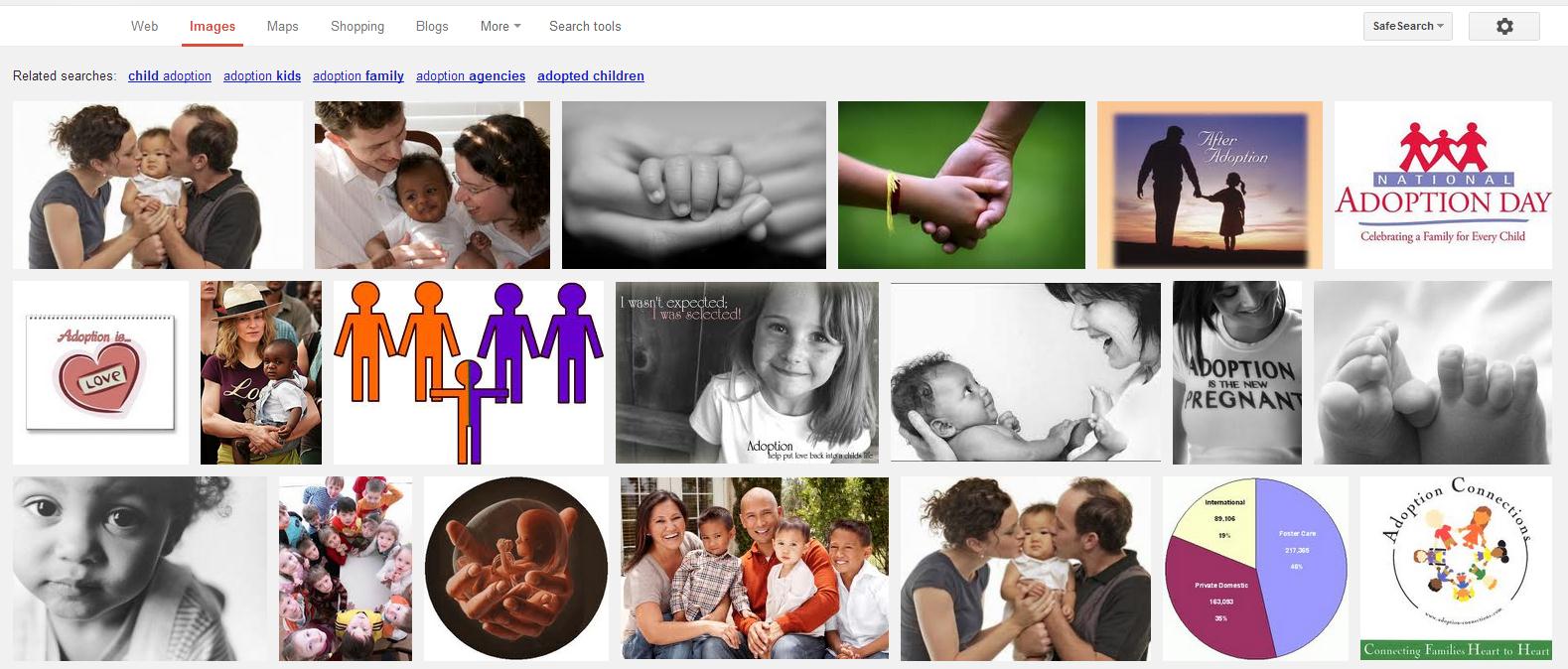
In a 2007 national survey, 40% of children adopted by Americans, both domestically and internationally, were of a different race than their adoptive parents (source). Transracial adoptions are very common.  But who adopts who?  If you ask Google Images, white families adopt non-white children. Six of the images below appear to feature white parents with children of color:

1

Why in America do we associate transracial adoptions with white parents?

One reason might be simply numerical.  White people aren’t more likely to adopt – in fact, the population of adopters is less white (73%) than the general population (78%) – but only 39% of adoptees are white. So, when white people do adopt, there’s a decent chance that they’ll adopt a non-white baby. Compounding this, they may be more likely to adopt transnationally because whites as a group are more affluent and so may have the money necessary pay the expenses of an overseas adoption, traveling across the globe possibly multiple times.

I think, however, that we also associate transracial adoptions with white parents out of bias.  Many Americans are suspicious that minorities might not be “fit parents,” especially to a white child.  In this scenario, we value white children more than other children and imagine that they should be placed only with good/white parents. Or, conversely, we imagine that it is only children of color that need saving and only white people that save.

The idea that people of color never raise white children as their own is illustrated by the story of Regina and Stacey Bush.  Regina is Stacey’s adoptive mother.  She’s black and Stacey is white.  Jessica Ravitz, at CNN, discusses the various ways in which the mother and child upset other people’s sense of what’s normal and right.  Ravitz writes:

When a young Stacey once started climbing into the van to join her family at an Arby’s restaurant, patrons came running to grab her, yelling that she was going into the wrong car. The girl was given detention at school, accused of lying because she called a young black boy her little brother, which he was. At a movie theater one time, someone called the police because they feared Stacey had been abducted.

These reactions reveal that many people still can’t imagine a non-white person raising a white child that is his or her own.

Hannah Rau is a sophomore at Occidental College. She plans to study Sociology and Art History.

Lisa Wade is a professor of sociology at Occidental College. You can follow her on Twitter andFacebook.