Search results for The

Vogues photo-shoot titled “Storm Troopers: Celebrating Hurricane Sandy First Responders” features various images of models with workers of different organizations who combated the damage of Hurricane Sandy. Vogue praises the attributes of these workers in the caption: “when Hurricane Sandy hit, the city’s bravest and brightest punched back.”

Although the title and caption suggest that the photos are meant celebrate the hard work of the men and women who responded to the hurricane, they also serve as a foil against which the models stand out. In other words, this photo spread is at least as concerned with celebrating a look and lifestyle associated with money and beauty, as it is with celebrating the working class.  This is obvious for at least two reasons.

First – the weaker argument — the majority of the workers are dressed in baggy, loosely fitting uniforms; they are not wearing the make-up or striking the poses so cherished by magazines like Vogue.  The models, in literal contrast, embody high fashion.  Their expressionless faces and leisurely poses are the province of the elite.

The next image is particularly striking in this regard.  The glamorous model not only contrasts with the gritty workers, she is elevated above them; the eye is drawn to her ephemeral presence, not to the men and women below.  Their presence serves to make her allure all the more impressive.So, the class contrast elevates the models, figuratively and sometimes literally in these images.  We see race contrast used to do the same thing when Black men and women are used as props in fashion shoots as well as East Indian and Asian people.

Second – the stronger argument – if Vogue wanted to celebrate the men and women in working class occupations that helped after Hurricane Sandy, they could have left the models out altogether.  As it is, the implication is that the workers aren’t valuable in themselves, they’re only valuable as a setting for high fashion.

The photo shoot, then, instead of honoring the workers, affirms the class hierarchy in which they are embedded.  The photographs fall in line with the magazine’s message – a celebration of an elite lifestyle – one that is well out of the reach of blue collar men and women.

Eliza Connors is a first year student at Occidental College.  She hopes to pursue a degree in sociology.  
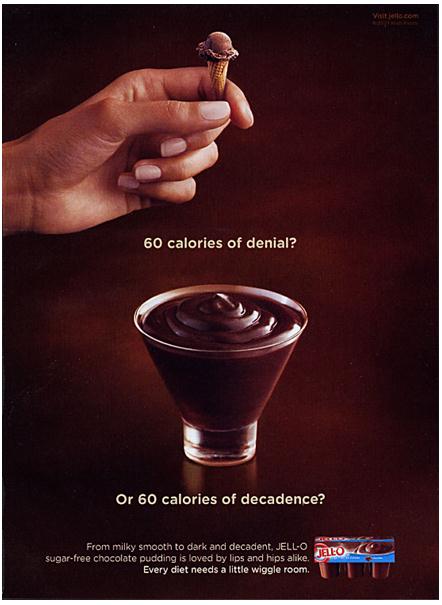
In this Jell-O ad, a perfectly manicured woman’s hand is holding a tiiiiiiiiiiny ice cream cone, suggesting that women are better off eating sugar-free pudding as a dessert. Below, I argue that this ad, far from promoting “decadence,” is actually a form of social control.

1

The words “60 Calories of Denial” imply that eating ice cream requires self-denial because a normal portion would be too high in calories.  In contrast, the large bowl of Jell-O pudding is labeled “60 Calories of Decadence.”  The fine print specifies that the pudding is “loved by lips and hips alike.”

To put it plainly, this ad for dessert tells women to be ashamed of wanting dessert.  It says, “You are a woman, so you are stressed about calories (and you should be). But we’re here to save the day. We can give you permission to have a little bit of dessert, but you will do so on our terms.”

So, while the ad suggests that Jell-O is offering women freedom, the converse of self-denial, in fact it is reminding women of the rule that they be calorie-conscious.  In other words, it reinforces the notion that every woman should be unhappy with or fearful of her body, always striving to attain or maintain thinness.

Camilla Bennett is a sophomore at Occidental College in Los Angeles, California where she is a Cognitive Science major with an emphasis in computation. 

Cross-posted at The Huffington Post.

This is a new one.

Some of you may know that there is a wave of colleges and universities filing complaints with the Office for Civil Rights, claiming that their institutions are failing to protect women from sexual assault. This (first) wave includes Amherst, Yale, the University of North Carolina, and Swarthmore, among others.

Well, last night many of the details of the stories of the students whose cases have been mishandled — right down to exact quotes from their lives — found themselves in an episode of Law&Order SVU.  They didn’t ask for permission, offer a “consulting” fee, or even warn them that it was coming.

This just leaves a this-is-so-wrong-I-don’t-even-know icky feeling in the pit of my gut.   I know that Law & Order has been ripping stories from the headlines for three decades, but it stuns me that it can claim to be fiction and not compensate the real women who’s lives are clearly and unequivocally depicted in this show.

Let me put this in stark terms: Law & Order is brazenly capitalizing on the pain and trauma of young women and not only failing to compensate them for stealing their stories, but actually denying that they exist by claiming that the “story is fictional and does not depict any actual person or event.”  Stunning.

Alexandra Brodsky, a survivor who filed the complaints against Yale, told Jezebel:

The SVU episode strikes me as an extreme example of the risk of going public as a survivor: your story is no longer your own.

I’ve not seen a more obvious example of this fact.

The teaser for the episode, plus a list of 15 ways the episode copied real life, collected by Katie J.M. Baker at Jezebel, is after the jump.

more...

Cross-posted at PolicyMic.

1Let me ask you a question: Do you have a good friend of the opposite sex?

Odds are you do. In fact, the odds are overwhelming.

When I first began teaching, 25 or so years ago, I asked my students how many of them had a good friend of the opposite sex. About 10% said they did. The rest were from what I called the When Harry Met Sally generation. You’ll remember the scene, early in the film, when Harry asserts that women and men can’t be friends because “sex always gets in the way.”  Sally is sure he’s wrong. They fight about it. Then, thinking she has the clincher for her position, she says, confidently, “So that means that you can be friends with them if you’re not attracted to them!”

“Ah,” says Harry, “you pretty much want to nail them too.”

Young people today have utterly and completely repudiated this idea. These days, when I ask my students, I’ve had to revise the question: “Is there anyone here who does not have a friend of the opposite sex?” A few hands perhaps, in the more than 400 students in the class.

But let’s think, for a moment, about the “politics” of friendship. With whom do you make friends? With your peers. Not your supervisor or boss. Not your subordinate. Your equal.  More than romance, and surely more than workplace relationships, friendships are the relationships with the least amount of inequality.

This changes how we can engage men in the efforts to end sexual assault, because there are three elements to sexual assault that can be discussed and disentangled.

First is m en’s sense of entitlement to women’s bodies, to sex. This sense of entitlement dissolves in the face of an encounter with your friends. After all, entitlement is premised on inequality. The more equal women are, the less entitlement men may feel. (Entitlement is not to be confused with resentment; equality often breeds resentment in the privileged group. The privileged rarely support equality because they fear they have something to lose.) Entitlement leads men to think that they can do whatever they want.

Second, the Bro Code tells those guys that they’re right – that they can get away with it because their bros won’t challenge or confront them. The bonds of brotherhood demand men’s silent complicity with predatory and potentially assaultive behavior. One never rats out the brotherhood. But if we see our female friends as our equals, then we might be more likely to act ethically to intervene and resist being a passive bystander. (And, of course, we rescue our male friends from doing something that could land him in jail for a very long time.)

Men’s silence is what perpetuates the culture of sexual assault; many of the excellent programs that work to engage men suggest that men start making some noise. We know the women, or know people who know them. This is personal.

Finally, we’re better than that – and we know it.

Sexual assault is often seen as an abstraction, a “bad” thing that happens to other people: Bad people do bad things to people who weren’t careful, were drunk or compromised. But, as I said, it’s personal. And besides, this framing puts all the responsibility on women to monitor their activities, alcohol consumption, and environments; if they don’t, whose fault is it?

This sets the bar far too low to men. It assumes that unless women monitor and police everything they do, drink, say, wear etc., we men are wild, out of control animals and we cannot be held responsible for our actions.

Surely we can do better than this. Surely we can be the good and decent and ethical men we say we are. Surely we can promise, publicly and loudly, the pledge of the White Ribbon Campaign (the world’s largest effort to engage men to end men’s violence against women): I pledge never to commit, condone, or remain silent about violence against women and girls.

Our friends – both women and men – deserve and expect no less of us.

Michael Kimmel is a professor of sociology at the State University of New York at Stonybrook.  He has written or edited over twenty volumes, including Manhood in America: A Cultural History and Guyland: The Perilous World Where Boys Become Men.  You can visit his website here.

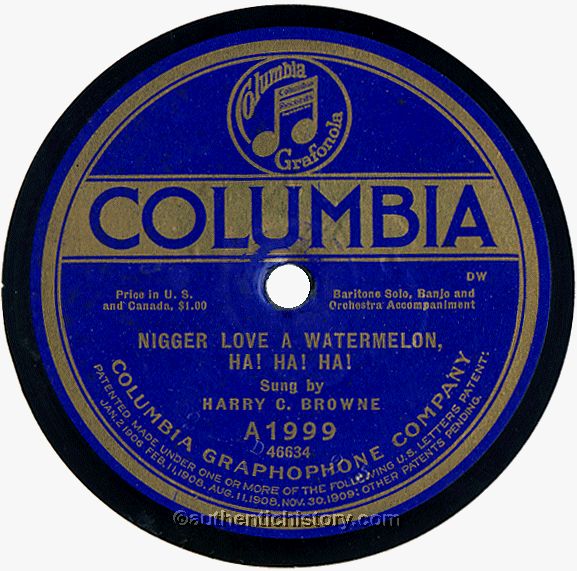
Here’s a random creepy fact: one of the tunes that float out of ice cream trucks all summer is a racist song called “Nigger Love a Watermelon Ha! Ha! Ha!,” first recorded 1916 or before.  Have a listen.

1

During slavery, the African population’s supposed taste for watermelon was used to suggest that they were stupid.  As I wrote in an earlier post:

…defenders of slavery used the watermelon as a symbol of simplicity.  African Americans, the argument went, were happy as slaves.  They didn’t need the complicated responsibilities of freedom; they just needed some shade and a cool, delicious treat.

Googling around, I learned almost nothing about the song.  It seems clear that it’s not an inside joke between Black people, making fun of the stereotype.  Instead, it’s an earnest, intended-to-be-humorous song meant to make fun of Black people.  But I could find little contextualizing information.  I also don’t know if the tune was also set to other lyrics that were or weren’t racist.

Still, the fact that the tune is an ice cream truck classic reveals how our racist history is still part and parcel of our everyday lives.

Hat tip to Theodore Johnson.

Lisa Wade, PhD is an Associate Professor at Tulane University. She is the author of American Hookup, a book about college sexual culture; a textbook about gender; and a forthcoming introductory text: Terrible Magnificent Sociology. You can follow her on Twitter and Instagram.

Here at SocImages, we typically use the phrase “cultural appropriation” to describe rather frivolous borrowing of cultural practices and objects for the purposes of fun and fashion.  We’ve posted on examples ranging from the appropriation of American Indian fashion,  the mocking of the Harlem Shake, and an Orthodox Jew-inspired fashion show.

A slideshow of members of the punk scene in Burma, however, offers another version of cultural appropriation.  Their fashion is clearly inspired by the punk scenes of Britain and the U.S., which started in the 1970s. Accordingly to an interview with Ko Gyi at Vice and an article at Spiegel Online, some members of the sub-culture believe themselves to be rebelling against an oppressive state, others are interested in “non-political anarchism.”  While their music has to pass through state censors, they are talented in pushing their lyrics right up to the limit and deft in using metaphor to get their point across.

This is a fully different kind of appropriation, the kind that is about fighting the establishment, not spicing it up with “colorful” bits of marginalized groups.  It is more akin to feminists and gay liberation activists borrowing the tactics of the civil rights movement.  Alexander Dluzak writes:

In Burma, punk is far more than just a superficial copy of its Western counterpart. Here, what is probably the most rebellious of all subcultures in the Southeast Asian country is going up against one of the world’s most authoritarian regimes.

Cultures can borrow from one another, then, in ways that both empower and disempower.  It will be fascinating to see if this particular appropriation can shape the future of Burma.

Lisa Wade, PhD is an Associate Professor at Tulane University. She is the author of American Hookup, a book about college sexual culture; a textbook about gender; and a forthcoming introductory text: Terrible Magnificent Sociology. You can follow her on Twitter and Instagram.

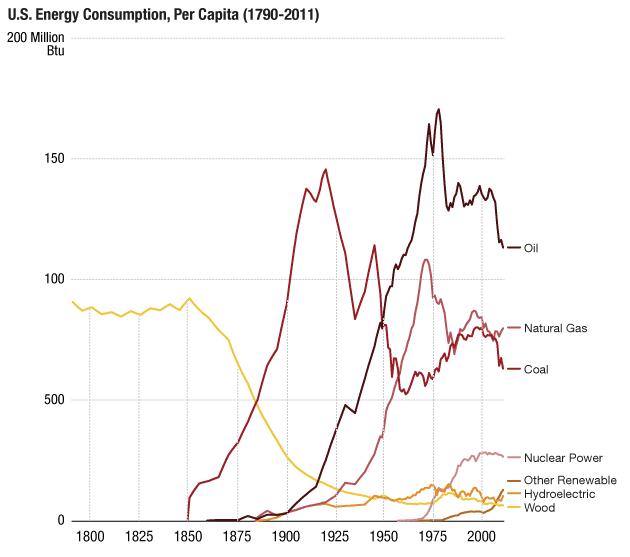
Planet Money’s Jacob Goldstein and Lam Thuy Vo offered some interesting data last week about the history of energy consumption in the U.S.  First they offered data on the rise and fall of alternative energy sources.

1

Coal, the first to replace wood, became a common energy source largely thanks to the railroads.  Wood was more or less everywhere, but coal had to be transported.

The invention and spread of the internal combustion engine drove the demand for oil.  According to this site (PM doesn’t say), natural gas becomes common in the ’50s thanks to the improvement of techniques for making metals and welding. This facilitates the building of oil pipelines, hence the rise of oil.

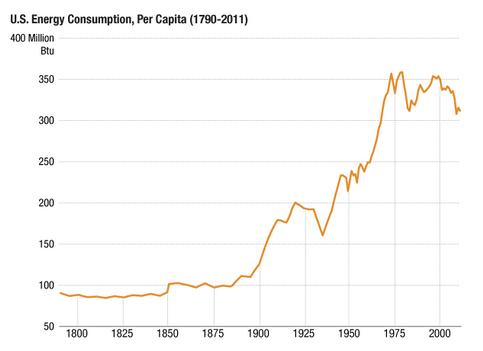
The overall rise in energy consumption per capita is worrisome, but it has fallen off since the mid-70s.  Thanks to high prices that encourage lower use and greater efficiency of appliances, our appetite for energy seems to have leveled off.

2

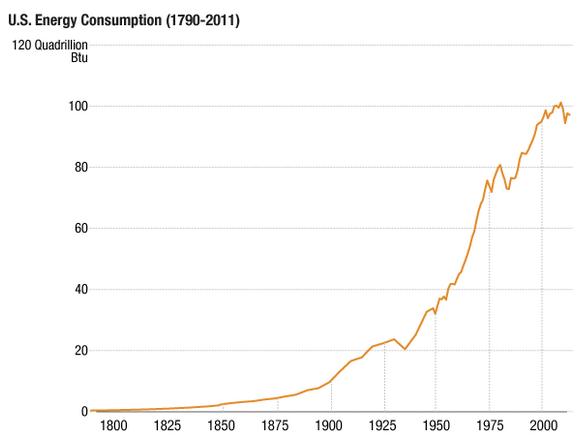
Not to end on an optimistic note, though.  That data is per capita.  Because our population has been rising, our overall energy use has continued to go up.

3

Lisa Wade, PhD is an Associate Professor at Tulane University. She is the author of American Hookup, a book about college sexual culture; a textbook about gender; and a forthcoming introductory text: Terrible Magnificent Sociology. You can follow her on Twitter and Instagram.

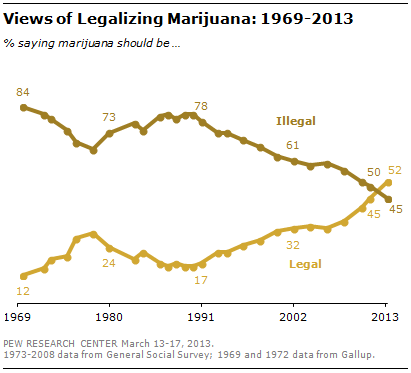
A guiding principle driving the sociological understanding and analysis of deviance is the recognition that behaviors themselves are not inherently deviant; rather it is the social perceptions and reactions to a behavior that makes a particular behavior deviant.  This explains why opinions and attitudes towards different forms of supposedly deviant behaviors regularly change.  A notable change in one type of deviance, using marijuana, is revealed in a report compiled by the Pew Research Center.

According to David F. Musto, a century ago marijuana was an obscure drug used almost exclusively by Hispanics in the Southwest.  Its limited association with this ethnic group is largely why marijuana initially became illegal.  With the onset of the Great Depression, both federal and state governments sought ways to expel nonwhites from the country as their cheap labor was no longer necessary.  Making one of this group’s pastimes illegal was a way to stigmatize Hispanics and rally public support for a population transfer.  With a populace stirred into a moral panic by racism, nativism and propaganda movies like Reefer Madness, there was little resistance to the 1937 Marijuana Tax Act which effectively made cannibas illegal.

In the 1960s marijuana experienced a cultural comeback when it became the drug of choice for baby-boomers who saw the drug as a safer alternative to the alcohol and methamphetamine that plagued their parents’ generation.  Marijuana was even legal for a brief period after the Supreme Court found the 1937 marijuana act unconstitutional.  However, because of widespread concern that drugs were corrupting the moral fabric of America’s youth, in 1970 marijuana was one of many drugs outlawed by President Nixon’s Comprehensive Drug Abuse Prevention and Control Act.  Interestingly, marijuana was the only drug targeted by this act that did not include a medical exception.  In the 1980s, President Reagan increased penalties for breaking drug laws, and subsequently the prison population in the United States swelled to a size seemingly unimaginable in a wealthy democracy.

The graph below from PEW’s report captures how federal action came during times of heightened public support to make marijuana illegal.

1

Yet, the graph also captures how in the early 1990s, support for the legalization of marijuana started to increase.  According to the PEW report, around this time California pioneered using the drug for medicinal purposes; seventeen other states (including D.C.) have since followed California’s lead while six other states decriminalized possession of small amounts.  In 2012, citizens in Colorado and Oregon voted to completely legalize marijuana despite federal law.  This relaxing and even elimination of marijuana laws mirrors favorable opinions of marijuana and growing support for its legalization.

It is difficult to tell if legalization, medical or otherwise, drives public opinion or vice-versa.  Regardless, an especially noteworthy finding of the PEW report is that right now, more than half of the United States’ citizens think marijuana should be legal.  Sociologists always take interest when trend lines cross in public opinion polls because the threshold is especially important in a majority-rule democracy; and the PEW report finds for the first time in the history of the poll, a majority of U.S. citizens support marijuana legalization.

This historical research data on opinions about marijuana reveals how definitions of deviance, and in many cases the ways those definitions are incorporated into the legal system, grow out of shared social perceptions.  Although there have been some notable genetic and cultivation advances, marijuana has changed relatively little in the last forty years; yet our perceptions of this drug (and therefore its definitions of use as deviant) regularly evolve and we can expect opinions, and therefore our laws, to further change in the future.

Jason Eastman is an Assistant Professor of Sociology at Coastal Carolina University who researches how culture and identity influence social inequalities.