Search results for The

Summer means writing!

We’re all breathing a sigh of relief now that the semester is over!  Gwen and I are both looking forward to making lots of progress on writing projects over the summer!  Myra Marx Ferree and I should be finishing our sociology of gender textbook within months and I can hardly wait!

Twitter love:

We reached a milestone on Twitter.  12,000 followers and counting!

12000 twitter

12,000 followers means lots of love!

1

We freaking love you too, Eli!

Upcoming lectures and appearances:

I am officially on sabbatical and writing full time, but I’d love to use my flexible schedule to do lots of public speaking as well.   I have great talks on the value of friendship, the biology of sex differencesthe politics of genital cutting and, of course, hook up culture.  And I do a pretty decent AKD induction ceremony/commencement speech.

I’ve already scheduled my first talk for next year. I’ll be part of the Bastian Diversity Lecture Series at Westminster College in Salt Lake City.  Looking forward to it already!

Virtual friends:

We continue to be thrilled to see SocImages’ posts cross-promoted on other sites.  Here are some graduation season-themed highlights of the month:

New Pinterest board on rape culture:

In response to the sudden public interest in sexual violence, we decided to begin a rape culture Pinterest board.  I recommend visiting with a stiff drink in hand.  If you’re sensitive to images of sexual violence, I wouldn’t go at all.

SocImages has 25 Pinterest boards and some of them aren’t horribly depressing!  You can visit our new guide or check out some of our more popular themes: sexy toy make-overswhat color is flesh?gendered housework and parenting“subliminal” sexual symbolism, and violence in fashion.

The national movement against sexual assault:

SocImages continues to follow the national movement to use Title IX to reform sexual assault adjudication on college — and now, rumor has it, middle school and high school — campuses.  Dartmouth, UC Berkeley, and USC, among others, are the most recent schools to file complaints with the federal government.

This month we posted about the role of social networking in the movement and covered the faculty votes of “no confidence” in higher level administrators at Occidental College.  I also had the opportunity to give a 12 minute interview to KPFK about the developments at my campus (you can listen here, starting at 28:30).

Social media:

SocImages is on TwitterFacebookGoogle+, and Pinterest.  Lisa is on Facebook and most of the team is on Twitter: @lisawade@gwensharpnv@familyunequal@carolineheldman, and @jaylivingston.

In other news…

I thought I’d share this nice shot from just after commencement at Occidental College.  To my left and right are two of the professors who have joined with students to lead the national movement against sexual assault: Dr. Caroline Heldman and Dr. Danielle Dirks.  In other words, some badass chicks right there.  Follow them on twitter @carolineheldman and @danielledirks!

20130519_120909

Lisa Wade, PhD is an Associate Professor at Tulane University. She is the author of American Hookup, a book about college sexual culture; a textbook about gender; and a forthcoming introductory text: Terrible Magnificent Sociology. You can follow her on Twitter and Instagram.

In April The Sierra Club announced that it was endorsing a path to citizenship for undocumented immigrants.  They argued that a preponderance of disempowered workers in some of the most polluted industries in the country was bad for the environment:

To protect clean air and water and prevent the disruption of our climate, we must ensure that those who are most disenfranchised and most threatened by pollution within our borders have the voice to fight polluters and advocate for climate solutions without fear.

This position nicely brings together one lefty political concern (the environment) with another (concern for undocumented immigrants).  This is probably entirely genuine, but it is also very convenient from a discursive perspective.

I tortured my Sociology 101 students this semester with the phrase “discursive opportunity structure,” which I introduce as “the arrangement of ideas in a society that constrain and enable communication and thought.”  For example, the connection between pink and femininity is automatic in our minds whether we want it to be or not, just as the letters C-A-T conjure up a cat and we couldn’t stop it if we tried.  So ideas aren’t just free floating in our collective minds, they’re built into a relationship with each other, and those relationships are part of our cognition.

Sociologist Leslie King has shown how this constrains how environmentalists can talk about immigration and how anti-immigration activists can talk about the environment.  She considers “population stabilization” activists, a group that believes that immigration is harmful to the environment (paper here, two examples here).

1King argues that the population stabilization movement has struggled largely because the two positions they bring together — pro-environment and anti-immigration — disrupt the discursive opportunity structure.  First, it’s harder for us to get our minds around the argument because it means bringing together a lefty political message and a right one.  Second, insofar as our identity categories depend on the discursive opportunity structure, it requires us to fragment them. Can one be both anti-immigration (on the right) and pro-environment (on the left)?  It takes cognitive work to think that through.

The position announced by The Sierra Club last month, however, neatly fits into our thought patterns.  Most fans of the environmental organization are on the left, so when the press release calls for a path for citizenship, it slips neatly into the political identities and cognitive structures of their audience.  That likely facilitates the likelihood that their position will be both heard and influential.

Lisa Wade, PhD is an Associate Professor at Tulane University. She is the author of American Hookup, a book about college sexual culture; a textbook about gender; and a forthcoming introductory text: Terrible Magnificent Sociology. You can follow her on Twitter and Instagram.

Screenshot_1In a wonderfully provocative article titled “Compulsory Heterosexuality and Lesbian Existence” (full text), writer and poet Adrienne Rich argues, among other things, that the assumption of heterosexuality in the context of patriarchy alternatively erases and stigmatizes woman-to-woman bonds.

Though the title specifies lesbianism, she means intense and meaningful relationships between women more generally.  In other words, an overbearing heterosexuality orients women towards men not just as sexual and romantic partners, but as the arbiters of all that is good and right. Accordingly, women don’t turn to other women to validate their ideas, their value, their beauty, or anything else about them.  This post, analyzing the reality show Battle of the Bods, is a stark example.

If only men can validate women’s worth, then other women exist only as competition for their approval.  This is good for patriarchy; it divides and conquers women, keeping them constantly looking to please the men around them and making them feel invisible and worthless if they can’t get attention from or endorsement from men.

There are various strategies for getting men’s stamp of approval: being the busy and useful mother of a man’s children is one way, while being a childless so-called “trophy wife” is another.  You can imagine, right away, that these two kinds of women might see themselves as in competition.  One may be more harried, with less time to tend to her physical fitness and keep her hair shiny and her make-up and clothes just right.  The other may have plenty of time to keep herself fit and beautiful, but knows that her connection to her husband may feel less permanent without children to tie her to him.  Moreover, the childless wife is often a second wife.  So all sexy, single, childless women are, theoretically, a threat to the wife and mother.  And all husband/dads are, theoretically, a target for wanna-be second wives.

Pop culture constantly re-affirms these narratives.  It frequently naturalizes the idea that women should turn to men, and not women, to reinforce their value. Portraying women as in competition is part of that.  The “trophy wife” vs. the “busy mom” is one of those match-ups. Enter this Volvo ad, sent in by Dolores R.:

The ad encourages us to think mean-spirited thoughts about the married but (presumably) childless woman with the puckered lips.  She clearly sees herself as in competition with the redhead, looking over to check that she is, in fact, more beautiful, and looking satisfied that she is.  The redhead, though, has (supposedly) more important things to do than check herself out in the mirror.  She’s got kids.  How shallow the blond, we’re told to think, how fake.  “Designed for real people,” the narrator explains, “designed around you.”

These battles — between childless women and mothers, one kind of mother and another, old women and young, thin women and fat, ugly women and beautifulpopular and less popular, mother-in-laws and daughter-in-laws, between strangers and between best friends — this is patriarchy in action.  It weakens women as as group and makes it more difficult to fight oppression.

As my good friend Caroline Heldman says, when we see women that excel in some way — whether they be accomplished in their career, impressive fashionistas, incredible parents, truly loved partners, inspired artists, or what-have-you —  we are taught to find something about them to dismiss because they make us feel insecure. Instead, we should think “How fabulous is she! I want to tell her how great she is and be her friend!”

Lisa Wade is a professor of sociology at Occidental College.  She elaborates on these themes in her talk, A Feminist Defense of FriendshipYou can follow her on Twitter and Facebook.

Cross-posted at Montclair SocioBlog.

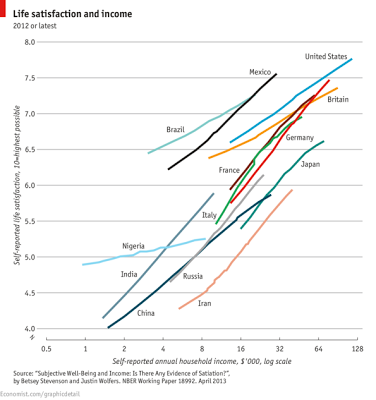
Forty years ago Richard Easterlin proposed the paradox that people in wealthier countries were no happier than those in less wealthy countries.  Subsequent research on money and happiness brought modifications and variations, notably that within a single country, while for the poor, more money meant fewer problems, for the wealthier people — those with enough or a bit more — enough is enough.  Increasing your income from $100,000 to $200,000 isn’t going to make you happier.

It was nice to hear researchers singing the same lyrics we’ll soon be hearing in commencement speeches and that you hear in Sunday sermons and pop songs (“the best things in life are free”; “mo’ money mo’ problems”).  But this moral has a sour-grapes taste; it’s a comforting fable we non-wealthy tell ourselves all the while suspecting that it probably isn’t true.

A recent Brookings paper by Betsey Stevenson and Justin Wolfers adds to that suspicion.  Looking at comparisons among countries and within countries, they find that when it comes to happiness, you can never be too rich.

1

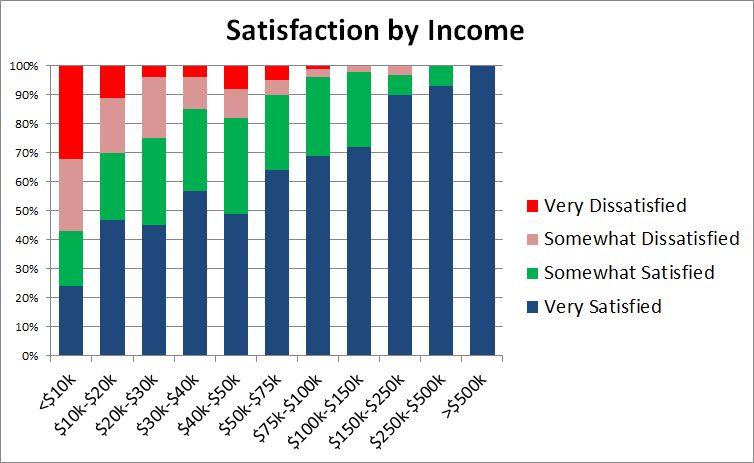
Stevenson and Wolfers also find no “satiation point,” some amount where happiness levels off despite increases in income.  They provide US data from a 2007 Gallup survey:

2

The data are pretty convincing.  Even as you go from rich to very rich, the proportion of “very satisfied” keeps increasing.  (Sample size in the stratosphere might be a problem: only 8 individuals reported annual incomes over $500,000;100% of them, though, were “very happy.”)

Did Biggie and Alexis get it wrong?

Around the time that the Stevenson-Wolfers study was getting attention in the world beyond Brookings, I was having lunch with a friend who sometimes chats with higher ups at places like hedge funds and Goldman Sachs.  He hears wheeler dealers complaining about their bonuses. “I only got ten bucks.”  Stevenson and Wolfers would predict that this guy’s happiness would be off the charts given the extra $10 million.  But he does not sound like a happy master of the universe.

I think that the difference is more than just the clash of anecdotal and systematic evidence.  It’s about defining and measuring happiness.  The Stevenson-Wolfers paper uses measures of “life satisfaction.”  Some surveys ask people to place themselves on a ladder according to “how you feel about your life.”  Others ask

All things considered, how satisfied are you with your life as a whole these days?

The GSS uses happy instead of satisfied, but the effect is the same:

Taken all together, how would you say things are these days – would you say that you are very happy, pretty happy, or not too happy?

When people hear these questions, they may think about their lives in a broader context and compare themselves to a wider segment of humanity.  I imagine that Goldman trader griping about his “ten bucks” was probably thinking of the guy down the hall who got twelve.  But when the survey researcher asks him where he is on that ladder, he may take a more global view and recognize that he has little cause for complaint.  Yet moment to moment during the day, he may look anything but happy.  There’s a difference between “affect” (the preponderance of momentary emotions) and overall life satisfaction.

Measuring affect is much more difficult — one method requires that people log in several times a day to report how they’re feeling at that moment — but the correlation with income is weaker.

In any case, it’s nice to know that the rich are benefitting from getting richer.  We can stop worrying about their being sad even in their wealthy pleasure and turn our attention elsewhere.  We got 99 problems, but the rich ain’t one.

Jay Livingston is the chair of the Sociology Department at Montclair State University. You can follow him at Montclair SocioBlog or on Twitter.

Cross-posted at Montclair SocioBlog.

Does “the abortion culture” cause infanticide?  That is, does legalizing the aborting of a fetus in the womb create a cultural, moral climate where people feel free to kill newborn babies?

It’s not a new argument.  I recall a 1998 Peggy Noonan op-ed in the Times, “Abortion’s Children,” arguing that kids who grew up in the abortion culture are “confused and morally dulled.”*  Earlier this week, USA Today ran an op-ed by Mark Rienzi repeating this argument in connection with the Gosnell murder conviction.

Rienzi argues that the problem is not one depraved doctor.  As the subhead says:

The killers are not who you think. They’re moms.

Worse, he warns, infanticide has skyrocketed.

While murder rates for almost every group in society have plummeted in recent decades, there’s one group where murder rates have doubled, according to CDC and National Center for Health Statistics data — babies less than a year old.

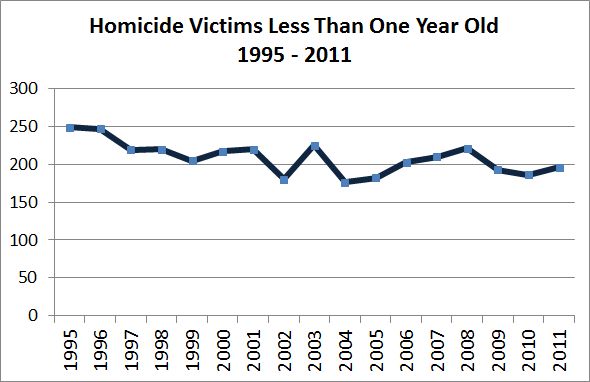
Really? The FBI’s Uniform Crime Reports has a different picture.

1

Many of these victims were not newborns, and Rienzi is talking about day-of-birth homicides — the type killing Dr. Gosnell was convicted of, a substitute for abortion.  Most of these, as Rienzi says are committed not by doctors but by mothers.  I make the assumption that the method in most of these cases is smothering.  These deaths show an even steeper decline since 1998.

2

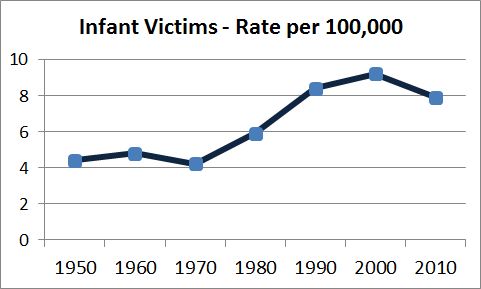
Where did Rienzi get his data that rates had doubled?  By going back to 1950.

3

The data on infanticide fit with his idea that legalizing abortion increased rates of infanticide.  The rate rises after Roe v. Wade (1973) and continues upward till 2000.

But that hardly settles the issue. Yes, as Rienzi says, “The law can be a potent moral teacher.”  But many other factors could have been affecting the increase in infanticide, factors much closer to actual event — the mother’s age, education, economic and family circumstances, blood lead levels, etc.

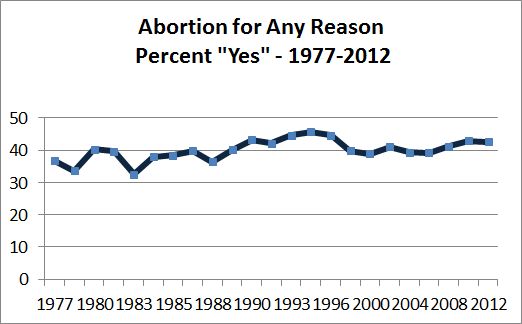
If Roe changed the culture, then that change should be reflected not just in the very small number of infanticides but in attitudes in the general population.  Unfortunately, the GSS did not ask about abortion till 1977, but since that year, attitudes on abortion have changed very little.   Nor does this measure of “abortion culture” have any relation to rates of infanticide.

4

Moreover, if there is a relation between infanticide and general attitudes about abortion, then we would expect to see higher rates of infanticide in areas where attitudes on abortion are more tolerant.

5

The South and Midwest are most strongly anti-abortion, the West Coast and Northeast the most liberal.  So, do these cultural difference affect rates of infanticide?

1

Well, yes, but it turns out the actual rates of infanticide are precisely the opposite of what the cultural explanation would predict.  The data instead support a different explanation of infanticide: Some state laws make it harder for a woman to terminate an unwanted pregnancy.  Under those conditions, more women will resort to infanticide.  By contrast, where abortion is safe, legal, and available, women will terminate unwanted pregnancies well before parturition.

The absolutist pro-lifers will dismiss the data by insisting that there is really no difference between abortion and infanticide and that infanticide is just a very late-term abortion. As Rienzi puts it:

As a society, we could agree that there really is little difference between killing a being inside and outside the womb.

In fact, very few Americans agree with this proposition. Instead, they do distinguish between a cluster of a few fertilized cells and a newborn baby. I know of no polls that ask about infanticide, but I would guess that a large majority would say that it is wrong under all circumstances.  But only perhaps 20% of the population thinks that abortion is wrong under all circumstances.

Whether the acceptance of abortion in a society makes people “confused and morally dulled” depends on how you define and measure those concepts.  But the data do strongly suggest that whatever “the abortion culture” might be, it lowers the rate of infanticide rather than increasing it.

* I had trouble finding Noonan’s op-ed at the Times Website.  Fortunately, then-Rep. Talent (R-MO) entered it into the Congressional Record.

Jay Livingston is the chair of the Sociology Department at Montclair State University. You can follow him at Montclair SocioBlog or on Twitter.

SocImages maintains an active Pinterest Account featuring over 25 boards.  The site allows you to browse through over 12,000 images and videos without any text.  You can borrow the material directly, or click through to the blog to read the analysis.

On this page, we direct your attention to our boards featuring social construction as well as those with content related to media and marketing, race and ethnicity, sexual orientation, gender, violence, economics, and other fun stuff.
x
Social Construction

25Social Construction
x
x
x
x
x
Sexual Orientation
x
2Before Homosexuality
x
x
x
x
16Heteronormativity
x
x
x
x
x
Race and Ethnicity
x
5What Color is Flesh?
x
x
x
x
10Racial Objectification
x
x
x
x
x
15Race as a Social Construction
x
x
x
x
1aRacist Antics at High Schools and Colleges
x
x
x
x
x
Gender
x
9Gendered Housework and Parenting
x
x
x
x
x
12The Tyranny of Pink and Blue
x
x
x
x
x
17Gendered and Sexualized Food
x
x
x
x
x
20Pointlessly Gendered Products
x
x
x
x
x
23Women vs. People
x
x
x
x
x
Screenshot_1The Mean Girls Meme
x
x
x
x
x
Violence
x
21Violence in Fashion (Trigger Warning)
x
x
x
x
x
24Rape Culture (Trigger Warning)
x
x
x
x
x
Media and Marketing
x
6Photoshop and Re-Touching
x
x
x
x
x
7 Sexually-Suggestive Advertising
x
x
x
x
x
3Sexy Toy and Logo Make-Overs
x
x
x
x
x
PinterestMarketing Feminism
x
x
x
x
8 Deconstructing Disney
x
x
x
x
1Mostly Misguided Safer Sex PSAs
x
x
x
x
13Masculinizing the Feminine
x
x
x
x
1 (3)Pinkwashing
x
x
x
x
1 (4)Sexy What!?
x
x
x
x
19Feminizing the Masculine


x
Economics
x
18The Great Recession
x
x
x
x
x
Just for Fun
x
4Vintage Ads, Products, and Stuff
x
x
x
x
11Comics and Cartoons
x
x
x
x
22Halloween
x
x
x
x
14The Social Construction of Flavor

Dieting is for women.

I mean we all know that dieting and women go together like peas and carrots.  We know this — collectively and together, even if we don’t agree that it should be this way — not because it’s inevitable or natural, but because we constantly get reminded that women should be on diets and dieting is a feminine activity.

@msmely tweeted us a fabulous example of this type of reminder.  It’s a reduced fat block of Monterey Jack cheese, re-named “Monterey Jill.”  There’s curvy purple font and a cow in pearls with a flower, in case you missed the message.  And, oh, on the odd chance you thought that this was about health and not weight, there’s a little sign there with a message to keep you on track: “Meet Jack’s lighter companion.”

Screenshot_2

So now we’ve gendered cheese and managed to affirm both the gender binary  (heavy vs. light), heterocentrism (Jack’s companion Jill), and the diet imperative for women.  And it’s just cheese people!  Cheese!

That is all.

Lisa Wade, PhD is an Associate Professor at Tulane University. She is the author of American Hookup, a book about college sexual culture; a textbook about gender; and a forthcoming introductory text: Terrible Magnificent Sociology. You can follow her on Twitter and Instagram.
Cross-posted at VitaminW.

In 2006, The Walt Disney Company bought the computer-animated feature film powerhouse Pixar.  This makes the lead of their most recent movie, Brave (2012), not just a princess, but a Disney Princess.  Merida is having a royal coronation at the Magic Kingdom this morning.

For her coronation, the princess has gotten a good ol’ Disney makeover. On the left is the new Merida (“after”) and on the right is the old Merida (“before”).  Notice any differences?

1

Here are the ones that I see:

  • Sleeker, longer hair with more body
  • Larger eyes and more arched eyebrows
  • Plumper lips
  • A thinner waist
  • More obvious breasts
  • An overall more adult and less adolescent appearance
  • Lighter colored and more ornate gown
  • A lower cut neckline that also shows more shoulder
  • Perhaps most symbolically, her bow and arrows have disappeared in favor of a fashionable belt

We’ll add the new Merida to our always-growing collection of toys and logos that have received sexy make-overs.  You’ll love this Pinterest page, featuring a surprising set of newly sexy characters, including Care Bears, Polly Pockets, Holly Hobbie, Strawberry Shortcake, My Little Pony, Rainbow Brite, Cabbage Patch Kids, Dora the Explorer, and the Trollz.

Lisa Wade, PhD is an Associate Professor at Tulane University. She is the author of American Hookup, a book about college sexual culture; a textbook about gender; and a forthcoming introductory text: Terrible Magnificent Sociology. You can follow her on Twitter and Instagram.