Flashback Friday.

Benedict Anderson famously coined the phrase “imagined community” to describe the way that large groups of people without direct contact could nonetheless think of themselves as a meaningful group.  He originally discussed this in the context of nations.  In his book, he writes:

It is imagined because the members of even the smallest nation will never know most of their fellow-members, meet them, or even hear of them, yet in the minds of each lives the image of their communion… it is imagined as a community, because, regardless of the actual inequality and exploitation that may prevail in each, the nation is always conceived as a deep, horizontal comradeship. Ultimately it is this fraternity that makes it possible, over the past two centuries, for so many millions of people, not so much to kill, as willingly to die for such limited imaginings.

Whenever someone refers to “Americans,” he or she is conjuring up this idea of an imagined community.  Why do we feel that we have so much in common with other Americans?   We will only meet a very small percentage of Americans in our lifetimes.  We have things in common with some other Americans, but very little in common with still others.  And, in many important ways, we are probably more like certain segments of other societies (e.g., individuals in the middle class in the U.S., for example, are probably more like those in the middle class in the U.K. than they are like very poor or very rich Americans).

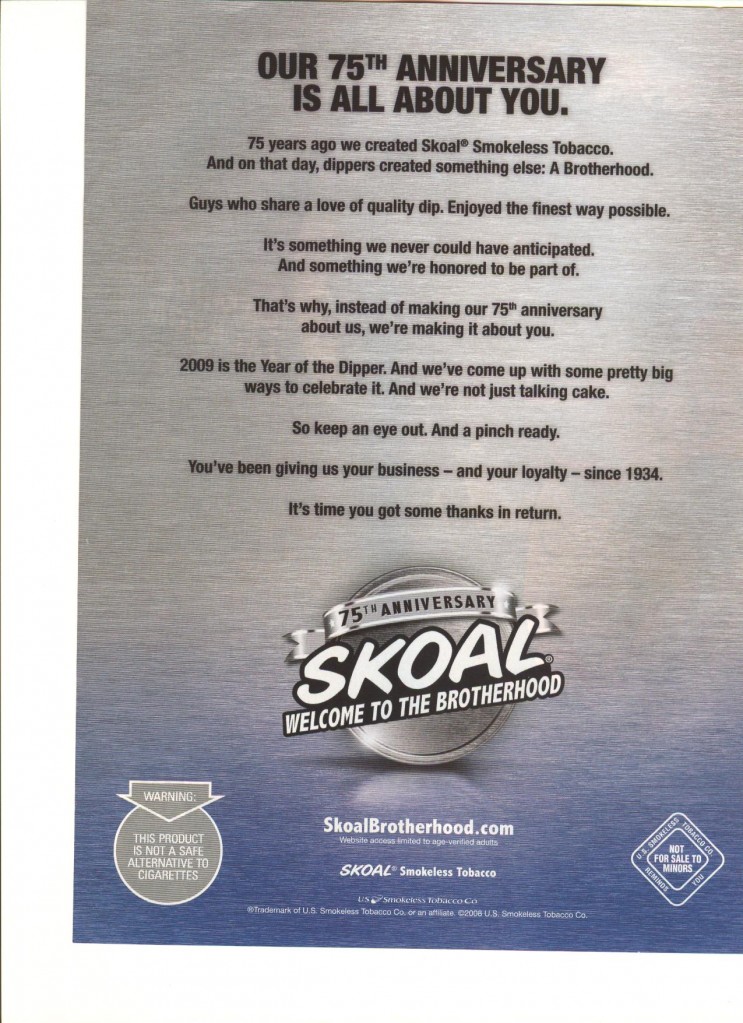
Others have used Benedict Anderson’s term to describe other kinds of imagined communities.  Apparently Skoal is hoping that “dippers” will find a sense of comraderie and devotion to each other (“loyalty”) and the product through the imagining of a Skoal community (“Brotherhood”):

03-011

Text:

OUR 75th ANNIVERSARY IS ALL ABOUT YOU.

75 years ago we created Skoal Smokeless Tobacco.  And on that day, dippers created something else: A Brotherhood.

Guys who share a love of quality dip.  Enjoyed the finest way possible.
It’s something we never could have anticipated.  And something we’re honored to be a part of.
That’s why, instead of making our 75th anniversary about us, we’re making it about you.

2009 is the Year of the Dipper.  And we’ve come up with some pretty big ways to celebrate it.  And we’re not just talking cake.
So keep an eye out.  And a pinch ready.
You’ve been giving us your business — and your loyalty — since 1934.
It’s time you got some thanks in return.

SKOAL
WELCOME TO THE BROTHERHOOD

Originally posted in 2009.

Lisa Wade, PhD is an Associate Professor at Tulane University. She is the author of American Hookup, a book about college sexual culture; a textbook about gender; and a forthcoming introductory text: Terrible Magnificent Sociology. You can follow her on Twitter and Instagram.

In the clip below, James Baldwin powerfully explains why he, as a black man, has no reason to assume that white people care about him and his people.

Responding to Dick Cavett, he says, “I don’t know what most white people in this country feel, but I can only conclude what they feel from the state of their institutions.”

He goes on to present a devastating list of ways in which American institutions are segregated and biased.  He concludes:

Now, this is the evidence. You want me to make an act of faith — risking myself, my wife, my woman, my sister, my children — on some idealization which you assure me exists in America, which I have never seen.

It was 1968, four years after the Civil Rights Act.  This year marks its 50th anniversary. How much have things changed?

Hat tip to Tim Wise. Cross-posted at Pacific Standard.

Lisa Wade, PhD is an Associate Professor at Tulane University. She is the author of American Hookup, a book about college sexual culture; a textbook about gender; and a forthcoming introductory text: Terrible Magnificent Sociology. You can follow her on Twitter and Instagram.
American divisions over the state of our country’s race relations were brought to the forefront in the aftermath of Mike Brown’s shooting by a Ferguson, MO police officer named Darren Wilson. Black Americans are more than twice as likely as whites or Hispanics to say that the killing was part of a broader pattern (source).  And blacks are twice as likely as whites to say that race played an important role in Wilson’s decision to shoot (source).

At The Atlantic, Robert Jones argues that these disparate opinions may be caused, in part, by the different life experiences of the typical white and black American. He shows data, from the American Values Survey, indicating that black people are much more likely than whites to report living in communities rife with problems, from a lack of jobs and inadequate school funding to crime and racial tension.

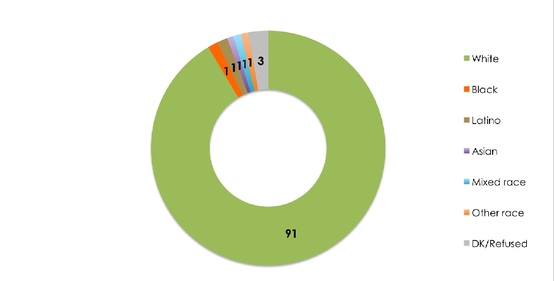
In the meantime, whites may be genuinely naive about what it’s like to be black in America because many of them don’t know any black people.  According to the survey, the average white American’s social network is only 1% black.  Three-quarters of white Americans haven’t had a meaningful conversation with a single non-white person in the last six months.

2

In contrast, the social network of the average black American is 65% black and, among Hispanic Americans, 46% Hispanic.

The average white person’s failure to engage meaningfully with people of color isn’t solely a matter of personal choice, though that is certainly part of it.  Nor is it simply a function of the country being majority white, non-Hispanic (but not for long).  White insularity is caused, too, by occupational and residential segregation which, in turn, is the result of both individual choices and institutionalized mechanisms that keep black people in poverty and prison.

If we want the people of America to embrace justice, we must make our institutions just.

Cross-posted at Pacific Standard.

Lisa Wade, PhD is an Associate Professor at Tulane University. She is the author of American Hookup, a book about college sexual culture; a textbook about gender; and a forthcoming introductory text: Terrible Magnificent Sociology. You can follow her on Twitter and Instagram.
Screenshot_1Today is Labor Day in the U.S. Though many think of it mostly as a last long weekend for recreation and shopping before the symbolic end of summer, the federal holiday, officially established in 1894, celebrates the contributions of labor.

Here are some SocImages posts on a range of issues related to workers, from the history of the labor movement, to current workplace conditions, to the impacts of the changing economy on workers’ pay:

The Social Construction of Work

Work in Popular Culture

Unemployment, Underemployment, and the “Class War”

Unions and Unionization

Economic Change, Globalization, and the Great Recession

Work and race, ethnicity, religion, and immigration

Gender and Work

The U.S. in International Perspective

Academia

Just for Fun

Who is the highest paid employee of your state?

Bonus!

Lisa Wade, PhD is an Associate Professor at Tulane University. She is the author of American Hookup, a book about college sexual culture; a textbook about gender; and a forthcoming introductory text: Terrible Magnificent Sociology. You can follow her on Twitter and Instagram.
SocImages news:

New Pinterest board!

Someone put panties on peaches and then we had to start a new Pinterest board called Sexy What!?  It’s a collection of totally random stuff being made weirdly and unnecessarily sexual by marketers. My favorites are the ads for organ donation, hearing aids, CPR, and sea monkeys.  Enjoy!

1

You like!  Here are our most appreciated posts this month:

Thanks everybody!

Editor’s pick:

Top post on Tumblr this month:

Don’t forget our course guides!

Classes are starting and if you’re teaching you might find our Course Guides useful.  These collect strong SocImages posts organized in a way that follows standard syllabi for frequently-taught sociology courses.  Please use and share freely!

We’d love more! If you are a sociology professor or graduate student who would like to make one.  Please get in touch!

Social Media ‘n’ Stuff:

Finally, this is your monthly reminder that SocImages is on TwitterFacebookTumblrGoogle+, and Pinterest.  I’m on Facebook and most of the team is on Twitter: @lisawade@gwensharpnv@familyunequal, and @jaylivingston.

Lisa Wade, PhD is an Associate Professor at Tulane University. She is the author of American Hookup, a book about college sexual culture; a textbook about gender; and a forthcoming introductory text: Terrible Magnificent Sociology. You can follow her on Twitter and Instagram.

When Hurricane Katrina broke the levees of New Orleans and flooded 85% of the city, 100,000 people were left homeless. Disproportionately, these were the poor and black residents of New Orleans. This same population faced more hurdles to returning than their wealthier and whiter counterparts thanks to the effects of poverty, but also choices made by policymakers and politicians — some would say made deliberately — that reduced the black population of the city.

With them went many of the practitioners of voodoo, a faith with its origins in the merging of West African belief systems and Catholicism.  At Newsweek, Stacey Anderson writes that locals claim that the voodoo community was 2,500 to 3,000 people strong before Katrina, but after that number was reduced to around 300.

The result has been a bridging of different voodoo traditions and communities. Prior to the storm, celebrations and ceremonies were race segregated and those who adhered to Haitian- and New Orleans-style voodoo kept their distance.  After the storm, with their numbers decimated, they could no longer sustain the in-groups and out-groups they once had.  Voodoo practitioners forged bonds across prior divides.

Cross-posted at Pacific Standard.

Lisa Wade, PhD is an Associate Professor at Tulane University. She is the author of American Hookup, a book about college sexual culture; a textbook about gender; and a forthcoming introductory text: Terrible Magnificent Sociology. You can follow her on Twitter and Instagram.
W.E.B. DuBois (1934):

The colored people of America are coming to face the fact quite calmly that most white Americans do not like them, and are planning neither for their survival, nor for their definite future if it involves free, self-assertive modern manhood. This does not mean all Americans. A saving few are worried about the Negro problem; a still larger group are not ill-disposed, but they fear prevailing public opinion. The great mass of Americans are, however, merely representatives of average humanity. They muddle along with their own affairs and scarcely can be expected to take seriously the affairs of strangers or people whom they partly fear and partly despise.

For many years it was the theory of most Negro leaders that this attitude was the insensibility of ignorance and inexperience, that white America did not know of or realize the continuing plight of the Negro.  Accordingly, for the last two decades, we have striven by book and periodical, by speech and appeal, by various dramatic methods of agitation, to put the essential facts before the American people.  Today there can be no doubt that Americans know the facts; and yet they remain for the most part indifferent and unmoved.

– From “A Negro Nation Within a Nation.

Borrowed from an essay by Tressie McMillan Cottom. Photo from ibtimes.com.

Lisa Wade, PhD is an Associate Professor at Tulane University. She is the author of American Hookup, a book about college sexual culture; a textbook about gender; and a forthcoming introductory text: Terrible Magnificent Sociology. You can follow her on Twitter and Instagram.

1 (2)

I got this email from an Ivy League student when I arrived to give a speech. She was responsible for making sure that I was delivered to my hotel and knew where to go the next day:

Omg you’re here! Ahh i need to get my shit together now lol. Jk. Give me a ring when u can/want, my cell is [redacted]. I have class until 1230 but then im free! i will let the teacher she u will be there, shes a darling. Perhaps ill come to the end of the talk and meet you there after. Between the faculty lunch and your talk, we can chat! ill take make sure the rooms are all ready for u. See ya!

To say the least, this did not make me feel confident that my visit would go smoothly.

I will use this poor student to kick off this year’s list of Professors’ Pet Peeves. I reached out to my network and collected some things that really get on instructors’ nerves. Here are the results: some of the “don’ts” for how to interact with your professor or teaching assistant. For what it’s worth, #2 was by far the most common complaint.

1. Don’t use unprofessional correspondence.

Your instructors are not your friends. Correspond with them as if you’re in a workplace, because you are. We’re not saying that you can’t ever write like this, but you do need to demonstrate that you know when such communication is and isn’t appropriate. You don’t wear pajamas to a job interview, right? Same thing.

2. Don’t ask the professor if you “missed anything important” during an absence.

No, you didn’t miss anything important. We spent the whole hour watching cats play the theremin on youtube!

Of course you missed something important! We’re college professors! Thinking everything we do is important is an occupational hazard. Here’s an alternative way to phrase it: “I’m so sorry I missed class. I’m sure it was awesome.”

If you’re concerned about what you missed, try this instead: Do the reading, get notes from a classmate (if you don’t have any friends in class, ask the professor if they’ll send an email to help you find a partner to swap notes with), read them over, and drop by office hours to discuss anything you didn’t understand.

3. Don’t pack up your things as the class is ending.

We get it. The minute hand is closing in on the end of class, there’s a shift in the instructor’s voice, and you hear something like “For next time…” That’s the cue for everyone to start putting their stuff away. Once one person does it, it’s like an avalanche of notebooks slapping closed, backpack zippers zipping, and cell phones coming out.

Don’t do it.

Just wait 10 more seconds until the class is actually over. If you don’t, it makes it seem like you are dying to get out of there and, hey, that hurts our feelings!

4. Don’t ask a question about the readings or assignments until checking the syllabus first.

It’s easy to send off an email asking your instructor a quick question, but that person put a lot of effort into the syllabus for a reason. Remember, each professor has dozens or hundreds of students. What seems like a small thing on your end can add up to death-by-a-thousand-paper-cuts on our end. Make a good faith effort to figure out the answer before you ask the professor.

5. Don’t get mad if you receive critical feedback.

If an instructor takes a red pen and massacres your writing, that’s a sign that they care. Giving negative feedback is hard work, so the red ink means that we’re taking an interest in you and your future. Moreover, we know it’s going to make some students angry at us. We do it anyway because we care enough about you to try to help you become a stronger thinker and writer. It’s counterintuitive but lots of red ink is probably a sign that the instructor thinks you have a lot of potential.

6. Don’t grade grub.

Definitely go into office hours to find out how to study better or improve your performance, but don’t go in expecting to change your instructor’s mind about the grade. Put your energy into studying harder on the next exam, bringing your paper idea to the professor or teaching assistant in office hours, doing the reading, and raising your hand in class. That will have more of a pay-off in the long run.

7. Don’t futz with paper formatting.

Paper isn’t long enough? Think you can make the font a teensy bit bigger or the margins a tad bit wider? Think we won’t notice if you use a 12-point font that’s just a little more widely spaced? Don’t do it. We’ve been staring at the printed page for thousands of hours. We have an eagle eye for these kinds of things. Whatever your motivation, here’s what they say to us: “Hi Prof!, I’m trying to trick you into thinking that I’m fulfilling the assignment requirements. I’m lazy and you’re stupid!” Work on the assignment, not the document settings.

8. Don’t pad your introductions and conclusions with fluff.

Never start off a paper with the phrase, “Since the beginning of time…” “Since the beginning of time, men have engaged in war.” Wait, what?  Like, the big bang? And, anyway, how the heck do you know? You better have a damn strong citation for that. “Historically,” “Traditionally,” and “Throughout history” are equally bad offenders. Strike them from your vocabulary now.

In your conclusion, say something smart. Or, barring that, just say what you said. But never say: “Hopefully someday there will be no war.” Duh. We’d all like that, but unless you’ve got ideas as to how to make it that way, such statements are simple hopefulness and inappropriate in an academic paper.

9. Don’t misrepresent facts as opinions and opinions as facts.

Figure out the difference. Here’s an example of how not to represent a fact, via CNN:

Considering that Clinton’s departure will leave only 16 women in the Senate out of 100 senators, many feminists believe women are underrepresented on Capitol Hill.

Wait. Feminists “believe”? Given that women are 51% of the population, 16 out of 100 means that women are underrepresented on Capitol Hill. This is a social fact, yeah? Now, you can agree or disagree with feminists that this is a problem, but don’t suggest, as CNN does, that the fact itself is an opinion.

This is a common mistake and it’s frustrating for both instructors and students to get past. Life will be much easier if you know the difference.

10. Don’t be too cool for school.

You know those students that sit at the back of the class, hunch down in their chair, and make an art of looking bored? Don’t be that person.  Professors and teaching assistants are the top 3% of students. They likely spent more than a decade in college. For better or worse, they value education. To stay on their good side, you should show them that you care too. And, if you don’t, pretend like you do.

Click here for a series of discussion questions and activities for the piece designed for students of composition by Dr. Nicole Boucher Spottke for The Kirkman Reader.

Thanks to @triciasryan, @hormiga, @wadewitz, @ameenaGK, @holdsher, @joanneminaker, @k_lseyrisman, @jessmetcalf87, @deeshaphilyaw, @currerbell, and @hist_enthusiast, and @gwensharpnv for their ideas!  Originally posted in 2013; cross-posted at Business Insider and Pacific Standard.

Lisa Wade, PhD is an Associate Professor at Tulane University. She is the author of American Hookup, a book about college sexual culture; a textbook about gender; and a forthcoming introductory text: Terrible Magnificent Sociology. You can follow her on Twitter and Instagram.