How are media sources from opposing sides of the political spectrum covering the election? Most of us have no idea. We live in a media “bubble,” one in which we usually only consume “friendly” material: news and opinion from outlets and commentators who share our lean.

At Facebook, employees followed a sample of 10.1 million users who publicly identified their political leanings. They then looked at the forces that created the bubble: (1) “ideological homophily,” the degree to which friends shared the same leanings; (2) Facebook’s algorithm, feeding you things it thinks you want to see; (3) and click-through behavior, which links were ignored and which attracted interaction.

They concluded that “individuals’ choices played a stronger role in limiting exposure” to politically diverse content than did their algorithm. (You can get the data yourself here.)

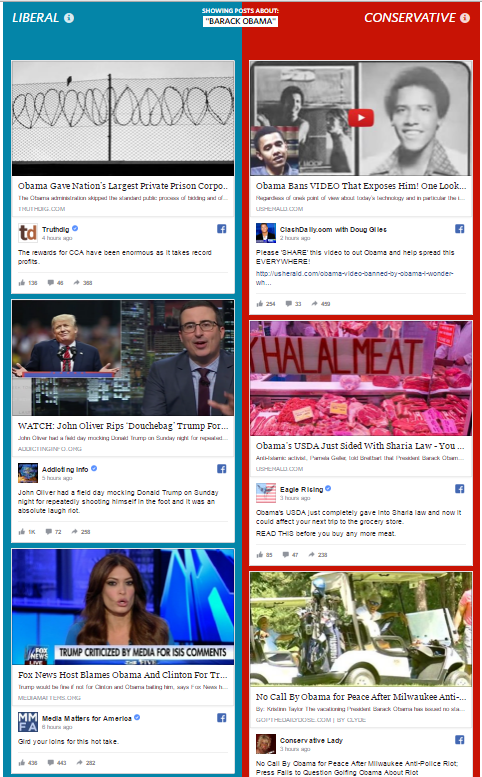
At the Wall Street Journal, you can take a look at these different media bubbles side-by-side. They frame the data as what you might see in your Facebook feed if most of your friends identify as “very liberal” or “very conservative.” More broadly, what the data represents is the use of Facebook data as an insight into the bigger media bubbles we all live in both on- and off-line.

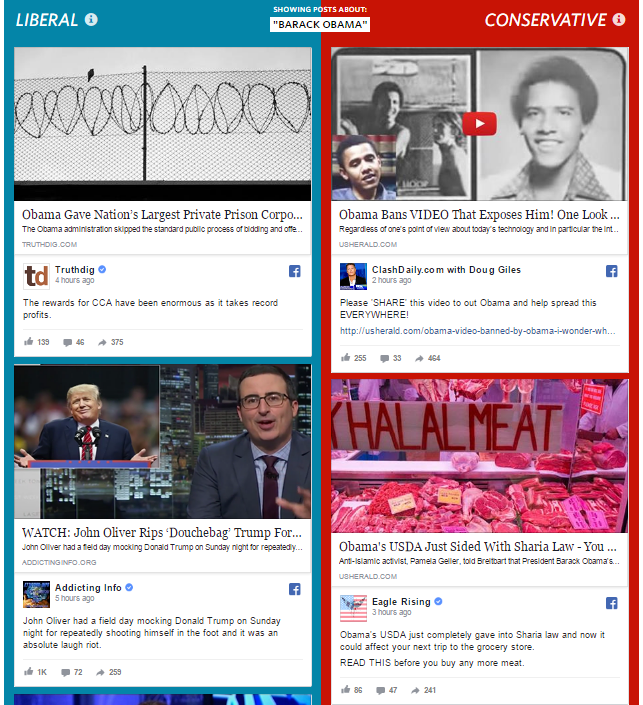
Here’s the first four results for posts about “Barack Obama”:
1

On the left you have a critical article about Obama’s light treatment of private prison corporations, but also a headline calling Donald Trump a “douchebag.” On the right you have a link to a video “banned by Obama himself” which purports to out him as an Islamist and a communist and a headline that says that Obama “gave into Sharia law.”

Liberal-leaning and conservative-leaning headlines and updates related to Donald Trump and Hillary Clinton read like this:

Liberal: “Clinton surges past 270 electoral votes…”

Conservative: “After Leading by 18 Points — Hillary’s Lead Over Trump Shrinks to Margin-of-Error”

Liberal: “Reagan’s Son Says His Dad Would be ‘Humiliated’ by Trump”

Conservative: “FBI Caves: Will Hand Over Notes from Clinton Interview”

Liberal: “Fox News is the Origin Story of Trump’s Bigotry”

Conservative:”Hillary Mobilizes Illegal Army”

Liberal: “Brian Stelter Blasts Sean Hannity for Spreading Conspiracy Theories Regarding Clinton’s Health”

Conservative: “Trump Releases Bombshell Report Linking Obama and Hillary to Rise of ISIS”

You get the picture.

It’s interesting that the narrative of America being a united country is so widely promulgated by both liberal and conservative sides alike. If the politicians really want us to come together (and I doubt they do), the media isn’t helping. Granted, these are the extremes, but the sources on the side I oppose look like delusional conspiracy hubs to me, whereas I recognize many of the outlets on the side to which I lean. To me, those are “good” news sources, ones I count on. Presumably someone on the other side would feel the same about theirs and be equally horrified about mine.

The stories these different sources tell are not compatible. The “very liberal” and “very conservative” side are two wholly different worlds. It’s no wonder each side has such a difficult time understanding the other. I fear what it means about the future of our democracy.

Lisa Wade, PhD is an Associate Professor at Tulane University. She is the author of American Hookup, a book about college sexual culture; a textbook about gender; and a forthcoming introductory text: Terrible Magnificent Sociology. You can follow her on Twitter and Instagram.
Flashback Friday.

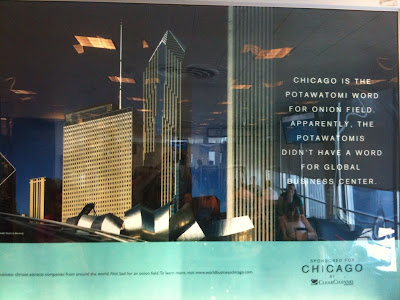
I was waiting for my connecting flight at Chicago O’Hare, and spotted this advertisement on the opposite side of our gate. It reads:

“Chicago is the Potawatomi word for onion field. Apparently, the Potawatomis didn’t have a word for global business center.”

This is an example of the use of Indigenous language and imagery that many people wouldn’t think twice about, or find any inherent issues with. But let’s look at this a little deeper:

  • The use of past tense. It’s not “The Potawatomis don’t have a word for…” it’s “The Potawatomis didn’t…” Implying that the Potawatomi no longer exist or are using their language.
  • The implication that “Indians” and “Global Business Center” aren’t in congruence. Which is assuming that Natives are static, unchanging, and unable to be modern and contemporary. “Potawatomi” and “Onion Field” are fine together, because American society associates Indians with the natural world, plants, animals, etc. But there is definitely not an association between “Potawatomi” and “Global Business”.

But, in reality, of course Potawotomis still exist today, are still speaking their language, and do have a word for Global Business Center (or multiple words…).

Language is constantly evolving, adapting to new technology (remember when google wasn’t a verb?) and community changes.  I remember reading a long time ago in one of my Native studies classes about the Navajo Nation convening a committee to discuss how one would say things like “computer” or “ipod” in Navajo language, in an effort to preserve language and culture and promote the use of Navajo language among the younger generation.

In fact, here’s an awesome video of a guy describing his ipod in Navajo, complete with concepts like “downloading” (there are subtitles/translations):

Native peoples have been trading and communicating “globally” for centuries, long before the arrival of Europeans. To imply that they wouldn’t have the ability to describe a “Global Business Center” reeks of a colonialist perspective (we must “civilize” the savage! show him the ways of capitalism and personal property, for they know not of society!).

Thanks, Chicago, for giving me one more reason to strongly dislike your airport.

Originally posted in 2010.

Adrienne Keene, EdD is a graduate of the Harvard Graduate School of Education and is now a postdoctoral fellow in Native American studies at Brown University. She blogs at Native Appropriations, where this post originally appeared. You can follow her on Twitter.

Today is Labor Day in the U.S. Though many think of it mostly as a last long weekend for recreation and shopping before the symbolic end of summer, the federal holiday, officially established in 1894, celebrates the contributions of labor.

Here are some SocImages posts on a range of issues related to workers, from the history of the labor movement, to current workplace conditions, to the impacts of the changing economy on workers’ pay:

The Social Construction of Work

Work in Popular Culture

Unemployment, Underemployment, and the “Class War”

Unions and Unionization

Economic Change, Globalization, and the Great Recession

Work and race, ethnicity, religion, and immigration

Gender and Work

The U.S. in International Perspective

Academia

Just for Fun

Bonus!

Lisa Wade, PhD is an Associate Professor at Tulane University. She is the author of American Hookup, a book about college sexual culture; a textbook about gender; and a forthcoming introductory text: Terrible Magnificent Sociology. You can follow her on Twitter and Instagram.
Originally posted at Reports from the Economic Front.

For years now the wealthy and their media have hammered on the need for lower taxes on their income, arguing that this would encourage investment, job creation, and growth.  The tax burden on the wealthy has indeed been lowered in one way or the other, but only the wealthy have benefited. In particular, our public sector and the activities it supports — public infrastructure, education, health care and human services, etc. — have suffered.

Apparently, people are starting to draw the right lesson from this experience.  As the Washington Post reports:

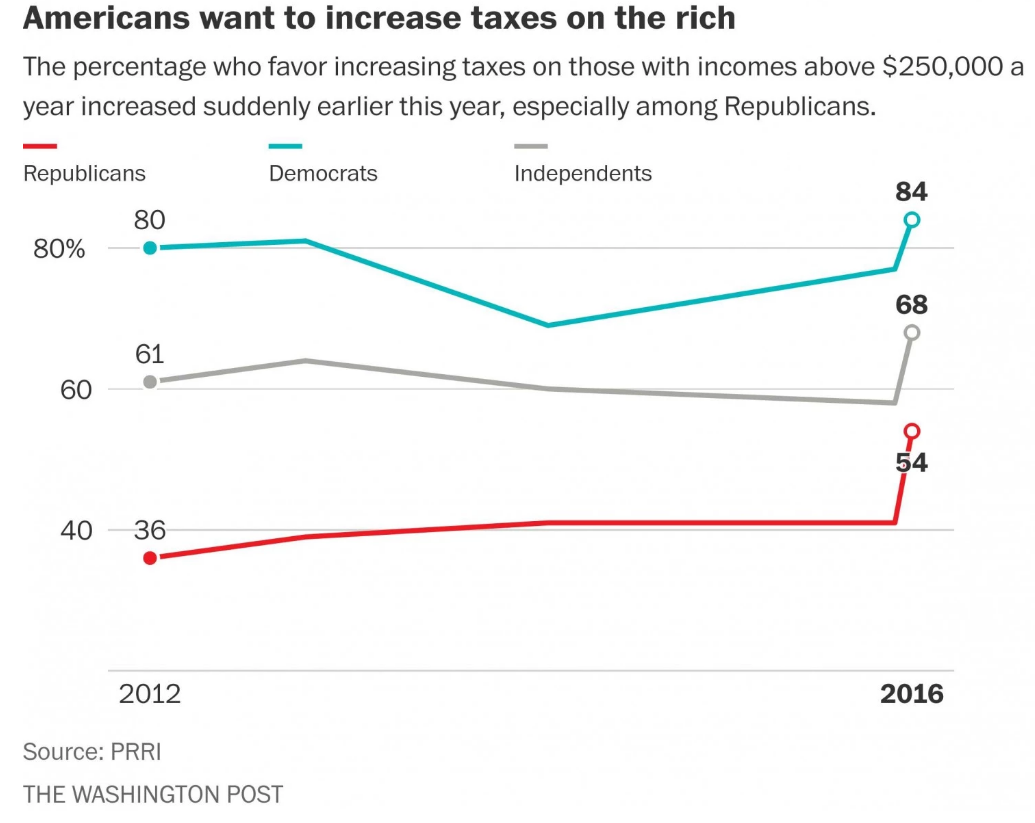
The results from the Public Religion Research Institute and the Brookings Institution [survey] show that 54 percent of Republicans support increasing taxes on those with incomes over $250,000 a year, an increase of 18 percentage points since the last presidential election in 2012. Among Americans as a whole, 69 percent support an increase.

tax increase

While the change in opinion was greatest for Republicans, as the figure above shows, the survey also found increased support for greater taxes on the rich among both Democrats and Independents.  The fact that this support began spiking early in the year suggests that the change is tied to the election process, although it is unclear whether the campaigns are driving the growing support for higher taxes on the wealthy or people are just taking advantage of the process to express their desire for change.

Martin Hart-Landsberg is a professor of economics at Lewis and Clark College. You can follow him at Reports from the Economic Front.

On this anniversary of Hurricane Katrina, all of Louisiana is reeling from this month’s floods. A third of the state has been declared a disaster area. Here in New Orleans we were spared, but we are opening our hearts, pocketbooks, and homes to our neighbors. It is in this time of crisis that we remember the day that Katrina devastated the Gulf Coast and side-swiped New Orleans, breaching and breaking the levees.

Was Hurricane Katrina a “Natural” Disaster?

Racism and Neglect

Disaster and Discourse

Devastation and Rebuilding

Flashback Friday.

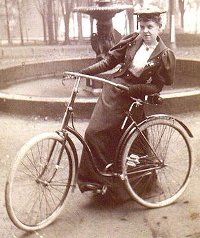
In the U.S. men’s and women’s bikes are built differently, with women’s bikes lacking the bar that goes from the handlebar to just below the seat. The bar is a matter of tradition.  According to Andrea at Bike City Recyclery, when women began riding bikes in the 1800s, they were required to wear heavy skirts.  The low bar allowed them to mount the bikes “modestly” and was a space for their skirts to go.  Back then, bikes also had “clothes-guards” that would keep women’s skirts from being caught up in the mechanics of the bike.  This picture is from the 1890s:

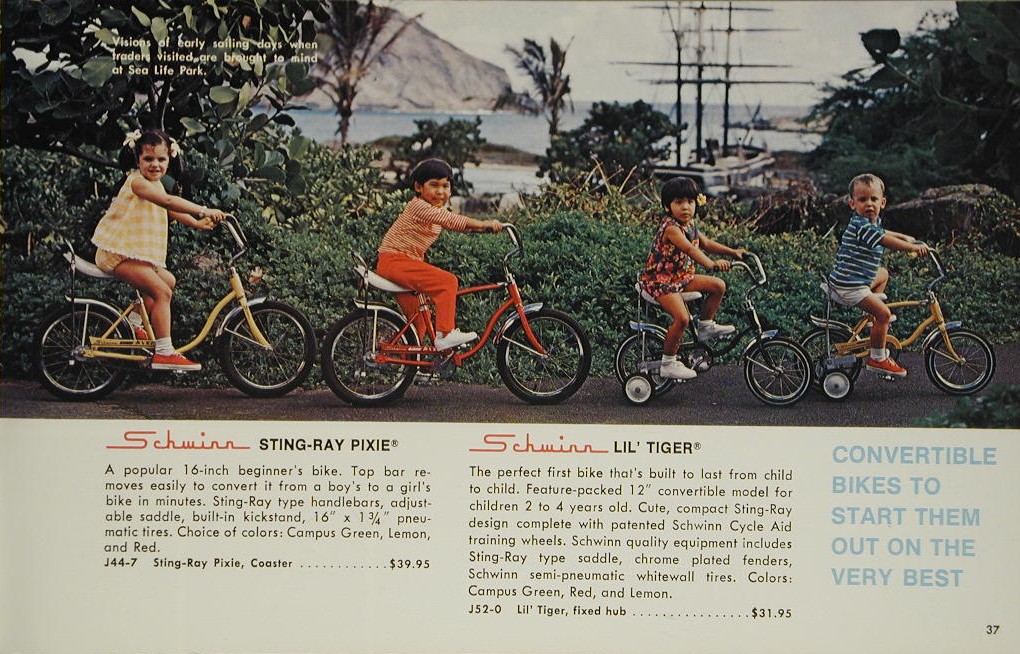
Today most women riding a bike do not wear heavy skirts and clothes-guards are rare, but the low bar persists.  This ad from 1971 assures parents that  “girl bikes” can be converted to “boy bikes” and vice versa. The upper bar is purely “decorative,” but boys apparently must have it.

Selected text:

A popular 16-inch beginner’s bike. Top bar removes easily to convert it from a boy’s to a girl’s bike in minutes… The perfect first bike that’s built to last from child to child.

This goes to show how strongly we invest in purely symbolic gender differentiation.  There is no need for a high bar and there is no need to differentiate bikes by gender in this way. We could do away with the bar distinction in the same way that we did away with the clothes-guard. But the bar is a highly visible signal that we are committed to a gender binary (men and women are “opposite” sexes). It is some men and the defenders of masculinity who are most opposed to this because collapsing the gender differentiation means collapsing a devalued category into a valued category. For individuals who embrace the valued category, this is a disaster. A male-coded bike frame is just one small way to preserve both the distinction and the hierarchy.

Originally posted in 2010.

Lisa Wade, PhD is an Associate Professor at Tulane University. She is the author of American Hookup, a book about college sexual culture; a textbook about gender; and a forthcoming introductory text: Terrible Magnificent Sociology. You can follow her on Twitter and Instagram.
Cultural appropriation generally refers to the adoption of traditional practices, objects, or images by a person or group that is not part of the originating culture. Cultural appropriation can become problematic when it is done without permission, serves to benefit the dominant group, and erases or further marginalizes the oppressed group. In this way, cultural appropriation can recreate larger structures of inequality.

On a recent stroll through a duty-free shop, I was introduced to one of these problematic examples in the form of a new Canadian product named “Totem Vodka,” packaged in a bottle resembling a totem pole. Totem Vodka is not a product of Indigenous entrepreneurship. Instead it is a form of problematic cultural appropriation. Here’s why:

First Nations Erasure

Totem poles are important symbolic creations of some First Nations families in Canada’s Pacific Northwest. They are symbols of family lineage that serve to document stories or histories of people, communities or clans. The Totem Vodka bottle and marketing images erases these families, while appropriating their symbols.


The bottle stopper is shaped like a Thunderbird, a supernatural bird who causes thunder and lightning according to First Nations mythology. The Thunderbird crest is traditionally carved on the totem poles of people from the Thunderbird clan of the Kwakwaka’wakw nations (on Vancouver Island). The origin of the Thunderbird (and totem poles) within Pacific Northwest First Nations communities is absent from the company’s description of the bottle’s design and construction. Instead, the bottle is superficially connected to a wide-array of global references; the bottle was “designed on the West Coast of Canada, moulded by French glassmakers and topped with an Italian-made custom stopper.”

Significantly, the individuals featured in pictures on the company’s Twitter account include few or no indigenous people.

First Nations Exploitation

The owner of Totem Distilleries is a wealthy white entrepreneur and proceeds from the vodka help support a wildlife rescue association without any First Nations connection.

Settler societies have, paradoxically, both outlawed the sacred work of totem pole carving by indigenous peoples and exploited it for their own profit. In this case, the totem pole is used as an aesthetic tool to distinguish the vodka as authentically “Canadian,” while reproducing an abstracted, exotified, and ultimately false vision of indigeneity. First Nations people in Canada have rarely been either credited or compensated for the use of their cultural symbol.

The example of Totem vodka fits within a larger pattern of racism and colonial exploitation of indigenous people. We can look to the historical effects of colonization in Canada to see how attempts to erase Indigenous culture, while simultaneously exploiting it for the benefit of colonizers, has led to systemic discrimination, exclusionary policies and neglect that continue into the present day. Using a totem pole as a vodka bottle symbolizes this larger, patterned systems of inequality.

Alexandra Rodney is a PhD candidate in the Department of Sociology at the University of Toronto. She teaches Cultural Sociology and researches in the areas of food, gender and health. You can read more of Alexandra’s work on her website or follow her on Twitter. 

A special thank-you to Josée Johnston and Samantha Maskwa for their feedback on this post. Samantha is of Cree, Ojibway and Celtic ancestry. Her family is from the Rice Lake area and the southern part of Turtle Island and she is Bear clan. In addition to her midwifery degree, she is also completing a minor in Sociology and an Aboriginal Knowledges and Experiences certificate at Ryerson University in Toronto.

The great Louisiana Floods of 2016 have led to the closure of at least 22 of the state’s 70 public school districts, with additional districts calling off classes as a precaution given the immense devastation. This means that as many as one-third of the state’s public school students were out of school last week ,and potentially for many weeks to come. That equates to more than 241,000 children who are not in classrooms where they belong; and these figures do not even account for the many thousands of private and charter school students also out of school across the water-logged state.

2

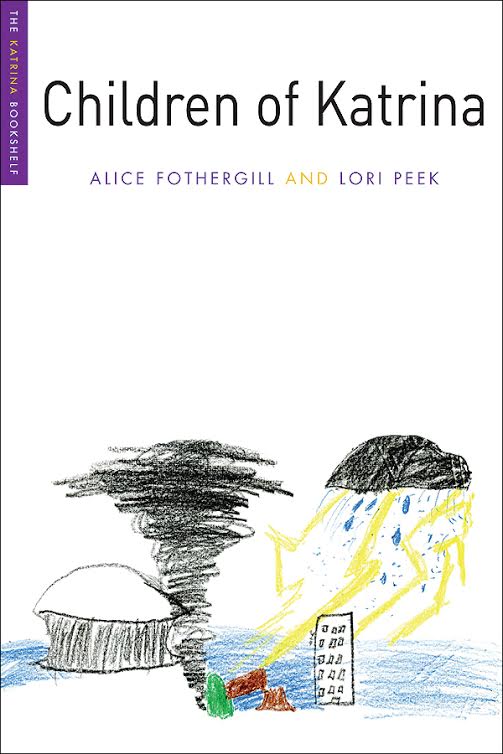
Almost exactly 11 years ago, Hurricane Katrina disrupted some 370,000 school-age children. For our book, Children of Katrina, we spent nearly a decade examining how their lives unfolded in the years after the catastrophe. We focused on education as a key “sphere” of children’s lives. It is a special sphere in that it is unique to children and youth and it has specific time parameters: when the window for schooling is gone, children cannot get it back. Missing school means missing critical stages in cognitive and social development and likely suffering irreparable harm in terms of their intellectual growth, development, and future educational goals.

The school sphere, as with the other spheres of children’s lives, is marked by inequality, with some students having access to greater advantages than others. Some school districts, often segregated by race and class, have more resources and support than others; some families have the ability to enroll children in private schools that require tuition or arrange to be in a high-quality school district, while other families do not have those options.

Keeping this in mind, and recognizing the importance of education during displacement and recovery, there are many things that can and should be done, to support disaster affected children and youth and their educational process. These include:

  • Reopening schools (including childcare centers and pre-schools) as quickly as possible after a disaster; this means allocating proper resources to repair, rebuild, and/or revive schools in disaster zones;
  • In receiving communities that receive large numbers of displaced children and youth, providing pathways for their rapid enrollment;
  • Offering emotional support through optional peer-oriented and/or peer-led support groups as well as licensed professional counselors, social workers, and school therapists;
  • Training all school staff—from upper-level administrators, to teachers, to custodians—how to be supportive of children and youth who have been affected by disaster as well as those who are in receiving communities who are now welcoming disaster-affected youth into their classrooms;
  • Designing and implementing disaster preparedness, response, and recovery curriculum within classrooms;
  • Providing opportunities for children to help their schools’ and classmates’ recovery; this could, for example, come in the form of service learning, fundraising, mentoring programs, or community action activities;
  • Offering immediate and long-term support for teachers, who are often recovering from disaster themselves; this may include financial, professional, and emotional support;
  • Intervening against bullying and stigma that may be attached to “disaster survivor” status for youth; reminding these professionals that bullying may be exacerbated based on region of origin, gender, age, race, or other characteristics;
  • Integrating displaced children in classrooms with familiar faces if possible;
  • Making school days as predictable as possible and re-establishing routines within classrooms and schools;
  • Allowing children and youth the opportunity to work on projects that help them process their disaster experience;
  • Funding school programs in arts, music, drama, and creative writing to encourage expression and foster healing.

Alice Fothergill, PhD is an associate professor of sociology at the University of Vermont. She is a member of the Social Science Research Council Research Network on Persons Displaced by Katrina. Fothergill’s book, Heads Above Water: Gender, Class, and Family in the Grand Forks Flood, examines women’s experiences in the 1997 flood in North Dakota. She is also co-editor of Social Vulnerability to Disasters.

Lori Peek, PhD is an associate professor of sociology and Co-Director of the Center for Disaster and Risk Analysis at Colorado State University. She also serves as the Associate Chair for the SSRC Task Force on Hurricane Katrina and Rebuilding the Gulf Coast and is a member of the SSRC Research Network on Persons Displaced by Katrina. Peek is the author of the award-winning book Behind the Backlash: Muslim Americans after 9/11 and co-editor of the volume Displaced: Life in the Katrina Diaspora.

Together, Fothergill and Peek are the authors of the award-winning book, Children of Katrina, the longest-term ethnographic study of children in disaster.