Search results for The

Privilege comes in many forms: class privilege, white privilege, male privilege, heterosexual privilege and so on.  Being privileged means that you “fit” in the society in which you live and reap rewards by virtue of just being.

Recognizing privilege isn’t just a matter of being thoughtful or empathetic, it usually involves sacrificing something.  Sometimes it’s something big (like the belief that your success is due entirely to your talents and hard work) and sometimes it’s something small.

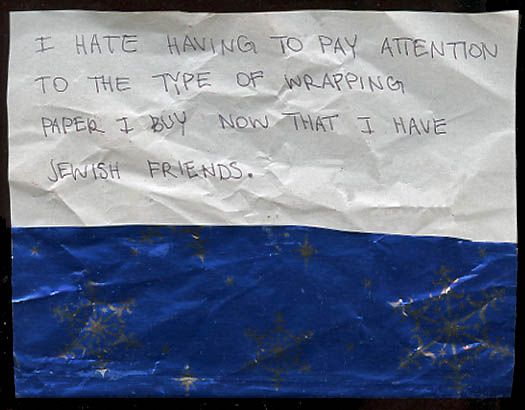
The person who sent this confession to PostSecret is admitting to feeling frustrated by giving up one of those small benefits that come with privilege:
wrapping_
Originally posted in 2009.

Lisa Wade, PhD is an Associate Professor at Tulane University. She is the author of American Hookup, a book about college sexual culture; a textbook about gender; and a forthcoming introductory text: Terrible Magnificent Sociology. You can follow her on Twitter and Instagram.

A new study has discovered that 48% of the nation’s 50 million public school students are in poverty, as measured by whether they qualify for free or reduced-priced lunches.  In 17 states, the majority of schoolchildren are poor.  Poverty rates are led by Mississippi, where 71% of children are in poverty.

These data represent a startling rise since 2000:

Screenshot_1

While the statistics are the worst for states in the South and the West, the percent increase in poor children was the highest in the Midwest (up 40% since 2001, compared to 33% in the South, 31% in the West, and 21% in the Northeast).  All, of course, extraordinary increases.

h/t @Miel_Machetes.  Cross-posted at Pacific Standard.

Lisa Wade, PhD is an Associate Professor at Tulane University. She is the author of American Hookup, a book about college sexual culture; a textbook about gender; and a forthcoming introductory text: Terrible Magnificent Sociology. You can follow her on Twitter and Instagram.
Kids growing up in dense, urban environments often turn to basketball as their sport of choice.  This is partly because it fits, in a physical sense.  All things being equal, a basketball court takes up a lot less room than a football or soccer field.  For the economically disadvantaged, it’s also relatively cheap to play.  If you have a court available, you only need a pair of shoes and a ball.  For this reason, whatever population finds itself in this type of environment tends to take up basketball.

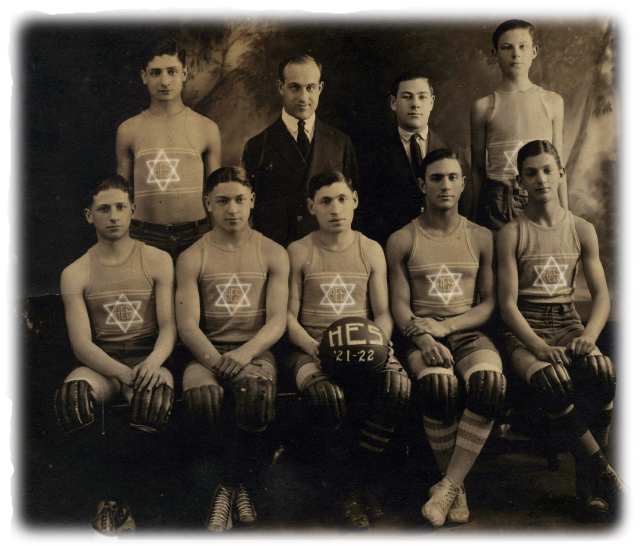
That’s why the sport was dominated by Jews in the first half of the 1900s.  Just like many African-Americans today, at that time many immigrant Jewish families found themselves isolated in inner cities.  Basketball seemed like a way out.  “It was absolutely a way out of the ghetto,” explained retired ball player Dave Dabrow.  Basketball scholarships were one of the few ways low income urban Jews could afford college.

Jewish basketball team (1921-22):

CA.1031.firstbasket

Today we refer to stereotypes about Black men to explain why they dominate basketball, but this is an after-the-fact justification.  At the time, very different characteristics — stereotypes associated with Jews — were used to explain why they dominated professional teams. Paul Gallico, sports editor of the NY Daily News in the 1930s, explained that “the game places a premium on an alert, scheming mind, flashy trickiness, artful dodging and general smart aleckness.”  All stereotypes about Jews.  Moreover, he argued, Jews were rather short and so had “God-given better balance and speed.”  Yep.  There was a time when we thought being short was an advantage in the sport of basketball.

Never underestimate the power of institutions and how much things can change.

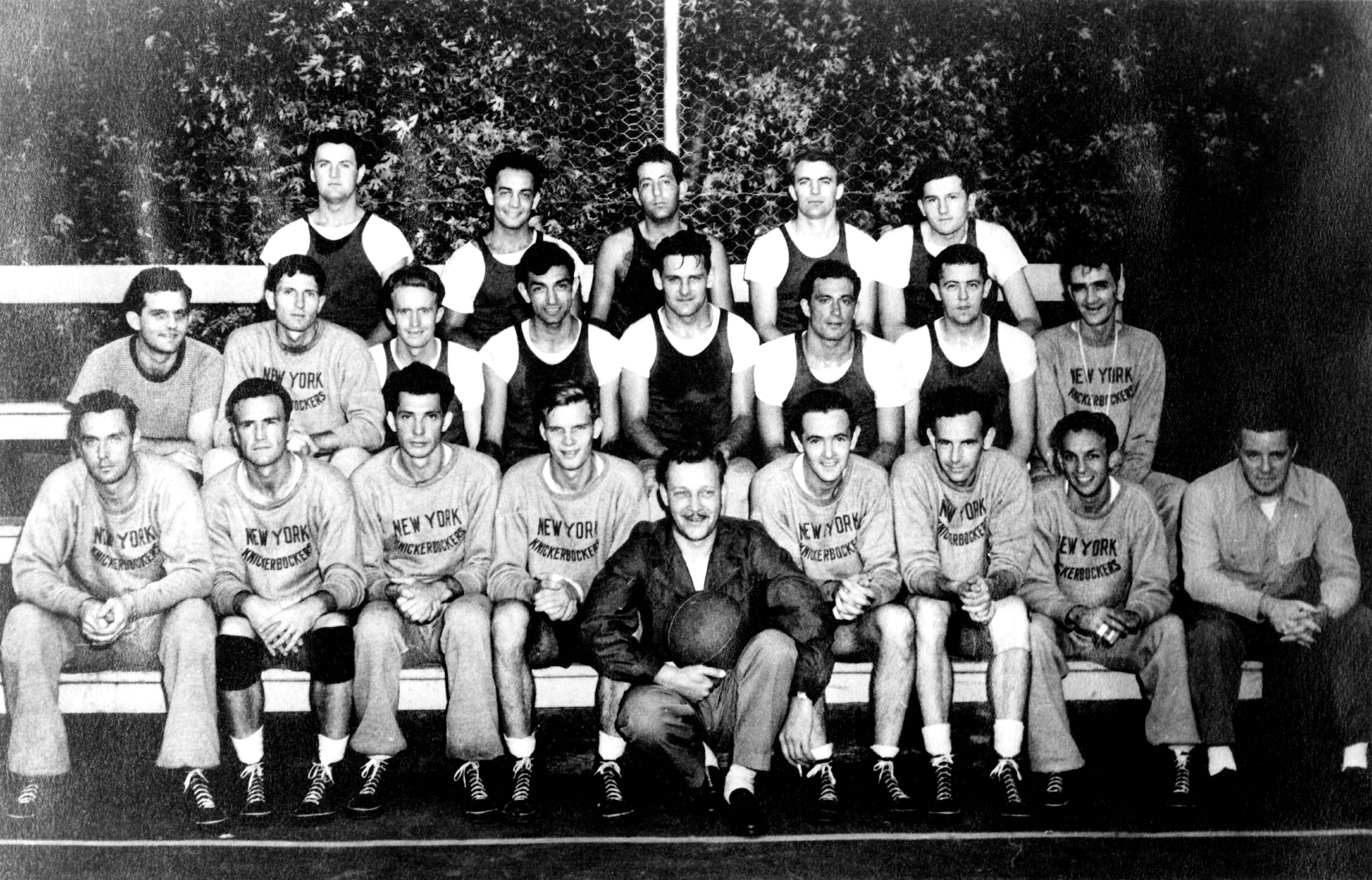
New York Knicks (1946-1947):

1946 New York Knicks Team PhotoCross-posted at Pacific Standard.


Lisa Wade, PhD is an Associate Professor at Tulane University. She is the author of American Hookup, a book about college sexual culture; a textbook about gender; and a forthcoming introductory text: Terrible Magnificent Sociology. You can follow her on Twitter and Instagram.
We’ve highlighted the ways in which society portrays men as people and women as women many times over.  So many times, in fact, that we started a Pinterest collection.  There are two scenarios in which men are the default person: (1) masculine spaces, like the workplace and politics, and (2) neutral spaces that aren’t associated with men or women, like museums and the internet.

When something is distinctly feminized, however, things flip.  @jessimckenzi and @freedenoeur forwarded us a pointed example: a brand of lotion called “everyone.”  Everyone lotion comes in two types: everyone lotion “for everyone and every body” and everyone lotion for men:

Screenshot_6This practice reminds us who belongs where by making one gender or the other the neutral participant and then adding a modifier in order to selectively include the other sex. Another example of this phenomenon is the masculinizing of feminine products in order to sell them to men and the feminizing of masculine products to sell them to women. Together these practices affirm and naturalize gender-based segregation in our social spaces and activities.

Lisa Wade, PhD is an Associate Professor at Tulane University. She is the author of American Hookup, a book about college sexual culture; a textbook about gender; and a forthcoming introductory text: Terrible Magnificent Sociology. You can follow her on Twitter and Instagram.

The Kennedy assassination was my first clear lesson in the sociology of emotions, though I didn’t know it at the time.  I was in Japan, living with a Japanese family in a small town in the mountains of Nagano prefecture. I had been there less than two months, my knowledge of the language was barely rudimentary. There were no other Americans. I was the first Westerner many people in the town had ever seen in the flesh. (Everyone had seen gaijin on TV since the Japanese networks ran many American shows.)

When I came to breakfast that Saturday morning, and even before I had taken my place the tatami floor with the others,  my Japanese family desperately tried to tell me the news. At first all I could understand was that it had something to do with Kennedy. The Japanese words for shoot or kill were not part of my tiny vocabulary. I knew the word for dead, but when the father of the family used it, I assumed I was hearing one of the many homophones. The television was on, but I certainly could not understand what the news readers were saying. Finally, the father, still seated, acted it out. He fired his index-finger pistol. Then pointing to himself and saying, “Kennedy,” he clutched his hands to his chest and canted his body over as if falling to the floor.  The gravest event translated into a simplified charade – it would have seemed ludicrous had it not been so serious.

I understood, but I was still incredulous. In the next few days, I learned more, mostly from the one person in the town who spoke fluent English (he had just come back from a year in Kansas), and from the English language daily, the Japan Times, my only outside source of information. I remained isolated from other Americans. If emotions are contagious, I had been quarantined.

It was only much later, when I was back in the US that I learned of what it was like to be here then. When I heard people describing where they were; or on anniversaries like today, when the media hauled out their archival footage – only then did I sense the emotion that so many Americans felt.

Most people, if asked, would probably have said that their grief was caused entirely by a personal sense of loss perhaps and the symbolic meaning they assigned to Kennedy – the president who, in is youth and vibrancy, represented hope for the future, etc.

I had felt none of that. I was stunned of course. In the world I had taken for granted, presidents did not get assassinated.  Now that assumption was shattered.  But the Kennedy in my mind was still the same person, politician, and president that he had been before the assassination. So I missed out on feeling of grief and great loss. And I think the reason that I did not feel those emotions is not that I was young and callow (though I was that too) but that I was so isolated. Had I been in the US, engaged in the flood of constant talk, both in person and in the media, I would probably have felt those feelings more intensely.

When something so unusual and traumatic happens, we search for a way to make sense of it – our old sociological friend, a “definition of the situation.”  In that search, we look to others, and the definition we learn from others – what this thing is and what it means – is not just information and explanation. We learn the emotions that are part of this definition. We have a fairly large repertoire of emotions that we can experience, and in a sympathetic-vibration-like process, the emotions we see all around us evoke the same emotion in us.  We experience that emotion as personal.  But in an important way, it is also social.

Cross-posted at Montclair SocioBlog.

Jay Livingston is the chair of the Sociology Department at Montclair State University. You can follow him at Montclair SocioBlog or on Twitter.

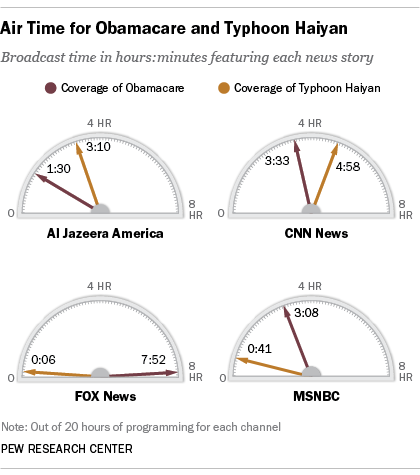
Yesterday the Pew Research Center released data on the news coverage of Typhoon Haiyan — a disaster that has killed at least 4,000 people — and the bungled Obamacare website roll-out.  Comparing 20 hours of news coverage over four major U.S. channels, they found dramatic differences.  The data below shows the hours and minutes spent on each topic at each channel (red = Obamacare, yellow = the typhoon).

large-1

First, the two partisan channels (Fox News and MSNBC) gave more time to Obamacare than the typhoon.  On MSNBC, there was four times as much coverage of Obamacare.  On Fox, there as a stunning 80 times as much coverage.  Al Jazeera America and CNN spent significantly more time on the typhoon, likely reflecting their more global focus and less of an ideological mission.

The channels also differed in how much time they spent on facts/reporting versus opinion/commentary.  Check it out:

1

While most all of us sometimes lazily refer to “the media” as if it’s a homogeneous thing, it’s important to remember that our perceptions of reality are strongly shaped by which media we consume.

Lisa Wade, PhD is an Associate Professor at Tulane University. She is the author of American Hookup, a book about college sexual culture; a textbook about gender; and a forthcoming introductory text: Terrible Magnificent Sociology. You can follow her on Twitter and Instagram.
131105124405-04-richie-incognito-horizontal-gallery
Source: Doug Benc/Getty Images.

On October 28th, Miami Dolphins offensive lineman Jonathan Martin left the National Football League citing emotional distress as a result of abuse at the hands of his teammate Richie Incognito.  Incognito admits to having sent Martin racist, homophobic, and threatening text messages and voicemails but argues that rather than hazing or bullying, this was merely an instance of miscommunication between the two men.

While a great deal of media attention has questioned the behavior of Richie Incognito, a disproportionate amount of attention has also been given to Martin’s choice to report the abuse.  Why has Martin’s choice to report the abuse received so much attention?  What has been the main theme of those critiquing Martin’s choice?  And, what does this discussion mean for our national discourse on bullying and hazing?  The answers to these questions, I argue, are all linked to masculinity.

The media talks about Martin’s choice to report because his decision violated accepted cultural norms of masculinity.  Some may call these norms, more colloquially, the “bro code,” “guy code,” or “man code.”  Whatever we choose to call it, there are accepted ways in which men and boys are expected to conduct ourselves and our relationships to other men.  Martin stands accused, especially within the athletic community, of having broken the code.

In a very telling interview, Channing Crowder, a former teammate of Incognito, made it clear that this conversation is really about masculinity.  According to Crowder, Incognito tests his teammates.  He “tests you to see if you have enough manhood or enough testosterone” (even though this type of bullying is just as much about the perpetrator’s masculinity as it is the victim’s).

In this case Martin’s masculinity is under attack on two fronts.  First, it is under attack because he failed Incognito’s “test” of his manhood.  Second, he is under attack because his solution to Incognito’s bullying violated guy code.  According to the code, real men solve their problems with one another through violence.

Sports Illustrated reported that many NFL personnel consider Martin to be a coward or a wimp for reporting the abuse.  One NFL informant was even quoted saying “I think Jonathan Martin is a weak person.  If Incognito did offend him racially, that’s something you have to handle as a man.”  Others said it would have been preferable for Martin to “go down swinging” or to “fight.”  Even NPR ran a piece in which a regular guest argued:

Martin should have taken that dude outside and put his lights out.  I do not – I absolutely do not believe in a society where we run to the principal’s office every time these petty tyrants make a threat… Only power dispatches bullies… Jonathan Martin is a grown man and you can’t bully a grown man.

To be fair, in that same NPR piece, another interviewee stated that “not everybody resorts to violence in response to bullying and I applaud him for that.”

Nevertheless, by reporting the abuse rather than physically confronting Incognito, Jonathan Martin has been publicly stripped of his “man card.”

But, so what?  Why should we care about how grown men address bullying?  We should care because just as Jonathan Martin is being told to “man up,” so are young boys all over the country when they are bullied.  Boys are told that when they cannot physically confront a bully they are inadequate and unworthy.  They are taught to remain silent in the face of insurmountable violence because speaking out is a sign of weakness, or worse, femininity.  Too many boys are left with nowhere to turn when bullying makes trauma a daily experience.  In this sort of environment can we really be surprised that boys are committing suicide, developing depression, and lashing out violently at incredibly high rates?

Incognito on film:

Cliff Leek is a PhD student in the Department of Sociology at Stony Brook University.  He is a News Editor for Sociology Lens, co-founder of Masculinities 101, a Program Director for the Center for the Study of Men and Masculinities and a Research Assistant to TrueChild.  

Cross-posted at Sociology Lens and The Good Men Project.

Sociologists like to say that gender identities are socially constructed. That just means that what it is, and what it means, to be male or female is at least partly the outcome of social interaction between people – visible through the rules, attitudes, media, or ideals in the social world.

And that process sometimes involves constructing people’s bodies physically as well. And in today’s high-intensity parenting, in which gender plays a big part, this includes constructing – or at least tinkering with – the bodies of children.

Today’s example: braces. In my Google image search for “child with braces,” the first 100 images yielded about 75 girls.

Screenshot_1

Why so many girls braced for beauty? More girls than boys want braces, and more parents of girls want their kids to have them, even though girls’ teeth are no more crooked or misplaced than boys’. This is just one manifestation of the greater tendency to value appearance for girls and women more than for boys and men. But because braces are expensive, this is also tied up with social class, so that richer people are more likely to get their kids’ teeth straightened, and as a result richer girls are more likely to meet (and set) beauty standards.

Hard numbers on how many kids get braces are surprisingly hard to come by. However, the government’s medical expenditure survey shows that 17 percent of children ages 11-17 saw an orthodontist in the last year, which means the number getting braces at some point in their lives is higher than that. The numbers are rising, and girls are wearing most of hardware.

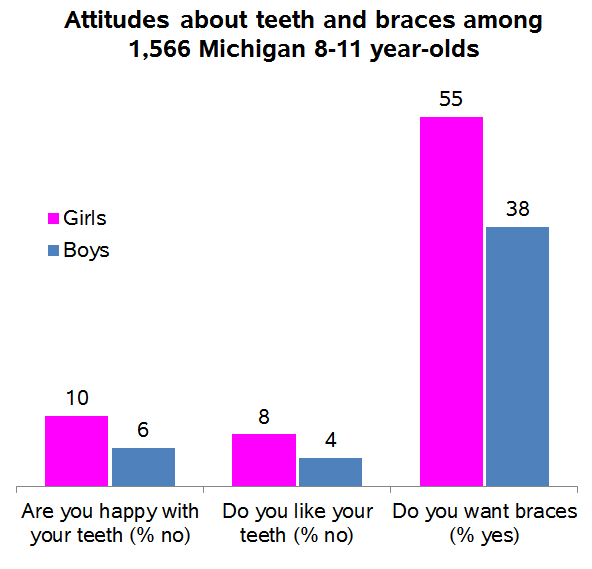
study of Michigan public school students showed that although boys and girls had equal treatment needs (orthodontists have developed sophisticated tools for measuring this need, which everyone agrees is usually aesthetic), girls’ attitudes about their own teeth were quite different:

michigan-braces

Clearly, braces are popular among American kids, with about half in this study saying they want them, but that sentiment is more common among girls, who are twice as likely as boys to say they don’t like their teeth.

This lines up with other studies that have shown girls want braces more at a given level of need, and they are more likely than boys to get orthodontic treatment after being referred to a specialist. Among those getting braces, there are more girls whose need is low or borderline. A study of 12-19 year-oldsgetting braces at a university clinic found 56 percent of the girls, compared with 47 percent of the boys, had “little need” for them on the aesthetic scale.

The same pattern is found in Germany, where 38 percent of girls versus 30 percent of boys ages 11-14 have braces, and in Britain – both countries where braces are covered by state health insurance if they are needed, but parents can pay for them if they aren’t.

Among American adults, women are also more likely to get braces, leading the way in the adult orthodontic trend. (Google “mother daughter braces” and you get mothers and daughters getting braces together; “father son braces” brings you to orthodontic practices run by father-son teams.)

Teeth and consequences

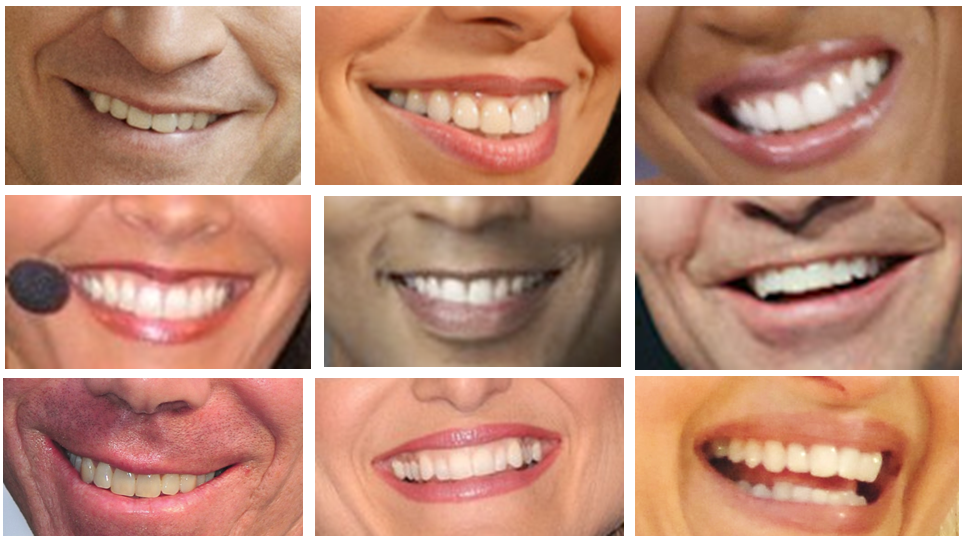
anchors-braces
Caption: The teeth of TV anchors Anderson Cooper, Soledad O’Brien, Robin Roberts, Suzanne Malveaux, Don Lemon, George Stephanopolous, David Gregory, Ashley Banfield, and Diane Sawyer.

.

Today’s rich and famous people – at least the one whose faces we see a lot – usually have straight white teeth, and most people don’t get that way without some intervention. And lots of people get that.

Girls are held to a higher beauty standard and feel the pressure – from media, peers or parents – to get their teeth straightened. They want braces, and for good reason. Unfortunately, this subjects them to needless medical procedures and reinforces the over-valuing of appearance. However, it also shows one way that parents invest more in their girls, perhaps thinking they need to prepare them for successful careers and relationships by spending more on their looks.

When they’re grown up, of course, women get a lot more cosmetic surgery than men do – 87 percent of all surgical procedures, and 94% of Botox-type procedures – and that gap is growing over time.

As is the case with lots of cosmetic procedures, people from wealthier families generally are less likely to need braces but more likely to get them. But add this to the gender pattern, and what emerges is a system in which richer girls (voluntarily or not) and their parents set the standard for beauty – and then reap the rewards (as well as harms) of reaching it.

Cross-posted at Family Inequality, Adios Barbie, and Jezebel.

Philip N. Cohen is a professor of sociology at the University of Maryland, College Park, and writes the blog Family Inequality. You can follow him on Twitter or Facebook.