Search results for The

It can be quite difficult to describe what it feels like to be a member of a group that is widely disparaged or hated. I mean really describe it in a way that other people who are not part of that group can understand. It is powerful when it can be done and even more powerful when it is done in a way such that members of other groups, who are disparaged or hated for other reasons, can see themselves in the story.

I think this is accomplished in the 10 minute monologue below. The speech is by Rory O’Neill, a famous Irish drag queen who goes by the name Panti Bliss. She speaks of what it feels like to encounter homophobia — indeed, to have internalized homophobia — and to try to manage life with an identity that some people openly disparage and hate.

She does such a wonderful job describing it, that I suspect that the feelings that she talks about might be familiar to a wide audience: women, people of color, people with disabilities, the homeless and the poor, people who speak English as a second language, and more.

Lisa Wade, PhD is an Associate Professor at Tulane University. She is the author of American Hookup, a book about college sexual culture; a textbook about gender; and a forthcoming introductory text: Terrible Magnificent Sociology. You can follow her on Twitter and Instagram.
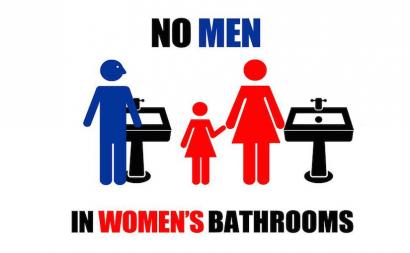
With interest, I have been watching the resistance to the right of trans people to choose public restrooms based on their identity instead of their biology at birth. Though there is no evidence that allowing trans people to use the bathroom of their choice will put anyone in danger, one of the arguments against doing so is that women or children will be victimized. Completely tone deaf to the actual experiences of trans people, the idea is nonetheless framed as allowing men to use women’s restrooms:

12

I can’t help but want to draw connections to history and a recent post at Notches, a history of sexuality blog, helped me do so.

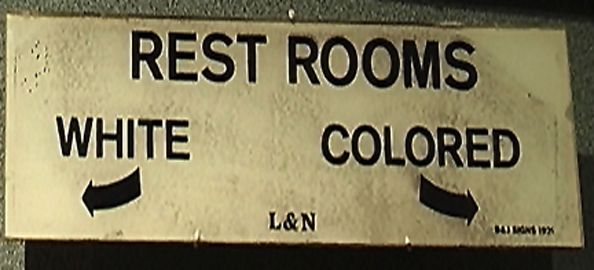
Recall that it wasn’t so long ago that black and white people weren’t allowed to use the same restrooms in public. When this practice came under attack, segregationists in the South, like anti-trans choice advocates today, claimed that it would be dangerous for white women, claiming that they would be infected with black women’s venereal diseases.

8

White women participated in this resistance, protesting against the integration of their bathrooms. A girl at Central High in Little Rock, AR, for example, claimed that bathroom integration functionally stole bathroom facilities from white girls. “Many of the girls won’t use the rest rooms at Central,” she said, “simply because the ‘Nigger’ girls use them.”

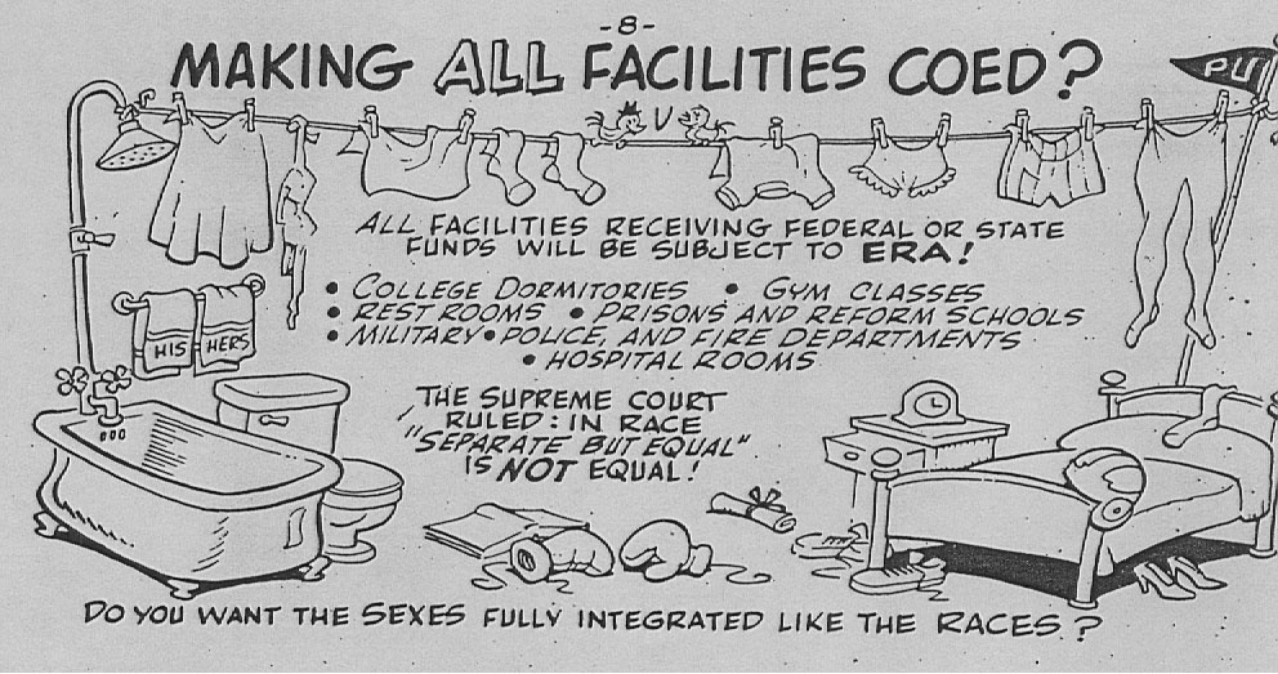
Several decades later, conservatives fighting the Equal Rights Amendment (ERA) for women drew again on racism and the politics of the bathroom. They stoked fear in the American public by suggesting that passage of the ERA would lead to the sex integration of bathrooms. Still smarting from the loss of racial segregation, they even compared race and sex segregation, hoping that the public would be opposed to both.

In this anti-ERA flyer, the final threat is: “Do you want the sexes fully integrated like the races?”

11

Combining the two was a powerful tool, exploiting the longstanding racist belief that white women were uniquely vulnerable to predatory, sexually voracious black men. Both race and sex integration of bathrooms would mean that white women would be going to the bathroom not just with black women, but with black men. “I ain’t going to have my wife be in the bathroom with some big, black, buck!” said one North Carolina legislator.

This same argument, now with trans women as the target, is being made today.

Lisa Wade, PhD is an Associate Professor at Tulane University. She is the author of American Hookup, a book about college sexual culture; a textbook about gender; and a forthcoming introductory text: Terrible Magnificent Sociology. You can follow her on Twitter and Instagram.
The 1% in America have an out-sized influence on the political process. What policies do they support? And do their priorities differ from those of less wealthy Americans?

Political scientist Benjamin Page and two colleagues wanted to find out, so they started trying to set up interviews with the richest of the rich. This, they noted, was really quite a feat, writing:

It is extremely difficult to make personal contact with wealthy Americans. Most of them are very busy. Most zealously protect their privacy. They often surround themselves with professional gatekeepers whose job it is to fend off people like us. (One of our interviewers remarked that “even their gatekeepers have gatekeepers.”) It can take months of intensive efforts, pestering staffers and pursuing potential respondents to multiple homes, businesses, and vacation spots, just to make contact.

Persistence paid off. They completed interviews with 83 individuals with net worths in in the top 1%.  Their mean wealth was over $14 million and their average income was over $1 million a year.

Page and his colleagues learned that these individuals were highly politically active. A majority (84%) said they paid attention to politics “most of the time,” 99% voted in the last presidential election, 68% contributed money to campaigns, and 41% attended political events.

Many of them were also in contact with politicians or officials. Nearly a quarter had conversed with individuals staffing regulatory agencies and many had been in touch with their own senators and representatives (40% and 37% respectively) or those of other constituents (28%).

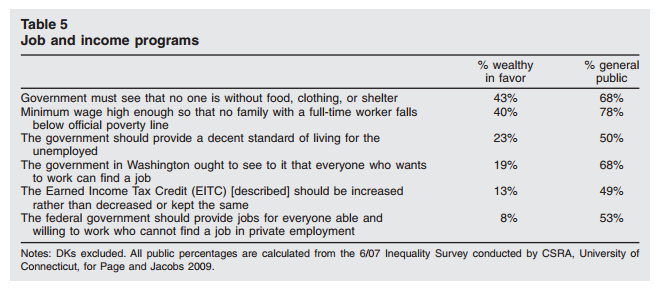
These individuals also reported opinions that differed from those of the general population. Some differences really stood out: the wealthy were substantially less likely to want to expand support for job programs, the environment, homeland security, healthcare, food stamps, Social Security, and farmers. Most, for example, are not particularly concerned with ensuring that all Americans can work and earn a living wage:

3

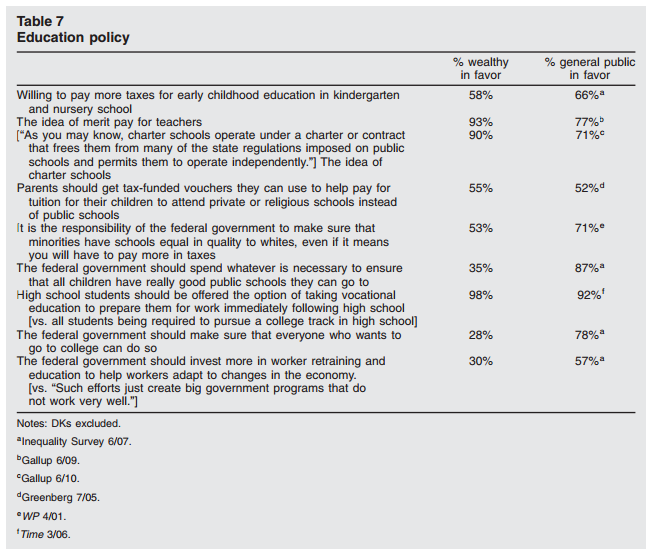
Only half think that the government should ensure equal schooling for whites and racial minorities (58%), only a third (35%) believe that all children deserve to go to “really good public schools,” and only a quarter (28%) think that everyone who wants to go to college should be able to do so.

4

The wealthy generally opposed regulation on Wall Street firms, food producers, the oil industry, the health insurance industry, and big corporations, all of which is favored by the general public. A minority of the wealthy (17%) believed that the government should reduce class inequality by redistributing wealth, compared to half of the general population (53%).

Interestingly, Page and his colleagues also compared the answers of the top 0.1% with the remainder of the top 1%. The top 0.1%, individuals with $40 million or more net worth, held views that deviated even farther from the general public.

These attitudes may explain why politicians take positions with which the majority of Americans disagree. “[T]he apparent consistency between the preferences of the wealthy and the contours of actual policy in certain important areas,” they write, “— especially social welfare policies, and to a lesser extent economic regulation and taxation — is, at least, suggestive of significant influence.”

Lisa Wade, PhD is an Associate Professor at Tulane University. She is the author of American Hookup, a book about college sexual culture; a textbook about gender; and a forthcoming introductory text: Terrible Magnificent Sociology. You can follow her on Twitter and Instagram.
It’s that time of year again!  Enjoy our collection of Halloween posts from years past or visit our Halloween-themed Pinterest page.

Just For Fun

History

Politics and Culture

Race and Ethnicity

Sexual Orientation

Gender

Gender and Kids

The intersection of Race, Class, and Gender

And, for no conceivable reason…

Lisa Wade, PhD is an Associate Professor at Tulane University. She is the author of American Hookup, a book about college sexual culture; a textbook about gender; and a forthcoming introductory text: Terrible Magnificent Sociology. You can follow her on Twitter and Instagram.
At Family Inequality, sociologist Phil Cohen argues that it would be relatively easy for Americans to raise the funds to end child poverty. All it would take is an average of $578 per non-poor family per year. Taxed on a sliding scale, the rich would pay more and the middle and working class less. This is what the tax would look like (more rich on the left, less rich on the right):

eliminate child poverty.xlsx

Thinking that ending poverty for children is “hard” is part of the problem, he argues.

Americans tend to think of poverty as a giant, intractable problem, combining intergenerational dynamics, complex policy tradeoffs, conflicting cultural values, and “personal responsibility” (not to mention genetics).

Ideas like these are a resource for conservatives who don’t want to help poor families or don’t want to help badly enough to let it come out of their pockets. They can argue complexity and shrug. But Cohen wants us to recognize that it would be easy.

And, if it’s so easy, then the persistence of child poverty means that we just don’t want to do it.

He concludes:

Some people say the Pope should stick to religious matters, and not speak about politics. Some people also say a social scientist should stick to scientific analysis, and not make moral demands. You can ignore my moralizing, as long as you understand the fact that child poverty is a choice we make with our policies. Eliminating child poverty does not require restructuring American families, mass contraception campaigns, or a new ethos of shame. It just costs a little money.

Lisa Wade, PhD is an Associate Professor at Tulane University. She is the author of American Hookup, a book about college sexual culture; a textbook about gender; and a forthcoming introductory text: Terrible Magnificent Sociology. You can follow her on Twitter and Instagram.
Opponents of government aid to the poor often argue that the poor are not really poor. The evidence they are fond of is often an inappropriate comparison, usually with people in other countries: “Thus we can say that by global standards there are no poor people in the US at all: the entire country is at least middle class or better” (Tim Worstall in Forbes).  Sometimes the comparison is with earlier times, as in this quote from Heritage’s Robert Rector: “‘Poor’ Americans today are better housed, better fed, and own more property than did the average US citizen throughout much of the 20th Century.”

I parodied this approach in a post a few years ago by using the ridiculous argument that poor people in the US are not really poor and are in fact “better off than Louis XIV because the Sun King didn’t have indoor plumbing.” I mean, I thought the toilet argument was ridiculous. But sure enough, Richard Rahn of the Cato Institute used it in an article last year in the Washington Times, complete with a 17th century portrait of the king:

2Common Folk Live Better Now than Royalty Did in Earlier Times

Louis XIV lived in constant fear of dying from smallpox and many other diseases that are now cured quickly by antibiotics. His palace at Versailles had 700 rooms but no bathrooms…

Barry Ritholtz at Bloomberg has an ingenious way of showing how meaningless this line of thinking his. He compares today not with centuries past but with centuries to come. Consider our hedge-fund billionaires, with private jets whisking them to their several mansions in different states and countries. Are they well off?  Not at all.  They are worse off than the poor of 2215.

Think about what the poor will enjoy a few centuries from now that even the 0.01 percent lack today. … “Imagine, they died of cancer and heart disease, had to birth their own babies, and even drove their own cars. How primitive can you get!”

Comparisons with times past or future tell us about progress. They can’t tell us who’s poor today. What makes people rich or poor is what they can buy compared with other people in their own society. To extrapolate a line from Mel Brooks’s Louis XVI, “It’s good to be the king . . . even if flush toilets haven’t been invented yet.”

And you needn’t sweep your gaze to distant centuries to find inappropriate comparisons. When Marty McFly in “Back to the Future” goes from the ’80s to the ’50s, he feels pretty cool, even though the only great advances he has over kids there seem to be skateboards, Stratocasters, and designer underpants. How would he have felt if in 1985 he could have looked forward thirty years to see the Internet, laptops, and smartphones?

People below the poverty line today do not feel well off  just because they have indoor plumbing or color TVs or Internet connections. In the same way,  our 1% do not feel poor even though they lack consumer goods that people a few decades from now will take for granted.

Originally posted at Montclair SocioBlog. Re-posted at Pacific Standard.

Jay Livingston is the chair of the Sociology Department at Montclair State University. You can follow him at Montclair SocioBlog or on Twitter.

This post is a collection of racially-themed parties and events at college campuses.  They’re examples of one kind of simple individual racism that still perpetuates daily life.

———————————

April 2017: The Kappa Sigma fraternity held a “Mexican Appropriation Party” where students costumed as maids and laborers.

———————————

February 2016: Students held a “Mexican-themed” party with sombreros at Bowdoin College.

———————————

October 2015: University of Louisville President James Ramsey held a staff Halloween party where stereotypically Mexican sombreros, maracas, and bushy mustaches were handed out to guests. Latinos account for 3.4% of the college’s student population.

———————————

October 2015: Members of UCLA’s Sigma Phi Epsilon fraternity and Alpha Phi sorority threw a “Kanye Western” party. According to UCLA’s Afrikan American Newsmagazine, witnesses reported:

  • “a group of women leaving the dormitory dressed in oversized shirts, gold chains, and form-fitting black dresses stuffed to caricature their butts.”
  • a girl who had “taped a wine glass to her fake butt.”
  • people “dressed in baggy clothing, bandanas, and gold chains.”
  • “fraternity members [wearing] black face paint.”
When witnesses tried to take photographs, they reported being rushed by fraternity members, but some images appeared on social media.

———————————

March 2015: Sigma Alpha Epsilon members and others at the University of Oklahoma sing:

There will never be a nigger in SAE.
You can hang them from a tree, but they’ll never sign with me.

———————————

November 2014: “USA vs. Mexico” party hosted by the Kappa Alpha fraternity at Randolph-Macon College.

———————————

September 2014: Entries in a “car costume” event by ENSOC, the Engineering Society of the University of Canterbury, mock ebola victims, the violence in the Gaza strip, and the Taliban. Discussed here and the university’s official response can be read here (thanks to Mark B. and another anonymous tipster for the heads up).

Earlier that year, in May, the same group also put out a song parody featuring an actor in blackface. The negative response to this incident was swift, but it did not apparently make much impact on the group.

———————————

February 2014: Photos from an Olympics-themed mixer co-hosted by the Kappa Alpha Theta sorority and the Sigma Phi Epsilon fraternity at Columbia University, discussed here.  Costumes and gags reflected racial/national stereotypes.

———————————

January 2014: The Tau Kappa Epsilon fraternity at Arizona State University hosted a so-called Martin Luther King, Jr party in which “mocked blacks by donning loose basketball jerseys, flashing gang signs and drinking from hollowed-out watermelons.” Photos online were tagged with #hood.

———————————

November 2013: The Phi Sigma Kappa fraternity at California Polytechnic – San Luis Obispo threw a “Colonial Bros and Nava-Hos” party.

———————————

October 2013: The Delta Kappa Epsilon sorority at the University of North Carolina, Chapel Hill, throws a 60s-themed party features “hippies” mixing with men in rice paddy hats. Faces blacked out. (Thanks to Holly for the link!)

———————————

July 2013: The Alpha Delta fraternity and Delta Delta Delta sorority at Dartmouth College hosted at “Bloods and Crips” party (story here).

———————————

June 2013: A “Cowboy and Indian”-themed graduation party thrown by a California State University, San Marcos student (via the California Indian Culture and Sovereignty Center). Ironically, the graduate majored in Anthropology.

———————————

April 2013: This still is from a video celebrating the spring semester induction of new recruits into UC Irvine’s Asian-American fraternity Lambda Theta Delta (via Colorlines).  It features a fraternity member in blackface.  The entire video can be seen here.

———————————

February 2013: Kappa Sigma Fraternity at Duke University throws an Asian-themed party. The invitation opened with “Herro Nice Duke Peopre!!

———————————

February 2013: Three hockey fans in the audience of a North Dakota high school semifinal donned Ku Klux Klan-ish hoods as a “joke,” they later said.

———————————

October 2012: The photograph below depicts the members of the Chi Omega sorority at Penn State (source).  It was taken during a Mexican fiesta-themed party around Halloween. The signs read: “will mow lawn for weed & beer” and “I don’t cut grass I smoke it.”

The Vice President of the college’s Mexican American Student Association, Cesar Sanchez Lopez, wrote:

The Mexican American Student Association is disappointed in the attire chosen by this sorority. It in no way represents our culture. Not only have they chosen to stereotype our culture with serapes and sombreros, but the insinuation about drug usage makes this image more offensive. Our country is plagued by a drug war that has led to the death of an estimated 50,000 people, which is nothing to be joked about.

The president of the sorority sent out an apology.  Penalties are under discussion as of this posting.

———————————

May 2012: The University of Chicago’s Alpha Delta Phi fraternity required pledges to wear “Mexican labor outfits” and sombreros while mowing the frat house lawn to Mexican ranchera music (source).

———————————

March 2012: “Cowboys and Indians” party, University of Denver, hosted by the Lambda Chi Alpha fraternity and Delta Delta Delta sorority:

———————————

February 2010: Members of the Athletics Union at the London School of Economics painted their faces brown and “dressed up as Guantanamo Bay inmates and drunkenly yelled ‘Oh Allah’…”  At least 12 students were found to have dressed up in costumes that were deemed “racist, religiously insensitive and demeaning.” Photos here and here.

———————————

October 2009: University of Toronto students decided to dress up like the Jamaican bobsled team from Cool Runnings for Halloween (source).  Their costume, which earned them a “Costume of the Night” award at this college-sponsored party, included blackface.

———————————

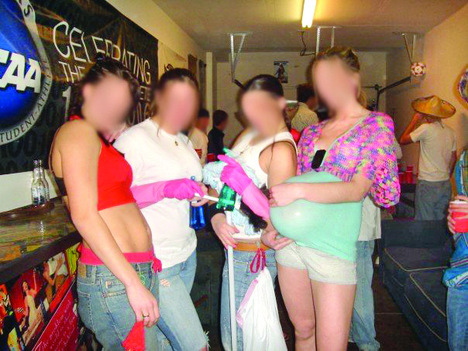
February 2007: Pictures from a “South of the Border” party at Santa Clara University in California.  Indeed, that IS a pregnant woman, cleaning ladies, and a slutty gang member.

———————————

January 2007: A party in “honor” of Martin Luther King Day at Tarleton State University in Texas:

———————————

January 2007: A party in “honor” of Martin Luther King Day at Clemson College in South Carolina.

———————————

January 2007: A party in “honor” of Martin Luther King Day at University of Connecticut School of Law.

———————————

May 2007: A Mexican-themed party at the University of Delaware (via Resist Racism).

 ———————————

2007: Students at Wilfrid Laurier University, celebrating Nations of the World, represented Jamaica by putting on blackface (via @LindaQuirke).

 ———————————

October 2001: A Delta Sigma Phi Halloween party at Auburn University (via).

Lisa Wade, PhD is an Associate Professor at Tulane University. She is the author of American Hookup, a book about college sexual culture; a textbook about gender; and a forthcoming introductory text: Terrible Magnificent Sociology. You can follow her on Twitter and Instagram.

Flashback Friday.

3

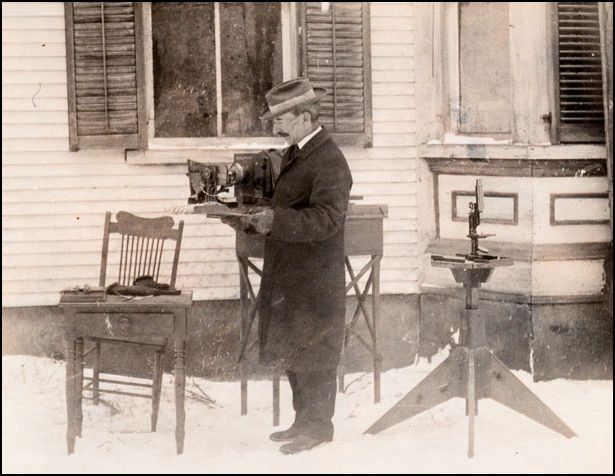
The image above is a photograph of a snowflake taken in the late 1800s by Wilson Bentley. Bentley, a 19-year-old farmer in Vermont, was the first person to ever photograph snowflakes. From the Guardian:

Bentley’s obsession with snow crystals began when he received a microscope for his 15th birthday. He became spellbound by their beauty, complexity and endless variety.

“Under the microscope, I found that snowflakes were miracles of beauty; and it seemed a shame that this beauty should not be seen and appreciated by others. Every crystal was a masterpiece of design and no one design was ever repeated. When a snowflake melted, that design was forever lost. Just that much beauty was gone, without leaving any record behind,” he said.

Bentley started trying to draw the flakes but the snow melted before he could finish. His parents eventually bought him a camera and he spent two years trying to capture images of the tiny, fleeting crystals.

He caught falling snowflakes by standing in the doorway with a wooden tray as snowstorms passed over. The tray was painted black so he could see the crystals and transfer them delicately onto a glass slide.

To study the snow crystals, Bentley rigged his bellows camera up to the microscope but found he could not reach the controls to bring them into focus. He overcame the problem through the imaginative use of wheels and cord.

Bentley took his first successful photomicrograph of a snow crystal at the age of 19 and went on to capture more than 5,000 more images.

What struck me about this story, other than the pretty pictures and neat historical trivia, was the fact that nearly every schoolchild in the Western world knows what a snowflake looks like under a microscope, even as their experience of snowflakes  is mostly of them as cold, fuzzy, frozen blobs, if they have any regular experience with snow at all.  They know because we teach them.

The idea of the meme is one way to discuss our ability to transfer elusive knowledge like this. A meme is a unit of knowledge or a type of behavior that’s passed on from generation to generation culturally. The gene is its evolutionary cousin, passing along knowledge and behavior genetically.  In the US, this particular knowledge meme is found in books or scientific discussions, but it has also become a common arts and craft project: many of us learn about snowflakes when we are shown how to make them from construction paper:

Snowflakes on flickr creative commons by Melissa Wilkins.

It’s quite amazing to consider how every human generation since Bentley understands the snowflake just a little bit differently than anyone before him.  Because of the advantage that human culture gives each new generation, nearly every child learns to appreciates their beauty.

See a slide show of his photographs at The Telegraph. This post originally appeared in 2010.

Lisa Wade, PhD is an Associate Professor at Tulane University. She is the author of American Hookup, a book about college sexual culture; a textbook about gender; and a forthcoming introductory text: Terrible Magnificent Sociology. You can follow her on Twitter and Instagram.