Search results for The

I recently moved to a neighborhood that people routinely describe as “bad.” It’s my first time living in such a place. I’ve lived in working class neighborhoods, but never poor ones. I’ve been lucky.

This neighborhood — one, to be clear, that I had the privilege to choose to live in — is genuinely dangerous. There have been 42 shootings within one mile of my house in the last year. Often in broad daylight. Once the murderers fled down my street, careening by my front door in an SUV. One week there were six rapes by strangers — in the street and after home invasions — in seven days. People are robbed, which makes sense to me because people have to eat, but with a level of violence that I find confusing. An 11-year-old was recently arrested for pulling a gun on someone. A man was beaten until he was a quadriplegic. One day 16 people were shot in a park nearby after a parade.

I’ve lived here for a short time and — being white, middle-aged, middle class, and female — I am on the margins of the violence in my streets, and yet I have never been so constantly and excruciatingly aware of my mortality. I feel less of a hold on life itself. It feels so much more fragile, like it could be taken away from me at any time. I am acutely aware that my skin is but paper, my bones brittle, my skull just a shell ripe for bashing. I imagine a bullet sheering through me like I am nothing. That robustness that life used to have, the feeling that it is resilient and that I can count on it to be there for me, that feeling is going away.

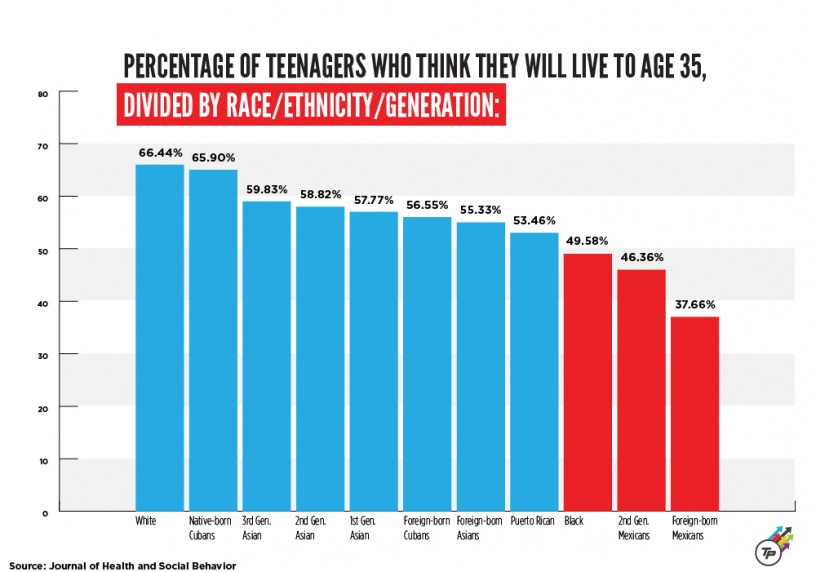
So, when I saw the results of a new study showing that only 50% of African American teenagers believe that they will reach 35 years of age, I understood better than I have understood before. Just a tiny — a teeny, teeny, tiny — bit better.
2

I have heard this idea before. A friend who grew up the child of Mexican immigrants in a sketchy urban neighborhood told me that he, as a teenager, didn’t believe he’d make it to 18. I nodded my head and thought “wow,”‘ but I did not understand even a little bit. He would be between the first and second column from the right: 54% of 2nd generation Mexican immigrants expect that they may very well die before 35. I understand him now a tiny — a teeny, teeny tiny — bit better.

Sociologists Tara Warner and Raymond Swisher, the authors of the study, make clear that the consequences of this fatalism are far reaching. If a child does not believe that they might live to see another day, what motivation can there possibly be for investing in the future, for caring for one’s body, for avoiding harmful habits or dangerous activities? Why study? Why bother to see a doctor? Why not do drugs? Why avoid breaking the law?

Why wouldn’t a person put their future at risk — indeed, their very life — if they do not believe in that future, that life, at all?

If we really want to improve the lives of the most vulnerable people in our country, we cannot allow them to live in neighborhoods where desperation is so high that people turn to violence. Dangerous environments breed fatalism, rationally so. And once our children have given up on their own futures, no teachers’ encouragement, no promise that things will get better if they are good, no “up by your bootstraps” rhetoric will make a difference. They think they’re going to be dead, literally.

We need to boost these families with generous economic help, real opportunities, and investment in neighborhood infrastructure and schools. I think we don’t because the people with the power to do so don’t understand — even a teeny, teeny tiny bit — what it feels like to grow up thinking you’ll never grow up. Until they do, and until we decide that this is a form of cruelty that we cannot tolerate, I am sad to say that I feel pretty fatalistic about these children’s futures, too.

Re-posted at Pacific Standard.

Lisa Wade, PhD is an Associate Professor at Tulane University. She is the author of American Hookup, a book about college sexual culture; a textbook about gender; and a forthcoming introductory text: Terrible Magnificent Sociology. You can follow her on Twitter and Instagram.
Monday marked the 50th anniversary of the intervention of the birth control pill. There is no doubt that the pill has had a huge influence on sexual attitudes, sexual activity, and how much control women had over their own fertility. The pill, although it may not be the right choice for everyone, should be celebrated for these reasons. But there is something else to consider here: how did the invention of the pill shape the way that women (and the medical community for that matter) view periods?

When you think of the pill, the first image that comes to mind is that iconic little container of pink and white pills that represents one menstrual “cycle.”

In Malcolm Gladwell’s fantastic article, John Rock’s Error, Gladwell explains how the invention of the pill was heavily influenced by the Catholic Church. One of the creators of the pill, a devout Catholic, wanted it to be viewed as “natural” since it used chemicals that naturally occur in the body to prevent pregnancy. It was necessary, then, for women to continue to have their period regularly to show that the pill did not interfere with a woman’s menstrual rhythm.

But, speaking from an evolutionary standpoint, there is nothing natural about having a menstrual period every month because it is not natural to limit fertility. Our female ancestors spent a good portion of their reproductive years pregnant and not having a period. And, in fact, having a period every month can be dangerous. Every time a woman has a period, tissue lining sheds and new cells must grow to replace it. And every time there is cell regrowth there is a new chance for mutations to occur. This leads to an increased risk of cancer and cysts.

It may be healthier (and more natural), then, for women to suppress menstruation (the way pregnancy used to). But because the idea of a natural rhythm is now synonymous with monthly periods, introducing pills with alternative cycles has proven difficult. Pills that allow for four periods a year (like Seasonale, Seasonique, and Yaz) have come on the market. But instead of discussing the medical benefits of fewer periods, they are marketed in a woman-on-the-go sort of way, as a way for women to “take back” their lives by avoiding an inconvenience.

Marketing the pill in this fashion has created push back by women who think this method this pill is all about suppressing “natural” womanhood, but it is a falsely constructed version of womanhood to begin with.

Sources: NY Times, LA Times, Planned Parenthood, WebMD, No Period, and Annals of Medicine. Originally posted in 2010.

Lauren McGuire interned for Sociological Images in 2010. See more posts from Lauren on social psychology and policing by race and the evolution of Cosmopolitan magazine.

Log onto any website where men who have sex with men (MSM) go to meet partners, and a key classification is whether a man is a “top,” a “bottom,” or “versatile.” These terms to refer to whether, when having anal sex with men, a man prefers to penetrate, to be penetrated, or is open to both. But are these durable roles?

We examined how much college MSM specialize as tops or bottoms. We find that, among college men who have ever had anal sex with a man, most have been both a top and a bottom sometime, most have done both across the course of their most recent relationship, and some have done both within a single date or hookup.

We use the Online College Social Life Survey (OCSLS) that surveyed more than 20,000 US students in 21 colleges and universities between 2005 and 2011. We use data from all 493 men who have had sexual interaction with men, and on the 826 events with men on which these men reported. The types of events respondents were asked to report on were their most recent hookup, their most recent date, and the most recent time they had sex within their most recent (or current) relationship of at least 6 months.

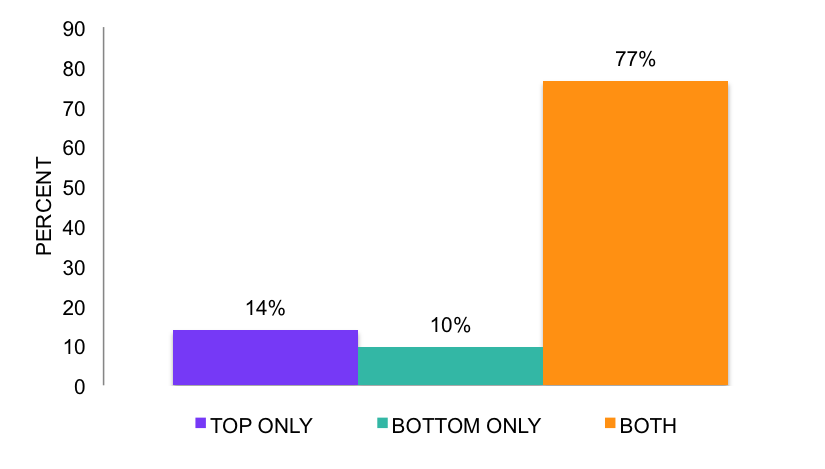
First, we found that only a small minority have only topped or bottomed. Of the men who have ever had anal sex with a man, 14% said they had only topped, 10% said they had only bottomed, and the vast majority, 77%, said they had done both.

Among MSM who have ever had anal sex, percent who have only topped, only bottomed, or done both

3

While the graph above shows that most MSM have tried both roles at least once, it is still possible that men tend to take only one role within any given relationship. In fact, this is true for 30% of men whose last relationship of at least 6 months in duration was with a man. But a large majority, 70%, played both roles with their partner sometime during the relationship – that is, they were both top and bottom at some point in that relationship.

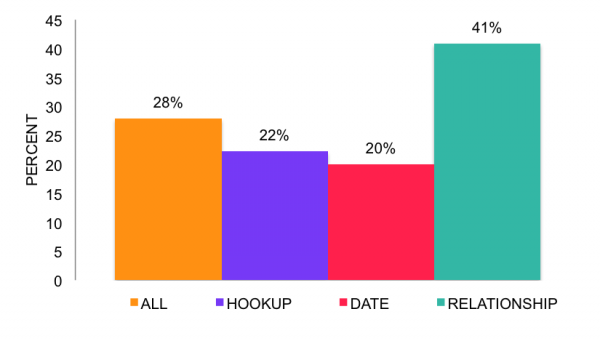
Our most striking finding is shown in the next graph: often men are both top and bottom within a single event. In MSM events that involved anal sex, over 25% entailed both partners being top and bottom in that event. Men did both in about 20% of hookups and dates. They were even more likely to have been top and bottom the last time they had sex in their most recent relationship — 41% of the time. Thus, combining the previous graph with this one, we see that 70% of MSM relationships involved the man doing both sometime across the duration of the relationship, and 41% of specific times they had sex with relationship partners involved doing both.

Among MSM events involving anal sex, percent in which men both top and bottom, by type of event

5

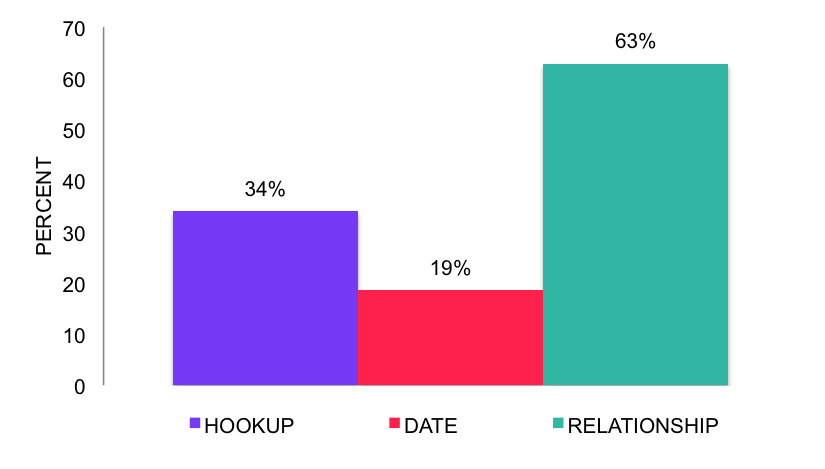
Everything we have shown above is limited to events involving anal sex, or men who have had anal sex with men. But how common is anal sex among college MSM? The graph below shows how often it occurred in specific events. Only about a fifth (19%) of events men labeled dates involved anal sex, compared to about a third (34%) of hookups (that difference is statistically significant). So most college MSM hookups and dates don’t involve anal sex at all. They generally involve oral sex (results not shown). But a majority of times when men have sex with a male relationship-partner, they do have anal sex — in 63% of cases. These findings bear some similarity to what we find for heterosexual students — that students are more likely to have intercourse in hookups than dates, but most likely to do so in relationships.

Percent of MSM events that involve anal sex, in hookups, dates, and relationships

 6In sum, the clear message of our analysis is that being versatile is common among college MSM — most men have been both tops and bottoms sometime, most relationships involve switching between roles, and a significant minority of single events involve both, especially when the event occurs within a relationship.

Methodological details included at Contexts, where this post originally appeared. 

Eliza Brown is a PhD student at NYU with interests in the sociologies of knowledge, health, and sexuality. Also at NYU, Paula England is a professor of sociology,  the Director of Graduate Studies, and the principal investigator for the Online College Social Life Survey. If you are a researcher and would like to have the OCSLS data for analysis, contact Dr. England for information.

The police do not shoot people. Not any more. Apparently, the word shoot has been deleted from the cop-speak dictionary.

A recently released video shows a Chicago cop doing what most people would describe as shooting a kid. Sixteen times. That’s not the way the Chicago Police Department puts it.

Chicago Tribune: A “preliminary statement” from the police News Affairs division, sent to the media early the next morning, said that after he had refused orders to drop the knife, McDonald “continued to approach the officers” and that as a result “the officer discharged his weapon, striking the offender.”

In Minneapolis, Black Lives Matter is protesting what they think is the shooting of Jamar Clark by a police officer. How wrong they are. The police did not shoot Clark. Instead, according to the Minnesota Bureau of Criminal Apprehension.

MPR News: At some point during an altercation that ensued between the officers and the individual, an officer discharged his weapon, striking the individual.

The police don’t shoot people. They discharge their weapons striking individuals, usually suspects or offenders. A Google search for “officer discharge weapon striking” returns 3.6 million hits.

Worse, the press often doesn’t even bother to translate but instead prints the insipid bureaucratic language of the police department verbatim.

Fearing for their safety and the safety of the public, they fired their guns, striking the suspect.

(Other sources on these stories do put the press-release prose in quotes. Also, in California, officers who discharge their weapons also usually “fear for their safety and the safety of the public.” I would guess that the phrase is part of some statute about police discharging their weapons)

Here’s another example from the Wilkes Barre area:2 (1)The writer nailed the lede: a police officer shot a suspect. But whoever wrote the headline had majored in Technical Language and Obfuscation rather than Journalism.

Does the language make a difference? I don’t know. Suppose the headlines two weeks ago had said, “In Paris, some people discharged their weapons striking individuals.”

Originally posted at Montclair SocioBlog; re-posted at Pacific Standard.

Jay Livingston is the chair of the Sociology Department at Montclair State University. You can follow him at Montclair SocioBlog or on Twitter.

I don’t know for sure what holidays are like at your house, but if they resemble holidays at my house, and most houses in the US, women do almost all of the holiday preparation: decorating, gift buying and wrapping, invitations, neighborhood and church activities, cooking, cooking, more cooking, and cleaning.

Holidays are moments in the year when women, specifically, have extra responsibilities. I distinctly remember my own beloved stepmother telling me — stress making her voice taut — that she just wanted everyone to have a nice Thanksgiving. She would work herself silly to do and have all the right things so that everyone else would have a good time. Multiple this by 10 at Christmas.

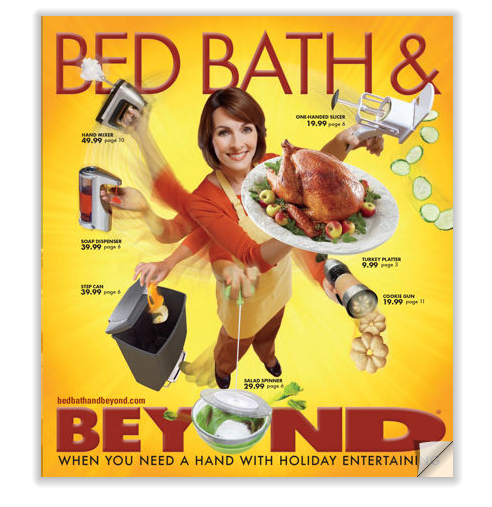
This Bed, Bath, & Beyond ad, sent in by Jessica E. and Jessica S., reminded me of the crazy workload that accompanies holidays for women:

Picture_1Alone with the responsibility of making a holiday for everyone else, the woman manages to mobilize technology and goods from BB&B to make it happen. Ironically, the text reads: “When you need a hand with holiday entertaining,” but actual human help in the form of hands is absent. Apparently it’s easier for women to grow five extra arms than it is to get kids and adult men to pitch in.

Anyhoo, be a peach and give your mom a hand this holiday season.

Originally published in 2009.

Lisa Wade, PhD is an Associate Professor at Tulane University. She is the author of American Hookup, a book about college sexual culture; a textbook about gender; and a forthcoming introductory text: Terrible Magnificent Sociology. You can follow her on Twitter and Instagram.
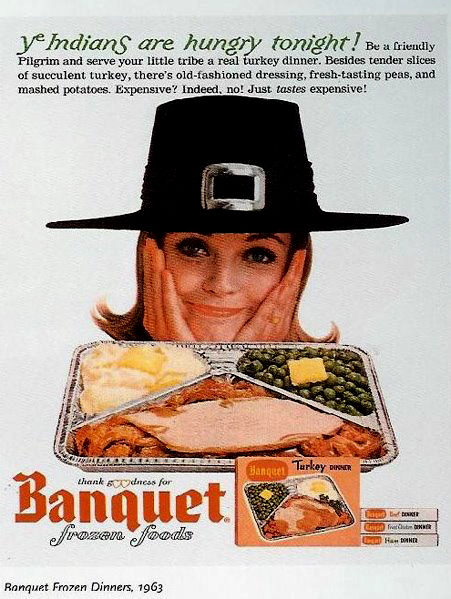
6a00d83451ccbc69e2010536215b89970bPre-prepared frozen meals pre-dated the Swanson “TV dinner,” but it was Swanson who brought the aluminum tray — previously only seen in taverns and airplanes — into the home.

They were motivated by opportunity and necessity. The necessity went something like this, or so the story goes: After the 1953 Thanksgiving holiday, Swanson found themselves up to their ears in turkey. They had overestimated demand, and there they were, with 260 tons of frozen turkey and the next bird holiday 364 days away. So, they slapped together a frozen turkey dinner, with peas and mashed potatoes, and held their breath.

3

The opportunity was the meteoric rise of living room television sets. In 1950, only 9% of American households had TVs. By 1953, 45% of households had one. The next year, that number would rise to 56%. Swanson’s overstock of turkeys occurred at exactly the same moment that owning a television became the new hot thing. So, Swanson tied their advertising directly to TV watching, inventing the phrase “TV dinner.”

2

Rumor is that Swanson wasn’t optimistic, but the dinners outsold their expectations. They planned to sell 5,000 turkey TV dinners that first year, in 1954, but they ended up selling 10 million.

So, if you celebrate Thanksgiving and are eating a TV dinner tonight instead of a whole bird, know that you, too, are part of a true American tradition.

Lisa Wade, PhD is an Associate Professor at Tulane University. She is the author of American Hookup, a book about college sexual culture; a textbook about gender; and a forthcoming introductory text: Terrible Magnificent Sociology. You can follow her on Twitter and Instagram.
4One of the first things other academics ask me is “why are you interested in toilets?”

For the vast majority of people, the biological function of waste excretion is an after thought, an activity that nobody wants to talk about, and often times, the mere thought of talking about shit grosses them out. I, however, am fascinated by the human and political dimensions of human waste and the challenges that solving the global sanitation crisis presents. More than excrement itself, I’m interested in a holistic view of sanitation (waste disposal, transportation, removal, treatment and reuse). This interest stems primarily from my training as a chemical engineer, my work experience as a sanitation engineer and researcher, and my interest from my doctoral studies in understanding the politics of policy intervention.

Contrary to what one might think, toilets are political. Owning a toilet will become a necessary prerequisite for politicians to run for office in Gujarat, India. The new Prime Minister of India, Shri Narendra Modi, has made ending open defecation and increasing access to toilets one of his campaign promises and a crucial component of his political and public policy agenda. Modi’s “toilets first, temples later” has been seen as a strong statement in favor of increasing toilet and latrine access in India.

In my own work I have emphasized that even if we have the technical capabilities to increase access to toilets, latrines and sanitation infrastructure, often times we see lack of progress because institutional, cultural, behavioral and societal barriers have been erected through time. I have shown that the behavioral determinants of sanitation governance are complex and multicausal, and also have multiple effects. Not having a toilet in your own home or easily accessible can lead to violence and physical/sexual assault. Lack of toilets affects women disproportionately and leaves them vulnerable to physical violence. Earlier this year I wrote about the complex linkages between menstrual hygiene management, access to toilets, and violence against women.

To end open defecation and increase sanitation access, we need a set of policy strategies that aren’t solely focused (individually) on cultural practices, or access to latrines, or poverty alleviation. All these factors must be tackled simultaneously.

World Toilet Day takes place on November 19th. This year finally the United Nations named World Toilet Day an official UN day, although for all the noise it has been making, we are WAY behind the target for the Millennium Development Goals. If we really want to end open defecation by 2025, as the UN indicates, we are definitely going to need a better approach. In my own research, I have found that institution- and routine-based strategies help increase access to sanitation. I have also argued that access to toilets can be used as a political manipulation strategy. We should be interested in the global politics of sanitation because the crisis is far-reaching and widespread.

Today, I encourage you to reflect on the fact that over 1 billion people defecate in the open because they lack the dignity of a toilet, and that 2.6 billion people don’t have access to improved water and sanitation sources.

Think about it. It IS political. Because we can’t wait to solve the global sanitation crisis.

Raul Pacheco-Vega, PhD is a professor of Resource Management and Environmental Studies with a specialty in the global politics of sanitation. You can follow him at raulpacheco.org, where this post originally appeared, and on Twitter and Facebook.

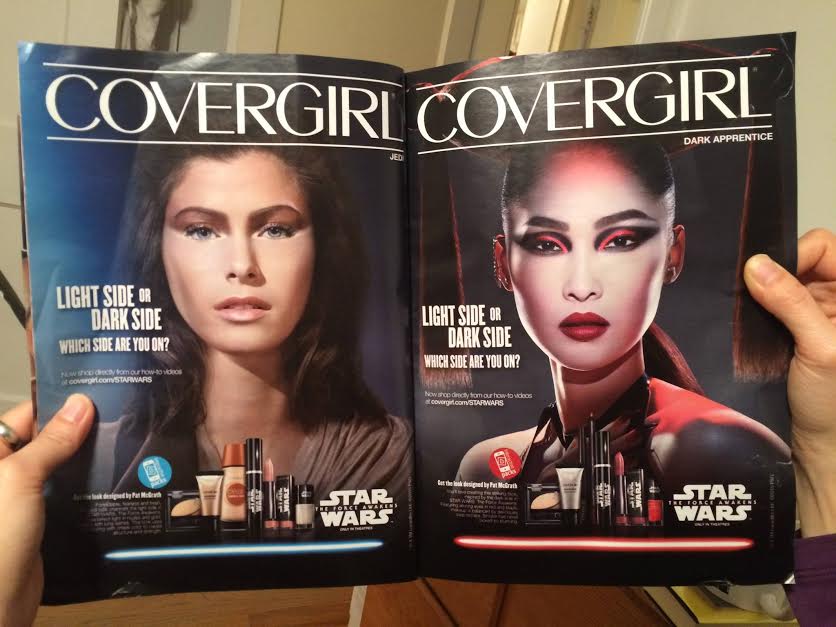
So, Star Wars is out with a new movie and instead of pretending female fans don’t exist, Disney has decided to license the Star Wars brand to Covergirl. A reader named David, intrigued, sent in a two-page ad from Cosmopolitan for analysis.

What I find interesting about this ad campaign — or, more accurately — boring, is its invitation to women to choose whether they are good or bad. “Light side or dark side. Which side are you on?” it asks. Your makeup purchases, apparently, follow.

3


4

This is the old — and by “old” I mean ooooooooold — tradition of dividing women into good and bad. The Madonna and the whore. The woman on the pedestal and her fallen counterpart. Except Covergirl, like many cosmetics companies before that have used exactly the same gimmick, is offering women the opportunity to choose which she wants to be. Is this some sort of feminist twist? Now we get to choose whether men want to marry us or just fuck us? Great.

But that part’s just boring. What’s obnoxious about the ad campaign is the idea that, for women, what really matters about the ultimate battle between good and evil is whether it goes with her complexion. It affirms the stereotype that women are deeply trivial, shallow, and vapid. What interests us about Star Wars? Why, makeup, of course!

If David — who also noted the inclusion of a single Asian model as part of the Dark Side — hadn’t asked me to write about this, I probably wouldn’t have. It feels like low hanging fruit because it’s just makeup advertising and who cares. But this constant message that women are genuinely excited at the idea of getting to choose which color packet to use as some sort of idiotic contribution to a battle of good versus evil is corrosive.

Moreover, the constant reiteration of the idea that we are thrilled to paint our faces actually obscures the fact that we are essentially required to do so if we want to be taken seriously as professionals, potential partners or, really, valuable human beings. So, not only does this kind of message teach us not to take women seriously at all, it hides the very serious way in which we are actively forced to capitulate to the male gaze — every. damn. day. — and feed capitalism while we’re at it.

This ad isn’t asking us if we want to be on the dark side or the light side. It’s asking us if we want to wear makeup or wear makeup. It’s not a choice at all. But it sure does make subordination seem fun.

Lisa Wade, PhD is an Associate Professor at Tulane University. She is the author of American Hookup, a book about college sexual culture; a textbook about gender; and a forthcoming introductory text: Terrible Magnificent Sociology. You can follow her on Twitter and Instagram.