Search results for The

2 (1)A substantial body of literature suggests that women change what they eat when they eat with men. Specifically, women opt for smaller amounts and lower-calorie foods associated with femininity. So, some scholars argue that women change what they eat to appear more feminine when dining with male companions.

For my senior thesis, I explored whether women change the way they eat  alongside what they eat when dining with a male vs. female companion. To examine this phenomenon, I conducted 42 hours of non-participant observation in two four-star American restaurants in a large west coast city in the United States. I observed the eating behaviors of 76 Euro-American women (37 dining with a male companion and 39 dining with a female companion) aged approximately 18 to 40 to identify differences in their eating behaviors.

I found that women did change the way they ate depending on the gender of their dining companion. Overall, when dining with a male companion, women typically constructed their bites carefully, took small bites, ate slowly, used their napkins precisely and frequently, and maintained good posture and limited body movement throughout their meals. In contrast, women dining with a female companion generally constructed their bites more haphazardly, took larger bites, used their napkins more loosely and sparingly, and moved their bodies more throughout their meals.

The unbearable daintiness of women who eat with men

On the size of bites, here’s an excerpt from my field notes:

Though her plate is filled, each bite she labors onto her fork barely fills the utensil. Perhaps she’s getting full because each bite seems smaller than the last… and still she’s taking tiny bites. Somehow she has made a single vegetable last for more than five bites.

I also observed many women who were about to take a large bite but stopped themselves. Another excerpt:

She spreads a cracker generously and brings it to her mouth. Then she pauses for a moment as though she’s sizing up the cracker to decide if she can manage it in one bite. After thinking for a minute, she bites off half and gently places the rest of the cracker back down on her individual plate.

Stopping to reconstruct large bites into smaller ones is a feminine eating behavior that implies a conscious monitoring of bite size. It indicates that women may deliberately change their behavior to appear more feminine.

I also observed changes in the ways women used their napkins when dining with a male vs. female companion. When their companion was a man, women used their napkins more precisely and frequently than when their companion was another woman. In some cases, the woman would fold her napkin into fourths before using it so that she could press the straight edge of the napkin to the corners of her mouth. Other times, the woman would wrap the napkin around her finger to create a point, then dab it across her mouth or use the point to press into the corners of her mouth. Women who used their napkins precisely also tended to use them quite frequently:

Using her napkin to dab the edges of her mouth – finger in it to make a tiny point, she is using her napkin constantly… using the point of the napkin to specifically dab each corner of her mouth. She is using the napkin again even though she has not taken a single bite since the last time she used it… using napkin after literally every bite as if she is constantly scared she has food on her mouth. Using and refolding her napkin every two minutes, always dabbing the corners of her mouth lightly.

In contrast, women dining with a female companion generally used their napkins more loosely and sparingly. These women did not carefully designate a specific area of the napkin to use, and instead bunched up a portion of it in one hand and rubbed the napkin across their mouths indiscriminately.

Each of the behaviors observed more frequently among women dining with a male companion versus a female one was stereotypically feminine. Many of the behaviors that emerged as significant among women dining with a female companion, on the other hand, are considered non-feminine, i.e. behaviors that women are instructed to avoid. Behavioral differences between the two groups of women suggest two things. First, women eat in a manner more consistent with normative femininity when in the presence of a male versus a female companion. And, second, gender is something that people perform when cued to do so, not necessarily something people internalize and express all the time.

Cross-posted at Pacific Standard.

Kate Handley graduated from Occidental College this month. This post is based on her senior thesis. After gaining some experience in the tech industry, she hopes to pursue a PhD in Sociology. 
 

2 (1)In 1994, a US immigration judge lifted an order to deport a woman named Lydia Oluloro. Deportation would have forced her to either leave her five- and six-year-old children in America with an abusive father or take them with her to Nigeria. There, they would have been at risk of a genital cutting practice called infibulation, in which the labia majora and minora are trimmed and fused, leaving a small opening for urination and menstruation.

Many Americans will agree that the judge made a good decision, as children shouldn’t be separated from their mothers, left with dangerous family members, or subjected to an unnecessary and irreversible operation that they do not understand. I am among these Americans. However, I am also of the view that Americans who oppose unfamiliar genital cutting practices should think long and hard about how they articulate their opposition.

The judge in the Oluloro case, Kendall Warren, articulated his opposition like this:

This court attempts to respect traditional cultures … but [infibulation] is cruel and serves no known medical purpose. It’s obviously a deeply ingrained cultural tradition going back 1,000 years at least.

Let’s consider the judge’s logic carefully. First, by contrasting the “court” (by which he means America)with “traditional cultures”, the judge is contrasting us (America) with a them (Nigeria). He’s implying that only places like Nigeria are “traditional” — a euphemism for states seen as backward, regressive, and uncivilised — while the US is “modern,” a state conflated with progressiveness and enlightenment.

When he says that the court “attempts to respect traditional cultures,” but cannot in this case, the judge is suggesting that the reason for the disrespect is the fault of the culture itself. In other words, he’s saying “we do our best to respect traditional cultures, but you have pushed us too far.” The reason for this, the judge implies, is that the practices in question have no redeeming value. It “serves no known medical purpose,” and societies which practice it are thus “up to no good” or are not engaging in “rational” action.

The only remaining explanation for the continuation of the practice, the judge concludes, is cruelty. If the practice is cruel the people who practice it must necessarily also be cruel; capriciously, pointlessly, even frivolously cruel.

To make matters worse, in the eyes of the judge, such cruelty can’t be helped because its perpetrators don’t have free will. The practice, he says, is “deeply ingrained” and has been so for at least 1,000 years. Such cultures cannot be expected to see reason. This is the reason why the court — or America — can and should be compelled to intervene.

In sum, the judge might well have said: “we are a modern, rational, free, good society, and you who practice female genital cutting—you are the opposite of this.”

**********

I’ve published extensively on the ways in which Americans talk about the female genital cutting practices (FGCs) that are common in parts of Africa and elsewhere, focusing on the different ways opposition can be articulated and the consequence of those choices. There are many grounds upon which to oppose FGCs: the oppression of women, the repression of sexuality, human rights abuse, child abuse, a violation of bodily integrity, harm to health, and psychological harm, to name just a few. Nevertheless, Judge Warren, chose to use one of the most common and counterproductive frames available: cultural depravity.

The main source of this frame has been the mass media, which began covering FGCs in the early 1990s. At the time anti-FGC activists were largely using the child abuse frame in their campaigns, yet journalists decided to frame the issue in terms of cultural depravity. This narrative mixed with American ethnocentrism, an obsession with fragile female sexualities, a fear of black men, and a longstanding portrayal of Africa as dark, irrational, and barbaric to make a virulent cocktail of the “African Other.”

The more common word used to describe FGCs — mutilation — is a symbol of this discourse. It perfectly captures Judge Warren’s comment. Mutilation is, perhaps by definition, the opposite of healing and of what physicians are called to do. Defining FGCs this way allows, and even demands, that we wholly condemn the practices, take a zero tolerance stance, and refuse to entertain any other point of view.

Paradoxically, this has been devastating for efforts to reduce genital cutting. People who support genital cutting typically believe that a cut body is more aesthetically pleasing. They largely find the term “mutilation” confusing or offensive. They, like anyone, generally do not appreciate being told that they are barbaric, ignorant of their own bodies, or cruel to their children.

The zero tolerance demand to end the practices has also failed. Neither foreigners intervening in long-practicing communities, nor top-down laws instituted by local politicians under pressure from Western governments, nor even laws against FGCs in Western countries have successfully stopped genital cutting. They have, however, alienated the very women that activists have tried to help, made women dislike or fear the authorities who may help them, and even increased the rate of FGCs by inspiring backlashes.

In contrast, the provision of resources to communities to achieve whatever goals they desire, and then getting out of the way, has been proven to reduce the frequency of FGCs. The most effective interventions have been village development projects that have no agenda regarding cutting, yet empower women to make choices. When women in a community have the power to do so, they often autonomously decide to abandon FGCs. Who could know better, after all, the real costs of continuing the practice?

Likewise, abandonment of the practice may be typical among immigrants to non-practicing societies. This may be related to fear of prosecution under the law. However, it is more likely the result of a real desire among migrants to fit into their new societies, a lessening of the pressures and incentives to go through with cutting, and mothers’ deep and personal familiarity with the short- and long-term pain that accompanies the practices.

The American conversation about FGCs has been warped by our own biases. As a Hastings Center Report summarizes, those who adopt the cultural depravity frame misrepresent the practices, overstate the negative health consequences, misconstrue the reasons for the practice, silence the first-person accounts of women who have undergone cutting, and ignore indigenous anti-FCG organizing. And, while it has fed into American biases about “dark” Africa and its disempowered women, the discourse of cultural depravity has actually impaired efforts to reduce rates of FGCs and the harm that they can cause.

Originally posted at Open Democracy and Pacific Standard.

Lisa Wade is a professor at Occidental College and the co-author of Gender: Ideas, Interactions, Institutions. You can follow up on her research about female genital cutting here.

2 (1)It seems certain that the political economy textbooks of the future will include a chapter on the experience of Greece in 2015.

On July 5, 2015, the people of Greece overwhelmingly voted “NO” to the austerity ultimatum demanded by what is colloquially being called the Troika, the three institutions that have the power to shape Greece’s future: the European Commission, the International Monetary Fund, and the European Central Bank.

The people of Greece have stood up for the rights of working people everywhere.

Background

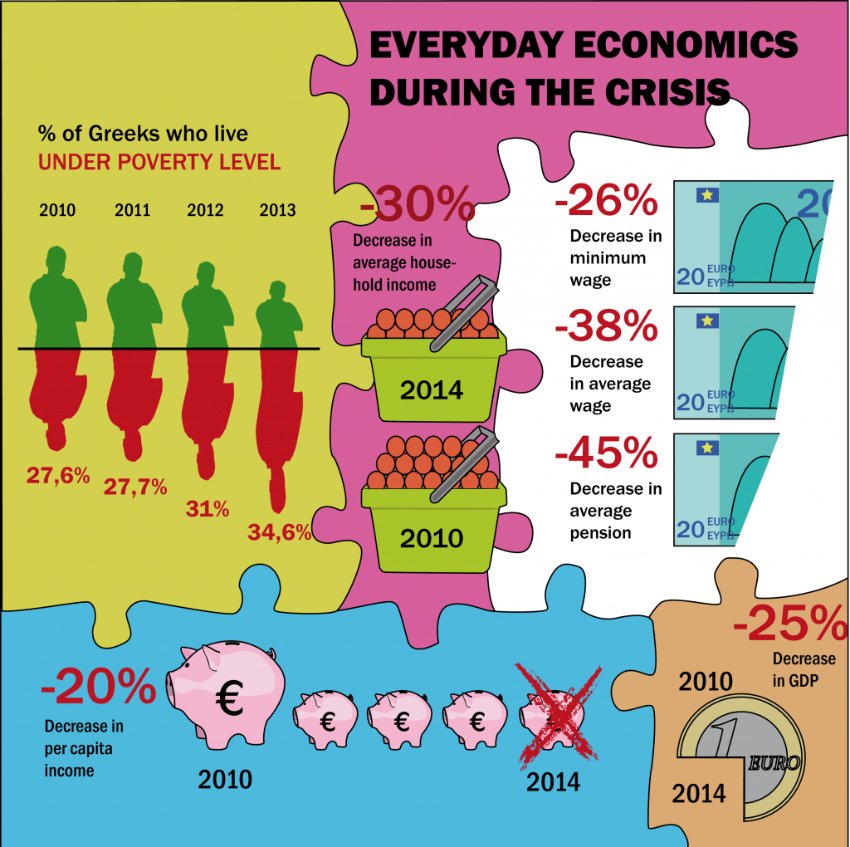
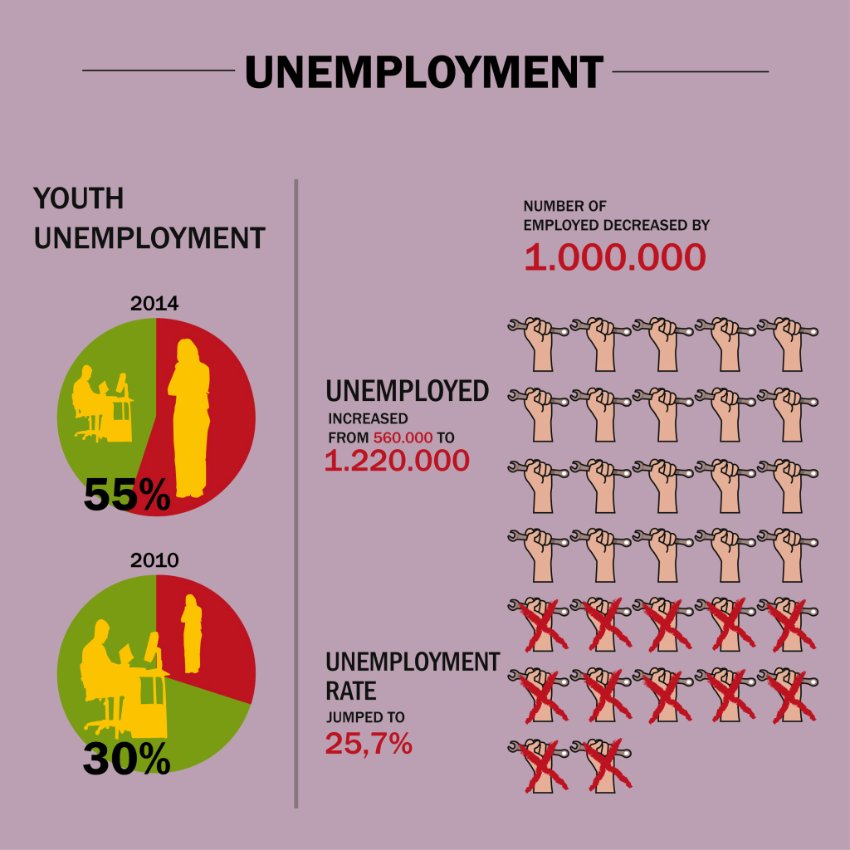
Greece has experienced six consecutive years of recession and the social costs have been enormous.  The following charts provide only the barest glimpse into the human suffering:

Infographics / Unemployment
Infographics / Social Impact
Infographics / Poverty

While the Troika has been eager to blame this outcome on the bungling and dishonesty of successive Greek governments and even the Greek people, the fact is that it is Troika policies that are primarily responsible. In broad brush, Greece grew rapidly over the 2000s in large part thanks to government borrowing, especially from French and German banks.  When the global financial crisis hit in late 2008, Greece was quickly thrown into recession and the Greek government found its revenue in steep decline and its ability to borrow sharply limited. By 2010, without its own national currency, it faced bankruptcy.

Enter the Troika. In 2010, they penned the first bailout agreement with the Greek government. The Greek government received new loans in exchange for its acceptance of austerity policies and monitoring by the IMF. Most of the new money went back out of the country, largely to its bank creditors. And the massive cuts in public spending deepened the country’s recession.

By 2011 it had become clear that the Troika’s policies were self-defeating. The deeper recession further reduced tax revenues, making it harder for the Greek government to pay its debts. Thus in 2012 the Troika again extended loans to the Greek government as part of a second bailout which included . . . wait for it . . . yet new austerity measures.

Not surprisingly, the outcome was more of the same. By then, French and German banks were off the hook. It was now the European governments and the International Monetary Fund that worried about repayment. And the Greek economy continued its downward ascent.

Significantly, in 2012, IMF staff acknowledged that the its support for austerity in 2010 was a mistake. Simply put, if you ask a government to cut spending during a period of recession you will only worsen the recession. And a country in recession will not be able to pay its debts. It was a pretty clear and obvious conclusion.

But, significantly, this acknowledgement did little to change Troika policies toward Greece.

By the end of 2014, the Greek people were fed up. Their government had done most of what was demanded of it and yet the economy continued to worsen and the country was deeper in debt than it had been at the start of the bailouts. And, once again, the Greek government was unable to make its debt payments without access to new loans. So, in January 2015 they elected a left wing, radical party known as Syriza because of the party’s commitment to negotiate a new understanding with the Troika, one that would enable the country to return to growth, which meant an end to austerity and debt relief.

Syriza entered the negotiations hopeful that the lessons of the past had been learned. But no, the Troika refused all additional financial support unless Greece agreed to implement yet another round of austerity. What started out as negotiations quickly turned into a one way scolding. The Troika continued to demand significant cuts in public spending to boost Greek government revenue for debt repayment. Greece eventually won a compromise that limited the size of the primary surplus required, but when they proposed achieving it by tax increases on corporations and the wealthy rather than spending cuts, they were rebuffed, principally by the IMF.

The Troika demanded cuts in pensions, again to reduce government spending. When Greece countered with an offer to boost contributions rather than slash the benefits going to those at the bottom of the income distribution, they were again rebuffed. On and on it went. Even the previous head of the IMF penned an intervention warning that the IMF was in danger of repeating its past mistakes, but to no avail.

Finally on June 25, the Troika made its final offer. It would provide additional funds to Greece, enough to enable it to make its debt payments over the next five months in exchange for more austerity.  However, as the Greek government recognized, this would just be “kicking the can down the road.” In five months the country would again be forced to ask for more money and accept more austerity. No wonder the Greek Prime Minister announced he was done, that he would take this offer to the Greek people with a recommendation of a “NO” vote.

The Referendum

Almost immediately after the Greek government announced its plans for a referendum, the leaders of the Troika intervened in the Greek debate. For example, as the New York Times reported:

By long-established diplomatic tradition, leaders and international institutions do not meddle in the domestic politics of other countries. But under cover of a referendum in which the rest of Europe has a clear stake, European leaders who have found [Greece Prime Minister] Tsipras difficult to deal with have been clear about the outcome they prefer.

Many are openly opposing him on the referendum, which could very possibly make way for a new government and a new approach to finding a compromise. The situation in Greece, analysts said, is not the first time that European politics have crossed borders, but it is the most open instance and the one with the greatest potential effect so far on European unity…

Martin Schulz, a German who is president of the European Parliament, offered at one point to travel to Greece to campaign for the “yes” forces, those in favor of taking a deal along the lines offered by the
creditors.

On Thursday, Mr. Schulz was on television making clear that he had little regard for Mr. Tsipras and his government. “We will help the Greek people but most certainly not the government,” he said.

European leaders actively worked to distort the terms of the referendum. Greeks were voting on whether to accept or reject Troika austerity policies yet the Troika leaders falsely claimed the vote was on whether Greece should remain in the Eurozone. In fact, there is no mechanism for kicking a country out of the Eurozone and the Greek government was always clear that it was not seeking to leave the zone.

Having whipped up popular fears of an end to the euro, some Greeks began talking their money out of the banks. On June 28, the European Central Bank then took the aggressive step of limiting its support to the Greek financial system.

This was a very significant and highly political step. Eurozone governments do not print their own money or control their own monetary systems. The European Central Bank is in charge of regional monetary policy and is duty bound to support the stability of the region’s financial system. By limiting its support for Greek banks it forced the Greek government to limit withdrawals which only worsened economic conditions and heightened fears about an economic collapse. This was, as reported by the New York Times, a clear attempt to influence the vote, one might even say an act of economic terrorism:    

Some experts say the timing of the European Central Bank action in capping emergency funding to Greek banks this week appeared to be part of a campaign to influence voters.

“I don’t see how anybody can believe that the timing of this was coincidence,” said Mark Weisbrot, an economist and a co-director of the Center for Economic and Policy Research in Washington. “When you restrict the flow of cash enough to close the banks during the week of a referendum, this is a very deliberate move to scare people.”

Then on July 2, three days before the referendum, an IMF staff report on Greece was made public. Echos of 2010, the report made clear that Troika austerity demands were counterproductive. Greece needed massive new loans and debt forgiveness. The Bruegel Institute, a European think tank, offered a summary and analysis of the report, concluding that “the creditors negotiated with Greece in bad faith” and used “indefensible economic logic.”

The leaders of the Troika were insisting on policies that the IMF’s own staff viewed as misguided.  Moreover, as noted above, European leaders desperately but unsuccessfully tried to kill the report. Only one conclusion is possible: the negotiations were a sham.

The Troika’s goals were political: they wanted to destroy the leftist, radical Syriza because it represented a threat to a status quo in which working people suffer to generate profits for the region’s leading corporations. It apparently didn’t matter to them that what they were demanding was disastrous for the people of Greece. In fact, quite the opposite was likely true: punishing Greece was part of their plan to ensure that voters would reject insurgent movements in other countries, especially Spain.

The Vote

And despite, or perhaps because of all of the interventions and threats highlighted above, the Greek people stood firm. As the headlines of a Bloomberg news story proclaimed: “Varoufakis: Greeks Said ‘No’ to Five Years of Hypocrisy.”

The Greek vote was a huge victory for working people everywhere.

Now, we need to learn the lessons of this experience. Among the most important are: those who speak for dominant capitalist interests are not to be trusted. Our strength is in organization and collective action. Our efforts can shape alternatives.

Cross-posted at Reports from the Economic Front.

Martin Hart-Landsberg is a professor of economics at Lewis and Clark College. You can follow him at Reports from the Economic Front.

Bentham and Foucault might have been interested in the panopticon but every December we get a view of  true social control in the form of an overweight man at the North Pole. Santa Claus (or Sandy Claws, as he is sometimes called) is just the latest in a long line of beings whose sole purpose is to control children through fear (Krampus is another example, as is the Belsnickel, as Dwight demonstrated on The Office). Recently, though, Santa has been doing his spying by proxy (giving him more time to bully young reindeer).

In Santa’s place are his elves on the shelves, a team of small elves who began taking up residence in people’s homes in 2005. These elves observe the behavior of children and then fly back to the North Pole to report their observations to Santa each night. The magical ability to do so begins when the elves are named (before this point they are apparently in some sort of coma during which they can be sealed in boxes and sent to stores around the country) but the elves are in danger of losing their magic if touched. Upon returning each night, the elves hide in a new place and children delight in finding them each morning. Apparently, some of the elves also like to get into mischief, making them both spies and hypocrites.

Warning: Spoilers Ahead

If you have continued reading, prepare yourself for a shock. The elves are actually inanimate objects with neither magic nor the ability to report to Santa Claus each night. Instead, adults in each household are responsible for moving the elves around (thus touching them and ruining any magical potential that they may have had). As you can imagine, this creates quite a bit of work for these adults, to the point that there are posts dedicated to dealing with the fact that they forgot to move the elves. The elves have also been copied in various ways. Telling children that Santa can see them when they’re sleeping and knows when they’re awake and knows if they’ve been bad or good seems much easier, especially since adults are likely to run out of creative places to hide the elf after about the third day.

Assuming that the intention of Santa, Krampus, the Belsnickel, and the elves on the shelves is social control, it seems that the elves would be both the least effective and the biggest pain in the ass. Imagine if the prison designed by Bentham made it possible that prisoners could be observed at any time unless they touched the prison wall, in which case a door came down that cut off the potential view of the guards. There might be no escaping Santa’s creepy spying or the Belsnickel’s judgment, but if I was a kid and I wanted to get away with bad behavior you can bet that the first thing I would do is touch the damn elf.

John is a pseudonymous assistant professor at a small liberal arts college (SLAC).  He finished his Ph.D. at a top-25 sociology program in the summer of 2009. He blogs at Memoirs of a SLACer, where this post originally appeared.

National Ugly Christmas Sweater Day has come and gone, falling this year on Friday, December 18th. Perhaps you’ve noticed the recent ascent of the Ugly Christmas Sweater or even been invited to an Ugly Christmas Sweater Party. How do we account for this trend and its call to “don we now our tacky apparel”?

Total search of term “ugly Christmas sweater” relative to other searches over time (c/o Google Trends):

Ugly Christmas Sweater parties purportedly originated in Vancouver, Canada, in 2001. Their appeal might seem to stem from their role as a vehicle for ironic nostalgia, an opportunity to revel in all that is festively cheesy. It also might provide an opportunity to express the collective effervescence of the well-intentioned (but hopelessly tacky) holiday apparel from moms and grandmas.

However, The Atlantic points to a more complex reason why we might enjoy the cheesy simplicity offered by Ugly Christmas Sweaters: “If there is a war on Christmas, then the Ugly Christmas Sweater, awesome in its terribleness, is a blissfully demilitarized zone.” This observation pokes fun at the Fox News-style hysterics regarding the “War on Christmas”; despite being commonly called Ugly Christmas Sweaters, the notion seems to persist that their celebration is an inclusive and “safe” one.

We might also consider the generally fraught nature of the holidays (which are financially and emotionally taxing for many), suggesting that the Ugly Sweater could offer an escape from individual holiday stress. There is no shortage of sociologists who can speak to the strain of family, consumerism, and mental health issues that plague the holidays, to say nothing of the particular gendered burdens they produce. Perhaps these parties represent an opportunity to shelve those tensions.

But how do we explain the fervent communal desire for simultaneous festive celebration and escape? Fred Davis notes that nostalgia is invoked during periods of discontinuity. This can occur at the individual level when we use nostalgia to “reassure ourselves of past happiness.” It may also function as a collective response – a “nostalgia orgy”- whereby we collaboratively reassure ourselves of shared past happiness through cultural symbols. The Ugly Christmas Sweater becomes a freighted symbol of past misguided, but genuine, familial affection and unselfconscious enthusiasm for the holidays – it doesn’t matter that we have not all really had the actual experience of receiving such a garment.

Jean Baudrillard might call the process of mythologizing the Ugly Christmas Sweater a simulation, a collapsing between reality and representation. And, as George Ritzer points out, simulation can become a ripe target for corporatization as it can be made more spectacular than its authentic counterparts. We need only look at the shift from the “authentic” prerogative to root through one’s closet for an ugly sweater bestowed by grandma (or even to retrieve from the thrift store a sweater imparted by someone else’s grandma) to the cottage-industry that has sprung up to provide ugly sweaters to the masses. There appears to be a need for collective nostalgia that is outstripped by the supply of “actual” Ugly Christmas Sweaters that we have at our disposal.

Colin Campbell states that consumption involves not just purchasing or using a good or service, but also selecting and enhancing it. Accordingly, our consumptive obligation to the Ugly Christmas Sweater becomes more demanding, individualized and, as Ritzer predicts, spectacular. For examples, we can view this intensive guide for DIY ugly sweaters. If DIY isn’t your style, you can indulge your individual (but mass-produced) tastes in NBA-inspired or cultural mash-up Ugly Christmas Sweaters, or these Ugly Christmas Sweaters that aren’t even sweaters at all.

The ironic appeal of the Ugly Christmas Sweater Party is that one can be deemed festive for partaking, while simultaneously ensuring that one is participating in a”safe” celebration – or even a gentle mockery – of holiday saturation and demands. The ascent of the Ugly Christmas Sweater has involved a transition from ironic nostalgia vehicle to a corporatized form of escapism, one that we are induced to participate in as a “safe” form of  festive simulation that becomes increasingly individualized and demanding in expression.

Re-posted at Pacific Standard.

Kerri Scheer is a PhD Student working in law and regulation in the Department of Sociology at the University of Toronto. She thanks her colleague Allison Meads for insights and edits on this post. You can follow Kerri on Twitter.

Americans have a low opinion of Congress. Less than 10% of the voters think that Congress is doing a good job. But their own Representative . . . not so bad. A third of us think that our own rep deserves re-election (Rasmussen). Even that is low. Until recently, a majority of people approved of their own representative while disapproving of Congress in general. It’s been the same with crime. People feel safer in their own neighborhoods than elsewhere, even when those other neighborhoods have less crime.

Race relations too are bad . . . elsewhere. In the last year, the percent of Americans saying that race relations in the country are “bad” doubled (roughly from 30% to 60%). That’s understandable given the media coverage of Ferguson and other conflicts centered on race. But people take a far more sanguine view of things in their own community.  Eighty percent rate local race relations as “good,” and that number has remained unchanged throughout this century. (See this post  from last summer.)

Not surprising then that the problem with marriage in the US turns out to be about other people’s marriages. A recent survey asked people about the direction of their own marriage and marriage in the US generally.3
Only a handful of people (5%) see marriage generally as getting stronger. More than eight times that say that their own marriages have strengthened. The results for “weaker” are just the reverse. Only 6% say that their own marriage has weakened, but 43% see marriage in the US as losing ground.

Why the “elsewhere effect”? One suspect is the media bias towards trouble. Good news is no news.  News editors don’t give us many stories about good race relations, or about the 25-year drop in crime, or about the decrease in divorce.  Instead, we get crime and conflict and a variety of  other problems. Add to this the perpetual political campaign with opposition candidates tirelessly telling us what’s wrong.  Given this balance of information, we can easily picture the larger society as a world in decline, a perilous world so different from the one we walk through every day.

At first glance, people seeing their own relationships as good, others’ relationships as more strained seems like the opposite of the pluralistic ignorance on college campuses. There, students often believe that things are better elsewhere, or at least better for other students. They think that most other students are having more sex, partying more heartily, and generally having a better time than they are themselves. But whether we see others as having fun or more problems, the cause of the discrepancy is the same – the information we have. We know our own lives first hand. We know about those generalized others mostly from the stories we hear. And the people – whether news editors or students on campus – select the stories that are interesting, not those that are typical.

Originally posted at Montclair SocioBlog.

Jay Livingston is the chair of the Sociology Department at Montclair State University. You can follow him at Montclair SocioBlog or on Twitter.

They hold the same amount of wealth.

We all know that wealth is unequally distributed in the US. But, the results of a new study by the Institute for Policy Studies, authored by Chuck Collins and Josh Hoxie, are still eye popping.

Collins and Hoxie find that the wealthiest 0.1 percent of US households, an estimated 115,000 households with a net worth starting at $20 million, own more than 20 percent of total US household wealth. That is up from 7 percent in the 1970s. This group owns approximately the same total wealth as the bottom 90 percent of US households.

Moving up the wealth ladder, they calculate that the top 400 people—yes, people not households, each with a net worth starting at $1.7 billion, have more wealth than the bottom 61 percent of the US population, an estimated 70 million households or 194 million people.

Finally, we get to the top 20 people, those sitting at the pinnacle of the US wealth distribution. As the authors explain:

The wealthiest 20 individuals in the United States today hold more wealth than the bottom half of the U.S. population combined. These 20 super wealthy — a group small enough to fly together on one Gulfstream G650 private jet — have as much wealth as the 152 million people who live in the 57 million households that make up the bottom half of the U.S. population.

2

Although obvious, it is still worth emphasizing, as Collins and Hoxie do, that great wealth translates into great power, the power to shape economic policies. And, in a self-reinforcing cycle, the resulting policies, by design, create new opportunities for the wealthy to capture more wealth. Think: free trade agreements, privatization policies, tax policy, and labor and environmental laws and regulations.

Oh yes, also think presidential politics. As a New York Times study points out:

They are overwhelmingly white, rich, older and male . . . . Across a sprawling country, they reside in an archipelago of wealth, exclusive neighborhoods dotting a handful of cities and towns… Now they are deploying their vast wealth in the political arena, providing almost half of all the seed money raised to support Democratic and Republican presidential candidates. Just 158 families, along with companies they own or control, contributed $176 million in the first phase of the campaign, a New York Times investigation found (emphasis added).

And yet, one still hears some people say that class analysis has no role to play in explaining the dynamics of the US political economy. Makes you wonder who pays their salary.

Originally posted at Reports from the Economic Front.

Martin Hart-Landsberg is a professor of economics at Lewis and Clark College. You can follow him at Reports from the Economic Front.

“That’s private equity for you,” said Steve Jenkins. He was standing outside the uptown Fairway grocery at 125th St. about to go to breakfast at a diner across the street. He no longer works at Fairway.

Steve was one of the early forces shaping Fairway back when it was just one store at 74th and Broadway. He hired on as their cheese guy. “What do you want that for?” he growled at me one day long ago when he saw me with a large wedge of inexpensive brie. “That’s the most boring cheese in the store.” He was often abrasive, rarely tactful. I tried to explain that it was for a party and most of the people wouldn’t care. He would have none of it. He cared. He cared deeply – about cheese, about food generally.

He helped Fairway expand from one store to two, then four. He still selected the cheeses. He wrote the irreverent text for their signs, including the huge electric marquee that drivers on the West Side Highway read. And then in 2007 Fairway got bought out by a private equity firm. The three original founders cashed out handsomely. Steve and others stayed on. Much of their their share of the deal was in Fairway stock, but with restrictions that prevented them from selling.

Fairway kept expanding – stores in more places around New York – and they aimed more at the median shopper. Gradually, the store lost its edge, its quirkiness. With great size comes great McDonaldization – predictability, calculability. “Like no other market,” says every Fairway sign and every Fairway plastic bag. But it became like lots of other markets, with “specials” and coupons. Coupons! Fairway never had coupons. Or specials.

The people who decided to introduce coupons and specials were probably MBAs who knew about business and management and maybe even research on the retail food business. They knew about costs and profits. Knowing about food was for the people below them, people whose decisions they could override.

“I gotta get permission from corporate if I want to use my cell phone,” said Peter Romano, the wonderful produce manager at 74th St. – another guy who’d been there almost from the start. He knew produce like Steve knew cheese. Peter, too, left Fairway a few months ago.

Maybe this is what happens when a relatively small business gets taken over by ambitious suits. Things are rationalized, bureaucratized. And bureaucracy carries an implicit message of basic mistrust:

If we trusted you, we wouldn’t make you get approval. We wouldn’t make you fill out these papers about what you’re doing; we’d just let you do it. These procedures are our way of telling you that we don’t trust you to do what you say you’re doing.

The need for predictability, efficiency, and calculability leave little room for improvisation. The food business becomes less about food, more about business. It stops being fun. The trade-off should be that you get more money. But there too, Fairway’s new management disappointed. They expanded rapidly, putting new stores in questionable locations. In the first months after the private equity firm took Fairway public in 2013, the stock price was as high as $26 a share. Yesterday, it closed at $1.04. The shares that Steve Jenkins and others received as their part of the private equity buyout are practically worthless.

4

Steve Jenkins will be all right. He’s well known in food circles. He’s been on television with Rachel Ray, Jacques Pepin. Still, there he was yesterday morning outside the store whose cheeses and olive oils had been his dominion. “I’m sixty-five years old, and I’m looking for a job.”

Originally posted at Montclair SocioBlog; re-posted at Pacific Standard.

Jay Livingston is the chair of the Sociology Department at Montclair State University. You can follow him at Montclair SocioBlog or on Twitter.