Search results for The

The ideology of intensive motherhood is a cultural approach toward parenting that suggests that competent childcare demands “copious amounts of time, energy, and material resources” and that providing such childcare should take priority over everything else a mother might like or need to do.  In South Korea, this imperative is at work even before babies are born and the practice is called tae-gyo. A reporter for the Korea Herald, a local newspaper, explains:

Since over 600 years ago, expectant mothers in Korea have been practicing taegyo, a series of prenatal routines aimed at nurturing a healthy, virtuous and skilled child. They try to see and hear only the most pleasant things starting from three months of pregnancy.

Koreans believe that a mother’s state of mind and ongoing education during pregnancy determines a baby’s prospects. Their educational and occupational future, even their personality, is dependent on what their mothers do while they’re pregnant. A reporter, below, quotes a South Korean figure who claims that “nine months of prenatal education is more valuable than nine years of post-natal learning.”

Interest in tae-gyo is escalating thanks to declining birth rates and hyper-competition. Fewer Korean couples are having more than one child and they want to give these “single” children an edge by helping them from the womb.  They want their children to survive in a hypercompetitive educational environment.

Accordingly, while the most common tae-gyo used to be listening to classical music, women are facing increasing pressure to do more and more for their child before it is born. During the past 20 years, tae-gyo has incorporated learning calligraphy or floral arrangement, crafts like knitting and sewing, and doing yoga. Expected mothers are doing English and math tae-gyo, meaning that they study English and do math for their unborn children to ensure that they will excel in those skills. Korea’s tourism industry have developed a “taegyo travel package,” which is supposed to be beneficial for babies in the womb.

This can all be quite intensive, as you might imagine, as women are expected to personally practice all of the skills and traits they hope their baby will have. Intensive mothering in South Korea, then, starts before the baby is born.

[youtube]https://www.youtube.com/watch?v=YX2C1ueBxY4[/youtube]

Cross-posted at Pacific Standard.

Sangyoub Park, PhD, is an associate professor of sociology at Washburn University, where he teaches Social Demography, Generations in the U.S., and Sociology of East Asia. His research interests include social capital, demographic trends, and post-Generation Y.


In a previous post, I wrote about a University of Illinois football coach forcing injured players to go out on the field even at the risk of turning those injuries into lifelong debilitating and career-ending injuries. The coach and the athletic director both stayed on script and insisted that they put the health and well-being of the scholar athletes “above all else.” Right.

My point was that blaming individuals was a distraction and that the view of players as “disposable bodies” (as one player tweeted) was part of a system rather than the moral failings of individuals.

But systems don’t make for good stories. It’s so much easier to think in terms of individuals and morality, not organizations and outcomes. We want good guys and bad guys, crime and punishment. That’s true in the legal system. Convicting individuals who commit their crimes as individuals or in small groups is fairly easy. Convicting corporations or individuals acting as part of a corporation is very difficult.

That preference for stories is especially strong in movies. In that earlier post, I said that the U of Illinois case had some parallels with the NFL and its reaction to the problem of concussions. I didn’t realize that Sony pictures had made a movie about that very topic (title – “Concussion”), scheduled for release in a few months.

Hacked e-mails show that Sony, fearful of lawsuits from the NFL, wanted to shift the emphasis from the organization to the individual.

Sony executives; the director, Peter Landesman; and representatives of Mr. Smith discussed how to avoid antagonizing the N.F.L. by altering the script and marketing the film more as a whistle-blower story, rather than a condemnation of football or the league…

Hannah Minghella, a top [Sony] executive, suggested that “rather than portray the N.F.L. as one corrupt organization can we identify the individuals within the N.F.L. who were guilty of denying/covering up the truth.” [source: New York Times]

I don’t know what the movie will be like, but the trailer clearly puts the focus on one man – Dr. Bennet Omalu, played by Will Smith. He’s the good guy.

Will the film show as clearly how the campaign to obscure and deny the truth about concussions was a necessary and almost inevitable part of the NFL? Or will it give us a few bad guys – greedy, ruthless, scheming NFL bigwigs – and the corollary that if only those positions had been staffed by good guys, none of this would have happened?

The NFL, when asked to comment on the movie, went to the same playbook of cliches that the Illinois coach and athletic director used.

We are encouraged by the ongoing focus on the critical issue of player health and safety. We have no higher priority.

Originally posted at Montclair SocioBlog. Cross-posted at Pacific Standard.

Jay Livingston is the chair of the Sociology Department at Montclair State University. You can follow him at Montclair SocioBlog or on Twitter.

The one-year anniversary of Eric Garner’s death passed a little more than a year ago. Before Garner’s death, I had never heard of Tompkinsville, the Staten Island neighborhood where Garner regularly hung out, near the busy intersection of Victory Boulevard and Bay Street.

This was Garner’s spot.  He played checkers and chess there, bought kids ice cream, earned the reputation of a “peacemaker” among his peers, and, yes, routinely sold untaxed “loose” cigarettes.

This was also the spot were Eric Garner was died.

Over the past year, despite the substantial media attention devoted to Garner’s death and the subsequent grand jury inquiry into the responsibility for his death, I didn’t hear or read much about Tompkinsville.

The lack of attention to the neighborhood in which Garner lived and died is strange given that the NYPD’s initial encounter with Garner was ostensibly motivated by the Broken Windows theory of crime causation.  According to the theory, “disorder” in any given neighborhood, if “left unchecked,” will result in ever greater levels of disorder, which, in turn, will ultimately result in higher rates of serious crime.  This is the justification for approaching and penalizing people like Garner who are engaged in non-violent, misdemeanors.

Based on my own research in Jersey City, New Jersey (approximately six miles, as the crow flies, from Tompkinsville), I’ve come to the conclusion that Broken Windows is more of a slogan than a theory and, when it comes down to it, morally and empirically wrong. As I wrote at City Limits:

The question that begs addressing is why the police or anyone else should ever aggressively police the likes of people who not only are “down and out,” but are doing nothing to directly harm others? Why create a situation of humiliation, tension, and hostility—the very kind of situation that led to Garner’s death—unless it is truly necessary? If only in one in a thousand instances, the circumstances are such that in such degrading and antagonistic encounters they result in death or serious injury, is that not one time too many? Or if all that results is humiliation and hostility, don’t these costs alone outweigh whatever benefits might conceivably come from cracking down on offenses like selling loosies?

In the three years of ethnographic work I did in Jersey City, I saw plenty of disorder, but this didn’t translate into serious crime:

Much as many people may not like who or what they see in the square, it is undoubtedly a safe space. I know this from experience and it is also borne out in the city’s official crime statistics.

Of course, one case doesn’t definitively show that high disorder never leads to high crime, but it does suggest that it doesn’t necessarily do so.  In any case, there has been no definitive science supporting the Broken Windows theory.

On the same logic, the case of Tompkinsville further undermines the theory that disorder leads to serious crime. According to official data, rates of serious crime in and around Tompkinsville have long been relatively low, even during the years when the NYPD was not employing the Broken Windows strategy.  This suggests that, however “disorderly” Tompkinsville may have been at times, the recent implementation of Broken Windows was, and remains, a solution in search of a problem.

Upon realizing the possibility that Tompkinsville might be another example of a high disorder/low crime space, I decided it was time to visit the neighborhood.  I made the trip twice and I did not encounter what appeared to me to be a dangerous neighborhood or a neighborhood on the verge of becoming dangerous anytime soon.

Here is the part of town where Garner lived out his days:

2

While this part of town didn’t strike me as “bad,” it is a far cry from the Tompkinsville that sits just a short walk away, separated only by a concrete path. Much of Tompkinsville is actually rather well-to-do:

3

The socioeconomic disparity on display in Tompkinsville illustrates how policing and punishment are but one part of a much larger, far more complex, and deeply-rooted equation of inequality in America. Perhaps if Garner’s part of the neighborhood had been farther from the kind of real estate that developers and wealthy residents value, a little disorder would have been a little more tolerable.

I’m more convinced than ever that Garner’s death was a gross injustice and the consequence, not just of the actions of a single individual, but of a deeply misguided policy and theory. As Jesse Myerson and Mychal Denzel Smith poignantly argued in The Nation (in the wake of a grand jury’s decision not to indict the officer whose chokehold certainly, at the very least, served as the but-for cause of Garner’s death), neither black lives, nor many other lives besides, will likely matter much unless, in addition to urgently-needed criminal justice reforms, something is done to seriously address the roots of poverty and inequality in America.

Mike Rowan is an assistant professor in the Sociology Department at John Jay College. His book in progress examines how a population of chronically homeless, jobless men and women were policed in a neighborhood of Jersey City. Dr. Rowan is also a member of the Executive Board for the Hudson County Alliance to End Homelessness, the director of the CUNY Service Corps’ Homeless Outreach and Advocacy Project, and a contributor to the Punishment to Public Health Initiative at John Jay.

Flashback Friday.

Jenn F. found herself faced with a “Lucky Taco” at the end of her meal at a Mexican restaurant.  It contained the following wisdom: “Paco says, ‘A bird in hand can be very messy.'”

The Lucky Taco is, of course, a “Mexican” version of the Chinese fortune cookie with which most Americans (at least) are familiar. Jenn also sent the link to the company that makes them, the Lucky Cookie Company, and they have two other versions, the Lucky Cannoli and the Lucky Cruncher (meant to be, respectively, version inspired by Italians and the “tribal” [their term, not mine]). Behold:

So this company took the Chinese fortune cookie and re-racialized it…. three times over. Is this is an appropriation of Chinese culture?

Nope.

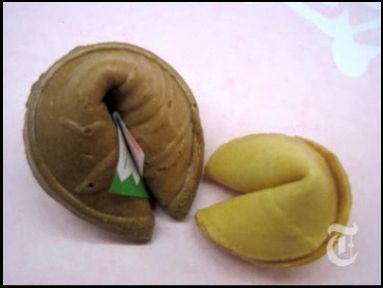
The fortune cookie isn’t Chinese. As best as can be figured out, it’s Japanese. But, in Japan, the fortune cookie wasn’t and isn’t like it is in the U.S. today. It’s larger and made with a darker batter seasoned with miso (instead of vanilla) and sprinkled with sesame seeds. This is a screenshot from a New York Times video about its history:

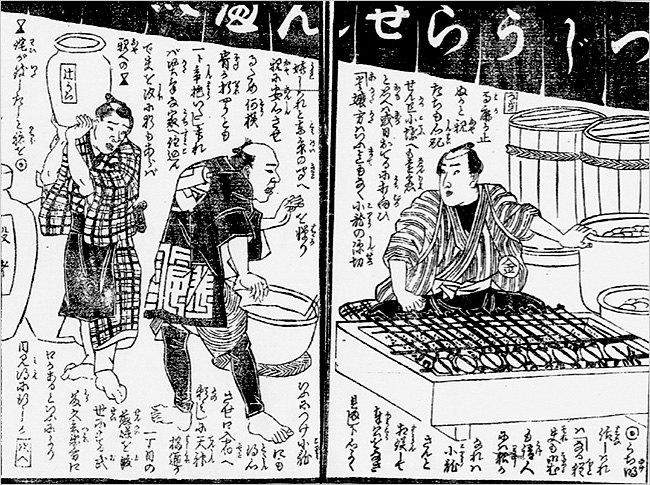
This drawing is believed to depict Japanese fortune cookie baking in 1878:

According to the New York Times, it was Japanese-Americans in California who first began making and selling fortune cookies in the ’20s. Many of them, however, served Chinese food. And Chinese-Americans may have picked up on the trend. Then, when the Japanese were forced into internment camps during WWII, Chinese-Americans took over the industry and, voila, the “Chinese fortune cookie.”

So the “Chinese” fortune cookie with which we’re all familiar isn’t Chinese at all and is certainly of American (re-)invention. So, insofar as the Lucky Taco, Lucky Cannoli, and the Lucky Cruncher are offensive — and I’m pretty sure they are — it’ll have to be for some other reason.

Originally posted in 2010.

Lisa Wade, PhD is an Associate Professor at Tulane University. She is the author of American Hookup, a book about college sexual culture; a textbook about gender; and a forthcoming introductory text: Terrible Magnificent Sociology. You can follow her on Twitter and Instagram.

Flashback Friday.

In the contemporary U.S., individuals choose who to marry based on personal preference, but there is a specific script by which those choices become a wedding day. Not everyone follows the script, but everyone knows it: the man decides to ask the woman to marry him, he buys a ring, he arranges a “special” event, he proposes, and she agrees. Many of us grow up dreaming of a day like this.

But this isn’t the only possible way to decide to marry. A reverse script might involve female choice. We can imagine a world in which, instead of hoping to be chosen, women decide to propose and men can only marry if they get asked. Another alternative script might involve no proposal at all, one in which two people discuss marriage and come to a decision together without the pop question and uncertain answer.

Of course, many couples essentially decide to marry through months or years of discussion, but these couples frequently act out the script anyway because, well, it’s so romantic and wonderful.

Or is it?

Andre M. sent in a clip of John Preator, a finalist on a previous season of American Idol. In the clip, he proposes to his girlfriend Erica on Main Street at a Disneyland Resort. The clip exaggerates the patriarchal underpinnings of both marriage and the marriage proposal. It may or may not be real, but it doesn’t really matter for our purposes.

Here it is:

First, Andre says, the spectacle is a shining testament to our commitment to the idea of marriage as an ideal state. Everyone loves marriage! As Andre writes:

A whole rainbow of characters come out of the shadows to push her towards yes, from the smiling Asian janitor, to the African American guy knighted by our hero and his plastic phallus, to the disabled woman who wishes to trade her fate with the bride-to-be.

We are supposed to think: “How wonderful! How sweet! How perfect!” What is made invisible is the fact that, in addition to a potential site of wedded bliss, marriage is the site of the reproduction of patriarchal privilege (especially through women’s disproportionate responsibility for housework and childcare) and heterosexist (still excluding same sex couples). But the audience knows that they are supposed to feel elated for the couple and privileged to witness their special moment (whether they feel these things or not).

Second, the public nature of the proposal put a lot of pressure on her to say “yes.” The audience is asked to participate in urging her to agree to marry him (“come on folks, how about a little encouragement?!”). And the performers, as well as the performance itself, create conditions that look a lot like coercion. Could she have said “no” if she wanted to? As if breaking his heart wouldn’t have been deterrent enough, saying “no” would have disappointed the onlookers and ruined the performance. He put so much work into scripting the proposal and it was very clear what her line was. How many women, with less pressure, have nonetheless felt it difficult or impossible to say “no”?

Okay, so let’s assume that Erica did want to marry John and that they will live happily ever after. And let’s also assume that most marriage proposals in the U.S. do not come with this degree of pressure. The clip is still a nice reminder of (1) just how taken-for-granted marriage is as an ideal state (can you imagine her saying, “I love you more than life itself and I want to be with you forever, but marriage, no thanks!”) and (2) the way that the proposal script puts men in the position of getting to choose and women in the position of having to agree or go off script.

Originally posted in 2010.

Lisa Wade, PhD is an Associate Professor at Tulane University. She is the author of American Hookup, a book about college sexual culture; a textbook about gender; and a forthcoming introductory text: Terrible Magnificent Sociology. You can follow her on Twitter and Instagram.

The Americans with Disabilities Act turned 25 years old last month. It was enacted by U.S. Congress with the goal of ensuring that people with disabilities had access to “reasonable accommodations” so that they could participate wholly in public life.

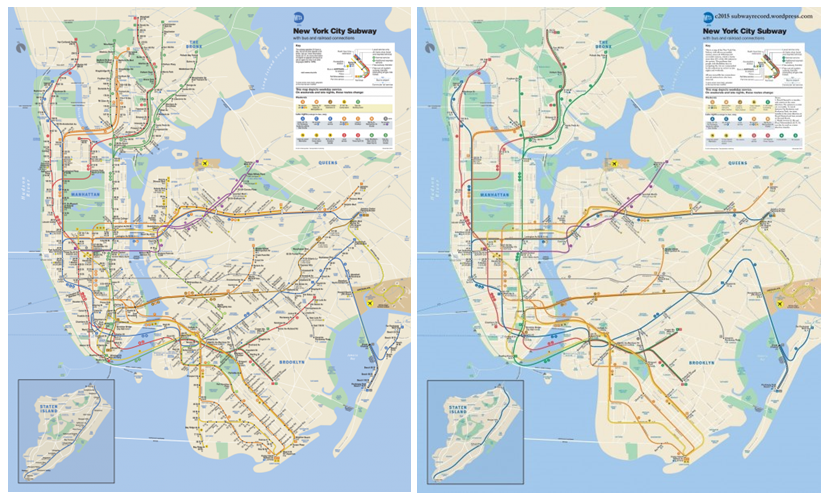
Did it work? Consider the New York City subway. SupraStructure featured these two maps. The one on the left is the NYC subway map of the 490 stations in the system; on the right is the accessible subway map, including only the 100 or so accessible stops:

15

“Essentially the NYC subway system is useless if you use a wheelchair,” writes Bad Cripple about the map. He continues:

Access to mass transportation for a person such as myself that uses a wheelchair is routinely difficult in the extreme. … Wheelchair lifts on buses are somehow broken or the drivers refuse to use the lift often claiming ignorance. Accessible taxis are as rare as diamonds in many cities. Subways in the vast majority of cities are grossly inaccessible. Rental car companies often do not have the car with hand controls rented weeks or days in advance. Shuttle buses at airports are not always accessible. Hotel shuttle buses are also typically not accessible.

He adds that discount travel is “pure folly” and that newer options like AirBnB and Uber seem to have no interest in accommodating people with disabilities. Not to mention the many places he travels that have broken lifts, elevators, and strangely non-accessible “accessible” accommodations.

As with much civil rights legislation, passing the ADA was just the first step in gaining equality. People have often had to sue piecemeal to get accessibility. A person identifies a restaurant without accessible bathrooms, for example, and begins legal proceedings to force the business to comply.  Slowly, little by little — thanks to lawsuits, building codes, and other means — the world is becoming more accessible, though not nearly as quickly as people with disabilities need it to.

Lisa Wade, PhD is an Associate Professor at Tulane University. She is the author of American Hookup, a book about college sexual culture; a textbook about gender; and a forthcoming introductory text: Terrible Magnificent Sociology. You can follow her on Twitter and Instagram.

“Asshole is a wonderful word,” said Mike Pesca in his podcast, The Gist. His former colleagues at NPR had wanted to call someone an asshole, and even though it was for a podcast, not broadcast, and even though the person in question was a certified asshole, the NPR censor said no. Pesca disagreed.

Pesca is from Long Island and, except for his college years in Atlanta, he has spent most of his time in the Northeast. Had he hailed from Atlanta – or Denver or Houston or even San Francisco – “asshole” might not have sprung so readily to his mind as le mot juste, even to denote Donald Trump. The choice of swear words is regional.

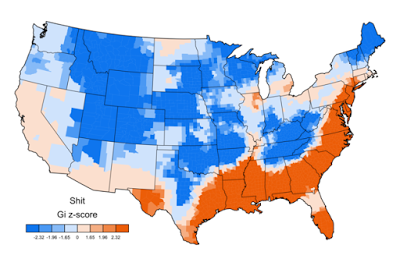
Linguist Jack Grieve has been analyzing tweets – billions of words – and recently he posted maps showing the relative popularity of different expletives. For example, every county in the Northeast tweets “asshole” at a rate at least two standard deviations above the national mean.

17
To my knowledge, Grieve has offered no explanation for this distribution, and I don’t have much to add. I assume that as with regional accents, historical factors are more important than the literal meanings of the words. It’s not that tweeters in the Northeast are generally more willing to use foul language, nor is this about anal imagery since the Northeast looks nearly prudish compared to other regions when it comes to “shit.”
18

Less surprising are the maps of toned-down expletives. People in the heartland are just so gosh darned polite in their speech. When Donald Trump spoke at the Family Leadership Summit in Iowa, what got all the attention was his dissing of John McCain (“He’s not a war hero. … He is a war hero because he was captured. I like people who weren’t captured.”) But there was also this paragraph in the New York Times’s coverage:

Mr. Trump raised eyebrows with language rarely heard before an evangelical audience — saying “damn” and “hell” when discussing education and the economy.

“Well, I was turned off at the very start because I didn’t like his language,” Becky Kruse, of Lovilia, Iowa, said…  Noting Mr. Trump’s comment about not seeking God’s forgiveness. “He sounds like he isn’t really a born-again Christian.”

Aside from the insight about Trump’s religious views, Ms. Kruse reflects the linguistic preferences of her region, where “damn” gets softened to “darn.”

journal.pone.0128832.g001 (1)

Unfortunately, Grieves did not post a map for “heck.” (I remember when “damn” and “hell” were off limits on television, though a newspaper columnist, usually in the sports section, might dare to write something like “It was a helluva fight.”) You can find maps for all your favorite words at Grieve’s website, where you can also find out what words are trending (as we now say) on Twitter. (“Unbothered” is spreading from the South and “fuckboy” is rising). Other words are on the way down (untrending?).  If you’re holding  “YOLO” futures, sell them now before it’s too late.

Originally posted at Montclair SocioBlog.

Jay Livingston is the chair of the Sociology Department at Montclair State University. You can follow him at Montclair SocioBlog or on Twitter.

Flashback Friday.

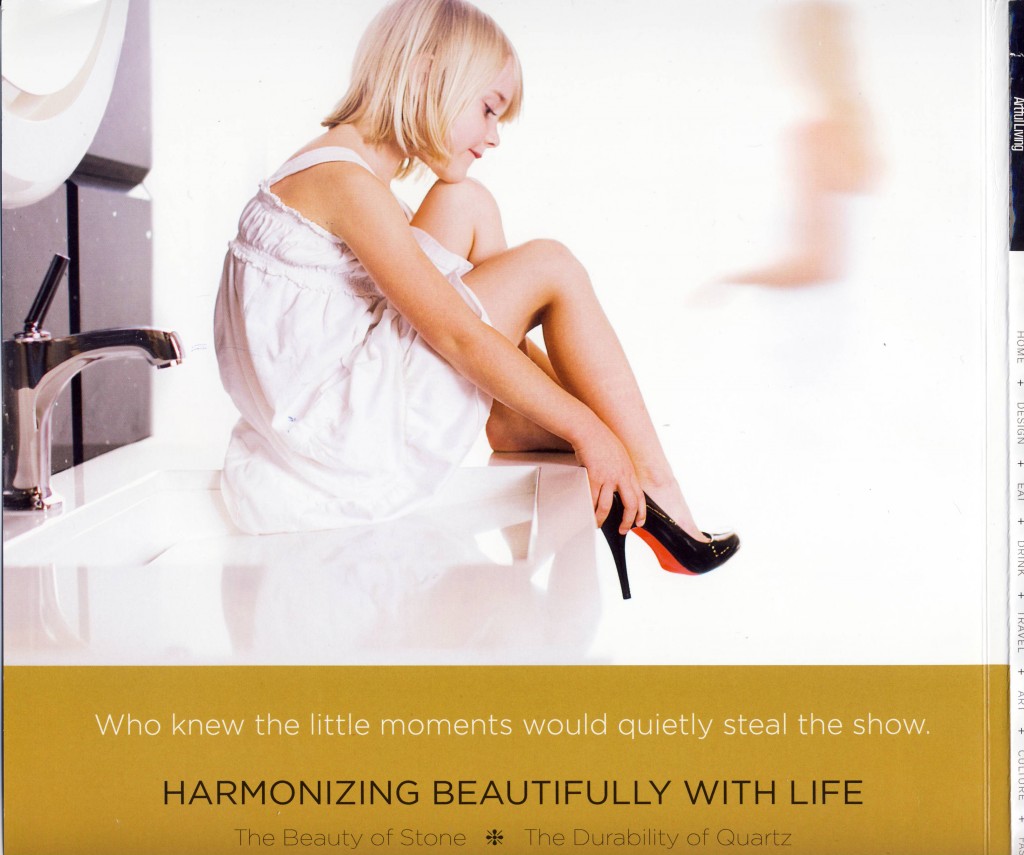
I just have to say “wow” to this ad for Quartz counter tops, sent it by Lisa Ray of Parents for Ethical Marketing and Corporate Babysitter:

The ad depicts a little girl fantasizing about growing up, but growing up means (extremely) high patent leather pumps; growing up means sexualizing herself.

And the ad does sexualize the little girl who, from the top-scanning-down, looks like a sweet girl trying on mommy’s shoes, but from the bottom-scanning-up, looks like an adult woman who suddenly transforms into a child. The white cotton dress implies innocence and purity, but it’s a costume we regularly see adult women wear when we want to both sexualize and infantilize them. In other words, this ad nicely plays into the mythology endorsed by pedophiles that even little girls want to feel sexy, even little girls want men’s attention, even little girls want sex.

And, yet, we are supposed to think this is sweet. The text, “Harmonizing Beautifully with Life” is, of course, ostensibly about the counter tops. But aligned with the image, it naturalizes both the girl’s fantasy and the conflation of female sex with the performance of sexualized femininity (it’s just “life”; as if there’s a gene for Christian Louboutin shoes that activates in the presence of double X chromosomes). More than simply naturalizing the girl’s fantasy of self-objectification, it endorses it (it’s beautiful harmony).

Notice also the class story in the ad. Who exactly is class privileged enough to have the freedom to allow “the quiet moments” to “steal the show”? Well, apparently people who are rich enough to wear Louboutin shoes. Louboutin began putting red soles on all his shoes as a not-so-subtle way to advertise that the shoe was Louboutin and, therefore, a very expensive shoe. It worked.  Fashion writers started pointing out the red soles with glee, as in this story about Angeline Jolie on a red carpet. The fact that the sole of this shoe is red is no accident, it’s meant to add class to the counter tops, in both senses of the word.

A final word on race: That the girl in the ad is white is no accident. And it’s not only because marketers expect the majority of their customers to be white, but because of what whiteness represents. Her white skin symbolizes the same thing that the white counter tops and white dress symbolize: purity, cleanliness, even innocence. It is only because all those symbolic elements are there that we can put a black patent leather heel with a red sole on her and still think “sweet.”  Imagine the same ad with a black child. In the U.S., black women are often stereotyped as sexually loose, morally corrupt, irresponsible teen mothers on welfare. With that symbolic baggage, this ad would be a morality lesson on the hypersexuality of black girls and their propensity to “grow up too fast.” It wouldn’t look sweet, it’d look dangerous.

“Harmonizing beautifully,” indeed.

Originally posted in 2010.

Lisa Wade, PhD is an Associate Professor at Tulane University. She is the author of American Hookup, a book about college sexual culture; a textbook about gender; and a forthcoming introductory text: Terrible Magnificent Sociology. You can follow her on Twitter and Instagram.