Search results for The

In 1970, the day after National Guard troops killed four unarmed protesters at Kent State University, students at Southern Illinois University went to the local McDonald’s and demanded that the flag be lowered to half staff.  The franchise owner complied.

Ray Kroc, the founder of McDonald’s got wind of this and told the franchise owner to raise the flag back up to full staff. When he conplied, the students threatened to burn the place down.

The whipsawed franchise owner phoned McDonald’s CEO Fred Turner asking what to do. If Turner’s response isn’t part of the canon of management courses, it ought to be:  “The next delivery truck that arrives, have him back in to the flag pole and knock it down.”

Lands’ End now finds itself in a similar position but with no flagpole and no trucks.

You may have noticed that the most Lands’ End catalogue looks different from the other 273 they’ve sent you this year. Lots of people in a tableau rather than close ups of one model in merch. And palm trees. Palm trees? From Wisconsin? The paper too is less slick, with more of a matte finish. But what has landed Lands’ End in hot water is the four-page interview with Gloria Steinem wearing Lands’ End gear. (The text in the upper right begins, “Introducing the Legend Series, our ode to individuals who have made a difference . . . .”)

Lands’ End is in trouble – profits and sales way down – and the new CEO wanted to change the look of the catalogue if not the clothes. But that was the beginning of more trouble. First, conservatives got word of it and started criticizing Lands’ End for celebrating a woman who not only spoke out in favor of legalized abortion but who had actually had an abortion and said so. Lands’ End responded:  “It was never our intention to raise a divisive political or religious issue, so when some of our customers saw the recent promotion that way, we heard them. We sincerely apologize for any offense.”

Besides apologizing, they also wiped the Gloria material from their website. (So far, they haven’t yet asked me to return my catalogue, but who knows?)

Then the pro-Gloria forces took to Facebook and Twitter.

“I don’t intend to teach my children that anyone should do business with a company that is ashamed to even talk about feminism,”

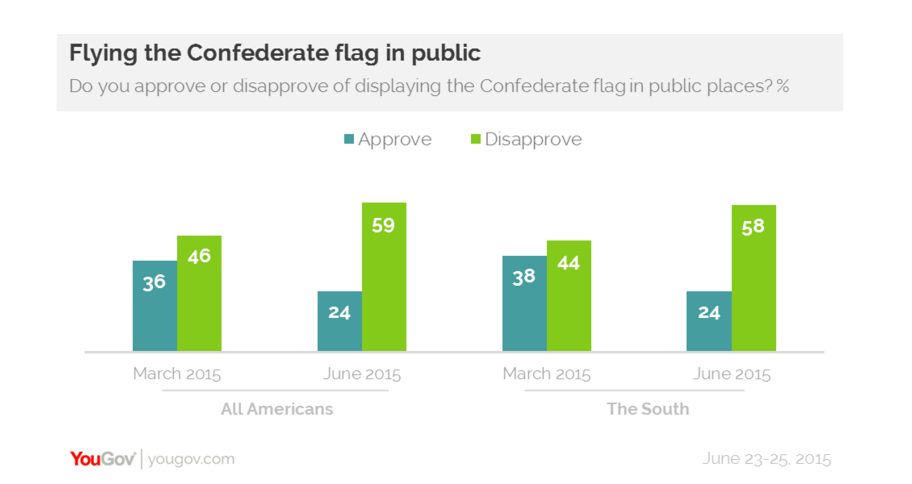
The Washington Post says that Lands’ End, in its attempt to retroactively duck the issue, is tacking away from the trend. Companies, says WaPo, have now become “unapologetic in their stance on social issues.” Big companies –Target, Gap, Visa, Cheerios, etc. – have supported the Supreme Court decision on gay marriage or criticized Trump’s denigration of Latinos. Sears and Wal-Mart came out against the Confederate flag.

The message of these earlier moves seemed to be that the companies were willing to stake out a position they felt strongly about, even if it meant alienating some customers. Lands’ End, it appears, may have a different mindset.

Is it Lands’ End, or is it the issue? After the Charleston Church Massacre of June 2015, retreating from the Confederate flag became the majority view even in the South.3
The trend on gay marriage has also made acceptance a safe bet:
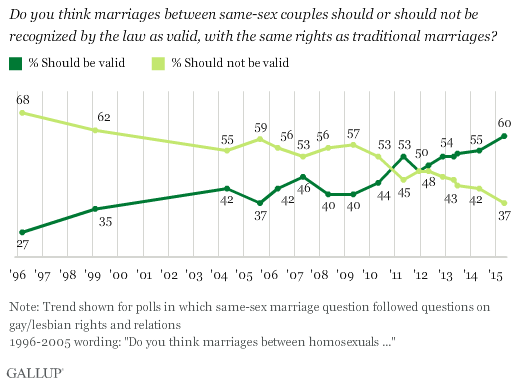
4

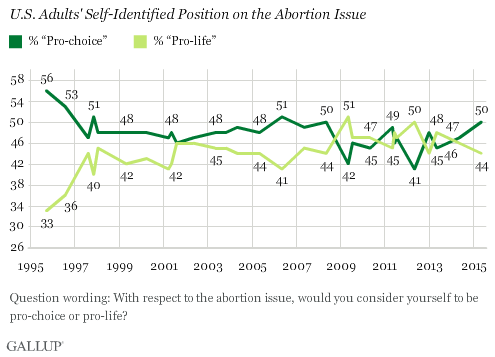
But on abortion, the public is still split and the issue is still salient:
5
Lands’ End was caught between equally strong opinions. Their dilemma on Gloria reflects their dilemma on clothing and clientele. Lands’ End wants to attract younger shoppers, who lean towards the pro-choice side, but not lose their older customers, who lean the opposite direction.
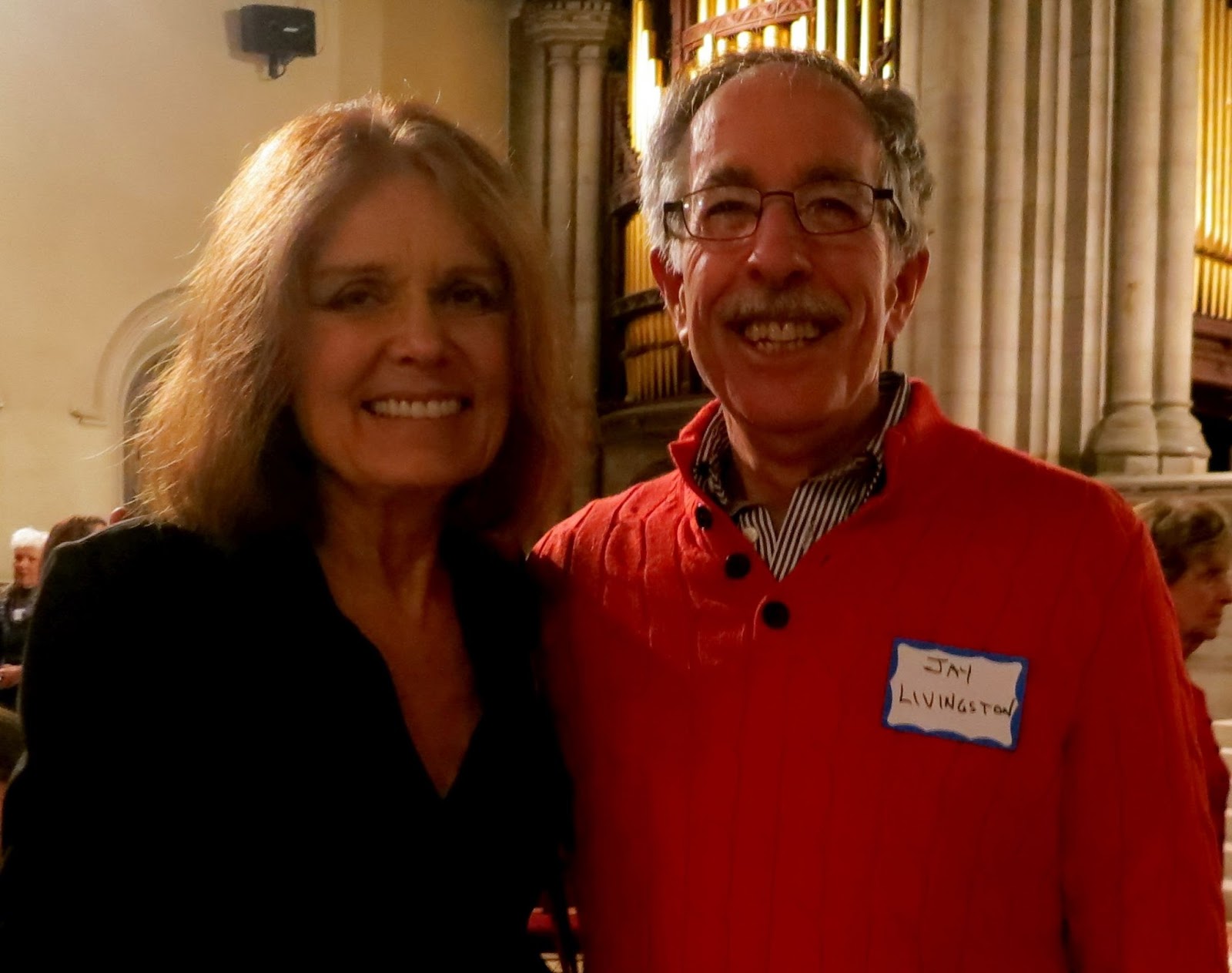
Here at the SocioBlog, we’re proud to show our colors – a bright orange Lands’ End sweater.
Originally posted at Montclair SocioBlog; cross-posted at Pacific Standard.

Jay Livingston is the chair of the Sociology Department at Montclair State University. You can follow him at Montclair SocioBlog or on Twitter.


On Mardi Gras mornings before dawn, members of the North Side Skull and Bones Gang prowl the streets. It’s a 200 year old tradition belonging to African American residents of the city. They first prowled in 1819.

Members of the gang dress up like ominous skeletons. At nola.com, Sharon Litwin writes:

Because the origins of the Gang were with working class folk who had little money for silks and satins, the skeleton suits are made from everyday items and simple fabrics. Baling wire (to construct the shape of the head) along with flour and water to bind together old newspapers, create the head itself.

Their message is to “warn [people] away from violence” — says the North Side Chief, Bruce “Sunpie” Barnes — especially young people, and especially gun and domestic violence. He explains:

The bone gang represents people… waking people up about what they’re doing in life, if they don’t change their lifestyle. You know. We’re like the dead angels. We let you know, if you keep doing what you’re doing, you’re gonna be with us.

Up before most residents, members of the gang cause a ruckus. They sing songs, bang on doors, and play-threaten their neighbors.

Here’s some footage:

Lisa Wade, PhD is an Associate Professor at Tulane University. She is the author of American Hookup, a book about college sexual culture; a textbook about gender; and a forthcoming introductory text: Terrible Magnificent Sociology. You can follow her on Twitter and Instagram.

2 (1)Hey, they did a study.

Psychologist Paul Thibodeau and three colleagues decided that it was time to take a closer look at the word “moist,” writing:

The word “moist” … has been the subject of a Facebook page (called “I HATE the word MOIST”) with over 3,000 followers and was rated as the least liked word in the English language by a Mississippi State Poll … ; feature articles have been written in Slate Magazine … and The New Yorker … ; and popular TV shows like“How I Met Your Mother” (“Stuff”) and “The New Girl” (“Birthday”) have devoted entire plot-lines to the comic consequences of word aversion.

Now it’s not just anecdotal. Thibodeau found that between 13 and 21% of people have an aversion to the word.

But why?

20150629_001830

Is it just a gross-sounding word? If so, then people who hate moist should also hate foist and rejoiced. Verdict: No. Hating the sound moist is independent of one’s appreciation for words that rhyme.

Is it because it makes people think of sex? Verdict: Yes! Priming people to think of sex versus, say, cake, makes people dislike the word more. Bonus: People who scored higher on a measure of disgust for bodily functions were more likely than those who scored lower to claim an aversion to the word.

So, if you don’t like the word moist, get your mind out of the gutter. And, if your aversion is severely hampering your life, just think about cake!

Lisa Wade, PhD is an Associate Professor at Tulane University. She is the author of American Hookup, a book about college sexual culture; a textbook about gender; and a forthcoming introductory text: Terrible Magnificent Sociology. You can follow her on Twitter and Instagram.

2 (1)Following the recent mass shooting in Charleston, South Carolina on June 17th, 2015 – a racially motivated act of domestic terrorism – President Barack Obama delivered a sobering address to the American people. With a heavy heart, President Obama spoke the day following the attack, stating:

At some point we as a country will have to reckon with the fact that this type of mass violence does not happen in other advanced countries. And it is in our power to do something about it. I say that recognizing that politics in this town foreclose a lot of those avenues right now. But it would be wrong for us not to acknowledge.

President Obama was primarily referring to gun control in the portion of his speech addressing the cause of attacks like this. Not all mass shootings are racially motivated, and not all qualify as “terrorist” attacks — though Charleston certainly qualifies.  And the mass shooting that occurred a just a month later in Chattanooga, Tennessee by a Kuwati-born American citizen was quickly labeled an act of domestic terrorism. But, President Obama makes an important point here: mass shootings are a distinctly American problem. This type of rampage violence happens more in the United States than anywhere else. And gun control is a significant part of the problem. But, gun control is only a partial explanation for mass shootings in the United States.

Mass shootings are also almost universally committed by men.  So, this is not just an American problem; it’s a problem related to American masculinity and to the ways American men use guns.  But asking whether “guns” or “masculinity” is more of the problem misses the central point that separating the two might not be as simple as it sounds.  And, as Mark Follman, Gavin Aronsen, and Deanna Pan note in the Mother Jones Guide to Mass Shootings in America, the problem is getting worse.

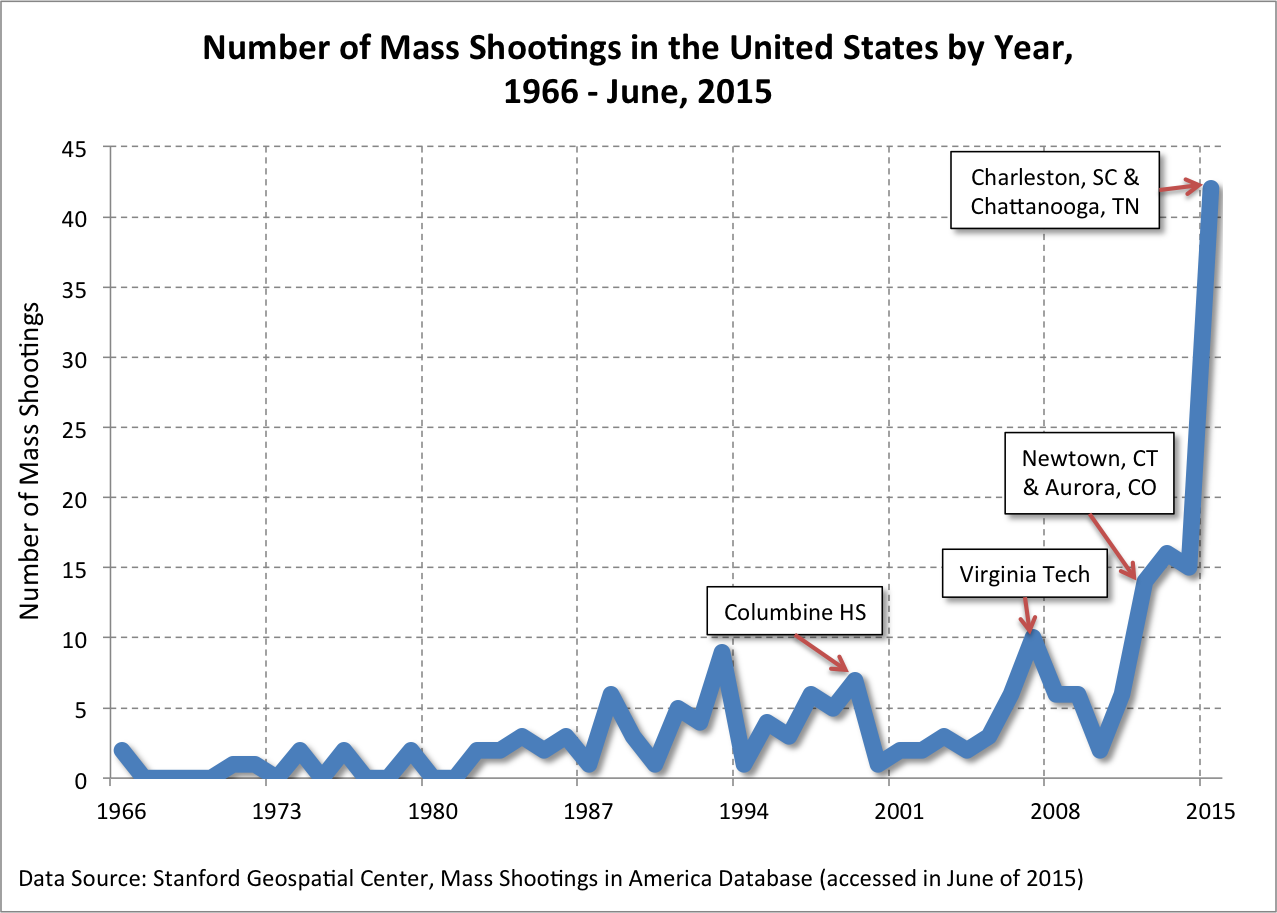
We recently wrote a chapter summarizing the research on masculinity and mass shootings for Mindy Stombler and Amanda Jungels’ forthcoming volume, Focus on Social Problems: A Contemporary Reader (Oxford University Press). And we subsequently learned of a new dataset on mass shootings in the U.S. produced by the Stanford Geospatial Center. Their Mass Shootings in America database defines a “mass shooting” as an incident during which an active shooter shoots three or more people in a single episode. Some databases define mass shootings as involving 4 shootings in a single episode. And part of this reveals that the number is, in some ways, arbitrary. What is significant is that we can definitively say that mass shootings in the U.S. are on the rise, however they are defined. The Mother Jones database has shown that mass shootings have become more frequent over the past three decades.  And, using the Stanford database, we can see the tend by relying on data that stretches back a bit further.

5

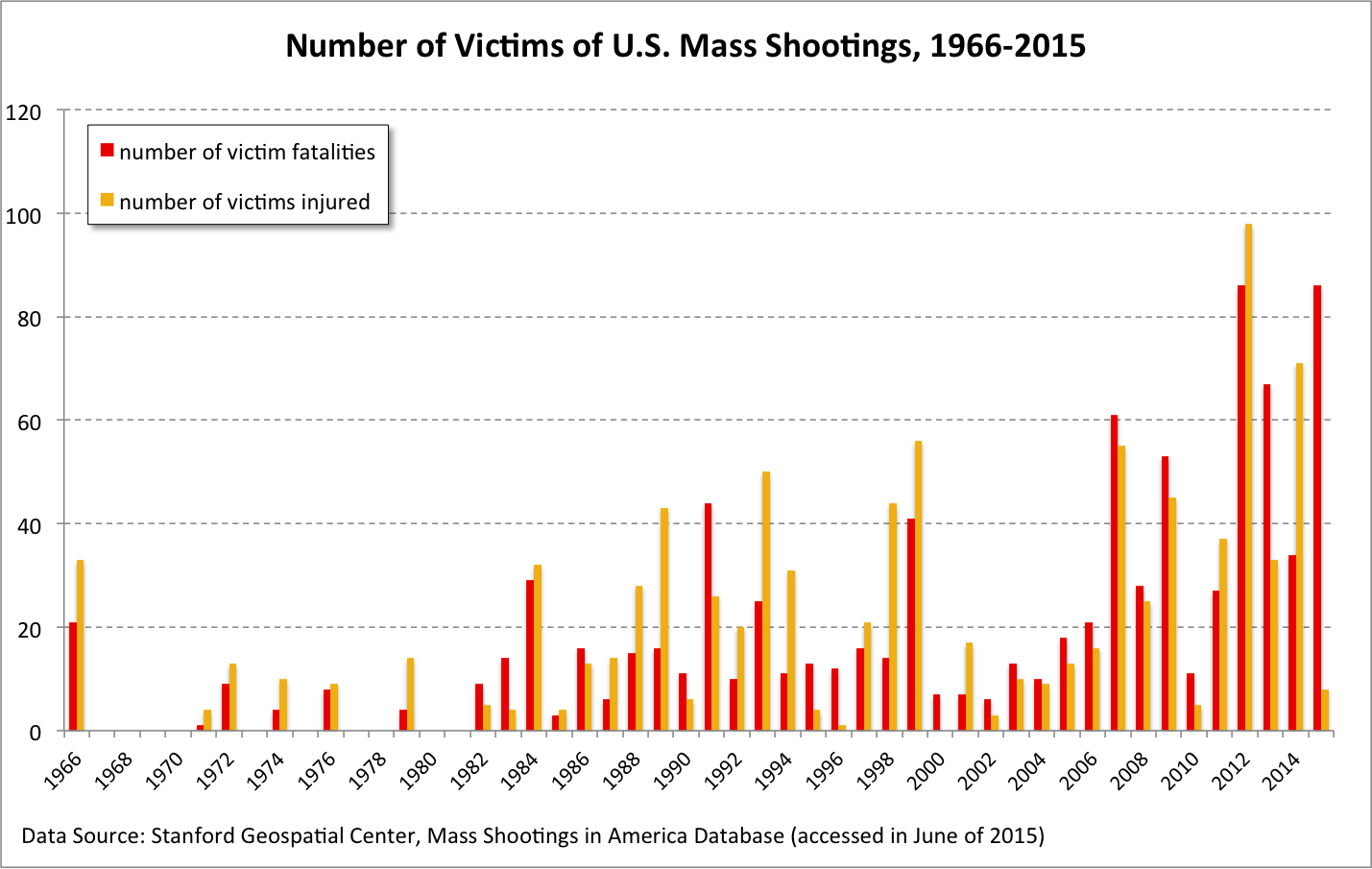
Additionally, we know that the number of victims of mass shootings is also at an historic high:

13

We also produced a time-lapse map of mass shootings in the United States illustrating both where and when mass shootings have occurred using the Stanford Geospatial Center’s database to illustrate this trend over time:

Our map charts mass shootings with 3 or more victims over roughly 5 decades, since 1966. The dataset takes us through the Charleston and Chattanooga shootings, which brought 2015 to 42 mass shootings . The dataset is composed of 216 separate incidents only 5 of which were committed by lone woman shooters. Below we produced an interactive map depicting all of the mass shootings in the dataset with brief descriptions of the shootings.

In our chapter in Stombler and Jungels’ forthcoming book, we cull existing research to answer two questions about mass shootings: (1) Why is it men who commit mass shootings? and (2) Why do American men commit mass shootings so much more than men anywhere else?  Based on sociological research, we argue that there are two separate explanations – a social psychological explanation and a cultural explanation (see the book for much more detail on each).

A Social Psychological Explanation

Research shows that when an identity someone cares about is called into question, they are likely to react by over-demonstrating qualities associated with that identity.  As this relates to gender, some sociologists call this “masculinity threat.”  And while mass shootings are not common, research suggests that mass shooters experience masculinity threats from their peers and, sometimes, simply from an inability to live up to societal expectations associated with masculinity (like holding down a steady job, being able to obtain sexual access to women’s bodies, etc.) – some certainly more toxic than others.

The research on this topic is primarily experimental.  Men who are brought into labs and have their masculinity experimentally “threatened” react in patterned ways: they are more supportive of violence, less likely to identify sexual coercion, more likely to support statements about the inherent superiority of males, and more.

This research provides important evidence of what men perceive as masculine in the first place (resources they rely on in a crisis) and a new kind evidence regarding the relationship of masculinity and violence.  The research does not suggest that men are somehow inherently more violent than women.  Rather, it suggests that men are likely to turn to violence when they perceive themselves to be otherwise unable to stake a claim to a masculine gender identity.

A Cultural Explanation

But certainly boys and men experience all manner of gender identity threat in other societies.  Why are American boys and men more likely to react with such extreme displays?  To answer this question, we need an explanation that articulates the role that American culture plays in influencing boys and young men to turn to this kind of violence at rates higher than anywhere else in the world.  This means we need to turn our attention away from the individual characteristics of the shooters themselves and to more carefully investigate the sociocultural contexts in which violent masculinities are produced and valorized.

Men have historically benefited from a great deal of privilege – white, educated, middle and upper class, able-bodied, heterosexual men in particular.  Social movements of all kinds have slowly chipped away at some of these privileges.  So, while inequality is alive and well, men have also seen a gradual erosion of privileges that flowed more seamlessly to previous generations of men (white, heterosexual, class-privileged men in particular).  Michael Kimmel suggests that these changes have produced a uniquely American gendered sentiment that he calls “aggrieved entitlement.”  Of course, being pissed off about an inability to cash in on privileges previous generations of men received without question doesn’t always lead to mass shootings.  But, from this cultural perspective, mass shootings can be understood as an extremely violent example of a more general issue regarding changes in relations between men and women and historical transformations in gender, race, and class inequality.

Mass shootings are a pressing issue in the United States.  And gun control is an important part of this problem.  But, when we focus only on the guns, we sometimes gloss over an important fact: mass shootings are also enactments of masculinity.  And they will continue to occur when this fact is combined with a sense among some men that male privilege is a birthright – and one that many feel unjustly denied.

Cross-posted at Feminist Reflections and Inequality by (Interior) Design.

Tristan Bridges and Tara Leigh Tober are sociologists at the University of California, Santa Barbara.   You can follow them on at @tristanbphd and @tobertara.


2 (1)When you travel, the option to stay in a private home instead of a hotel might seem like a nice idea. Your experience of the city might be a little more authentic, maybe you’ll meet a local, and you can keep your money out of the hands of giant corporations. It’s a tiny way to fight the shrinking of the middle class.

These options, though, may not be a panacea. After discovering that his Brooklyn neighborhood had 1,500 listings on Airbnb, Murray Cox decided to take a closer look. How many residences now invite tourists? How small scale were the profits? Did the money really go to locals?

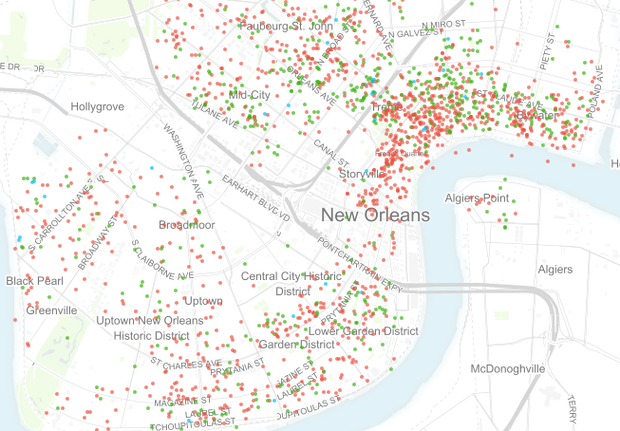
New Orleans wanted to know the answers to these questions, too. The city has been hit by what nola.com reporter Robert McClendon calls a “Airbnb gold rush.” It turns out the city currently has about 2,600 rentals on Airbnb, plus another 1,000 or so on VRBO.com. This has sparked a heated debate among residents, business owners, and politicians about the future of the practice.

So, Cox jumped in to give us the data and figure out where the money is going.

4

Are Airbnb hosts living in the spaces they rent?

Cox found that they generally are not. Only 34% of rentals are for rooms or shared rooms; 66% of listings are for an entire home or apartment. More than two-thirds (69%) are rented year-round. Almost half of all hosts operate at least two rentals.

These numbers suggest that your modal Airbnb host doesn’t live in the home they rent out. Some may actually live in another city altogether. Others are using Airbnb as an investment opportunity, buying homes and turning them into full time rentals.

What’s the downside?

Locals are complaining about deterioration in the feeling of community in their neighborhoods. It’s difficult to make friends with your neighbors when they turn over twice a week. Tourists are also more likely than locals to come home drunk and disorderly, disturbing the peace and quiet.

And they are pricing people who actually live in New Orleans out of the rental market. Short-term renting offers owners the opportunity to make four or five times the amount of money they could make with a long-term tenant, so it’s an economic no-brainer to sign up for Airbnb. But, as more and more people do so, there are fewer and fewer places for locals to live and so the supply-and-demand curve increasingly favors owners who can jack up long-term rental prices.

So, when you give your money to an Airbnb host in New Orleans or elsewhere, you might be giving some extra money to a local, but you might also be harming the residential neighborhoods you enjoy and the long-term viability of local life.

Lisa Wade, PhD is an Associate Professor at Tulane University. She is the author of American Hookup, a book about college sexual culture; a textbook about gender; and a forthcoming introductory text: Terrible Magnificent Sociology. You can follow her on Twitter and Instagram.

2 (1)There was a great article in The Nation last week about social media and ad hoc credit scoring. Can Facebook assign you a score you don’t know about but that determines your life chances?

Traditional credit scores like your FICO or your Beacon score can determine your life chances. By life chances, we generally mean how much mobility you will have. Here, we mean a number created by third party companies often determines you can buy a house/car, how much house/car you can buy, how expensive buying a house/car will be for you. It can mean your parents not qualifying to co-sign a student loan for you to pay for college. These are modern iterations of life chances and credit scores are part of it.

It does not seem like Facebook is issuing a score, or a number, of your creditworthiness per se. Instead they are limiting which financial vehicles and services are offered to you in ads based on assessments of your creditworthiness.

One of the authors of The Nation piece (disclosure: a friend), Astra Taylor, points out how her Facebook ads changed when she started using Facebook to communicate with student protestors from for-profit colleges. I saw the same shift when I did a study of non-traditional students on Facebook.

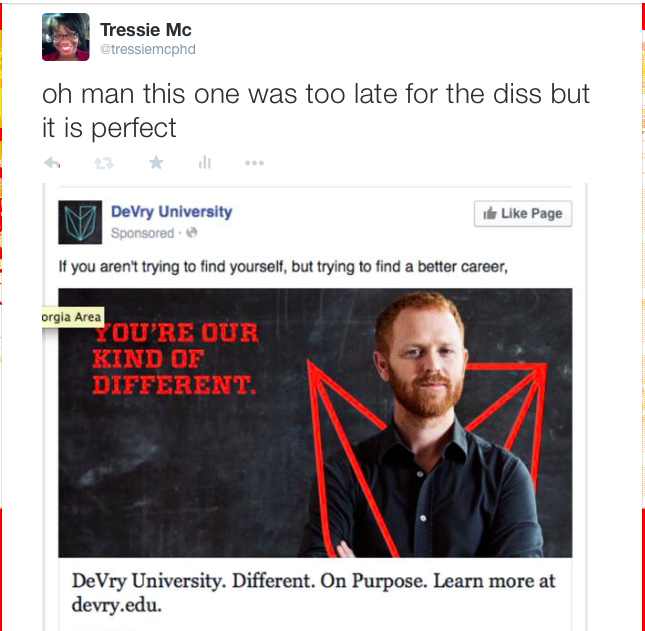
You get ads like this one from DeVry:

2 (1)

Although, I suspect my ads were always a little different based on my peer and family relations. Those relations are majority black. In the U.S. context that means it is likely that my social network has a lower wealth and/or status position as read through the cumulative historical impact of race on things like where we work, what jobs we have, what schools we go to, etc. But even with that, after doing my study, I got every for-profit college and “fix your student loan debt” financing scheme ad known to man.

Whether or not I know these ads are scams is entirely up to my individual cultural capital. Basically, do I know better? And if I do know better, how do I come to know it?

I happen to know better because I have an advanced education, peers with advanced educations and I read broadly. All of those are also a function of wealth and status. I won’t draw out the causal diagram I’ve got brewing in my mind but basically it would say something like, “you need wealth and status to get advantageous services offered you on the social media that overlays our social world and you need proximity wealth and status to know when those services are advantageous or not”.

It is in interesting twist on how credit scoring shapes life chances. And it runs right through social media and how a “personalized” platform can never be democratizing when the platform operates in a society defined by inequalities.

I would think of three articles/papers in conversation if I were to teach this (hint, I probably will). Healy and Fourcade on how credit scoring in a financialized social system shapes life chances is a start:

providers have learned to tailor their products in specific ways in an effort to maximize rents, transforming the sources and forms of inequality in the process.

And then Astra Taylor and Jathan Sadowski’s piece in The Nation as a nice accessible complement to that scholarly article:

Making things even more muddled, the boundary between traditional credit scoring and marketing has blurred. The big credit bureaus have long had sidelines selling marketing lists, but now various companies, including credit bureaus, create and sell “consumer evaluation,” “buying power,” and “marketing” scores, which are ingeniously devised to evade the FCRA (a 2011 presentation by FICO and Equifax’s IXI Services was titled “Enhancing Your Marketing Effectiveness and Decisions With Non-Regulated Data”). The algorithms behind these scores are designed to predict spending and whether prospective customers will be moneymakers or money-losers. Proponents claim that the scores simply facilitate advertising, and that they’re not used to approve individuals for credit offers or any other action that would trigger the FCRA. This leaves those of us who are scored with no rights or recourse.

And then there was Quinn Norton this week on The Message talking about her experiences as one of those marketers Taylor and Sadowski allude to. Norton’s piece summarizes nicely how difficult it is to opt-out of being tracked, measured and sold for profit when we use the Internet:

I could build a dossier on you. You would have a unique identifier, linked to demographically interesting facts about you that I could pull up individually or en masse. Even when you changed your ID or your name, I would still have you, based on traces and behaviors that remained the same — the same computer, the same face, the same writing style, something would give it away and I could relink you. Anonymous data is shockingly easy to de-anonymize. I would still be building a map of you. Correlating with other databases, credit card information (which has been on sale for decades, by the way), public records, voter information, a thousand little databases you never knew you were in, I could create a picture of your life so complete I would know you better than your family does, or perhaps even than you know yourself.

It is the iron cage in binary code. Not only is our social life rationalized in ways even Weber could not have imagined but it is also coded into systems in ways difficult to resist, legislate or exert political power.

Gaye Tuchman and I talk about this full rationalization in a recent paper on rationalized higher education. At our level of analysis, we can see how measurement regimes not only work at the individual level but reshape entire institutions. Of recent changes to higher education (most notably Wisconsin removing tenure from state statute causing alarm about the role of faculty in public higher education) we argue that:

In short, the for-profit college’s organizational innovation lies not in its growth but in its fully rationalized educational structure, the likes of which being touted in some form as efficiency solutions to traditional colleges who have only adopted these rationalized processes piecemeal.

And just like that we were back to the for-profit colleges that prompted Taylor and Sadowski’s article in The Nation.

Efficiencies. Ads. Credit scores. Life chances. States. Institutions. People. Inequality.

And that is how I read. All of these pieces are woven together and its a kind of (sad) fun when we can see how. Contemporary inequalities run through rationalized systems that are being perfected on social media (because its how we social), given form through institutions, and made invisible in the little bites of data we use for critical minutiae that the Internet has made it difficult to do without.

Tressie McMillan Cottom is an assistant professor of sociology at Virginia Commonwealth University.  Her doctoral research is a comparative study of the expansion of for-profit colleges.  You can follow her on twitter and at her blog, where this post originally appeared.

2 (1)Compared to the less powerful, more powerful people feel more entitled to be treated fairly, are quicker to identify an instance in which they are mistreated, and more likely to take action in response.

These are the findings of a new study by social psychologist Takuya Sawaoka and colleagues. They defined power as “disproportionate control over other people’s individuals’ outcomes.” I imagine someone who is a boss, perhaps, or a police officer, professor in a classroom, or patriarch of a family, or even just people who are wealthy and can pretty much pay people to do anything they want.

The scholars review the literature showing that people with power are entitled to a disproportionate share of resources and more likely to cheat, steal, and lie. They hypothesize that this “individual variability in entitlement shapes people’s reactions to injustices that they experience” and designed a series of studies to test it.

In the first study, participants were primed to feel either powerful or powerless by being asked to write about and reflect on a situation in which they felt they had power over someone else or, alternatively, someone had power over them. They were then instructed to play a game with a confederate (unknown to them) who had ten tokens that they could divide up however they pleased. Participants who had been primed to feel low power expected to get less than half the tokens, but participants who had been primed to feel powerful expected a fair outcome.

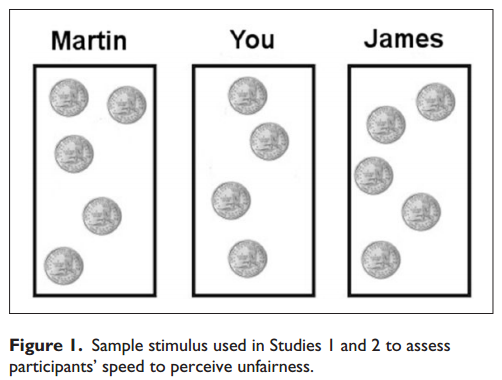
They then tested individuals’ sensitivity to unfairness. They showed people primed to feel powerful and powerless distributions of tokens that looked liked this, but with varying amounts, and asked them to indicate whether the distribution was fair or unfair.

2 (1)

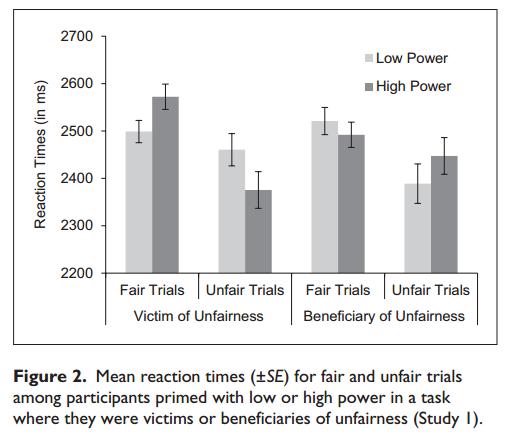
Their measure of sensitivity was how quickly the person identified the distribution as unfair. Their findings showed that, when they were the victim of unfairness (see the second pair of columns from the left), people feeling powerful were quicker to identify it as unfair (a lower bar = faster) than were people feeling powerless.

But, when they benefited from unfairness (see the pair of columns on the far right), people feeling powerful were slower to identify it as unfair than when they were the victims and slower than people who felt powerless.

2

They had similar findings when people primed to feel powerful didn’t directly benefit, but simply observed other people being treated unfairly. And, they tested whether their findings extended to interpersonal justice, too, by asking how people responded to being socially excluded. They found the same pattern.

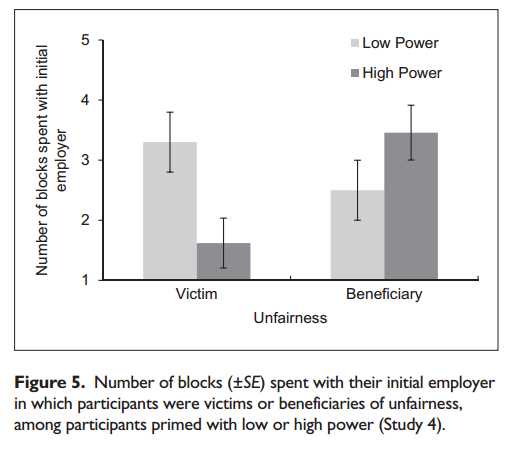
Finally, they found that, when being treated unfairly, participants primed to feel powerful were quicker to take action than those primed to feel powerless. The two columns on the left below show that high power people quickly left a hypothetical employer for a different one if they were treated unfairly.

3

So, to conclude, people who are primed to feel powerful feel entitled to fair treatment — both economically and socially — and are quick to recognize and correct it when they are treated unfairly, but they are significantly less likely to notice or care when the less powerful are injustice’s victims.

Lisa Wade, PhD is an Associate Professor at Tulane University. She is the author of American Hookup, a book about college sexual culture; a textbook about gender; and a forthcoming introductory text: Terrible Magnificent Sociology. You can follow her on Twitter and Instagram.

2 (1)

Mr. Draper, I don’t know what it is you really believe in but I do know what it feels like to be out of place, to be disconnected, to see the whole world laid out in front of you the way other people live it. There’s something about you that tells me you know it too.

Mad Men, Season 1, Episode 1

The ending of Mad Men was brilliant. It was like a good mystery novel: once you know the solution – Don Draper creating one of the greatest ads in Madison Avenue history – you see that the clues were there all along.  You just didn’t realize what was important and what wasn’t. Neither did the characters. This was a game played between Matt Weiner and the audience.

The ending, like the entire series, was also a sociological commentary on American culture. Or rather, it was an illustration of such a commentary. The particular sociological commentary I have in mind is Philip Slater’sPursuit of Loneliness, published in 1970, the same year that this episode takes place. It’s almost as if Slater had Don Draper in mind when he wrote the book, or as if Matt Weiner had the book in mind when he wrote this episode.

In the first chapter, “I Only Work Here,” Slater outlines “three human desires that are deeply and uniquely frustrated by American culture”:

(1) the desire for community – the wish to live in trust, cooperation, and friendship with those around one.

(2) the desire for engagement – the wish to come to grips directly with one’s social and physical environment.

(3) the desire for dependence – the wish to share responsibility for the control of one’s impulses and the direction of one’s life.

The fundamental principle that gives rise to these frustrations is, of course, individualism.

Individualism is rooted in the attempt to deny the reality of human interdependence. One of the major goals of technology in America is to “free” us from the necessity of relating to, submitting to, depending upon, or controlling other people. Unfortunately, the more we have succeeded in doing this, the more we have felt disconnected, bored, lonely, unprotected, unnecessary, and unsafe.

Most of those adjectives could apply to Don Draper at this point. In earlier episodes, we have seen Don, without explanation, walk out of an important meeting at work and, like other American heroes, light out for the territory, albeit in a new Cadillac. He is estranged from his family. He is searching for something – at first a woman, who turns out to be unattainable, and then for… he doesn’t really know what. He winds up at Esalen, where revelation comes from an unlikely source, a nebbishy man named Leonard. In a group session, Leonard says:

I’ve never been interesting to anybody. I, um –  I work in an office. People walk right by me. I know they don’t see me. And I go home and I watch my wife and my kids. They don’t look up when I sit down…

I had a dream. I was on a shelf in the refrigerator. Someone closes the door and the light goes off. And I know everybody’s out there eating. And then they open the door and you see them smiling. They’re happy to see you but maybe they don’t look right at you and maybe they don’t pick you. Then the door closes again. The light goes off.

People are silent, but Don gets up, slowly moves towards Leonard and tearfully, silently, embraces him. 3

On the surface, the two men could not be more different. Don is interesting. And successful. People notice him. But he shares Leonard’s sense that his pursuit – of a new identity, of career success, of unattainable women – has left him feeling inauthentic, disconnected, and alone. “I’ve messed everything up,” he tells his sometime co-worker Peggy in a phone conversation. “I’m not the man you think I am.”

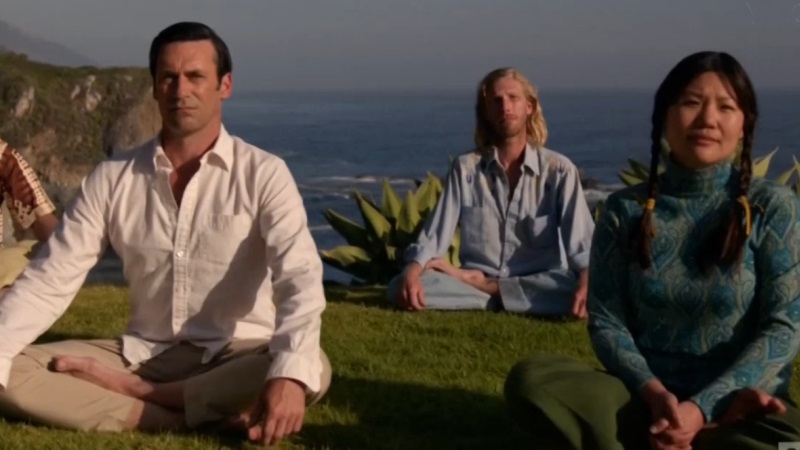
The next time we see him, he is watching from a distance as people do tai-chi on a hilltop.1b

And then he himself is sitting on a hilltop, chanting “om” in unison with a group of people. At last he is sharing something with others rather than searching for ego gratifications. 1c

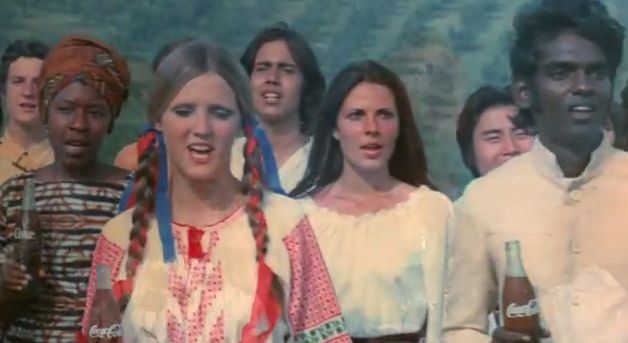
And then the punch line. We cut to the Coke hilltop ad with its steadily expanding group of happy people singing in perfect harmony. 2A simple product brings universal community (“I’d like to buy the world a Coke and keep it company”). It also brings authenticity. “It’s the real thing.” Esalen and Coca-Cola. Both are offering solutions to the frustrated needs Slater identifies. But both solutions suffer from the same flaw – they are personal rather than social. A few days of spiritual healing and hot springs brings nor more social change than does a bottle of sugar water.It’s not that real change is impossible, Slater says, and in the final chapter of the book, he hopes that the strands in the fabric of American culture can be rewoven.  But optimism is difficult.
So many healthy new growths in our society are at some point blocked by the overwhelming force and rigidity of economic inequality… There’s a… ceiling of concentrated economic power that holds us back, frustrates change, locks in flexibility.

The Mad Men finale makes the same point, though with greater irony (the episode title is “Person to Person”). When we see the Coke mountaintop ad, we realize that Don Draper has bundled up his Esalen epiphany, brought it back to a huge ad agency in New York, and turned it into a commercial for one of the largest corporations in the world.

Cross-posted at Montclair SocioBlog and Pacific Standard.

Jay Livingston is the chair of the Sociology Department at Montclair State University. You can follow him at Montclair SocioBlog or on Twitter.