
RU031513The Art of Being Edited*

A primer on getting the most out of the editing process, this short article assumes that you’re working on a journal submission, but is generally applicable to an op-ed you might be pitching, sample chapters for a book proposal, etc. I am also assuming you’ve already found an editor, but I’ll talk about that a little bit. As always, I take questions and additional recommendations—I’m positive I’ve overlooked, oh, about a hundred things. A hundred seems about right.

Getting Started

  1. When is it time to get an editor involved? If someone else has told you that your piece needs an editor (this will sometimes occur at the final stages of a dissertation), it’s clearly time, but otherwise, it’s subjective. The best time, from the editorial point of view, is when you have gotten to a solid second draft. 
  2. What does your editor need? The full manuscript, including the bibliography, should travel together wherever possible. This is particularly the case where you have multiple authors and your editor will be working to “cover the seams” (that is, to make sure there aren’t three distinct voices throughout or three different citation styles poking holes in the reader’s experience). If possible, send the author’s guide from your target journal, as each has its particulars, and your editor can more easily let you know if you’re missing a required title page or reformat your bibliography entries as needed if they have this information. Your editor also needs a timeline; if you’re hoping to get your edits in under two weeks, expect to pay a rush fee, as the editor will likely need to reshuffle priorities.Be sure to include preferences, if you know them: are there words you hate? Phrases you think are key to your writing style and should not be excised? And if it’s at all possible, send the “Twitter” version of your paper: what’s the key point in 2 sentences or so? This is a great guide for your editor.
  3. What do you need from your editor? An agreed-upon timeline and format (that is, do you prefer paper markups or a word .doc with track changes) are key, as is an idea of what you can expect to pay. And if you have a great deal of technical information in your piece, you will likely need to confirm that your editor is comfortable in your field (this is rarely applicable for all but the most technical scientific or mathematical writing). In some cases, you should also ask if they have any conflicts of interest, particularly if your paper is on a topic that might be considered controversial (and might disagree vehemently) or if they have a full-time job working for a journal in your field.

Letting Go

You’ve got your editor, you’ve got your paper, you know where you want to submit it, and hopefully you feel good about your argument—after all, the editor can only work from what’s on the page, unless they happen to be an expert in your field (and really, this isn’t a good place to have an expert; that’s what peer reviewers will do for you!). Now it needs to be spiffed up, but of course, you’ve birthed this lovely, wonderful, insightful, and sure-to-change-the-field piece! It has pithy sentences and adjectives honed to perfection! You’ve… got your ego attached. Let’s send off your article with a mantra:

I care more about the finished product than the first draft.

I care more about the finished product than the first draft.

I care more about the finished product than the first draft.

Now go get a cocktail and stop thinking about this paper. The less you stew, the better. It will come back to you. It will be better. This is great! Think of it as sending your loving dog off to be trained for a week or so… it’ll be your dog when it returns, it might just have some boundaries. That’s a good thing.

Receiving Edits (and Learning from Them)

The e-mail arrives: your manuscript, with edits. What’s that mantra?

I care more about the finished product than the first draft.

Right. Try to care more about the finished product than the first draft. An edited paper has a better chance of getting accepted! An edited paper shows that you’re serious and professional about this process! An edited paper will make you look good! An editor is an invisible helper-elf!

Dive in. Some editors will send you a revision memo of sorts, while others will delve right in with comments sprinkled throughout the paper. And trust me, when you open your paper, with all those track changes, it will look a fright. You will immediately suffer a blow and must steady yourself to read on. The best possible thing to do is HIDE THE TRACK CHANGES. For right now, go into the reviewing pane and select “final.” This doesn’t dispose of the changes, it just lets you see a final draft as the editor has prepared it. Their comments will still show up (and will, usually, point out where your citations and your bibliography don’t match, as well as any areas where the editor is nervous they may have changed meaning in smoothing a sentence or paragraph).

Now, sit back and read this paper. What do you think? Does it sound like you? Is everything you wanted in there still there? Are there places your argument’s been screwed up in translation? Take some notes, but really, just read. If you’re feeling daring and have made a few tweaks here and there, save the document as a new one and accept all of the changes. Let it sit for a day or two.

When you go back again, look at  your clean copy and start editing it yourself. Forget about that first draft somewhere in some folder. This is your new, nearly finished piece! There are sure to be new typos—editors always introduce a new error here and there. Fix them, move on. Finish your paper. Make note of edits that didn’t feel “you” so that you have more information for working with the same or a new editor next time. Submit your paper.

The final step is learning from this process. What you’ll notice is that your editor can’t teach you anything about, say, sociology. He or she simply isn’t qualified. But if you go back now and open up that fully track-change-defiled document, you can start looking at each individual change the editor recommended, and you can start to learn from it. Do you make consistent mistakes? Here they are, fixed. How did they get fixed? How will you not make them again? Do you always use several adjectives, but notice that your editor limited you to just a couple? That’s something to note. And so on. This isn’t an exercise in beating yourself up, but in trying to see your own writing through someone else’s eyes. Every paper you write and every paper you have edited, will teach you. The key is in being receptive to the lessons.

Time for the Roundup!

Features:

Creating a ‘Latino’ Race,” by Wendy D. Roth. In which race, ethnicity, and identity become tangled.

Citings & Sightings:

Mega-Corps and Micro-Soc,” by Andrew Wiebe. In which companies realize social scientists know stuff about society and start asking questions (and signing checks).

February 2013 TSP Media Award for Measured Social Science,” by Carolyn Lubben. In which the Boston Globe’s Brainiac blog takes top honors. Spoiler alert! Wait. I’m doing that wrong.

Well, This is Weird,” by Evan Stewart. In which exceptionalism ruins everything.

The City of Put-Upon Curmudgeons?” by Carolyn Lubben. In which a Philly writer spawns a controversy by revealing the “secret thoughts” of the city’s white residents.

Reading List:

What We Wear When We Wed,” by Kia Heise. In which “non-traditional” couples keep up at least one tradition.

jk not dead lol!!! —juliet,” by Evan Stewart. In which researchers consider insular networks and why Romeo and Juliet were ahead of their time.

Teaching TSP:

Digital Activism,” by Hollie Nyseth Brehm. In which digital activism comes to the classroom.

A Few From the Community Pages:

Scholars’ Strategy Network:

Why America Needs Another ‘Sputnik Moment’ to Tackle National Challenges,” by Thomas F. Remington. If 1957 spurred social change, what will it take to get Americans to work together to strengthen our economy, society, and democracy today?

World Conferences in the Fight for Women’s Rights,” by Dongxiao Liu. Sponsors of transnational campaigns should watchongoing developments within and among domestic organizations, while domestic groups recognize that world conferences are sources of long-term leverage.

*By a woman who finds having her work edited terrifying.
RU030813Proofreading

Typos lurk, mock, elude, persist. This Friday, I offer some quick(ish) tips for effective proofreading*:

  1. Remember: proofing is a final step. This is not the time to edit, reorganize, or create new subsections. We’re past that.
  2. Do not proofread your own work if at all possible. You can no longer spot errors when you already know the text. Find a buddy and exchange proofing for proofing (or pies, pen-lathing, vacuuming, etc.). If you’re an academic, try to find a non-academic proofer-friend.
  3. Your proofer should read your piece quickly, as though it’s in a magazine. You don’t want this to be analyzed (see: #1, this is not editing). As with editing, most mistakes will jump out if the reader has to pause in the flow of reading.
  4. If it absolutely has to be as perfect as you can make it (say, in a cover letter for a job application, book proposal, or grant application), your proofer will need to take a second pass, and this one’s the kicker. You should probably paint their house. They need to read it backwards. Yes, it sounds insane, but it works. This perspective allows a focus on just the words (that is, you can’t skim), and it’s nearly guaranteed new errors will be uncovered. When you have time to waste, try it on the last recommendation letter you asked for or wrote.

Now, on to the Roundup! Please add your proofing tips in the comments. I always need mre. More. Ugh.

Features:

Juvenile Lifers, Learning to Lead,” by Michelle Inderbitzin, Trevor Walraven, and Joshua Cain. In which two inmates and their professor write about the experiences of those sentenced to life in prison before they could vote, buy cigarettes, or rent a car (let alone the hat trick), and how they work to grow into leadership behind the walls.

The Editors’ Desk:

Facebook and the Freshman Experience,” by Doug Hartmann. In which a man all-too-familiar with college freshmen recommends some reading.

Citings & Sightings:

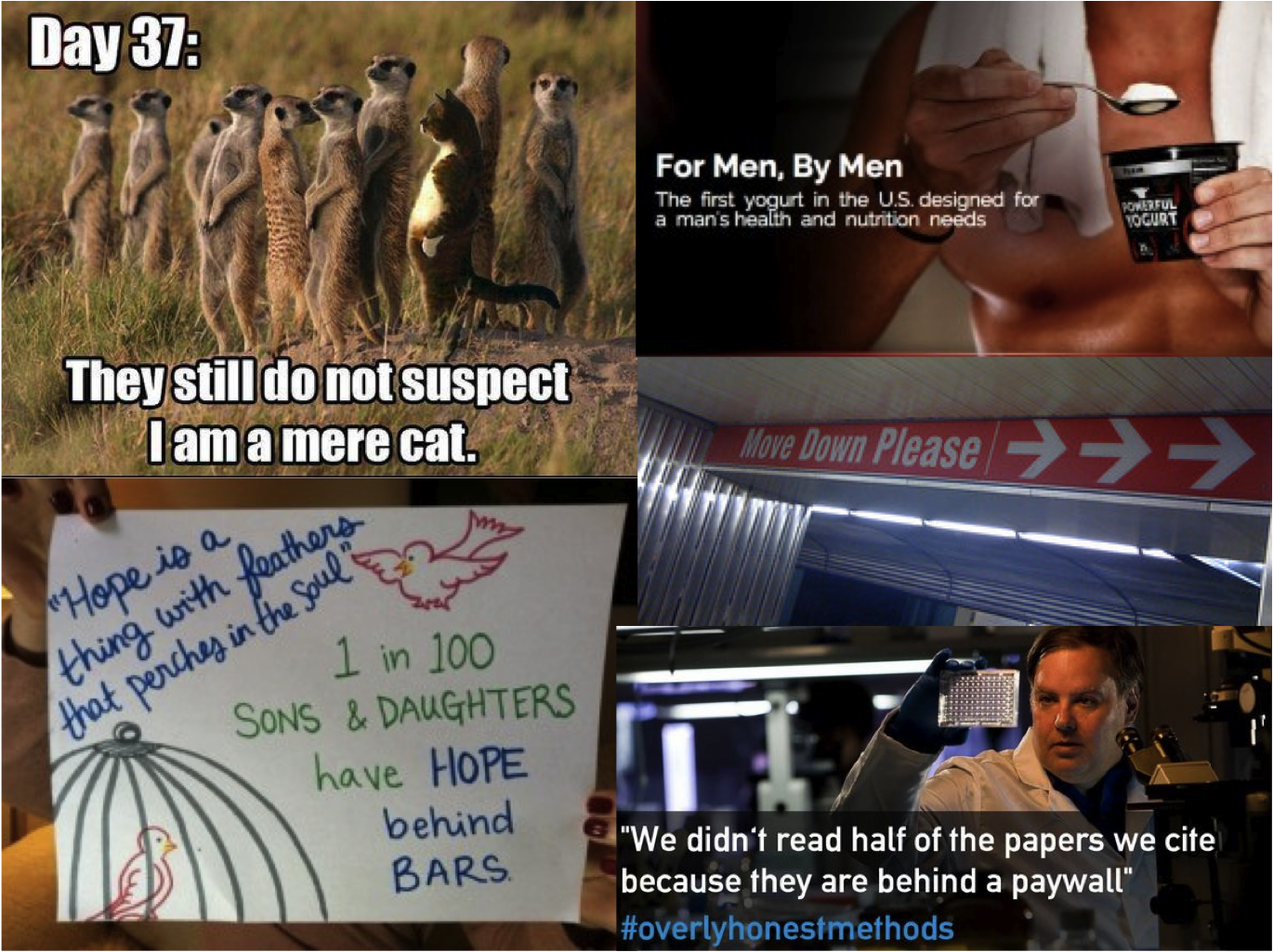
Making Dairy Manly,” by Andrew Wiebe. In which, taking a cue from an old Conan sketch, a company tries to alleviate the terrible embarrassment suffered by all XYers in the dairy aisle.

Movin’ on… Down,” by Evan Stewart. In which housing mobility takes a turn for the worse and Evan gets to show off his skill with song lyrics.

Office Hours:

Shai Dromi on Beggars and Morality,” with Kyle Green. In which pleas for spare change spur introspection.

Teaching TSP:

Beggars & Morality,” by Kia Heise. In which Heise shares a series of questions to stimulate classroom discussion on panhandling and sociological observation.

A Few from the Community Pages:

  • Sociological Images. Cultural norms get in the way of calculus, Oxy—and many, many other colleges—is discounting sexual assault, and #overlyhonestmethods is both true and a little terrifying because it shakes our false sense of scientific certainty.
  • Cyborgology. “It’s as if a TED conference smashed headfirst into a hackathon and then fell into an NGO strategy summit.” “Okay, so let’s get it out front that we all have a lot of feelings about stuff.” “It might be fun to play Thoreau and sit in judgment of what the Internet does to people, but I’d rather be a cyborg than a romantic.”
  • Sociology Lens. Cheryl Llwellyn shares the good—and bad—news about HIV, Candace Smith outlines some criminological terminology, and Amanda talks nude bodies: representations, stigma, and gender.
  • Thick Culture.  The filibuster! Don’t call it a comeback. And why not learn from all those talks you attend? José did!

Scholars Strategy Network:

What Can U.S. Presidents Accomplish in a Second Term?” by Daniel Paul Franklin. Obama: take notes.

Do New Communications Media—Like the Internet—Hurt Individuals and Society?” by Joli Jensen. Is all that hand-wringing worth it? I mean, you’re going to need so much moisturizer.

*NB: This column does not have a proofreader, unless you count a rather needy rat terrier that just took the “z” key off the laptop in an attempt to write some sort of doggie manifesto. Please, be kind.

RU030113Read Widely

In case it’s hard to tell, that’s an imperative, not a descriptor. Today I plan to use my little soapbox to trumpet some fabulous writing, while also seeking submissions to what I lovingly call “Letta’s List.”

See, many authors ask me for examples of how to incorporate a lot of information into something that’s thorough, academically sound, and engaging. It’s a tough balance, to be sure, but over the years, I’ve collected a number of books (and this is by no means a list of all of them) I can hand off as representations of that ideal. They likely have nothing to do with your area of study, but watching the authors’ deft hands at work (and knowing there are surely unsung editor elves in there, too) can be a truly enjoyable homework assignment. Think of it as authorial excellence by osmosis. Absorb and emulate.

And then, leave me your list of rockin’ non-fiction in the comments, because Letta’s List is in no way complete. I want it to grow longer every year (which isn’t to say this isn’t already long; skip it if you just want the roundup!). Links go to the presses’ sites wherever possible. Note to those authors and presses prepping to send me book copies: please send paperbacks! Also: thank you.

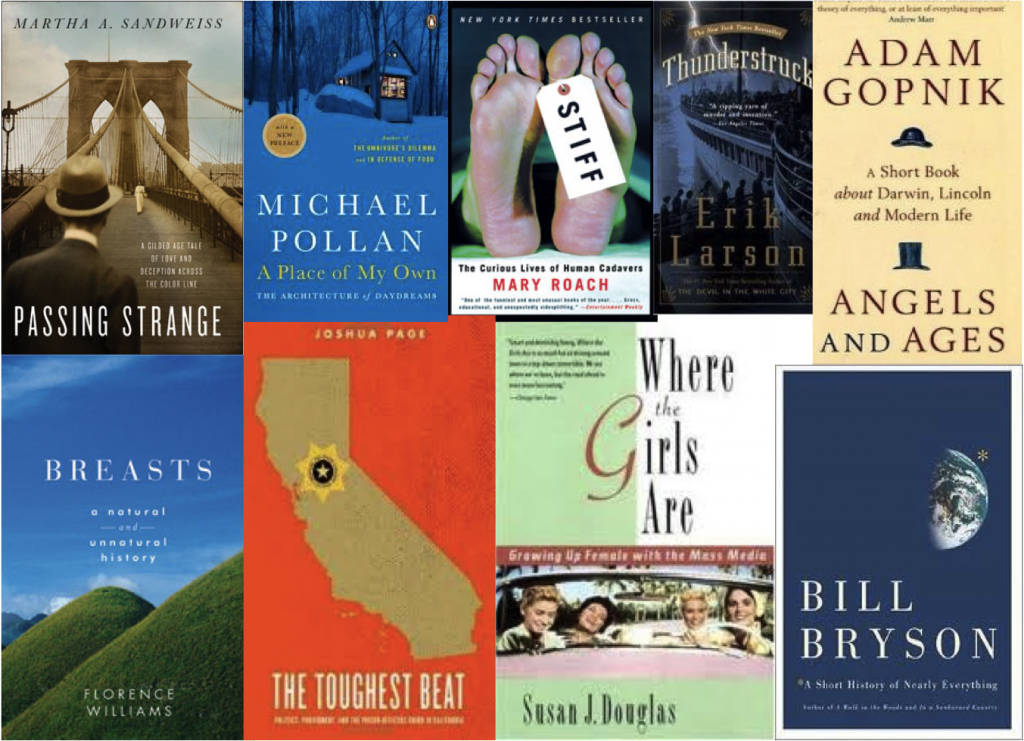
  1. Martha A. Sandweiss. 2009 (paperback out in 2010). Passing Strange: A Gilded Age Tale of Love and Deception Across the Color Line. Penguin. Sandweiss usess demography, history, and Census data to trace a prominent man’s journey back and forth from the worlds of white luminaries (he was the playboy head of the National Geographic Survey) and black Pullman Porters (in which he was a simple man with a wife, kids, and a job that required a lot of travel). It’s a fascinating true tale that reveals the permeability of 19th and 20th century color lines.
  2. Mary Roach. 2004. Stiff: The Curious Lives of Human CadaversW.W. Norton. Roach has a particularly well-honed touch with science, and is the author of other notable Norton books Packing for MarsGulpBonk, and Spook. Each is packed with information you didn’t know you craved, but here you are, gobbling up the details of what cadavers have done for you lately, just how astronaut food is developed, and why it’s hard to describe tastes. Stiff is an excellent introduction into her excellent catalog, packed with participant-observation, rigorous research, in-depth interviews, and no shortage of good humor.
  3. Adam Gopnik. 2010. Angels and Ages: A Short Book about Darwin, Lincoln, and Modern Life. Vintage/Knopf Doubleday. I like to think of Gopnik as the master of final sentences. He can close a paragraph, a chapter, or a book like no other. Doing it in the service of a parallel tale of Lincoln and Darwin, two surprising contemporaries, Gopnik shines. He gives us history, law, theology, and sociology and brilliantly renders a time of modern upheaval, in war and words.
  4. Steven Johnson. 2007 (reprint edition). The Ghost Map: The Story of London’s Most Terrifying Epidemic—and How It Changed Cities, Science, and the Modern World. Riverhead Trade. Epidemiology, sociology, and mapping shouldn’t make for a gripping tale with life and death consequences, but that’s the talent of Steven Johnson. He traces the sleuths who mapped and interviewed and walked their way through London in search of a killer disease and finally put an end to a public health nightmare, and every bit of it feels vital.
  5. Bill Bryson. 2003.  A Short History of Nearly Everything. Random House. Bill Bryson could—and should—write the phonebook and make it into a hilarious, informative page-turner. His romp across Australia (and through its flora, fauna, and fascinating history), In a Sunburned Country, passes out of my hands with astonishing rapidity, but it’s A Short History that most highlights Bryson’s talent with insurmountable tasks. He explains scientific progress (and the unsung scientists who move it forward) with care and humor and a brisk pace that’s nearly alarming. His At Home is another classic packed with millennia of culture and human behavior, but I’d happily point anyone to any one of his books. Random House: do whatever you can to keep Bryson on your roster. I suggest Scrooge-McDuck-piles of money.
  6. Susan J. Douglas. 1994. Where the Girls Are: Growing Up Female with the Mass Media. Three Rivers Press. A professor of communications, Douglas used her first book (named one of the year’s top ten by NPR in 1994) to take seriously all that pop culture others at the time were ignoring. ’50s girl groups, Gidget, vacuum cleaner ads, and beehives weren’t, in her view, the things that kept feminism at bay, they formed the incubator from which a new generation of feminism and social change would arise. Or: why shimmying to “Will He Still Love Me Tomorrow?” was—and remains—a feminist act.
  7. Erik Larson. 2006. Thunderstruck. Broadway Crown Trade GroupA totally spellbinding book about the development of wireless telegraphy? That’s a tall order, but with Larson’s trademark ability to weave two stories together (in this case, the race to establish overseas telegraphy and to solve a London murder), Larson creates a coup. It’s a potboiler with morse code—even if you try to read it just for the sensationalist murder details, you’ll find yourself taking sides in scientific debate.
  8. Florence Williams. 2012. Breasts: A Natural and Unnatural History. W.W. Norton. This book left me like a teenager: both fascinated by and terrified of breasts. In fact, the science surrounding this functional, titillating, contentious body part left me so utterly freaked out I forced myself to stop reading the book, out of the very real knowledge that continuing might lead me down a certain paranoid path wherein I could no longer look at paint or hold a water bottle. Williams is incredibly talented and I can’t wait to see what she takes on next. Also: the book may be worth the price of purchase for the aforementioned Mary Roach’s back-cover blurb alone.
  9. Joshua Page. 2011. “The Toughest Beat”: Politics, Punishment, and the Prison Officers’ Union in California. Oxford University Press. Full disclosure: not only am I married to the author of this book, I edited every word of it—and there are probably still typos lurking within. The reason I want it on this list, though, is not simply out of affection or pride, it’s because the author is a true demonstration of how to be edited in the service of a great book. That is, he cares more about the finished product than the first draft. And that finished product has won awards and created comment among policy makers, union leaders, lay readers, and even one of Rolling Stone’s Top 100 guitar players. It’s worth checking out.
  10. Michael Pollan. 2008 (reprint edition). A Place of My Own: The Architecture of Daydreams. Penguin Books. [Originally published in 1998 as A Place of My Own: The Education of an Amateur Builder by Dell.] Some books have seasons, and I return to this one every spring. Yes, Pollan’s much better known for his screeds on food—the history of it, the best ways to source it, the best way to eat it—but this elegant little book explores the traditions of culture, architecture, and the act of writing, letting readers dabble with shipbuilding and concrete construction, feng shui and barn-raising right along with him. The book itself is a dream made sturdy.

What, you ask, have we been doing on The Society Pages this week? Well, I can tell you that, too. Again, though, let me urge you to share your best examples of gripping non-fiction, especially those books that share science (social or otherwise) in a publicly engaging way, in the comments.** I need to add to the list!

Features:

A Social Welfare Critique of Crime Control,” by Richard Rosenfeld and Steven F. Messner. In which we learn about managing criminal motivations and opportunities and how we might be able to get to a crime-free society, but it may not be worth it.

Citings & Sightings:

“Service with a Smile—Or Else,” by Evan Stewart. In which Hochschild’s notion of “emotional labor” is employed among employees.

A Few from the Community Pages:

Scholars Strategy Network:

Migrant Health in the Debate about Immigration Reform,” by Micah Gell Redman. Citizenship has very little to do with the public health risks and benefits of each additional member of “the herd.” Why the U.S. should be paying attention to everyone‘s health.

What the Proliferation of Recognized Mental Disorders Means for American Healthcare,” by Owen Whooley. With the DSM V,  “Disruptive Mood Dysregulation Disorder” is now a thing. Asperger’s Syndrome is not. What gives?

**P.S. Please, please add your favorites in the comments? No comments=lonely editor.

RU022213A Few Things I’ve Learned

In academic writing, inscrutability is often treated as a virtue. I have a few theories:

  1. “Smarter than thou.” Ever been at a talk where someone asks a “question” that’s just a transparent way to prove that they know a lot? And that they know big words, too? It’s annoying. For writers, the logic often seems: if the piece technically makes sense, but no one else can make sense of it, you must be the smartest person in the journal. You may be revered for your brilliance, but no one’s going to actually talk about your work. Readers will be too afraid to admit they don’t understand it (and too unsure about whether you do).
  2. Tone-deafness. This might, more kindly, be called the expertise problem. In essence, you, the author, know this stuff backward and forward. You may start assuming everyone else does, too. Alternatively, you’ve simply read it all so many times you can no longer see the gaps in your logic or spot places that just plain don’t make sense.
  3. Longer is better. In trying to cover all the bases, you go too far, accidentally creating 5th base and a watering hole somewhere in left field. Looking for a thorough lit. review, an overview of the thinking in the field, and presenting many opportunities for future researchers, you find yourself at 25 pages, when your point could have been made—and made well—in 10.

As an editor and sometime “translator” of ivory-tower-talk, I also have a few suggestions:

  1. It’s your job to communicate. Identify your audience and speak to them. If you really don’t believe your work needs to be read outside the academy, by all means, mire yourself in theory and let the reader figure it out. But if you’re trying to go further, call a non-professor friend (or your mom) and tell them what your paper or book is about. Ideally, record this conversation. In a nutshell, what you’ve just explained to a non-expert is both your abstract and your outline. Now get to writing.
  2. This one’s pretty easy: find someone (anyone!) who hasn’t read your paper, and ask them to read it. All they need to do is make a little hash mark where something doesn’t quite make sense or where they simply pause while reading. It’s not their job to figure out what tripped them up, but letting you know where the stumbling blocks lay is invaluable work. Give them a cookie and a shout-out in the acknowledgments—they deserve it. Alternatively, bite the bullet and hire an editor. For a couple hundred bucks, you can get your prose detangled and your bibliography spiffed up. After all, others in your field are just going to check if they’re cited before they even read the paper… you might want to get those citations right.
  3. Brevity conveys confidence, and confident prose inspires confidence in the readers. Follow that old canard, “Your writing should be like a pair of shorts: long enough to cover the business, short enough to keep things interesting” (I paraphrase). When you strip away the unnecessary bits, your argument can shine, and your readers will feel positive that you know what you’re talking about. To go one step further, be sure there are a few quotable sentences that really sum up the paper and place them prominently in the abstract, at the start and end of sections, or as the first or last sentence of the entire paper.
  4. I think we can all agree calls for future research are superfluous. It’s science: there’s always more research to be done.

Honestly, all of this advice comes down to one standard: reader clarity. If you’re taking the time to write about something, ideally that means it’s important to you and you think it should be important to others. Speak to them, tell them the story, and please, please, don’t hide the point. None of this is to say you should dumb down your work, just be confident enough in what you’re saying to do it plainly. Now, on to the Roundup!

Features:

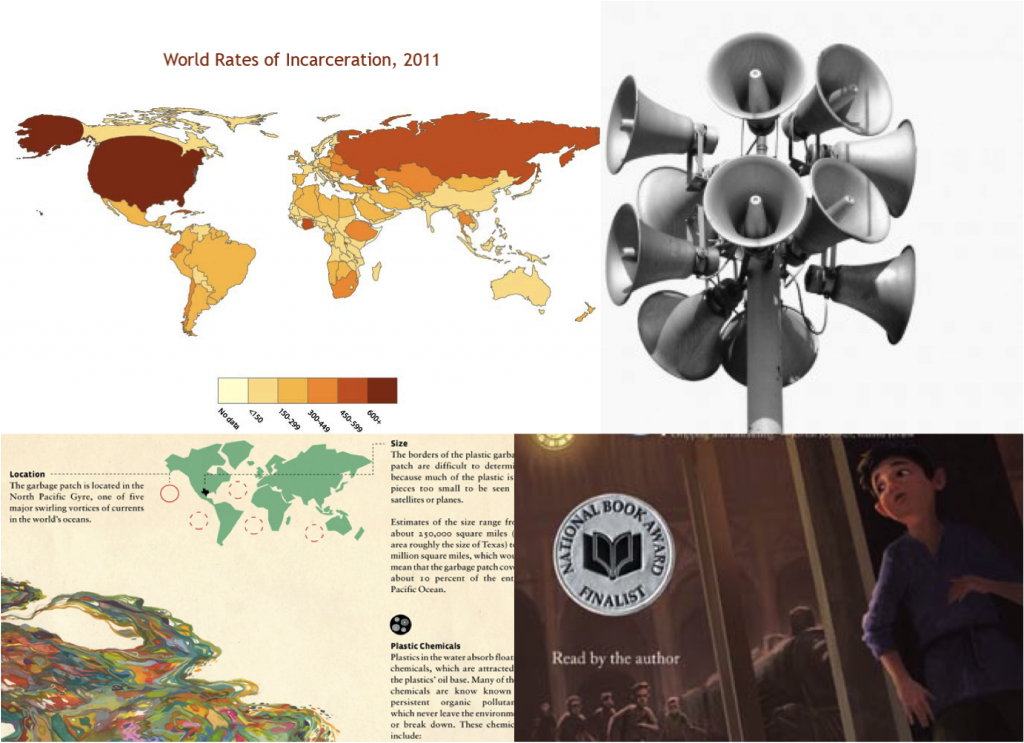
Visualizing Punishment,” by Sarah Shannon and Chris Uggen. In which we get a bracing look at U.S. incarceration trends across time, states, and populations.

Citings & Sightings:

Demography is Democrats’ Destiny?” by John Ziegler. In which a rising Hispanic population puts the GOP on the ropes.

Slow Down to Pick Up the Pace,” by Andrew Wiebe. In which we get sage advice: take a nap.

Office Hours:

William Alexander on Fantasy and the Social World,” by Kyle Green. In which we talk to a celebrated author about the relationship between fiction and society.

Reading List:

Jeopardy?” by Suzy McElrath. In which new sociolinguistic research gets the lowdown on uptalk.

Measuring ‘Good Fit’ in Hiring,” by Shannon Golden. In which Lauren Rivera measures the murky process of choosing a colleague.

Teaching TSP:

International Criminal Justice,” by Hollie Nyseth Brehm. In which we use videos and transcripts from the International Criminal Court to stimulate classroom discussion.

A Few from The Community Pages:

Scholars Strategy Network:

The Business of Egg and Sperm Donation,” by Rene Almeling. Is this like when my grandma told me not to “give it away”?

Money Matters—For All Schoolchildren,” by Melissa F. Weiner. The title says it all!


RU021513Criminal Activity

As mentioned over on Public Criminology, things are really coming together on the second of our TSP books for W.W. Norton (the first, The Social Side of Politics, is in production now). This means we’ve been immersed in all kinds of fascinating pieces on trends in and understandings of crime and punishment. Many of the pieces have already come out  (including a new Roundtable on international criminal justice published this week), but we’ve got a lot in the hopper yet. While you await that goodness—and we work furiously to get it produced—why not check out everything else we’ve done this week?

The Editors’ Desk:

Growing Up, Twentysomethings and Tenured Professors,” by Doug Hartmann. In which our editor tips his hat to a New Yorker author who sums up emerging adulthood with clarity and brevity. Damn him!

Roundtables:

International Criminal Justice, with Suzanne Karstedt, Naomi Roht-Arriaza, Wenona Rymond-Richmond, and Kathryn Sikkink,” by Shannon Golden and Hollie Nyseth Brehm. In which we consider states, sovereignty, and efforts to assert international justice with four experts.

Citings & Sightings:

Excavating the Wealth Gap,” by Erin Hoekstra. In which researching the black-white wealth gap shows it really is dangerous to lend money to friends and family (just not for the reasons we thought).

Concerns over Canadian Crime,” by Suzy McElrath. In which a year’s rise in homicides raises Canadian concerns, even though overall crime continues to drop like so many hockey pucks.

January 2013 TSP Media Award for Measured Social Science,” by Letta Page. In which Wired UK takes up research on religious tolerance and media rhetoric with aplomb.

Real Talk on Immigration,” by Evan Stewart. In which Nancy Foner needs less than 300 words to make recommendations on immigration reform.

The Invisible Employee,” by Andrew Wiebe. In which a graying society means a graying workforce—but are boomers content to fade away?

The Reading List:

Be All You Can Be,” by Shannon Golden. In which new research finds the military might be a path to higher education, it’s just the path may not be long enough to get all the way to a B.A.

A Few from the Community Pages:

Contexts:

The Winter 2013 issue of Contexts magazine is out now, and we’re happy to be able to share a number of its articles:

Scholars Strategy Network:

Unmarried Baby Boomers on the Brink of Old Age,” by Susan L. Brown. Between this and the whole graying workforce thing, we’re worried about the boomers. Social Science Debbie Downer strikes again?

How National Advocates Encourage Conservatism on America’s College Campuses,” by Amy J. Binder and Kate Wood. The Young Republicans aren’t the only game in town (or in the country).

Double. Am I in trouble?

Scheduling strikes again! But the great news for you, dear readers, is that, while I’ve been immersed in creating our first volumes to publish with W.W. Norton, our authors, bloggers, and volunteer grad board members have continued to put out exciting new pieces on The Society Pages. Here’s what they’ve been doing in the past couple of weeks!

Features:

Six Social Sources of the U.S. Crime Drop,” by Chris Uggen and Suzy Maves McElrath. In which a long-term crime drop is explored as a social phenomenon (with fantastic graphics by the Shannon Golden).

Editors’ Desk:

Whatever Happened to the Shotgun Wedding?” by Doug Hartmann. In which our editor considers a study that implies single motherhood is a result of the anti-abortion movement.

Changing Lenses:

Exploring Dora,” by Doug Hartmann and Wing Young Huie. In which the sociologist and the photographer talk about an image of a young girl wrapped up in a cartoon character who really looks like her.

Citings & Sightings:

Do Your Chores (Whatever They Are),” by Carolyn Lubben. In which we learn the sexiest hetero marriages seem to go in order of: man does nothing (no fun), everyone does everything (pretty fun), and “Leave it to Beaver” (I feel like I already made the joke).

Are We All in Steubenville?” by Evan Stewart. In which sociologist Michael Kimmel explores the insularity (and ubiquity) of rape culture.

Superheroes and Social Context,” by Andrew Wiebe. In which we follow the changing social constructions of gender by reading up on old comic books. (Side note: I did not know Lois Lane was black for a while until looking for images for this piece.)

December Media Award for Measured Social Science,” by Hollie  Nyseth Brehm. In which we congratulate journalist Joanna Small for her explanation of the bystander effect to help discuss a controversial photo.

China’s Sexual Supply Chain,” by Carolyn Lubben. In which a Chinese social scientist argues for the decriminalization of prostitution from an unusual angle.

Office Hours:

Mary Joyce on Digital Activism,” by Kyle Green. In which Green and Joyce talk big-picture research and the role of technology in social movements.

Reading List:

Equally Unequal,” by Sarah Lageson. In which social movements bring inequality into the limelight, but fail to change Americans’ opinions.

Teaching TSP:

Obedience to Authority,” by Hollie Nyseth Brehm. In which a video of Milgram’s famous experiment is used to teach the concept of authority.

Evolution and Heterosexual Dating Rituals,” by Kia Heise. In which undergrads are asked to get a little more analytical about a familiar experience.

A Few from the Community Pages:

Scholars Strategy Network:

Promoting Women’s Political Representation Overseas,” by Sarah Bush. If we can’t set an example…

To Help Disadvantaged Children Learn, We Must Acknowledge that Poverty Hampers Education,” by Helen F. Ladd. It’s time to stop pretending inequality doesn’t affect educational outcomes. Why not start now?

How the War on Drugs and Terror Creates New Challenges for Nonprofits Operating across the U.S.-Mexican Border,” by Margath A. Walker. How fear and funding are getting more complicated for NGOs.

Should Citizens Have a Say about Emerging Technologies?” by Jennifer Kuzma. People want to learn about new tech, but there are two obstacles: lack of access to timely information and elite prejudices about “non-experts.”

SocImages Reminds Us All How It’s Done

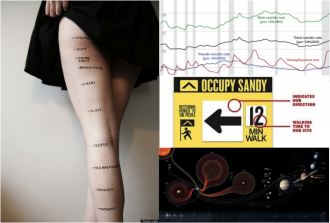
This week, SocImages saw its most popular post ever, and with good reason. “The Balancing Act of Being Female; Or, Why We Have So Many Clothes” contained a provocative image by art student Rosea Lake (one easily used in a classroom without uproar) and Lisa Wade’s thoughtful, sociological take. What was particularly interesting (I absolutely invite you to take a look and read through the comments if you haven’t already) is the way that Wade went in an unexpected direction and, in a tightly wrapped commentary—maybe 500 words or less?—used the image to help readers think not only about body policing and the ways in which women are (ahem) hemmed in when it comes to clothing choices, but how privilege dictates who can and cannot follow the “rules” of dressing appropriately. 12,000+ likes on Facebook and some 80,000 individual visitors later (not to mention readers on the Huffington Post, which has since reposted the piece), a lot more of the Internet is thinking sociologically. Take a read; it’s fantastic.

Here’s what the rest of us got up to this week:

Features:

Social Fact: The Great Depressions?” by Deborah Carr and Julie Phillips. In which another set of authors shows the power of brevity, tying American recessionary periods to suicide rates (with the help of a fantastic graphic from Shannon Golden).

Citings & Sightings:

The Urbanite’s Guide to Surviving Climate Change,” by Erin Hoekstra. In which social cohesion may prove as important as infrastructure in dealing with natural disaster.

Shortage of Sick Days: Worse than Shortage of Flu Vaccine?” by Letta Page. In which Shamus Khan argues for paid sick leave as a public health measure.

Reading List:

Now Boarding: Subculture Careers,” by Stephen Suh. In which Gregory J. Snyder finds kids are going kick, push, kick, push, kick, push, coasssssst… right into real adult jobs. (H/T Lupe Fiasco)

Teaching TSP:

Whiteness, Sport, and NASCAR Nation,” by Kia Heise. In which and Office Hours interview comes to the classroom.

Getting Students to Read,” by guest author Nathan Palmer. In which Sociology Source’s editor shares his method (a little more work for the teacher, but a lot more work from the class).

Scholars’ Strategy Network:

How Families Suffer when So Many Fathers Go to Prison,” by Raymond R. Swisher. If millions of people are in prison, and millions of people are parents, surely many prisoners are parents. What are the consequences for their children and communities?

Does Providing Publicly Funded Jobs to Hard-to-Employ People Reduce Crime and Drug Use?” by Sarah Shannon. Uses a large-scale data set and qualitative interviews to look at links between employment and recidivism.

A Few from The Community Pages:

Doubling Down!

Loyal readers may have noticed the absence of a roundup last week; shuffled schedules led to shuffled writing, and so this week we’ll have a double dose of goodness to share. Please enjoy what the TSP crew has been rustling up in the past couple of weeks.

Editors’ Desk:

Parking Wars, Public Soc, and Professional Thinkers,” by Doug Hartmann. In which a Cyborgology post starts a great discussion on “public sociology.”

Finding Sociology,” by Doug Hartmann. In which a talk with photographer Wing Young Huie spurs a search for sociology outside academia.

Citings & Sightings:

You May Not Know It Yet, But You’re Changing,” by Hollie Nyseth Brehm. In which we realize we’re different people than we were at age 12, but we’ll also be different people in another 12 years.

Bad News for Americans Under 50,” by Hollie Nyseth Brehm. In which… uh-oh! Hide! Move! Yikes.

School’s Not Out for Summer?” by Letta Page. In which it’s the time, not the timing, that counts when it comes to education.

Darwin Was Wrong,” by Hollie Nyseth Brehm. In which evolutionary biology butts heads with sociology and psychology. And there’s speed-dating.

Hold the Check or Hold the Laude,” by Suzy Maves McElrath. In which we learn paying their own way through college might spur students to keep their grades up. Just try not to think about the loan debt.

Office Hours:

Joshua Newman and Michael Giardina on NASCAR Nation,” by Kyle Green. In which Newman and Giardina do their fieldwork from the infield.

Gabriella Coleman on Anonymous,” by Kyle Green. In which Coleman explores hacking, Anonymous, the free flow of information, and the free flow of her own book, available online under Creative Commons licensing.

Teaching TSP:

Recession Trends,” by Hollie Nyseth Brehm. In which Brehm explores ways to use a new online tool and a TSP podcast to talk economics and inequality.

Scholars Strategy Network:

The Strengths and Limits of the Earned Income Tax Credit as a Tool to Fight Poverty,” by Daniel S. Feder. The fiscal cliff deal extended the EITC for five years—will it do anything to fight poverty?

Should States Create Exchanges to Implement Obamacare?” by David K. Jones. Either the states do it, or the federal government will step in. Jones debates the best strategy.

How Democrats and Republicans Can Draw Uncommitted Minorities into Politics,” by Zoltan Hajnal and Taeku Lee. Getting a minority-majority population to the polls.

America’s Low Taxes in Comparative Perspective,” by Andrea Louise Campbell. Feeling overtaxed? Check the chart.

A Few from The Community Pages:

It’s been a quiet week in Lake Woebegon…

As this week, stretching out from Christmas to the New Year, generally is. But that isn’t to say that The Society Pages has gone dark; perhaps just a bit dusky, enjoying this still moment before the New Year comes on with its full force. Here’s a bit of what we were up to this week.

Editors’ Desk:

2012: Your TSP Favorites,” by Letta Page. In which we learn which 2012 posts got the most views in every section of our site. Surprise! Y’all have good taste. Actually, we knew that.

Citings & Sightings:

Distorted Discourse on Islam,” by Andrew Wiebe. In which sociologists Christopher Bail and Penny Edgell consider American media and post-9/11 perceptions of Muslims.

Reading List:

Beyond the Ribbons,” by Sarah Shannon. In which Rachel Kahn Best looks at medical research funding, stigma, and disease awareness campaigns.

Teaching TSP:

Understanding the Causes of Genocide,” by Kia Heise. In which we share discussion ideas on a tough topic.

From the Community Pages:

Happy New Year!

2012 is over, and as we looked back at what The Society Pages accomplished in that span, we realized there’s no way to choose a “Best Of.” Other sites might be up to the task, but here we’d be weighing so many factors that the results would be somewhere between utterly irrelevant to most readers and totally gut-wrenching for us. And since we do our best to avoid gut-wrenching anything, instead we’re offering up a list based on one very simple metric: the most popular post published in each area of our site this year. That is, what got the eyeballs. These might be controversial, weird, the beneficiaries of 12 months of results rather than 1 (if they happened to be published in December)… who knows? Let’s find out together. Thanks for your support, comments, readership, and curiosity!

White Papers:Tiger Kids and the Success Frame,” by Jennifer Lee.

Special Features:Documentaries for the Classroom,” with Jessie Daniels.

Editors’ Desk:Altruism, Ants, and E.O. Wilson,” by Doug Hartmann (oddly edged out juuuust slightly by a post about my own editorial and sartorial style by Chris Uggen. Executive decision to skip to the real content; personal realization that I can’t even bring myself to lie about stats on the Internet.)

Changing Lenses:Big Geno, Little Geno,” by Doug Hartmann and Wing Young Huie.

Office Hours:Joel Best on Social Problems,” by Sarah Lageson.

Citings & Sightings:Segmented Sleep: A Cure for Modern Ills,” by Letta Page.

Roundtables:Social Scientists Studying Social Movements,” by Kyle Green, Sinan Erensu, and Sarah Lageson, featuring Jeffrey Alexander, Neal Caren, Nathan Clough, Myra Marx Ferree, Sarah Gaby, David S. Meyer, and Fabio Rojas.

Reading List:Breaking Up Is Actually Hard To Do,” by Sarah Lageson.

Teaching TSP:Racist Halloween Costumes,” by guest poster Meg Krausch.

Scholars Strategy Network:The Uneven Representation of Women and Minorities in America’s State Legislatures—And Why It Matters,” by Beth Reingold.

Contexts:India’s Reproductive Assembly Line,” by Sharmila Rudrappa.

Sociological Images:The Marilyn Meme,” by guest poster Heather Cramarty.

Cyborgology:Pinterest and Feminism,” by Nathan Jurgenson.

Graphic Sociology:Race and Gender in Higher Education—Who Gets Degrees?” by Laura Noren.

A Backstage Sociologist:Karl Marx’s Comments on Mitt Romney’s Theory of the 47 Percent,” by Monte Bute.

New Books in Sociology:Phil Zuckerman, ‘Society without God: What the Least Religious Nations Can Tell Us about Contentment,‘” by Annie Sepucaia.

Public Criminology:A Broader Based Approach to Shootings,” by Chris Uggen.

Sexuality and Society:The Price(s) of Pleasure in the Classroom: The Appalachian State University Controversy’s Relevance to Sex Workers,” by Jayne Swift.

Sociology Improv:Erotica Friday,” by Jon Smajda, with Arturo Baiocchi and Shannon Golden.

Sociology Lens:Social Class: Income, Wealth, and Race,” by Jeff Dowd.

The Color Line:It Was Inevitable: Racial Ignorance against Jeremy Lin,” by C.N. Le.

ThickCulture:Away from a Sociology of Hipsters,” by Andrew Lindner.