
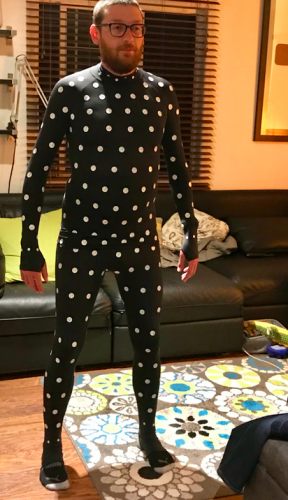
Well that was quick. Around 18 months after launching their ambitious “ZOZOSUIT” product, the Japanese clothing company has shut down all international operations and is no longer offering the custom-fit service. Quartzy, which seems to have an unhealthy obsession with ZOZO and its founder and CEO, Yusaku Maezawa, has covered the rise and fall of ZOZOSUIT pretty well, so I’ll let you catch up over there. But I wanted to post something with a few quick reactions to the demise of “Custom-Fit Clothing for a Size-Free World”.
My first reaction when I received the email letting me know they were shutting the service down was, “are they going to keep my data?” The answer, of course, is yes. More specifically, “All body data will be anonymized and rendered unidentifiable by July 31, 2019.” It’s an old story that anonymized data is everything but, so color me unimpressed. One assumes they will be using the data for a future custom-sizing related project, or, given their recent financial troubles, selling to an interested acquisition or merger partner. Remember how their Privacy Policy claims to “not sell your data to third parties, ever”? Now that it’s considered “anonymized” is it still “my data”?
Then I put on my scholar hat (to be honest, it’s just a red beanie that I ironed a DSA patch onto) and had a few broader questions. Right now, I’m working on a dissertation that looks at the history of those designs which we use to self-report pain to our doctors. You know, like the smiley face chart on the wall at the doctor. I’m exploring questions of who designed them, when, how, etc. I want to contextualize their prominence in the experience of someone actually experiencing pain. And so of course, I am considering a chapter on new ways to facilitate pain self-reporting—mobile sites and apps with body diagrams and color codes or EEG-based offerings that promise “true” readings of someone’s pain.
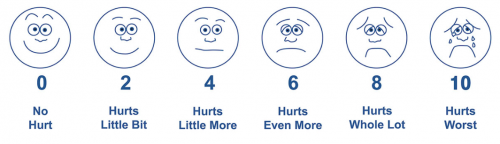
The problem is, what happens when the latest and greatest goes defunct? I dropped 1,500 words on ZOZOSUIT back in October and, while it was a great excuse to put on a spandex onesie and teach readers about Henry Dreyfuss Associates, did I jump the gun? I suppose that’s the luxury of writing for a blog like Cyborgology—we’re focused on what’s being promised next, not what’s guaranteed to stay. Still, I don’t see that post aging very well. I worry about the same thing when picking which apps or services to include in my PhD research.
It’s a struggle any scholar working on tech and culture has. Even the most exciting books I’ve read that came out in the last year document and analyze websites that are not longer active. When our collective attention (and venture capitalist’s funding) jumps from latest app to newest device, it’s tough to predict what really has staying power. So I suppose the best alternative we can hope for is that something we’ve documented has some sort of influence as a precedent, a critical step in the genealogy of something big to come. Who knows, maybe in 2040, when Cyborgology turns 30, an emerging scholar will need some sort of reference to understand where that multi-billion dollar digitally-fit clothing industry came from and they’ll stumble upon my post.
If so, I hope our image archive has degraded by then…
Gabi Schaffzin is a PhD candidate in Art History, Theory, and Criticism, with a concentration in Art Practice, at UC San Diego. He’s glad to know that those jeans really didn’t fit…it wasn’t just him being super un-hip.



 Nathan- I started Cyborgology four years ago with PJ Rey, and today we’re handing it to long-time Cyborgologists David Banks and Jenny Davis. I’m very excited for the future of the blog and happy to reflect on the past year. Again, the blog has been a central part of the Theorizing the Web conference, and #TtW14 was my favorite yet. We saw the inclusion of Robin James whose brilliant work has made the blog even more fun to read. The one post of my own from the past year I’d like to highlight was a short reaction to a news story about Facebook throwing a sociology conference. Akin to what I’ve seen firsthand in academic department meetings and conferences as well as in governmental and corporate research groups, so-called “big” data swiftly passes right by basic methodological and ethical issues because the N is sooo biiiig. A sociology graduate student was quoted discussing how neutral Facebook is as a research environment and I responded with
  PJ- It’s hard to believe that over four years have passed since Nathan and I sat in our neighborhood bar in DC, spitballing silly names for a technology and society blog. It seems impossible to have imagined where this idea was headed and how profoundly it would shape our experience as a grad students. Cyborgology allowed us to start communicating with a wide range people who were excited to discuss the same sorts of questions that we were asking about technology and society, even as our own department proved unreceptive. I quickly realized that many of the most profound insights on these issues were not coming from the conventional academic sources that grad students are taught to rely on (though journal articles and conferences certainly have their place). Most important, Cyborgology has connected me to my fellow Cyborgologists, who have been an invaluable source of support, information, and ideas. I consider myself incredibly fortunate for this. I wish Jenny and David luck as they step into their new roles as our chief editors. I expect Cyborgology’s fifth year to be its best yet!
 Jenny- I’m feeling pretty lucky that I got to spend another year blogging alongside, and exchanging gif-laden emails with, such a fantastic group of writers. Through the years, I’ve found that my favorite posts are the ones I never meant to write, but felt I had to write. This year, I wrote one such post,
  David- This last year was a blast! I had a great time writing
  Sarah- This last year has been marked by a great deal of transition and reexamination – with my career, with where I live, with what I do and what I want and what truly matters to me. I think my writing here has been a reflection of that, and part of the process for me has been learning to be comfortable with letting more and more of it show – or at least learning to be comfortable with the discomfort. Probably one of the posts that stands out the most to me is “
 Robin- Two of my most successful posts this year were