politics

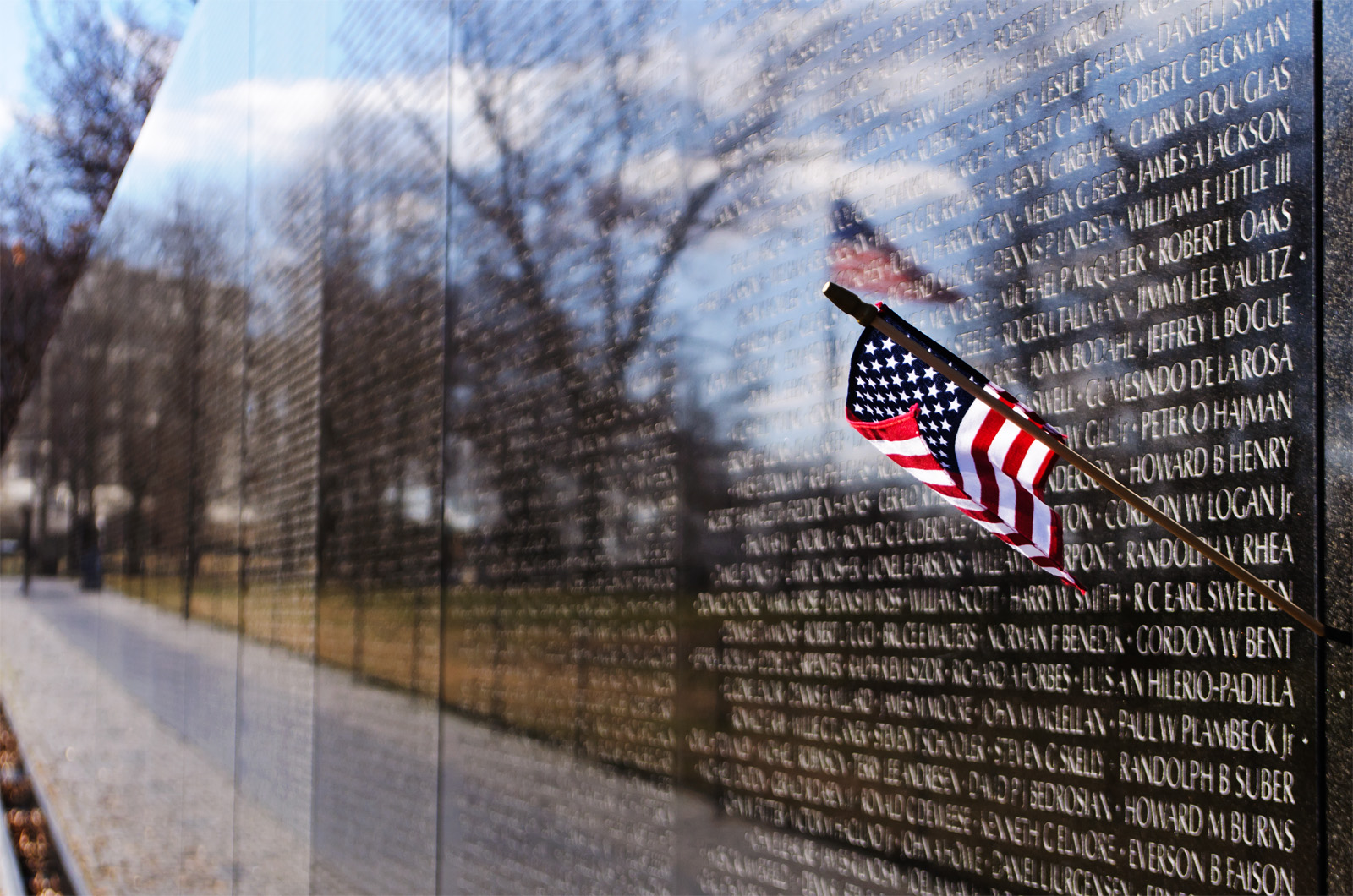
Image: A small American flag placed within the Vietnam Veteran’s Memorial in Washington, D.C. Image courtsey of InSapphoWeTrust, CC BY-SA 2.0.

On January 19, 2021, less than 24 hours before their swearing-in, Joe Biden and Kamala Harris, and their spouses, Dr. Jill Biden and Douglas Emhoff, stood at the foot of the Lincoln Memorial to light the first COVID-19 memorial. Looking out over the Reflecting Pool, they led a moment of silence to honor the more than 400,000 American lives lost to the deadly virus. Following months of government inaction and widespread denial,  this ceremony marked the first national commemoration of COVID victims. Despite its immediacy and ephemerality, the memorial shares much in common with other public memorials commemorating events of mass violence and loss of life. An interdisciplinary body of literature sheds light on public memorials’ complex, contested, and inherently political nature.  

Temporality, Immediate response, and Grassroots memorials

Many memorials begin organically, in the immediate aftermath of a traumatic event that captures public attention. For instance, in 1997, following Princess Diana’s sudden death, Londoners left more than 60 million flowers outside her homes at Kensington and Buckingham Palaces. Similarly, in the wake of 9/11, grassroots memorials to the victims sprang up on streetlights and walls throughout New York, in open areas near the Pentagon, and in the fields near the Flight 93 crash site outside Pittsburgh. These spontaneous and temporary memorials reflected the visceral public grief experienced and mediated in real time, in public and collective ways.

Official Memorials

When the immediate shock of traumatic events wears off, plans for official memorializations begin taking shape, often led by governmental bodies with input from both the public and private sectors. Around the globe, from Seoul, to Berlin, to Lower Manhattan, decisions about public memorials have grown increasingly democratic, as leaders seek out input and participation from community members and engaged groups. As with any other democratic process, memorial developments are subject to group conflicts and financial constraints. Decisions for public memorials such as the Vietnam Veterans Memorial in Washington, the Flight 93 National Memorial in Southeast Pennsylvania, or  the Memorial to Murdered Jews of Europe in Berlin, were  shaped by the interests of commemorated groups, long-term urban master plans, the goals of the tourism industry and the larger social significance memorials invoke among the broader public. 

The Contested Politics of Memory 

While highlighting traumatic events and experiences, permanent and temporary memorials often shape public discourse around politically charged topics. For example, the NAMES Project AIDS Memorial Quilt, which blanketed the National Mall from 1987 to 1996, commemorating the predominantly queer victims of HIV/AIDS, helped break the silence around the deadly disease. Located immediately off the National Mall, the subterranean Vietnam Veterans Memorial – designed by the American sculptor Maya Lin – incited a public reckoning over an unpopular war that continues to stoke controversy. 
Still, various communities affected by AIDS – including BIPOC and working class communities – have expressed concern over the installment’s predominantly-gay focus, arguing non-queer AIDS victims’ expereinces were being overlooked. Just last summer, following the killing of George Floyd at the hands of Minneapolis Police, cities across the US painted messages of support for global Black Lives Matter movement on city streets, sparking robust public debate on police violence and the use of public dollars on law enforcement. These debates are ongoing, signalling that rituals of commemoration are inherently fraught and contested processes.
Alongside loss of life, new forms of public commemorations have highlighted ‘experiences’ of trauma, abuse, and human rights violations and the survivors. With similar political goals, these politically-motivated installments aim to harness political energy around these salient topics in support of policy change, reparations, and broader societal awareness.
A black and white image of a jail cell, bars in the foreground. Image via pixabay, Pixabay License.

The United States, with only 5% of the world’s population, incarcerates nearly 20% of the world’s prisoners. At the peak of the mass incarceration era in 2000, one in three Black men was projected to be incarcerated in his lifetime, compared to 1 in 17 White men. The racial disparities of the criminal-legal system are well-documented, particularly for Black populations. How can we understand the origins of these racial disparities in mass incarceration in order to reduce or eliminate them? 

Arguably the most famous account of anti-black racism and mass incarceration, The New Jim Crow remains a watershed work in literature on prisons. By tracing parallels between slavery, Jim Crow, and mass incarceration, law professor Michelle Alexander connects present-day criminal justice to the long history of American racial control to demonstrate how incarceration targets the Black community. Alexander’s argument draws from key sociological findings about racial control, including the scholarship of Loïc Wacquant, Michael Tonry, and others.
Alexander traces the history of voting rights to show the connections between slavery, Jim Crow, and mass incarceration. Although Black men gained the right to vote following the abolition of slavery, during Jim Crow these voting rights were systematically violated. In 1940, only 3% of African Americans in Louisiana were registered to vote. While the Voting Rights Act of 1965 reaffirmed these rights, issues of disenfranchisement remained, particularly as mass incarceration unfolded and more Black individuals lost their right to vote. Today, an estimated one in 16 Black adults in the United States cannot vote due to a felony conviction. From Alexander’s perspective, prisons are merely the latest iteration of racial control in the United States which limit the rights and livelihood of Black Americans.
Historian Khalil Gibran Muhammad offers an alternative vision that centers the myth of “the Black criminal” as a source of racial oppression in the modern United States. Muhammad connects this myth to the long history of false ideas that have perpetuated white supremacy, such as biological notions of racial superiority, eugenics, and social-Darwinism. Blackness was intricately connected to crime in the late 19th century as a justification for discrimination and inequality in the United States. In this way, the very category of crime was racialized so that Black people were associated with criminal activity. This myth continues to influence perceptions of crime; for example, White people overestimate the level of crime committed by Black and Hispanic people and media representations consistently reinforce this image. 
Law professor James Forman presents a different history by chronicling how Black leaders advocated for tough-on-crime policies to protect their own communities. When seeing the damage that drugs and violence wrought on their communities, Black voters and politicians sought solutions, including policies that inevitably contributed to mass incarceration such as harsher punishments. In doing so, Forman shows that African Americans were not solely the victims of the law-and-order movement. By chronicling the nuances of these policies, he argues that The New Jim Crow oversimplifies the origins of mass incarceration, even while it helps shed light on its injustice. 

After four decades of increases, the long wave of racialized mass incarceration may be receding. Since 2009, the overall U.S. imprisonment rate has dropped by about 17% and the Black imprisonment rate has declined by 29%. Nevertheless, enormous racial disparities remain, with the Black community continuing to suffer disproportionately from U.S. mass incarceration. How did this era come to be, and how can we stop it?  These different visions of the racial disparities of mass incarceration are meaningful because they can help scholars, activists, and the public consider potential paths towards justice. Social science has greatly advanced the understanding of the historical causes of mass incarceration, which is essential for imagining a different and more just future.

Image: An American Flag flies in the foreground. In the background lies Pearl Harbor. Image courtesy of Ms_Spinwax, CC BY-NC-ND 2.0.

On the 7th day of each December, Americans are reminded of Pearl Harbor — the 1941 attack on an American naval base that killed 2,400 Americans. This event has become an icon in American memory. The events of that day have been told and retold by the media and amongst families. It has been featured in history books and the focal point of Hollywood movies, museums, and memorials. In fact, sociologists suggest that iconic events like Pearl Harbor have come to define the nation.

Sociologists also insist that memories are socially constructed. To say that a memory is socially constructed means that our recollections of events such as Pearl Harbor are not natural or unfiltered history but in fact mediated and filtered through social institutions like the media and politics. Some sociologists argue that this construction of memory is motivated by contemporary  interests. For example, at the time, media reports on Pearl Harbor highlighted national security and portrayed Japan as America’s enemy. These accounts were used to invoke American anger and pride. Both political actors and the media created moral depictions of the event, emphasizing American victimhood and the need for immediate action.
Yet over time, our collective recollection and interpretation of events may change, and sometimes, we use past events to understand current events. For instance, in the aftermath of 9/11, memories of Pearl Harbor were invoked to both give meaning to and to make sense of the surprise attacks on American soil. The use of a past event, Pearl Harbor, to understand a contemporary event like 9/11 is what has been called a bridging metaphor. And politicians often use bridging metaphors to inspire new emotional responses by connecting current events to memories and sentiments of past events.

Sociologists think of history, memories, and the commemoration of iconic events such as Pearl Harbor as interrelated. History is not an unbiased and fixed account of past events and people, but rather, something that is actively, collectively remembered and reconstructed. History, in this sense, does not simply exist, but has to be made and remade. This process is inevitably shaped by the conditions and concerns of both the past and the present, and the narratives that emerge are key in creating a collective, American identity. What other iconic historical events can you think of that shape how Americans understand themselves and current events today? How do you think they may shift and change in the coming years?

Image: Black and white photo of a jail cell, bars in the foreground. Image via pixabay, CC0. In many states people convicted of a felony lose their right to vote.

The election results are more or less in, along with a slew of disinformation about alleged voter fraud. You’ve probably head of #StoptheSteal, a viral-hashtag linked to groups claiming that the election results are inaccurate or illegitimate due to voter fraud. We at TheSocietyPages have published multiple articles and posts pointing to social science research demonstrating that voter fraud is not a big problem in the USA. Following the events of the last few weeks, we decided to provide you with an updated refresher of work in this area.  It documents that voter fraud is virtually non-existent, and that if there are problems related to voting and voters in the USA, they have more to do with suppression and disenfranchisement. 

Across a variety of social science fields, data and research in the last decade shows that voter fraud is extremely rare in the USA. Some scholars estimate the level to be less than one-thousandth of one percent of all votes (i.e less than  0.001%), and that number is actually considered high by other scholars! Furthermore, of the few instances that could qualify as “voter fraud,” most involve issues of individual registration or ballot damage. There is no evidence of systemic, malicious attempts to subvert the results of the election. Indeed, the existing system of voter registration, as well as processing, counting, and sorting ballots, has been validated by extensive  quality-control checks and fraud-prevention procedures. It will be a while before social scientists publish research about the 2020 election, but this author is willing to bet that findings will continue to illustrate a lack of voter fraud in the USA. Remember that the Federal Elections Commission has already stated that the 2020 election was one of the safest, most-secure elections in recent history.
There is a real voting-related issue in the USA that goes unnoticed: voter disenfranchisement and voter suppression. In the past decade, the right to vote has come under attack in ways that are both typical and novel. For example, in many states people convicted of a felony lose their right to vote, even after their prison sentence is completed. This is a long-standing legal norm, but in recent decades, the population of incarcerated Americans has skyrocketed within a criminal justice system already rife with racial inequalities. Today, millions of Americans have been effectively barred from democratic participation, and a disproportionate number are Black, Hispanic, or Native-American.
Relatedly, voter suppression has grown throughf stricter ID laws, de-registration of voters, and other bureaucratic obstacles that make it harder for people to vote, even people who have voted in many elections beforehand. As the research below shows, voter suppression works in ways that skew the American electorate on racial and partisan lines, meaning the votes being cast are not truly representative of the American population.

Ideally, our society would take the energy spurred by the fantastical, imaginary arguments of the #StoptheSteal campaign and instead address the very real issues that compromise our democracy, taint the voting process, and unduly impact election outcomes. The research cited above suggests that removing obstacles to voting would increase individual political participation and general voter turnout; if we’re in pursuit of an ideal democracy, shouldn’t such issues be at the forefront?

Election Day is right around the corner. In this #TSPClassic Collection, we review several oldies-but-goodies about voting and elections. These include pieces on historical and contemporary patterns in voter turnout,  and the evolution of voter laws in the USA.. We also take stock of how political participation and democracy itself goes beyond just voting on Election Day.

Who Votes and Why?

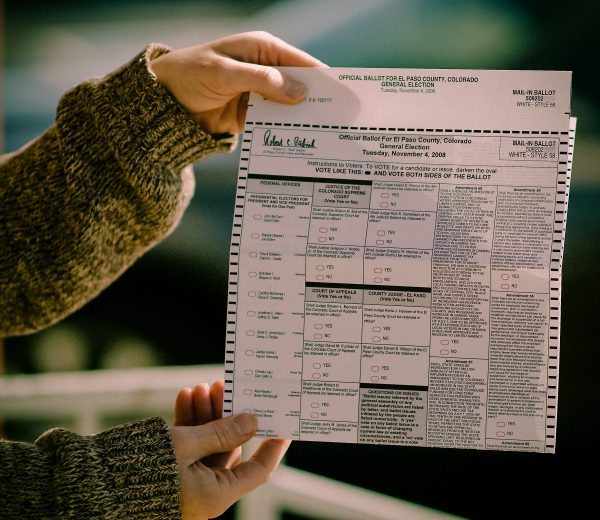
A woman holds up a ballot. Image via flickr, CCO.

Who people vote for, and why they vote for them, is an important element of studying elections and political participation in social science, That doesn’t mean you can convince everybody on the other side of the political aisle to vote for your preferred candidate. This Sociological Images post considers the growing field of cognitive sociology to explain why voter choice and voter preferences are complex and hard to change.

A common question in American politics is whether people will vote: what motivates some people to vote regularly in national and local elections versus others who don’t really vote at all? This Soc Images post describes the answers people give when asked why they didn’t vote? This can range from personal attitudes such as opinions about the candidates on the ticket and or a general disinterest in politics. A lack of voter turnout can also be explained by barriers in the process including registering to vote, finding time to vote, and even dealing with bad weather on Election Day. Importantly, voter patterns differ by demographics. As described by this Soc Images post and this TSP Special, there are clear differences in voter registration and turnout among people of varying races, education, gender, and other differing backgrounds. This research question has been studied at length for decades, and considering such findings over time reveals important trends. This post from Sociological images discusses how voter turnout has both grown and dipped over the 20th and early 21st centuries. 

Gender is an important element in studying voter patterns, turnout, and political impacts during election season. Indeed, the stories of radicalism, feminism, and the women’s suffrage movement were important historical moments when key ideas about democracy and equality developed. These ideas shape how we think about voting, identity, and activism today, as described in this Soc Images post. This is particularly relevant in recent decades as more female politicians are represented in major races and as social conversations, norms, and understandings of gender evolve. This Council on Contemporary Families post breaks down the nuts and bolts of gender, voting, and the 2016 election, which point to interesting directions for for future research down the road; how will gender shape the 2020 election?

Voting in the 21st Century: A New Era of Oppression?

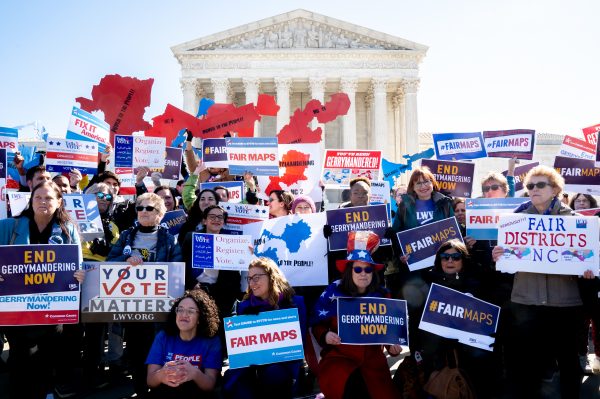
Protests against gerrymandering in front of the Supreme Court. Image via Flickr, CCO.

Voter suppression is on the rise in the USA, which is ironic given the prevalence of “Get Out the Vote!” messaging. Social scientists have investigated voter restriction laws, legislation, and policies implemented in the 2000’s and 2010’s  as a new chapter in America’s troubled history with voter suppression and voting right’s restriction. As described by this TSP Special, we’re over fifty years past the Voting Rights Act, yet voter suppression seems to be gaining momentum in recent years. History is indeed repeating itself as shown in this Soc Images post about voter suppression in the past and in the present.

Voter suppression can happen at the level of large locales or entire states. “Gerrymandering” is a process in which electoral maps are redrawn to favor one party over the others; the name is inspired by a salamander-shaped picture of a district which politicians had  redrawn so that voters from one region would cancel out others. Regardless of political affiliation or partisanship, we should all be concerned by the very real threat that Gerrymandering represents to our democracy, voting, and election outcomes, as explained by this TROT post and this Soc Images post.

One important dimension of voter suppression is felon disenfranchisement, wherein Americans convicted of a felony lose their right to vote. In recent decades, legislators have created new laws which expand the definition of felonious crimes; this has developed alongside other inequalities in policing, incarceration, and the criminal justice system. Thus, felon disenfranchisement represents an important product and driver of contemporary inequalities in the USA that unfold on racial and class lines, as described by several different #TSPClassics. TSP Editor Chris Uggen has been a major contributor to this area; his and colleagues’ research shows that millions of American votes have been lost to felon disenfranchisement, as discussed on The Sentencing Project.

Voter disenfranchisement has taken on a new face, as described in this post from Soc Images.  As Scholar Strategy Network explains, seemingly-innocent but problematic methods of voter suppression include the passage of voter ID laws and other individual requirements. These laws require voters to have financial resources and access to public institutions such as a local DMV. These requirements disproportionately affect racial minorities, the poor, the elderly, and other groups in the USA who already experience structural inequalities. Voter ID laws, as explained here by Soc Images, represent another chapter in voter suppression which thusly works to prevent people from accessing their right to vote.

Scholars in sociology and beyond have raised concerns about the recent growth of voter suppression and its consequences. Learn about the many dimensions of social science research on voter suppression from this post by Scholars Strategy Network’s research compendium. Voter suppression is a fundamental attack on the rights of citizenship and the pursuit of specific laws and rules that  make it harder to vote is often a targeted  strategy to prevent certain populations from voting. This post from Scholars Strategy Network presents research on politicians’ and policymakers’ attempts to suppress the vote of racial minorities.

Voter suppression has not waned in the twenty-first century. Most scholars agree that the problem has only gotten worse in  recent years. An important consequence of ongoing voter restriction is the distortion of the electorate. This means that rather than representing the general American population, the electorate is whiter and more conservative, as described by this Soc Images post. As described in this TROT post, the racial, class, and other inequalities heightened by voter suppression mean that gaps in who can vote have tangible, direct impacts on elections, politics, and policy.

“Democracy:” Elections and Beyond

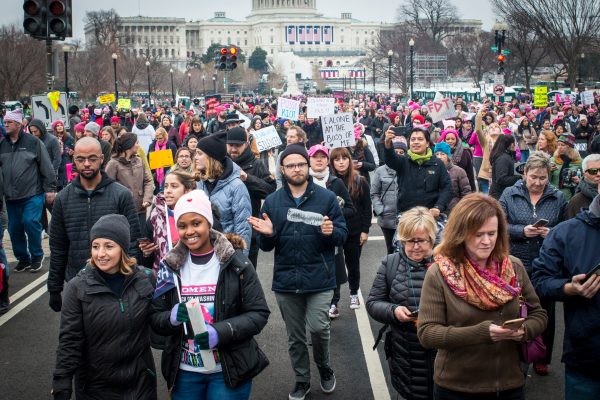
Image from the 2017 Women’s March in Washington, D.C. Image via Flickr, CCO.

Voting is a cornerstone of our democratic state and is the primary method by which the average citizen can impact politics. And yes, your vote matters!  This post from Sociological Images discusses how voting relates to public policy and how voter turnout predicts how public policies unfold. As described in this post from Cyborgology, elections and voting represent an important symbolic, social ritual for the fulfilment of democracy.This post from Feminist Reflections, aptly titled “When Women Roar,” considers gender in the 2016 election and politics as related to pop culture and equality in representation. 

Voting and election day can tell us a lot about our society; elections and voting are snapshots of social change and progress, as described by this TSP Special about the intersections of professional sports league, profits, and politics. We should remember, however, that being an involved citizen goes beyond Election Day. Social movements and activism are important parts of the democratic process and social change in a democracy, as described by this TSP Special. As we move forward, we should remember that voting is only one way to participate in democracy That being said, the right to vote–which some people take for  granted–has been increasingly restricted in recent years via several forms of voter suppression. We must continue  academic research and provide critical solutions to tackle this source of inequality and threat to our democracy.  We could also expand access to voting by modernizing   voter registration and voting as described in this post from SSN.  And, as many of us vote remotely during COVID, it’s important to reiterate that voter fraud is not a major issue in the USA, as described by this TSP Teaching post. Social science can help us move towards a future  with increased voting access and voter participation.

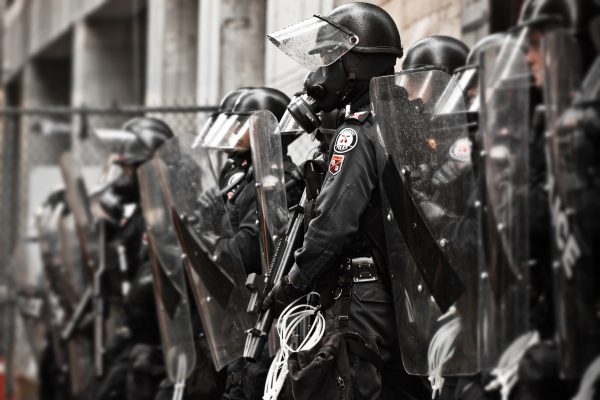
Police form a line in riot gear. Violence against citizens by police is often perceived as legitimate. Image via Flickr.

Can your country be a criminal? Until recently, the legal answer has often been no. Today, sociologists answer: it depends. For instance, this past summer, the federal government resumed executing death row inmates, and more recently, officer-involved shootings have drawn attention to how police officers are entrusted with violent force as part of their duty to protect and serve the people. In many circumstances, these killings are defended as legal or legitimate forms of violence. But many other kinds of killing, such as genocide or murder, are not.

Early sociologist Max Weber argued that countries have historically been defined by the power and right to exercise “legitimate violence,” or violence that is normalized and legal. Although they are entrusted to use violence  to protect their citizens from violence, countries routinely use violence against their own citizens.
Legitimate violence, often carried out by a country’s police forces or military, is typically reserved for those that are marginalized or alienated.  When a nation commits violence against criminals, those who present security risks, or even those whom we fear, it is often accepted  as a “reasonable” use of force.  Some scholars argue that most forms of police violence, in particular, are difficult to recognize as anything but legitimate and necessary for protection. For example, we often presume that police violence is committed against criminals, in an effort to protect innocent citizens.
It wasn’t until WWII and the Holocaust that the international community questioned a nation’s right to perpetuate violence against its people. For example, Hitler’s murderous campaign against the Jews and other social outcasts was, in fact legal, as genocide was not yet a crime. A state’s right to legitimate violence has only diminished with the recent development and globalization of human rights.

Both police violence and mass violence committed by states against their own populations are beginning to be understood as crimes. Internationally, we have seen this with the creation of the International Criminal Court. Closer to home, we see this with the calls to prosecute police officers who have engaged in police brutality. Yet many forms of violence committed by the state are still perceived as legitimate, despite the fact they involve the same type of violence. For example, intentionally targeting and killing a civilian may be labeled an illegal crime against humanity or the legal result of a capital criminal prosecution.

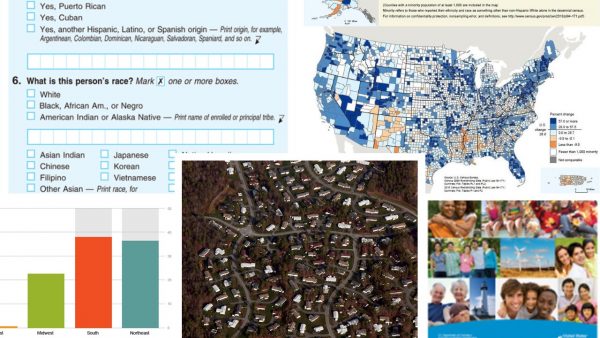
2020 is a census year in the United States, meaning that this year represents the major moment of a constitutionally-mandated survey about the American population.

Since it was first introduced in the 18th century, the U.S. Census has always provided important data for guiding public policy and served as a crucial source of evidence for social science research. Considering we only get this chance once a decade, here at The Society Pages we took a quick census of our own content to bring you our favorites #TSPClassics about the Census. This collection covers a variety of topics, ranging from the nuts and bolts of conducting the Census itself, to how the history of the Census reflects and impacts changing racial and ethnic boundaries in the United States, and the variety of ways social scientists have used census data in conducting research and building theory. Read on!

The Census and Social Science: Lessons for and from Conducting Research

Advances in social science methodology and research have contributed to developments in the Census. Though it is a rare and large research endeavor unlike any other, the Census is a great example of theoretical and methodological considerations that social scientists grapple with every day. Not only does the Census give us a chance to put sociological theory and methodology into action, but Census data has been important in social science literature and research across a variety of fields.

As one of the largest endeavors in data collection, the Census has many complicated issues to consider as part of the practical processes involved with research and the interpretation of data.
  • In this #TSPClassic episode of Office Hours, we hear from Robert M Groves, a sociologist who was then Director of the Census Bureau, about how the Census manages and works through such complications.
  • In this Clipping, Robin Autry speaks with The Atlantic about how researchers clean census data to deal with ambiguous, fluid concepts such as race and ethnicity.
  • Then, read this #TSPClassic from The Color Line about the preparation and planning behind the 2010 Census; how does such thinking relate to the 2020 Census?
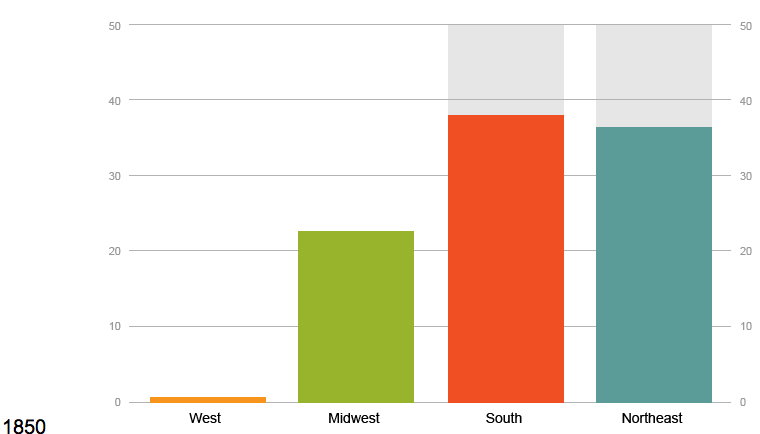
Bar graph with different colored lines shows U.S. regional distribution based on 1850 census. The northeast and south have the highest lines and are about the same. The west line is barely visible and the midwest line is in between.
Click to enlarge. Graph shows U.S. regional distribution based on the 1850 census, SocImages
Census data and related research can tell us a lot about our lives, particularly when it comes to where we live and how we work.
  • Scholars have used such data to understand the history of urbanization and suburbanization in the United States; this Sociological Images post draws on census data to visualize the development of the modern American metropolis and contemporary communities.
  • Read this Sociological Images post about inequalities in Americans’ commutes to work and access to transportation.
  • Finally, see how Graphic Sociology uses on census data to discuss how unemployment and poverty relates to age, gender, and much more. 
Photo shows a collage of pictures featuring people in groups. At the top, it says American Community Survey.
Photo via CCF
The Census can tell us a lot about the big picture, but what can it tell you about yourself?
  • In this article from Contexts, Leah Sabo reflects on how thinking about the Census can teach us about the individual and make us think about our own lives. Read on to spark your sociological imagination about privilege, neighborhoods, diversity, and much more.
The Census, and subsidiary projects it manages such as the American Community Survey (ACS), provide incredibly important data for social science research. Though the ACS reaches fewer people than the one-a-decade Census, it gathers information about ancestry, neighborhoods, and communities in more detail and with more regularity.
  • In this #TSPClassic from Council on Contemporary Families, Philip Cohen challenges proposed budget cuts to the ACS and explains why it is important to fund this survey and social science in general.
  • Furthermore, such research processes are important around the world; read a Sociological Images piece about what other censuses around the world look like, based on resources from the American Anthropological Association.

The Census and Race: The Social Construction of Race and Diversity in the USA

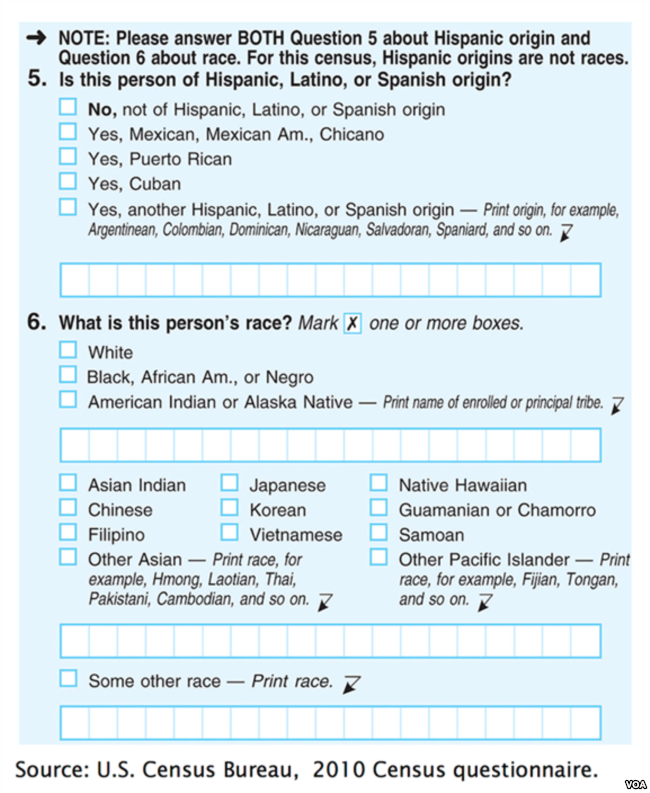
Photo shows a copy of the 2010 census questionnaire. The form is blue with check boxes and grids for the answers.
Click to enlarge. Photo via SocImages

“Race” is a social construction. Social forces shape how physical characteristics and groups become seen in racialized ways, and this happens through a variety of cultural and material processes. The ways the Census approaches race, ethnicity, and identity have changed drastically over its centuries-long history; much of this reflects shifting norms about racial categories and racism itself in the United States. Census data thus shows us how race and racial landscapes change, and the complexities of race in the United States.

Racial identification on the Census has changed and evolved.
  • This Sociological Images post describes how the Census’ racial categories have changed over the years
  • This Sociological Images post describes shifts in Census practices regarding the measurement of race through appearance versus identity. 
  • Be sure to read this summary of research on how the fluidity of racial identification on the Census can itself be a fluid process.
  • These next two Clippings consider how the Census relates to the intersections of race, ethnicity, nationality, and citizenship: the first describes how the Census affects the historical development of “Hispanic” as an ethnic category, and the second points to complexities in measuring American-Indian identities in census data. 
Census research has been used to study racial inequality both past and present.
  • This post from Sociological Images uses census data to illustrate discuss historical quantification of slavery.
  • And this #TSPClassic via Council on Contemporary Families draws on census data to discuss how, despite the passage of fifty years since the Civil Rights Act, racial inequality and disadvantage persist in a variety of outcomes.
  • Finally, read this Sociological Images post to learn more about racial residential segregation in several American metropolises.
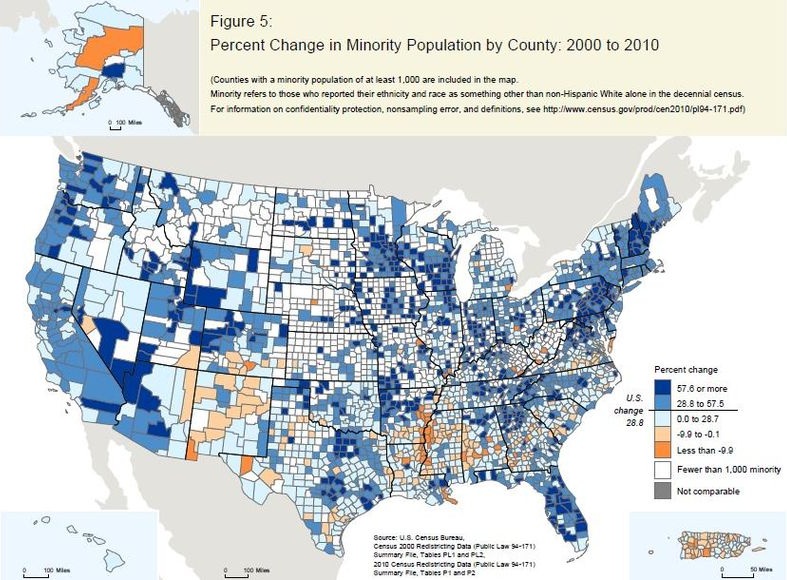
Image shows a color-coded map of the United States divided into counties. Each county's color is determined by the percent change in minority population by county from 2000 to 2010. The coasts look darker blue meaning there is more change.
Click to enlarge. Photo via SocImages
The twenty-first century has witnessed the rise of unprecedented racial and ethnic diversity in the United States.
  • This post from Council on Contemporary Families uses census data to capture how America’s children are growing up in a new era of everyday diversity
  • And this #TSPClassic from Sociological Images shows racial and ethnic diversity within American families.
  • This Sociological Images post considers potential contrasts between the demographics of the mid-20th and the mid-21st century.
  • Along these lines, read this post from Color Lines about the rise of interracial marriage and families, particularly for Asian-Americans. 
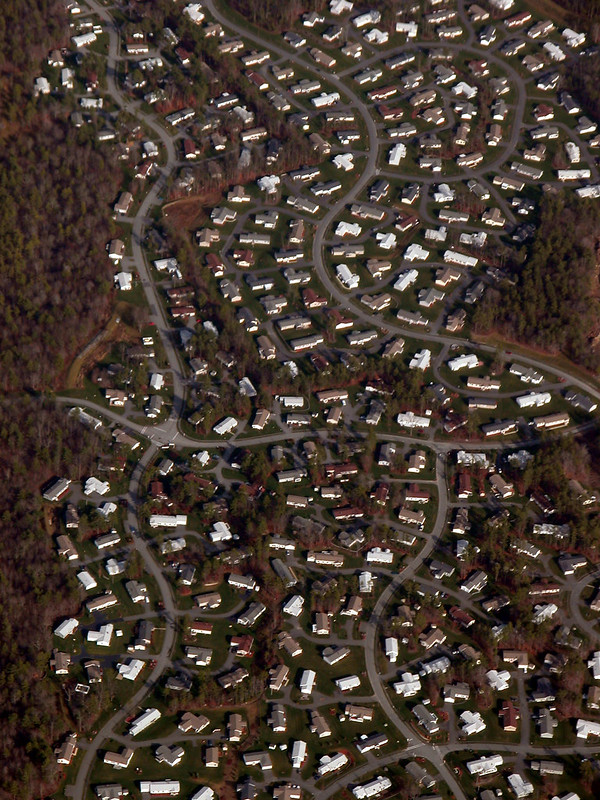
Image shows an aerial  view of a suburban community.
Photo by Art01852, Flickr CC
The rise of difference and diversity has drawn discomfort, racial tensions, and backlash, and much of this comes from the ways that everyday people react to census data and population projects.
  • This Clipping describes such reactions
  • And this Clipping describes how census data can be used to stoke fears about immigration.
  • Finally, be sure to read this #TSPClassic, a special feature about the “whitelash” against diversity.
As American diversity continues to rise, push back and resentment will surely continue to be relevant to how people use and react to census data. What will we see once the 2020 numbers come out?
Finally, it is important to recognize that rising racial diversity does not necessarily mean that racial inequality will disappear; in fact, sociologists often find the opposite. One such area of research is related to segregation and concentrated disadvantage, wherein non-white communities often have less cultural, political, and economic power.
  • Be sure to read this Discoveries post about historical and contemporary racial segregation between the North and the South,
  • And read this Clippings piece about how segregation persists despite an increasingly racially diverse population. 
As we move into a future of greater difference, such ideas are important to keep in mind; what will the 2020 Census tell us about race, diversity, and inequality?

We hope you enjoy these #TSPClassics as much as we do, and we look forward to working with the 2020 Census data!

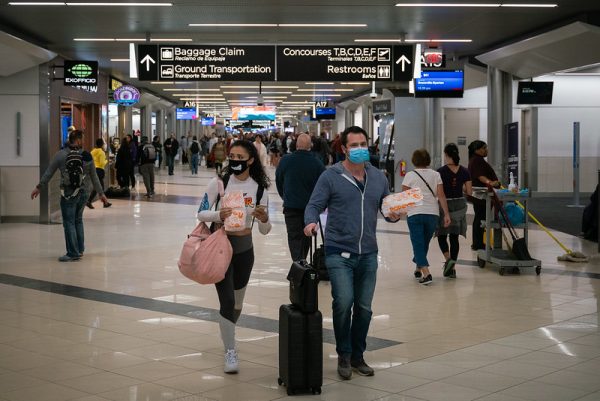
Flyers at Hartsfield-Jackson Atlanta International Airport wearing facemasks. Photo by Chad Davis, Flickr CC

During times of crisis, existing prejudices often become heightened. Fears about the current coronavirus, or COVID-19, have revealed rampant racism and xenophobia against Asians. Anti-Asian discrimination ranges from avoiding Chinese businesses to direct bullying and assaults of people perceived to be Asian. This discriminatory behavior is nothing new. The United States has a long history of blaming marginalized groups when it comes to infectious disease, from Irish immigrants blamed for carrying typhus to “promiscuous women” for spreading sexually transmitted infections. 

Historically, the Chinese faced blame time and again. In the 19th century, public health officials depicted Chinese immigrants as “filthy,” carriers of disease. These views influenced Anti-Chinese policies and practices, including humiliating medical examinations at Angel Island — the entry port for many Chinese immigrants coming to America — and the violent quarantine and disinfection of San Francisco’s Chinatown in the early 20th century when a case of the Bubonic plague was confirmed there. 
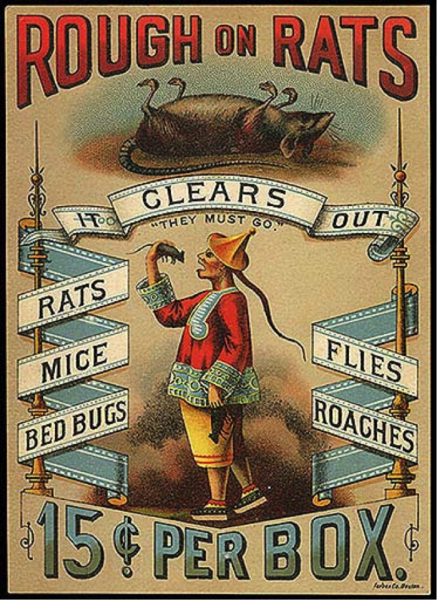
An advertisement for "Rough on Rats" rat poison. On the flyer there is an image of a stereotypically drawn "china man" eating a rat.
Late 19th century racist advertisement for rat poison

Discrimination against the Chinese is one example among many. Such discrimination had nothing to do with their actual hygiene and health, and everything to do with their social position relative to other racial groups. It’s easy to look back on the xenophobic U.S. policies and behavior in earlier times. Let’s not fall into the same patterns today.

For more on xenophobia and coronavirus, listen to Erika Lee on a recent episode of NPR’s podcast, Code Switch.

Many stacks of textbooks. Photo via Pixabay.

Textbooks are more prevalent in American history courses than in any other subject, and a recent article from The New York Times revealed how geography has influenced what U.S. students learn. Despite having the same publisher, textbooks in California and Texas (the two largest markets for textbooks in the U.S.) vary wildly in educational content. Researchers have also found numerous inconsistencies and inaccuracies in American history textbooks, resulting in the glorification of national figures and spread of national myths.

Depictions of violence in textbooks are also highly politicized. Episodes of violence are often muted or emphasized, based on a country’s role in the conflict. For example, conflicts with foreign groups or countries are more likely than internal conflicts to appear in textbooks. Additionally, American textbooks consistently fail to acknowledge non-American casualties in their depictions of war, citing American soldiers as victims, rather than perpetrators of the horrors of war. Depictions of conflicts also vary over time, and as time passes, textbooks move away from nationalistic narratives to focus instead on individualistic narratives.
Public figures, like Hellen Keller and Abraham Lincoln, tend to be “heroified” in American textbooks. Rather than treating these public figures as flawed individuals who have accomplished great things, American textbooks whitewash their personal histories. For example, textbooks overlook Keller’s fight for socialism and support of the USSR and Lincoln’s racist beliefs. The heroification of these figures is meant to inspire the myth of the American Dream — that if you work hard, you can achieve anything, despite humble beginnings.
Symbolic representation of the past is important in stratified societies because it affects how individuals think about their society. Emphasizing the achievements of individuals with humble beginnings promotes the belief among American students that if they work hard they can achieve their goals, despite overwhelming structural inequalities. Furthermore, as historical knowledge is passed down from one generation to the next, this knowledge becomes institutionalized and reified–making it more difficult to challenge or question.
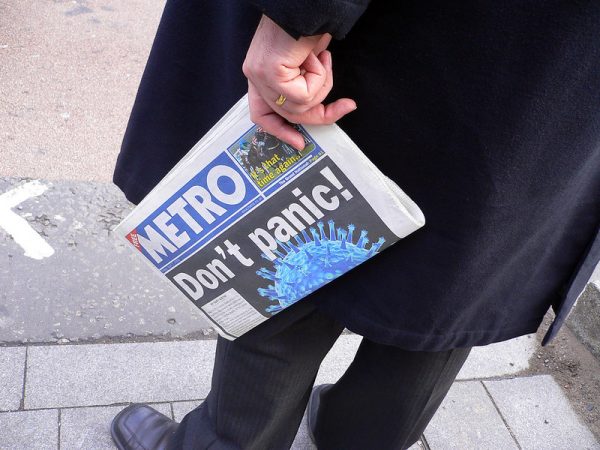
Photo by photologic, Flickr CC

This post was created in collaboration with the Minnesota Journalism Center

Coronavirus — also known as COVID-19 — has taken the global media world by storm. Over 2,000 have died and more than 79,000 are infected globally. The World Health Organization has been criticized for not declaring a public health emergency earlier than they did, but doctors including Dr. Emily Landon at the University of Chicago are saying that “people shouldn’t panic.” 

In cases of public health epidemics, whether people panic depends in part on how journalists cover the issue and which experts they cite. Journalists tend to quote official sources like government officials and public health officials to inform the public about outbreaks of illness including influenza, swine flu, Zika, Ebola, and more recently, coronavirus. Being quoted in news articles gives public health officials the opportunity to share their expertise on said topics to help inform readers about how to protect themselves and avoid infection. From a sociological perspective, focusing on the spread of information about pandemics and infectious diseases provides opportunities for scholars to comment on evolving social structures and processes in a way that will influence the biomedical sciences’ public and policy agenda.

As epidemiologist Adam Kucharski wrote in The Guardian, “stories sparking fear seem to have overtaken the outbreak in real life” and misinformation (a topic The Society Pages has written about here) seems to be more contagious than the virus itself. The “need for speed” in publishing journalistic updates about the virus as well as scholarly work has resulted in several retractions, including the retraction of a preprint of a scholarly paper after its analysis was found to be faulty. 

Further, the spread of information — and misinformation, including conspiracy theories — about health crises often occurs on social media platforms including Twitter and Instagram. Scholars found that false information spread especially quickly during Ebola outbreaks in West Africa and in the Zika outbreak in Brazil, which led to the formation of counterproductive policies passed by public health officials who struggled to combat false claims. In recent years, Instagram was found to be the most effective platform for health organizations including Centers for Disease Control, the World Health Organization, and Doctors without Borders to engage followers during global health crises.
Scholars, including Dr. Anita Varma, recently published five tips for journalists on covering coronavirus. These include paying attention to the frames used and including quotes from official sources like government officials as well as the people directly affected by the health concern. Dr. Karin Wahl-Jorgensen published an article on the role that fear plays in narratives about public health crises. The bottom line is: The way stories are told matters and affects the management of pandemics and policy responses.