politics

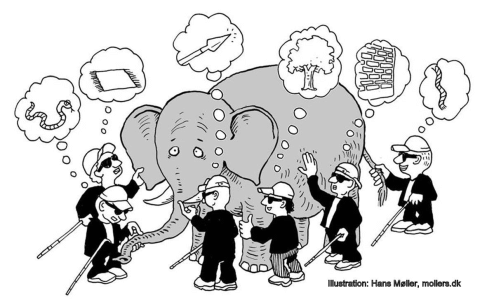
Cartoon. Six blind men touch different parts of an elephant and each has a different idea of what the elephant is based on what they've touched

This post was created in collaboration with the Minnesota Journalism Center

Objectivity and neutrality have been cornerstone norms of journalistic practice in democracies in the Western world for over a century. However, in recent years ideals of fairness, accuracy, and balance have come under increasing attack from many different and sometimes unexpected directions. 

Many beliefs about the need for media objectivity go back to Alexis de Tocqueville’s 19th century argument that the circulation of newspapers are integral to fostering a functional and effective democracy. Indeed, objectivity became a news value in the 1830s, partly to do with the rise of the Associated Press (AP), created in 1848 by a group of New York newspapers that wanted to take advantage of the speed of the telegraph in transmitting news to multiple outlets. To transmit news to a variety of news outlets with a variety of political allegiances consistently, a sense of objectivity had to be maintained to be relevant to as wide an audience and clientele as possible. 
Cutting against these norms was the sensationalism of newspaper content in the late 19th century. While the use of emotion in reporting has often been connected to the commercialization and tabloidization of journalism, in recent years it has also appeared in coverage of disasters, crises, and human rights abuses — and has come to be seen as positive and valuable as well. The roles of objectivity and impartiality have always been contested within journalistic practice, so rather than seeing emotion as the opposite of objectivity, some scholars now argue it can come alongside and inform journalistic practice worldwide.
The role of objectivity has also come into question as a mechanism that can silence marginalized writers and populations. Relatedly, news can also reinforce institutions of power in society, for better or for worse. In populist countries including Argentina, Bolivia, Ecuador, Nicaragua, and Venezuela, “professional journalism” is often pitted against “militant journalism” promoted by neo-populist governments and their sympathizers — a movement that has critical implications for the freedom of the press in societies in the Global South. Also, news media has been found to negatively portray protests and protesters.
Hand holding a diamond. Photo via pxfuel.

Over one million people will get engaged on Valentine’s Day, and as a result, diamond sales usually uptick around this time. Diamonds are both historical and cultural objects; they carry meaning for many — symbolizing love, commitment, and prestige. Diamonds are highly coveted objects, and scholars have found about 90 percent of American women own at least one diamond. In the 1990s, war spread throughout West Africa over these precious pieces of carbon, as armed political groups vied for control over diamond mines and their profits.

Given their role in financing brutal West African civil wars, diamonds became associated with violence and international refugee crises, rather than financial prosperity and love. Diamonds became pejoratively known as blood diamonds, or conflict diamonds, and consumers became more likely to perceive diamonds as the result of large scale violence and rape.  As a result, major diamond producers have attempted to reconstruct the symbolic meaning of diamonds, turning them into symbols of international development and hope.
As the diamond trade became immoral and socially unjust, new global norms emerged around corporate and consumer responsibility. Non-governmental organizations (NGOs) lobbied for the diamond industry to change their behaviors and support of conflict mines while simultaneously creating new global norms and expectations. In the early 2000s, international NGOs, governments and the diamond industry came together to develop the Kimberley Process — to stop the trade of conflict diamonds. Today, 75 countries participate, accounting for 99% of the global diamond trade. 
Bieri & Boli argue that when NGOs urge companies to employ social responsibility in their commercial practice, they are mobilizing a global moral order. Diamonds provide an example of how symbols, products, and meaning are socially and historically constructed and how this meaning can change over time. The case of blood diamonds also illustrates how changing global norms about what is and is not acceptable can redefine the expectations of how industries conduct business.
Photo by torbakhopper, Flickr CC

Originally published July 30, 2019.

As candidates gear up for this week’s democratic debates, constituents continue to voice concerns about the student debt crisis. Recent estimates indicate that roughly 45 million students in the United States have incurred student loans during college. Democratic candidates like Senators Elizabeth Warren and Bernie Sanders have proposed legislation to relieve or cancel  this debt burden. Sociologist Tressie McMillan Cottom’s congressional testimony on behalf of Warren’s student loan relief plan last April reveals the importance of sociological perspectives on the debt crisis. Sociologists have recently documented the conditions driving student loan debt and its impacts across race and gender. 

In recent decades, students have enrolled in universities at increasing rates due to the “education gospel,” where college credentials are touted as public goods and career necessities, encouraging students to seek credit. At the same time, student loan debt has rapidly increased, urging students to ask whether the risks of loan debt during early adulthood outweigh the reward of a college degree. Student loan risks include economic hardship, mental health problems, and delayed adult transitions such as starting a family. Individual debt has also led to disparate impacts among students of color, who are more likely to hail from low-income families. Recent evidence suggests that Black students are more likely to drop out of college due to debt and return home after incurring more debt than their white peers. Racial disparities in student loan debt continue into their mid-thirties and impact the white-Black racial wealth gap.
Other work reveals gendered disparities in student debt. One survey found that while women were more likely to incur debt than their male peers, men with higher levels of student debt were more likely to drop out of college than women with similar amounts of debt. The authors suggest that women’s labor market opportunities — often more likely to require college degrees than men’s — may account for these differences. McMillan Cottom’s interviews with 109 students from for-profit colleges uncovers how Black, low-income women in particular bear the burden of student loans. For many of these women, the rewards of college credentials outweigh the risks of high student loan debt.
Photo by Andrew Turner, Flickr CC

Originally posted July 8, 2019.

On July 4th, 1776, signers of the Declaration of Independence declared their intent to “dissolve the political bands” holding the United States and Great Britain together. That subtle language quells the imagery of violent revolution — over nearly a decade of warfare, thousands died in the conflict. Today, in the midst of flags and cookouts, the violence of the revolution may yet again fade to the background. But many social scientists examine such violence deeply, and in doing so showcase the power of violence to remake identity, redraw state boundaries, and bring power to marginalized groups.

Acts of violence can redefine the boundaries of groups. During crises like civil war or political upheaval, political elites may seek to unite ethnic, racial, or religious groups to consolidate power. Threats of violence may motivate these groups, for fear or for self-protection, to mobilize. Historically, these changing groups have influenced national boundaries — indigenous groups were often targeted for violent elimination in order to conquer a space for a particular identity group, or areas were conquered to make more space for a group in power. In these ways, many of the symbolic and physical boundaries in the world around us carry traces of violence.
Violence and conflict can also create opportunities for those with limited political power. Elisabeth Jean Wood, for example, analyzed how insurgent groups of impoverished and exploited workers could use organizing and sometimes violent tactics to convince powerful leaders to negotiate, thus installing democratic governments. Marie Berry examines political power in the aftermath of conflict, showing how the participation of women in traditionally male spaces after violence enabled political organizing and gains in power. Though the extent and longevity of these changes differ between conflicts, violence and its aftermath have the capacity to result in political change.
While the transformative power of violence looks different across cases, its power doesn’t exist in a vacuum — global norms and regulations around violence often impact its destructive and constructive capacities. Today’s belligerents are often aware of laws surrounding the use of violence, like regulations about who or what can be targeted and what types of strategies are permitted. To garner favor with powerful international actors, many combatants abide by these regulations. Others abide selectively, like signing onto treaties in order to partake in other forms of violence with less oversight.

In the centuries that have passed since the revolution, many Americans now think of July 4thas a day of parades and parties, as representations of conflict have faded over time. But amongst the fireworks, social science shows the centrality of violence in national histories, international relations, and the relative power of social groups. 

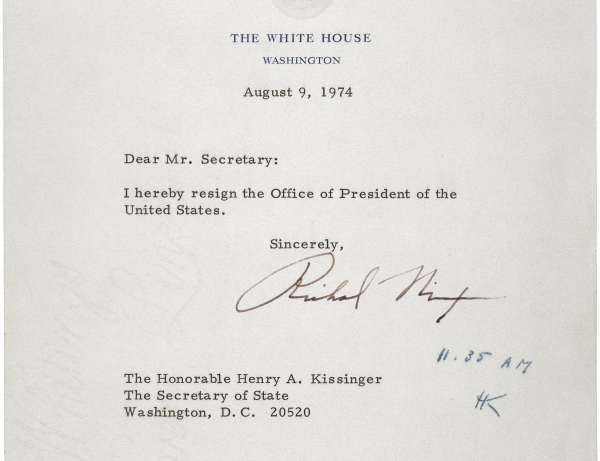
Richard Nixon’s resignation letter from August 9, 1974. Photo via Wikimedia Commons.

The impeachment proceedings have sparked contentious public debates about what should and should not be considered a “scandal” today. From the earliest days of the discipline, sociologists have employed theory and research to study why some incidents and individuals who seem scandalous have major impacts and lasting legacies, while others seem to make no mark whatsoever. They also help us see how both scandals and the public outcry that they can occasion are socially constructed by norms and values, organizational processes, and inequalities that extend well beyond any one individual person or event. It’s so sociological, it’s almost scandalous!

To begin, the identification of something as a social problem or “a scandal” requires that an issue is well known in society and intersects with a meaningful moral set of concerns. The construction of a scandal also involves who or what has the power to apply and enforce social norms about right and wrong. For example, public sanctions and normalized stigma against prominent queer citizens and pro-gray groups reinforced widespread bigotry, marginalization, and violence.
Media obviously plays an important role in creating and framing a scandal. Its coverage is shaped by often invisible social factors such as media businesses’ goals, newsroom budgets, and journalistic practices. In addition, the activities of political groups, social movements, and civic organizations can drive public debate and attention to certain issues or problems. Such groups’ impact is not necessarily a product of their moral beliefs or strength of conviction, but factors such as their name-recognition, finances, and networks. Thus, institutional processes, civic organizations, and material factors shape how a scandal is socially constructed.
Sociological factors such as status, gender, and race intersect with organizational contexts, media factors, and broader public norms to shape the aftermath of scandals as well. In political or corporate contexts, the power and resources of an individual or organization often determine whether and how they are punished for transgressions (or exonerated) and what kinds of reforms must be undertaken. Furthermore, the aftermath of a state scandal can be greatly determined by whether the government has a system of checks and balances, as well as whether criticizing state actors comes with consequences of its own. Unweaving such complex webs can show why some shocking scandals leave affected parties unscathed, while others leave long-lasting scars.

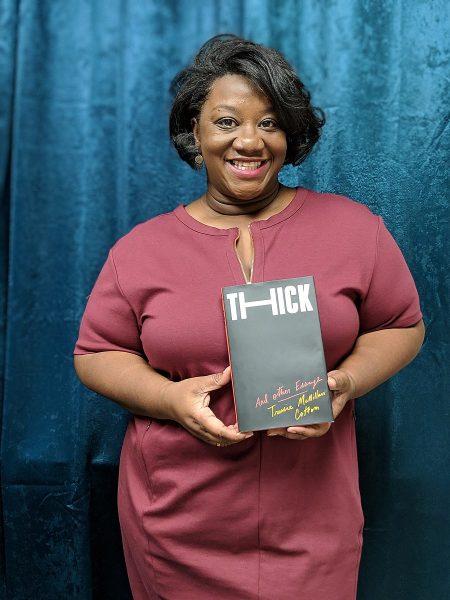
Tressie Mc Millan Cottom displays her essay collection Thick, which was nominated as a National Book Award Finalist. Photo via Wikimedia Commons.

In addition to being a formidable sociologist of technology and education, Tressie McMillan Cottom is an upender extraordinaire of class, race, and gender hierarchies throughout academia and the broader social world. Her book, Thick, was recently nominated as a National Book Award Finalist. With over 100 thousand followers, she is the center of gravity of an ever-expanding Twitter community, and also writes an extremely influential blog. Moreover, she has created a new program of study–Digital Sociology–at Virginia Commonwealth University, where she teaches as an Associate Professor in the Sociology Department.

Even before making her mark in the sociology of higher education with her book, Lower ed: The troubling rise of for-profit colleges in the new economy, McMillan Cottom had become an expert at using social media to assert and establish her legitimacy among scholars. As a graduate student she posted a critical analysis of arguments made by a more senior scholar on her blog, and this earned her the support of a wide and diverse readership. She carries on this tradition of bringing voice and legitimacy to Black women in Thick. Through her essays, McMillan Cottom centers the Black women’s intellectual tradition and their experiences while asking readers to get comfortable with some of the most uncomfortable topics: misogynoir, child loss, sexual violence, to name a few. Her powerful blend of sociology and poignant, personal stories give voice and representation to so many, in a space where such stories so often go unheard.
On Twitter, McMillan Cottom has also created a conversation space where thousands of followers feel supported as they navigate intersecting identities which are oftentimes complicated offline. This virtual space has also become a novel topic for scholarly research. Known as Black Cyberfeminism, this research explores how identities are created and interpreted in virtual places. It also critically examines the intersectional oppressions faced by Black women in virtual institutions. As Cottom argues, Black Cyberfeminist Theory provides a new lens for understanding and engaging in conversations around sociological phenomena.
Working with the Virginia Commonwealth University Sociology Department, Tressie McMillan Cottom has developed undergraduate and graduate Programs in Digital Sociology. Digital Sociology focuses on the use of social media as part of everyday life and the ways it contributes to patterns of human behavior, social relationships, and concepts of the self. Her curriculum encourages students to apply sociological theory to analyze data produced by online human activity, including endless timelines and trends offered from various digital technologies and platforms.

Photo is shows a child covering their ears while watching tv
Photo by Miles Bannan, Flickr CC

This post was created in collaboration with the Minnesota Journalism Center

Obstruction, quid pro quo, impeachment. The tweets, the news alerts, the endless headlines. This political landscape, and the overall media news landscape, can be exhausting, and news consumers are showing they are tired of it all. A June 2019 Digital News Report explained that this news fatigue has turned into news avoidance: 41 percent of respondents in the United States (and 32 percent worldwide) said they “often or sometimes” avoid the news. 

Scholars are exploring the reasons for news avoidance, with some readers finding news “too negative,” “frustrating” or “annoying.” Other research shows that women are more likely than men to avoid the news, a gap explained by structural inequalities, like family commitments and household responsibilities.
One of the first journalism studies on this topic found that participants avoided the news but counted on the news finding them. The study from Stephanie Edgerly identified participants who did not follow any news accounts or journalists on social media but relied on Facebook to notify them of significant news and events.
These news avoiders are less inclined to vote, a troubling fact to University of Minnesota researcher Benjamin Toff:

“I do have concerns about whether our news environment is all that conducive to creating an electorate of people who actually hear the other side, can think through complicated political debates and issues, and understand a variety of different perspectives.”

Women’s news avoidance is intertwined with a lack of political engagement. This can lead to women facing difficulty advocating for themselves in the political sphere and fewer women involved in the political process or even running for office.
One way to decrease the number of news avoiders is to improve the quality of news itself and make news consumption more appealing. “Solutions journalism” explores sociological problematic issues in communities (homelessness, childhood obesity, etc) and critically examines problem-solving efforts. This goes beyond more straight-forward traditional reporting of the facts and, instead, offers ideas on how to resolve issues important to community members. Research demonstrates that readers are more likely to engage with (share, like, etc) solutions-oriented content than traditional news content. In addition, findings reveal readers report more favorable attitudes towards the news story and news organization when news discussed solutions.

Another important avenue in combating this news avoidance issue is media literacy. For more on media literacy, click here.

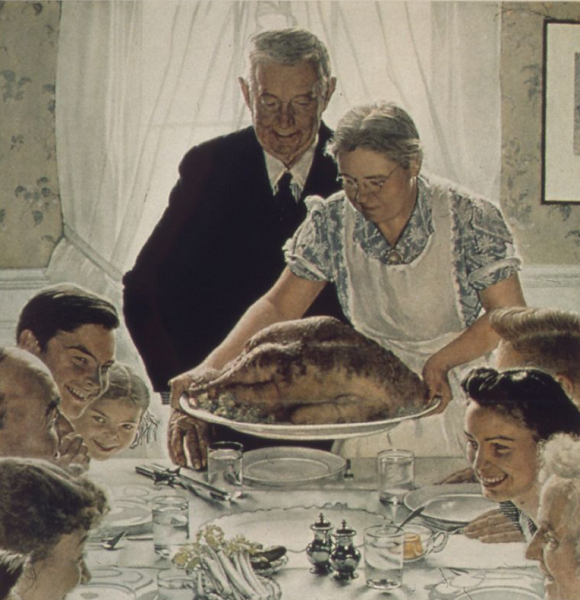
Peaceful holiday meals may still be the ideal, but they are not the norm. The image shows part of a World War II propaganda poster by Norman Rockwell, proclaiming, “OURS… to fight for: Freedom from want,” via Wikimedia Commons.

As we prepare for Thanksgiving, many people look forward to sharing a warm meal with their family and friends. Others dread the holiday, gearing up to argue with their relatives or answer nosey questions. TSP has written about the political minefield that holiday meals can be in the past. This year we want to point out that the roots of difficult dinners actually run deep in everyday family mealtime. Thanksgiving, like any family mealtime, has the potential for conflict. 

Scholars have documented how important meal time can be for families in terms of cultivating relationships and family intimacy. However, they also show that despite widespread belief that families should share “happy meals” together, meals can be emotionally painful and difficult for some families and family members.
Disagreements between parents and children arise at mealtime, in part, because of the meal itself. Some caregivers go to battle with “picky eaters.” Migrant parents struggle to pass cultural food traditions to children born in the United States. Low income parents worry that their children will not like or eat the food they can afford.
Family meals also reproduce conflict between heterosexual partners. Buying, preparing, and serving food are important ways that women fulfill gendered expectations. At family meal-times men continue to do less work but hold more power about how and when dinner is served.
Thanksgiving, or any big holiday meal, can involve disagreements. However, that is not altogether surprising considering that everyday family meals are full of conflicts and tension.
1894 newspaper illustration by Frederick Burr Opper, Library of Congress via Wikimeida commons

The election of President Donald Trump in the United States in 2016 ushered in an era of attacks on the media and accusations that outlets such as The New York Times and The Washington Post are publishing “fake news.” But what exactly is “fake news”? And why are claims about information, misinformation, and disinformation in American journalism so troubling?

TSP has previously published articles summarizing scholarly concerns about fake news–in particular, its role in the political polarization phenomenon. Media scholars also now see these trends as part of a larger, longer-term crisis of democracy itself, beginning sometime in the final decades of the 20th century.

In spite of all of these questions and controversies, one thing is clear: there is no consensus on what exactly fake news is. The definition of fake news is unclear to many Americans. According to a 2018 study from The Media Insight Project, there are several understandings of what “fake news” really means to Americans nationwide:  

  • 71% of Americans think fake news is “made-up stories from news outlets that don’t exist”
  • 63% think fake news refers to “media outlets that pass on conspiracy theories and unsubstantiated rumors”
  • 62% think it means “journalists from real news organizations making stuff up” 
  • 43% think fake news refers to news organizations making sloppy mistakes
  • 25% call satire or comedy about current events fake news
Audiences play a key role in interpreting the news and acting on it — or not. Pew Research Center data shows 68 percent of American adults say that they get their news on social media even though 57 percent of them expect the news they see on social media to be “largely inaccurate.” Academic studies also find that “fake news” is often used by social media users to insult information shared by members of opposing political parties.  

Photo by the euskadi 11, Flickr CC

Originally posted April 2017. We’re reposting this in light of California’s recent decision to prevent the renewal of contracts with for-profit prison companies.

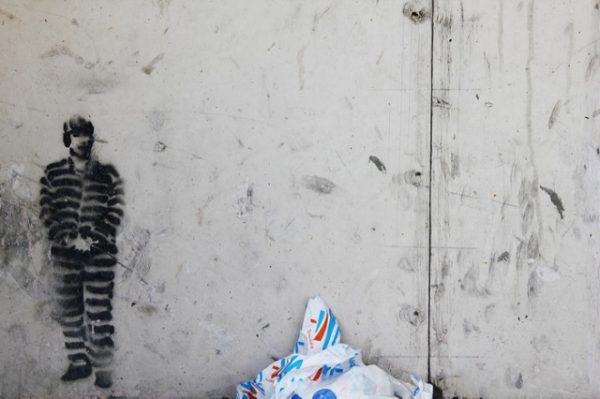
Last month, Attorney General Jeff Sessions reinstated the use of private prisons in the federal system. This move is welcome news to top corrections corporations such as CoreCivic, but human rights activists are concerned about this shift. Opponents claim that these corporations bring in large profits while their prisons remain rife with safety and healthcare deficiencies, as well as underpaid employees. While these concerns are important to consider, the private prison industry represents a small segment of the American correctional system. According to the Bureau of Justice Statistics, only 17% of inmates in federal prisons and 7% in state prisons were held in private facilities in 2015.

During their initial inception, private prisons were believed to be a cost-effective option that could provide better services than government facilities. Despite these goals, much of the current evaluative research suggests that private facilities are no more cost effective than public facilities. Likewise, private prisons appear to perform worse in reducing recidivism than public correctional facilities and have similar (and sometimes worse) conditions than public facilities. In contrast, some evidence suggests that private prisons may be less overcrowded. Due to these ambiguities, scholars of the privatization debate are calling for more research into the qualitative differences between the private and public sector of prisons.
Regardless of their effectiveness, research suggests that the demographic composition of private prisons is racially disparate. In an analysis of adult correctional facilities in 2005, private prisons had significantly fewer white and more Hispanic populations when compared to their public counterparts. As to why racial and ethnic disparities exist, research points to the role of private prisons in immigrant detention, which has lead some scholars to argue that the private prison industry is just a small segment of a massive immigrant industrial complex. This line of research posits that this complex perpetuates the criminalization and stigmatization of immigrants, especially among Latinos, and as a result comes at a significant cost to immigrant families and communities.