Search results for The

This November, a wave of student activism drew attention to the problem of racism at colleges and universities in the US.  Sparked by protests at the University of Missouri, nicknamed Mizzou, we saw actions at dozens of colleges. It was a spectacular show of strength and solidarity and activists have won many concessions, including new funding, resignations, and promises to rename buildings.

Activists’ grievances are structural — aimed at how colleges are organized and who is in charge, what colleges teach and who does the teaching, and what values are centered and where they come from — but they are also interpersonal. Student activists of color talked about being subject to overtly racist behavior from others and being on the receiving end of microaggressions, seemingly innocuous commentary from others that remind them that they do not, as a Claremont McKenna dean so poorly put it, “fit the mold.” That dean lost her job after that comment. Many student activists seem to embrace the policing of offensive speech, both the hateful and the ignorant kind.

Negative reactions to this activism was immediate and widespread. Much of it served only to affirm the students’ claims: that we are still a racist society and that we, at best, tolerate our young people of color only if they stay “in their place.” Other times, it was confusion about the kind of world these young people seemed to want to live in. Why, some people asked, would anyone — especially a member of a marginalized population — want to shut down free speech?

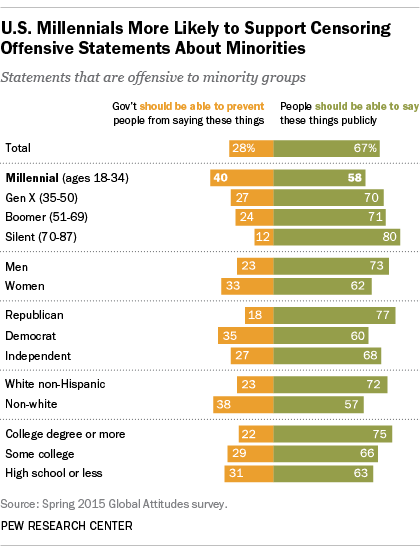
Well, it may be that the American love of free speech is waning. The Pew Research Center released data measuring attitudes about censorship. They asked Americans whether they thought the government should be able to prevent people from saying things that are “offensive to minorities.” Millennials — that is, today’s college students — are significantly more likely than any other generation to say that they should.

In fact, the data show a steady decrease in the proportion of Americans who are eager to defend speech that is offensive to minorities. Only 12% of the Silent generation is in favor of censorship, compared to 24% of the Baby Boomers, 27% of Gen X, and 40% of Millennials. Notably, women, Democrats, and non-whites are all more likely than their counterparts to be willing to tolerate government control of speech.
4

Americans still stand out among their national peers. Among European Union countries, 49% of citizens are in favor of censorship, compared to 28% of Americans. If the Millennials have anything to say about it, though, that might be changing. Assuming this is a cohort effect and not an age effect (that is, assuming they won’t change their minds as they age), and with the demographic changes this country will see in the next few decades, we may  very soon look more like Europe on this issue than we do now.

Re-posted at Pacific Standard.

Lisa Wade, PhD is an Associate Professor at Tulane University. She is the author of American Hookup, a book about college sexual culture; a textbook about gender; and a forthcoming introductory text: Terrible Magnificent Sociology. You can follow her on Twitter and Instagram.
SocImages News:

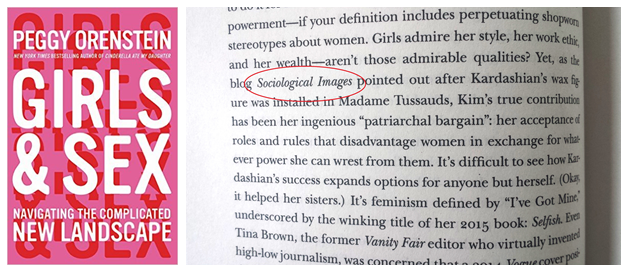
Sociological Images’ post on Kim Kardashian and the patriarchal bargain is mentioned in Peggy Orenstein’s forthcoming book, Girls and Sex: Navigating the Complicated New Landscape. What a wonderful surprise!

7

Also this month, we featured a guest post by sociology graduate student Nicole Bedera. Her criticism of the latest viral Barbie ad prompted NPR to do a story. Listen to hear Nicole and Barbie-scholar Ann DuCille comment on about how far the doll has, or hasn’t, come.

Finally, I had the opportunity to contribute to a smart analysis of energy drink marketing at the New Yorker and a really nice discussion of “love your body”-type marketing at The Establishment.

You like!  Here are our most appreciated posts this month:

Thanks everybody!

Editor’s pick:

Top post on Tumblr this month:

Upcoming Lectures and Appearances:

Hey folks, I’m all booked up for February and March, but might be able to squeeze something in later in the semester. Happy to talk about hookup culture (that’s the favorite) or to offer some of the other talks I’ve worked up on American thinking about genital cutting, the science of sex differences, feminism and friendship, public sociology, and more!

Social Media ‘n’ Stuff:

Finally, this is your monthly reminder that SocImages is on TwitterFacebookTumblrGoogle+, and Pinterest.  I’m on Facebook and Instagram and most of the team is on Twitter: @lisawade@gwensharpnv@familyunequal, and @jaylivingston.

Lisa Wade, PhD is an Associate Professor at Tulane University. She is the author of American Hookup, a book about college sexual culture; a textbook about gender; and a forthcoming introductory text: Terrible Magnificent Sociology. You can follow her on Twitter and Instagram.

The Economy of Christmas

Lisa Wade, PhD is an Associate Professor at Tulane University. She is the author of American Hookup, a book about college sexual culture; a textbook about gender; and a forthcoming introductory text: Terrible Magnificent Sociology. You can follow her on Twitter and Instagram.
 

Thanksgiving Mythology

Theorizing Thanksgiving:

Some Fun History:

Cigarette Advertising, on this Holiday:

Thanksgiving, Race, and Gender:

Five minutes for fun facts on this almost-Thanksgiving day in the US. Some of my favorites:

  • Stuffing goes back to at least the 4th century CE.
  • Potatoes are truly an American tuber; it’s grown in every 50 states.
  • Corn is a flower.
  • Meat pies preceded desert pies and they were called “coffins.”
  • In case you need a 15th century aphrodisiac recipe: boiled peas and onions sprinkled with cinnamon, ginger, and cardamon.
  • The average American eats between 3,000 and 5,000 calories at Thanksgiving dinner.

Thanks Mental Floss!

Enjoy!

Flashback Friday.

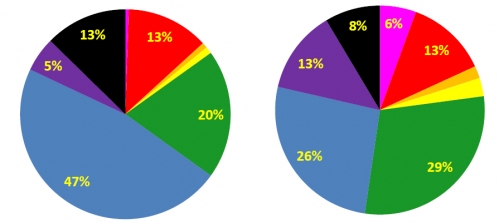
A study published in 2001, to which I was alerted by Family Inequality, asked undergraduate college students their favorite color and presented the results by sex.  Men’s favorites are on the left, women’s on the right:

The article is a great example of the difference between research findings and the interpretation of those findings.  For example, this is how I would interpret it:

Today in the US, but not elsewhere and not always, blue is gendered male and pink gendered female.  We might expect, then, that men would internalize a preference for blue and women a preference for pink.  We live, however, in an androcentric society that values masculinity over femininity.  This rewards the embracing of masculinity by both men and women (making it essentially compulsory for men) and stigmatizes the embracing of femininity (especially for men).

We might expect, then, that men would comfortably embrace a love of blue (blue = masculinity = good), while many women will have a troubled relationship to pink (pink = femininity = devalued, but encouraged for women) and gravitate to blue and all of the good, masculine meaning it offers.

That’s how I’d interpret it.

Here’s how the authors of the study interpreted it:

…we are inclined to suspect the involvement of neurohormonal factors. Studies of rats have found average sex differences in the number of neurons comprising various parts of the visual cortex. Also, gender differences have been found in rat preferences for the amount of sweetness in drinking water. One experiment demonstrated that the sex differences in rat preferences for sweetness was eliminated by depriving males of male-typical testosterone levels in utero. Perhaps, prenatal exposure to testosterone and other sex hormones operates in a similar way to “bias” preferences for certain colors in humans.

Go figure.

Important lesson here: data never stands alone. It must always be interpreted.

Originally posted in 2010.

Lisa Wade, PhD is an Associate Professor at Tulane University. She is the author of American Hookup, a book about college sexual culture; a textbook about gender; and a forthcoming introductory text: Terrible Magnificent Sociology. You can follow her on Twitter and Instagram.
Flashback Friday.

Joan Jacob Brumberg’s fantastic book, Fasting Girls: The History of Anorexia Nervosa, is an excellent example of the benefits of sociologically-inspired history.  Brumberg begins by explaining that girls who starved themselves have been recorded in many historical epochs, but the way in which societies have made sense of that starvation has varied.

Today we medicalize self-starvation; we call it a mental illness and we name it “anorexia nervosa.”

In Medieval Europe, fasting girls were labeled with the term “anorexia mirabilis”; these girls were seen as miracles, able to survive on spiritual devotion alone. During the Victorian Era, people would pilgrimage to these fasting girls and leave offerings.  A famous fasting girl could be a financial boon to a struggling family.

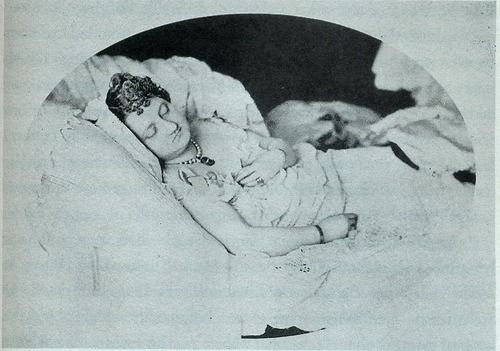
Fasting Girl Mollie Fancher in 1887:

2

During the nineteenth century, medical doctors and psychiatrists (who generally saw religion as a threat to their nascent authority) argued that the fasting girls were impossibilities, that no one could survive without food. The competition between medicine and religion became so intense that doctors became intent on proving that these fasting girls were not surviving on holiness, but were sneaking food. In several cases, doctors staked out fasting girls, watching her to make sure that she did not eat, and these girls, relentless in the illusion, sometimes died.

In any case, I thought of Brumberg’s book when I came across a story about Prahlad Jani, an Indian man who claims that he has not had any food or drink for 70 years, surviving on “spiritual life force” instead.

In 2003 and 2010, Jani’s claims were tested by physicians. In the latest round, Indian military scientists held him in a hospital, watching him to ensure he did not eat or drink.  Unlike the doctors in the Victorian era, however, who wanted the girls to fail, these doctors think Jani might hold a secret that will be useful for the military and they’re hoping that, by watching, they will be able to discover it.

They released him after 15 days. As they did in 2003, they said that his tests came back normal despite complete abstinence from food and water.

Originally posted in 2010.

Lisa Wade, PhD is an Associate Professor at Tulane University. She is the author of American Hookup, a book about college sexual culture; a textbook about gender; and a forthcoming introductory text: Terrible Magnificent Sociology. You can follow her on Twitter and Instagram.
We often think that as long as a white person doesn’t fly the Confederate flag, use the n-word, or show up to a white supremacist rally that they aren’t racist. However, researchers at Harvard and the Ohio State University, among others, have shown that even whites who don’t endorse racist beliefs tend to be biased against non-whites. This bias, though, is implicit: it’s subconscious and activated in decisions we make that are faster than our conscious mind can control.

You can test your own implicit biases here. Millions of people have.

But where do these negative subconscious attitudes come from? And when do they start?

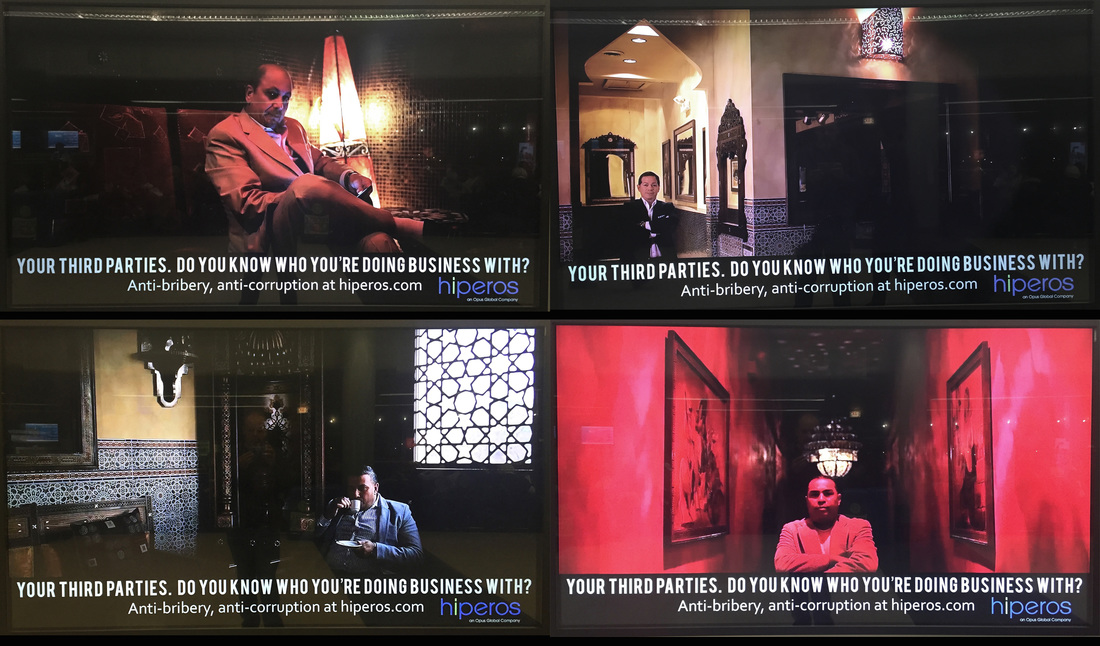
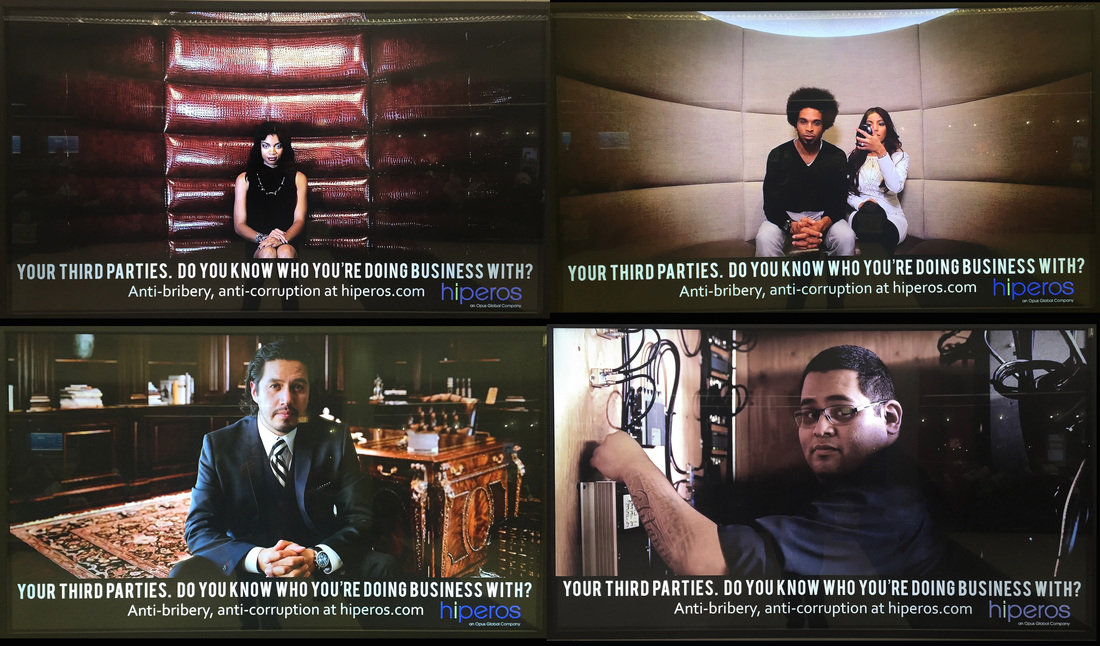
The Kirwan Institute for the study of race and ethnicity has found that we learn them early and often from the mass media. As an example, consider this seemingly harmless digital billboard for Hiperos, a company that works to protect clients against risk online. The ad implies that, as a business, you need to be leery of working with third parties. Of particular risk is exposure to bribery or corruption. Whom can you trust? Who are the people you should be afraid of? Who might be corrupt?

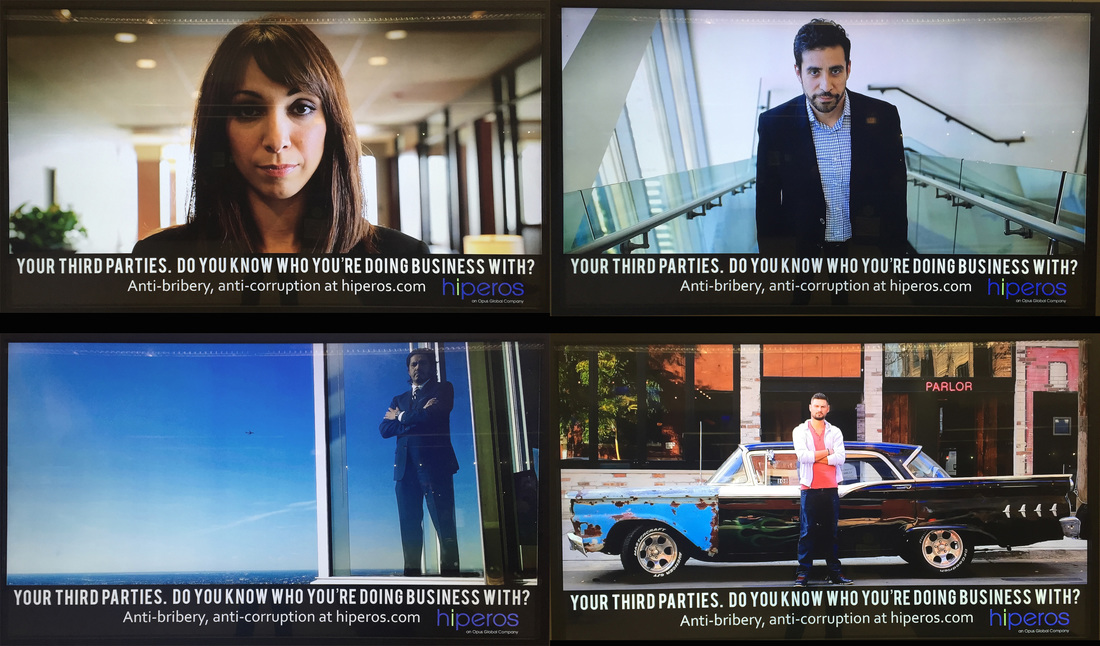
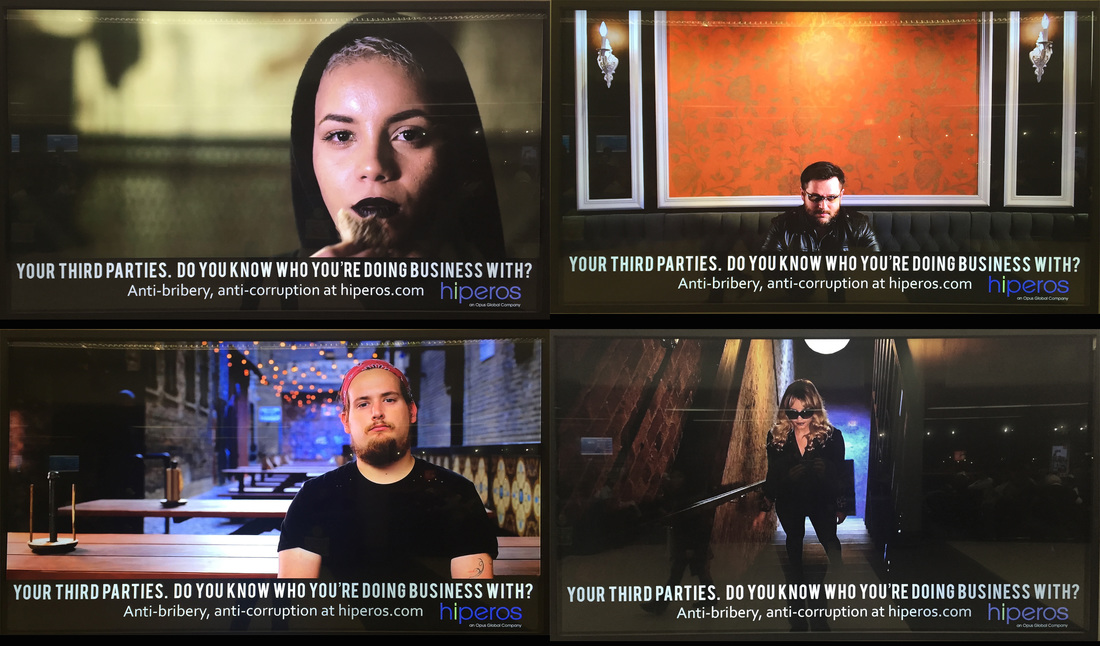
I took a photo of each of the ads as they cycled through. Turns out, the company portrays people you should be worried about as mostly non-white or not-quite-white.

3

Who is untrustworthy? Those that seem exotic: brown people, black people, Asian people, Latinos, Italian “mobsters,” foreigners. 4 5 6

There were comparatively few non-Hispanic whites represented: 7

Of course, this company’s advertising alone could not powerfully influence whom we consider suspicious, but stuff like this — combined with thousands of other images in the news, movies, and television shows — sinks into our subconscious, teaching us implicitly to fear some kinds of people and not others.

For more, see the original post on sociologytoolbox.com.

Todd Beer, PhD is an Assistant Professor at Lake Forest College, a liberal arts college north of Chicago. His blog, SOCIOLOGYtoolbox, is a collection of tools and resources to help instructors teach sociology and build an active sociological imagination.