Search results for The

4The Numbers

Some History

The Winners and the Losers

Tax Cultures

Lisa Wade, PhD is an Associate Professor at Tulane University. She is the author of American Hookup, a book about college sexual culture; a textbook about gender; and a forthcoming introductory text: Terrible Magnificent Sociology. You can follow her on Twitter and Instagram.

Originally posted at Montclair Socioblog.

Does crime go up when cops, turtle-like, withdraw into their patrol cars, when they abandon “proactive policing” and respond only when called?

In New York we had the opportunity to test this with a natural experiment. Angry at the mayor, the NYPD drastically cut back on proactive policing starting in early December of 2014. The slowdown lasted through early January. This change in policing – less proactive, more reactive – gave researchers Christopher Sullivan and Zachary O’Keeffe an opportunity to look for an effect. (Fair warning: I do not know if their work has been published yet in any peer-reviewed journal.)

First, they confirmed that cops had indeed cut back on enforcing minor offenses. In the graphs below, the yellow shows the rate of enforcement in the previous year (July 2013 to July 2014) when New York cops were not quite so angry at the mayor. The orange line shows the next year. The cutback in enforcement is clear. The orange line dips drastically; the police really did stop making arrests for quality-of-life offenses.

.

Note also that even after the big dip, enforcement levels for the rest of the year remained below those of the previous year, especially in non-White neighborhoods.Sullivan and O’Keeffe also looked at reported crime to see if the decreased enforcement had emboldened the bad guys. The dark blue line shows rates for the year that included the police cutback; the light blue line shows the previous year.

 .

No effect. The crime rates in those winter weeks of reduced policing and after look very much like the crime rates of the year before.

It may be that a few weeks is not enough time for a change in policing to affect serious crime. Certainly, proponents of proactive policing would argue that what attracts predatory criminals to an area is not a low number of arrests but rather the overall sense that this is a place were bad behavior goes unrestrained. Changing the overall character of a neighborhood – for better or worse – takes more than a few weeks.

I have the impression that many people, when they think about crime, use a sort of cops-and-robbers model: cops prevent crime and catch criminals; the more active the cops, the less active the criminals. There may be some truth in that model but, if nothing else, the New York data shows that the connection between policing and crime is not so immediate or direct.

Jay Livingston is the chair of the Sociology Department at Montclair State University. You can follow him at Montclair SocioBlog or on Twitter.

This Flashback Friday is in honor of the 20th anniversary of Dorothy Roberts’ groundbreaking book, Killing the Black Body.

One of the most important moments of my graduate education occurred during a talk by Dorothy Roberts for the sociology department at the University of Wisconsin, Madison. At the time I had been teaching her book, Killing the Black Body. I thought this book was genius, absolutely loved it, so I was really excited to be seeing her in person.

I sat in anticipation; she was introduced and then, before she launched into the substance of her talk, she apologized for likely weaknesses in her thinking as, she explained, she had only been thinking about it for “about a year.”

I was stunned.

I couldn’t believe that Dorothy Roberts would have to think about anything for a year. In my mind, her brilliance appeared full form, in a span of mere moments, perfectly articulated.

Her comment made me realize, for the first time, that the fantastic books and expertly-crafted journal articles written by scholars were the result of hard work, not just genius. And I realized that part of the task of writing these things is to hide all of the hard work that goes into writing them. They read as if it were obvious that the conclusions of the paper are true when, in fact, the conclusion on paper are probably just one of many sets of possible conclusions with which the author experimented. Roberts’ humble admission made me realize that all of the wild intellectual goose chases, mental thrashing, deleted passages, and revised arguments were part of my job, not evidence that I was perpetually failing.

And I was and am tremendously grateful to Dr. Roberts for that insight.

Lisa Wade, PhD is an Associate Professor at Tulane University. She is the author of American Hookup, a book about college sexual culture; a textbook about gender; and a forthcoming introductory text: Terrible Magnificent Sociology. You can follow her on Twitter and Instagram.

Originally posted at Scatterplot.

There are few things more satisfying than finding another reason that millennials are the worst. They’re narcissistic, coddled, unpatriotic, racist, and nervous about free speech. And now, millennial men want a return to the nostalgic 1950s, with women in the kitchen, whipping up a nice quiche after a hard day on the line.

This is the story presented in Stephanie Coontz’s Friday piece in the New York Times, “Do Millennial Men Want Stay-at-Home Wives,”which reports on evidence from the Council on Contemporary Families (using the General Social Survey) and from sociologists Joanna Pepin and David Cotter (using Monitoring the Future ).

Journalists have gone a bit nuts for this millennial-as-Ward-Cleaver narrative, consistent with what we already know about garbage millennials, and stories from Quartz and Time Magazine have already popped up.

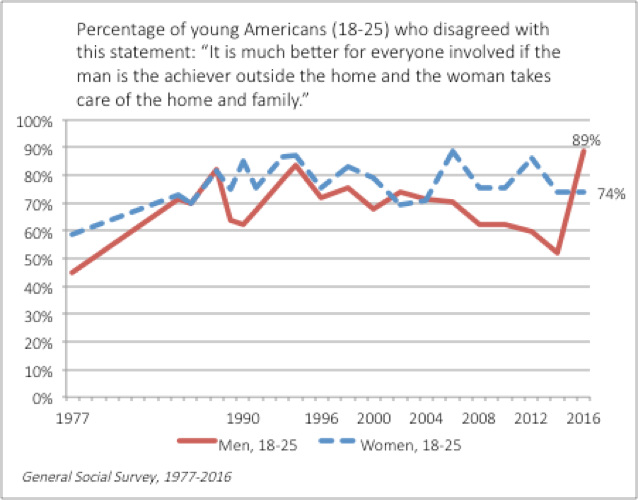
The Times piece includes this damning trend among men ages 18-25:

Picture1.png
See? Millennial men are the WORST.


But the GSS just released their 2016 data this week. 89% of men disagree or strongly disagree with the statement “It is much better for everyone involved if the man is the achiever outside the home and the women takes care of the home and family” – the highest rate among either men or women ages 18-25 in the GSS’s 40-year history. It’s also much higher than the rate reported by everyone older than 25, about 71%.

So is the story, “Clinton defeat inspires millennial men to gender equality”? Or more likely, “Garbage millennial men can’t make up their mind about women”?

I suspect it’s another, less sexy story: you can’t say a lot about millennials based on talking to 66 men.

The GSS surveys are pretty small – about 2,000-3,000 per wave – so once you split by sample, and then split by age, and then exclude the older millennials (age 26-34) who don’t show any negative trend in gender equality, you’re left with cells of about 60-100 men ages 18-25 per wave. Standard errors on any given year are 6-8 percent.

So let’s throw some statistics at it. Suppose you want to know whether there is a downward trend in young male disagreement with the women-in-the-kitchen statement. Using all available GSS data, there is a positive, not statistically significant trend in men’s attitudes (more disagreement). Starting in 1988 only, there is very, very small negative, not statistically significant effect.

Only if we pick 1994 as a starting point, as Coontz does, ignoring the dip just a few years prior, do we see a negative less-than half-percentage point drop in disagreement per year, significant at the 10-percent level.

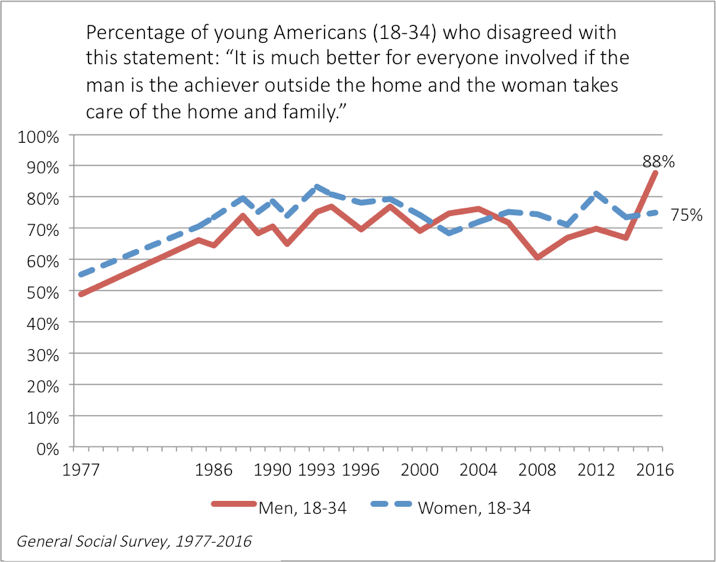
As Columbia statistician Andrew Gelman wisely warns, none of these results account for the many, many paths the researchers could have taken to arrive at these results, which can make overreliance on any of these p-values problematic. For example, if we just looked at millennials the way they’re usually defined, as individuals ages 18-34?

The Pepin and Cotter piece, in fact, presents two additional figures in direct contrast with the garbage millennial theory – in Monitoring the Future, millennial men’s support for women in the public sphere has plateaued, not fallen; and attitudes about women working have continued to improve, not worsen. Their conclusion is, therefore, that they find some evidence of a move away from gender equality – a nuance that’s since been lost in the discussion of their work.

So what does this mean? Standard errors matter, and millennials might not always be as garbage as we think they are.

Emily Beam is Assistant Professor of Economics at the University of Vermont. She studies labor and development economics, with a particular focus on employment and education policy, migration, fertility and marriage, and the role of incomplete information and behavioral biases on individual decision-making.

Flashback Friday.

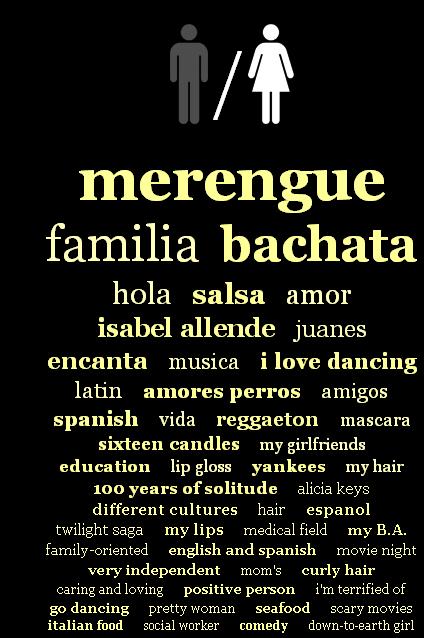
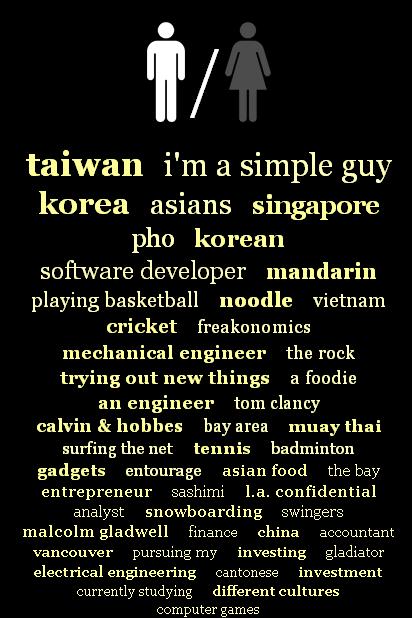
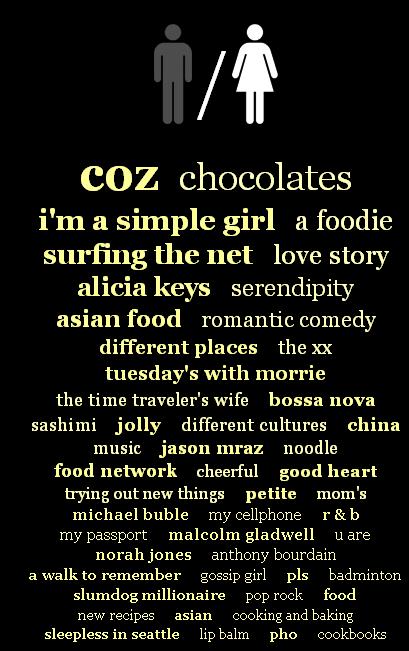
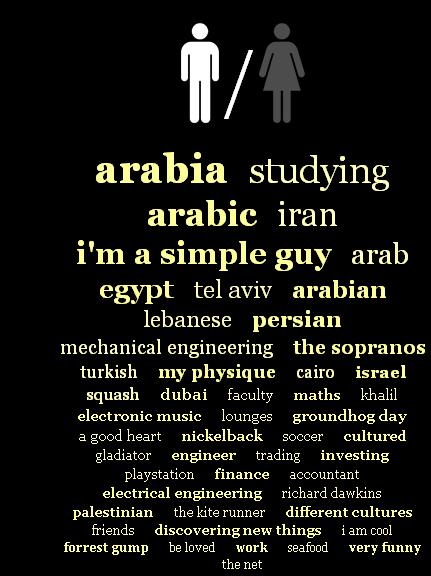
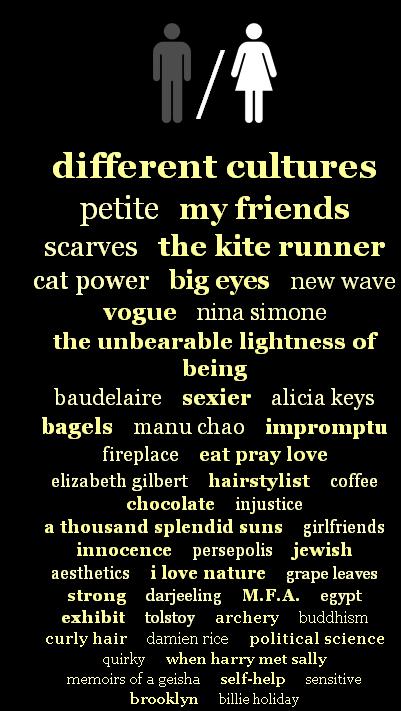
Emma M.H., Rebecca A., Natalee B., Josh L., Anna M., Jordan G., and an anonymous reader all sent in a link to a new analysis released by OkTrends, this time of members’ profile essays and the likes/interests/hobbies the essays mention, broken down by race/ethnicity and gender. They list items that were statistically unevenly distributed by race/ethnicity, showing up much more in some groups’ profiles than others’; these aren’t necessarily the most common items listed by each group.

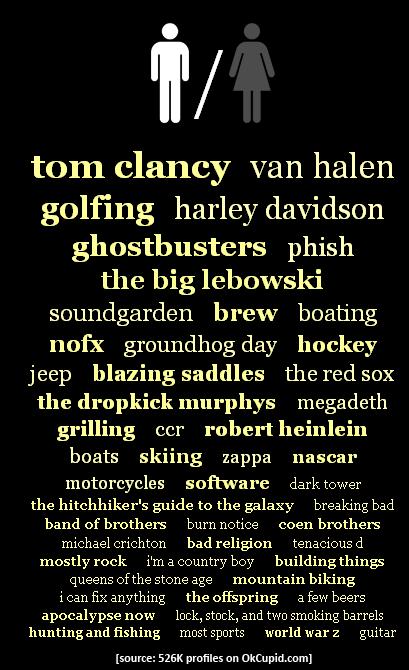
White men:

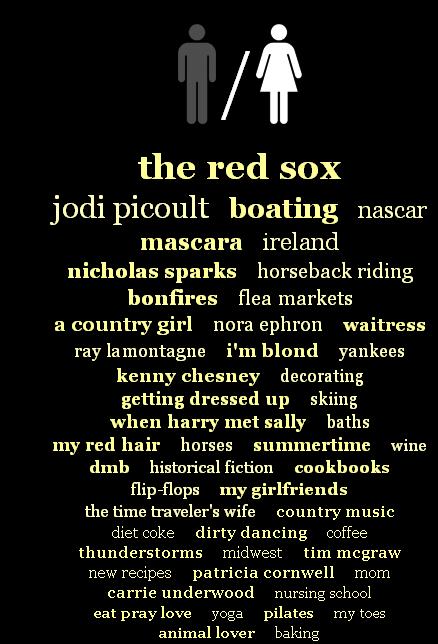
White women:

Christian Rudder, the author of the OkTrends post, points out an interesting trend: rural identifying/mythologizing. White men mention “I’m a country boy,” while for White women, being a “country girl” features prominently, meaning both groups are more likely to use this term than other racial/ethnic groups. The men also mention liking hunting/fishing, while White women include horses/horseback riding, bonfires, and the “midwest,” as well as country music/musicians. Most OkCupid users, according to Rudder, are in large metro areas. Of course, you can live in a city and still go riding or fishing, or these can be things you did before you moved to the city that you still really wish you could do and so remain an important part of your identity; and given current demographics, it’s more likely that a former rural resident would be White than non-White, thus showing up more in Whites’ profiles. But I also suspect that references to the “midwest,” or things associated with romanticized rural life (you know, running around in a beautiful wheat field during a thunderstorm and stuff) are a code for a certain type of masculinity and femininity. Among Whites, hunting/fishing indicates you’re a particular type of “guy’s guy,” while being “a country girl” who likes horses and thunderstorms is, I think, a stand-in for implying you’re down-to-earth, nice, not superficial. Being “country” is thus, a lot of the time, shorthand for being authentic.

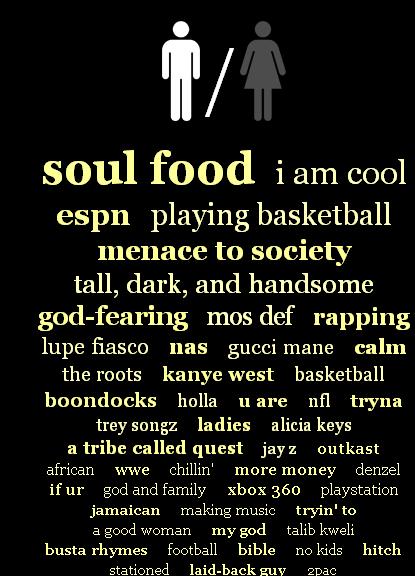
Moving on, here’s the image for Black men:

We see more self-description than in White men’s profiles — “I am cool,” “tall, dark, and handsome,” “god-fearing,” “calm,” “laid-back guy.” White men (and to a lesser extent women) seem to focus on what they like, not really what they are like, with only “I’m a country boy” and “I can fix anything” showing up in the analysis.

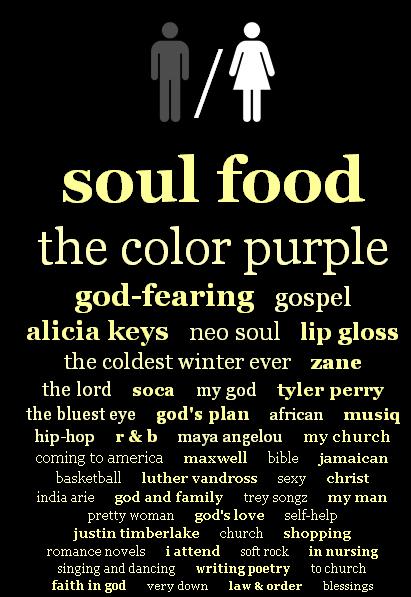
Black women:

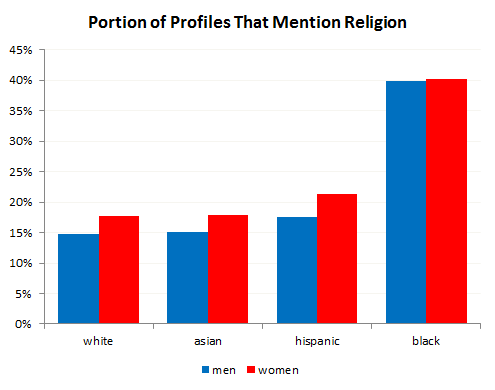
If you combined general references to religion, they would stand out even more. In fact, African American men and women are quite a bit more likely than other groups to mention religion:

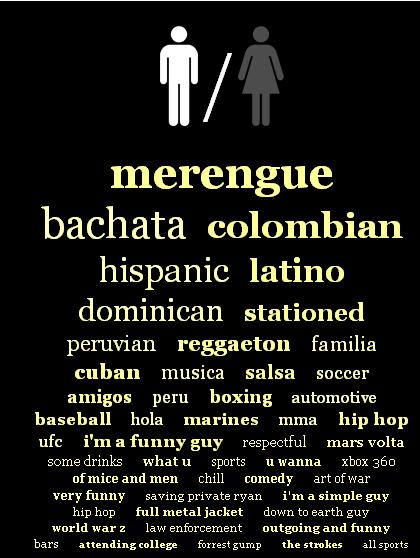
Data for Latino men:

Like Black men, they more frequently than White men  mention personality characteristics — “I’m a funny guy,” “respectful,” “I’m a simple guy,” “outgoing and funny,” etc.

Latinas, like Latino men, mention specific dances, not just a love of music or musicians:

Rudder notes that Asian men are the most likely of any group to highlight a specific ethnic/national identity in addition to the more general “Asian” label:

I see that above with Latino men, too — references to being Peruvian, Colombian, Dominican, etc. If I had to take a stab at explaining this, I’d guess it was related to differences in how racial/ethnic categories have been applied to different groups. In the U.S. over time, White ethnic categories (say, being Dutch-American vs. Polish-American) have largely faded into the background, all subsumed under the powerful racial label “White.” Distinctions within that grouping have become largely optional, a neat thing to mention, perhaps, but not very socially meaningful. African Americans have often found themselves in the same situation, but due to much more negative forces. The generally shared experience of slavery, racism, and discrimination, as well as negative stereotypes of anyone perceived as Black, mostly erased ethnic identifications among African Americans. Being Black became a master status, such a socially important racial categorization that even those who wanted to be recognized as from a specific location (South Africa, Jamaica, etc.) often found themselves unable to get others to recognize their ethnic distinction.

The broader “Asian” and “Hispanic” labels emerged more recently in U.S. history, and members of both groups often actively fought to preserve distinctions within them. It wasn’t until the ’60s that a pan-Asian identity really began to emerge, such that being called “Asian” really meant anything to people, as opposed to thinking of themselves as Chinese, Vietnamese, etc. And “Hispanic” refers to ethnicity, not race (most Hispanics identify as White); ethnic identities are generally more flexible than racial categories. Aside from personal attachments, many groups thrown into the labels Asian and Hispanic have seen clear advantages to preserving distinctions based on nationality, believing that, say, being Japanese American would be less negatively stereotyped than being simply “Asian.”

So I wasn’t extremely surprised to see that Latino and Asian men specified identifies within those categories…but look back at the Latina image, and then this one for Asian women:

Nothing. Not one specific identifier for either group stood out. I don’t know what to make of that, and would love to hear your suggestions.

There are also specific breakdowns for Asian Indians and Pacific Islanders on the OkTrends, if you’re interested.

Middle Eastern men (a sort of odd category, but whatever) also specify nationalities, which is to be expected as this is another group that has engaged in active contests about their racial categorization in the U.S. (in particularly, fighting to be considered White, not Asian or Black) and also focus on technical/financial careers or expertise:

Middle Eastern women are the only group who prominently mention something about their physical appearance (“petite”), for whatever that’s worth, and again, no nationalities listed:

Of course, as Anna pointed out when she sent in the link, this data isn’t necessarily about people’s actual likes/interests, it’s about what they present as their likes/interests in the dating marketplace. On a dating website, you’re trying to present a profile of yourself…but one tailored to be attractive to others. She wonders to what degree social stereotypes of your racial group, as well as the group you’re interested in dating (if you have any preference) affects how you would describe your interests. That is, it’s possible that in some cases people highlight interests or hobbies that seem to fit social expectations of what they’ll like doing…or what they think the individuals they want to date will want to do, or want their date to want to do. To interpret these results, as OkTrends does, as straightforward evidence of differences in preferences by race/ethnicity, ignores the important fact that these are interests presented as part of an intentional performance for strangers, and may or may not reflect what we actually spend time doing, learning about, or paying attention to in our daily lives.

Originally posted in September, 2010.

Gwen Sharp is an associate professor of sociology at Nevada State College. You can follow her on Twitter at @gwensharpnv.

Flashback Friday.

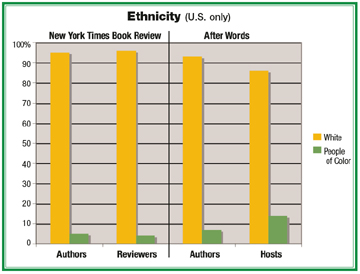
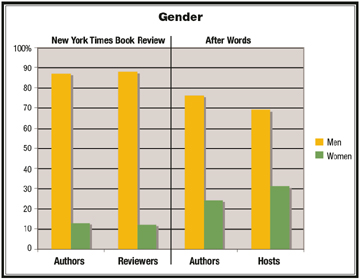
In a post at Fairness and Accuracy in Reporting, Steve Rendall and Zachary Tomanelli investigated the racial breakdown of the book reviewers and authors in two important book review venues, the New York Times Book Review and C-SPAN’s After Words.  They found that the vast majority of both reviewers and authors were white males.

Overall, 95% of the authors and 96% of the reviewers were non-Latino white (compare that with the fact that whites are just over 60% of the U.S. population as of 2016).

Women accounted for between 13 and 31% of the authors and reviewers:

This is some hard data showing that white men’s ideas are made more accessible than the ideas of others, likely translating into greater influence on social discourse and public policy.  These individuals certainly don’t all say the same thing, nor do they necessarily articulate ideas that benefit white men, but a greater diversity of perspectives would certainly enrich our discourse.

Via Scatterplot.

Originally posted in September, 2010.

Lisa Wade, PhD is an Associate Professor at Tulane University. She is the author of American Hookup, a book about college sexual culture; a textbook about gender; and a forthcoming introductory text: Terrible Magnificent Sociology. You can follow her on Twitter and Instagram.

Flashback Friday.

Add to the list of new books to read Delusions of Gender: How Our Minds, Society, and Neurosexism Create Difference, by Cordelia Fine. Feeding my interest in the issue of sexual dimorphism in humans — which we work so hard to teach to children — the book is described like this:

Drawing on the latest research in neuroscience and psychology, Cordelia Fine debunks the myth of hardwired differences between men’s and women’s brains, unraveling the evidence behind such claims as men’s brains aren’t wired for empathy and women’s brains aren’t made to fix cars.

Good reviews here and here report that Fine tackles an often-cited study of newborn infants’ sex difference in preferences for staring at things, by Jennifer Connellan and colleagues in 2000. They reported:

…we have demonstrated that at 1 day old, human neonates demonstrate sexual dimorphism in both social and mechanical perception. Male infants show a stronger interest in mechanical objects, while female infants show a stronger interest in the face.

And this led to the conclusion: “The results of this research clearly demonstrate that sex differences are in part biological in origin.” They reached this conclusion by alternately placing Connellan herself or a dangling mobile in front of tiny babies, and timing how long they stared. There is a very nice summary of problems with the study here, which seriously undermine its conclusion.

However, even if the methods were good, this is a powerful example of how a tendency toward difference between males and females is turned into a categorical opposition between the sexes — as in, the “real differences between boys and girls.”

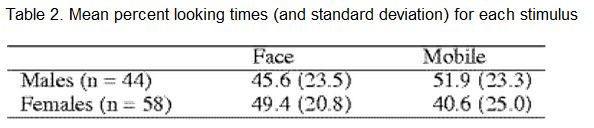
To illustrate this, here’s a graphic look at the results in the article, which were reported in this table:

They didn’t report the whole distribution of boys’ and girls’ gaze-times, but it’s obvious that there is a huge overlap in the distributions, despite a difference in the means. In the mobile-gaze-time, for example, the difference in averages is 9.7 seconds, while the standard deviations are more than 20 seconds. If I turn to my handy normal curve spreadsheet template, and fit it with these numbers, you can see what the pattern might look like (I truncate these at 0 seconds and 70 seconds, as they did in the study):

Source: My simulation assuming normal distributions from the data in the table above.

All I’m trying to say is that the sexes aren’t opposites, even if they have some differences that precede socialization.

If you could show me that the 1-day-olds who stare at the mobiles for 52 seconds are more likely to be engineers when they grow up than the ones who stare at them for 41 seconds (regardless of their gender) then I would be impressed. But absent that, if you just want to use such amorphous differences at birth to explain actual segregation among real adults, then I would not be impressed.

Originally posted in September, 2010.

Philip N. Cohen is a professor of sociology at the University of Maryland, College Park. He writes the blog Family Inequality and is the author of The Family: Diversity, Inequality, and Social Change. You can follow him on Twitter or Facebook.

Originally posted at Feminist Reflections.

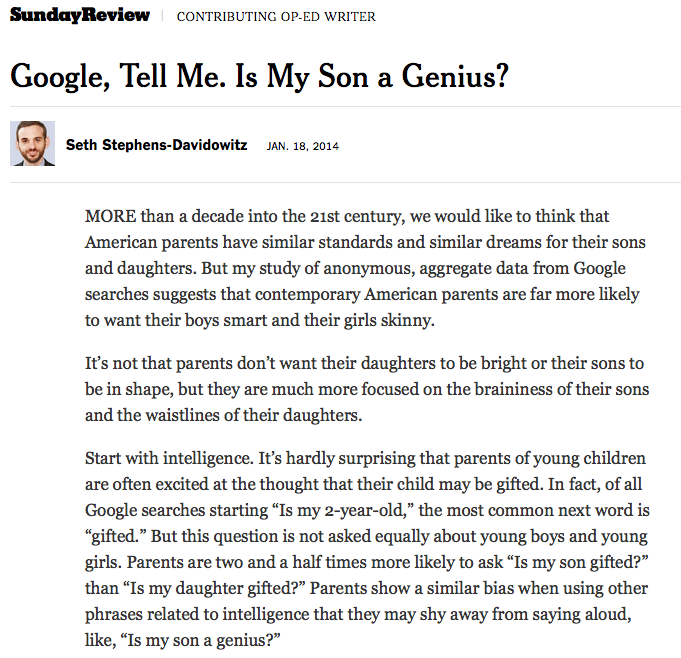
Screen Shot 2016-06-01 at 3.40.39 PMIn 2014, a story in The New York Times by Seth Stephens-Davidowitz went viral using Google Trend data to address gender bias in parental assessments of their children—“Google, Tell Me. Is My Son a Genius?”  People ask Google whether sons are “gifted” at a rate 2.5x higher than they do for daughters.  When asking about sons on Google, people are also more likely to inquire about genius, intelligence, stupidity, happiness, and leadership than they are about daughters.  When asking about daughters on Google, people are much more likely to inquire about beauty, ugliness, body weight, and just marginally more likely to ask about depression.  It’s a pretty powerful way of showing that we judge girls based on appearance and boys based on abilities.  It doesn’t mean that parents are necessarily consciously attempting to reproduce gender inequality.  But it might mean that they are simply much more likely to take note of and celebrate different elements of who their children are depending on whether those children are girls or boys.

To get the figures, Stephens-Davidowitz relied on data from Google Trends. The tool does not give you a sense of the total number of searches utilizing specific search terms; it presents the relative popularity of search terms compared with one another on a scale from 0 to 100, and over time (since 2004).  For instance, it allows people selling used car parts to see whether people searching for used car parts are more likely to search for “used car parts,” “used auto parts,” or something else entirely before they decide how to list their merchandise online.  I recently looked over the data the author relied on for the piece.  Stephens-Davidowitz charted searches for “is my son gifted” against searches for “is my daughter gifted” and then replaced that last word in the search with: smart, beautiful, overweight, etc.

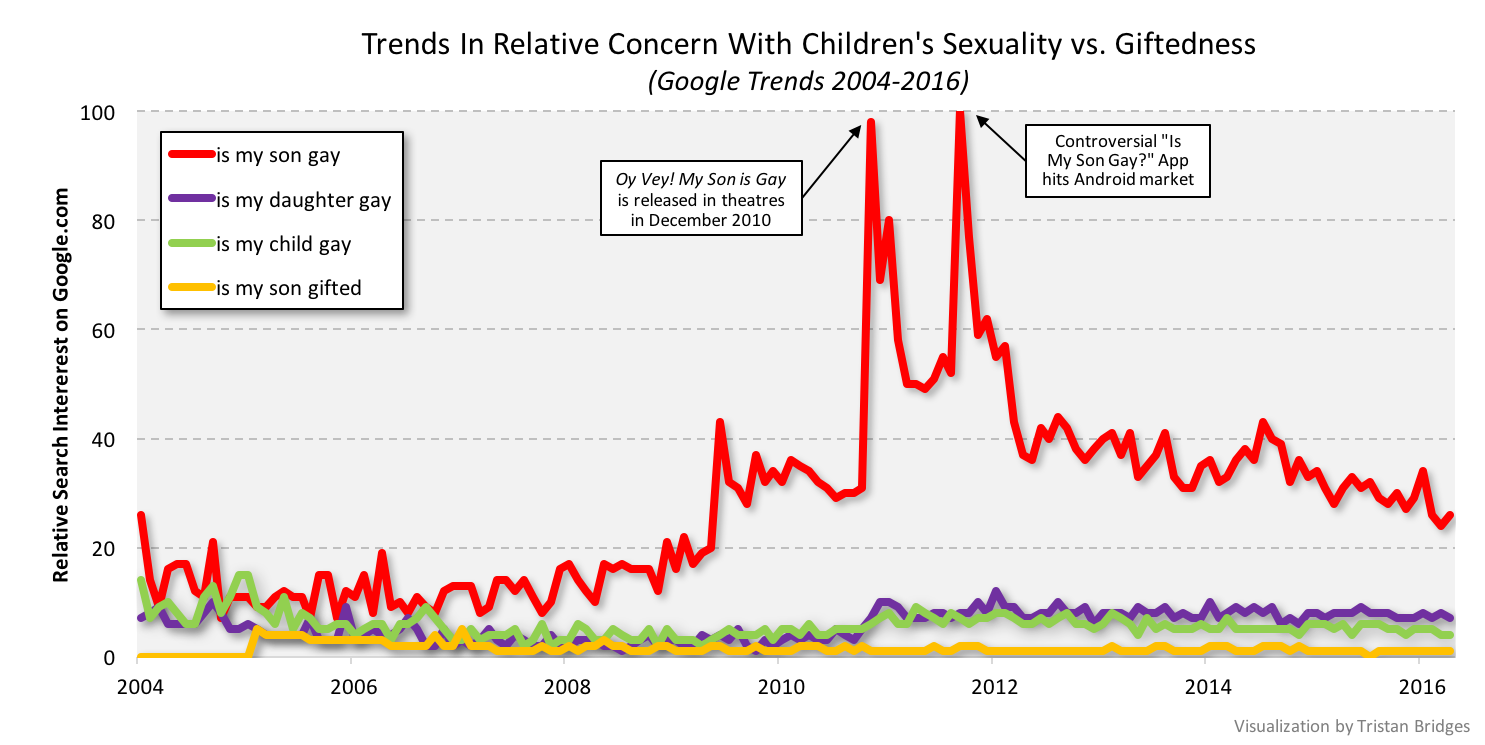
And while people are more likely to turn to Google to ask about their son’s intelligence than whether or not their daughters are overweight, people are much more likely to ask Google about children’s sexualities than any other quality mentioned in the article.  And to be even more precise, parents on Google are primarily concerned with boys’ sexuality.  Below, I’ve charted the relative popularity of searches for “is my son gay” alongside searches for “is my daughter gay,” “is my child gay,” and “is my son gifted.”  I included “child” to illustrate that Google searches here are more commonly gender-specific.  And I include “gifted” to illustrate how much more common searches for son’s sexuality is compared with searches for son’s giftedness (which was among the more common searches in Stephens-Davidowitz’s article).

Picture1

The general trend of the graph is toward increasing popularity.  People are more likely to ask Google about their children’s sexuality since 2004 (and slightly less likely to ask Google about their children’s “giftedness” over that same time period).  But they are much more likely to inquire about son’s sexuality.  At two points, the graph hits the ceiling.  The first, in November of 2010, corresponds with the release of the movie “Oy Vey! My Son is Gay” about a Jewish family coming to terms with a son coming out as gay and dating a non-Jewish young man.  The second high point, in September of 2011, occurred during a great deal of press surrounding Apple’s recently released “Is my son gay?” app, which was later taken off the market after a great deal of protest.  And certainly, some residual popularity in searches may be associated with increased relative search volume since.  But, the increase in relative searches for “is my son gay” happens earlier than either of these events.

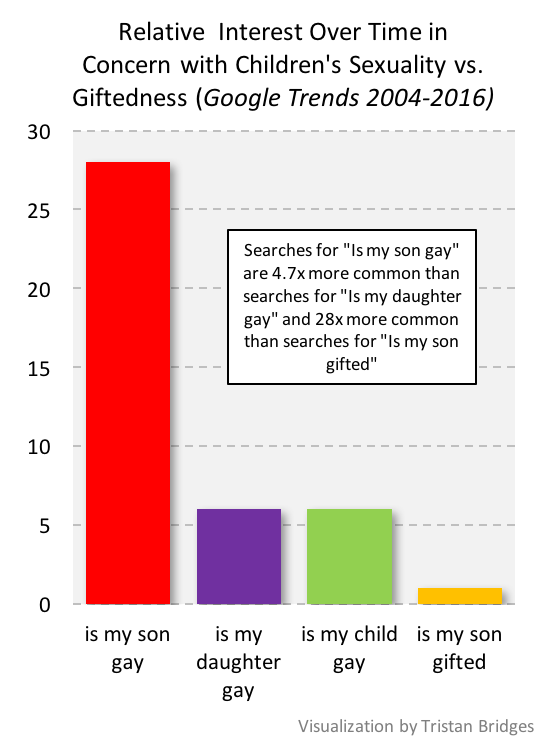
Relative Search PopularityIndeed, over the period of time illustrated here, people were 28x more likely to search for “is my son gay” than they were for “is my son gifted.”  And searches for “is my son gay” were 4.7x more common than searches for “is my daughter gay.”

Reading Google Trends is a bit like reading tea leaves in that it’s certainly open to interpretation.  For instance, this could mean that parents are increasingly open to sexual diversity and are increasingly attempting to help their children navigate coming to terms with their sexual identities (whatever those identities happen to be).  Though, were this the case, it’s interesting that parents are apparently more interested in helping their sons navigate any presumed challenges than their daughters.  It could mean that as performances of masculinity shift and take on new forms, sons are simply much more likely to engage with gender in ways that cause their parents to question their (hetero)sexuality than they used to.  Or it could mean that parents are more scared that their sons might be gay.  It is likely all of these things.

I’m not necessarily sold on the idea that the trend can only be seen as a sign of the endurance of gender and sexual inequality.  But one measure of that might be to check back in with Google Trends to see if people start asking Google whether their sons and daughters are straight.  At present, both searches are uncommon enough that Google Trends won’t even display their relative popularity.

Tristan Bridges, PhD is a professor at the University of California, Santa Barbara. He is the co-editor of Exploring Masculinities: Identity, Inequality, Inequality, and Change with C.J. Pascoe and studies gender and sexual identity and inequality. You can follow him on Twitter here. Tristan also blogs regularly at Inequality by (Interior) Design.