Search results for The

In an earlier post, Caroline Heldman offered a typology of objectification. No. 6 was a conflation of a person with a commodity.  This photo of a display at the 1936 Los Angeles Electrical Exposition seems to qualify, but somehow that doesn’t make it any less charming!

Hat tip: Retronaut.

Lisa Wade, PhD is an Associate Professor at Tulane University. She is the author of American Hookup, a book about college sexual culture; a textbook about gender; and a forthcoming introductory text: Terrible Magnificent Sociology. You can follow her on Twitter and Instagram.

Cross-posted at Family Inequality and The Atlantic.

The problem of income inequality often gets forgotten in conversations about biological clocks.

The dilemma that couples face as they consider having children at older ages is worth dwelling on, and I wouldn’t take that away from Judith Shulevitz’s essay in the New Republic, “How Older Parenthood Will Upend American Society,” which has sparked commentary from Katie RoipheHanna RosinRoss Douthat, and Parade, among many others.

The story is an old one — about the health risks of older parenting and the implications of falling fertility rates for an aging population — even though some of the facts are new. But two points need more attention. First, the overall consequences of the trend toward older parenting are on balance positive, both for women’s equality and for children’s health. And second, social-class inequality is a pressing — and growing — problem in children’s health, and one that is too easily lost in the biological-clock debate.

Older mothers

First, we need to distinguish between the average age of birth parents on the one hand versus the number born at advanced parental ages on the other. As Shulevitz notes, the average age of a first-time mother in the U.S. is now 25. Health-wise, assuming she births the rest of her (small) brood before about age 35, that’s perfect.

Consider two measures of child well-being according to their mothers’ age at birth. First, infant mortality:

(Source: Centers for Disease Control)

Health prospects for children improve as women (and their partners) increase their education and incomes, and improve their health behaviors, into their 30s. Beyond that, the health risks start accumulating, weighing against the socioeconomic factors, and the danger increases.

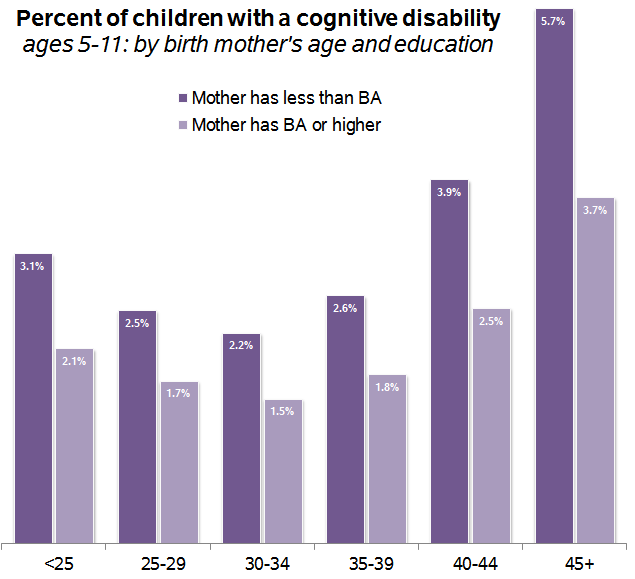
Second, here is the rate of cognitive disability among children according to the age of their mothers at birth, showing a very similar pattern:

(Source: Calculations made for my working paper)

Again, the lowest risks are to those born when their parents are in their early 30s, a pattern that holds when I control for education, income, race/ethnicity, gender, and child’s age.

When mothers older than age 40 give birth, which accounted for 3 percent of births in 2011, the risks clearly are increased, and Shulevitz’s story is highly relevant. But, at least in terms of mortality and cognitive disability, an average parental age in the late 20s and early 30s is not only not a problem, it’s ideal.

Unequal health

But the second figure above hints at another problem — inequality in the health of parents and children. On that purple chart, a college graduate in her early 40s has the same risk as a non-graduate in her late 20s. And the social-class gap increases with age. Why is the rate of cognitive disabilities so much higher for the children of older mothers who did not finish college? It’s not because of their biological clocks or genetic mutations, but because of the health of the women giving birth.

For healthy, wealthy older women, the issue of aging eggs and genetic mutations from fathers’ run-down sperm factories are more pressing than it is for the majority of parents, who have not graduated college.

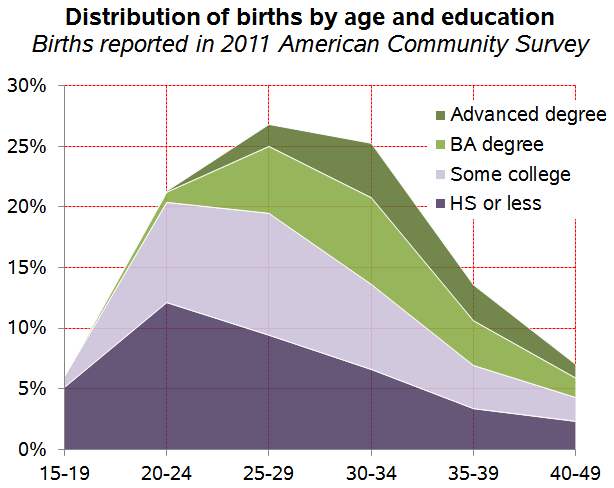
If you look at the distribution of women having babies by age and education, it’s clear that the older-parent phenomenon is disproportionately about more-educated women. (I calculated these from the American Community Survey, because age-by-education is not available in the CDC numbers, so they are a little different.)

Most of the less-educated mothers are giving birth in their 20s, and a bigger share of the high-age births are to women who’ve graduated college — most of them married and financially better off. But women without college degrees still make up more than half of those having babies after age 35, and the risks their children face have more to do with high blood pressure, obesity, diabetes, and other health conditions than with genetic or epigenetic mutations. Preterm births, low birth-weight, and birth complications are major causes of developmental disabilities, and they occur most often among mothers with their own health problems.

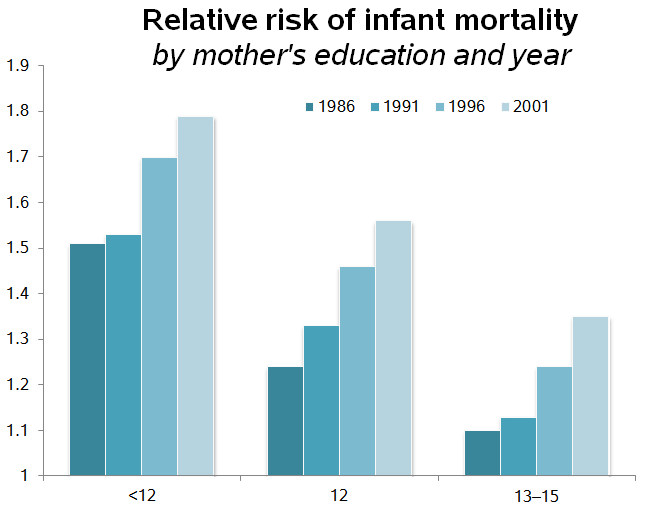
Most distressing, the effects of educational (and income) inequality on children’s health have been increasing. Here are the relative odds of infant mortality by maternal education, from 1986 to 2001, from a study in Pediatrics. (This compares the odds to college graduates within each year, so anything over 1.0 means the group has a higher risk than college graduates.)

This inequality is absent from Shulevitz’s essay and most of the commentary about it. She writes, of the social pressure mothers like her feel as they age, “Once again, technology has given us the chance to lead our lives in the proper sequence: education, then work, then financial stability, then children” — with no consideration of the 66 percent of people who have reached their early 30s with less than a four-year college degree. For the vast majority of that group, the sequence Shulevitz describes is not relevant.

In fact, if Shulevitz had considered economic inequality, she might not have been quite as worried about advancing parental age. When she worries that a 35-year-old mother has a life expectancy of just 46 more years — years to be a mother to her child — the table she consulted applies to the whole population. She should breathe a little bit easier: Among 40-year-old white college graduates women are expected to live an average extra five years compared with those who have a high school education only.

When it comes to parents’ age versus social class, the challenges are not either/or. We should be concerned about both. But addressing the health problems of parents — especially mothers — with less than a college degree and below-average incomes is the more pressing issue — both for potential lives saved or improved and for social equality.

Philip N. Cohen is a professor of sociology at the University of Maryland, College Park, and writes the blog Family Inequality. You can follow him on Twitter or Facebook.

In her classic article, Teddy Bear Patriarchy, Donna Haraway examined the arrangement of the taxidermied animals in the American Museum of Natural History mammal hall in the first half of the 1900s.  She observed that the dioramas consistently featured nuclear families with strong fathers alert for dangers and nurturing mothers attending to their children.

This was a lie, of course. As we well know, the nuclear family is the exception, not the rule among mammals.  Instead of science, it was our own beliefs about men, women, and gender roles that informed the curators of the exhibits… and left viewers with a sense that these arrangements were more natural and universal than they are.

I’m an animal lover and have a broad appreciation for science, so I particularly enjoy exposing this type of projection.  Bee Movie was a particularly egregious case and we’ve written posts on nature documentaries that do this (on hyenas and flatworms).  The latest case is a Geico commercial.  See if you can catch it:

So, if you know anything about lions, you know that it’s unlikely that “Karl” is doing the hunting.  Among lions, it is the females who specialize in hunting (and they usually do so in groups, for what it’s worth).

See, no manes:

The commercial certainly coincides nicely with what many of us believe to be true about the natural role of human men, but it doesn’t reflect the reality of lion life at all.

Perhaps the people at Geico thought that a female huntress would confuse or distract the reader from their joke.  Or perhaps everyone involved in the project didn’t know this fact about lions; their gender ideology would have masked their ignorance, such that it never occurred to them to look it up.  Either way, contemporary ideas about gender shaped this “diorama” and it potentially reinforces similar beliefs among viewers.

Lisa Wade, PhD is an Associate Professor at Tulane University. She is the author of American Hookup, a book about college sexual culture; a textbook about gender; and a forthcoming introductory text: Terrible Magnificent Sociology. You can follow her on Twitter and Instagram.
Gwen and I ran our favorite posts from 2012 over the last six days.  Just in case you missed them, here’s our best of 2012!

Social Theory

Parenting

Race and Ethnicity

Transnational Politics and Neocolonialism

Class

Gender and Sexual Orientation

Health and Body Weight

History and Vintage Stuff

Media

See also, last year’s highlights:

And a Happy New Year to everyone!!!

Lisa Wade, PhD is an Associate Professor at Tulane University. She is the author of American Hookup, a book about college sexual culture; a textbook about gender; and a forthcoming introductory text: Terrible Magnificent Sociology. You can follow her on Twitter and Instagram.
SocImages News:

In betwixt the holidays, we’ve been keeping busy.  I booked an additional talk for the Spring; I’ll be visiting Queen’s University of Kingston to talk about the relationship between hook up culture and sexual assault (see upcoming lectures for details).  I always try to squeeze in a Meet Up when I travel so, if you’re in the area, keep your eyes peeled for an announcement!

Speaking of college kids gone wild, I was tickled to get the last word in this Bloomberg article by Chris Staiti on bad behavior in the Ivy League.  I concurred that there were some pretty gnarly things going on at the Ivies, but closed out the piece with this comment:

Colleges are a microcosm of American society. It’s a story of hormone-driven kids packed into dorms like sardines. And what we see when we look there — the glamorization of casual sex; the binge-drinking; the crude, insensitive humor; the homophobia; the racism — is a story about us.

So, that was a treat!

Since many people have had kids and toys on the brain this past month, you might be interested in listening to my appearance as a guest expert on At Issue with Ben Merens for Wisconsin Public Radio.  I talked with the host and guests about the history, politics, and economics of gender-segregated toys, plus gave a little advice to parents (download).

SocImages was also cross-posted at Jezebel (How Infant and Toddler Girls Learn to Beautify) and Ms. (The Truth About Pink and Blue Brains) and enjoyed links from French SlateMarginal RevolutionThe IndependentThe FriskyBitchAfroSpear, and GigaOm.

All in all, a great month!  Oh, and we reached 21,000 Facebook followers and are SO CLOSE to 10,000 on Twitter! Hopefully that’ll be part of our news for January.

Upcoming Lectures:

  • Western Political Science Association (Hollywood, CA, Mar. 28-30): panels on “Public Intellectualism” and the “Twenty-First Century Sex Wars”
  • Harvard University (Women’s Week, Mar. 8-14): “A Feminist Defense of Friendship”
  • University of Akron (Apr. 19): “Anatomy of an Outrage: Female Genital Cutting and the Politics of Acculturation”
  • Queen’s University of Kingston (Feb. 26): “‘The Night Overall Wasn’t Bad’: What College Students Really Think About Hooking Up”

Social Media ‘n’ Stuff:

Finally, this is your monthly reminder that SocImages is on TwitterFacebookGoogle+, and Pinterest.  Lisa is on Facebook and most of the team is on Twitter: @lisadwade@gwensharpnv@familyunequal@carolineheldman@jaylivingston, and @wendyphd.

In Other News…

Both Gwen and I will be in South America for the beginning of January, so hopefully we’ll have some fabulous photos to share next month!

Lisa Wade, PhD is an Associate Professor at Tulane University. She is the author of American Hookup, a book about college sexual culture; a textbook about gender; and a forthcoming introductory text: Terrible Magnificent Sociology. You can follow her on Twitter and Instagram.
For the last week of December, we’re re-posting some of our favorite posts from 2012. Cross-posted at The Huffington Post.

If you live in the U.S. you are absolutely bombarded with the idea that being overweight is bad for your health.  This repetition leaves one with the idea that being overweight is the same thing as being unhealthy, something that is simply not true.  In fact, people of all weights can be either healthy or unhealthyoverweight people (defined by BMI) may actually have a lower risk of premature death than “normal” weight people.  Being fat is simply not the same thing as being unhealthy.

The Health At Every Size (HAES) movement attempts to interrupt the conflation of health and thinness by arguing that, instead of using one’s girth as an indicator of one’s health, we should be focusing on eating/exercising habits and more direct health measures (like blood pressure and cholesterol).

A recent study offered the HAES movement some interesting ammunition in this battle. The study recruited almost 12,000 people of varying BMIs and followed them for 170 months as they adopted healthier habits.  Their conclusion? ” Healthy lifestyle habits are associated with a significant decrease in mortality regardless of baseline body mass index.”

Take a look.  The “hazard ratio” refers to the risk of dying early, with 1 being the baseline.  The “habits” along the bottom count how many healthy habits a person reported.  The shaded bars represent people of different BMIs from “healthy weight” (18.5-24.9) to “overweight” (25-29.9), to “obese” (over 30).

The three bars on the far left show the relative risk of premature death for people with zero healthy habits. It suggests that being overweight increases that risk, and being obese much more so.  The three bars on the far right show the relative risk for people with four healthy habits; the differential risk among them is essentially zero; for people with healthy habits, then, being fatter is not correlated with an increased relative risk of premature death.  For everyone else in between, we more-or-less see the expected reduction in mortality risk given those two poles.

This data doesn’t refute the idea that fat matters.  In fact, it shows clearly that thinness is protective if people are doing absolutely nothing to enhance their health.  It also suggests, though, that healthy habits can make all the difference.  Overweight and obese people can have the same mortality risk as “normal” weight people; therefore, we should reject the idea that fat people are “killing themselves” with their extra pounds.  It’s simply not true.

h/t to BigFatBlog.

Lisa Wade, PhD is an Associate Professor at Tulane University. She is the author of American Hookup, a book about college sexual culture; a textbook about gender; and a forthcoming introductory text: Terrible Magnificent Sociology. You can follow her on Twitter and Instagram.

For the last week of December, we’re re-posting some of our favorite posts from 2012. Cross-posted at Pacific Standard and Global Policy TV.

The United States is unusual among developed countries in guaranteeing exactly zero weeks of paid time-off from work upon the birth or adoption of a child. Japan offers 14 weeks of paid job-protected leave, the U.K. offers 18, Denmark 28, Norway 52, and Sweden offers 68 (yes, that’s over a year of paid time-off to take care of a new child).

The U.S. does guarantee that new parents receive 12 weeks of non-paid leave, but only for parents who work in companies that employ 50 workers or more and who have worked there at least 12 months and accrued 1,250 hours or more in that time.  These rules translate to about 1/2 of women.  The other half are guaranteed nothing.

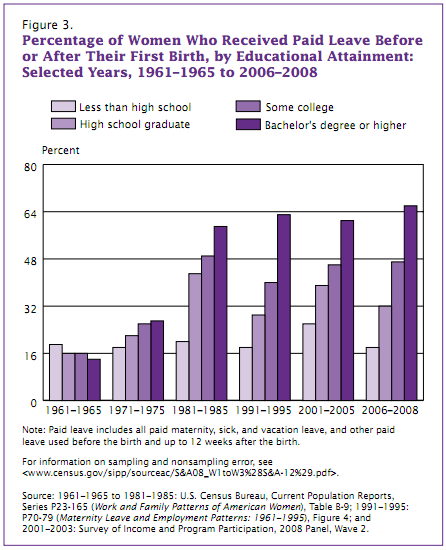
Companies, of course, can offer more lucrative benefits if they choose to, so some parents do get paid leave.  This makes the affordability of having children and the pleasure and ease with which one can do so a class privilege.  A new report by the U.S. Census Bureau documents this class inequality, using education as a measure.  If you look at the latest data on the far right (2006-2008), you’ll see that the chances of receiving paid leave is strongly correlated with level of education:

Looking across the entire graph, however, also reveals that this class inequality only emerged in the early 1970s and has been widening ever since.  This is another piece of data revealing the way that the gap between the rich and the poor has been widening.

Just to emphasize how perverse this is:

  • People with more education, who on average have higher incomes, are often able to take paid time off; but less-economically advantaged parents are more likely to have to take that time unpaid.  During the post-birth period, then, the economic gap widens.

There’s more:

  • Many less-advantaged parents can’t afford to take time off un-paid, so they keep working.  But even this widens the gap because their salary is lower than the salary the richer person continues to receive during their paid time off of work.  So the rich get paid more for staying home than the poor get for going to work.

We often use the minimizing word  “just” when  describing what stay-at-home parents do.  “What are you doing these days?” asks an old friend at a class reunion.  “Oh, just staying home and taking care of my kids,” a parent might say, as if raising kids is “doing nothing.”  We trivialize what parents do.  But, in fact, raising children is a valuable contribution to the nation.  We need a next generation to keep moving forward as a country.  Unfortunately the U.S. continues to treat having kids like a hobby (something its citizens choose to do for fun, and should pay for themselves).  Without state support for early parenting, being present in those precious early months is a class-based privilege, one that ultimately exacerbates the very class disadvantage that creates unequal access to the luxury of parenting in the first place.

Lisa Wade, PhD is an Associate Professor at Tulane University. She is the author of American Hookup, a book about college sexual culture; a textbook about gender; and a forthcoming introductory text: Terrible Magnificent Sociology. You can follow her on Twitter and Instagram.

For the last week of December, we’re re-posting some of our favorite posts from 2012.

Today in the U.S., one of the major rules of masculinity is that men must avoid physical intimacy with each other unless they want to have their sexuality called into question. The guy horrified by the potential implications of a casual physical touch is a common trope in our pop culture.

But this wasn’t always the case. For physical closeness and even casual expressions of intimacy to become threats to masculinity, homosexuality had to enter the public consciousness as a stigmatized identity. That is, a man being gay had to be a possibility in observers’ minds when interpreting their behavior, and men had to be eager to avoid any such assumptions.

Over at the Art of Manliness, Brett and Kate McKay have posted a fantastic collection of old photos showing men posing in ways that show a high level of comfort with physical contact between men. Many of them show men posed in ways that would be unacceptable among straight men today. Here are just a few; I highly recommend looking at their entire post:

The McKays point out that sitting for a portrait required men to go to public businesses and openly pose for a photographer. These poses were quite common for men at the time and wouldn’t have been read through the lens of potential gayness that viewers today would likely apply.

Once personal cameras became popular, formal studio photos waned, but early snapshots showed similar poses. Though snapshots eliminated the need to go to a public place of business and pose, film still had to be developed by a professional, who would look at each image (and, even when I was a kid, developers would occasionally refuse to develop photos due to content, and occasionally you heard of a developer calling the police about photos they believed revealed illegal activities). The fact that physical touching is so common among men in early snapshots indicates that there was nothing scandalous or threatening bout such poses. Only as the performance of masculinity became increasingly focused on an obsessive avoidance of any perception of gayness or femininity did such touching become taboo.

Seriously, though — -check out their entire post. It’s awesome!

Gwen Sharp is an associate professor of sociology at Nevada State College. You can follow her on Twitter at @gwensharpnv.