Search results for The

Cross-posted at Kieran Healy’s blog.

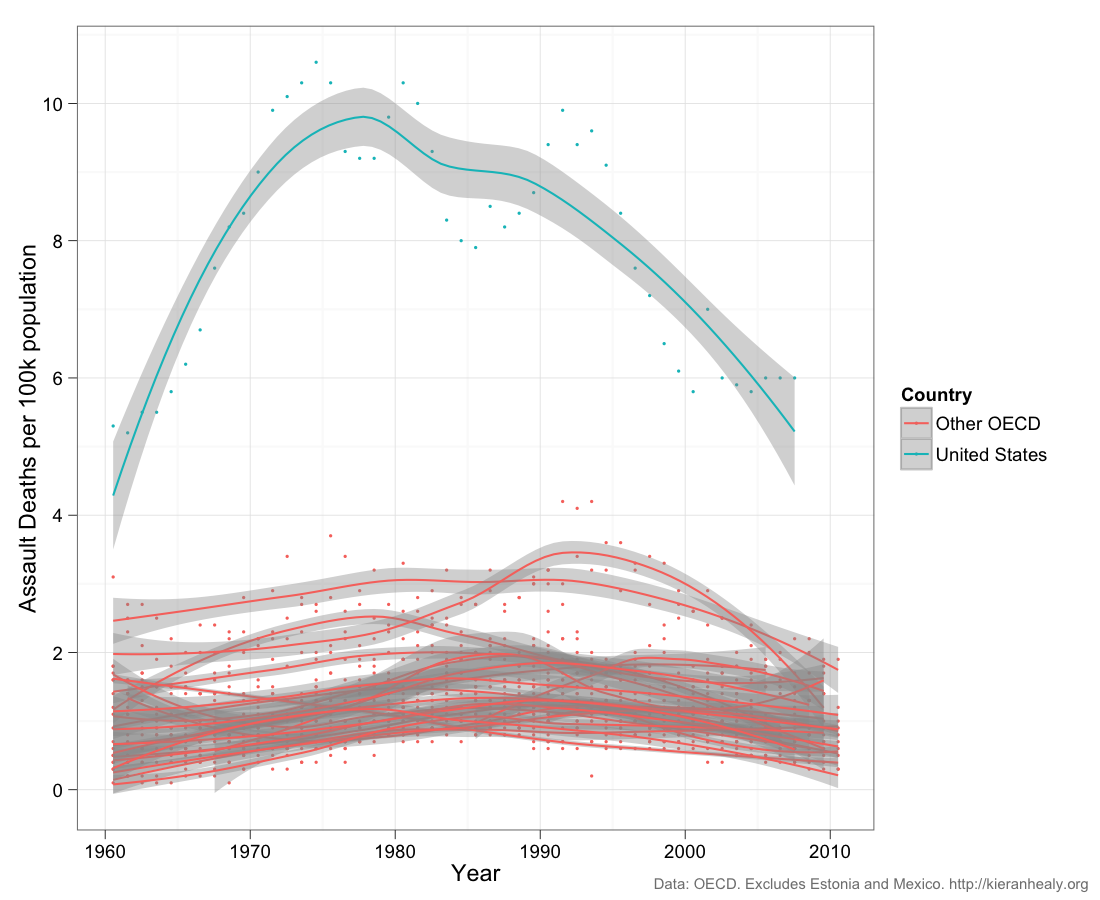
The terrible events in Connecticut prompted me to update an old post about comparative death rates from assault across different societies. The following figures are from the OECD for deaths due to assault per 100,000 population from 1960 to the present.

As before, the most striking features of the data are (1) how much more violent the U.S. is than other OECD countries (except possibly Estonia and Mexico, not shown here), and (2) the degree of change — and recently, decline — there has been in the U.S. time series considered by itself. Note that “assault” as a cause of death does not distinguish the mechanism of death (gunshot, stabbing, etc). If anyone knows of a similar time series for gun-related deaths only, let me know.
(Click for a larger PNG or PDF.)

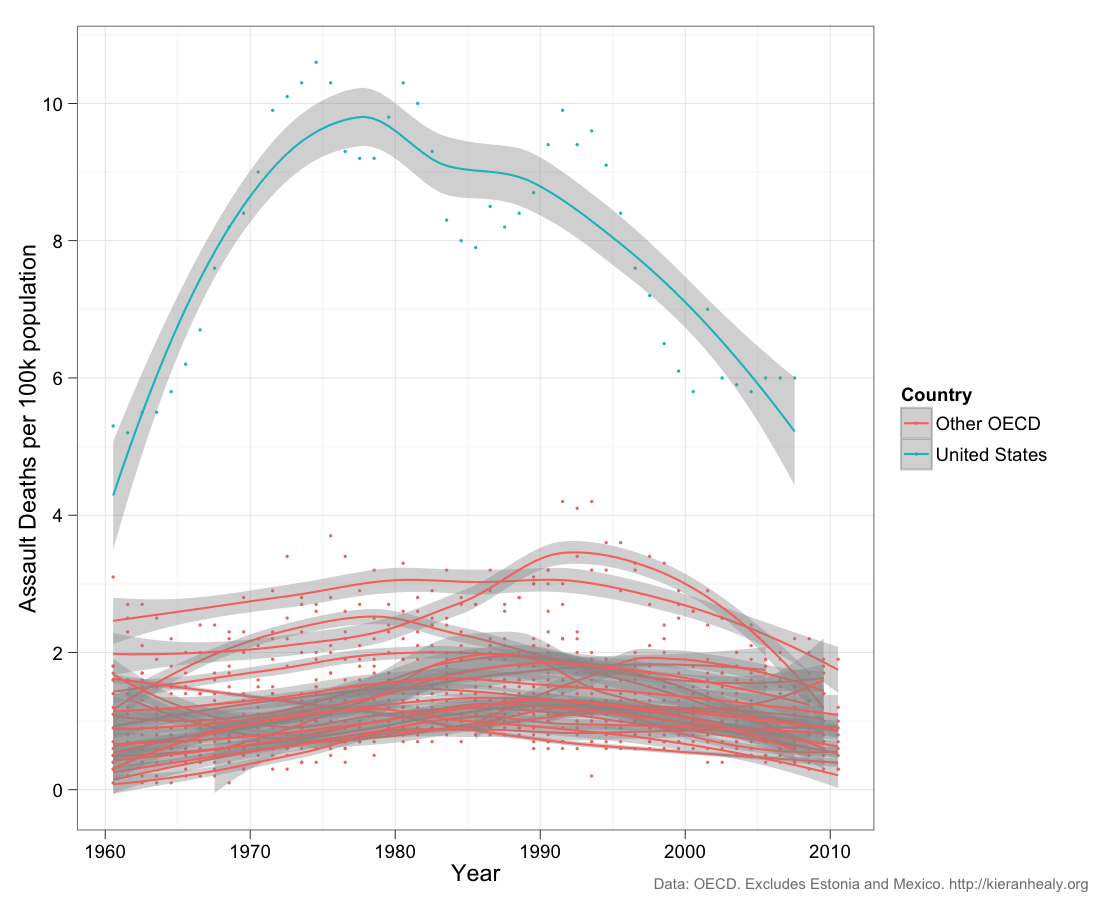
Here are the individual time series:

(Click for a larger PNG or PDF.)

—————————

Kieran Healy is a professor of sociology in the Kenan Institute for Ethics at Duke University.  His research is primary concerned with the moral order of a market society. You can follow him on twitter and at his blog.
A moment of silence for the victims of the shooting at Sandy Hook Elementary School.

Lisa Wade, PhD is an Associate Professor at Tulane University. She is the author of American Hookup, a book about college sexual culture; a textbook about gender; and a forthcoming introductory text: Terrible Magnificent Sociology. You can follow her on Twitter and Instagram.

Over at The Global Sociology Blog, SocProf put up some interesting visuals about social mobility, the likelihood that you have a significantly different economic status than your father.  Social mobility is important because it measures the degree to which a society has a caste system (in which you are restricted to the class you are born into, by whatever means) or one that gives people equal opportunities to ascend or descend the class hierarchy according to their hard work and talent.

Compared to similar countries, the U.S. has low social mobility (though most Americans think the opposite), along with Italy, the U.K., Chile, and Slovenia .  Scandinavian countries, Canada, and Australia have the most (see SocProf’s data here).

SocProf, however, asked a question I’ve never seen asked before: does this mobility differ by gender?  It does.  She found that daughters are more upwardly mobile than sons.

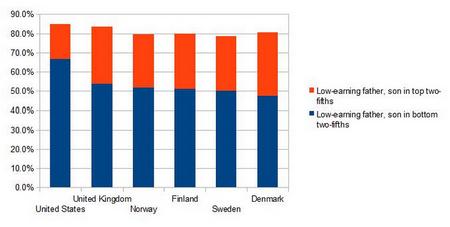
This first graph shows the percent of sons, born to a low-earning father, who will end up the top 40% of earners (orange) or the bottom 40% (blue).  Social mobility in the U.S. is lowest among the countries featured; almost 70% of American sons of low-earners stay in the bottom 40%.

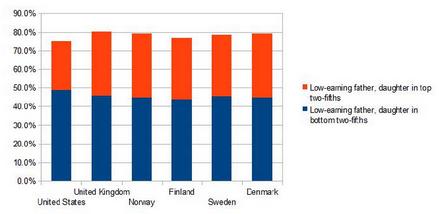
The second graph is the same data for daughters.  Mobility for daughters is higher in all countries, but it is especially so in the U.S.  While 70% of sons stay in the bottom 40%, we can say the same for less than half of daughters.

Reflecting on the fact that the difference between daughters and sons was higher in the U.S. than in the comparison countries, SocProf suggests that “[g]reater mobility seems to go together with greater gender equality” in mobility.

See also this interactive graph mapping social mobility where you can see how you compare to the rest of the U.S.

Lisa Wade, PhD is an Associate Professor at Tulane University. She is the author of American Hookup, a book about college sexual culture; a textbook about gender; and a forthcoming introductory text: Terrible Magnificent Sociology. You can follow her on Twitter and Instagram.

While I’m most well-known for my work on hook up culture, I’ve written extensively on a different topic altogether: how Americans talk about female genital cutting practices (FGCs), better known as female genital “mutilation.”  While FGCs are passionately opposed by essentially all Americans who learn about them, our understanding of the practices is, in fact, skewed by misinformation, ethnocentrism, and a history of portraying Africa as naively “backwards” or cruelly “barbaric.”

The main source of distortion has been the mass media.  Aiming to encourage journalists to think twice when covering the topic, the Hastings Center has released a report by the Public Policy Advisory Network on Female Genital Surgeries in Africa.  In the rest of this post, I briefly discuss some of the things they want journalists — and the rest of us — to know and add a couple of my own:

Using the word “mutilation” is counterproductive.

People who support genital cutting typically believe that a cut body is a more aesthetically pleasing one.  The term “mutilation” may appeal to certain Westerners, but people in communities where cutting occurs largely find the term confusing or offensive.

Media coverage usually focuses on one of the more rare types of genital cutting: infibulation.

Infibulation involves trimming and fusing the labia so as to close the vulva, leaving an opening in the back for intercourse, urination, and menses.  In fact, 10% of the procedures involve infibulation.  The remainder involve trimming, cutting, or scarification of the clitoris, clitoral hood (prepuce), or labia minora or majora.  While none of these procedures likely sound appealing, some are more extensive than others.

Research has shown that women with cutting are sexually responsive.

Women who have undergone genital surgeries report “rich sexual lives, including desire, arousal, orgasm, and satisfaction…”  This is true among women who have experienced clitoral reductions and undergone infibulation, as well as women who’ve undergone lesser forms of cutting.

Health complications of genital cutting “represent the exception rather than the rule.”

News reports often include long lists of acute and long-term negative medical consequences of FGCs, and these may feel intuitively true, but efforts to document their incidence suggest that health problems are, for the most part, no more common in cut than uncut women.  The Report concludes: “…from a public health point of view, the vast majority of genital surgeries in Africa are safe, even with current procedures and under current conditions.”

Girls are not generally cut in response to the influence of cruel patriarchs.

Most societies that cut girls also cut boys; some groups that engage in cutting have relatively permissive sexual rules for women, some do not; and female genital cutting practices are typically controlled and organized by women (correspondingly, men control male genital surgeries).

FGCs are not an “African practice.”

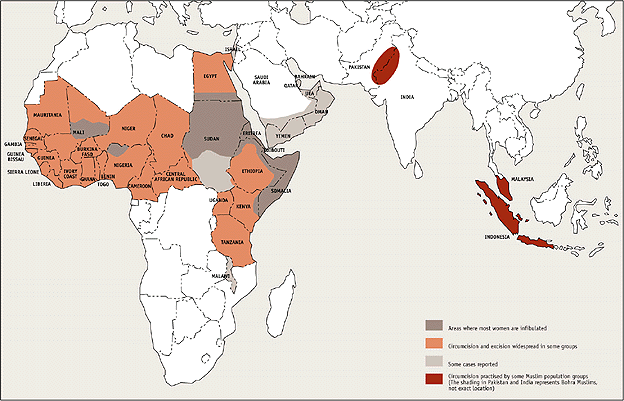
The procedures we label “female genital mutilation” occur only in some parts of Africa and occur outside of the continent as well (source):

Moreover, cosmetic genital surgeries in the U.S. are among the fastest growing procedures.  These include clitoral reduction, circumcision of the clitoral foreskin, labia trimming, and vaginal tightening, not to mention mons liposuction, collagen injected into the g-spot, color correction of the vulva, and anal bleaching.  While it would be simplistic to say that these are the same as the procedures we typically call “mutilation,” they are not totally different either.

Western-led efforts to eliminate FGCs are largely ineffective and sometimes backfire.

It turns out that people don’t appreciate being told that they are barbaric, ignorant of their own bodies, or cruel to their children.  Benevolent strangers who try to stop cutting in communities, as well as top-down laws instituted by politicians (often in response to Western pressure), are very rarely successful.  The most impressive interventions have involved giving communities resources to achieve whatever goals they desire and getting out of the way.

In sum, it’s high time Americans adopt a more balanced view of female genital cutting practices.  Reading The Hastings Center Report is a good start.  You might also pick up Genital Cutting and Transnational Sisterhood by Stanlie James and Claire Robertson.  Full text links to my papers on the topic, including a discourse analysis of 30 years of the academic conversation, can be found here.

————————

Lisa Wade is a professor of sociology at Occidental College.  She frequently delivers public lectures about female genital cutting. You can follow her on Twitter and Facebook.

A couple of months back I posted a video that illustrated the way that our expectations shape our perceptions. In it, Jimmy Kimmel gave people an iPhone 4 but told them it was an iPhone 5. Believing they were holding a neat new Apple product, they identify a range of features that make it clearly superior — often holding it up to their identical iPhone 4s and perceiving significant differences between the two.

Following up on this theme, Kimmel followed up by asking people on the street to try two cups of coffee and tell him which one had the new $7-per-cup premium coffee from Starbucks and which had a cheap brand. Except both cups of coffee were actually full of the same, non-premium, non-Starbucks coffee. Nonetheless, a number of testers immediately identify striking differences in taste between the two options, providing specific differences in quality that they think distinguish the coffees. It’s a fun illustration of a basic aspect of human cognition — that what we expect to see or experience affects how we interpret the sensory information we encounter:

Thanks to Dmitriy T.C. for the tip!

Gwen Sharp is an associate professor of sociology at Nevada State College. You can follow her on Twitter at @gwensharpnv.


2013

2012

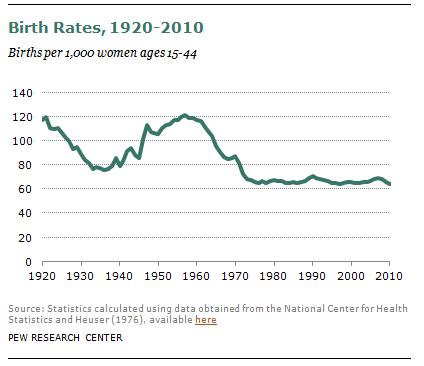
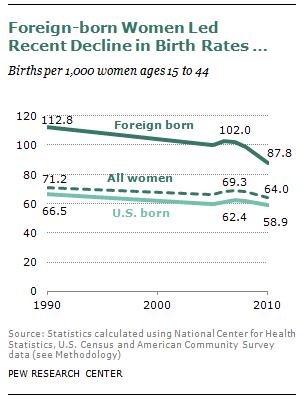
In 2011 the U.S. birth rate dropped to the lowest ever recorded, according to preliminary data released by the National Center for Health Statistics and reported by Pew Social Trends:

The decline was led by foreign-born women, who’s birthrate dropped 14% between 2007 and 2010, compared to a 6% drop for U.S.-born women.

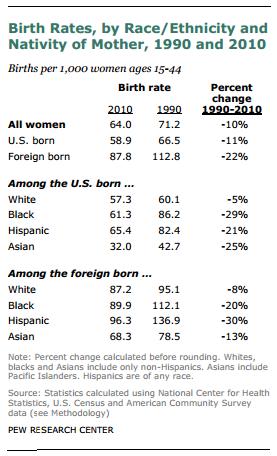
Considering the last two decades, birthrates for all racial/ethnic groups and both U.S.- and foreign-born women have been dropping, but the percent change is much larger among the foreign-born and all non-white groups.  The drop in the birthrate of foreign-born women is double that of U.S.-born and the drop in the birthrate of white women is often a fraction that of women of color.

It’s easy to forget that effective, reversible birth control was invented only about 50 years ago.  Birth control for married couples was illegal until 1965; legalization for single people would follow a few years later.  In the meantime, the second wave of feminism would give women the opportunity to enter well-paying, highly-regarded jobs, essentially giving women something rewarding to do other than/in addition to raise children.  The massive drop in the birthrate during the ’60s likely reflects these changes.

In addition to a drop in the number of children women are having, this data reflects a steady rise in the number of women deciding not to have children at all.  The decision to eschew parenting altogether is disproportionately high among highly educated women, suggesting that the there-are-now-other-things-in-life-to-do phenomenon might be at play.

Many European countries are facing less than replacement levels of fertility and scrambling to figure out what to do about it (the health of most economies in the developed world is predicated on population growth), the U.S. is likely not far behind.

Lisa Wade, PhD is an Associate Professor at Tulane University. She is the author of American Hookup, a book about college sexual culture; a textbook about gender; and a forthcoming introductory text: Terrible Magnificent Sociology. You can follow her on Twitter and Instagram.

Cross-posted at Montclair SocioBlog.

Liberal women want more sex.

Controversial sociologist Mark Regnerus has been fooling around with the New Family Structures Survey.  Back in June, Regnerus used the NFSS data to conclude that gay parents are bad for children.  Now, he runs the regressions and finds that liberalism leaves women sexually dissatisfied.

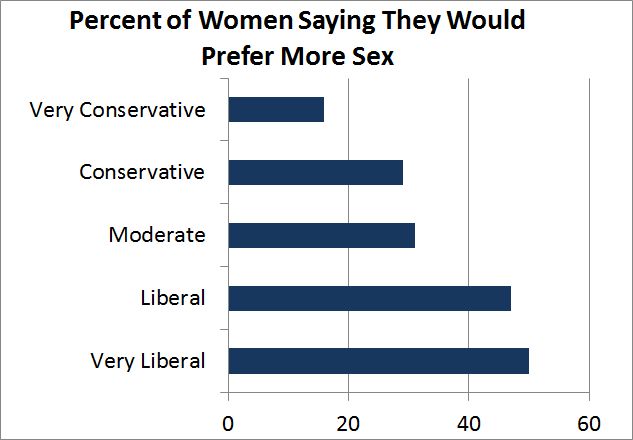
Question:“Are you content with the amount of sex you’re having?”

The possible answers:

  • Yes
  • No, I’d prefer more
  • No, I’d prefer less

The differences were clear.

Those liberal women, they try and they try and they try; they can’t get no… satisfaction. Hey, hey, hey — that’s what they say.

The differences held even with controls for how much sex the woman had had recently.  Nor did adding other possible explanatory variables dampen the effect:

[T]he measure of political liberalism remains significantly associated with the odds of wanting more sex even after controlling for the frequency of actual intercourse over the past two weeks, their age, marital status, education level, whether they’ve masturbated recently, their anxiety level, sexual orientation, race/ethnicity, depressive symptoms, and porn use.

Regnerus says he was puzzled and asked an economist friend for her explanation.  She, like Regnerus, is a serious Christian, and saw it as a matter of seeking “transcendence.”  Liberal women want to have more sex because they feel the lack of sufficient transcendence in life and seek it in sex.  Conservative women find transcendence in the seemingly mundane — “sanctifying daily life” — so they do not need sex for transcendence.  Or as Regnerus puts it, “Basically, liberal women substitute sex for religion.”

To test this idea, Regnerus controlled for religious attendance.  When he did,  “political liberalism finally went silent as a predictor.”  Churchgoing liberals were no more insatiable than were their sexually content conservative co-worshipers.

So here’s the scenario.  All women want transcendence.  Since liberal women are not religious, they seek transcendence in sex and don’t find it.  They’re dissatisfied, but they cling to the idea that sex will bring them transcendence if only they have more of it.   So they keep looking for transcendence in all the wrong places.  Conservative women seek transcendence in religion and in everyday activities.  And that works.

Conclusion: Religion is deeply satisfying; sex, not so much.

This explanation, with its attribution of psychological-spiritual longing, makes some huge assumptions about what’s going on inside women’s heads.

I can offer a contrasting sociological explanation for Regnerus’ findings.  It looks not to deep inner longings for transcendence but to social norms, beliefs, and values.  It rests on the assumption that people’s desires are shaped by external forces, especially the culture of the social world they live in.  In some groups, sex for women is good, so it’s OK for them to want more sex.  In other social worlds, sex for women has a lower place on the scale of values.  It is less of a “focal concern.”

These differences make for differences in who is content with what — a liberal, East Coast man and a WASP woman from the Midwest, for example:

Can we really say that the difference here is about spiritual transcendence?

In some social worlds, a woman can never be too thin or too rich.  In those worlds, women diet and exercise in a way we might find obsessive.  But that’s what their culture rewards.  Some cultures hold that sex is a good thing — certainly more pleasurable than dieting and exercising — therefore,  more is better.  In some social worlds, that’s the way some people feel about money.  Are these desires really about transcendence, or they about cultural values?

Oh, and on the sexual discontent matter, there are two other possibilities that may not to have occurred to Regnerus: (1) maybe conservative men are better lovers; they satisfy their conservative bedmates in ways liberals can only dream of.   Or (2) conservative men are so bad at sex that when you ask their partners if they want more, the answer is, “No thanks.”

—————————

Jay Livingston is the chair of the Sociology Department at Montclair State University.  You can follow him at Montclair SocioBlog or on Twitter.

Jay Livingston is the chair of the Sociology Department at Montclair State University. You can follow him at Montclair SocioBlog or on Twitter.