Search results for The

For the last week of December, we’re re-posting some of our favorite posts from 2012. Cross-posted at Global Policy TV and Pacific Standard.

Publicizing the release of the 1940 U.S. Census data, LIFE magazine released photographs of Census enumerators collecting data from household members.  Yep, Census enumerators. For almost 200 years, the U.S. counted people and recorded information about them in person, by sending out a representative of the U.S. government to evaluate them directly (source).
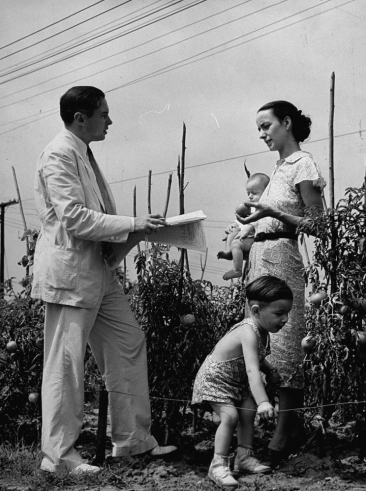
By 1970, the government was collecting Census data by mail-in survey. The shift to a survey had dramatic effects on at least one Census category: race.

Before the shift, Census enumerators categorized people into racial groups based on their appearance.  They did not ask respondents how they characterized themselves.  Instead, they made a judgment call, drawing on explicit instructions given to the Census takers.

On a mail-in survey, however, the individual self-identified.  They got to tell the government what race they were instead of letting the government decide.  There were at least two striking shifts as a result of this change:

  • First, it resulted in a dramatic increase in the Native American population.  Between 1980 and 2000, the U.S. Native American population magically grew 110%.  People who had identified as American Indian had apparently been somewhat invisible to the government.
  • Second, to the chagrin of the Census Bureau, 80% of Puerto Ricans choose white (only 40% of them had been identified as white in the previous Census).  The government wanted to categorize Puerto Ricans as predominantly black, but the Puerto Rican population saw things differently.

I like this story.  Switching from enumerators to surveys meant literally shifting our definition of what race is from a matter of appearance to a matter of identity.  And it wasn’t a strategic or philosophical decision. Instead, the very demographics of the population underwent a fundamental unsettling because of the logistical difficulties in collecting information from a large number of people.  Nevertheless, this change would have a profound impact on who we think Americans are, what research about race finds, and how we think about race today.

See also the U.S. Census and the Social Construction of Race and Race and Censuses from Around the World. To look at the questionnaires and their instructions for any decade, visit the Minnesota Population Center.  Thanks to Philip Cohen for sending the link.

Lisa Wade, PhD is an Associate Professor at Tulane University. She is the author of American Hookup, a book about college sexual culture; a textbook about gender; and a forthcoming introductory text: Terrible Magnificent Sociology. You can follow her on Twitter and Instagram.
For the last week of December, we’re re-posting some of our favorite posts from 2012. Originally cross-posted at Ms.

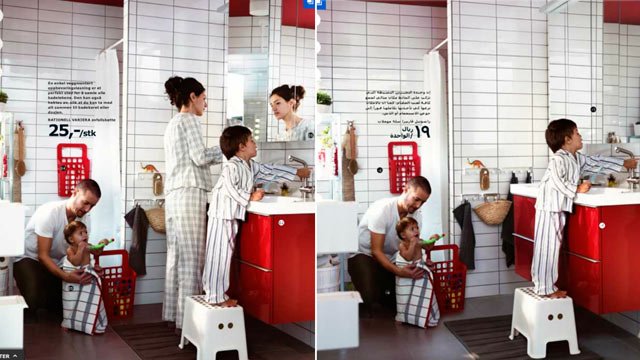
Mojca P., Jason H., Larry H., and Cindy S. sent us a link to a story about a Saudi Arabian version of an IKEA catalog in which all of the women were erased.  Here is a single page of the American and Saudi Arabian magazines side-by-side:

After the outcry in response to this revelation began, IKEA responded by called the removal of women a “mistake” “in conflict with the IKEA Group values.”   IKEA seems to have agreed with its critics: erasing women capitulates to a sexist society and that is wrong.

But, there is a competing progressive value at play: cultural sensitivity.  Isn’t removing the women from the catalog the respectful and non-ethnocentric thing to do?

Susan Moller Okin wrote a paper that famously asked, “Is Multiculturalism Bad for Women?”  The question led to two decades of debate and an interrogating of the relationship between culture and power.  Who gets to decide what’s cultural?  Whose interests does cultural sensitivity serve?

The IKEA catalog suggests that (privileged) men get to decide what Saudi Arabian culture looks like (though many women likely endorse the cultural mandate to keep women out of view as well).  So, respecting culture entails endorsing sexism because men are in charge of the culture?

Well, it depends.  It certainly can go that way, and often does.  But there’s a feminist (and anti-colonialist) way to do this too.  Respecting culture entails endorsing sexism only if we demonize certain cultures as irredeemably sexist and unable to change.  In fact, most cultures have sexist traditions.  Since all of those cultures are internally-contested and changing, no culture is hopelessly sexist.  Ultimately, one can bridge their inclinations to be both culturally sensitive and feminist by seeking out the feminist strains in every culture and hoping to see those manifested as it evolves.

None of this is going to solve IKEA’s problem today, but it does illustrate one of difficult-to-solve paradoxes in contemporary progressive politics.

—————————

Lisa Wade has published extensively on the relationship between feminism and multiculturalism, using female genital cutting as a case.  You can follow her on Twitter and Facebook (where she keeps discussion of “mutilation” to a minimum).

For the last week of December, we’re re-posting some of our favorite posts from 2012.

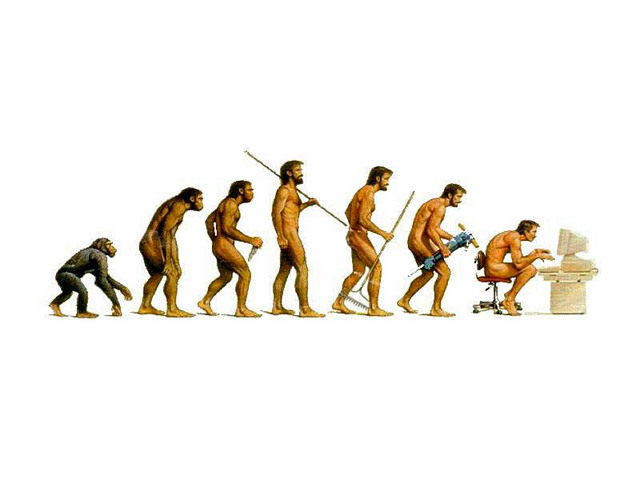
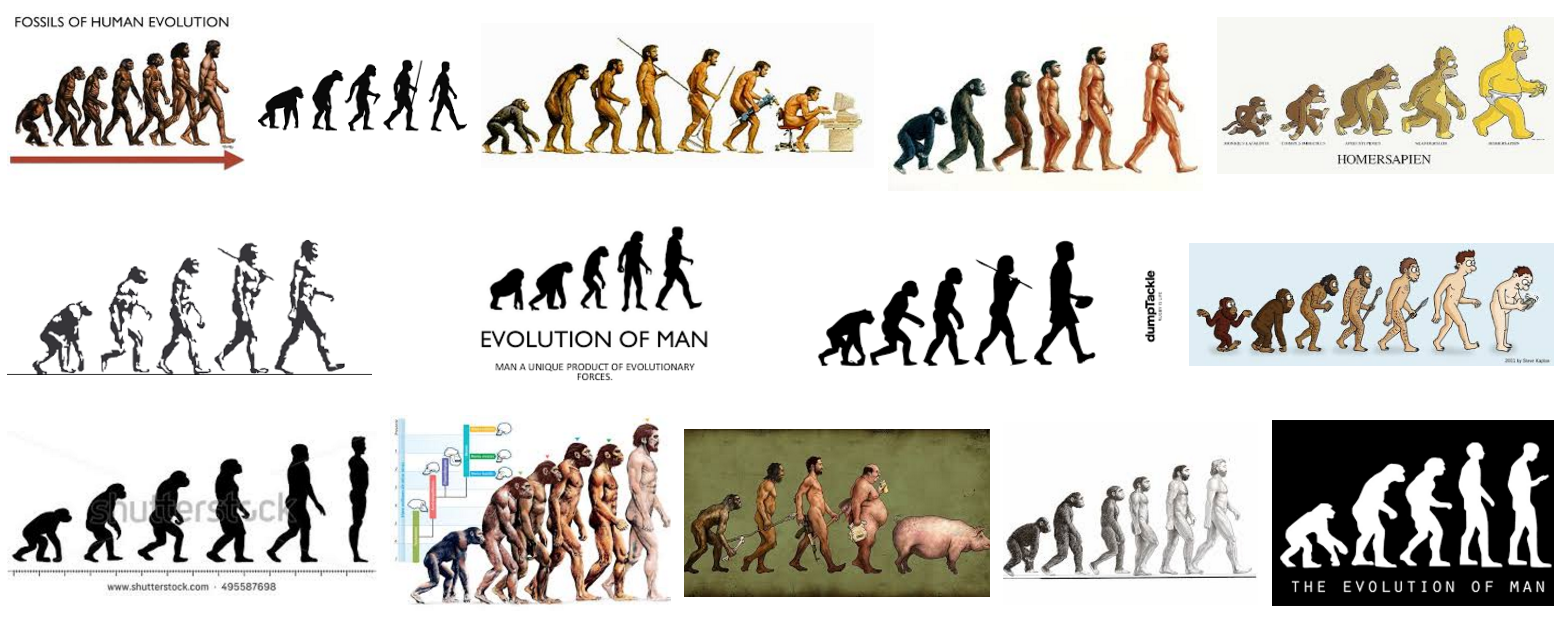
Paul M. sent along the image below, from an NPR story, commenting on the way skin color is used in the portrayal of evolution.  There’s one obvious way to read this graphic: lighter-skinned people are more evolved (dare we say, “civilized”) than darker-skinned people. It seemed worthy to make a point of Paul’s observation, because this racialized presentation of evolution is really common.  A search for the word on Google Images quickly turns up several more.  In fact, almost every single illustration of evolution of this type, unless it’s in black and white, follows this pattern.  (See also our post on representations of modern man.) Here’s what a Google image search returns, for example:


This is important stuff.  It reinforces the idea that darker-skinned people are more animalistic than the lighter-skinned.  It also normalizes light-skinned people as people and darker-skinned peoples as Black or Brown people, in the same way that we use the word “American” to mean White-American, but various hyphenated phrases (African-American, Asian-American, etc) to refer to everyone else.  So, though this may seem like a trivial matter, the patterns add up to a consistent centering and applauding of Whiteness.

Lisa Wade, PhD is an Associate Professor at Tulane University. She is the author of American Hookup, a book about college sexual culture; a textbook about gender; and a forthcoming introductory text: Terrible Magnificent Sociology. You can follow her on Twitter and Instagram.
For the last week of December, we’re re-posting some of our favorite posts from 2012. Originally cross-posted at Family Inequality.

The other day the New York Times had a Gray Matter science piece by the authors of a study in PLoS One that showed some people could identify gays and lesbians based only on quick flashes of their unadorned faces. They wrote:

We conducted experiments in which participants viewed facial photographs of men and women and then categorized each face as gay or straight. The photographs were seen very briefly, for 50 milliseconds, which was long enough for participants to know they’d seen a face, but probably not long enough to feel they knew much more. In addition, the photos were mostly devoid of cultural cues: hairstyles were digitally removed, and no faces had makeup, piercings, eyeglasses or tattoos.

…participants demonstrated an ability to identify sexual orientation: overall, gaydar judgments were about 60 percent accurate.

Since chance guessing would yield 50 percent accuracy, 60 percent might not seem impressive. But the effect is statistically significant — several times above the margin of error. Furthermore, the effect has been highly replicable: we ourselves have consistently discovered such effects in more than a dozen experiments.

This may be seen as confirmation of the inborn nature of sexual orientation, if it can be detected by a quick glance at facial features.

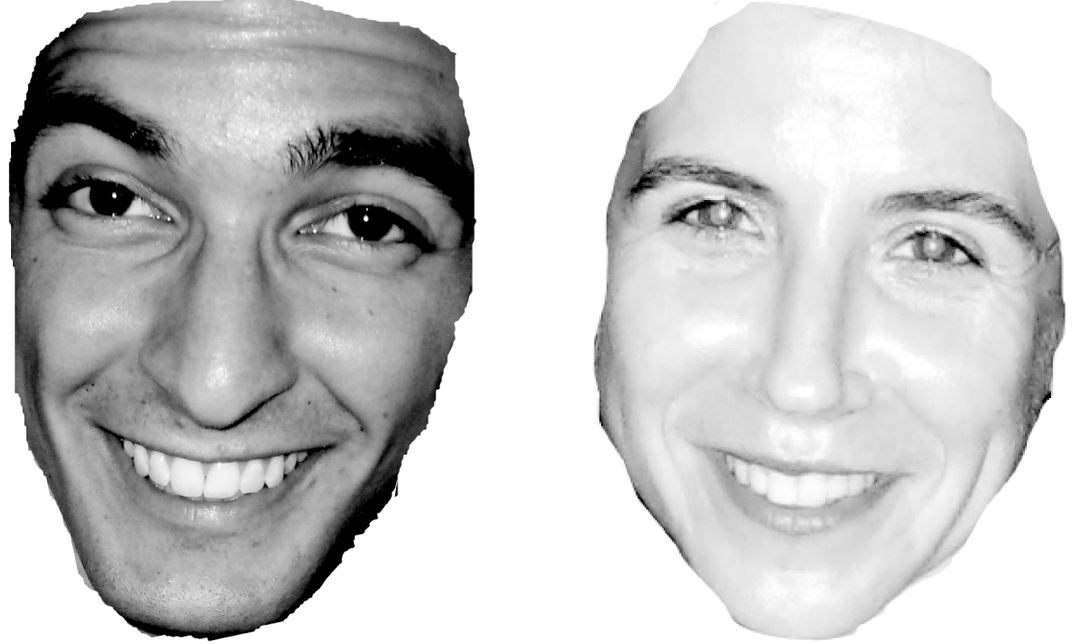
Sample images flashed during the “gaydar” experiment:

There is a statistical issue here that I leave to others to consider: the sample of Facebook pictures the researchers used was 48% gay/lesbian (111/233 men, 87/180 women). So if, as they say, it is 64% accurate at detecting lesbians, and 57% accurate at detecting gay men, how useful is gaydar in real life (when about 3.5% of people are gay or lesbian, when people aren’t reduced to just their naked, hairless facial features, and you know a lot of people’s sexual orientations from other sources)? I don’t know, but I’m guessing not much.

Anyway, I have a serious basic reservation about studies like this — like those that look for finger-lengthhair-whorltwin patterns, and other biological signs of sexual orientation. To do it, the researchers have to decide who has what sexual orientation in the first place — and that’s half the puzzle. This is unremarked on in the gaydar study or the op-ed, and appears to cause no angst among the researchers. They got their pictures from Facebook profiles of people who self-identified as gay/lesbian or straight (I don’t know if that was from the “interested in” Facebook option, or something else on their profiles).

Sexual orientation is multidimensional and determined by many different things — some combination of (presumably many) genes, hormonal exposures, lived experiences. And for some people at least, it changes over the course of their lives. That’s why it’s hard to measure.

Consider, for example, a scenario in which someone who felt gay at a young age married heterogamously anyway — not too uncommon. Would such a person self-identify as gay on Facebook? Probably not. But if someone in that same situation got divorced and then came out of the closet they probably would self-identify as gay then.

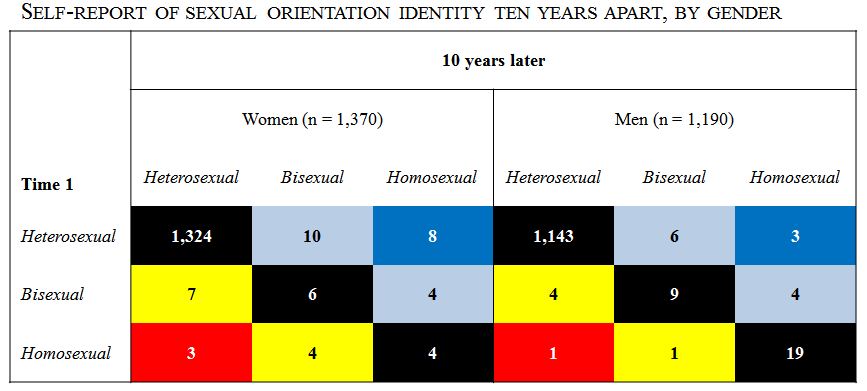
Consider another new study, in the Archives of Sexual Behavior, which used a large sample of people interviewed 10 years apart. They found changes in sexual orientation were not that rare. Here is my table based on their results:Overall, 2% of people changed their response to the sexual orientation identity question. That’s not that many — but then only 2.5% reported homosexual or bisexual identities in the first place.

In short, self identification may be the best standard we have for sexual orientation identity (which isn’t the same as sexual behavior), but it’s not a good fit for studies trying to get at deep-down gay/straight-ness, like the gaydar study or the biological studies.

And we need to keep in mind that this is all complicated by social stigma around sexual orientation. So who identifies as what, and to whom, is never free from political or power issues.

Philip N. Cohen is a professor of sociology at the University of Maryland, College Park, and writes the blog Family Inequality. You can follow him on Twitter or Facebook.

For the last week of December, we’re re-posting some of our favorite posts from 2012. Originally cross-posted at Ms.

Larry H., Shayna A.-S., and Laura F. sent in a recently released study, “Science Faculty’s Subtle Gender Biases Favor Male Students,” that shows compelling evidence for unconscious gender bias among faculty, specifically in some natural and biological science fields. The researchers asked a national sample of 127 biology, physics, and chemistry professors to evaluate the application materials of an undergrad science student who applied for a lab manager position, a job they saw as a gateway to other opportunities. Everyone was given the same materials (excerpts here), but half the applicants were given the first name Jennifer and half were called John. The participants were told the student would be given feedback based on their evaluations.

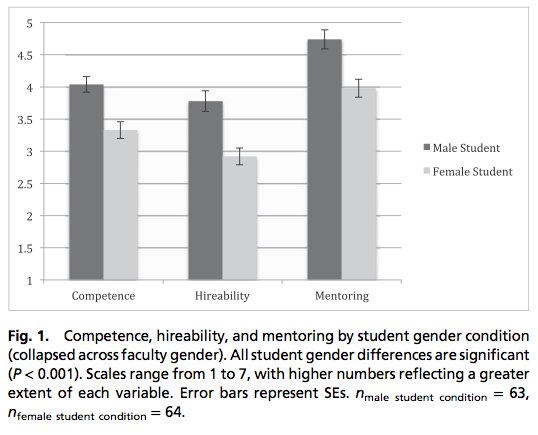
The results are sobering. There was a significant difference in the average competence, hireability, and mentoring ratings by gender. Professors who thought they were evaluating a female applicant saw a less qualified candidate than professors who were evaluating the identical application materials but thought it was from a man:

So not only was there a gap in perceived competence and fit for the position, but professors were less willing to engage in the type of mentoring that can help students gain both skills and confidence in their abilities — which can be especially important for under-represented groups.

And despite what you might expect, female professors were just as likely to do this as male professors were. Just thinking an applicant was female seems to have touched off an unconscious bias that led them to see female candidates negatively and to be less willing to spend time mentoring them. Professors’ age, tenure status, and discipline didn’t make a difference, either.

The professors were also asked to recommend a starting salary. Again, there was a significant difference. The average suggested beginning salary for the male candidate was $30,238, while for the female student it was $26,507:

The authors point out that these findings are especially noteworthy because, unlike many studies of gender bias that use college students or people who have never had to make the type of hiring or mentoring decisions they’re being asked to engage in for the study, this sample was made up of scientists who are active in their fields, regularly working with students.

Interestingly, when asked how much they liked the candidate, those evaluating the female student gave a higher score than those assigned the male student. But this didn’t translate into seeing the female candidate as competent. The study authors argue that this is strong evidence for subtle gender bias. The professors didn’t express dislike or hostility toward a female candidate. In fact, they tended to actively like her. But as the researchers explained,

…despite expressing warmth toward emerging female scientists, faculty members of both genders appear to be affected by enduring cultural stereotypes about women’s lack of science competence that translate into biases in student evaluation and mentoring. (p. 4)

This study implies that women in the natural and biological sciences (and yes, surely other fields too) still face prejudices that can impact the opportunities they are given to work closely with professors to gain important experiences and skills, as well as limiting their access to jobs and starting them out at a lower salary. These factors can snowball over time, creating larger and larger gaps in career achievements and income as men capitalize on opportunities while women find it impossible to catch up.

Gwen Sharp is an associate professor of sociology at Nevada State College. You can follow her on Twitter at @gwensharpnv.

For the last week of December, we’re re-posting some of our favorite posts from 2012.

In Counted Out: Same-Sex Relations and Americans’ Definitions of Family, released last month, authors Brian Powell, Catherine Bolzendahl, Claudia Geist, and Lala Carr Steelman look at how Americans conceptualize “the family” — that is, not what they think about their own families, but what they think counts as a family. Which groups or living arrangements do they include in the definition of “family,” and who is excluded?

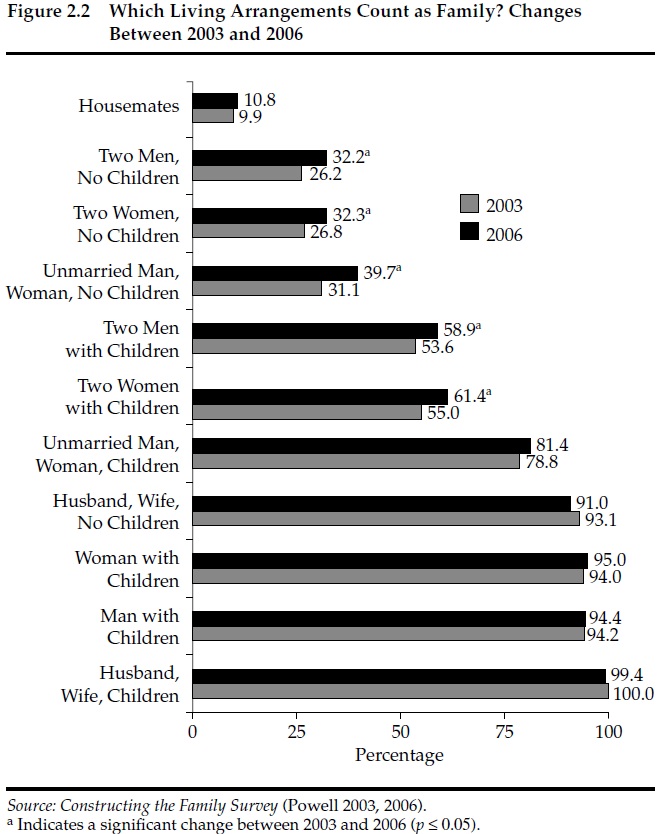
Based on surveys conducted in 2003 and 2006, Americans still hold the stereotypical nuclear family (husband, wife, kids) as the gold standard — virtually everyone agrees that such a group counts as a family. Being legally married, or the presence of children, generally leads to acceptance of a grouping as a family — the overwhelming majority believed single parents and their children count as families, as do married heterosexual couples without kids, and even unmarried heterosexual couples who have children. But when couples are same-sex, or don’t have kids, Americans are much less certain that they can qualify as a family. In 2006, the percent of respondents believing gay or lesbian couples with kids are families was notably smaller than for those agreeing that single parents or straight couples count, though it had increased since 2003:

And notice the importance of children to definitions of family — only a minority of respondents thought that gay, lesbian, or straight couples without kids are a family.

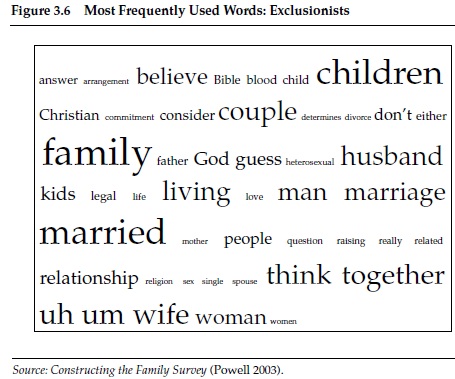
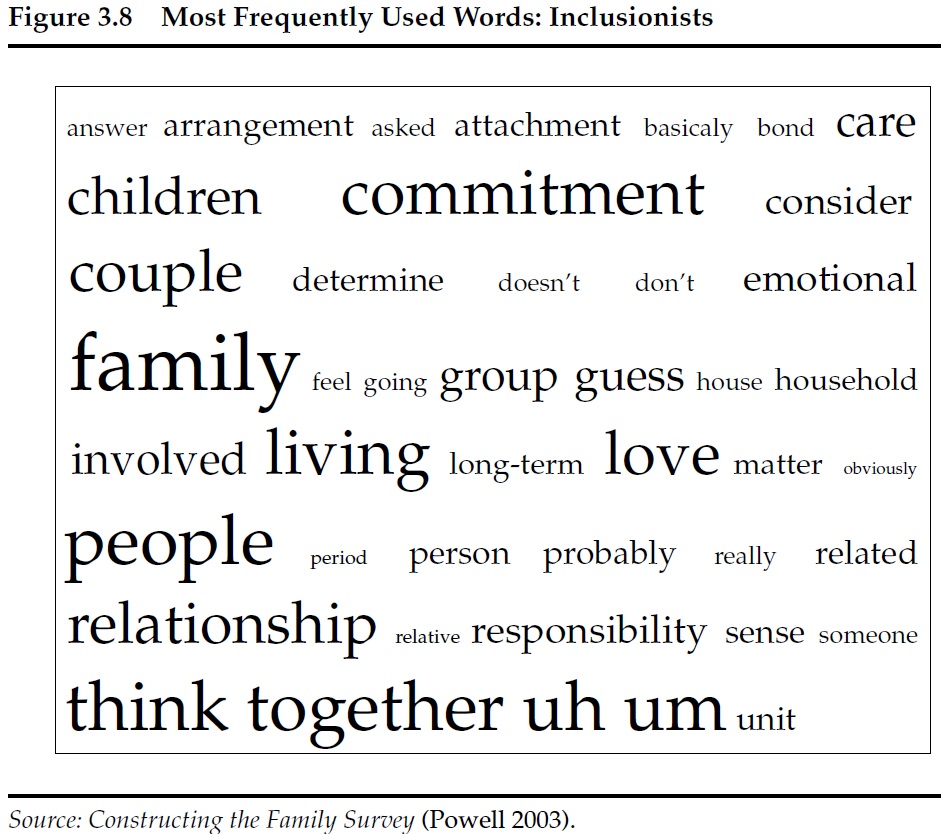
The authors divided respondents into three groups, based on their answers: exclusionists (those with the most restrictive definitions of family), moderates, and inclusionists (those with the most expansive definitions). Looking at the words these groups used as the talked about their characterizations of family, we see clear differences. The words used most frequently by exclusionists highlight the centrality of marriage, as well as an emphasis on what type of people constitute a family (husband, wife, woman, man), and the explicit inclusion of religious-based elements in their ideas of what makes a family:

The language used by inclusionists emphasized emotional attachments rather than the legal institution of marriage as the basis for determining what counts as a family:

Women were more inclusive than men, in general:

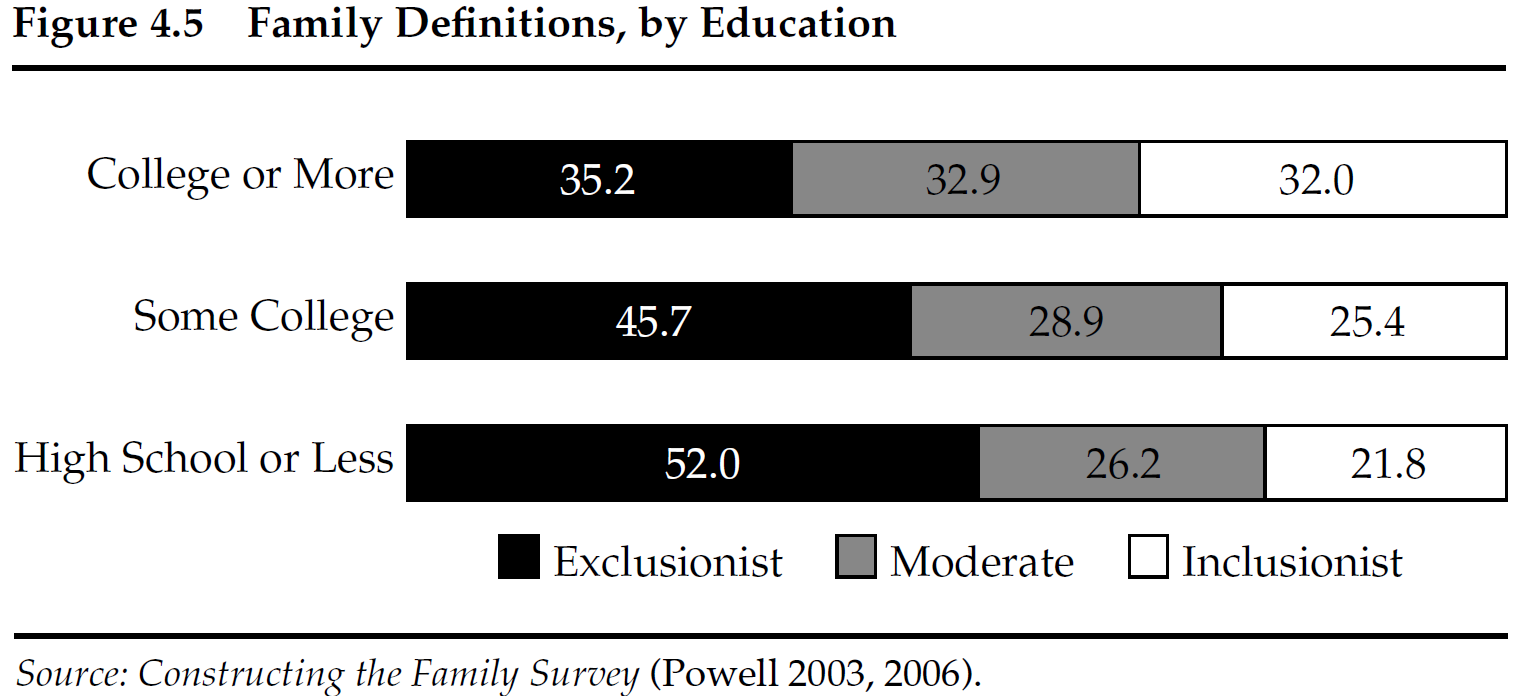
The more educated respondents were, the more inclusive their definitions of family tended to be:

The Russell Sage Foundation released these and many other charts and tables from the book, so it’s definitely worth a look if you’re interested in how Americans think about the family. Overall, the authors found that definitions of the family were becoming more inclusive. Presumably this trend has continued and even accelerated since the 2006 survey, given how attitudes have shifted on a number of issues involving gay and lesbian rights in the past few years.

Gwen Sharp is an associate professor of sociology at Nevada State College. You can follow her on Twitter at @gwensharpnv.

Christmas Across Cultures

The Economics of Christmas

Racializing Christmas

Christmas and Gender

Gift Guides and the Social Construction of Gender

Sexifiying Christmas

Christmas Marketing

Lisa Wade, PhD is an Associate Professor at Tulane University. She is the author of American Hookup, a book about college sexual culture; a textbook about gender; and a forthcoming introductory text: Terrible Magnificent Sociology. You can follow her on Twitter and Instagram.
This is one of our favorite Christmas-themed posts from the archive.  We hope you don’t mind the re-post!

Stressing remarkable differences between the two, Rachel and Lucy sent in the music videos for the original Mariah Carey version of “All I Want for Christmas is You” (1994) and the re-make (2011).  They suggested that the comparison reveals two trends: the rising emphasis placed on consumption and the new hyper-sexualization.  I figured, “yeah, I’ll bet they’re onto something there.”  And boy were they.

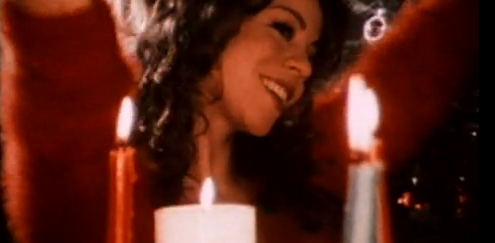
The first video involves Mariah mostly bounding around in the snow in a snow suit. Often acting pretty darn goofy, with dogs and Santa.

She spends part of the video inside with kids, a Christmas tree, presents, and more animals.  She’s usually wearing a sweater.

She spends less than (I’m guessing) 10 seconds of the video in a sexy Mrs. Claus outfit and, when she’s wearing it, it looks like she’s got long johns on her legs.

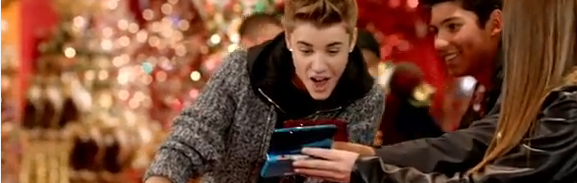
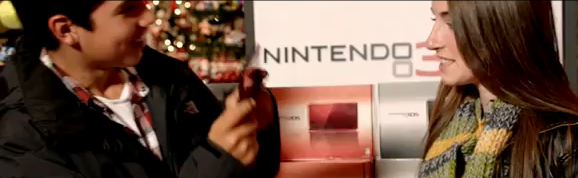
The new video, featuring Justin Bieber, is wildly different. Instead of a snowy field or an intimate home, the video takes place in a shopping mall.  It centrally features a Nintendo product.

Likewise, instead of bounding around in the snow like a goof, she spends the entire video up against a wall in super high heels and the sexy Mrs. Claus outfit (except this one doesn’t have sleeves or a midriff).

At one point she runs her hand down her body, touching her breast and moving down to her crotch; at another she just leans against the wall with her back to us and swings her butt back and forth.

So there’s one data point, for what it’s worth, but in line with emerging research on and plenty of anecdotal evidence of the “pornification” of American culture.

“All I Want for Christmas is You” (1994):

“All I Want for Christmas is You” (2011):

Lisa Wade, PhD is an Associate Professor at Tulane University. She is the author of American Hookup, a book about college sexual culture; a textbook about gender; and a forthcoming introductory text: Terrible Magnificent Sociology. You can follow her on Twitter and Instagram.