Search results for The

In honor of yesterday’s game, we’re re-posting two of our favorite football-related posts. This one and one about how much of a three-hour televised NFL games actually involves the game itself.

MontClair SocioBlog’s Jay Livingston posted the wickedly creative football play embedded below.  The play, pulled off by Driscoll Middle School’s football team (Corpus Christi, TX), is a wonderful example of the importance of a shared understanding of context.  Watch the clip:

Understanding the context of interaction heavily influences what you say and do and how you interpret others’ speech and actions. The behavior that you exhibit on a first date, for example, is very different than the behavior you exhibit in your professor’s office hours, or at Thanksgiving, or at a sports bar with your buddies. The situation shapes whether or not you can get away with bragging, farting, or being withdrawn, drunk, or loquacious.  And it shapes what we expect from others too.  In other words, we often think we know who we are, but who we are actually changes quite dramatically from situation to situation.

In this case, the offense did something entirely unexpected given the understanding of the context.  He isn’t supposed to just get up and walk through the defensive line.  And, so, when he did, the defense took several seconds to figure out what to do.  It’d be like your Grandma getting drunk at Thanksgiving (maybe) or your partner farting on the first date; such behaviors are confounding because it involves deviating from the script determined by the situation.  In Livingston’s words:

In this middle-school football play, the quarterback and center do something unusual for someone in those roles. They don’t violate the official rulebook, but their behavior is outside the norms of the game everyone knows. What’s going on? The defense looks around to the others for their cue as to what to do. They see the offensive line motionless in their stances, and they see their own teammates too looking uncertain rather than trying to make a tackle. So nobody defines the play as having started. But it has. Only when the quarterback, having walked past eight definitionless players, starts running do they arrive at an accurate definition, and by then, it’s too late. Touchdown.

See also our post about virtuoso violinist Joshua Bell in the subway.

Lisa Wade, PhD is an Associate Professor at Tulane University. She is the author of American Hookup, a book about college sexual culture; a textbook about gender; and a forthcoming introductory text: Terrible Magnificent Sociology. You can follow her on Twitter and Instagram.
In honor of yesterday’s game, we’re re-posting two of our favorite football-related posts. This one and one about a young team that confused its opponent by deviating from the football script without breaking the rules.

In “Televised Sport and the (Anti)Sociological Imagination,” Dan C. Hilliard discusses the rigid segmentation of televised sports programs, a schedule that in some cases requires “television timeouts”–that is, timeouts in the game due primarily to the need to break up the broadcast for commercials. Televised sports programs and advertising have become increasingly intertwined, such that they’re often nearly indistinguishable, what with the frequent mention of sponsors’ products by sports commentators.

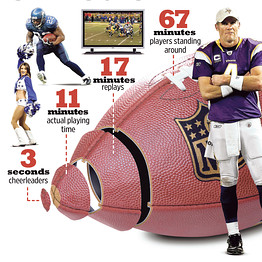
In this video from the Wall Street Journal, a journalist talks about the results of a study he completed in which he timed every element of a large number of televised football (as in American football, not soccer) games. The results? In a typical 3-hour broadcast, barely over 10 minutes shows action on the field. What makes up the rest? Well, advertising, of course, but even aside from that, most of the game coverage is made up of replays, players standing around or huddling before plays, shots of coaches or the crowd, and about 3 seconds of cheerleaders:

A breakdown of game coverage:

Here’s a breakdown of the amount of time spent on each element for a bunch of specific games.

Of course, in some cases these breaks in the action are an integral part of the game. But as things such as television timeouts show, games may also be intentionally slowed down to be sure the game fills the allotted time slot… and provides plenty of time for all the advertising they sold during it.

Gwen Sharp is an associate professor of sociology at Nevada State College. You can follow her on Twitter at @gwensharpnv.

An expanded version of this post is cross-posted at Montclair SocioBlog.

Six years ago, I wrote that the Pittsburgh Steelers had become “America’s Team,” a title once claimed, perhaps legitimately, by the Dallas Cowboys.

Now Ben Blatt at The Harvard College Sports Analysis Collective concludes that it’s still the Cowboys:

…based on their huge fan base and ability to remain the most popular team coast-to-coast, I think the Dallas Cowboys have earned the right to use the nickname  ‘America’s Team’.

To get data, Blatt posed as an advertiser and euchred Facebook into giving him some data from 155 million Facebook users, about half of the US population.  Blatt counted the “likes” for each NFL team:

It’s Superbowls X, XIII, and XXX all over again – Steelers vs. Cowboys.  And the Cowboys have a slight edge.  But does that make them “America’s Team”? It should be easy to get more likes when you play to a metro area like Dallas that has twice as many people as Pittsburgh.  If the question is about “America’s Team,” we’re not interested in local support.  Just the opposite: if you want to know who America’s team is, you should find out how many fans it has outside its local area.

Unfortunately, Blatt doesn’t provide that information. So for a rough estimate, I took the number of Facebook likes and subtracted the metro area population.  Most teams came out on the negative side. The Patriots, for example, had 2.5 million likes. but they are in a media market of over 4 million people.  The Cowboys too wound up in the red  3.7 million likes in a metro area of 5.4 million people.

Likes outnumbered population for only five teams.  The clear winner was the Steelers.

Jay Livingston is the chair of the Sociology Department at Montclair State University. You can follow him at Montclair SocioBlog or on Twitter.

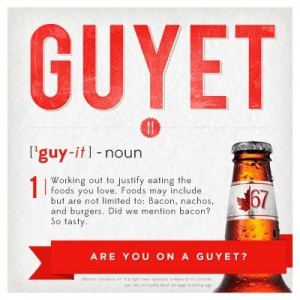
The Ethical Adman’s Tom Meggison sent along a new ad campaign by Molson.  The campaign coins the word “guyet,” a supposedly masculine alternative to “diet.”

If dieting is working out in order to be thin, then guyeting is “working out to justify eating the foods you love… Bacon, nachos, and burgers.”

There’s a very simple thing going on here: things associated with women are NOT-FOR-MEN, so anything that rings feminine must be covered in bacon, dipped in beer batter, and fried masculinized. See, for lots of examples, our Pinterest page on the phenomenon with almost 100 examples.

Importantly, this isn’t just about maintaining a strong distinction between men and women, it’s about maintaining gender inequality.  We disparage and demean femininity, which is why men want to avoid it.  Listen to the tone of voice that the narrator uses when saying the word “diet” at 21 seconds:

Dieting is stupid ’cause girls and everything associated with girls is stupid.  Guyeting is awesome ’cause guys are awesome.

The reverse doesn’t apply. Women who do things men like to do — drink whiskey, play sports, become surgeons, have dogs, etc — somehow rise in our esteem.  Men’s worth, in contrast, is harmed by their association with femininity.  This is a layer of gender inequality above and beyond sexism, the privileging of men over women; it’s androcentrism, the privileging of the masculine over the feminine.  Since women are required to do femininity, it means being required to do trivial, demeaned, and disparaged things.  Meanwhile, men have to come up with stupid excuses for participating in basic healthy activities like going for a jog.

More posts on androcentrism: “woman” as an insultbeing a girl is degradingmaking it manly: how to sell a car, good god don’t let men have long hairdon’t forget to hug like a dudesaving men from their (feminine) selvesmen must eschew femininitynot impressed with Buzz Lightyear commercialdinosaurs can’t be for girls, and sissy men are so uncool.

UPDATE: Comments closed.

Lisa Wade, PhD is an Associate Professor at Tulane University. She is the author of American Hookup, a book about college sexual culture; a textbook about gender; and a forthcoming introductory text: Terrible Magnificent Sociology. You can follow her on Twitter and Instagram.

Cross-posted at Reports from the Economic Front.

The British economy is a disaster.  Oddly enough most analysts find it difficult to explain why.

Actually the reason is quite simple. The British government responded to its own Great Recession by cutting spending and raising taxes.  The result, which is anything but mysterious, is that the county remains in deep recession.

Matthew O’Brien, writing in The Atlantic, describes the situation as follows:

…public net investment — things like roads and bridges and schools,  and everything else the economy needs to grow — has fallen by half the past three years, and is set to fall even further the next two. It’s the economic equivalent of shooting yourself in both feet, just in case shooting yourself in one doesn’t completely cripple you. Austerity has driven down Britain’s borrowing costs even further, but that’s been due to investors losing faith in its recovery, rather than having more faith in its public finances. Indeed, weak growth has kept deficits from coming down all that much, despite the higher taxes and slower spending. In other words, it’s economic pain for no fiscal gain.

Below is a chart taken from The Atlantic article.  It shows that:

Britain’s stagnating economy has left it in worse shape at this point of its recovery than it was during the Great Depression. GDP is still more than 3 percent below its 2008 peak, and it hasn’t done anything to catchup in years. At this pace, there will be no recovery in our time, or any other time.

 gdp to december 2012

In other words, while the British economy suffered a deeper decline during the Great Depression period of 1930 to 1934 than to this point in the Great Recession which started in 2008, the economy recovered far more quickly then than now.  In fact, it doesn’t seem to be recovering now at all.

Perhaps the most surprising thing about the situation is that political leaders appear determined to stay the course.

Martin Hart-Landsberg is a professor of economics at Lewis and Clark College. You can follow him at Reports from the Economic Front.

SocImages News:

A huge “thank you” to all of the nearly 30,000 readers who liked and shared our post The Balancing Act of Being Female; Or, Why Women Wear So Many Clothes!  I’m thrilled that it stuck such a nerve!

In Twitter news, SocImages’ account reached 10,000 followers!

I’m also pleased to announce a new relationship with PolicyMic, a site dedicated to democratic media for the Millennial generation. I’ll be posting select stuff there.  (Special thanks to Sam Meier!)  I’ve re-started my blog on The Huffington Post as well.

Thanks, as well, to Jezebel, Racialicious, and Ms. Magazine for re-posting our bits about:

Tonight at 7pm I’m giving a public lecture about hook up culture on the campus of Occidental College in Los Angeles.  If you’re in town and would like to drop by, we can convene for drinks afterward!

Upcoming Lectures and Appearances:

I have six talks scheduled for Spring. If you’re in Kingston, Boston, or Akron, I’d love to schedule a meet up!

  • Jan. 31 — Occidental College — “‘The Night Overall Wasn’t Bad’: Oxy Students on Hooking Up”
  • Feb. 26 — Queen’s University of Kingston — Hook Up Culture Lecture and Workshop
  • Mar. 8-14 — Harvard University — “A Feminist Defense of Friendship”
  • Mar. 27 — Ponoma College — “‘The Night Overall Wasn’t Bad’: What College Students Really Think About Hooking Up”
  • Mar. 28-30 — Western Political Science Association (Hollywood, CA) — panels on “Public Intellectualism” and the “Twenty-First Century Sex Wars”
  • Apr. 19 — University of Akron — “Anatomy of an Outrage: Female Genital Cutting and the Politics of Acculturation”

Social Media ‘n’ Stuff:

Finally, this is your monthly reminder that SocImages is on TwitterFacebookGoogle+, and Pinterest.  Lisa is on Facebook and most of the team is on Twitter: @lisawade@gwensharpnv@familyunequal@carolineheldman, and @jaylivingston.

In Other News…

I was in Costa Rica this month and this — a wild sloth that came down from the trees to cross the path — was my favorite moment of the trip.  After he climbed into the forest on the other side, I actually burst into tears.
You would’ve too! Look at that face!!!

Lisa Wade, PhD is an Associate Professor at Tulane University. She is the author of American Hookup, a book about college sexual culture; a textbook about gender; and a forthcoming introductory text: Terrible Magnificent Sociology. You can follow her on Twitter and Instagram.

Cross-posted at Montclair Socioblog.

In the New York Times, Arthur Brooks argues that conservatives are happier than liberals.

Brooks starts with a reference to Barack Obama’s remark four years ago  about “bitter” blue-collar Whites who “cling to guns or religion.” Misleading, says Brooks.  So is a large body of research showing conservatives as “authoritarian, dogmatic, intolerant of ambiguity, fearful of threat and loss, low in self-esteem and uncomfortable with complex modes of thinking.”

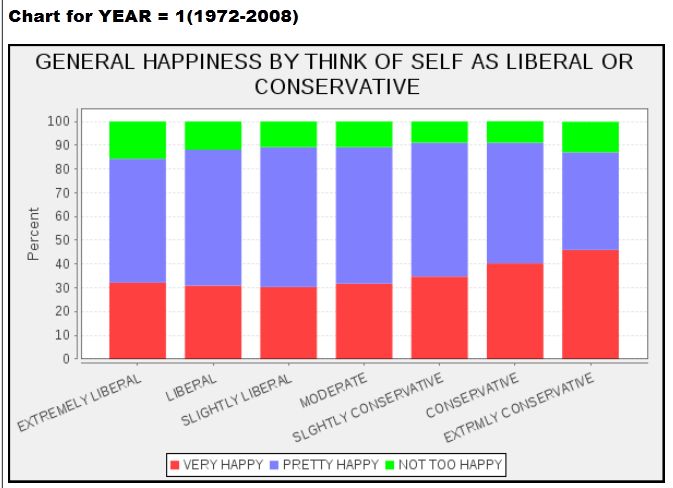
Despite that research, it’s conservatives, not liberals, who identify themselves as happy.  And, Brooks adds, the farther right you go on the political spectrum, the more happy campers you find.

Brooks cites a couple of surveys that support this view.  I was a bit skeptical, so I went to the GSS.

Sure enough, by about 10 percentage points, more conservatives identify themselves as “very happy” than do liberals.  The difference is even higher among the extreme conservatives.   As Brooks says, “none, it seems, are happier than the Tea Partiers, many of whom cling to guns and faith with great tenacity.”

Brooks cites two important factors linking political views and happiness: marriage (with children) and religion.

Religious participants are nearly twice as likely to say they are very happy about their lives as are secularists (43 percent to 23 percent). The differences don’t depend on education, race, sex or age; the happiness difference exists even when you account for income.*

I still found it hard to reconcile these sunny right-wingers with the image of bitter and angry Tea Partiers.  Then I remembered that the Tea Party is a very recent phenomenon.  To a great extent, it’s a reaction to the election of President Obama.    But Brooks is looking at pre-Obama studies of happiness.  The most recent one he cites is from 2006.  As the GSS graph above shows, Brooks is correct when he says, “This pattern has persisted for decades.”  But those decades don’t include the Tea Party.

Maybe conservatives were happy because until recently, they didn’t have much to be bitter about.  The US was their country, and they knew it.   Then Obama was elected, and ever since November 2008 conservatives have kept talking about “taking back our country.” (See my “Repo Men” post from 2 1/2 years ago.)

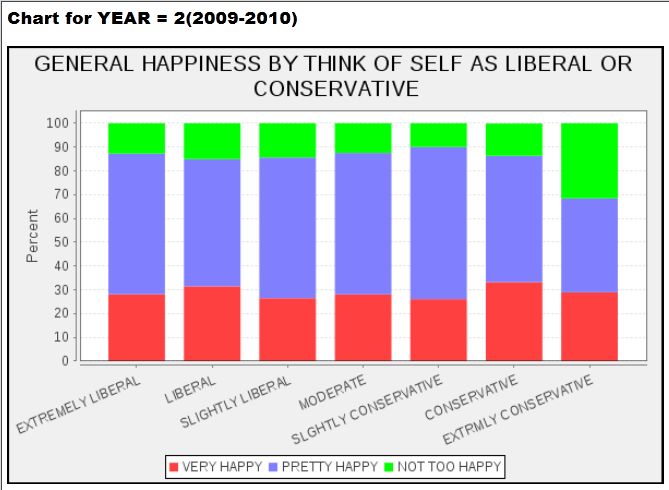
What if we look at the data from the Obama years?

Maybe that bitter Tea Party image isn’t such a distortion.  The GSS does not offer “bitter” or “Tea Party”  as choices, but those who identify themselves as “extreme conservative” are nearly three times as likely as others to be “not too happy.”  And overall, the happiness gap between conservatives and liberals is hard to find.

For all I know, Brooks’s general conclusion may be correct, but the recent data do at least raise some questions and suggest that the political context is itself a relevant variable.

Nearly eighty years ago, Harold Lasswell said that politics is about “who gets what, when, and how.”  Maybe the lesson here is that if you are going to study the connection between political views and happiness, you should take account of who is getting what, and when.

*That’s a bit misleading.  Happiness is in fact related to income, race, and education in exactly the ways you would expect, though for some reason Brooks does not include those variables in his analysis.  What Brooks means is that the religion effect holds even when you control for those variables. 

—————————

Jay Livingston is the chair of the Sociology Department at Montclair State University.  You can follow him at Montclair SocioBlog or on Twitter.

Cross-posted at PolicyMic.At the end of my sociology of gender class, I suggest that the fact that feminists are associated with negative stereotypes — ugly, bitter, man-haters, for example — is not a reflection of who feminists really are, but a sign that the anti-feminists have power over how we think about the movement.  The very idea of a feminist, in other words, is politicized… and the opposition might be winning.

A clip forwarded by Dmitriy T.C. is a great example.  In the 1.38 minute Fox News clip below, two pundits discuss a North Carolina teacher, Leah Gayle, who was accused of having sex with her 15-year-old student.  One of the show’s hosts suggests that feminism is to blame for Gayle’s actions. She says:

There’s something about feminism that lets them know, I can do everything a man does. I can even go after that young boy. I deserve it… It’s turning women into sexualized freaks.

This clip reveals a discursive act.  She is defining who feminists are and what they believe.  And this idea is being broadcast across the airwaves.

This happens all day every day.  Some of the messages are friendly to feminists, and some are not.  These messages compete in our collective imagination.  Most have little to do with what feminists (who are a diverse group anyway) actually believe and many are outrageous lies and distortions, like this one.

So, next time you hear someone describing a feminist, know that what you’re hearing is almost never a strict definition of the movement. Instead, it’s a battle cry, with one side competing with the other to shape what we think of people who care about women’s equality with men.

Lisa Wade, PhD is an Associate Professor at Tulane University. She is the author of American Hookup, a book about college sexual culture; a textbook about gender; and a forthcoming introductory text: Terrible Magnificent Sociology. You can follow her on Twitter and Instagram.