Search results for The

Originally posted in 2010. Re-posted in honor of the holiday.

This morning I heard an interesting story on NPR about the celebration of Valentine’s Day in Japan.

In the U.S., Valentine’s Day is pretty much for women. While women do give Valentine’s gifts to male partners, the emphasis among adults is on men giving items to women: flowers, candy, cards, taking them out to dinner, and so on. In many cases women aren’t expected to reciprocate, or can give a less expensive/significant present, and I doubt many give flowers or chocolate in heart-shaped boxes.

In Japan, however, the roles are reversed: women give chocolates to men, as well as often buying gifts and providing meals. It apparently isn’t entirely clear how this tradition emerged.

There are two types of chocolates that women give men. Giri-choco, or “obligation chocolate,” is relatively cheap and is what you give to coworkers and the like. Honmei-choco is higher-quality chocolate reserved for men a woman is close to–partners or perhaps a family member. Some women choose to make their own honmei.

Men aren’t off the hook, however. A month later, on March 14th, is White Day, a day when men give candy and other gifts to women. According to wikipedia, these gifts are supposed to be more expensive than what the men received on Valentine’s Day.

A lot of websites say that White Day was invented by a marshmallow company in the ’60s as a way to increase sales, but I can’t find any reliable source for this explanation.

It’s a good example of the social construction of holidays and food. In the U.S., chocolate is highly feminized–we think of it as a food that women particularly like, and ads about chocolate, especially fancy chocolates, are usually aimed at women (or men buying for them). Valentine’s Day and big heart-shaped boxes with large bows on them are likewise feminized. Valentine’s Day is, primarily, a day when men are expected to show their affection for women through the purchase of these things (and, as a side note, the chocolate that comes in those heart-shaped boxes is often pretty unappealing). Insofar as women reciprocate with gifts for men, they’re unlikely to come in a similar heart-shaped box. When I brought up this possibility to my students, they said that would be really unusual and the male recipient would probably feel strange about it.

In Japan, clearly chocolates for Valentine’s Day (even expensive, fancy chocolate), heart-shaped boxes, and big bows are considered appropriate gifts for men. It makes it clear how our association of chocolate with women is culturally specific.

Of course, the fact that on White Day men are supposed to give women more expensive gifts than they received indicates that, while Valentine’s Day specifically is for men, the expectation is that overall, the balance of gift-giving requires men to show more affection-via-spending, similar to U.S. expectations surrounding the holiday.

Other posts: the social construction of chocolate and marketing chocolate to men.

Gwen Sharp is an associate professor of sociology at Nevada State College. You can follow her on Twitter at @gwensharpnv.
Consumption:

Heteronormativity

Cross-Cultures

Race/Ethnicity

Gender


Lisa Wade, PhD is an Associate Professor at Tulane University. She is the author of American Hookup, a book about college sexual culture; a textbook about gender; and a forthcoming introductory text: Terrible Magnificent Sociology. You can follow her on Twitter and Instagram.

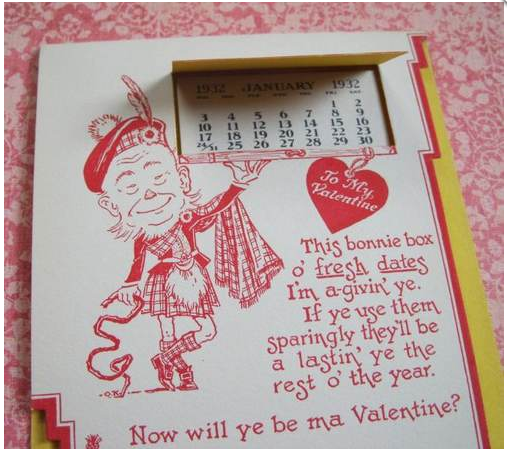
On previous Valentine’s Days, we’ve featured vintage holiday cards caricaturing African Americans, Asian Americans, and American Indians.  This year I stumbled upon a card that draws upon stereotypes of the Scottish.

Though it has largely disappeared as a well-known stereotype, at one time in American/British history, the Scottish were stereotyped as cheap.  Accordingly, this 1932 Scotch-themed valentine boasts that it’s box of dates (a type of dried fruit) can last all year if “ye use them sparingly.” A great example of a bygone stereotype (I think):

Valentine found at Kitsch Slapped.

Lisa Wade, PhD is an Associate Professor at Tulane University. She is the author of American Hookup, a book about college sexual culture; a textbook about gender; and a forthcoming introductory text: Terrible Magnificent Sociology. You can follow her on Twitter and Instagram.

Originally posted in 2011. Re-posted in honor of the holiday.

I recently posted a vintage cartoon featuring men showering. Today, in the context of “don’t drop the soap” jokes, it seems obviously homo-erotic (or -threatening).   At the time, however, it likely didn’t because homosexuality didn’t hold such a central place in our collective imagination.

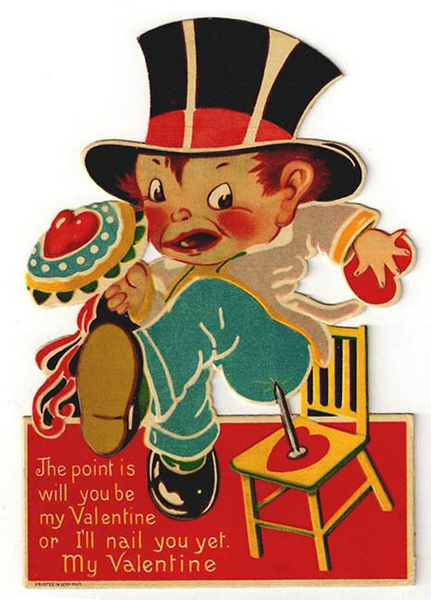
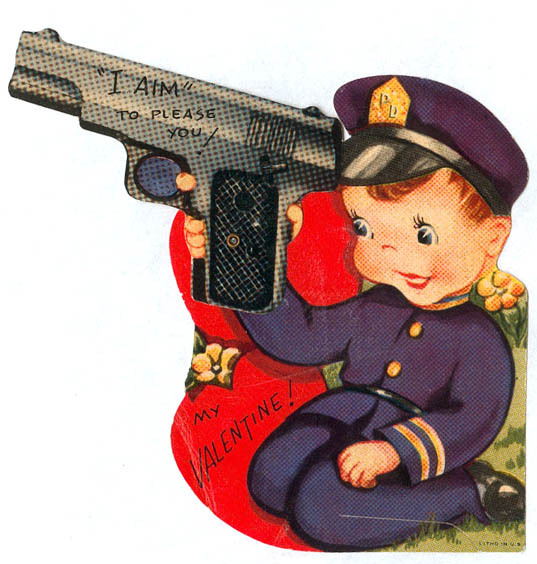
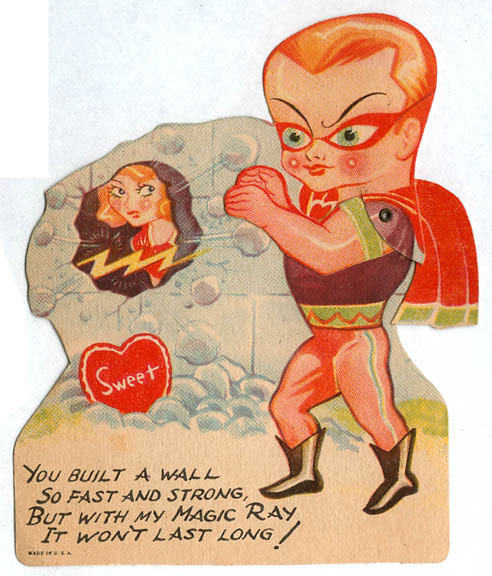
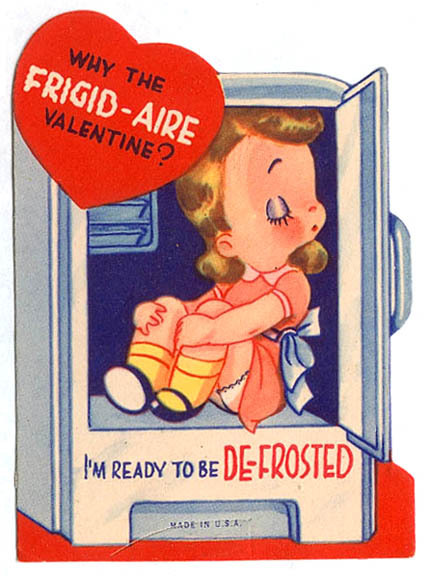
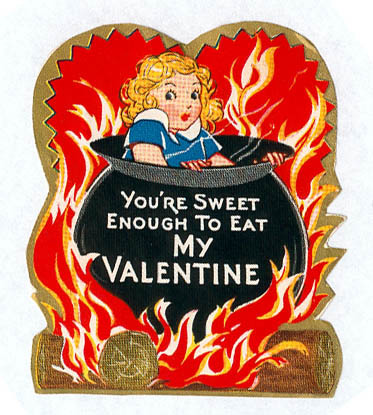
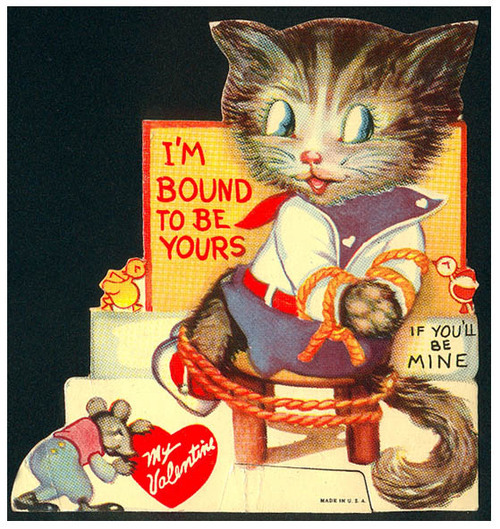
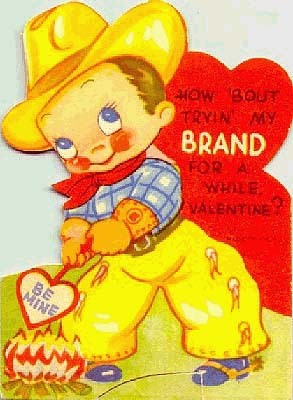
Dmitriy T.M. sent along a series of vintage Valentine’s Day cards that, similarly, have a different effect given our contemporary cultural sensibilities. After decades of efforts to draw attention to and problematize men’s violence against women, these cards seem misguided at best:

1 (2) 1 (3) 1 (4) 1

Cards borrowed from Funny or Die and Buzzfeed.

Lisa Wade, PhD is an Associate Professor at Tulane University. She is the author of American Hookup, a book about college sexual culture; a textbook about gender; and a forthcoming introductory text: Terrible Magnificent Sociology. You can follow her on Twitter and Instagram.

Happy Fat Tuesday to all our friends in New Orleans! Don’t do anything we wouldn’t do!

If you’re not in the middle of the revelry, enjoy these Mardi Gras posts from previous years:

This post originally appeared in 2011.  Revised and re-posted in honor of Mardi Gras.

If you attend a Mardi Gras parade this year, you’ll likely notice that the float riders will be all-White or all-Black and all-female or all-male.  In fact, the majority of krewes — clubs that sponsor parades and other festivities — are race- and gender-segregated.  This is not de facto, but according to official krewe policy. And it remains legal to discrimate along these lines.  How did this happen?

According to Kevin Fox Gotham‘s book, Authentic New Orleans, Mardi Gras was transformed from an unorganized local festival to a rationalized tourist attraction by white elites. The first organized parade occurred in 1857 and was organized by the Mystick Krewe of Comus, several dozen social elites. This krewe, like many that followed, was race, gender, and class specific. Only white males who could afford membership in the krewe (essentially a social club) could participate.

Krewe of Comus (1867):

ComusLeslies1867Epecurian

White only parades were part of a strategy to make New Orleans a tourist destination for white travelers. Unlike today, when New Orleans capitalizes on its multicultural heritage, for a very long time New Orleans tried to suppress popular knowledge of its non-white population, disinvested in that population, and drove them out of touristy areas.

It was not until 1991 that the City Council proposed banning racial segregation of the krewes and the Council voted unanimously to make bias illegal. Krewes that refused to integrate (in principle, if not in reality) would be denied “city services and parade permits, and would require jail time and fines” (p. 182). Mayor Sidney Barthelemy said:

We close off streets. We deny the taxpayer the right to drive down the street to give a segregated club the opportunity to parade. Now that’s unbelievable in 1991.

The decision brought simmering racial tension to a boil. Two krewes, the Krewe of Comus and the Knights of Momus, cancelled their parades in 1992 rather than comply with the new law. Another, the Krewe of Proteus, canceled the following year. An African American krewe, the Krewe of Zulu, mocked the decisions of the all-white krewes in 1992.

Ultimately the anti-bias law came under fire from all-female krewes such as Krewes of Isis. Wanting to preserve their exclusive membership, Iris and Venus “opposed any discrimination ordinance because they recognized that it would undermine their power to exclude men” (p. 185).

In the end:

…the City Council voted to remove the jail sentence provisions in the ordinance and shifted the burden of proof onto individuals who maintained that they had been discriminated against if they attempted to join a krewe (p. 185).

But even this did not hold. Courts decided that the anti-bias laws violated laws of free association and, when the case came before the Supreme Court, they declined to revisit it. So, race and gender segregation of krewes remains legal.

Today, krewes segregated by race and gender still persist (and people without means are excluded from krewes generally, as they are very expensive), though newly formed krewes are often integrated on both axes, including Harry Connick Jr.’s Krewe of Orpheus.

Lisa Wade, PhD is an Associate Professor at Tulane University. She is the author of American Hookup, a book about college sexual culture; a textbook about gender; and a forthcoming introductory text: Terrible Magnificent Sociology. You can follow her on Twitter and Instagram.

Cross-posted at Hawkblocker.This Dove commercial for hair dye is just fascinating.  It features a woman talking about what color means to her.  She observes that color is sensual, drawing connections between certain colors and the feeling of a cool breeze, the sun on one’s skin, a taste on one’s tongue, and more.  She says colors are moods: blonde is bubbly, red is passionate. The voice-over explains that dying her hair makes life “more vivid” and makes her want to laugh and dance.  She does it to invoke these characteristics.

She then explains that she’s blind.  The commercial uses her blindness to suggest that hair dye isn’t about color at all.  It’s about the feeling having dyed hair gives you, even if you can’t see the color.  “I don’t need to see it,” she says, “I can feel it.”

By using a woman who is (supposedly) blind, the commercial for hair dye uses the element of surprise to detach the product from the promise.  The sole purpose of hair dye is changing how something looks, but this ad claims that the change in appearance is entirely incidental.  Instead, dying one’s hair is supposed to make all of life more vibrant, every moment incredibly special, every pleasure more intense, and fill you to the brim with happy emotions.  It’s completely absurd.  Fantastically absurd. Insult-our-intelligence absurd.

And yet, it’s also exactly what nearly every other commercial and print ad does.  Most ads promise — in one way or another — that their product will make you happier, your life brighter, and your relationships more magical.  The product is positioned as the means, but not an end.   Most hair dye commercials, for example, promise that (1) if your hair is dyed to be more conventionally beautiful, (2) you will feel better/people will treat you better and, so, (3) your life will be improved.  This ad just skips the middle step, suggesting that chemicals in hair dye do this directly.

So, I’m glad to come across this utterly absurd commercial. It’s a good reminder to be suspicious of this message in all advertising.

Lisa Wade, PhD is an Associate Professor at Tulane University. She is the author of American Hookup, a book about college sexual culture; a textbook about gender; and a forthcoming introductory text: Terrible Magnificent Sociology. You can follow her on Twitter and Instagram.

Greenwashing refers to efforts to present products or practices as environmentally friendly while making only minimal efforts to really reduce negative environmental impacts.

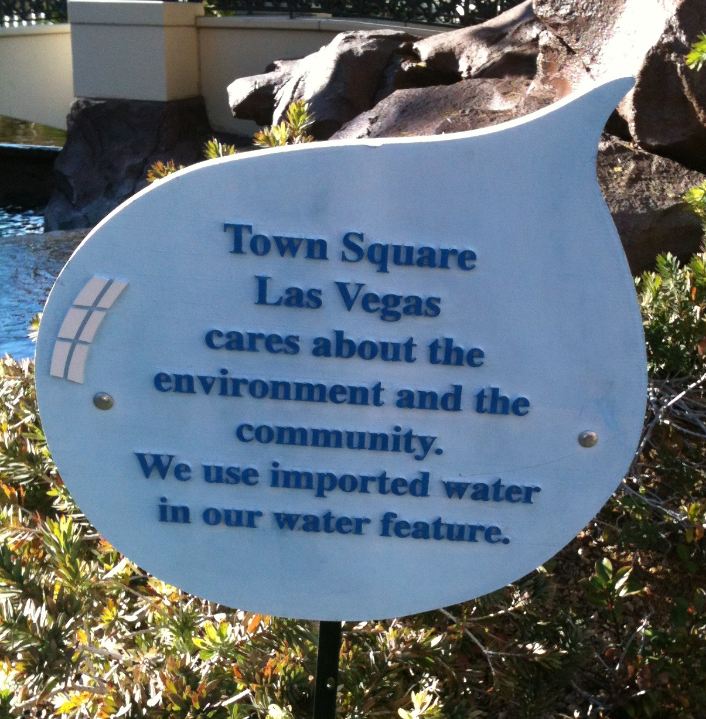
I saw a great example of this last weekend at a shopping center here in Vegas. As I was walking by a pond and water fountain, I noticed this sign:

It has several elements of classic greenwashing. The organization “cares about the environment and the community” — a vague, general claim that commits them to nothing specific. And their supposedly eco-friendly behavior is dubious and hard to evaluate. With Lake Mead (Vegas’s main drinking water source) depleted from a decade of drought, certainly any efforts to reduce demands on it are welcome.

But that seems like a rather superficial definition of what it means to care about the environment. The imported water comes from somewhere — an aquifer? another water shed? thousands of bottles of Perrier? — and it seems it would require energy to get it from there to here. The focus on not using a local water source sidesteps the larger question of whether it is environmentally responsible to build ponds and fountains (and grass-based lawns, for that matter) in the desert, regardless of where the water originates.

Gwen Sharp is an associate professor of sociology at Nevada State College. You can follow her on Twitter at @gwensharpnv.