Search results for The

Cross-posted at Cyborgology.

Humans produce waste. A lot of waste—much of which comes from our very bodies. Indeed, the average American produces 7 pounds of organic waste per day, largely made up of feces and urine. Cities have to somehow manage this waste, manage these now expelled parts of human bodies, manage that which we produce, drop, leave, and conscientiously ignore. Such management is typically engaged by an underclass of workers, the sanitation department, waste management employees, septic cleaners. When all goes well, waste remains invisible. Unsmelled. Unseen. Silently moved through underground systems and channeled out in ambiguous ways. This is a process to which most producers of bodily waste remain blissfully ignorant.

Sometimes, however, this waste management becomes a problem, and when it does, our expelled and forgotten matter spills back up into human view, reconnecting humans with the ways in which their own bodies must be managed through external structures; reminding humans of the dirty reality of organic embodiment. Such is the case in the New York City sewer system. High water levels, coupled with high waste levels, can lead to sewer overflows, flushing raw human waste into the city’s waterways — including the East River and the Hudson. Nothing reminds humans of their own embodiment like literal consumption of expelled matter. Nothing reconnects humans to an otherwise hidden process than their own shit floating down the river.

A recent solution to this problem of waste re-emergence comes from an unlikely place: social media. Leif Percifield recently introduced a social media tool called DontFlushMe, which allows New Yorkers to keep track of water levels and make waste management decisions accordingly — that is, decisions about whether or not to flush. The system works through sensors within the sewers, which notify users of high water levels via text message, Twitter, a call-in number, or by a website. When water levels get too high, users will ostensibly “let it mellow,” reducing the influx of waste into the sewer systems, and preserving the waterways.

The role of social media here is particularly interesting. Here we have a social tool, a communication medium necessarily removed from the body and physicality, working to reconnect the user to hir body, and reconnect the body to the architectures and structures in which it dwells. This form of mediated communication thins the mediating line between personal actions and public good, between expelling and consuming, between individuals and infrastructures. This tool makes invisible processes visible, and turns everyone into stewards of the shared land.

Such reconnection — between humans and their bodies; between individuals and infrastructures — is facilitated by a tool so often accused of causing disembodiment and disconnection. Social media republicizes and disseminates responsibility for that which was previously relegated out of sight, smell, and mind. This “new” technology, ironically, brings us back to an earlier time of chamber pots and smelly streets, in which bodily awareness was a communal necessity.

*Special thanks to James Chouinard for bringing this social media tool to my attention, and for sharing his vast knowledge on the Sociology of Dirt.

 ————————-

Jenny Davis is a postdoctoral researcher in the social psychology lab at Texas A&M University. Follow Jenny on twitter @Jup83.
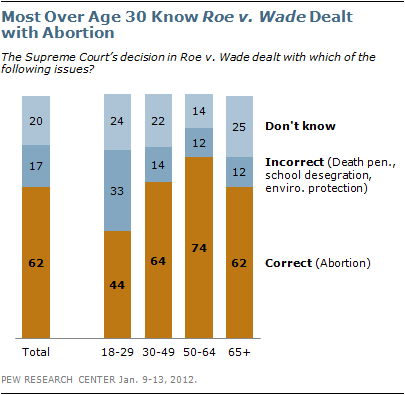
Yesterday was the anniversary of the landmark Roe v. Wade decision. On January 22, 1973, the U.S. Supreme Court handed down the landmark case establishing women’s right to an abortion (though not an unrestricted right).

The Pew Research Center released some data on current public knowledge and opinion about abortion in the U.S. They found that well under half (44%) of younger people — those under 30 — knew what Roe v. Wade was about. A quarter said they didn’t know, and a third thought it was about another issue. This was a much lower level of familiarity than older age groups:

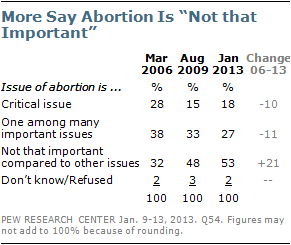
Abortion is still certainly a contentious issue, but it may not be quite the galvanizing cultural flashpoint it once was. Indeed, fewer people seem to see it as a critical issue. A growing percent of respondents say that abortion isn’t all that important — now over half say so:

That seems to indicate a lessening of the intensity of the culture war surrounding abortion. That could mean less intensity in opposition to abortion (most respondents thought it should be legal, though many personally thought it was morally wrong), but it may also lead to less resistance to the types of restrictions on clinics that leave abortion technically legal, but so difficult to access that it’s a hollow legality.

Gwen Sharp is an associate professor of sociology at Nevada State College. You can follow her on Twitter at @gwensharpnv.

My brilliant colleague, Adrianne Wadewitz, was featured on Wikipedia last month. In this two-minute video, she talks about how she’s incorporated writing for Wikipedia into her classes and why it’s such a powerful teaching tool.

Lisa Wade, PhD is an Associate Professor at Tulane University. She is the author of American Hookup, a book about college sexual culture; a textbook about gender; and a forthcoming introductory text: Terrible Magnificent Sociology. You can follow her on Twitter and Instagram.

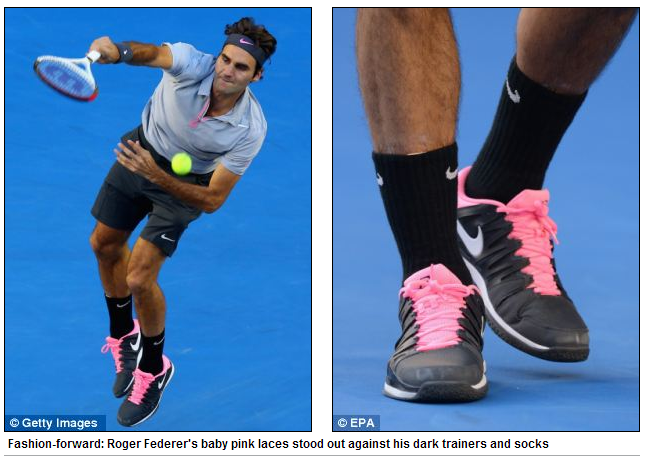
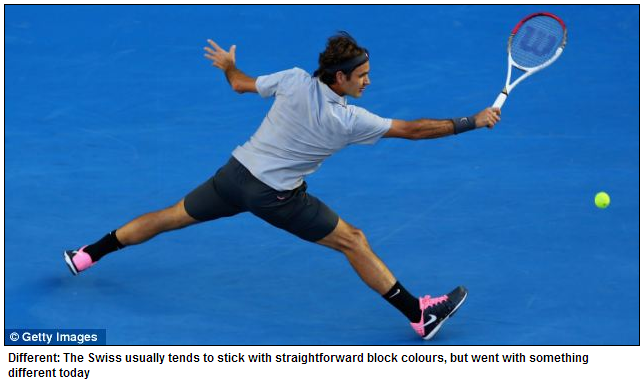
I know, I know. We can expect nothing more from the Daily Mail.  And yet I can’t help but point out this scintillating article on what tennis player Roger Federer wore at the Australian Open.  An article on what a man was wearing, you might ask?  Indeed.  What might prompt such an abnormality?  Well, you see, Federer was wearing just the slightest bit of pink.

This daring choice earned Federer 374 words in the Mail Online and six photographs highlighting his apparently newsworthy fashion choice.

Now this isn’t a big deal, but it is a particularly striking example of the little ways in which rules around gender are enforced.  Federer took a risk by wearing even a little bit of pink; the Daily Mail goes to great lengths to point this out.  He also gets away with it, in the sense that the article doesn’t castigate or attempt to humiliate him for doing so.

Federer, however, is near the top of a hierarchy of men. Research shows that men who otherwise embody high-status characteristics — which includes being light-skinned, ostensibly straight, attractive, athletic, and wealthy — can break gender rules with fewer consequences (see also, the fashion choices of Andre 3000 and Kanye).  A less high-status man might read this article and take note: Federer can get away with this, kinda, but I should steer clear…. and they’re probably right.

Thanks to Todd Schoepflin @CreateSociology for the tip!

Lisa Wade, PhD is an Associate Professor at Tulane University. She is the author of American Hookup, a book about college sexual culture; a textbook about gender; and a forthcoming introductory text: Terrible Magnificent Sociology. You can follow her on Twitter and Instagram.

Cross-posted at Reports from the Economic Front.

Considering the enormous time spent debating tax policy, it is easy to imagine that the U.S. must have one of the high tax rates in the world.  Well, that is not the case.

The Atlantic has a great post which includes Business Insider graphs drawn from a KPMG report on global tax rates.

Here is one of them.  It shows the personal tax rate paid by people making the equivalent of $100,000 a year in 2012.  The U.S. is the 55th ranked country out of 114 in terms of tax rates.

tax rates ranking 100k (1)

The next graph shows the same thing but for those earning the equivalent of $300,000 a year.  The U.S. ranking is similar for this upper income group, 53rd highest out of 114.

tax rates world ranking 300k

 Moreover, as Derek Thompson, the author of the Atlantic post, notes:

But these numbers might understate how low taxes have been in the U.S. Unlike most advanced economies, the U.S. don’t supplement personal income taxes with a national sales tax, or value-added tax (VAT). Consumption taxes accounted for about a fifth of total U.S. revenue in 2008 (mostly at the state and local level) compared to an OECD average of 32 percent. In other words, the U.S. relies uniquely on personal tax rates to raise revenue — and we have relatively low personal tax rates.

Finally, here is a look at the U.S. ranking among OECD countries for taxes as a share of GDP in 2008.

The-Numbers-Jan-2012-International_1

So, given that the U.S. doesn’t seem to be a high-tax rate country, why is tax policy so contentious?  No doubt the answer has a lot to do with who actually pays the taxes and, perhaps even more importantly, what the revenue is used for.

—————————

Martin Hart-Landsberg is a professor of Economics and Director of the Political Economy Program at Lewis and Clark College.  You can follow him at Reports from the Economic Front.

Advanced quantitative analysis often controls for variables that aren’t of central interest. But what does it mean to “control for” a variable?  XKCD offers a fun example.

So, do subscribers to Martha Stewart Living live alongside furries?  Probably not. In any case, these maps don’t offer any evidence in favor of this conclusion.  This is because of a variable that hasn’t been controlled for: population density.

To control for population, one would have to divide the number of subscribers/furries by the total population.  This would give us the percentage of the population that is described by both proclivities, instead of the sheer number of devotees.  Then the maps would actually show variance in the proportion of the population instead of variance in the population itself.

In other words, we would have controlled for population in order to get a closer look at what we’re really interested in: furries, of course.

Lisa Wade, PhD is an Associate Professor at Tulane University. She is the author of American Hookup, a book about college sexual culture; a textbook about gender; and a forthcoming introductory text: Terrible Magnificent Sociology. You can follow her on Twitter and Instagram.

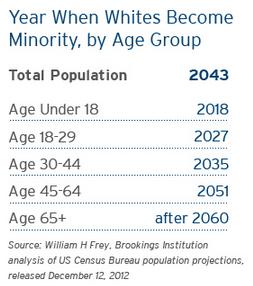
The year during which the U.S. will become a “majority minority” is well discussed.  It looks like it’s going to happen sometime around 2050 or earlier. This statistic, however, elides an interesting subplot: the year various age groups will be majority minority.

Over at The Society Pages Editors’ Desk, sociologist Doug Hartmann offered the following table. It shows that children under the age of 18 will be majority minority 32 years earlier, by 2018.  Young people ages 18-29 will join them by 2027.  By 2035, people aged 35-64 will be majority minority.  People 65 and older are quick to follow.

This data reminds us that demographic change is gradual.  The year 2018 is just five years away.  If young people continue to vote in numbers similar to those in the last two elections, their changing demographics could push forward a change that looks all but inevitable in the long run.

In the meantime, we need to be vigilant about how younger people are portrayed.  Today poverty is racialized so as to demonize social programs designed to help the less fortunate.  Can we imagine a future in which public education and other youth-oriented programming is similarly framed: as white people helping supposedly undeserving people of color?  This is likely something that we should be vigilant against in the coming years.

Lisa Wade, PhD is an Associate Professor at Tulane University. She is the author of American Hookup, a book about college sexual culture; a textbook about gender; and a forthcoming introductory text: Terrible Magnificent Sociology. You can follow her on Twitter and Instagram.

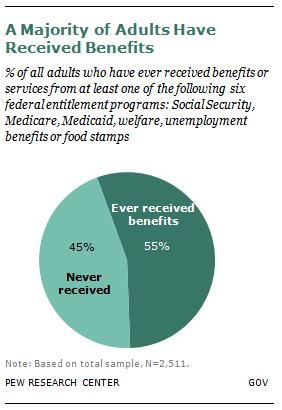
As politicians negotiated regarding the fiscal cliff, they debated whether to cut social programs aimed at alleviating poverty and deprivation.  Most of us imagine that these programs help a minority of the population.  In fact, the Pew Research Center reports that more than half of the population has received government benefits from one of the six most well-known programs:

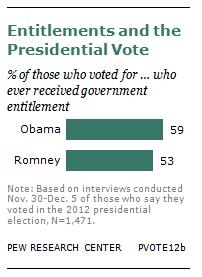
This isn’t the so-called 47% that Romney claimed would vote for a Democrat no matter what.  In fact, people who received one of these six benefits were only slightly more likely to vote Democratic:

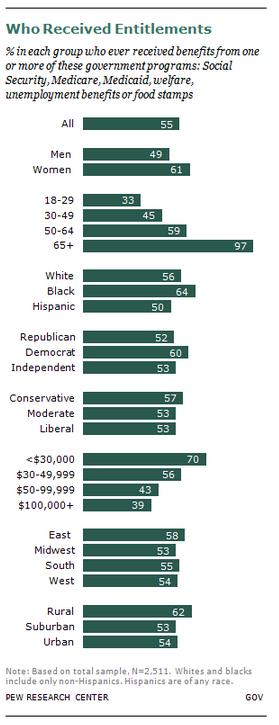
In fact, receiving benefits is pretty well spread out among the population. Except for people over 65, there seems to be significant consistency in the receipt of at least one benefit:

Notably, these programs also go to help the poor, women (largely because they end up single with young children), and people in rural areas.

Interestingly, many of us who have benefited from targeted government programs (“targeted” because we all benefit from programs like, oh, transportation initiatives and environmental protection and [insert dozens more here]) don’t know that we do.  In a previous post, we showed that large proportions of people who’ve benefited from social programs don’t recognize that they have unless their thinking is sparked by asking them about specific programs.  (It’s kind of like responding “No I don’t do drugs” and then being asked specifically about marijuana and saying, “Oh yeah, well that one I guess!”).

Since it is indeed the majority of Americans who benefit from targeted programs, it shouldn’t be too hard for politicians to find it in their hearts to support these programs.  That 57% of conservatives and 52% of Republicans have used them suggests that the political right is more interested in purporting an ideology than serving its constituency.

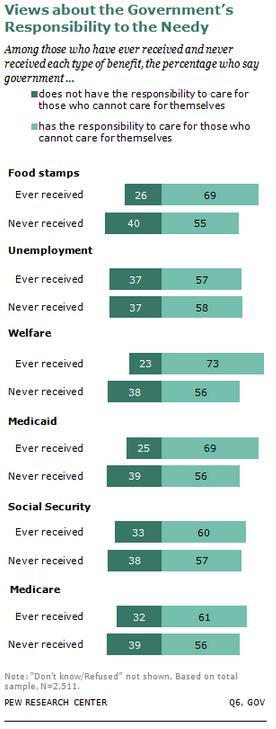
Alternatively, they realize that a certain proportion of benefit recipients also believe that the government “does not have the responsibility to care for those who cannot care or themselves.” About a third of people who hold onto this principle have used benefits:

It seems that data like this might be very useful for what we really need: an educational campaign designed to help Americans understand what social programs do and who benefits from them.   Maybe then we could have sensible policy discussions.

Lisa Wade, PhD is an Associate Professor at Tulane University. She is the author of American Hookup, a book about college sexual culture; a textbook about gender; and a forthcoming introductory text: Terrible Magnificent Sociology. You can follow her on Twitter and Instagram.